PREPARING WORKPLACE PRESENTATIONS Lesson 2
Learning Outcomes for this lesson….. On completing this chapter you should be able to: Select relevant information Organise ideas Use different types of speaking styles appropriate to different situations Express ideas clearly and audibly Identify and use appropriate nonverbal communication in speaking Deliver an effective presentation
Presentations in the workplace Examples of the  oral presentations  they may be asked to make include: introductions instructions team briefings brief reports long formal presentations
Planning the presentation Establish your context. Design it to be relevant.  To fulfill these aims the presentation needs to be   designed  to achieve one or more of the following  inform persuade entertain
Planning the presentation.. cont This preparation involves  six   steps: Define   the purpose Analyse  the audience Consider  the context and setting Identify   the main ideas Research  and find supporting material for the message Plan  and organise the material
Define the purpose What should I be asking myself? Why is it important?
Analyse the audience The audience’s… experience age interests reasons for listening … greatly influence the  meaning  they receive from the message  How  much   does the audience know about the topic? How  involved  is the audience in the topic or issue? How  controversial   will the topic be for the audience? How can the topic be   related  to audience  interests ?
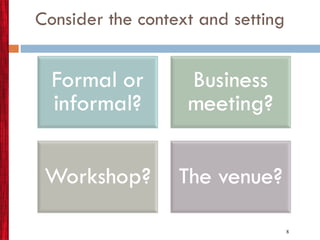
Consider the context and setting
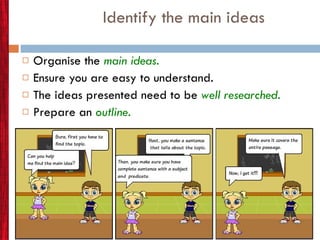
Identify the main ideas Organise the  main ideas. Ensure you are easy to understand. The ideas presented need to be  well researched. Prepare an  outline.
Plan the presentation An  effective structure  is created by using the following approach: Keep it simple  – 3 points rather than 12 Prepare  a strong opening and close Present  a transparent structure Use   notes effectively
Approaches to speaking to a group Six approaches  to speaking in public are: prepared speeches impromptu speeches manuscript speeches memorised speeches
The prepared speech A prepared speech is planned and organised before   the time of presentation. Al Gore - New thinking on the climate crisis
The impromptu speech An impromptu speech is unexpected, and delivered unprepared
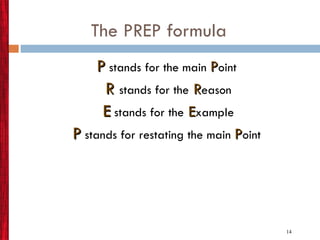
The PREP formula P  stands for the main  P oint  R   stands for the   R eason E  stands for the   E xample P  stands for restating the main  P oint
The manuscript speech A manuscript speech is researched and structured, and generally read The Declaration of Independence - A reading
The memorised speech A memorised speech is suited to short talks. Sir Ken Robinson - Bring on the learning revolution
Preparing the presentation There are  four steps  in this stage: write the presentation rewrite for the  ear practise and revise the content organise the visual aids
Speaker credibility Speakers can  develop  credibility by: communicating  positive attitudes  about self, the message, and the audience finding and emphasising  common ground  between the speaker and the audience preparing every speech  with care , to ensure demonstration of confidence, clear reasoning and extensive knowledge
Write the presentation The presentation has  three  parts: the  introduction   (creates interest) the  body   (develops the central theme) the  conclusion   (reinforces the main idea or provides a final summary) Strategies  to achieve these things are: pose a question use humour appropriate to the audience and relevant to the topic relate a short anecdote (i.e. a brief story) present an interesting fact
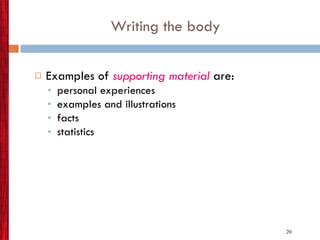
Writing the body Examples of  supporting material  are: personal experiences examples and illustrations facts statistics
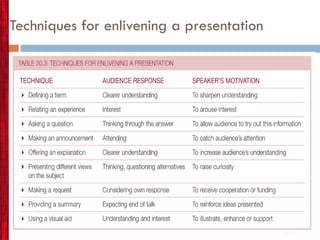
Techniques for enlivening a presentation
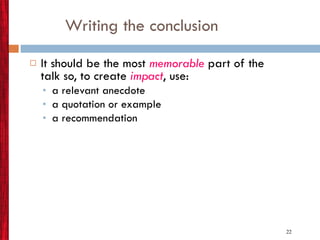
Writing the conclusion It should be the most   memorable   part of the talk so, to create  impact , use: a relevant anecdote a quotation or example a recommendation
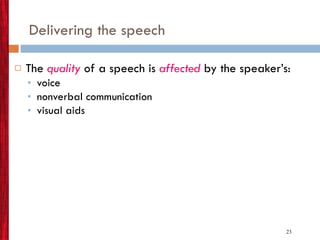
Delivering the speech The  quality  of a speech is  affected  by the speaker’s: voice nonverbal communication visual aids
Review Questions What are examples of the  oral presentations ? introductions instructions team briefings brief reports Preparation involves  six   steps: Define   the purpose Analyse  the audience Consider  the context and setting Identify   the main ideas Research  and find supporting material for the message Plan  and organise the material
Review Questions A memorised speech is suited to … short talks A prepared speech is … planned and organised before   the time of presentation An impromptu speech is … unexpected, and delivered unprepared A manuscript speech is … researched and structured, and generally read
Presentation Activity INDIVIDUALLY:  You will be provided with a speech/news report/short story OR poem. You will be required to record your own voice and reflect on areas of improvement.  Ensure that you practice your presentation with a partner and use your  Student Observation Sheet  to guide you in what is expected. You are expected to present your manuscript reading at  830am the 5 th  of October.

Make Presentations (2)

  • 1.
  • 2.
    Learning Outcomes forthis lesson….. On completing this chapter you should be able to: Select relevant information Organise ideas Use different types of speaking styles appropriate to different situations Express ideas clearly and audibly Identify and use appropriate nonverbal communication in speaking Deliver an effective presentation
  • 3.
    Presentations in theworkplace Examples of the oral presentations they may be asked to make include: introductions instructions team briefings brief reports long formal presentations
  • 4.
    Planning the presentationEstablish your context. Design it to be relevant. To fulfill these aims the presentation needs to be designed to achieve one or more of the following inform persuade entertain
  • 5.
    Planning the presentation..cont This preparation involves six steps: Define the purpose Analyse the audience Consider the context and setting Identify the main ideas Research and find supporting material for the message Plan and organise the material
  • 6.
    Define the purposeWhat should I be asking myself? Why is it important?
  • 7.
    Analyse the audienceThe audience’s… experience age interests reasons for listening … greatly influence the meaning they receive from the message How much does the audience know about the topic? How involved is the audience in the topic or issue? How controversial will the topic be for the audience? How can the topic be related to audience interests ?
  • 8.
  • 9.
    Identify the mainideas Organise the main ideas. Ensure you are easy to understand. The ideas presented need to be well researched. Prepare an outline.
  • 10.
    Plan the presentationAn effective structure is created by using the following approach: Keep it simple – 3 points rather than 12 Prepare a strong opening and close Present a transparent structure Use notes effectively
  • 11.
    Approaches to speakingto a group Six approaches to speaking in public are: prepared speeches impromptu speeches manuscript speeches memorised speeches
  • 12.
    The prepared speechA prepared speech is planned and organised before the time of presentation. Al Gore - New thinking on the climate crisis
  • 13.
    The impromptu speechAn impromptu speech is unexpected, and delivered unprepared
  • 14.
    The PREP formulaP stands for the main P oint R stands for the R eason E stands for the E xample P stands for restating the main P oint
  • 15.
    The manuscript speechA manuscript speech is researched and structured, and generally read The Declaration of Independence - A reading
  • 16.
    The memorised speechA memorised speech is suited to short talks. Sir Ken Robinson - Bring on the learning revolution
  • 17.
    Preparing the presentationThere are four steps in this stage: write the presentation rewrite for the ear practise and revise the content organise the visual aids
  • 18.
    Speaker credibility Speakerscan develop credibility by: communicating positive attitudes about self, the message, and the audience finding and emphasising common ground between the speaker and the audience preparing every speech with care , to ensure demonstration of confidence, clear reasoning and extensive knowledge
  • 19.
    Write the presentationThe presentation has three parts: the introduction (creates interest) the body (develops the central theme) the conclusion (reinforces the main idea or provides a final summary) Strategies to achieve these things are: pose a question use humour appropriate to the audience and relevant to the topic relate a short anecdote (i.e. a brief story) present an interesting fact
  • 20.
    Writing the bodyExamples of supporting material are: personal experiences examples and illustrations facts statistics
  • 21.
  • 22.
    Writing the conclusionIt should be the most memorable part of the talk so, to create impact , use: a relevant anecdote a quotation or example a recommendation
  • 23.
    Delivering the speechThe quality of a speech is affected by the speaker’s: voice nonverbal communication visual aids
  • 24.
    Review Questions Whatare examples of the oral presentations ? introductions instructions team briefings brief reports Preparation involves six steps: Define the purpose Analyse the audience Consider the context and setting Identify the main ideas Research and find supporting material for the message Plan and organise the material
  • 25.
    Review Questions Amemorised speech is suited to … short talks A prepared speech is … planned and organised before the time of presentation An impromptu speech is … unexpected, and delivered unprepared A manuscript speech is … researched and structured, and generally read
  • 26.
    Presentation Activity INDIVIDUALLY: You will be provided with a speech/news report/short story OR poem. You will be required to record your own voice and reflect on areas of improvement. Ensure that you practice your presentation with a partner and use your Student Observation Sheet to guide you in what is expected. You are expected to present your manuscript reading at 830am the 5 th of October.