IKEA 
Case Study 12.1 
Crossing cultural boundaries to furnish the globe 
Presented by Persia Brooks, Bozheng Wu (Cahil), Yunhan Zhu (Fred)
1. How has IKEA successfully sold its home furnishing products 
in so many countries around the world? 
Vision – IKEA’s vision statement is ‘To create a better life for many 
people’ 
Concept - IKEA’s company mantra or vision is ‘You do your part. We 
do our part. Together we save money.’ 
Strategy – To produce good quality products at low cost prices. 
Ensuring products are sustainable, modern, innovative inspired and 
wide variety. 
IKEA
http://www.youtube.com/watch?v=MJ6YL3IekYs 
IKEA 
Communication Strategy 
In 2013 IKEA distributed their catalogue to 43 countries, in 62 versions 
in 30 different languages 
It was estimated that over 100 million copies were distributed all free 
of charge, taking 70% of marketing budget 
IKEA’s website is customized for 48 countries in 34 different languages; 
this alone is a mass communication effort
Do global customer segments exist? 
IKEA’s customer segments: 
• Consumers who love ideas based around hidden and limited space 
• Middle/lower class population 
• All age groups 
• New home buyers/families 
• Students 
• Consumers who love innovative designs 
• Consumers who love multi functional designs 
IKEA
2. How important is the role of IKEA’s Swedish brand 
image? 
• Brand image: 
• “brand” is considered to be a product which has a unique and 
consistent character. 
• “image” is the compound of individuals’ personal experience of the 
products. 
• country of origin is one of plenty factors which influence customers 
perceptions of brand image. 
• IKEA: a high-quality and affordable brand image. 
IKEA
IKEA 
What are the implications for marketing? 
Country-of-origin effect: 
Known as made-in image, which make some psychological influences. 
the country of origin decide the first impression of the product. 
IKEA: popular in Swedish market due to local-made product 
advantages 
Popular in other foreign market due to brand image.
3. To what extent has IKEA practiced a standardized 
strategy versus an adapted strategy in it’s global 
marketing? 
Standardized strategy is good for IEKA when their early globalization pl 
an 
• IKEA concentrates on developing in other western countries. 
• Furniture products with High quality and high standard are importan 
t for customer in developed countries. 
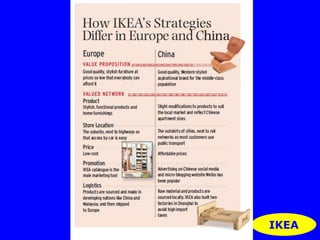
An adapted strategy should be practiced for IKEA 
• Nowadays, Marketing in Asian and other developing country is impo 
rtant 
for IKEA 
• The new standard of products should be update, the customers fro 
m 
developing need a suitable and adjustable standard.
IKEA
What are the advantages and disadvantages of this approach? 
IKEA 
Advantages: 
• cost saving; 
• effective control on the branch; 
•Integrating and strengthen the general brand image. 
disadvantages: 
• could not be suitable for Asian marketing and customers in 
developing countries; 
•Adjusting the standardized strategy will bring the risks and costs.
4. Some say communications, 
especially the Internet and 
television, enable a global culture 
to be broadcast to all societies. 
IKEA
Are the cultures of the world becoming more similar or more 
different? Discuss. 
Becoming more similar: 
• Cultures of world becoming more similar due to mass movements 
of people from country to country 
• More people are learning about other cultures, which is integrating 
into multiple-cultures 
• Due to the development of technology. Internet, television and 
mobiles give people the potential to share and learn. 
• Multinational corporations accelerate the assimilation of cultures 
• Believe it or not, people are influenced by the cultures they are 
exposed to more than they think. 
IKEA
Are the cultures of the world becoming more similar or more 
different? Discuss. 
Becoming more different: 
• Personality cultures have more resources because of the global 
cultures are available; 
• Different cultures beget more subcultures. 
IKEA
Any Questions? 
Thank you  
IKEA

Ikea presentation (Customer Behavior)

  • 1.
    IKEA Case Study12.1 Crossing cultural boundaries to furnish the globe Presented by Persia Brooks, Bozheng Wu (Cahil), Yunhan Zhu (Fred)
  • 2.
    1. How hasIKEA successfully sold its home furnishing products in so many countries around the world? Vision – IKEA’s vision statement is ‘To create a better life for many people’ Concept - IKEA’s company mantra or vision is ‘You do your part. We do our part. Together we save money.’ Strategy – To produce good quality products at low cost prices. Ensuring products are sustainable, modern, innovative inspired and wide variety. IKEA
  • 3.
    http://www.youtube.com/watch?v=MJ6YL3IekYs IKEA CommunicationStrategy In 2013 IKEA distributed their catalogue to 43 countries, in 62 versions in 30 different languages It was estimated that over 100 million copies were distributed all free of charge, taking 70% of marketing budget IKEA’s website is customized for 48 countries in 34 different languages; this alone is a mass communication effort
  • 4.
    Do global customersegments exist? IKEA’s customer segments: • Consumers who love ideas based around hidden and limited space • Middle/lower class population • All age groups • New home buyers/families • Students • Consumers who love innovative designs • Consumers who love multi functional designs IKEA
  • 5.
    2. How importantis the role of IKEA’s Swedish brand image? • Brand image: • “brand” is considered to be a product which has a unique and consistent character. • “image” is the compound of individuals’ personal experience of the products. • country of origin is one of plenty factors which influence customers perceptions of brand image. • IKEA: a high-quality and affordable brand image. IKEA
  • 6.
    IKEA What arethe implications for marketing? Country-of-origin effect: Known as made-in image, which make some psychological influences. the country of origin decide the first impression of the product. IKEA: popular in Swedish market due to local-made product advantages Popular in other foreign market due to brand image.
  • 7.
    3. To whatextent has IKEA practiced a standardized strategy versus an adapted strategy in it’s global marketing? Standardized strategy is good for IEKA when their early globalization pl an • IKEA concentrates on developing in other western countries. • Furniture products with High quality and high standard are importan t for customer in developed countries. An adapted strategy should be practiced for IKEA • Nowadays, Marketing in Asian and other developing country is impo rtant for IKEA • The new standard of products should be update, the customers fro m developing need a suitable and adjustable standard.
  • 8.
  • 9.
    What are theadvantages and disadvantages of this approach? IKEA Advantages: • cost saving; • effective control on the branch; •Integrating and strengthen the general brand image. disadvantages: • could not be suitable for Asian marketing and customers in developing countries; •Adjusting the standardized strategy will bring the risks and costs.
  • 10.
    4. Some saycommunications, especially the Internet and television, enable a global culture to be broadcast to all societies. IKEA
  • 11.
    Are the culturesof the world becoming more similar or more different? Discuss. Becoming more similar: • Cultures of world becoming more similar due to mass movements of people from country to country • More people are learning about other cultures, which is integrating into multiple-cultures • Due to the development of technology. Internet, television and mobiles give people the potential to share and learn. • Multinational corporations accelerate the assimilation of cultures • Believe it or not, people are influenced by the cultures they are exposed to more than they think. IKEA
  • 12.
    Are the culturesof the world becoming more similar or more different? Discuss. Becoming more different: • Personality cultures have more resources because of the global cultures are available; • Different cultures beget more subcultures. IKEA
  • 13.