




@flipyrthinking
New
Pedagogies for
Deep
Learning
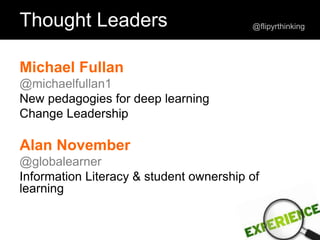
Michael Fullan
@flipyrthinking
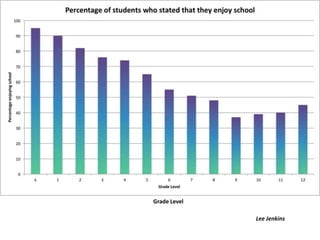
Grade Level
Lee Jenkins
• Deep learning goals
• New pedagogies
• Technology
Integrating 3 elements
critical thinking
creativity
collaboration
communication
character
citizenship
@flipyrthinking
irresistible
@flipyrthinking
Aaron & Jon
“There is no ONE
way to flip a class”
50 shades of flip
Michael Fullan
@michaelfullan1
New pedagogies for deep learning
Change Leadership
Alan November
@globalearner
Information Literacy & student ownership of
learning
Thought Leaders @flipyrthinking
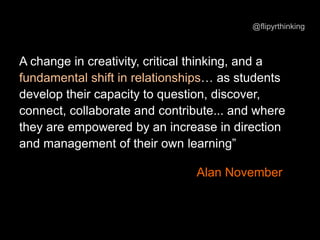
A change in creativity, critical thinking, and a
fundamental shift in relationships… as students
develop their capacity to question, discover,
connect, collaborate and contribute... and where
they are empowered by an increase in direction
and management of their own learning”
Alan November
@flipyrthinking
“New pedagogies require students not only
to create new knowledge but also to
connect it to the world”.
Michael Fullan
@flipyrthinking
@flipyrthinking
A cautionary tale
MYTH
@flipyrthinking
REALITYV
Instructional content viewed at home
rather than delivered in class, via videos or
podcasts (found online or created by the
teacher)
Students arrive pre-loaded
Connect with students in the classroom
Application and analysis
Personal learning pathways
Learning rather than teaching
Increased student to teacher time
Relationships: Student : teacher, Student :
student
Initiate
Deep
Understanding
Flipped Learning: the beauty lies beneath
©Learnology
10%
90%
@flipyrthinking
INNOVATORS
ONLY
Difficult to
scale
@flipyrthinking
@flipyrthinking
@flipyrthinking
Guide
on the
side
@flipyrthinking
Sage on
the
stage
V
Automation Innovationv
Status quo Change
Who owns
the
learning?
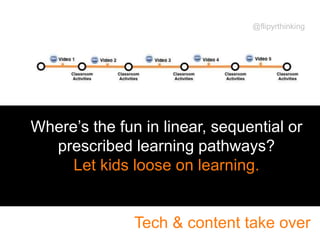
Where’s the fun in linear, sequential or
prescribed learning pathways?
Let kids loose on learning.
Tech & content take over
@flipyrthinking
Predictions
&
Assumptions
@flipyrthinking
Self paced
or
Self directed?
@flipyrthinking
@flipyrthinking
Rewind?
@flipyrthinking
Spoon
Feeding wont
bring back
awe and
wonder
@flipyrthinking
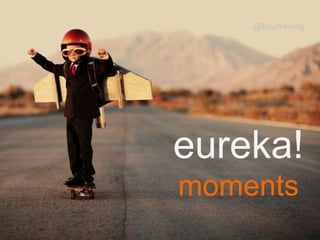
eureka!
moments
@flipyrthinking
The currency
of the
classroom
should be
questions not
answers
Accountability
Motivation?
Mr Motivator?
So……..
@flipyrthinking
irresistible
@flipyrthinking
critical thinking
creativity
collaboration
communication
character
citizenship
@flipyrthinking
“If dispositions are to be strengthened, then
opportunities to manifest them must be
available”
Lilian Katz
@flipyrthinking
Curiosity
is the very basis of
education and if
you tell me that
Curiosity killed the
Cat, I say only
the cat died nobly
Arnold Edinborough
@flipyrthinking
wonder - full
@flipyrthinking
Curiosity + Inspiration
Wonderful =
@flipyrthinking
Carol S Dweck
@mindsetworks
Growth mindsets & effort over achievement
John Hattie
@visiblelearning
Visible Teaching, Visible Learning
Dylan Wiliam
@dylanwiliam
Formative assessment
Thought Leaders
Activator
Change Agent
Reciprocal Teaching
Feedback
Teaching self-verbalization
Metacognition strategies
Direct Instruction
Negotiated goals
0.74
0.72
0.67
0.59
0.59
0.56
@flipyrthinking
Activate
Cultivate
Initiate
Provocations:
Activating deep thinking
Deliberate and thoughtful challenges created
by the teacher with the intention of initiating
thinking, extending ideas and exposing
original thinking and individual learning needs
in order to inform practice.
@flipyrthinking
Ramsey Musallam
@ramusallam
Teachers as cultivators of curiosity and Inquiry
Derek Muller
@veritasium
Using student misconceptions to initiate learning
JJ Abrams
Knowingly withholding information
A pinch of… @flipyrthinking
@flipyrthinking
Watch the video and think about what is happening.
RESPOND: What do you think the video teaches us about the properties of this
shape?
COMMENT: Read as many responses as you can before selecting three that you
think you can help with.
How could these ideas be tested mathematically in class? Explain what would need
to be done to prove whether they are correct or not.
Properties of shapes (Part 3)
Where am I going?
FEED UP
How am I doing?
FEED BACK
Where to next?
FEED FORWARD
Teacher
Peer
Student
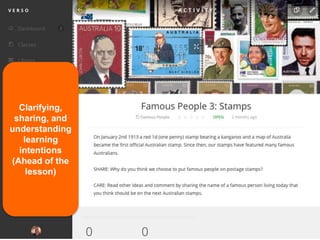
Clarifying,
sharing, and
understanding
learning
intentions
(Ahead of the
lesson)
Eliciting authentic
evidence of
learning*
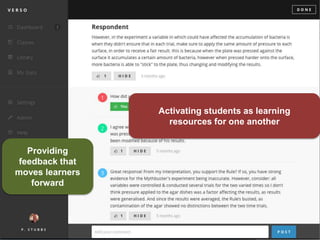
Providing
feedback that
moves learners
forward
Activating students as learning
resources for one another
Ownership: Changing relationships
between and amongst students and
teachers
54
Flip: short cycle formative assessments
Clarifying,
sharing, and
understanding
learning
intentions
(Ahead of the
lesson)
Michael Gomez Matias Chavez
Max Williams Siu Ming Lee
Eliciting authentic
evidence of
learning*
Activating students as learning
resources for one another
Providing
feedback that
moves learners
forward
Using evidence and
data to adapt what
happens in
classrooms to meet
learner needs
Visual 1: Student outcomes and builds on evidence from Verso
Julie Nguyen
Thomas Pinto
Michael Gomez
Jennifer Gomez
Matias Chavez
Siu Ming Lee
Maria Hernandez
Max Williams Ownership: Changing relationships
between and amongst students and
teachers
The first thing
we steal from
children is their
questions
Dr. John Edwards
@flipyrthinking
@flipyrthinking
Grade Level
Lee Jenkins
If they
build it
they will come
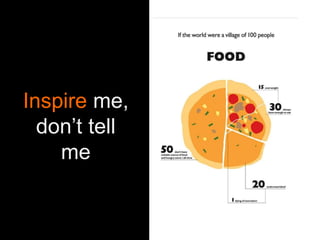
Toby Ng has created this superb series of posters and I want us to treat each idea as a
dot to be connected as to taking each one in isolation fails to uncover the real issues
facing society
Consider each of the 18 images. Find two or three that appeal to your interests and try
to connect the thinking.
Design an inquiry question that seeks to connect one set of statistics with at least one
other.
E.g 1% of the world's population has HIV but the percentage is greater in areas where
literacy levels are lower
OR 1% of the world's population has HIV. Is that percentage higher in areas with access
to greater wealth?
RESPOND: Share your essential question along with your initial ideas about what think
you might find.
COMMENT: Select a few responses and see if they meet with our criteria.
Can you add value or tighten up the question?
Maybe you can share your thoughts in order to further activate each respondent's
thinking
Inquiry Question B: Connecting the Dots
Inspire me,
don’t tell
me
“The cure for boredom is
curiosity.
There is no cure for curiosity”
Dorothy Parker
@flipyrthinking
www.newpedagogies.info
Thank you
Phil Stubbs
@flipyrthinking
Make learning irresistible

Make learning irresistible

Editor's Notes

  • #3 Problem you’re trying to solve should influence your approach
  • #4 NPDL is a research project established by Michael Fullan in partnership with schools from 10 participating countries responses to the current challenges.
  • #5 Teachers and students being psychologically pushed out of school: Kids increasingly bored v Add to this the PULL. The lure of digital. Ss have never been more socially connected .outside school non-formal learning is social;, connected, relevant – interest based and on demand. Students learn what they want to know when they want to know it. Learning is fuelled by curiosity Together, the push and pull conspire to drive students away
  • #6 The project was established to address a crisis in education. Students are checking out: as they progress through the years, students are becoming increasingly bored and disaffected. this data is from the US but research from around the world back this up where less than 40% of upper secondary students are intellectually engaged in class. This makes them, more difficult to teach leading to teacher satisfaction rates dropping from 65 to 38%
  • #7 So I can see an alignment with flipped learning but can it meet the challenge of reengaging our students in learning?
  • #8 Key Learning Dispositions Deep learning goals
  • #9 BUT how do we do that Flipped learning could be a good starting point
  • #11 workshop with colleagues the kind of opportunities you want for your students. Consider the relationships you want to develop between and amongst students and teachers and the relationship you want your students to develop with knowledge. Once this is done, create a version of flipped learning that is right for you and your students in the context of your subject, your school and your community.
  • #12 What does that mean? What does it look like and more importantly how do I get started?
  • #13 Creativity, critical thinking, capacity to connect, collaborate, contribute. Fundamental shift in relationships. Students develop THEIR capacity to question
  • #14 Only the teacher can deliver
  • #15 Jon and aaron have raised the debate , Like a great painting. If you don’t like it it still makes you question what art is
  • #16 In practice, easy to do it badly. Myths that some pioneers try to extinguish, too often become the reality.
  • #17 Effort required means difficult to scale. Which is why so few schools are doing it. Pedagogical and technical obstacles too great Videos go home and then what?
  • #18 For the flip to move beyond the innovators Pedagogy, technology and change knowledge ,
  • #19 so many communities online “Ive flipped now what do I do in class” If you think you can be replaced by video then maybe you should be
  • #20 If you didn’t know before then you’re in trouble.
  • #21 Didactic teaching and facilitator – both low effect sizes and if you’ve always been sage it’s a hard transition
  • #22 IS ONLINE CONTENT DELIVERY INNOVATIVE? Done badly – these people are automating a 10 minute instruction and moving it out of class. Innovation is doing new things in new ways to do things better If you weren’t using class time effectively before flipping, you’re not going to start now. C19th factory model just got automated
  • #23 Teacher centric Motivation? As long as we focus on content we are swimming against the tide Direct teaching : kids need to be taught how to learn. Passion and curiosity cement learning. Can you imagine the difference in motivation if you allowed a student to research a topic that truly piqued his or her interest? Motivation to climb over obstacles is far easier to muster when the student is allowed to choose what educational mountain to tackle first. Internal satisfaction: Independent learners are not born, they are made. Intrinsically motivated to learn..just as they are in the informal setting of the playground. They have mountains to climb but let them choose their mountains.
  • #24 MAN CAVE Videos tend to be produced ahead of time because the focus is on the content , the technology, the videos (Schools that do this) Forces a linear sequential approach…. Focus on the content Industrial model on
  • #25 Whether flipping or not, this is part of the problem Predictive and prescriptive Teachers know what to do in class…… they just need data to show how effective it is.. Constantly reflecting on practice… and this presents another problem…Feedback
  • #26 Again, a mismatch between collaborative classroom and a self paced, keep going on your own competitive environment. It should be about developing depth and breadth of understanding, making connections-not running s fast as you can
  • #27 Presented in one way What place critical thinking? Passion and curiosity cement learning. Can you imagine the difference in motivation if you allowed a student to research a topic that truly piqued his or her interest? Motivation to climb over obstacles is far easier to muster when the student is allowed to choose what educational mountain to tackle first. Internal satisfaction: Independent learners are not born, they are made. Intrinsically motivated to learn..just as they are in the informal setting of the playground. They have mountains to climb but let them choose their mountains.
  • #28 And one video/ modality certainly doesn’t.
  • #29 Wheres my feedback? I need feedback from Charlie to tell me how well im doing/ where I am going wrong or where I need to improve. If I don’t understand the 3rd time I can rewind all I like. It wont help
  • #31 We are not going to bring back awe and wonder by spoon feeding.
  • #32 We give kids answers rather than questions. What place critical thinking?
  • #33 We deny students Eureka moments
  • #34 Teacher talk
  • #35 Who has watched To what extent have they engaged – passive? What questions do they have What do I need to do next? 5 min before lesson – does that count? What if they don’t watch – why should they?
  • #36 80% as opposed to teacher perception Less teacher talk not more
  • #37 Dad dancing is not sufficient motivator. We need to find ways of shifting motivation from extrinsic to intrinsic And if we’re focused on being in the video – what place sharing with colleagues. All making own…all inventing wheel?
  • #38 How can we better meet the needs of our kids How can we take learning deeper How can we re-engage How can we avoid those myths becoming reality? How can we make this about the classroom?
  • #39 BUT irresistible doesn’t go far enough . learning IS already irresistible…the pull factor tells us that….just not in school…. So how do we motivate / reengage? .
  • #40 One Missing
  • #41 ONE C missing
  • #42 Move from extrinsic to intrinsic motivation
  • #44 meets the students on their terms, it values their questions, their ideas, their challenges…the things that matter to them and help them to connect with the world All of our students are wonder-full. It is part of who they are but Kath Murdoch tells us that schools are not great places for wonder.
  • #45 Curiosity has no lid – opens a door to the unknown. It’s inherently about the things that matter….. Curiosity is part of what makes us human its the reason to engage Inspiration is, the activator, the stimulus. The element that makes the student want to take risks,(lego) share their idea, collect multiple ideas and then use their curiosity to form relationships between ideas.. BUT it also motivates students to want to apply what they have learnt to new real world contexts…taking learning from the point of “I get it to I own it –
  • #46 Flip as a short burst formative assessment cycle between lessons
  • #47 Forget sage on stage and guide on side - distractions PROCESS v OUTCOME “When students and teachers partner with each other in more transparent and personal learning processes, where high expectations are mutually negotiated and achieved through challenging deep learning tasks. The focus becomes on ensuring that students master the process of learning. Helping students learn about themselves as learners and continuously assess and reflect on their own progress in essential to the process.
  • #48 It’s not about the sage on the stage being rep[laced by the guide on the side. Its about finding ways to activate learning, cultivate curiosity, initiate deep thinking Hattie- high effect size
  • #49 No more what do I do in class!
  • #50 http://pamhook.com/solo-taxonomy/SOLO- Structure of observed learning outcomes- perfect for the design of questions and essential questions Make way for EXPERIENCE: Finding the balance between Nest practice and best practice
  • #52 Creating simple provocations designed to activate learning..inspiration Those that know Verso will appreciate that when engaging – productive discomfort etc…
  • #55 Cant personalise without data or involving students
  • #60 No more what do I do in class.
  • #61 We replace student questions with our own But research shows we are not very good at asking questions 80% of the questions we ask are surface – seeking to prove or disprove learning rather than unlocking new worlds.
  • #62 80% surface questions focus on the quick and the decisive, the right and the wrong, over “if…”, “maybe…” and “I wonder…..”.
  • #63 Skill usage
  • #64 If kids arent engaged at school, why would they then engage at home? Does watching content 30 mins before the lesson count?
  • #65 Flip classroom tries to do – BUT often ends up sage on stage at home – didactic And facilitating in class Owned by the teacher
  • #66 Replace essential question with a QF
  • #68 Creating simple provocations designed to
  • #69 A provocation from Tony Ng designed to get children to ask big questions as part of an inquiry into food. Imagine the Qs this info graphic might generate Great thing is that once they submit their own they get to see and respond to each others
  • #70 Another te4acher chose to add another so that kids could start to look at the distribution of the problem and issues such as equity. – Again, imagine the questions
  • #71 And now to make it really interesting….to broaden the scope
  • #72 Dorothy Parker –somebody who always had the last word
  • #73 No man caves No dramas No dad dancing!