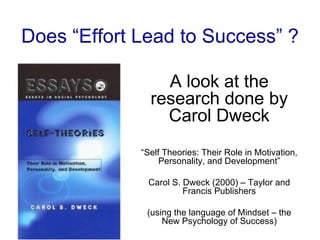
Does “Effort Lead to Success” ? A look at the research done by Carol Dweck “ Self Theories: Their Role in Motivation, Personality, and Development” Carol S. Dweck (2000) – Taylor and Francis Publishers (using the language of Mindset – the New Psychology of Success)
Your view of INTELLIGENCE affects the way you LEARN If you believe INTELLIGENCE to be a fixed trait that you have, then you have a
Your view of INTELLIGENCE affects the way you LEARN If you believe INTELLIGENCE to be a fixed trait that you have, then you have a FIXED MINDSET (Entity Theorist)
Your view of INTELLIGENCE affects the way you LEARN If you believe INTELLIGENCE to be a fixed trait that you have, then you have a FIXED MINDSET ►  pursue performance goals
Your view of INTELLIGENCE affects the way you LEARN If you believe INTELLIGENCE to be a fixed trait that you have, then you have a FIXED MINDSET ►  pursue performance goals   ►  makes you vulnerable   ►  go for easy tasks   ►  low effort   ►  give up easily
Your view of INTELLIGENCE affects the way you LEARN Holding a  FIXED MINDSET  Failure/Difficulty IMPLIES Low Intelligence Failure/Difficulty provides proof that others can measure your intelligence directly You go for easily completed tasks that enable you to show your “intelligence” You avoid challenging tasks which tests your “intelligence”
Your view of INTELLIGENCE affects the way you LEARN If you believe INTELLIGENCE to be a malleable aspect which you can improve, then you have a
Your view of INTELLIGENCE affects the way you LEARN If you believe INTELLIGENCE to be a malleable aspect which you can improve, then you have a   ►  GROWTH MINDSET  (Incremental Theorist)
Your view of INTELLIGENCE affects the way you LEARN If you believe INTELLIGENCE to be a malleable aspect which you can improve, then you have a   ►  GROWTH MINDSET   ►  Pursue Learning Goals   ►  You are empowered to learn and overcome difficulties   ►  More willing to take risks   ►  More effort   ►  You learn
Your view of INTELLIGENCE affects the way you LEARN Holding an  GROWTH MINDSET Failure/Difficulty IMPLIES change your EFFORT or STRATEGY Failure/Difficulty provides a challenge to be taken on Intelligence can be improved See success and difficulties in terms of personal EFFORT or learning STRATEGIES
“Helpless Reaction” Seen in “bright” girls on transferring to Secondary Seen in  FIXED MINDSET  when meeting more challenging tasks Seen in Talented and Gifted Students when out of small pond situation
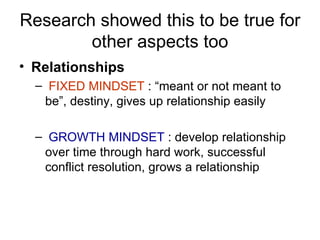
Research showed this to be true for other aspects too Relationships FIXED MINDSET  : “meant or not meant to be”, destiny, gives up relationship easily
Research showed this to be true for other aspects too Relationships FIXED MINDSET  : “meant or not meant to be”, destiny, gives up relationship easily GROWTH MINDSET   : develop relationship over time through hard work, successful conflict resolution, grows a relationship
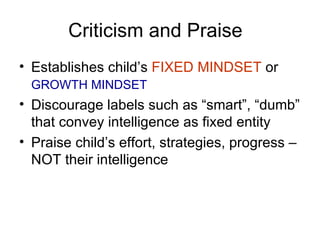
Criticism and Praise Establishes child’s  FIXED MINDSET  or  GROWTH MINDSET   Discourage labels such as “smart”, “dumb” that convey intelligence as fixed entity Praise child’s effort, strategies, progress – NOT their intelligence
Criticism and Praise When child  PRAISED  for their  INTELLIGENCE  after a job well done:
Criticism and Praise When child  PRAISED  for their  INTELLIGENCE  after a job well done: VULNERABILITY
Criticism and Praise When child  PRAISED  for their  INTELLIGENCE  after a job well done: VULNERABILITY might show straight away (choosing assured success with easier work rather than challenging learning task)
Criticism and Praise When child  PRAISED  for their  INTELLIGENCE  after a job well done: VULNERABILITY might show straight away (choosing assured success with easier work rather than challenging learning task) or later, after a failure experience (doubt his/her intelligence) – helpless reaction
Criticism and Praise When child  CRITICISED  for their  INTELLIGENCE or other FIXED TRAIT :
Criticism and Praise When child  CRITICISED  for their  INTELLIGENCE or other FIXED TRAIT : VULNERABILITY
Criticism and Praise When child  CRITICISED  for their  INTELLIGENCE or other FIXED TRAIT : VULNERABILITY when encounters later setbacks (measure him/herself from their performance and, in the presence of poor performance, would measure themselves negatively) – helpless reaction
Criticism and Praise When child CRITICISED for their  EFFORT or STRATEGIES :
Criticism and Praise When child CRITICISED for their  EFFORT or STRATEGIES : MASTERY ORIENTATED RESPONSE later
Criticism and Praise When child CRITICISED for their  EFFORT or STRATEGIES : MASTERY ORIENTATED RESPONSE later makes child alter effort or strategy in solving later difficult problem
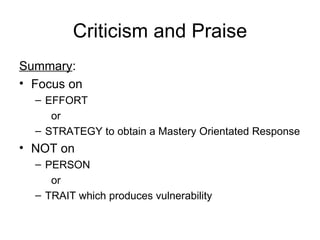
Criticism and Praise Summary : Focus on  EFFORT or STRATEGY to obtain a Mastery Orientated Response NOT on  PERSON or TRAIT which produces vulnerability
Criticism and Praise Beware of  CONTINGENT SELF-WORTH :
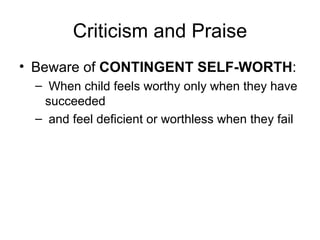
Criticism and Praise Beware of  CONTINGENT SELF-WORTH : When child feels worthy only when they have succeeded and feel deficient or worthless when they fail
Self Esteem Well-meant but misguided practices
Self Esteem Well-meant but misguided practices SE seen as something children have or do not have
Self Esteem Well-meant but misguided practices SE seen as something children have or do not have SE  instilled  also at fault – it is not something that we  give  children by telling them that they have a host of good things inside them
Self Esteem Well-meant but misguided practices SE seen as something children have or do not have SE  instilled  also at fault – it is not something that we  give  children by telling them that they have a host of good things inside them Leads adults to lie to children (exaggerate positives, sugar-coat negatives, hide information entirely)
Self Esteem Operating within  FIXED MINDSET  boosts EGO instead of boosting EFFORT
Self Esteem Operating within  FIXED MINDSET  boosts EGO instead of boosting EFFORT works only in short term
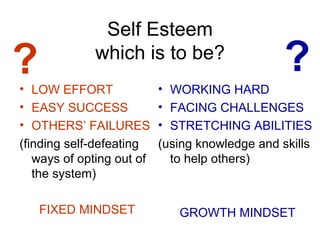
Self Esteem which is to be? LOW EFFORT EASY SUCCESS OTHERS’ FAILURES (finding self-defeating ways of opting out of the system) FIXED MINDSET WORKING HARD FACING CHALLENGES STRETCHING ABILITIES (using knowledge and skills to help others) GROWTH MINDSET ? ?
How to facilitate the second kind of Self Esteem? EMPHASIZING LEARNING EMPHASIZING CHALLENGES EMPHASIZING EFFORT EMPHASIZING STRATEGIES
How to facilitate the second kind of Self Esteem? EMPHASIZING LEARNING EMPHASIZING CHALLENGES EMPHASIZING EFFORT EMPHASIZING STRATEGIES Tell the truth: when student does not have the skills or knowledge, or are behind others, NOT a sign of deep, shameful deficit. It is a sign that they need to:
How to facilitate the second kind of Self Esteem? EMPHASIZING LEARNING EMPHASIZING CHALLENGES EMPHASIZING EFFORT EMPHASIZING STRATEGIES Tell the truth: when student does not have the skills or knowledge, or are behind others, NOT a sign of deep, shameful deficit. It is a sign that they need to: STUDY HARDER, FIND NEW LEARNING STRATEGIES
What can we do? Teach students to think of brain as a MUSCLE which strengthens with use
What can we do? Teach students to think of brain as a MUSCLE which strengthens with use Teach students STRATEGIES for learning and problem solving
What can we do? Teach students to think of brain as a MUSCLE which strengthens with use Teach students STRATEGIES for learning and problem solving Discourage labels that convey intelligence as a fixed entity
What can we do? Teach students to think of brain as a MUSCLE which strengthens with use Teach students STRATEGIES for learning and problem solving Discourage labels that convey intelligence as a fixed entity Praise student’s effort, strategies, progress, NOT their intelligence
What can we do? Teach students to think of brain as a MUSCLE which strengthens with use Teach students STRATEGIES for learning and problem solving Discourage labels that convey intelligence as a fixed entity Praise student’s effort, strategies, progress, NOT their intelligence Give students challenging work
Does “Effort Lead to Success” ? A look at the research done by Carol Dweck “ Self Theories: Their Role in Motivation, Personality, and Development” Carol S. Dweck (2000) – Taylor and Francis Publishers (using the language of Mindset – the New Psychology of Success)

Effort Does Lead To Success (2)

  • 1.
    Does “Effort Leadto Success” ? A look at the research done by Carol Dweck “ Self Theories: Their Role in Motivation, Personality, and Development” Carol S. Dweck (2000) – Taylor and Francis Publishers (using the language of Mindset – the New Psychology of Success)
  • 2.
    Your view ofINTELLIGENCE affects the way you LEARN If you believe INTELLIGENCE to be a fixed trait that you have, then you have a
  • 3.
    Your view ofINTELLIGENCE affects the way you LEARN If you believe INTELLIGENCE to be a fixed trait that you have, then you have a FIXED MINDSET (Entity Theorist)
  • 4.
    Your view ofINTELLIGENCE affects the way you LEARN If you believe INTELLIGENCE to be a fixed trait that you have, then you have a FIXED MINDSET ► pursue performance goals
  • 5.
    Your view ofINTELLIGENCE affects the way you LEARN If you believe INTELLIGENCE to be a fixed trait that you have, then you have a FIXED MINDSET ► pursue performance goals ► makes you vulnerable ► go for easy tasks ► low effort ► give up easily
  • 6.
    Your view ofINTELLIGENCE affects the way you LEARN Holding a FIXED MINDSET Failure/Difficulty IMPLIES Low Intelligence Failure/Difficulty provides proof that others can measure your intelligence directly You go for easily completed tasks that enable you to show your “intelligence” You avoid challenging tasks which tests your “intelligence”
  • 7.
    Your view ofINTELLIGENCE affects the way you LEARN If you believe INTELLIGENCE to be a malleable aspect which you can improve, then you have a
  • 8.
    Your view ofINTELLIGENCE affects the way you LEARN If you believe INTELLIGENCE to be a malleable aspect which you can improve, then you have a ► GROWTH MINDSET (Incremental Theorist)
  • 9.
    Your view ofINTELLIGENCE affects the way you LEARN If you believe INTELLIGENCE to be a malleable aspect which you can improve, then you have a ► GROWTH MINDSET ► Pursue Learning Goals ► You are empowered to learn and overcome difficulties ► More willing to take risks ► More effort ► You learn
  • 10.
    Your view ofINTELLIGENCE affects the way you LEARN Holding an GROWTH MINDSET Failure/Difficulty IMPLIES change your EFFORT or STRATEGY Failure/Difficulty provides a challenge to be taken on Intelligence can be improved See success and difficulties in terms of personal EFFORT or learning STRATEGIES
  • 11.
    “Helpless Reaction” Seenin “bright” girls on transferring to Secondary Seen in FIXED MINDSET when meeting more challenging tasks Seen in Talented and Gifted Students when out of small pond situation
  • 12.
    Research showed thisto be true for other aspects too Relationships FIXED MINDSET : “meant or not meant to be”, destiny, gives up relationship easily
  • 13.
    Research showed thisto be true for other aspects too Relationships FIXED MINDSET : “meant or not meant to be”, destiny, gives up relationship easily GROWTH MINDSET : develop relationship over time through hard work, successful conflict resolution, grows a relationship
  • 14.
    Criticism and PraiseEstablishes child’s FIXED MINDSET or GROWTH MINDSET Discourage labels such as “smart”, “dumb” that convey intelligence as fixed entity Praise child’s effort, strategies, progress – NOT their intelligence
  • 15.
    Criticism and PraiseWhen child PRAISED for their INTELLIGENCE after a job well done:
  • 16.
    Criticism and PraiseWhen child PRAISED for their INTELLIGENCE after a job well done: VULNERABILITY
  • 17.
    Criticism and PraiseWhen child PRAISED for their INTELLIGENCE after a job well done: VULNERABILITY might show straight away (choosing assured success with easier work rather than challenging learning task)
  • 18.
    Criticism and PraiseWhen child PRAISED for their INTELLIGENCE after a job well done: VULNERABILITY might show straight away (choosing assured success with easier work rather than challenging learning task) or later, after a failure experience (doubt his/her intelligence) – helpless reaction
  • 19.
    Criticism and PraiseWhen child CRITICISED for their INTELLIGENCE or other FIXED TRAIT :
  • 20.
    Criticism and PraiseWhen child CRITICISED for their INTELLIGENCE or other FIXED TRAIT : VULNERABILITY
  • 21.
    Criticism and PraiseWhen child CRITICISED for their INTELLIGENCE or other FIXED TRAIT : VULNERABILITY when encounters later setbacks (measure him/herself from their performance and, in the presence of poor performance, would measure themselves negatively) – helpless reaction
  • 22.
    Criticism and PraiseWhen child CRITICISED for their EFFORT or STRATEGIES :
  • 23.
    Criticism and PraiseWhen child CRITICISED for their EFFORT or STRATEGIES : MASTERY ORIENTATED RESPONSE later
  • 24.
    Criticism and PraiseWhen child CRITICISED for their EFFORT or STRATEGIES : MASTERY ORIENTATED RESPONSE later makes child alter effort or strategy in solving later difficult problem
  • 25.
    Criticism and PraiseSummary : Focus on EFFORT or STRATEGY to obtain a Mastery Orientated Response NOT on PERSON or TRAIT which produces vulnerability
  • 26.
    Criticism and PraiseBeware of CONTINGENT SELF-WORTH :
  • 27.
    Criticism and PraiseBeware of CONTINGENT SELF-WORTH : When child feels worthy only when they have succeeded and feel deficient or worthless when they fail
  • 28.
    Self Esteem Well-meantbut misguided practices
  • 29.
    Self Esteem Well-meantbut misguided practices SE seen as something children have or do not have
  • 30.
    Self Esteem Well-meantbut misguided practices SE seen as something children have or do not have SE instilled also at fault – it is not something that we give children by telling them that they have a host of good things inside them
  • 31.
    Self Esteem Well-meantbut misguided practices SE seen as something children have or do not have SE instilled also at fault – it is not something that we give children by telling them that they have a host of good things inside them Leads adults to lie to children (exaggerate positives, sugar-coat negatives, hide information entirely)
  • 32.
    Self Esteem Operatingwithin FIXED MINDSET boosts EGO instead of boosting EFFORT
  • 33.
    Self Esteem Operatingwithin FIXED MINDSET boosts EGO instead of boosting EFFORT works only in short term
  • 34.
    Self Esteem whichis to be? LOW EFFORT EASY SUCCESS OTHERS’ FAILURES (finding self-defeating ways of opting out of the system) FIXED MINDSET WORKING HARD FACING CHALLENGES STRETCHING ABILITIES (using knowledge and skills to help others) GROWTH MINDSET ? ?
  • 35.
    How to facilitatethe second kind of Self Esteem? EMPHASIZING LEARNING EMPHASIZING CHALLENGES EMPHASIZING EFFORT EMPHASIZING STRATEGIES
  • 36.
    How to facilitatethe second kind of Self Esteem? EMPHASIZING LEARNING EMPHASIZING CHALLENGES EMPHASIZING EFFORT EMPHASIZING STRATEGIES Tell the truth: when student does not have the skills or knowledge, or are behind others, NOT a sign of deep, shameful deficit. It is a sign that they need to:
  • 37.
    How to facilitatethe second kind of Self Esteem? EMPHASIZING LEARNING EMPHASIZING CHALLENGES EMPHASIZING EFFORT EMPHASIZING STRATEGIES Tell the truth: when student does not have the skills or knowledge, or are behind others, NOT a sign of deep, shameful deficit. It is a sign that they need to: STUDY HARDER, FIND NEW LEARNING STRATEGIES
  • 38.
    What can wedo? Teach students to think of brain as a MUSCLE which strengthens with use
  • 39.
    What can wedo? Teach students to think of brain as a MUSCLE which strengthens with use Teach students STRATEGIES for learning and problem solving
  • 40.
    What can wedo? Teach students to think of brain as a MUSCLE which strengthens with use Teach students STRATEGIES for learning and problem solving Discourage labels that convey intelligence as a fixed entity
  • 41.
    What can wedo? Teach students to think of brain as a MUSCLE which strengthens with use Teach students STRATEGIES for learning and problem solving Discourage labels that convey intelligence as a fixed entity Praise student’s effort, strategies, progress, NOT their intelligence
  • 42.
    What can wedo? Teach students to think of brain as a MUSCLE which strengthens with use Teach students STRATEGIES for learning and problem solving Discourage labels that convey intelligence as a fixed entity Praise student’s effort, strategies, progress, NOT their intelligence Give students challenging work
  • 43.
    Does “Effort Leadto Success” ? A look at the research done by Carol Dweck “ Self Theories: Their Role in Motivation, Personality, and Development” Carol S. Dweck (2000) – Taylor and Francis Publishers (using the language of Mindset – the New Psychology of Success)