@flipyrthinking
Phil Stubbs
Education Director
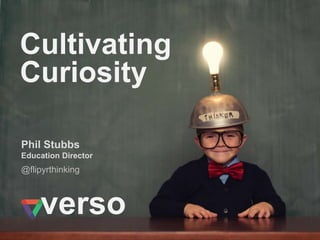
Cultivating
Curiosity
verso
New
Pedagogies for
Deep
Learning
Michael Fullan
Grade Level
Lee Jenkins
A change in creativity, critical thinking, and a
fundamental shift in relationships… as students
develop their capacity to question, discover,
connect, collaborate and contribute... and where
they are empowered by an increase in direction
and management of their own learning”
Alan November
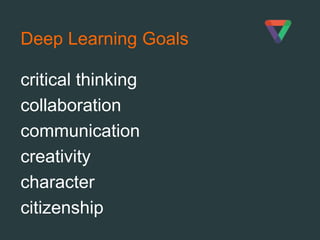
Deep Learning Goals
critical thinking
collaboration
communication
creativity
character
citizenship
irresistible
wonder - full
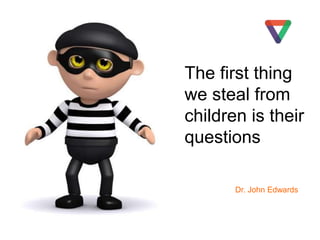
The first thing
we steal from
children is their
questions
Dr. John Edwards
eureka!
moments
Wonderful =
Curiosity + Inspiration
Activate
Cultivate
Initiate
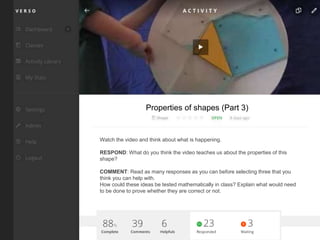
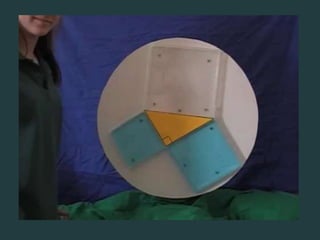
Watch the video and think about what is happening.
RESPOND: What do you think the video teaches us about the properties of this
shape?
COMMENT: Read as many responses as you can before selecting three that you
think you can help with.
How could these ideas be tested mathematically in class? Explain what would need
to be done to prove whether they are correct or not.
Properties of shapes (Part 3)
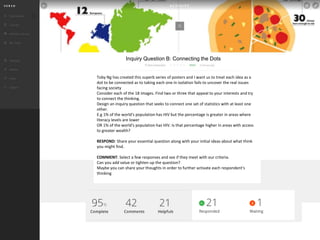
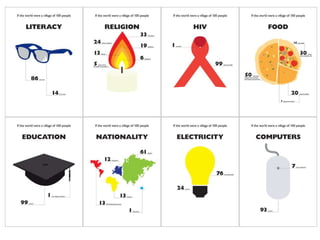
Toby Ng has created this superb series of posters and I want us to treat each idea as a
dot to be connected as to taking each one in isolation fails to uncover the real issues
facing society
Consider each of the 18 images. Find two or three that appeal to your interests and try
to connect the thinking.
Design an inquiry question that seeks to connect one set of statistics with at least one
other.
E.g 1% of the world's population has HIV but the percentage is greater in areas where
literacy levels are lower
OR 1% of the world's population has HIV. Is that percentage higher in areas with access
to greater wealth?
RESPOND: Share your essential question along with your initial ideas about what think
you might find.
COMMENT: Select a few responses and see if they meet with our criteria.
Can you add value or tighten up the question?
Maybe you can share your thoughts in order to further activate each respondent's
thinking
Inquiry Question B: Connecting the Dots
Inspire me,
don’t tell
me
Know
your
Impact
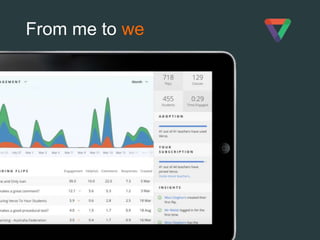
From me to we
Michael Fullan
Teaching
Like a Pro’
Constantly trying to improve practice and
working with all the collective might and
ingenuity of professional colleagues to do
so.
Prof. Stephen Heppell
In Plain Sight
“Teachers in sight of colleagues learn
from and with their peers. Sharing
improves the quality of teaching as
good ideas gain greater currency within
a school”
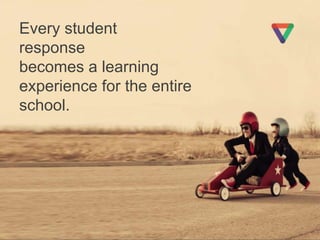
Visible Change
Every student
response
becomes a learning
experience for the entire
school.
www.newpedagogies.info
verso
Meet the team
Stand 173
Thank you
Edutech 2015 v2

Edutech 2015 v2

  • 1.
  • 2.
  • 3.
  • 5.
    A change increativity, critical thinking, and a fundamental shift in relationships… as students develop their capacity to question, discover, connect, collaborate and contribute... and where they are empowered by an increase in direction and management of their own learning” Alan November
  • 6.
    Deep Learning Goals criticalthinking collaboration communication creativity character citizenship
  • 7.
  • 9.
  • 10.
    The first thing westeal from children is their questions Dr. John Edwards
  • 12.
  • 14.
  • 15.
  • 16.
    Watch the videoand think about what is happening. RESPOND: What do you think the video teaches us about the properties of this shape? COMMENT: Read as many responses as you can before selecting three that you think you can help with. How could these ideas be tested mathematically in class? Explain what would need to be done to prove whether they are correct or not. Properties of shapes (Part 3)
  • 18.
    Toby Ng hascreated this superb series of posters and I want us to treat each idea as a dot to be connected as to taking each one in isolation fails to uncover the real issues facing society Consider each of the 18 images. Find two or three that appeal to your interests and try to connect the thinking. Design an inquiry question that seeks to connect one set of statistics with at least one other. E.g 1% of the world's population has HIV but the percentage is greater in areas where literacy levels are lower OR 1% of the world's population has HIV. Is that percentage higher in areas with access to greater wealth? RESPOND: Share your essential question along with your initial ideas about what think you might find. COMMENT: Select a few responses and see if they meet with our criteria. Can you add value or tighten up the question? Maybe you can share your thoughts in order to further activate each respondent's thinking Inquiry Question B: Connecting the Dots
  • 19.
  • 23.
  • 24.
  • 25.
    Michael Fullan Teaching Like aPro’ Constantly trying to improve practice and working with all the collective might and ingenuity of professional colleagues to do so.
  • 26.
    Prof. Stephen Heppell InPlain Sight “Teachers in sight of colleagues learn from and with their peers. Sharing improves the quality of teaching as good ideas gain greater currency within a school”
  • 27.
    Visible Change Every student response becomesa learning experience for the entire school.
  • 28.

Editor's Notes

  • #3 NPDL is a research project established by Michael Fullan in partnership with schools from 10 participating countries – About 100 schools from each including 10 from tasmania. And we are excited to have been selected by the Dept to work with 80 in victoria.
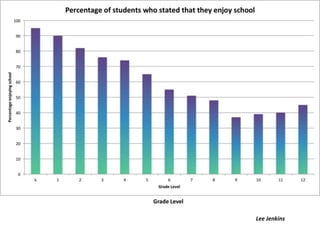
  • #4 The project was established to address a crisis in education. Students are checking out: as they progress through the years, students are becoming increasingly bored and disaffected. this data is from the US but research from around the world back this up where less than 40% of upper secondary students are intellectually engaged in class. This makes them, more difficult to teach leading to teacher satisfaction rates dropping from 65 to 38%
  • #5 Teachers and students being psychologically pushed out of school: The PUSH factor Add to this the PULL. The lure of digital. Ss have never been more socially connected .outside school non-formal learning is social;, connected, relevant – interest based and on demand. Students learn what they want to know when they want to know it. Learning is fuelled by curiosity Together, the push and pull conspire to drive students away
  • #6 Creativity, critical thinking, capacity to connect, collaborate, contribute. Fundamental shift in relationships. Students develop THEIR capacity to question
  • #7 Missing C- Creativity (habit of mind Doesn’t speak of the reqd change in relationships Learning IS irresistible- PULL – just not in school Project seeks to bridge those 2 worlds
  • #8 BUT irresistible doesn’t go far enough Irresistible doesn’t speak of the change in relationships, thats required, the shift in ownership. learning IS already irresistible…the pull factor tells us that….just not in school…. . Believe me… I tried to make learning irresistible and thought I was doing ok. I downloaded the latest top 10 apps for the classroom, I learnt to LOL
  • #9 It hindsight it probably came off as the pedagogical equivalent of Dad dancing at a wedding. Things didn’t look so good from their perspective. Problem based Moonwalk Flipped learning shuffle
  • #10 meets the students on their terms, it values their questions, their ideas, their challenges…the things that matter to them and help them to connect with the world All of our students are wonder-full. It is part of who they are but Kath Murdoch tells us that schools are not great places for wonder.
  • #11 We replace student questions with our own But research shows we are not very good at asking questions 80% of the questions we ask are surface – seeking to prove or disprove learning rather than unlocking new worlds.
  • #12 Instead of learning being a journey we focus on the final destination We give kids answers rather than questions when the currency of the classroom should be Qs
  • #13 We deny students Eureka moments
  • #14 no matter how we sugar coat it, dress it up in C21st skills, or commit instruction to video, spoon feeding or traditional teaching will not bring back awe and wonder.
  • #15 Curiosity has no lid – opens a door to the unknown. It’s inherently about the things that matter….. Curiosity is part of what makes us human its the reason to engage Inspiration is, the activator, the stimulus. The element that makes the student want to take risks,(lego) share their idea, collect multiple ideas and then use their curiosity to form relationships between ideas.. BUT it also motivates students to want to apply what they have learnt to new real world contexts…taking learning from the point of “I get it to I own it –
  • #16 It’s not about the sage on the stage being rep[laced by the guide on the side. Its about finding ways to activate learning, cultivate curiosity, initiate deep thinking
  • #17 Creating simple provocations designed to activate learning..inspiration Those that know Verso will appreciate that when engaging – productive discomfort etc…
  • #19 Creating simple provocations designed to
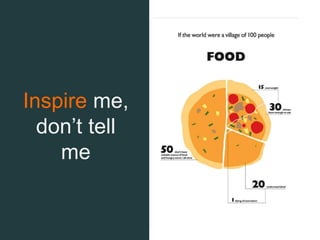
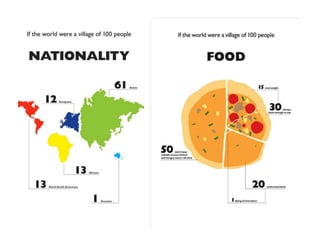
  • #20 A provocation from Tony Ng designed to get children to ask big questions as part of an inquiry into food. Imagine the Qs this info graphic might generate Great thing is that once they submit their own they get to see and respond to each others
  • #21 Another te4acher chose to add another so that kids could start to look at the distribution of the problem and issues such as equity. – Again, imagine the questions
  • #22 And now to make it really interesting….to broaden the scope
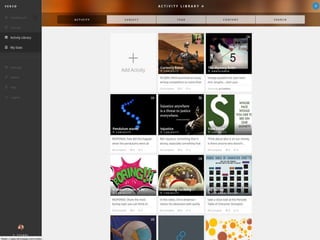
  • #23  We have created a shared library of high quality provocations, questions, Sparks- from schools, across a range of contexts and year levels. Chosen in response to data – test driven in class. Questions and strategies
  • #24  John Hattie tells us how vital it is for teachers to “know thy impact” and this is also a cornerstone of the NPDL project All activities are supported by decisional data and evidence of student engagement, student learning perspectives, process data and data allowing individual teachers to track their own development, learn from their mistakes as well as from their colleagues. At a school level, the data offers a dashboard on what’s working across domains. Trends and insights into successful strategies that are forging a path and making a change.
  • #25 Not enough to focus on the individual PD as a collective response. Build entitlement Allow Ts to share to library
  • #26 Fukllen refers to this as TLaP The NPDL project is about whole school change…a collective response to the challenge, informed by data and evidence in the context of each school
  • #27 Hattie: Good ideas gain greater currency through visibility on learning – both in class and professionalq
  • #28 For me the this echoes those changed relationships because