Submitted By: Krishnav Ray Baruah
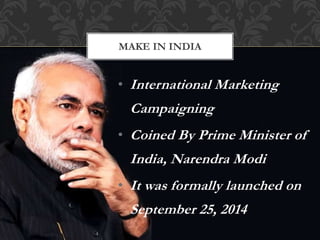
• International Marketing
Campaigning
• Coined By Prime Minister of
India, Narendra Modi
• It was formally launched on
September 25, 2014
MAKE IN INDIA
• To convert India into a global manufacturing hub, to
help create jobs and boost economic growth.
• To urge both local and foreign companies to invest in
India.
MAKE IN INDIA: AIM
• Make India a Manufacturing Hub
• Generating Employment
OBJECTIVE
• Eliminating the unnecessary laws and regulations
• Time-bound project clearances through a single online portal
HIGHLIGHTS
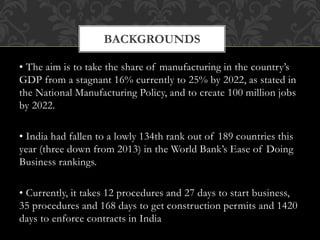
• The aim is to take the share of manufacturing in the country’s
GDP from a stagnant 16% currently to 25% by 2022, as stated in
the National Manufacturing Policy, and to create 100 million jobs
by 2022.
• India had fallen to a lowly 134th rank out of 189 countries this
year (three down from 2013) in the World Bank’s Ease of Doing
Business rankings.
• Currently, it takes 12 procedures and 27 days to start business,
35 procedures and 168 days to get construction permits and 1420
days to enforce contracts in India
BACKGROUNDS
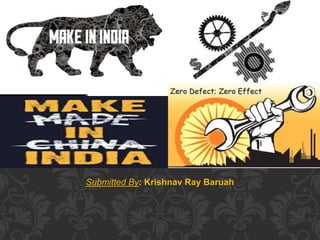
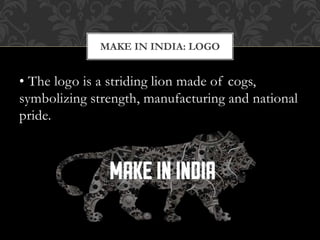
• The logo is a striding lion made of cogs,
symbolizing strength, manufacturing and national
pride.
MAKE IN INDIA: LOGO
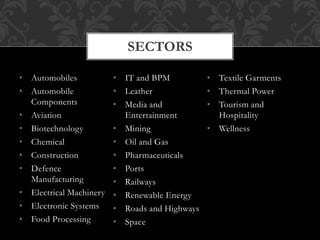
• Automobiles
• Automobile
Components
• Aviation
• Biotechnology
• Chemical
• Construction
• Defence
Manufacturing
• Electrical Machinery
• Electronic Systems
• Food Processing
• IT and BPM
• Leather
• Media and
Entertainment
• Mining
• Oil and Gas
• Pharmaceuticals
• Ports
• Railways
• Renewable Energy
• Roads and Highways
• Space
• Textile Garments
• Thermal Power
• Tourism and
Hospitality
• Wellness
SECTORS
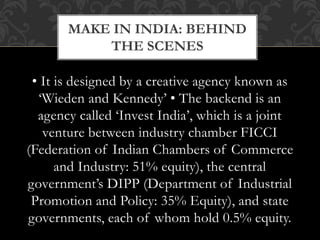
• It is designed by a creative agency known as
‘Wieden and Kennedy’ • The backend is an
agency called ‘Invest India’, which is a joint
venture between industry chamber FICCI
(Federation of Indian Chambers of Commerce
and Industry: 51% equity), the central
government’s DIPP (Department of Industrial
Promotion and Policy: 35% Equity), and state
governments, each of whom hold 0.5% equity.
MAKE IN INDIA: BEHIND
THE SCENES
5 THINGS ‘’MAKE IN INDIA’’ WILL DO
Invest India will act as the first reference
point for guiding foreign investors on all
aspects of regulatory and policy issues and
to assist them in obtaining regulatory
clearances.
#1 GUIDE FOREIGN INVESTORS
Investor facilitation cell will provide assistance to the
foreign investors from the time of their arrival in the
country to the time of their departure, with focus on
green and advanced manufacturing and helping these
companies to become an important part of the global
value chain.
#2 ASSISTANCE TO FOREIGN INVESTORS
Prospective investors can post questions on the
Make In India portal and they will be answered
by a panel of experts within 72 hours.
#3 PROMPT RESPONSE
Visitors registered on the website or raising
queries will be followed up with relevant
information and newsletter.
#4 PROVIDE RELEVANT
INFORMATION
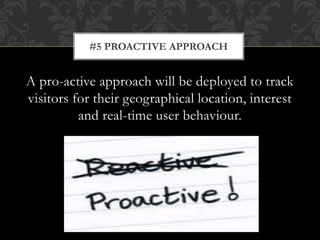
A pro-active approach will be deployed to track
visitors for their geographical location, interest
and real-time user behaviour.
#5 PROACTIVE APPROACH
2nd largest exporter of Ayurvedic and alternative medicine in the world.
Reason to Invest
• Indian system of medicine & homoeopathy are widely recognised for their
holistic approach to health & capability for meeting health challenges.
• The sector is growing at 20% from year to year.
Growth Drivers
• Department of Ayurveda, Yoga and Naturopathy, Unani, Siddha and Homoeopathy
• Central Sector Scheme for promotion of International Cooperation
FDI Policy
• 100% FDI is permitted in the AYUSH sector.
Sector Policy
• The National Rural Health Mission
• National Policy on Indian Systems of Medicine & Homoeopathy – 2002.
WELLNESS
The project is featured in KPMG’s ‘100 Most Innovative Global
Projects.
Delhi-Mumbai Industrial Corridor (DMIC) and it utilize the 1,483
km-long, high-capacity western Dedicated Railway Freight
Corridor (DFC) as the backbone.
Twenty four manufacturing cities are envisaged in the perspective
plan of the DMIC project
LIVE PROJECTS
 In the first phase, seven cities are being developed.
 Uttar Pradesh
Haryana
Rajasthan
Madhya Pradesh
Gujarat
Two in Maharashtra.
The Phase I is initially is to be completed by 2019.
DMIC states (Uttar Pradesh, Haryana, Rajasthan, Madhya Pradesh,
Gujarat & Maharashtra) contribute 43% to the country’s GDP.
FIRST PHASE
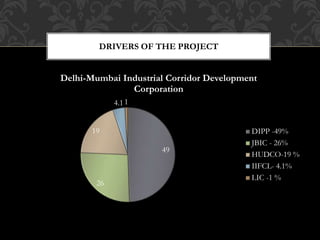
DRIVERS OF THE PROJECT
49
26
19
4.11
Delhi-Mumbai Industrial Corridor Development
Corporation
DIPP -49%
JBIC - 26%
HUDCO-19 %
IIFCL- 4.1%
LIC -1 %
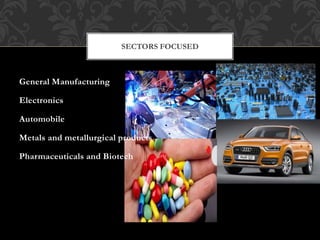
SECTORS FOCUSED
General Manufacturing
Electronics
Automobile
Metals and metallurgical products
Pharmaceuticals and Biotech
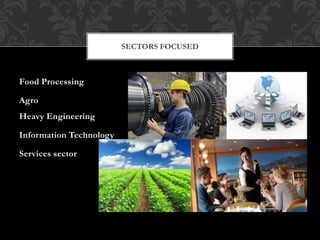
SECTORS FOCUSED
Food Processing
Agro
Heavy Engineering
Information Technology
Services sector
Public Private Partnership
Contractors/Consultants
Equipment suppliers
Financing
OPPORTUNITIES ACROSS
THE VALUE CHAIN
POLICIES
The Indian Government has brought about various changes
in its standing policies to encourage the MAKE IN INDIA
program.
These changes are in form of New Initiatives, increased FDI,
improved IPR apparatus and a robust infrastructure for
Manufacturing.
NEW INITIATIVES
• Process of applying for Industrial License & Industrial Entrepreneur
Memorandum made online on 24×7 basis through eBiz portal.
• Validity of Industrial license extended to three years.
• Major components of Defence products’ list excluded from industrial
licensing.
• Dual use items having military as well as civilian applications deregulated.
• Services of all Central Govt. Departments & Ministries will be integrated
with the eBiz – a single window IT platform for services by 31 Dec. 2014.
• Process of obtaining environmental clearances made online.
• All returns should be filed on-line through a unified form.
• A check-list of required compliances should be placed on
Ministry’s/Department’s web portal.
THANK YOU

Make in India

  • 1.
  • 2.
    • International Marketing Campaigning •Coined By Prime Minister of India, Narendra Modi • It was formally launched on September 25, 2014 MAKE IN INDIA
  • 3.
    • To convertIndia into a global manufacturing hub, to help create jobs and boost economic growth. • To urge both local and foreign companies to invest in India. MAKE IN INDIA: AIM
  • 4.
    • Make Indiaa Manufacturing Hub • Generating Employment OBJECTIVE • Eliminating the unnecessary laws and regulations • Time-bound project clearances through a single online portal HIGHLIGHTS
  • 5.
    • The aimis to take the share of manufacturing in the country’s GDP from a stagnant 16% currently to 25% by 2022, as stated in the National Manufacturing Policy, and to create 100 million jobs by 2022. • India had fallen to a lowly 134th rank out of 189 countries this year (three down from 2013) in the World Bank’s Ease of Doing Business rankings. • Currently, it takes 12 procedures and 27 days to start business, 35 procedures and 168 days to get construction permits and 1420 days to enforce contracts in India BACKGROUNDS
  • 6.
    • The logois a striding lion made of cogs, symbolizing strength, manufacturing and national pride. MAKE IN INDIA: LOGO
  • 7.
    • Automobiles • Automobile Components •Aviation • Biotechnology • Chemical • Construction • Defence Manufacturing • Electrical Machinery • Electronic Systems • Food Processing • IT and BPM • Leather • Media and Entertainment • Mining • Oil and Gas • Pharmaceuticals • Ports • Railways • Renewable Energy • Roads and Highways • Space • Textile Garments • Thermal Power • Tourism and Hospitality • Wellness SECTORS
  • 8.
    • It isdesigned by a creative agency known as ‘Wieden and Kennedy’ • The backend is an agency called ‘Invest India’, which is a joint venture between industry chamber FICCI (Federation of Indian Chambers of Commerce and Industry: 51% equity), the central government’s DIPP (Department of Industrial Promotion and Policy: 35% Equity), and state governments, each of whom hold 0.5% equity. MAKE IN INDIA: BEHIND THE SCENES
  • 9.
    5 THINGS ‘’MAKEIN INDIA’’ WILL DO
  • 10.
    Invest India willact as the first reference point for guiding foreign investors on all aspects of regulatory and policy issues and to assist them in obtaining regulatory clearances. #1 GUIDE FOREIGN INVESTORS
  • 11.
    Investor facilitation cellwill provide assistance to the foreign investors from the time of their arrival in the country to the time of their departure, with focus on green and advanced manufacturing and helping these companies to become an important part of the global value chain. #2 ASSISTANCE TO FOREIGN INVESTORS
  • 12.
    Prospective investors canpost questions on the Make In India portal and they will be answered by a panel of experts within 72 hours. #3 PROMPT RESPONSE
  • 13.
    Visitors registered onthe website or raising queries will be followed up with relevant information and newsletter. #4 PROVIDE RELEVANT INFORMATION
  • 14.
    A pro-active approachwill be deployed to track visitors for their geographical location, interest and real-time user behaviour. #5 PROACTIVE APPROACH
  • 15.
    2nd largest exporterof Ayurvedic and alternative medicine in the world. Reason to Invest • Indian system of medicine & homoeopathy are widely recognised for their holistic approach to health & capability for meeting health challenges. • The sector is growing at 20% from year to year. Growth Drivers • Department of Ayurveda, Yoga and Naturopathy, Unani, Siddha and Homoeopathy • Central Sector Scheme for promotion of International Cooperation FDI Policy • 100% FDI is permitted in the AYUSH sector. Sector Policy • The National Rural Health Mission • National Policy on Indian Systems of Medicine & Homoeopathy – 2002. WELLNESS
  • 16.
    The project isfeatured in KPMG’s ‘100 Most Innovative Global Projects. Delhi-Mumbai Industrial Corridor (DMIC) and it utilize the 1,483 km-long, high-capacity western Dedicated Railway Freight Corridor (DFC) as the backbone. Twenty four manufacturing cities are envisaged in the perspective plan of the DMIC project LIVE PROJECTS
  • 17.
     In thefirst phase, seven cities are being developed.  Uttar Pradesh Haryana Rajasthan Madhya Pradesh Gujarat Two in Maharashtra. The Phase I is initially is to be completed by 2019. DMIC states (Uttar Pradesh, Haryana, Rajasthan, Madhya Pradesh, Gujarat & Maharashtra) contribute 43% to the country’s GDP. FIRST PHASE
  • 18.
    DRIVERS OF THEPROJECT 49 26 19 4.11 Delhi-Mumbai Industrial Corridor Development Corporation DIPP -49% JBIC - 26% HUDCO-19 % IIFCL- 4.1% LIC -1 %
  • 19.
    SECTORS FOCUSED General Manufacturing Electronics Automobile Metalsand metallurgical products Pharmaceuticals and Biotech
  • 20.
    SECTORS FOCUSED Food Processing Agro HeavyEngineering Information Technology Services sector
  • 21.
    Public Private Partnership Contractors/Consultants Equipmentsuppliers Financing OPPORTUNITIES ACROSS THE VALUE CHAIN
  • 22.
    POLICIES The Indian Governmenthas brought about various changes in its standing policies to encourage the MAKE IN INDIA program. These changes are in form of New Initiatives, increased FDI, improved IPR apparatus and a robust infrastructure for Manufacturing.
  • 23.
    NEW INITIATIVES • Processof applying for Industrial License & Industrial Entrepreneur Memorandum made online on 24×7 basis through eBiz portal. • Validity of Industrial license extended to three years. • Major components of Defence products’ list excluded from industrial licensing. • Dual use items having military as well as civilian applications deregulated. • Services of all Central Govt. Departments & Ministries will be integrated with the eBiz – a single window IT platform for services by 31 Dec. 2014. • Process of obtaining environmental clearances made online. • All returns should be filed on-line through a unified form. • A check-list of required compliances should be placed on Ministry’s/Department’s web portal.
  • 24.