Introduction
• Make in India is an initiative launched by the Government of India to encourage
multi-national, as well as national companies to manufacture their products in
India.
• It was launched by Prime Minister Narendra Modi on 25 September 2014.
• In 2015, India received US $63 billion in foreign direct investment (FDI), emerging
as the top destination globally, surpassing the United States of America as well as
the People's Republic of China.
• https://www.youtube.com/watch?v=i4Kj9SsPRbY
The Make in India Vision
• Manufacturing currently contributes just over 15% to the
national GDP. The aim of this campaign is to grow this to a
25% contribution as seen with other developing nations of
Asia. In the process, the government expects to generate
jobs, attract much foreign direct investment, and transform
India into a manufacturing hub preferred around the globe.
• The logo for the Make In India campaign is a an elegant
lion, inspired by the Ashoka Chakra and designed to
represent India's success in all spheres.The campaign was
dedicated by the Prime Minister to the eminent patriot,
philosopher and political personality, Pandit Deen Dayal
Upadhyaya who had been born on the same date in 1916.
Objectives
Why Companies were not
manufacturing in India
• Make in India campaign is at loggerheads with the Make in China
ideal that has gained momentum over the past decade.
• China is a major rival to India when it comes to the outsourcing,
manufacturing, and services business.
• India's ailing infrastructure scenario and defunct logistics facilities
make it difficult for the country to achieve an elite status as a
manufacturing hub.
• The bureaucratic approach of former governments, lack of robust
transport networks, and widespread corruption makes it difficult for
manufacturers to achieve timely and adequate production.
• The Modi government has vowed to remove these hurdles and
make the nation an ideal destination for investors to set up
industries.
Benefits of Make in India
• India is a country rich in natural resources. Labour
is aplenty and skilled labour is easily available
given the high rates of unemployment among the
educated class of the country. With Asia
developing as the outsourcing hub of the world,
India is soon becoming the preferred
manufacturing destination of most investors
across the globe. Make in India is the Indian
government's effort to harness this demand and
boost the Indian economy.
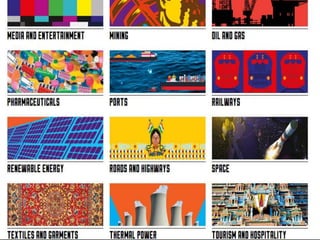
• Make in India focuses on the twenty-five
sectors of the economy. (Refer next slides)
• As per the new Govt. Policy, 100% FDI is
permitted in all the above sectors, except
for space (74%), defence (49%) and news
media (26%).
25 Key Sectors
The Make in India Website
• The Make In India website highlights each of the
25 target sectors with statistics, reasons to invest,
growth drivers, all policies relevant to investors
and the individual sectors, government support,
and opportunities for investors apart from
showcasing the live projects that have been
undertaken and FAQs. The website also links to
the campaigns Social Media feeds on Twitter,
Facebook, Google Plus, and YouTube.
Thank
You

Make in india

  • 2.
    Introduction • Make inIndia is an initiative launched by the Government of India to encourage multi-national, as well as national companies to manufacture their products in India. • It was launched by Prime Minister Narendra Modi on 25 September 2014. • In 2015, India received US $63 billion in foreign direct investment (FDI), emerging as the top destination globally, surpassing the United States of America as well as the People's Republic of China. • https://www.youtube.com/watch?v=i4Kj9SsPRbY
  • 3.
    The Make inIndia Vision • Manufacturing currently contributes just over 15% to the national GDP. The aim of this campaign is to grow this to a 25% contribution as seen with other developing nations of Asia. In the process, the government expects to generate jobs, attract much foreign direct investment, and transform India into a manufacturing hub preferred around the globe. • The logo for the Make In India campaign is a an elegant lion, inspired by the Ashoka Chakra and designed to represent India's success in all spheres.The campaign was dedicated by the Prime Minister to the eminent patriot, philosopher and political personality, Pandit Deen Dayal Upadhyaya who had been born on the same date in 1916.
  • 4.
  • 5.
    Why Companies werenot manufacturing in India • Make in India campaign is at loggerheads with the Make in China ideal that has gained momentum over the past decade. • China is a major rival to India when it comes to the outsourcing, manufacturing, and services business. • India's ailing infrastructure scenario and defunct logistics facilities make it difficult for the country to achieve an elite status as a manufacturing hub. • The bureaucratic approach of former governments, lack of robust transport networks, and widespread corruption makes it difficult for manufacturers to achieve timely and adequate production. • The Modi government has vowed to remove these hurdles and make the nation an ideal destination for investors to set up industries.
  • 6.
    Benefits of Makein India • India is a country rich in natural resources. Labour is aplenty and skilled labour is easily available given the high rates of unemployment among the educated class of the country. With Asia developing as the outsourcing hub of the world, India is soon becoming the preferred manufacturing destination of most investors across the globe. Make in India is the Indian government's effort to harness this demand and boost the Indian economy.
  • 20.
    • Make inIndia focuses on the twenty-five sectors of the economy. (Refer next slides) • As per the new Govt. Policy, 100% FDI is permitted in all the above sectors, except for space (74%), defence (49%) and news media (26%).
  • 22.
  • 24.
    The Make inIndia Website • The Make In India website highlights each of the 25 target sectors with statistics, reasons to invest, growth drivers, all policies relevant to investors and the individual sectors, government support, and opportunities for investors apart from showcasing the live projects that have been undertaken and FAQs. The website also links to the campaigns Social Media feeds on Twitter, Facebook, Google Plus, and YouTube.
  • 25.