

BRIEFING ON MAKE ON INDIA
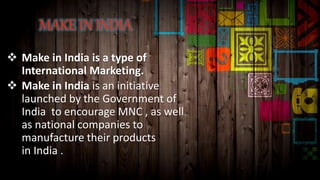
 Make in India is a type of
International Marketing.
 Make in India is an initiative
launched by the Government of
India to encourage MNC , as well
as national companies to
manufacture their products
in India .
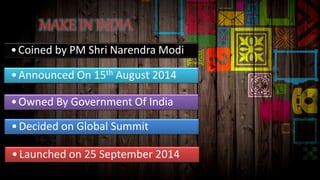
•Coined by PM Shri Narendra Modi
•Announced On 15th August 2014
•Owned By Government Of India
•Launched on 25 September 2014
•Decided on Global Summit
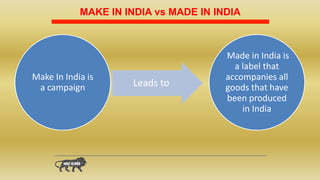
MAKE IN INDIA vs MADE IN INDIA
Make In India is
a campaign Leads to
Made in India is
a label that
accompanies all
goods that have
been produced
in India
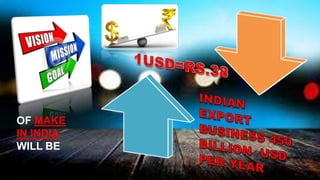
OF MAKE
IN INDIA
WILL BE
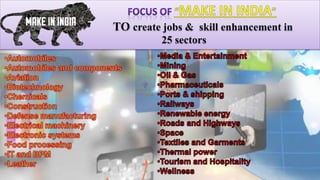
TO create jobs & skill enhancement in
25 sectors
.
No Uniform Tax
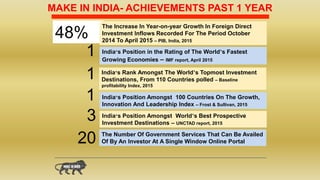
MAKE IN INDIA- ACHIEVEMENTS PAST 1 YEAR
48%
India‘s Position in the Rating of The World’s Fastest
Growing Economies – IMF report, April 2015
1
India‘s Rank Amongst The World’s Topmost Investment
Destinations, From 110 Countries polled – Baseline
profitability Index, 2015
1
India‘s Position Amongst 100 Countries On The Growth,
Innovation And Leadership Index – Frost & Sullivan, 2015
India‘s Position Amongst World’s Best Prospective
Investment Destinations – UNCTAD report, 2015
The Increase In Year-on-year Growth In Foreign Direct
Investment Inflows Recorded For The Period October
2014 To April 2015 – PIB, India, 2015
3
1
The Number Of Government Services That Can Be Availed
Of By An Investor At A Single Window Online Portal20
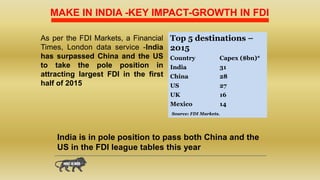
MAKE IN INDIA -KEY IMPACT-GROWTH IN FDI
Top 5 destinations –
2015
Country Capex ($bn)*
India 31
China 28
US 27
UK 16
Mexico 14
Source: FDI Markets.
As per the FDI Markets, a Financial
Times, London data service -India
has surpassed China and the US
to take the pole position in
attracting largest FDI in the first
half of 2015
India is in pole position to pass both China and the
US in the FDI league tables this year
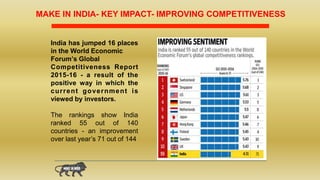
MAKE IN INDIA- KEY IMPACT- IMPROVING COMPETITIVENESS
India has jumped 16 places
in the World Economic
Forum’s Global
Competitiveness Report
2015-16 - a result of the
positive way in which the
current government is
viewed by investors.
The rankings show India
ranked 55 out of 140
countries - an improvement
over last year’s 71 out of 144
.
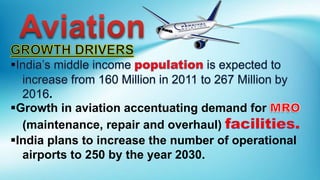
Growth in aviation accentuating demand for
(maintenance, repair and overhaul)
India plans to increase the number of operational
airports to 250 by the year 2030.
CASE STUDY MAKE IN INDIA
Impact of Make in India on unorganized
Sector
Prime minister of India has recently been launched the “Make in India” policy Campaign he assured
the global investor and domestic investor for safety of their investment vision of this policy is
increase contribution in GDP through manufacturing, Creation of appropriate skill, enhancing global
competitiveness of Indian manufacturing. It can say it is a New Manufacturing policy of India
manufacturing sector can be divide in two part organized and unorganized in India. Both are different
to each other in terms of business volume, employment, technologies as well as their contribution in
GDP. But word Informal sector and Unorganized sector meaning exchange each other. National
Commission for Enterprise has accepted definition for Unorganized Sector which is measurable in
numerical term “The unorganized sector consists of all unincorporated private enterprises owned by
individuals or households engaged in the sale and production of goods and services operated on a
proprietary or partnership Basis and with less than 10 total workers.” But International Conference of
Labor Statisticians has not given any maximum limit for labor in unorganized sector. And discussed
some feature Informal workers whose employment relationship is not subject to labor legislation
social protection and certain employment benefits. (International labor organist ion 2002) As per
NSSO data 2009-10 unorganized sector contribute 94 % in Employment.
STRENGTH
1. Demography
2. Demand
3. Democratic country
4. Presence of Organized Sector or
Big houses
5. Network or Strong financial
institutions
WEAKNESS
1.Availability of technology
2.Infrastructure Facility
3.Managerial Competence
4.Non Availability of Quality
Department
5.Unable to invest in Research and
Development
OPPORTUNITIES
1. Employment generation
2. Enhancement of export
3. As supplier for organized Units
4. Reduction of Inequality
5. Product at optimum price for low income group
6. Building of Nation
THREATS
1. General view: No specific plan for unorganized sector.
2. Global Competition
3. Multifunctional politics
4. Social Security
5. Lack of branding
6. Lack of skill development institution
RECOMMENDATIONS
1. In this policy Government has made provision for regional unit, in these regional unit should be
some provisions established, promoted and protected for unorganized sector according to local
level expertise.
2. To solve problem skill gap of manpower, Government should establish regional institutions for
specific skill development.
3. To fulfill Research and Development gap in this policy, Government should establish institutions for
R&D.
4. 93% of small scale units are self-dependent in finance, so they need relaxation in norms for
financing and require more wide and effective role of SIDBI.
5. Infrastructure development is more important for proper implementation because unorganized
sector face infrastructure problems as major challenge.
6. To solve the problem of multifunctional politics like dispute between center and state government
for policy implementation and execution, policy makers need clear and unambiguous norms for
organized sector as well as unorganized sector.
7. Unorganized sector face branding problem in comparison to organized sector so government
should adopt some promotional activity to promote unorganized sector products as unorganized
product branding help to capture market opportunities
8. Unorganized sector face the problem of social security there should some provision as life insurance,
The Way Ahead For Excellence
in
Manufacturing and Service Sector
lets work together to
make
India of our dreams….
SET AN EXAMPLE
Make in india

Make in india

  • 3.
  • 4.
     Make inIndia is a type of International Marketing.  Make in India is an initiative launched by the Government of India to encourage MNC , as well as national companies to manufacture their products in India .
  • 5.
    •Coined by PMShri Narendra Modi •Announced On 15th August 2014 •Owned By Government Of India •Launched on 25 September 2014 •Decided on Global Summit
  • 6.
    MAKE IN INDIAvs MADE IN INDIA Make In India is a campaign Leads to Made in India is a label that accompanies all goods that have been produced in India
  • 9.
  • 12.
    TO create jobs& skill enhancement in 25 sectors
  • 14.
  • 15.
  • 22.
    MAKE IN INDIA-ACHIEVEMENTS PAST 1 YEAR 48% India‘s Position in the Rating of The World’s Fastest Growing Economies – IMF report, April 2015 1 India‘s Rank Amongst The World’s Topmost Investment Destinations, From 110 Countries polled – Baseline profitability Index, 2015 1 India‘s Position Amongst 100 Countries On The Growth, Innovation And Leadership Index – Frost & Sullivan, 2015 India‘s Position Amongst World’s Best Prospective Investment Destinations – UNCTAD report, 2015 The Increase In Year-on-year Growth In Foreign Direct Investment Inflows Recorded For The Period October 2014 To April 2015 – PIB, India, 2015 3 1 The Number Of Government Services That Can Be Availed Of By An Investor At A Single Window Online Portal20
  • 23.
    MAKE IN INDIA-KEY IMPACT-GROWTH IN FDI Top 5 destinations – 2015 Country Capex ($bn)* India 31 China 28 US 27 UK 16 Mexico 14 Source: FDI Markets. As per the FDI Markets, a Financial Times, London data service -India has surpassed China and the US to take the pole position in attracting largest FDI in the first half of 2015 India is in pole position to pass both China and the US in the FDI league tables this year
  • 24.
    MAKE IN INDIA-KEY IMPACT- IMPROVING COMPETITIVENESS India has jumped 16 places in the World Economic Forum’s Global Competitiveness Report 2015-16 - a result of the positive way in which the current government is viewed by investors. The rankings show India ranked 55 out of 140 countries - an improvement over last year’s 71 out of 144
  • 28.
    . Growth in aviationaccentuating demand for (maintenance, repair and overhaul) India plans to increase the number of operational airports to 250 by the year 2030.
  • 35.
  • 36.
    Impact of Makein India on unorganized Sector Prime minister of India has recently been launched the “Make in India” policy Campaign he assured the global investor and domestic investor for safety of their investment vision of this policy is increase contribution in GDP through manufacturing, Creation of appropriate skill, enhancing global competitiveness of Indian manufacturing. It can say it is a New Manufacturing policy of India manufacturing sector can be divide in two part organized and unorganized in India. Both are different to each other in terms of business volume, employment, technologies as well as their contribution in GDP. But word Informal sector and Unorganized sector meaning exchange each other. National Commission for Enterprise has accepted definition for Unorganized Sector which is measurable in numerical term “The unorganized sector consists of all unincorporated private enterprises owned by individuals or households engaged in the sale and production of goods and services operated on a proprietary or partnership Basis and with less than 10 total workers.” But International Conference of Labor Statisticians has not given any maximum limit for labor in unorganized sector. And discussed some feature Informal workers whose employment relationship is not subject to labor legislation social protection and certain employment benefits. (International labor organist ion 2002) As per NSSO data 2009-10 unorganized sector contribute 94 % in Employment.
  • 37.
    STRENGTH 1. Demography 2. Demand 3.Democratic country 4. Presence of Organized Sector or Big houses 5. Network or Strong financial institutions
  • 38.
    WEAKNESS 1.Availability of technology 2.InfrastructureFacility 3.Managerial Competence 4.Non Availability of Quality Department 5.Unable to invest in Research and Development
  • 39.
    OPPORTUNITIES 1. Employment generation 2.Enhancement of export 3. As supplier for organized Units 4. Reduction of Inequality 5. Product at optimum price for low income group 6. Building of Nation
  • 40.
    THREATS 1. General view:No specific plan for unorganized sector. 2. Global Competition 3. Multifunctional politics 4. Social Security 5. Lack of branding 6. Lack of skill development institution
  • 41.
    RECOMMENDATIONS 1. In thispolicy Government has made provision for regional unit, in these regional unit should be some provisions established, promoted and protected for unorganized sector according to local level expertise. 2. To solve problem skill gap of manpower, Government should establish regional institutions for specific skill development. 3. To fulfill Research and Development gap in this policy, Government should establish institutions for R&D. 4. 93% of small scale units are self-dependent in finance, so they need relaxation in norms for financing and require more wide and effective role of SIDBI. 5. Infrastructure development is more important for proper implementation because unorganized sector face infrastructure problems as major challenge. 6. To solve the problem of multifunctional politics like dispute between center and state government for policy implementation and execution, policy makers need clear and unambiguous norms for organized sector as well as unorganized sector. 7. Unorganized sector face branding problem in comparison to organized sector so government should adopt some promotional activity to promote unorganized sector products as unorganized product branding help to capture market opportunities 8. Unorganized sector face the problem of social security there should some provision as life insurance,
  • 42.
    The Way AheadFor Excellence in Manufacturing and Service Sector lets work together to make India of our dreams….
  • 43.