2
2
OBJECTIVES
OBJECTIVES
Explain theimportance of
Explain the importance of
maintenance in production systems.
maintenance in production systems.
Describe the range of maintenance
Describe the range of maintenance
activities.
activities.
Discuss preventive maintenance and
Discuss preventive maintenance and
the key issues associated with it.
the key issues associated with it.
Discuss breakdown maintenance
Discuss breakdown maintenance
and the key issues associated with it.
and the key issues associated with it.
State how the Pareto phenomenon
State how the Pareto phenomenon
pertains to maintenance discussions.
pertains to maintenance discussions.
3.
3
3
DEFINITION
DEFINITION
WHAT ISMEANT BY THE TERM
WHAT IS MEANT BY THE TERM
“MAINTENANCE” ?
“MAINTENANCE” ?
Maintenance encompasses all those
Maintenance encompasses all those
activities that maintain facilities &
activities that maintain facilities &
equipment in good working order so
equipment in good working order so
that a system can perform as
that a system can perform as
intended.
intended.
Maintenance can also be termed as
Maintenance can also be termed as
asset management system which
asset management system which
keeps them in optimum operating
keeps them in optimum operating
condition.
condition.
4.
4
4
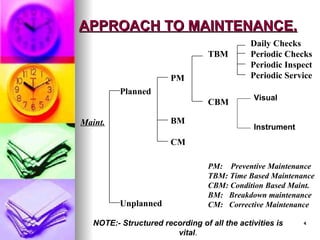
APPROACH TO MAINTENANCE.
APPROACHTO MAINTENANCE.
Maint.
Planned
Unplanned
PM
BM
CM
TBM
CBM
Daily Checks
Periodic Checks
Periodic Inspect
Periodic Service
PM: Preventive Maintenance
TBM: Time Based Maintenance
CBM: Condition Based Maint.
BM: Breakdown maintenance
CM: Corrective Maintenance
Visual
Instrument
NOTE:- Structured recording of all the activities is
vital.
5.
5
5
GOAL OF MAINTENANCE
GOALOF MAINTENANCE
The goal of maintenance is to
The goal of maintenance is to
keep the production system in
keep the production system in
good working order at minimal
good working order at minimal
cost.
cost.
Decision makers have 2 basic
Decision makers have 2 basic
options with respect to
options with respect to
maintenance. They are: -
maintenance. They are: -
BREAKDOWN MAINTENANCE.
BREAKDOWN MAINTENANCE.
PREVENTIVE MAINTENANCE.
PREVENTIVE MAINTENANCE.
6.
6
6
TYPES OF MAINTENANCE
TYPESOF MAINTENANCE
BREAKDOWN MAINTAINANCE:-
BREAKDOWN MAINTAINANCE:-
Real approach,
Real approach,
Dealing with breakdowns or problems
Dealing with breakdowns or problems
when they occur…
when they occur…
PREVENTIVE MAINTENANCE:-
PREVENTIVE MAINTENANCE:-
Proactive approach;
Proactive approach;
Reducing breakdowns through a
Reducing breakdowns through a
program of lubrication, adjustment,
program of lubrication, adjustment,
cleaning, inspection, and replacement of
cleaning, inspection, and replacement of
worn parts.
worn parts.
7.
7
7
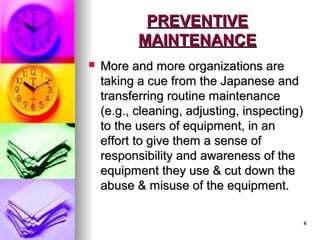
The bestapproach is to
The best approach is to
seek a balance between
seek a balance between
preventive maintenance
preventive maintenance
and breakdown
and breakdown
maintenance. The same
maintenance. The same
concept applies to
concept applies to
maintaining production
maintaining production
systems.
systems.
The age and condition of
The age and condition of
facilities and equipment,
facilities and equipment,
the degree of technology
the degree of technology
involved,
involved,
The type of production
The type of production
process,
process,
The decision of how
The decision of how
much preventive
much preventive
maintenance is desirable.
maintenance is desirable.
8.
8
8
PREVENTIVE
PREVENTIVE
MAINTENANCE
MAINTENANCE
More andmore organizations are
More and more organizations are
taking a cue from the Japanese and
taking a cue from the Japanese and
transferring routine maintenance
transferring routine maintenance
(e.g., cleaning, adjusting, inspecting)
(e.g., cleaning, adjusting, inspecting)
to the users of equipment, in an
to the users of equipment, in an
effort to give them a sense of
effort to give them a sense of
responsibility and awareness of the
responsibility and awareness of the
equipment they use & cut down the
equipment they use & cut down the
abuse & misuse of the equipment.
abuse & misuse of the equipment.
9.
9
9
PREVENTIVE
PREVENTIVE
MAINTENANCE
MAINTENANCE
Preventive maintenanceextends back to
Preventive maintenance extends back to
the design and selection stage of
the design and selection stage of
equipment and facilities.
equipment and facilities.
Poor design can cause equipment to wear
Poor design can cause equipment to wear
out at an early age or experience a much
out at an early age or experience a much
higher than expected breakdown rate.
higher than expected breakdown rate.
Durability and ease of maintenance can
Durability and ease of maintenance can
have long term implications for preventive
have long term implications for preventive
maintenance programs.
maintenance programs.
Training employees in proper operating
Training employees in proper operating
procedures and in how to keep equipment
procedures and in how to keep equipment
in good operating order – and providing the
in good operating order – and providing the
incentive to do so – are also important.
incentive to do so – are also important.
10.
10
10
PREVENTIVE
PREVENTIVE
MAINTENANCE
MAINTENANCE
The goal ofpreventive maintenance
The goal of preventive maintenance
Preventive maintenance is
Preventive maintenance is periodic.
periodic.
Preventive maintenance is generally
Preventive maintenance is generally
scheduled using some of the
scheduled using some of the
following contributions:-
following contributions:-
The result of planned inspections that
The result of planned inspections that
reveal a need for maintenance.
reveal a need for maintenance.
According to the calendar (passage of
According to the calendar (passage of
Time).
Time).
After a predetermined no. of operating
After a predetermined no. of operating
hours.
hours.
11.
11
11
PREDICTIVE
PREDICTIVE
MAINTENANCE
MAINTENANCE
PREDICTIVE MAINTENANCE
PREDICTIVE MAINTENANCE
This is an attempt to determine
This is an attempt to determine
when best to perform preventive
when best to perform preventive
maintenance.
maintenance.
The better the predictions of
The better the predictions of
failures are, the more effective
failures are, the more effective
preventive maintenance will be.
preventive maintenance will be.
12.
12
12
Predictive Maintenance
Predictive Maintenance
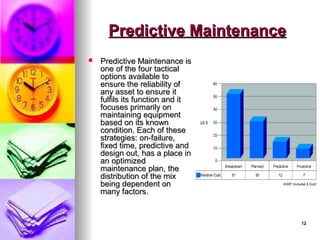
Predictive Maintenance is
Predictive Maintenance is
one of the four tactical
one of the four tactical
options available to
options available to
ensure the reliability of
ensure the reliability of
any asset to ensure it
any asset to ensure it
fulfils its function and it
fulfils its function and it
focuses primarily on
focuses primarily on
maintaining equipment
maintaining equipment
based on its known
based on its known
condition. Each of these
condition. Each of these
strategies: on-failure,
strategies: on-failure,
fixed time, predictive and
fixed time, predictive and
design out, has a place in
design out, has a place in
an optimized
an optimized
maintenance plan, the
maintenance plan, the
distribution of the mix
distribution of the mix
being dependent on
being dependent on
many factors.
many factors.
13.
13
13
Predictive Maintenance
Predictive Maintenance
Predictive maintenance is often the most attractive concept,
Predictive maintenance is often the most attractive concept,
since action is only undertaken when knowledge of the asset
since action is only undertaken when knowledge of the asset
indicates that failure or underperformance is imminent, making it
indicates that failure or underperformance is imminent, making it
a cost effective asset management option.
a cost effective asset management option.
Many other benefits, some intangible such as the increased
Many other benefits, some intangible such as the increased
motivation of the workforce through increased competency, exist.
motivation of the workforce through increased competency, exist.
Others include:
Others include:
Equipment may be shut down before severe damage occurs or
Equipment may be shut down before severe damage occurs or
can be run to failure if required.
can be run to failure if required.
Production can be modified to extend the asset's life i.e. until the
Production can be modified to extend the asset's life i.e. until the
next planned shutdown.
next planned shutdown.
Required maintenance work can be planned
Required maintenance work can be planned
All of the above lead to increased safety, plant output and
All of the above lead to increased safety, plant output and
availability and lead to improvements in final product quality.
availability and lead to improvements in final product quality.
14.
14
14
Predictive maintenanceis a process that requires
Predictive maintenance is a process that requires
clear roles and responsibilities. As such we develop
clear roles and responsibilities. As such we develop
company appropriate predictive maintenance
company appropriate predictive maintenance
processes, supported by definitions of
processes, supported by definitions of
responsibilities, and communication paths, which
responsibilities, and communication paths, which
integrate into the Reliability effort as a whole.
integrate into the Reliability effort as a whole.
Condition monitoring facilitates Predictive
Condition monitoring facilitates Predictive
Maintenance.
Maintenance.
Condition monitoring is a knowledge-based activity,
Condition monitoring is a knowledge-based activity,
so for it to be successful and sustainable, it requires
so for it to be successful and sustainable, it requires
comprehensive skills training.
comprehensive skills training.
Any successful predictive maintenance program,
Any successful predictive maintenance program,
not only has a technology element, but requires a
not only has a technology element, but requires a
measurement system that continuously accounts for
measurement system that continuously accounts for
the benefits.
the benefits.
Predictive Maintenance
Predictive Maintenance
15.
15
15
Asset Performance
Asset Performance
Troubleshooting
Troubleshooting
Often it is a couple of poor performing assets with a
Often it is a couple of poor performing assets with a
chronic repeated failure condition that absorb the
chronic repeated failure condition that absorb the
majority of the maintenance budget. Some
majority of the maintenance budget. Some
commentators state that approximately 80% of a
commentators state that approximately 80% of a
typical maintenance budget is stored away for
typical maintenance budget is stored away for
chronic failures, making these the most cost
chronic failures, making these the most cost
depletive of all maintenance expenditures.
depletive of all maintenance expenditures.
The following methodologies are key in any multi-
The following methodologies are key in any multi-
technology condition monitoring program :
technology condition monitoring program :
Root Cause Failure Analysis
Root Cause Failure Analysis
Tribology And Lubrication Engineering Services
Tribology And Lubrication Engineering Services
Specialist Condition Monitoring Services
Specialist Condition Monitoring Services
16.
16
16
ROOT CAUSE FAILURE
ROOTCAUSE FAILURE
ANALYSIS
ANALYSIS
Root Cause Failure Analysis (RCFA) is both a
Root Cause Failure Analysis (RCFA) is both a
process and a set of technical skills, which in
process and a set of technical skills, which in
combination find out why a particular failure or
combination find out why a particular failure or
problem exists and sets in place a set of defense
problem exists and sets in place a set of defense
actions correcting those causes.
actions correcting those causes.
Typically, when assets fail most organizations have
Typically, when assets fail most organizations have
always found some understanding and rational
always found some understanding and rational
leading to an explanation as to why it broke. But
leading to an explanation as to why it broke. But
root cause failure analysis takes you beyond that to
root cause failure analysis takes you beyond that to
the latent roots, which are the management system
the latent roots, which are the management system
weaknesses. Once you've found these, you have
weaknesses. Once you've found these, you have
the means to solve many other potential problems
the means to solve many other potential problems
that haven't yet occurred.
that haven't yet occurred.
17.
17
17
Tribology And Lubrication
TribologyAnd Lubrication
Tribology is the study of wear
Tribology is the study of wear
and lubrication.Tribology as it is
and lubrication.Tribology as it is
estimated that component wear
estimated that component wear
and lubrication problems are
and lubrication problems are
responsible for at least 70 % of
responsible for at least 70 % of
mechanical failures.
mechanical failures.
19
19
Condition Monitoring
Condition Monitoring
In industry, condition monitoring is the
In industry, condition monitoring is the
measurement of parameters which may indicate a
measurement of parameters which may indicate a
fault condition either by an increase or decrease in
fault condition either by an increase or decrease in
overall measured value or by some other change to
overall measured value or by some other change to
a characteristic value.
a characteristic value.
When used as part of a pro-active maintenance
When used as part of a pro-active maintenance
plan, the use of condition monitoring enables the
plan, the use of condition monitoring enables the
operation of a predictive maintenance policy and
operation of a predictive maintenance policy and
provides major improvements in productivity.
provides major improvements in productivity.
Condition monitoring depends on selecting the right
Condition monitoring depends on selecting the right
mix of parameters that match expected faults and
mix of parameters that match expected faults and
using the correct measurement technique, location
using the correct measurement technique, location
interval and processing, it is also important to
interval and processing, it is also important to
record enough information in order to be able to
record enough information in order to be able to
carry out monitoring and diagnosis.
carry out monitoring and diagnosis.
20.
20
20
Condition Monitoring
Condition Monitoring
Considerations include:
Considerations include:
• Type of measurement
Type of measurement
• Measurement interval
Measurement interval
• Accuracy of measurement
Accuracy of measurement
• Repeatability
Repeatability
Condition monitoring falls into two distinct classes:
Condition monitoring falls into two distinct classes:
Monitoring which can be carried out without interruption to
Monitoring which can be carried out without interruption to
the operation of the machine
the operation of the machine
Monitoring which requires the shutdown of the unit, or at
Monitoring which requires the shutdown of the unit, or at
least the releases of the machine from its prime duty
least the releases of the machine from its prime duty
The range of methods in use is very wide, from simple
The range of methods in use is very wide, from simple
techniques such as visual surface inspections to more
techniques such as visual surface inspections to more
complicated procedures like spectral vibration analysis.
complicated procedures like spectral vibration analysis.
21.
21
21
PREVENTIVE
PREVENTIVE
MAINTENANCE
MAINTENANCE
TOTAL PREVENTIVE MAINTENANCE
TOTALPREVENTIVE MAINTENANCE
JIT approach where workers perform
JIT approach where workers perform
preventive maintenance on the
preventive maintenance on the
machines they operate.
machines they operate.
This approach is consistent with JIT
This approach is consistent with JIT
systems and lean production, where
systems and lean production, where
employees are give greater
employees are give greater
responsibility for quality, productivity
responsibility for quality, productivity
and the general functioning of the
and the general functioning of the
system.
system.
22.
22
22
The TPM Concept
TheTPM Concept
Develop a Company-wide philosophy to
Develop a Company-wide philosophy to
maximize the effectiveness of production
maximize the effectiveness of production
systems.
systems.
Build an organization that prevents every
Build an organization that prevents every
type of loss
type of loss
zero accidents
zero accidents
zero defects
zero defects
zero failures
zero failures
Involve all departments in TPM
Involve all departments in TPM
implementation.
implementation.
Involve everyone from top management to
Involve everyone from top management to
shop-floor operators
shop-floor operators
Use small groups (teams) to make
Use small groups (teams) to make
improvements.
improvements.
23.
23
23
The “Total” inTPM
The “Total” in TPM
Total effectiveness:
Total effectiveness:
pursuit of economic efficiency and profitability
pursuit of economic efficiency and profitability
Total PM:
Total PM:
establishing a maintenance plan for the life of
establishing a maintenance plan for the life of
the equipment - preventative maintenance -
the equipment - preventative maintenance -
improved maintainability
improved maintainability
Total Participation:
Total Participation:
autonomous maintenance by operators and
autonomous maintenance by operators and
team based approach to problem solving
team based approach to problem solving
28
28
The TPM Prerequisite
TheTPM Prerequisite
Only by adopting a proactive approach
and putting in the time, effort, and resources
required can TPM be profitable for an
Organization
29.
29
29
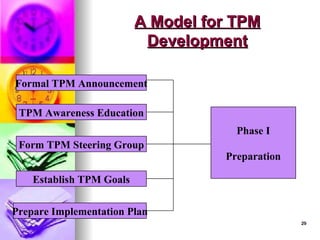
A Model forTPM
A Model for TPM
Development
Development
Formal TPM Announcement
TPM Awareness Education
Form TPM Steering Group
Establish TPM Goals
Prepare Implementation Plan
Phase I
Preparation
30.
30
30
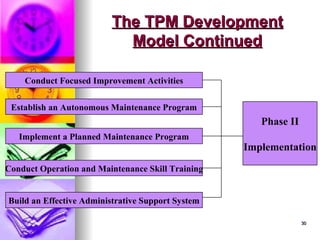
The TPM Development
TheTPM Development
Model Continued
Model Continued
Conduct Focused Improvement Activities
Establish an Autonomous Maintenance Program
Implement a Planned Maintenance Program
Conduct Operation and Maintenance Skill Training
Build an Effective Administrative Support System
Phase II
Implementation
31.
31
31
Core TPM Activities
CoreTPM Activities
Focused Improvement Projects
Focused Improvement Projects
Autonomous Maintenance
Autonomous Maintenance
Planned (Preventive) Maintenance
Planned (Preventive) Maintenance
Education and Training
Education and Training
Early Management (Equipment Design and
Early Management (Equipment Design and
Installation)
Installation)
Quality Maintenance
Quality Maintenance
Administrative and Support Activities
Administrative and Support Activities
Safety and Environmental Management
Safety and Environmental Management
Diagnostic and Predictive Maintenance
Diagnostic and Predictive Maintenance
32.
32
32
The Major PlantLosses
The Major Plant Losses
Equipment Failures
Equipment Failures
Process and Equipment Set-ups And
Process and Equipment Set-ups And
Adjustments
Adjustments
Idling and minor stoppages
Idling and minor stoppages
Reduced Processing Speed
Reduced Processing Speed
Quality Defects
Quality Defects
Reduced Yield
Reduced Yield
33.
33
33
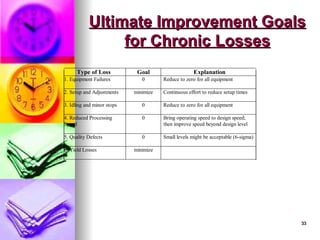
Ultimate Improvement Goals
UltimateImprovement Goals
for Chronic Losses
for Chronic Losses
Type of Loss Goal Explanation
1. Equipment Failures 0 Reduce to zero for all equipment
2. Setup and Adjustments minimize Continuous effort to reduce setup times
3. Idling and minor stops 0 Reduce to zero for all equipment
4. Reduced Processing
Speed
0 Bring operating speed to design speed;
then improve speed beyond design level
5. Quality Defects 0 Small levels might be acceptable (6-sigma)
6. Yield Losses minimize
35
35
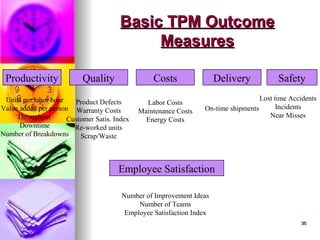
Basic TPM Outcome
BasicTPM Outcome
Measures
Measures
Productivity
Units per labor hour
Value added per person
Throughput
Downtime
Number of Breakdowns
Quality
Product Defects
Warranty Costs
Customer Satis. Index
Re-worked units
Scrap/Waste
Costs
Labor Costs
Maintenance Costs
Energy Costs
Delivery
On-time shipments
Safety
Lost time Accidents
Incidents
Near Misses
Employee Satisfaction
Number of Improvement Ideas
Number of Teams
Employee Satisfaction Index
37
37
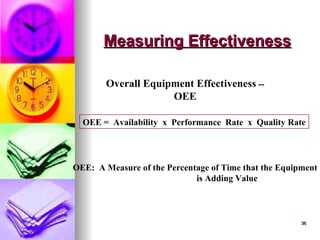
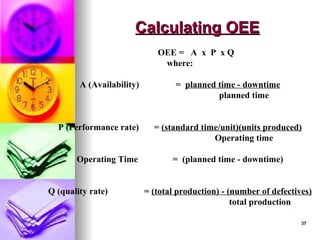
Calculating OEE
Calculating OEE
OEE= A x P x Q
where:
A (Availability) = planned time - downtime
planned time
P (Performance rate) = (standard time/unit)(units produced)
Operating time
Operating Time = (planned time - downtime)
Q (quality rate) = (total production) - (number of defectives)
total production
38.
38
38
OEE Example
OEE Example
ThePlant operates 1,440 minutes per day (3 shifts) Downtime
averages 120 minutes per day. Daily production averages 900
units with a 20 % defect rate. The standard time per unit is .8
minutes. (Assume that A, P, and Q are equally weighted.)
Compute OEE
39.
39
39
Computing OEE
Computing OEE
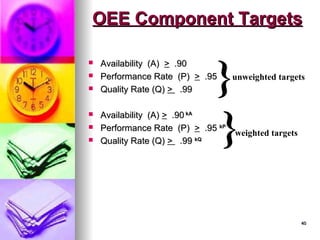
Weightingson A, P, and Q
Weightings on A, P, and Q
In many instances Availability, Performance rate and Quality
rate are
not considered to be equal in importance. Instead they are
weighted
differently. For example:
kA = .3 kP = .2 kQ = .5
OEE = A.3
x P.2
x Q.5
Compute OEE using these weights.
41
41
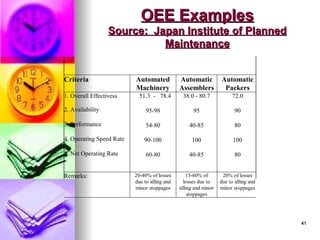
OEE Examples
OEE Examples
Source:Japan Institute of Planned
Source: Japan Institute of Planned
Maintenance
Maintenance
Criteria Automated
Machinery
Automatic
Assemblers
Automatic
Packers
1. Overall Effectivess
2. Availability
3. Performance
4. Operating Speed Rate
5. Net Operating Rate
51.3 - 78.4
95-98
54-80
90-100
60-80
38.0 - 80.7
95
40-85
100
40-85
72.0
90
80
100
80
Remarks: 20-40% of losses
due to idling and
minor stoppages
15-60% of
losses due to
idling and minor
stoppages
20% of losses
due to idling and
minor stoppages
42.
42
42
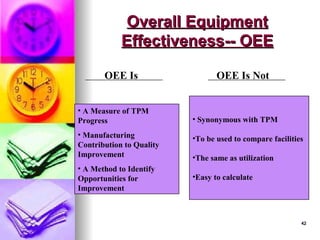
Overall Equipment
Overall Equipment
Effectiveness--OEE
Effectiveness-- OEE
OEE Is OEE Is Not
• A Measure of TPM
Progress
• Manufacturing
Contribution to Quality
Improvement
• A Method to Identify
Opportunities for
Improvement
• Synonymous with TPM
•To be used to compare facilities
•The same as utilization
•Easy to calculate
43.
MB 533 Shannon/FryOctober, 2000
43
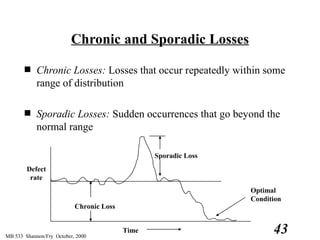
Chronic and Sporadic Losses
■ Chronic Losses: Losses that occur repeatedly within some
range of distribution
■ Sporadic Losses: Sudden occurrences that go beyond the
normal range
Sporadic Loss
Chronic Loss
Defect
rate
Time
Optimal
Condition
44.
44
44
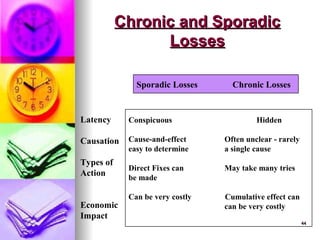
Chronic and Sporadic
Chronicand Sporadic
Losses
Losses
Sporadic Losses Chronic Losses
Latency
Causation
Types of
Action
Economic
Impact
Conspicuous Hidden
Cause-and-effect Often unclear - rarely
easy to determine a single cause
Direct Fixes can May take many tries
be made
Can be very costly Cumulative effect can
can be very costly
45.
45
45
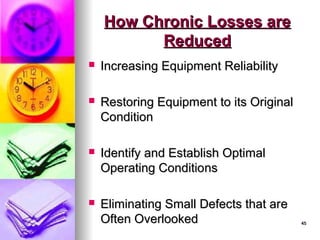
How Chronic Lossesare
How Chronic Losses are
Reduced
Reduced
Increasing Equipment Reliability
Increasing Equipment Reliability
Restoring Equipment to its Original
Restoring Equipment to its Original
Condition
Condition
Identify and Establish Optimal
Identify and Establish Optimal
Operating Conditions
Operating Conditions
Eliminating Small Defects that are
Eliminating Small Defects that are
Often Overlooked
Often Overlooked
46.
46
46
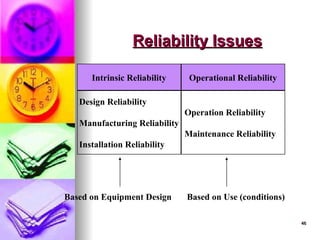
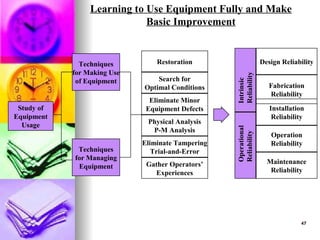
Reliability Issues
Reliability Issues
IntrinsicReliability Operational Reliability
Design Reliability
Manufacturing Reliability
Installation Reliability
Operation Reliability
Maintenance Reliability
Based on Equipment Design Based on Use (conditions)
47.
47
47
Learning to UseEquipment Fully and Make
Basic Improvement
Study of
Equipment
Usage
Techniques
for Making Use
of Equipment
Techniques
for Managing
Equipment
Restoration
Search for
Optimal Conditions
Eliminate Minor
Equipment Defects
Physical Analysis
P-M Analysis
Eliminate Tampering
Trial-and-Error
Gather Operators’
Experiences
Design Reliability
Fabrication
Reliability
Installation
Reliability
Operation
Reliability
Maintenance
Reliability
Intrinsic
Reliability
Operational
Reliability
48.
48
48
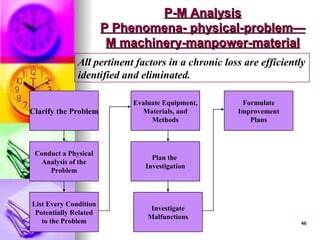
P-M Analysis
P-M Analysis
PPhenomena- physical-problem—
P Phenomena- physical-problem—
M machinery-manpower-material
M machinery-manpower-material
All pertinent factors in a chronic loss are efficiently
identified and eliminated.
Clarify the Problem
Conduct a Physical
Analysis of the
Problem
List Every Condition
Potentially Related
to the Problem
Evaluate Equipment,
Materials, and
Methods
Plan the
Investigation
Investigate
Malfunctions
Formulate
Improvement
Plans
49.
49
49
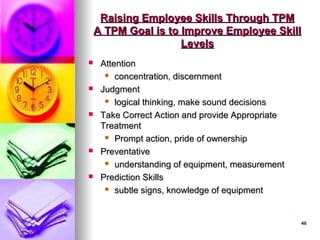
Raising Employee SkillsThrough TPM
Raising Employee Skills Through TPM
A TPM Goal is to Improve Employee Skill
A TPM Goal is to Improve Employee Skill
Levels
Levels
Attention
Attention
concentration, discernment
concentration, discernment
Judgment
Judgment
logical thinking, make sound decisions
logical thinking, make sound decisions
Take Correct Action and provide Appropriate
Take Correct Action and provide Appropriate
Treatment
Treatment
Prompt action, pride of ownership
Prompt action, pride of ownership
Preventative
Preventative
understanding of equipment, measurement
understanding of equipment, measurement
Prediction Skills
Prediction Skills
subtle signs, knowledge of equipment
subtle signs, knowledge of equipment
50.
50
50
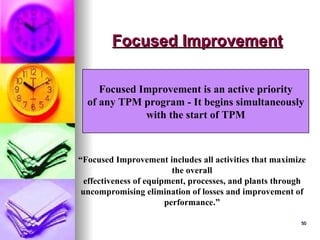
Focused Improvement
Focused Improvement
FocusedImprovement is an active priority
of any TPM program - It begins simultaneously
with the start of TPM
“Focused Improvement includes all activities that maximize
the overall
effectiveness of equipment, processes, and plants through
uncompromising elimination of losses and improvement of
performance.”
51.
51
51
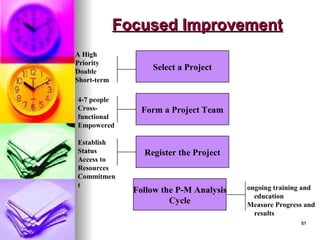
Focused Improvement
Focused Improvement
Selecta Project
Form a Project Team
Register the Project
Follow the P-M Analysis
Cycle
A High
Priority
Doable
Short-term
4-7 people
Cross-
functional
Empowered
Establish
Status
Access to
Resources
Commitmen
t ongoing training and
education
Measure Progress and
results
52.
52
52
Preparation by ImprovementTeams
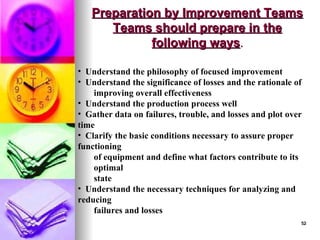
Preparation by Improvement Teams
Teams should prepare in the
Teams should prepare in the
following ways
following ways.
.
• Understand the philosophy of focused improvement
• Understand the significance of losses and the rationale of
improving overall effectiveness
• Understand the production process well
• Gather data on failures, trouble, and losses and plot over
time
• Clarify the basic conditions necessary to assure proper
functioning
of equipment and define what factors contribute to its
optimal
state
• Understand the necessary techniques for analyzing and
reducing
failures and losses
53.
53
53
Focused Improvement
Focused Improvement
Step-by-StepProcedure
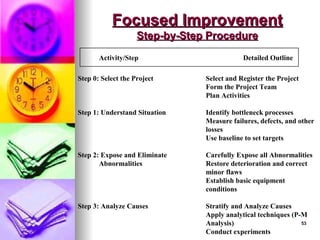
Step-by-Step Procedure
Activity/Step Detailed Outline
Step 0: Select the Project Select and Register the Project
Form the Project Team
Plan Activities
Step 1: Understand Situation Identify bottleneck processes
Measure failures, defects, and other
losses
Use baseline to set targets
Step 2: Expose and Eliminate Carefully Expose all Abnormalities
Abnormalities Restore deterioration and correct
minor flaws
Establish basic equipment
conditions
Step 3: Analyze Causes Stratify and Analyze Causes
Apply analytical techniques (P-M
Analysis)
Conduct experiments
54.
54
54
Focused Improvement
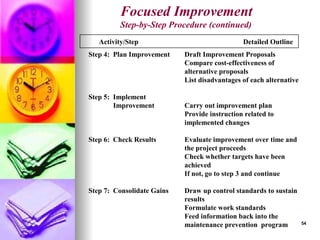
Step-by-Step Procedure(continued)
Activity/Step Detailed Outline
Step 4: Plan Improvement Draft Improvement Proposals
Compare cost-effectiveness of
alternative proposals
List disadvantages of each alternative
Step 5: Implement
Improvement Carry out improvement plan
Provide instruction related to
implemented changes
Step 6: Check Results Evaluate improvement over time and
the project proceeds
Check whether targets have been
achieved
If not, go to step 3 and continue
Step 7: Consolidate Gains Draw up control standards to sustain
results
Formulate work standards
Feed information back into the
maintenance prevention program
55.
55
55
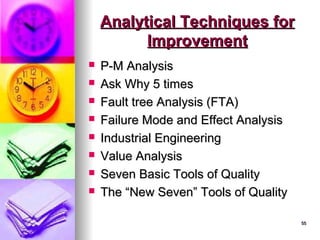
Analytical Techniques for
AnalyticalTechniques for
Improvement
Improvement
P-M Analysis
P-M Analysis
Ask Why 5 times
Ask Why 5 times
Fault tree Analysis (FTA)
Fault tree Analysis (FTA)
Failure Mode and Effect Analysis
Failure Mode and Effect Analysis
Industrial Engineering
Industrial Engineering
Value Analysis
Value Analysis
Seven Basic Tools of Quality
Seven Basic Tools of Quality
The “New Seven” Tools of Quality
The “New Seven” Tools of Quality
56.
56
56
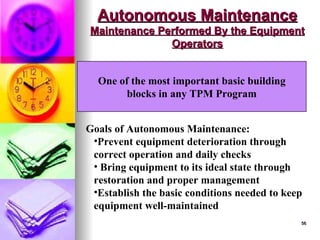
Autonomous Maintenance
Autonomous Maintenance
MaintenancePerformed By the Equipment
Maintenance Performed By the Equipment
Operators
Operators
One of the most important basic building
blocks in any TPM Program
Goals of Autonomous Maintenance:
•Prevent equipment deterioration through
correct operation and daily checks
• Bring equipment to its ideal state through
restoration and proper management
•Establish the basic conditions needed to keep
equipment well-maintained
57.
57
57
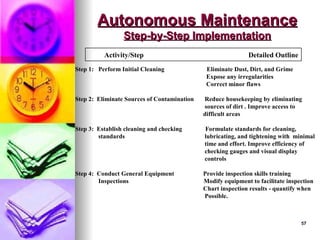
Autonomous Maintenance
Autonomous Maintenance
Step-by-StepImplementation
Step-by-Step Implementation
Activity/Step Detailed Outline
Step 1: Perform Initial Cleaning Eliminate Dust, Dirt, and Grime
Expose any irregularities
Correct minor flaws
Step 2: Eliminate Sources of Contamination Reduce housekeeping by eliminating
sources of dirt . Improve access to
difficult areas
Step 3: Establish cleaning and checking Formulate standards for cleaning,
standards lubricating, and tightening with minimal
time and effort. Improve efficiency of
checking gauges and visual display
controls
Step 4: Conduct General Equipment Provide inspection skills training
Inspections Modify equipment to facilitate inspection
Chart inspection results - quantify when
Possible.
58.
58
58
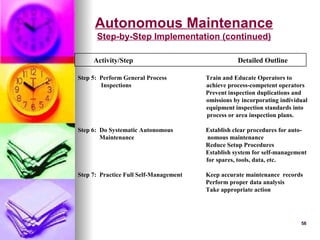
Autonomous Maintenance
Step-by-Step Implementation(continued)
Activity/Step Detailed Outline
Step 5: Perform General Process Train and Educate Operators to
Inspections achieve process-competent operators
Prevent inspection duplications and
omissions by incorporating individual
equipment inspection standards into
process or area inspection plans.
Step 6: Do Systematic Autonomous Establish clear procedures for auto-
Maintenance nomous maintenance
Reduce Setup Procedures
Establish system for self-management
for spares, tools, data, etc.
Step 7: Practice Full Self-Management Keep accurate maintenance records
Perform proper data analysis
Take appropriate action
59.
59
59
Necessary Accomplishments for
NecessaryAccomplishments for
Process-Competent Operators
Process-Competent Operators
Level 1:
Level 1:
Understand Process Performance and Function
Understand Process Performance and Function
Operates Process Correctly
Operates Process Correctly
Level 2:
Level 2:
Understands the properties of the materials handled
Understands the properties of the materials handled
Performs correct adjustment and settings
Performs correct adjustment and settings
Level 3:
Level 3:
Detects abnormalities promptly
Detects abnormalities promptly
Takes emergency action against abnormalities
Takes emergency action against abnormalities
Level 4:
Level 4:
Recognizes sign of abnormality
Recognizes sign of abnormality
Deal with abnormalities correctly
Deal with abnormalities correctly
Performs periodic overhaul checking and parts
Performs periodic overhaul checking and parts
replacement
replacement
60.
60
60
Keys to Successful
Keysto Successful
Autonomous Maintenance
Autonomous Maintenance
Introductory Education and Training
Introductory Education and Training
TPM Objectives, TPM Benefits, TPM Overview
TPM Objectives, TPM Benefits, TPM Overview
Cooperation Between Departments and Shifts
Cooperation Between Departments and Shifts
Consensus agreement on how to support TPM
Consensus agreement on how to support TPM
and AM
and AM
Group Activities
Group Activities
small groups with leadership from shop floor to
small groups with leadership from shop floor to
management
management
AM is not voluntary
AM is not voluntary
mandatory and necessary
mandatory and necessary
management must provide leadership and
management must provide leadership and
support
support
61.
61
61
Keys to SuccessfulAM
Keys to Successful AM
(continued)
(continued)
Practice
Practice
practical application versus conceptual understanding
practical application versus conceptual understanding
Progressive Education and Training
Progressive Education and Training
gradual skill development - step-by-step - as needed
gradual skill development - step-by-step - as needed
Aim for Measurable Results
Aim for Measurable Results
clear, appropriate measures (and goals)
clear, appropriate measures (and goals)
Operators Should Determine Standards to Follow
Operators Should Determine Standards to Follow
operators set standards and criteria for maintenance
operators set standards and criteria for maintenance
consistent with organizational objectives
consistent with organizational objectives
Management Should Audit the AM Progress
Management Should Audit the AM Progress
provide guidance, support and critique
provide guidance, support and critique
62.
62
62
Keys to SuccessfulAM
Keys to Successful AM
(continued)
(continued)
Use Model Projects
Use Model Projects
Use as examples for the rest of the
Use as examples for the rest of the
organization
organization
Correct Equipment Problems Promptly
Correct Equipment Problems Promptly
Maintenance department must react
Maintenance department must react
quickly to fix problems uncovered by AM
quickly to fix problems uncovered by AM
activities - will require commitment and
activities - will require commitment and
appropriate staffing
appropriate staffing
Take Time to Perfect AM
Take Time to Perfect AM
Don’t rush the process - make sure the
Don’t rush the process - make sure the
skills are there
skills are there
63.
63
63
Measures of Preventive
Measuresof Preventive
Maintenance Results
Maintenance Results
Downtime Trend
Downtime Trend
Operating Rate
Operating Rate
Failure Frequency
Failure Frequency
Failure Severity (length of failure
Failure Severity (length of failure
downtime)
downtime)
Maintenance Time per Incident
Maintenance Time per Incident
Quality Defect Rate
Quality Defect Rate
Failure Costs
Failure Costs
Emergency Repair Time
Emergency Repair Time
Ratio of Maintenance Cost to Unit
Ratio of Maintenance Cost to Unit
Production Cost
Production Cost
64.
64
64
IMPLEMENTATION
IMPLEMENTATION
SUMMARY OF PM
SUMMARYOF PM
Step 1:
Step 1: Evaluate Equipment and Understand
Evaluate Equipment and Understand
Current Conditions.
Current Conditions.
Step 2:
Step 2: Restore Deterioration and Correct
Restore Deterioration and Correct
Weaknesses.
Weaknesses.
Step 3:
Step 3: Build an Appropriate Information
Build an Appropriate Information
System.
System.
Step 4:
Step 4: Build a Periodic Maintenance System
Build a Periodic Maintenance System
Step 5:
Step 5: Build a Predictive Maintenance
Build a Predictive Maintenance
System.
System.
Step 6:
Step 6: Evaluate the Preventive Maintenance
Evaluate the Preventive Maintenance
System.
System.
Like everything associated with TPM, successful
implementation of a
preventive maintenance system will take time and support.
65.
65
65
BREAKDOWN
BREAKDOWN
MAINTENANCE
MAINTENANCE
The riskof a breakdown can be greatly
The risk of a breakdown can be greatly
reduced by an effective preventive
reduced by an effective preventive
maintenance program.
maintenance program.
The major approaches used to deal with
The major approaches used to deal with
breakdowns are:-
breakdowns are:-
Standby or backup equipment can be quickly
Standby or backup equipment can be quickly
pressed into service.
pressed into service.
Inventories of spare parts.
Inventories of spare parts.
Operators who are able to perform at least
Operators who are able to perform at least
minor repairs on their equipment.
minor repairs on their equipment.
Repair people who are well trained and readily
Repair people who are well trained and readily
available to diagnose and correct problems with
available to diagnose and correct problems with
equipment.
equipment.
66.
66
66
BREAKDOWN
BREAKDOWN
MAINTENANCE
MAINTENANCE
Breakdown programsare most
Breakdown programs are most
effective when they take into
effective when they take into
account the degree of
account the degree of
importance a piece of
importance a piece of
equipment has in the production
equipment has in the production
system
system
The ability of the system to do
The ability of the system to do
without it for a period of time.
without it for a period of time.
67.
67
67
Review of Equipment
Reviewof Equipment
Maintenance
Maintenance
The Review of Equipment Maintenance (REM) is an
The Review of Equipment Maintenance (REM) is an
incremental approach, designed to deliver financially
incremental approach, designed to deliver financially
driven results at minimum cost and time. It provides
driven results at minimum cost and time. It provides
optimum results when a review of equipment maintenance
optimum results when a review of equipment maintenance
is required to ensure that:
is required to ensure that:
The most effective maintenance plan is adopted
The most effective maintenance plan is adopted
Preventive, scheduled, design put and on-failure
Preventive, scheduled, design put and on-failure
maintenance are integrated into a cohesive strategy
maintenance are integrated into a cohesive strategy
The maintenance plan needs to respond to changes in
The maintenance plan needs to respond to changes in
plant operation
plant operation
The review may also be required to introduce a new
The review may also be required to introduce a new
technique, such as condition monitoring, or to adjust
technique, such as condition monitoring, or to adjust
changes in maintenance resources. Typically REM
changes in maintenance resources. Typically REM
requires only 30-50% of the resource input that would be
requires only 30-50% of the resource input that would be
required for RCM, while achieving similar results.
required for RCM, while achieving similar results.
68.
68
68
Review of Equipment
Reviewof Equipment
Maintenance
Maintenance
REM focuses primarily
REM focuses primarily
on maintenance
on maintenance
strategy arising from
strategy arising from
business drivers, such
business drivers, such
as demand and
as demand and
operating patterns and
operating patterns and
can be considered in
can be considered in
two major stages:
two major stages:
Reliability and
Reliability and
criticality analysis
criticality analysis
Maintenance review
Maintenance review
69.
69
69
The output ofa REM study is an
The output of a REM study is an
optimized maintenance plan, where
optimized maintenance plan, where
the appropriate risk based defence
the appropriate risk based defence
of the asset is defined. This takes in
of the asset is defined. This takes in
to account the goals of the
to account the goals of the
organisation, the criticality of the
organisation, the criticality of the
asset, the resources available, and
asset, the resources available, and
the level of technology employed by
the level of technology employed by
the organization. This is a working
the organization. This is a working
document, which can be translated
document, which can be translated
into the physical reality of conducting
into the physical reality of conducting
operational maintenance.
operational maintenance.
Review of Equipment
Review of Equipment
Maintenance
Maintenance
70.
70
70
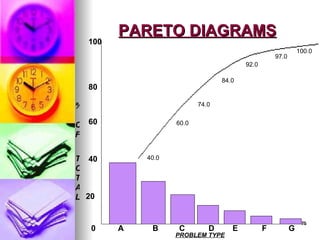
PARETO DIAGRAMS
PARETO DIAGRAMS
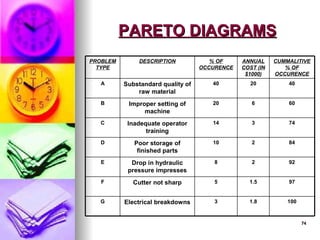
Pareto diagram is an important
Pareto diagram is an important
quality tool used in prioritizing &
quality tool used in prioritizing &
deciding the course of action in
deciding the course of action in
maintenance management.
maintenance management.
Of all the problems that occur, only a
Of all the problems that occur, only a
few are quite frequent/costly.
few are quite frequent/costly.
The others seldom occur/cost less.
The others seldom occur/cost less.
The problems are grouped and
The problems are grouped and
labeled as
labeled as vital few and trivial many.
vital few and trivial many.
71.
71
71
PARETO DIAGRAMS
PARETO DIAGRAMS
Pareto principle lends support to
Pareto principle lends support to
the 80/20 rule.
the 80/20 rule.
Pareto diagrams help quickly
Pareto diagrams help quickly
identify the critical areas for
identify the critical areas for
management’s attention.
management’s attention.
72.
72
72
STEPS FOR CONSTRUCTING
STEPSFOR CONSTRUCTING
PARETO DIAGRAMS
PARETO DIAGRAMS
STEP 1
STEP 1
Decide on data categorization system by problem type,
Decide on data categorization system by problem type,
type of conformity (critical, major, minor) or whatever else
type of conformity (critical, major, minor) or whatever else
seems appropriate.
seems appropriate.
STEP 2
STEP 2
Determine how relative importance is to be judged i.e.,
Determine how relative importance is to be judged i.e.,
whether it should be based on cost or frequency of
whether it should be based on cost or frequency of
occurrence.
occurrence.
STEP 3
STEP 3
Rank the categories from most important to least
Rank the categories from most important to least
important.
important.
STEP 4
STEP 4
Compute the cumulative frequency of the data categories
Compute the cumulative frequency of the data categories
in their chosen order.
in their chosen order.
STEP 5
STEP 5
Plot a bar graph showing the relative problem of each
Plot a bar graph showing the relative problem of each
problem area in descending order.
problem area in descending order.
73.
73
73
STEP 6
STEP6
Identify the vital few that
Identify the vital few that
deserve immediate attention.
deserve immediate attention.
STEPS FOR CONSTRUCTING
STEPS FOR CONSTRUCTING
PARETO DIAGRAMS
PARETO DIAGRAMS
74.
74
74
PARETO DIAGRAMS
PARETO DIAGRAMS
100
1.8
3
Electricalbreakdowns
G
97
1.5
5
Cutter not sharp
F
92
2
8
Drop in hydraulic
pressure impresses
E
84
2
10
Poor storage of
finished parts
D
74
3
14
Inadequate operator
training
C
60
6
20
Improper setting of
machine
B
40
20
40
Substandard quality of
raw material
A
CUMMALITIVE
% OF
OCCURENCE
ANNUAL
COST (IN
$1000)
% OF
OCCURENCE
DESCRIPTION
PROBLEM
TYPE