By
Karthikeyan.I
Asst.Professor
Department of Mechanical Engineering
Sri Ramakrishna Engineering College,Cbe
Maintenance Engineering
(ME6012)
OBJECTIVES
To enable the student to understand the principles, functions
and practices adapted in industry for the successful
management of maintenance activities.
To explain the different maintenance categories like
Preventive maintenance, condition monitoring and repair of
machine elements.
To illustrate some of the simple instruments used for
condition monitoring in industry.
OUTCOMES
Upon completion of the programme, the students can able
to implement the maintenance function and different
practices in industries for the successful management of
maintenance activities
To identify the different maintenance categories like
Preventive maintenance, condition monitoring and repair of
machine elements
TEXT BOOKS:
1. Srivastava S.K., “Industrial Maintenance Management”,
S. Chand and Co., 1981
2. Venkataraman .K “Maintancence Engineering and
Management”, PHI Learning, Pvt. Ltd., 2007
REFERENCES:
1. Bhattacharya S.N., “Installation, Servicing and
Maintenance”, S. Chand and Co., 1995
2. White E.N., “Maintenance Planning”, I Documentation,
Gower Press, 1979.
3. Garg M.R., “Industrial Maintenance”, S. Chand & Co.,
1986.
4. Higgins L.R., “Maintenance Engineering Hand book”, 5th
Edition, McGraw Hill, 1988.
5. Armstrong, “Condition Monitoring”, BSIRSA, 1988.
6. Davies, “Handbook of Condition Monitoring”, Chapman &
Hall, 1996. 6. “Advances in Plant Engineering and
Management”, Seminar Proceedings - IIPE, 1996.
Unit 1-Principles and Practices of
Maintenance Planning
Basic Principles of maintenance planning – Objectives and
principles of planned maintenance activity – Importance and
benefits of sound Maintenance systems – Reliability and
machine availability – MTBF, MTTR and MWT – Factors of
availability – Maintenance organization – Maintenance
economics
Maintenance Engineering
 It is the art that is intended to retain an machine or an
equipment or restore it to, a state in which it can perform a
required function or an operation.
 It is the discipline and profession of applying engineering
concepts to the optimization of equipments, procedures to
achieve better reliability and availability of equipments.
 It is the art, science and philosophy that aides in increased
productivity and has become the most important component
of plant maintenance.
 In general,
All actions necessary for retaining an item, or restoring to
it, a serviceable condition, include servicing, repair,
modification, overhaul, inspection and condition
verification.
 Increase availability of a system.
 Keep system’s equipment in working order are the main
role of maintenance Engineering.
It’s purpose
 The main purpose of maintenance in an industrial
perspective is to reduce the business risks.
 Production capacity, productivity and business profit mainly
depends on maintenance operations.
 Its main purpose is to support ,configure, diagnose , repair,
update and mange a equipment throughout it’s life cycle.
 In general maintaining all equipments at its full functionality
and helping productivity is the main function of maintenance
engineering.
1. Attempt to maximize performance of production
equipment efficiently and regularly.
2. Prevent breakdown or failures.
3. Minimize production loss from failures.
4. Increase reliability of the operating systems.
 With the increased complexity, Sophistication and
automation of the equipments and systems , a heavy
burden falls on maintenance engineers regarding the
quality and quantity of maintenance , maintenance aids,
documentation etc.,
 The current scenario is that today’s jobs and problems
cannot be solved with yesterday’s tools and techniques.
So continuous development is needed in maintenance
areas to tackle today’s need and also anticipated need
of tomorrow.
Principle Objectives in Maintenance
1. To achieve product quality and customer satisfaction
through adjusted and serviced equipment.
2. Maximize useful life of equipments.
3. Keep equipments safe and prevent from hazards.
4. Minimize frequency and severity of interruptions.
5. Maximize production capacity – through high utilization of
facility.
MAINTENANCE FACTS AND FIGURES
Some of the important facts and figures directly or indirectly
associated with engineering maintenance are as follows:
 Each year over $300 billion are spent on plant maintenance
and operations by U.S. industry, and it is estimated that
approximately 80% of this is spent to correct the chronic
failure of machines, systems, and people.
 In 1970, a British Ministry of Technology Working Party
report estimated that maintenance cost the United Kingdom
(UK) was approximately £3000 million annually.
 Annually, the cost of maintaining a military jet aircraft is around
$1.6 million; approximately 11% of the total operating cost for an
aircraft is spent on maintenance activities.
 The typical size of a plant maintenance group in a manufacturing
organization varied from 5 to 10% of the total operating force: in
1969, 1 to 17 persons, and in 1981, 1 to 12 persons.
 The U.S. Department of Defense is the steward of the world’s
largest dedicated infrastructure, with a physical plant valued at
approximately $570 billion on approximately 42,000 square miles
of land, i.e., roughly the size of the state of Virginia.
 The operation and maintenance budget request of the U.S.
Department of Defense for fiscal year 1997 was on the
order of $79 billion.
 Annually, the U.S. Department of Defense spends around
$12 billion for depot maintenance of weapon systems and
equipment: Navy (59%), Air Force (27%), Army (13%), and
others (1%).
 In 1968, it was estimated that better maintenance practices
in the U.K. could have saved approximately £300 million
annually of lost production due to equipment unavailability.
1.Maintenance Planning
 Maintenance planning consists of set of tasks of organizing
resources to carry out a job satisfactorily at reasonable
cost within a specified period of time.
It involves
 Assignment of jobs to the crew on the basis of job
scheduling.
 Also ensures methods to tackle emergency maintenance
 It ensures smooth operation of the system.
Main classification of planning in engineering system are as
follows,
1. Long range planning
2. Short range planning
3. Planning for immediate activity
1. Long Range planning : for a period of five years at least.
Involves capital budgeting, strategies and operational
programmers.
2. Short range: up to one year. Made to achieve short term
goals.
3. Immediate Activity Planning : it is done frequently whenever
required.
Objectives of maintenance planning
Some important objectives are
 Maximising production or increasing facilities availability
at the lowest cost and at the highest quality and safety
standards.
 Reducing breakdowns and emergency shutdowns.
 Optimising resources utilisation.
 Reducing downtime.
 Improving spares stock control.
 To keep time schedule of delivery to the customers.
 To control the cost of maintenance related activities.
 Improving equipment efficiency and reducing scrap rate.
 Minimising energy usage.
 Optimising the useful life of equipment.
 Identifying and implementing cost reductions.
 To provide effective and trained supervision.
Principles of Maintenance :
They are followed in a system to guide the staff to work
efficiently and effectively to achieve the overall objectives
of the maintenance system,
Main areas of work governed by this principles are
 Plant management in Maintenance work
 Production and maintenance objectives
 Establishment of work order and recording system
 Information based Decision making
 Adherence to planned maintenance strategy .
 Manpower for Maintenance
 Planning for maintenance functions
 Role of Spare parts
 Training.
Sound maintenance system-
importance
 Profit depends mainly on return on the investments.
 Higher investments- possible –machineries and
equipments in proper working condition.
Some benefits of sound maintenance are,
 Minimization of downtime
 Provide Adequate back up supply
 Extended life of equipment
 Increased reliability of the system
 Safety of the personal involved.
2.Machine Failures
Reliability
Reliability may be defined in several ways:
 The idea that an item is fit for a purpose with respect to
time.
 In the most practical sense: "Items that do not fail in use
are reliable" and "Items that do fail in use are not reliable".
 The capacity of a designed, produced or maintained item
to perform as required over time.
 The resistance to failure of an item over time.
 The probability of an item to perform a required
function under stated conditions for a specified
period of time.
 In line with the creation of safety cases for safety,
the goal is to provide a robust set of qualitative
and quantitative evidence that an item or system
will not contain unacceptable risk.
 The basic sorts of steps to take are to:
 First thoroughly identify as many as possible
reliability hazards (e.g. relevant System Failure
Scenarios item Failure modes, the basic Failure
mechanisms and root causes) by specific analysis
or tests.
 Propose mitigations by which the risks may be
lowered and controlled to an acceptable level.
 Select the best mitigations and get agreement
on final (accepted) Risk Levels, possible based
on cost-benefit analysis.
RELIABILITY THEORY
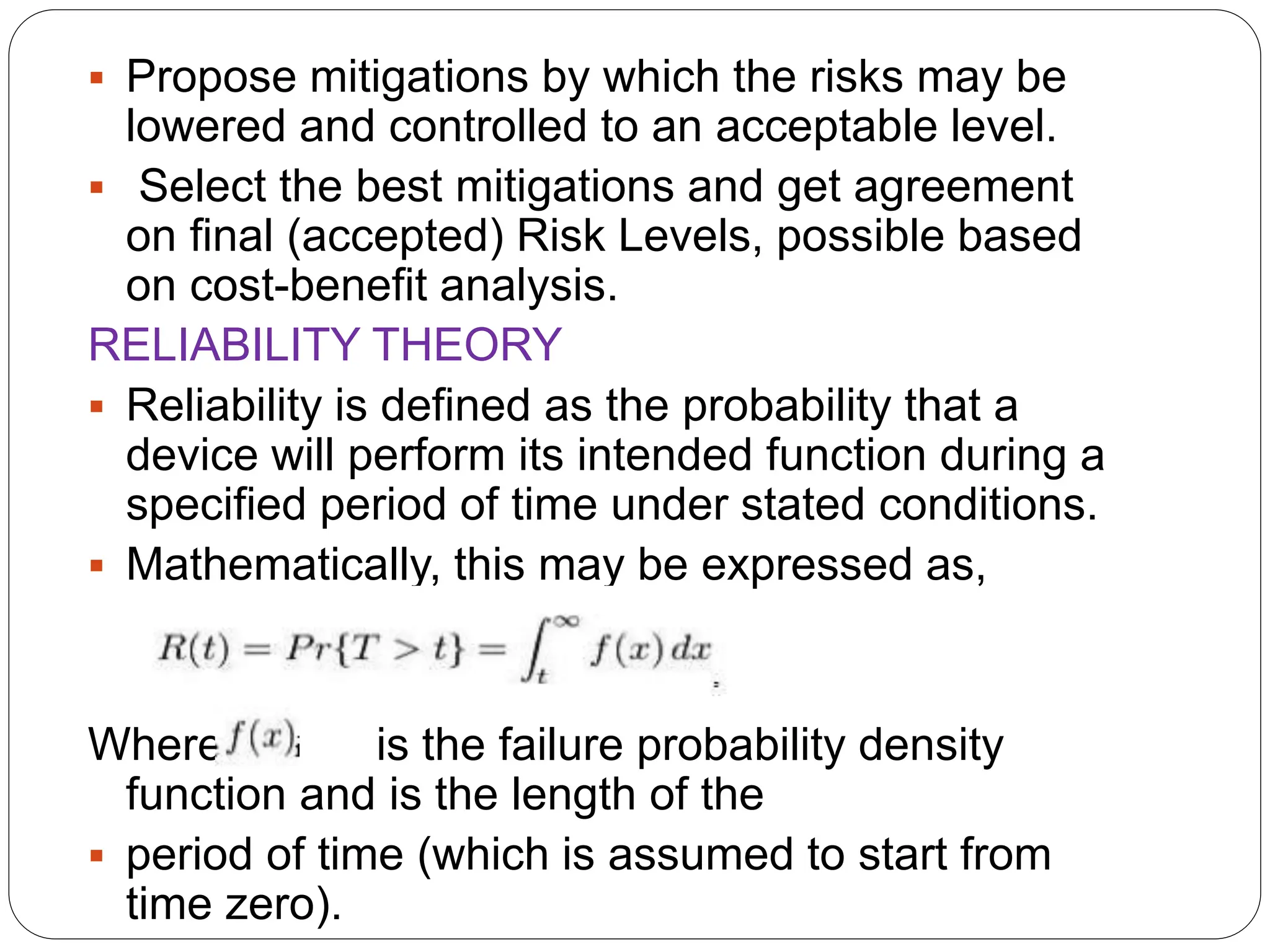
 Reliability is defined as the probability that a
device will perform its intended function during a
specified period of time under stated conditions.
 Mathematically, this may be expressed as,
Where is the failure probability density
function and is the length of the
 period of time (which is assumed to start from
time zero).
MEAN TIME BETWEEN FAILURES
 Mean time between failures (MTBF) is the predicted
elapsed time between inherent failures of a system
during operation. MTBF can be calculated as the
arithmetic mean (average) time between failures of a
system.
 The MTBF is often denoted by the Greek letter θ, or
 The MTBF can be defined in terms of the expected
value of the density function ƒ(t)
where ƒ is the density function of time until failure –
satisfying the standard requirement of density
functions
 MTBF value prediction is an important element in
the development of products. Reliability engineers /
design engineers, often utilize Reliability Software
to calculate products' MTBF according to various
methods/standards (MIL-HDBK-217F, Telcordia
SR332, Siemens Norm, FIDES,UTE 80-810
(RDF2000), etc.).
MTTR
 The M can stand for any of minimum, mean or
maximum, and the R can stand for any of recovery,
repair, respond, or restore.
 The most common, mean, is also subject to
interpretation, as there are many different ways in
which a mean can be calculated.
 Mean time to repair
 Mean time to recovery/Mean time to restore
 Mean time to respond
 Mean time to replace
 Mean time to repair (MTTR) is the average time
required to troubleshoot and repair failed equipment
and return it to normal operating conditions.
 It is a basic technical measure of the maintainability
of equipment and repairable parts.
 Maintenance time is defined as the time between the
start of the incident and the moment the system is
returned to production (i.e. how long the equipment
is out of production).
 This includes notification time, diagnostic time, fix
time, wait time (cool down), reassembly, alignment,
calibration, test time, back to production, etc..
 Mean time to repair ultimately reflects how well an
organization can respond to a problem and repair it.
 Expressed mathematically, it is the total
maintenance time divided by the total number of
maintenance actions over a specific period.
 Over the lifetime of an asset, each failure will vary
depending on the severity of the issue.
 Some issues will require a simple parts swap, while
others could take days to diagnose and repair.
 Prediction of the number of hours that a system or
component will be unavailable whilst undergoing
maintenance is of vital importance in reliability and
availability studies.
 Mean time to repair yields a lot of information that
can help reliability engineers make informed
decisions such as repair or replace, hire, optimize
maintenance schedules,
Mean Waiting Time
The mean waiting period for a actual repair to begin is
known as mean waiting time.
Maintenance Action Rate
It is the number of maintenance action that can be
carried out on an equipment per hour.
µ = 1÷MTTR
3. Maintainability , Availability:
Maintainability :
 It is can be defined as the probability that a
system or a unit will be restored to specific
working conditions within a given period, when
maintenance action is taking place.
- As per accordance with prescribed procedures
and resources.
- It includes minimum cost as well as accuracy.
4.Availability
 It is the ratio of the time at which equipment is
available for the designated operations to the total
time of operation and maintenance of the equipment.
- Ratio of equipment uptime to downtime over a
specified period of time.
Availability Classifications
 Instantaneous (or Point) Availability
 Average Uptime Availability (or Mean Availability)
 Steady State Availability
 Inherent Availability
 Achieved Availability
 Operational Availability
Instantaneous or Point Availability, A(t)
 Instantaneous (or point) availability is the probability
that a system (or component) will be operational (up
and running) at a specific time, t.
 This classification is typically used in the military, as
it is sometimes necessary to estimate the availability
of a system at a specific time of interest (e.g., when
a certain mission is to happen).
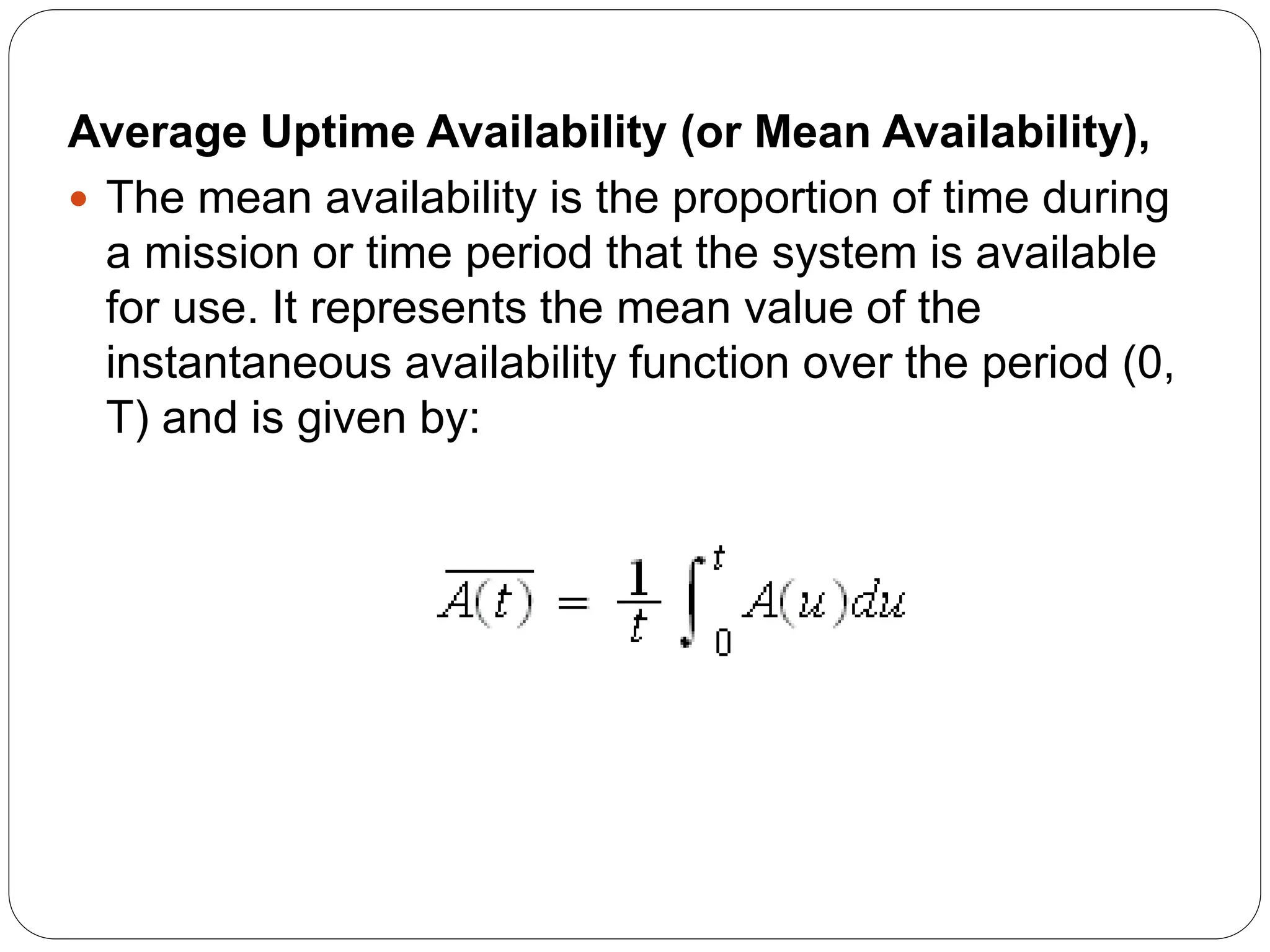
Average Uptime Availability (or Mean Availability),
 The mean availability is the proportion of time during
a mission or time period that the system is available
for use. It represents the mean value of the
instantaneous availability function over the period (0,
T) and is given by:
Steady State Availability, A(∞)
 The steady state availability of the system is the
limit of the availability function as time tends to
infinity. Steady state availability is also called the
long-run or asymptotic availability. A common
equation for the steady state availability found in
literature is:
Inherent Availability :
It is the probability that a system or equipment will
operate satisfactorily when used under a prescribed
conditions without any scheduled or preventive
maintenance at any given time.
Inherent Availability= MTBM/MTBM+MTTR
Achieved Availability :
It is the probability that a system or equipment will
operate satisfactorily when used under a prescribed
conditions with any scheduled or preventive
maintenance at any given time.
Achieved Availability = MTBM/MTBM+M
Operational Availability :
In industry, a certain downtime always take place
due to supplies or administrative works etc.,
It is the probability that a system or equipment will
operate satisfactorily when used under a prescribed
conditions in an actual environment without any
scheduled or preventive maintenance at any given
time.
Operational Availability= MTBM/MTBM+MDT
4. Maintenance Organisation
It’s Classification are
DeCentralized Maintenance:
 This model is the most common.
 Here, you have a self-standing facility management
organization and structure for each of the major business
groups:
 The Central Plant, which handles major heating and
cooling, electrical, and possibly the roads, grounds, and
sidewalks;
 A Central Facility Group, which handles classroom and
office buildings, including electrical, HVAC, plumbing, and
structures,
 These individual groups often have separate capital
programs, purchasing and supply systems, fleets,
maintenance teams and contractors.
 They typically enjoy higher customer satisfaction than do
those in a centralized structure, as well as a better team
attitude and ownership
Centralized :
 The centralized organization brings all of the facility
management and maintenance groups into one
organization, so control of standards and
procedures becomes consistent across the entire
organization.
 A centralized approach undoubtedly is more
efficient, the quality of repairs and installations is
higher, and more consistency exists in the approach
to asset and equipment reliability.
 The most common negative is typically a reduction
in customer satisfaction. To address this challenge,
the leadership team of the program and process
must be very strong and have best-in-class
performance measures in place so everyone can
easily see even the most subtle changes in
performance.
 Partially Localized/ Cetnralized Planning:
Suppose there five plants in an organization. For
three plants they have central planning plant and for
rest other two they have local planning. Such type of
Maintenance Planning is known as Partially
Centralized Maintenance Planning.
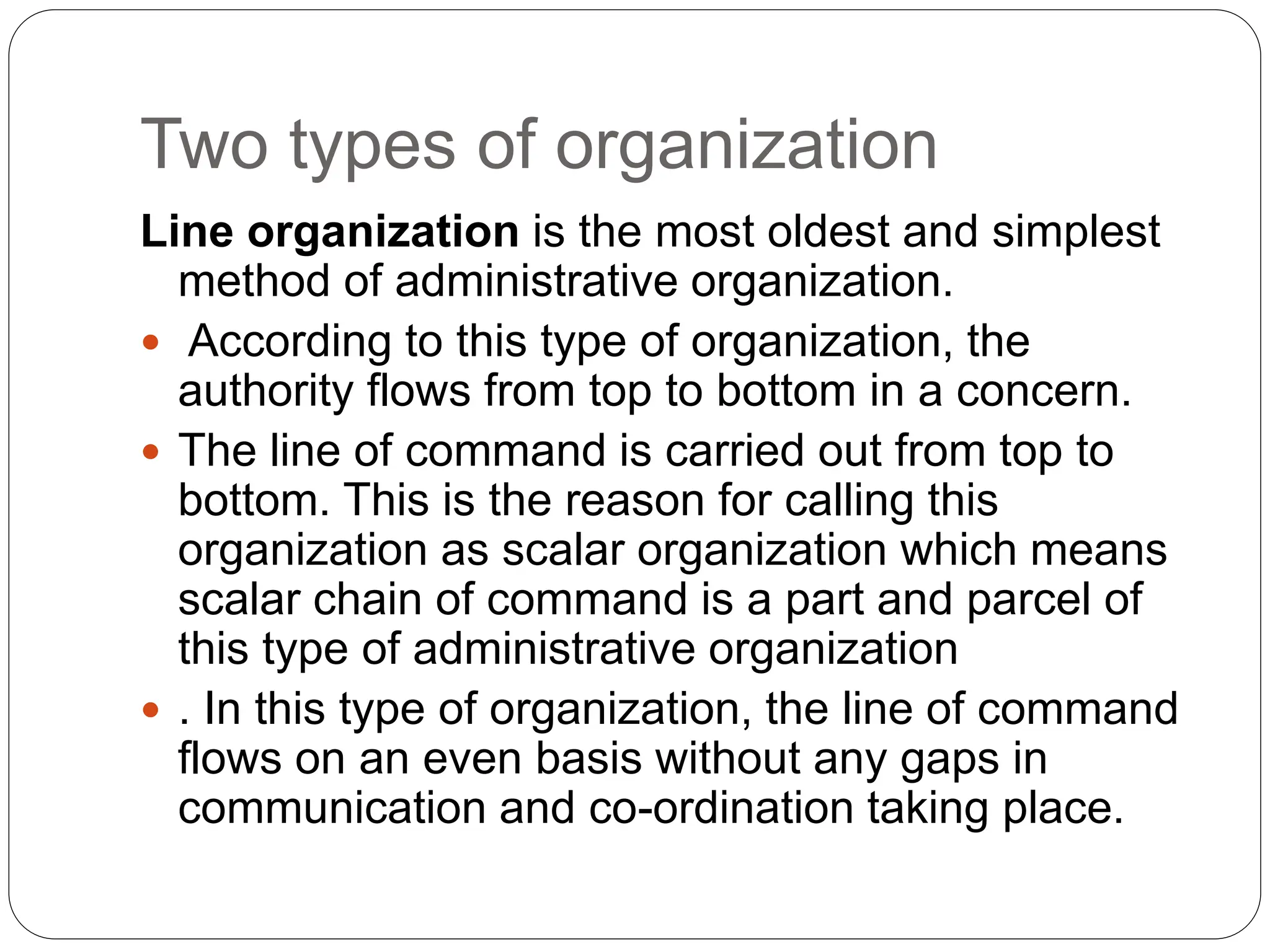
Two types of organization
Line organization is the most oldest and simplest
method of administrative organization.
 According to this type of organization, the
authority flows from top to bottom in a concern.
 The line of command is carried out from top to
bottom. This is the reason for calling this
organization as scalar organization which means
scalar chain of command is a part and parcel of
this type of administrative organization
 . In this type of organization, the line of command
flows on an even basis without any gaps in
communication and co-ordination taking place.
Features of Line Organization
 It is the most simplest form of organization.
 Line of authority flows from top to bottom.
 Specialized and supportive services do not take
place in these organization.
 Unified control by the line officers can be maintained
since they can independently take decisions in their
areas and spheres.
 This kind of organization always helps in bringing
efficiency in communication and bringing stability to
a concern.
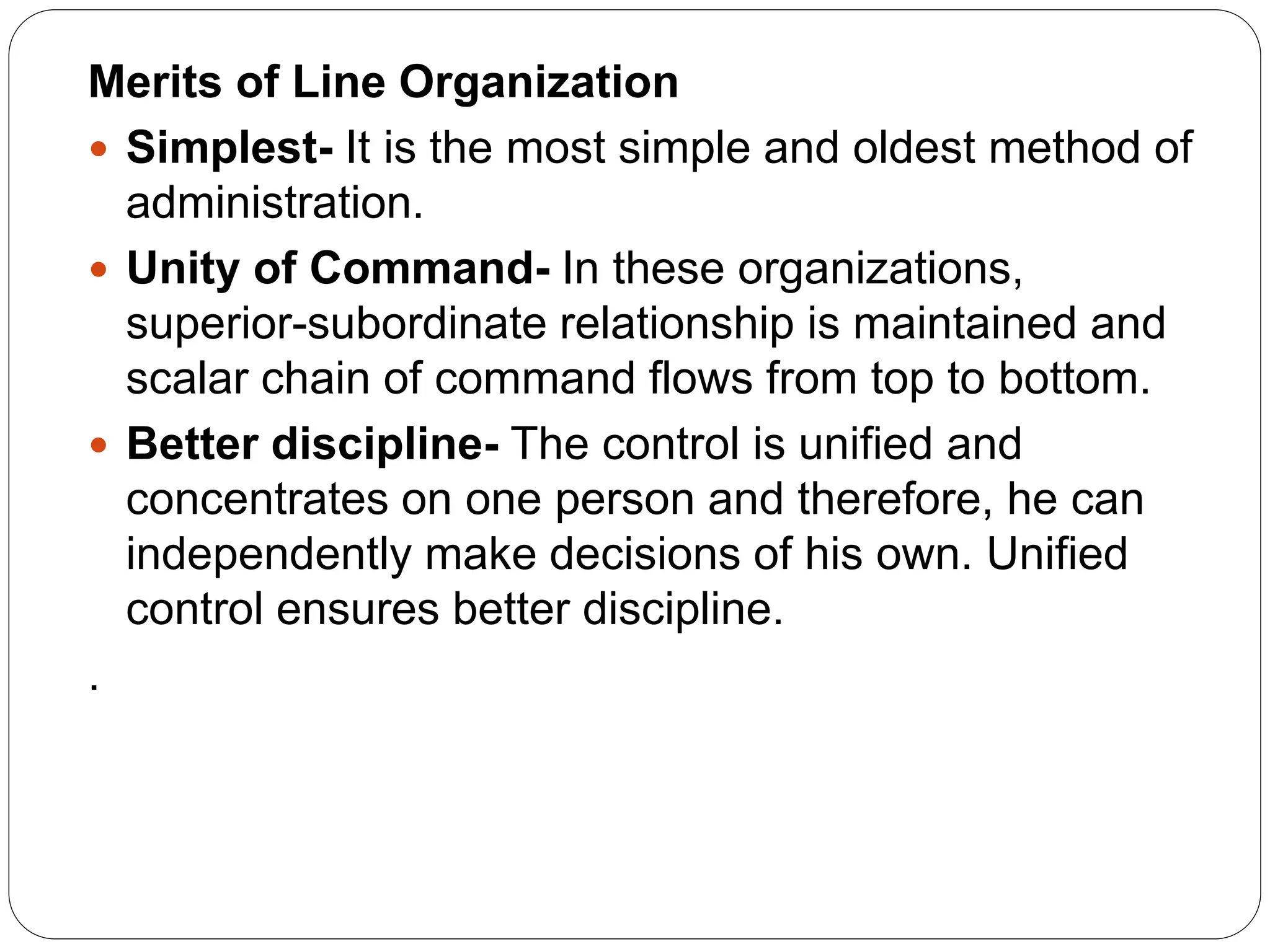
Merits of Line Organization
 Simplest- It is the most simple and oldest method of
administration.
 Unity of Command- In these organizations,
superior-subordinate relationship is maintained and
scalar chain of command flows from top to bottom.
 Better discipline- The control is unified and
concentrates on one person and therefore, he can
independently make decisions of his own. Unified
control ensures better discipline.
.
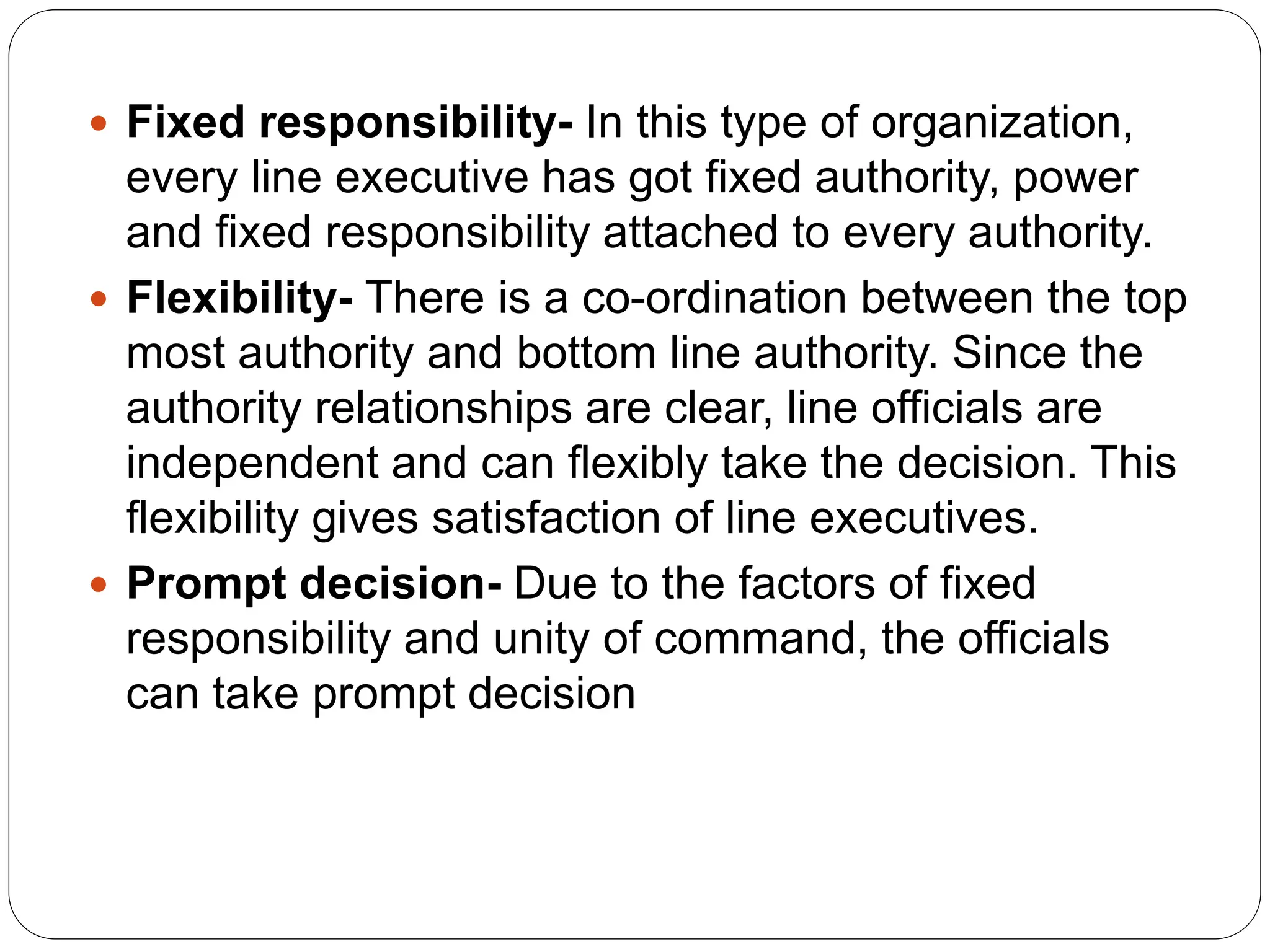
 Fixed responsibility- In this type of organization,
every line executive has got fixed authority, power
and fixed responsibility attached to every authority.
 Flexibility- There is a co-ordination between the top
most authority and bottom line authority. Since the
authority relationships are clear, line officials are
independent and can flexibly take the decision. This
flexibility gives satisfaction of line executives.
 Prompt decision- Due to the factors of fixed
responsibility and unity of command, the officials
can take prompt decision
 Over reliance- The line executive’s decisions are
implemented to the bottom. This results in over-
relying on the line officials.
 Lack of specialization- A line organization flows in
a scalar chain from top to bottom and there is no
scope for specialized functions. For example, expert
advices whatever decisions are taken by line
managers are implemented in the same way.
 Inadequate communication- The policies and
strategies which are framed by the top authority are
carried out in the same way. This leaves no scope
for communication from the other end. The
complaints and suggestions of lower authority are
not communicated back to the top authority. So
there is one way communication.
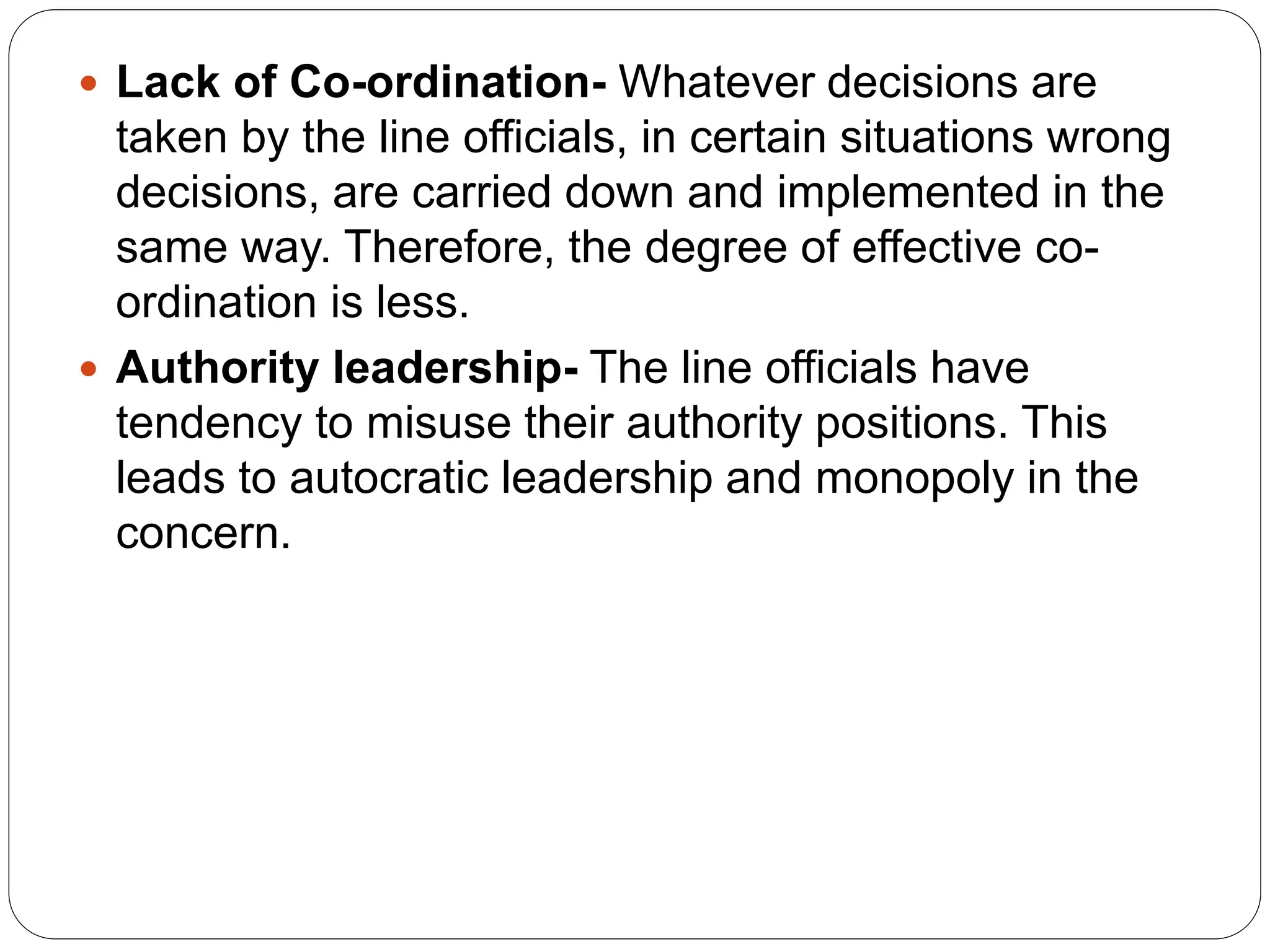
 Lack of Co-ordination- Whatever decisions are
taken by the line officials, in certain situations wrong
decisions, are carried down and implemented in the
same way. Therefore, the degree of effective co-
ordination is less.
 Authority leadership- The line officials have
tendency to misuse their authority positions. This
leads to autocratic leadership and monopoly in the
concern.
Line and staff organization
 Line and staff organization is a modification of line
organization and it is more complex than line
organization.
 According to this administrative organization,
specialized and supportive activities are attached to
the line of command by appointing staff supervisors
and staff specialists who are attached to the line
authority.
 The power of command always remains with the
line executives and staff supervisors guide, advice
and council the line executives. Personal Secretary
to the Managing Director is a staff official.
It’s Benefits :
 Relief to line of executives- In a line and staff
organization, the advice and counseling which is
provided to the line executives divides the work between
the two. The line executive can concentrate on the
execution of plans and they get relieved of dividing their
attention to many areas.
 Expert advice- The line and staff organization facilitates
expert advice to the line executive at the time of need.
The planning and investigation which is related to
different matters can be done by the staff specialist and
line officers can concentrate on execution of plans.
 Benefit of Specialization- Line and staff through division
of whole concern into two types of authority divides the
enterprise into parts and functional areas. This way every
officer or official can concentrate in its own area.
 Better co-ordination- Line and staff organization
through specialization is able to provide better decision
making and concentration remains in few hands. This
feature helps in bringing co-ordination in work as every
official is concentrating in their own area.
 Benefits of Research and Development- Through the
advice of specialized staff, the line executives, the line
executives get time to execute plans by taking productive
decisions which are helpful for a concern. This gives a
wide scope to the line executive to bring innovations and
go for research work in those areas. This is possible due
to the presence of staff specialists.
 Training- Due to the presence of staff specialists and
their expert advice serves as ground for training to line
officials. Line executives can give due concentration to
their decision making. This in itself is a training ground for
 Balanced decisions- The factor of specialization
which is achieved by line staff helps in bringing co-
ordination. This relationship automatically ends up
the line official to take better and balanced decision.
 Unity of action- Unity of action is a result of unified
control. Control and its effectivity take place when
co-ordination is present in the concern. In the line
and staff authority all the officials have got
independence to make decisions. This serves as
effective control in the whole enterprise
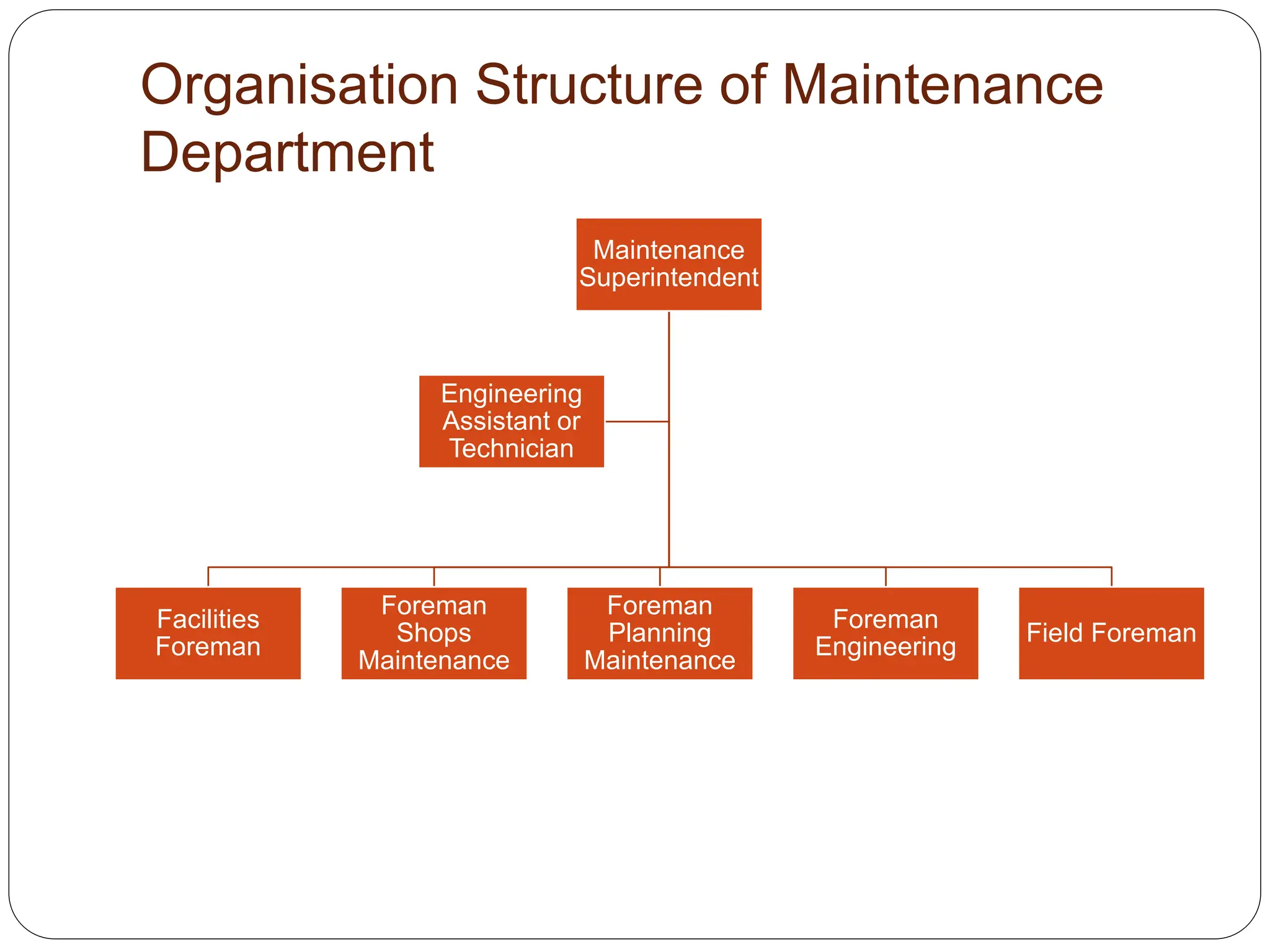
Organisation Structure of Maintenance
Department
Maintenance
Superintendent
Facilities
Foreman
Foreman
Shops
Maintenance
Foreman
Planning
Maintenance
Foreman
Engineering
Field Foreman
Engineering
Assistant or
Technician
Facilities Foreman
 Air Conditioning
 Water Supply
 Steam
 Power Required.
Shops Maintenance
 Maintenance of Machines/Equiments
 Repair
 Lubrication
Foreman Planning and Maintenance
 Work order system
 Scheduling
 Backlogs Control
 Performance Reports
Field Foreman
 Buildings
 Yards
 Fire Protection
 Waste Disposal
5. Maintenance Economics
 Life Cycle Cost Analysis
The factors to be considered in the purchase of
equipment for industries include the cost, quality,
performance and maintenance requirements.
Life cycle costing is the cost analysis for the
equipment over a span of time which includes the
capital cost, operating cost and maintenance
costs.
It leads to selection of proper and economically
viable equipment.
 Maintenance cost :
-difficult to measure due to random nature of failures.
-records on maintenance history can be used .
Component of Maintenance Cost :
Fixed cost and Variable cost :
Fixed includes the cost of support facilities, including
the maintenance staff.
Variable cost includes the consumption of spare parts,
components replacements etc.,
 All buildings & capital assets go through a life cycle
process during the course of their life.
 In the asset life cycle class, there are three different
phases identified based on studies.
 Almost all the equipment, that operates under
normal distribution curve (over 99.0%) goes through
the following three phases. As per Six Sigma &
Statistical studies, 95% of the universal processes
go under normal distribution curve (bell curve).
 You can take up any process like making a
lemonade and selling on the street or buying a car,
the experiences remain the same and all these
activities fall under bell curve.
 Studies from top universities in the world on plant
maintenance have revealed that majority of the
asset / equipment maintenance issues are caused
due to dirt & dust, which is single most key
constituent in the equipment break downs; followed
by frictional issues & failure of materials.
 But the mother of all maintenance failures is human
error, which causes 80% of the breakdowns in any
organization, for the equipment failure
 Phase-1 "Start-Up Cycle": Failures occur on
materials, workmanship, installation, and/or operator
mis-handling on new equipment. Some of the costs
are partially covered by equipment warranty. By the
nature of this life cycle, there is a lack of historical
data.
 The failures are very hard to predict or plan for, and it
is difficult to know which parts / components to be
kept in stock (for back filling in case of failure)
 Preventative Maintenance Standards are developed
in this cycle. This period could last from one day to
several years on a complex system. Be vigilant in
monitoring the mis-application (the wrong machine
for the right job), inadequate engineering and
manufacturer deficiencies.
 Phase-2 "Wealth Cycle": This cycle is where the
organization makes money on the useful output of
the machine, building, or other asset. This cycle is
also called the “usage cycle”.
 Phase-3 "Breakdown Cycle": This is the cycle that
organizations find themselves 'in', when they do not
follow a good Preventative Maintenance (PM)
practice. Phase-3 is characterized by wear out
failures, breakdowns, corrosion failures, fatigue,
downtime, and other general headaches
 Parts usage change as we move more deeply
into life cycle 3.
 The parts tend to be more in number, bigger,
more expensive, and harder to get.
 The goal of most maintenance operations is to
identify when an asset is slipping into this
Phase-3 and fix the problems. Fixing the
problem will result in the assets moving back to
life cycle 2, which is getting back to Wealth
Cycle mode.
End of unit 1

Maintenance Engineering, Principle of Maintenance

  • 1.
    By Karthikeyan.I Asst.Professor Department of MechanicalEngineering Sri Ramakrishna Engineering College,Cbe Maintenance Engineering (ME6012)
  • 2.
    OBJECTIVES To enable thestudent to understand the principles, functions and practices adapted in industry for the successful management of maintenance activities. To explain the different maintenance categories like Preventive maintenance, condition monitoring and repair of machine elements. To illustrate some of the simple instruments used for condition monitoring in industry.
  • 3.
    OUTCOMES Upon completion ofthe programme, the students can able to implement the maintenance function and different practices in industries for the successful management of maintenance activities To identify the different maintenance categories like Preventive maintenance, condition monitoring and repair of machine elements
  • 4.
    TEXT BOOKS: 1. SrivastavaS.K., “Industrial Maintenance Management”, S. Chand and Co., 1981 2. Venkataraman .K “Maintancence Engineering and Management”, PHI Learning, Pvt. Ltd., 2007 REFERENCES: 1. Bhattacharya S.N., “Installation, Servicing and Maintenance”, S. Chand and Co., 1995 2. White E.N., “Maintenance Planning”, I Documentation, Gower Press, 1979. 3. Garg M.R., “Industrial Maintenance”, S. Chand & Co., 1986. 4. Higgins L.R., “Maintenance Engineering Hand book”, 5th Edition, McGraw Hill, 1988. 5. Armstrong, “Condition Monitoring”, BSIRSA, 1988. 6. Davies, “Handbook of Condition Monitoring”, Chapman & Hall, 1996. 6. “Advances in Plant Engineering and Management”, Seminar Proceedings - IIPE, 1996.
  • 5.
    Unit 1-Principles andPractices of Maintenance Planning Basic Principles of maintenance planning – Objectives and principles of planned maintenance activity – Importance and benefits of sound Maintenance systems – Reliability and machine availability – MTBF, MTTR and MWT – Factors of availability – Maintenance organization – Maintenance economics
  • 6.
    Maintenance Engineering  Itis the art that is intended to retain an machine or an equipment or restore it to, a state in which it can perform a required function or an operation.  It is the discipline and profession of applying engineering concepts to the optimization of equipments, procedures to achieve better reliability and availability of equipments.  It is the art, science and philosophy that aides in increased productivity and has become the most important component of plant maintenance.
  • 7.
     In general, Allactions necessary for retaining an item, or restoring to it, a serviceable condition, include servicing, repair, modification, overhaul, inspection and condition verification.  Increase availability of a system.  Keep system’s equipment in working order are the main role of maintenance Engineering.
  • 8.
    It’s purpose  Themain purpose of maintenance in an industrial perspective is to reduce the business risks.  Production capacity, productivity and business profit mainly depends on maintenance operations.  Its main purpose is to support ,configure, diagnose , repair, update and mange a equipment throughout it’s life cycle.  In general maintaining all equipments at its full functionality and helping productivity is the main function of maintenance engineering. 1. Attempt to maximize performance of production equipment efficiently and regularly. 2. Prevent breakdown or failures. 3. Minimize production loss from failures. 4. Increase reliability of the operating systems.
  • 9.
     With theincreased complexity, Sophistication and automation of the equipments and systems , a heavy burden falls on maintenance engineers regarding the quality and quantity of maintenance , maintenance aids, documentation etc.,  The current scenario is that today’s jobs and problems cannot be solved with yesterday’s tools and techniques. So continuous development is needed in maintenance areas to tackle today’s need and also anticipated need of tomorrow.
  • 10.
    Principle Objectives inMaintenance 1. To achieve product quality and customer satisfaction through adjusted and serviced equipment. 2. Maximize useful life of equipments. 3. Keep equipments safe and prevent from hazards. 4. Minimize frequency and severity of interruptions. 5. Maximize production capacity – through high utilization of facility.
  • 11.
    MAINTENANCE FACTS ANDFIGURES Some of the important facts and figures directly or indirectly associated with engineering maintenance are as follows:  Each year over $300 billion are spent on plant maintenance and operations by U.S. industry, and it is estimated that approximately 80% of this is spent to correct the chronic failure of machines, systems, and people.  In 1970, a British Ministry of Technology Working Party report estimated that maintenance cost the United Kingdom (UK) was approximately £3000 million annually.
  • 12.
     Annually, thecost of maintaining a military jet aircraft is around $1.6 million; approximately 11% of the total operating cost for an aircraft is spent on maintenance activities.  The typical size of a plant maintenance group in a manufacturing organization varied from 5 to 10% of the total operating force: in 1969, 1 to 17 persons, and in 1981, 1 to 12 persons.  The U.S. Department of Defense is the steward of the world’s largest dedicated infrastructure, with a physical plant valued at approximately $570 billion on approximately 42,000 square miles of land, i.e., roughly the size of the state of Virginia.
  • 13.
     The operationand maintenance budget request of the U.S. Department of Defense for fiscal year 1997 was on the order of $79 billion.  Annually, the U.S. Department of Defense spends around $12 billion for depot maintenance of weapon systems and equipment: Navy (59%), Air Force (27%), Army (13%), and others (1%).  In 1968, it was estimated that better maintenance practices in the U.K. could have saved approximately £300 million annually of lost production due to equipment unavailability.
  • 15.
    1.Maintenance Planning  Maintenanceplanning consists of set of tasks of organizing resources to carry out a job satisfactorily at reasonable cost within a specified period of time. It involves  Assignment of jobs to the crew on the basis of job scheduling.  Also ensures methods to tackle emergency maintenance  It ensures smooth operation of the system.
  • 16.
    Main classification ofplanning in engineering system are as follows, 1. Long range planning 2. Short range planning 3. Planning for immediate activity 1. Long Range planning : for a period of five years at least. Involves capital budgeting, strategies and operational programmers. 2. Short range: up to one year. Made to achieve short term goals. 3. Immediate Activity Planning : it is done frequently whenever required.
  • 17.
    Objectives of maintenanceplanning Some important objectives are  Maximising production or increasing facilities availability at the lowest cost and at the highest quality and safety standards.  Reducing breakdowns and emergency shutdowns.  Optimising resources utilisation.  Reducing downtime.  Improving spares stock control.  To keep time schedule of delivery to the customers.  To control the cost of maintenance related activities.
  • 18.
     Improving equipmentefficiency and reducing scrap rate.  Minimising energy usage.  Optimising the useful life of equipment.  Identifying and implementing cost reductions.  To provide effective and trained supervision.
  • 20.
    Principles of Maintenance: They are followed in a system to guide the staff to work efficiently and effectively to achieve the overall objectives of the maintenance system, Main areas of work governed by this principles are  Plant management in Maintenance work  Production and maintenance objectives  Establishment of work order and recording system  Information based Decision making  Adherence to planned maintenance strategy .  Manpower for Maintenance  Planning for maintenance functions  Role of Spare parts  Training.
  • 21.
    Sound maintenance system- importance Profit depends mainly on return on the investments.  Higher investments- possible –machineries and equipments in proper working condition. Some benefits of sound maintenance are,  Minimization of downtime  Provide Adequate back up supply  Extended life of equipment  Increased reliability of the system  Safety of the personal involved.
  • 22.
  • 23.
    Reliability Reliability may bedefined in several ways:  The idea that an item is fit for a purpose with respect to time.  In the most practical sense: "Items that do not fail in use are reliable" and "Items that do fail in use are not reliable".  The capacity of a designed, produced or maintained item to perform as required over time.  The resistance to failure of an item over time.
  • 24.
     The probabilityof an item to perform a required function under stated conditions for a specified period of time.  In line with the creation of safety cases for safety, the goal is to provide a robust set of qualitative and quantitative evidence that an item or system will not contain unacceptable risk.  The basic sorts of steps to take are to:  First thoroughly identify as many as possible reliability hazards (e.g. relevant System Failure Scenarios item Failure modes, the basic Failure mechanisms and root causes) by specific analysis or tests.
  • 25.
     Propose mitigationsby which the risks may be lowered and controlled to an acceptable level.  Select the best mitigations and get agreement on final (accepted) Risk Levels, possible based on cost-benefit analysis. RELIABILITY THEORY  Reliability is defined as the probability that a device will perform its intended function during a specified period of time under stated conditions.  Mathematically, this may be expressed as, Where is the failure probability density function and is the length of the  period of time (which is assumed to start from time zero).
  • 26.
    MEAN TIME BETWEENFAILURES  Mean time between failures (MTBF) is the predicted elapsed time between inherent failures of a system during operation. MTBF can be calculated as the arithmetic mean (average) time between failures of a system.
  • 27.
     The MTBFis often denoted by the Greek letter θ, or  The MTBF can be defined in terms of the expected value of the density function ƒ(t) where ƒ is the density function of time until failure – satisfying the standard requirement of density functions
  • 29.
     MTBF valueprediction is an important element in the development of products. Reliability engineers / design engineers, often utilize Reliability Software to calculate products' MTBF according to various methods/standards (MIL-HDBK-217F, Telcordia SR332, Siemens Norm, FIDES,UTE 80-810 (RDF2000), etc.).
  • 30.
    MTTR  The Mcan stand for any of minimum, mean or maximum, and the R can stand for any of recovery, repair, respond, or restore.  The most common, mean, is also subject to interpretation, as there are many different ways in which a mean can be calculated.  Mean time to repair  Mean time to recovery/Mean time to restore  Mean time to respond  Mean time to replace
  • 31.
     Mean timeto repair (MTTR) is the average time required to troubleshoot and repair failed equipment and return it to normal operating conditions.  It is a basic technical measure of the maintainability of equipment and repairable parts.  Maintenance time is defined as the time between the start of the incident and the moment the system is returned to production (i.e. how long the equipment is out of production).
  • 32.
     This includesnotification time, diagnostic time, fix time, wait time (cool down), reassembly, alignment, calibration, test time, back to production, etc..  Mean time to repair ultimately reflects how well an organization can respond to a problem and repair it.
  • 33.
     Expressed mathematically,it is the total maintenance time divided by the total number of maintenance actions over a specific period.  Over the lifetime of an asset, each failure will vary depending on the severity of the issue.  Some issues will require a simple parts swap, while others could take days to diagnose and repair.  Prediction of the number of hours that a system or component will be unavailable whilst undergoing maintenance is of vital importance in reliability and availability studies.  Mean time to repair yields a lot of information that can help reliability engineers make informed decisions such as repair or replace, hire, optimize maintenance schedules,
  • 34.
    Mean Waiting Time Themean waiting period for a actual repair to begin is known as mean waiting time. Maintenance Action Rate It is the number of maintenance action that can be carried out on an equipment per hour. µ = 1÷MTTR
  • 35.
    3. Maintainability ,Availability: Maintainability :  It is can be defined as the probability that a system or a unit will be restored to specific working conditions within a given period, when maintenance action is taking place. - As per accordance with prescribed procedures and resources. - It includes minimum cost as well as accuracy.
  • 36.
    4.Availability  It isthe ratio of the time at which equipment is available for the designated operations to the total time of operation and maintenance of the equipment. - Ratio of equipment uptime to downtime over a specified period of time. Availability Classifications  Instantaneous (or Point) Availability  Average Uptime Availability (or Mean Availability)  Steady State Availability  Inherent Availability  Achieved Availability  Operational Availability
  • 37.
    Instantaneous or PointAvailability, A(t)  Instantaneous (or point) availability is the probability that a system (or component) will be operational (up and running) at a specific time, t.  This classification is typically used in the military, as it is sometimes necessary to estimate the availability of a system at a specific time of interest (e.g., when a certain mission is to happen).
  • 38.
    Average Uptime Availability(or Mean Availability),  The mean availability is the proportion of time during a mission or time period that the system is available for use. It represents the mean value of the instantaneous availability function over the period (0, T) and is given by:
  • 39.
    Steady State Availability,A(∞)  The steady state availability of the system is the limit of the availability function as time tends to infinity. Steady state availability is also called the long-run or asymptotic availability. A common equation for the steady state availability found in literature is:
  • 40.
    Inherent Availability : Itis the probability that a system or equipment will operate satisfactorily when used under a prescribed conditions without any scheduled or preventive maintenance at any given time. Inherent Availability= MTBM/MTBM+MTTR Achieved Availability : It is the probability that a system or equipment will operate satisfactorily when used under a prescribed conditions with any scheduled or preventive maintenance at any given time. Achieved Availability = MTBM/MTBM+M
  • 41.
    Operational Availability : Inindustry, a certain downtime always take place due to supplies or administrative works etc., It is the probability that a system or equipment will operate satisfactorily when used under a prescribed conditions in an actual environment without any scheduled or preventive maintenance at any given time. Operational Availability= MTBM/MTBM+MDT
  • 43.
    4. Maintenance Organisation It’sClassification are DeCentralized Maintenance:  This model is the most common.  Here, you have a self-standing facility management organization and structure for each of the major business groups:  The Central Plant, which handles major heating and cooling, electrical, and possibly the roads, grounds, and sidewalks;  A Central Facility Group, which handles classroom and office buildings, including electrical, HVAC, plumbing, and structures,  These individual groups often have separate capital programs, purchasing and supply systems, fleets, maintenance teams and contractors.  They typically enjoy higher customer satisfaction than do those in a centralized structure, as well as a better team attitude and ownership
  • 44.
    Centralized :  Thecentralized organization brings all of the facility management and maintenance groups into one organization, so control of standards and procedures becomes consistent across the entire organization.  A centralized approach undoubtedly is more efficient, the quality of repairs and installations is higher, and more consistency exists in the approach to asset and equipment reliability.  The most common negative is typically a reduction in customer satisfaction. To address this challenge, the leadership team of the program and process must be very strong and have best-in-class performance measures in place so everyone can easily see even the most subtle changes in performance.
  • 45.
     Partially Localized/Cetnralized Planning: Suppose there five plants in an organization. For three plants they have central planning plant and for rest other two they have local planning. Such type of Maintenance Planning is known as Partially Centralized Maintenance Planning.
  • 47.
    Two types oforganization Line organization is the most oldest and simplest method of administrative organization.  According to this type of organization, the authority flows from top to bottom in a concern.  The line of command is carried out from top to bottom. This is the reason for calling this organization as scalar organization which means scalar chain of command is a part and parcel of this type of administrative organization  . In this type of organization, the line of command flows on an even basis without any gaps in communication and co-ordination taking place.
  • 48.
    Features of LineOrganization  It is the most simplest form of organization.  Line of authority flows from top to bottom.  Specialized and supportive services do not take place in these organization.  Unified control by the line officers can be maintained since they can independently take decisions in their areas and spheres.  This kind of organization always helps in bringing efficiency in communication and bringing stability to a concern.
  • 49.
    Merits of LineOrganization  Simplest- It is the most simple and oldest method of administration.  Unity of Command- In these organizations, superior-subordinate relationship is maintained and scalar chain of command flows from top to bottom.  Better discipline- The control is unified and concentrates on one person and therefore, he can independently make decisions of his own. Unified control ensures better discipline. .
  • 50.
     Fixed responsibility-In this type of organization, every line executive has got fixed authority, power and fixed responsibility attached to every authority.  Flexibility- There is a co-ordination between the top most authority and bottom line authority. Since the authority relationships are clear, line officials are independent and can flexibly take the decision. This flexibility gives satisfaction of line executives.  Prompt decision- Due to the factors of fixed responsibility and unity of command, the officials can take prompt decision
  • 51.
     Over reliance-The line executive’s decisions are implemented to the bottom. This results in over- relying on the line officials.  Lack of specialization- A line organization flows in a scalar chain from top to bottom and there is no scope for specialized functions. For example, expert advices whatever decisions are taken by line managers are implemented in the same way.  Inadequate communication- The policies and strategies which are framed by the top authority are carried out in the same way. This leaves no scope for communication from the other end. The complaints and suggestions of lower authority are not communicated back to the top authority. So there is one way communication.
  • 52.
     Lack ofCo-ordination- Whatever decisions are taken by the line officials, in certain situations wrong decisions, are carried down and implemented in the same way. Therefore, the degree of effective co- ordination is less.  Authority leadership- The line officials have tendency to misuse their authority positions. This leads to autocratic leadership and monopoly in the concern.
  • 53.
    Line and stafforganization  Line and staff organization is a modification of line organization and it is more complex than line organization.  According to this administrative organization, specialized and supportive activities are attached to the line of command by appointing staff supervisors and staff specialists who are attached to the line authority.  The power of command always remains with the line executives and staff supervisors guide, advice and council the line executives. Personal Secretary to the Managing Director is a staff official.
  • 54.
    It’s Benefits : Relief to line of executives- In a line and staff organization, the advice and counseling which is provided to the line executives divides the work between the two. The line executive can concentrate on the execution of plans and they get relieved of dividing their attention to many areas.  Expert advice- The line and staff organization facilitates expert advice to the line executive at the time of need. The planning and investigation which is related to different matters can be done by the staff specialist and line officers can concentrate on execution of plans.  Benefit of Specialization- Line and staff through division of whole concern into two types of authority divides the enterprise into parts and functional areas. This way every officer or official can concentrate in its own area.
  • 55.
     Better co-ordination-Line and staff organization through specialization is able to provide better decision making and concentration remains in few hands. This feature helps in bringing co-ordination in work as every official is concentrating in their own area.  Benefits of Research and Development- Through the advice of specialized staff, the line executives, the line executives get time to execute plans by taking productive decisions which are helpful for a concern. This gives a wide scope to the line executive to bring innovations and go for research work in those areas. This is possible due to the presence of staff specialists.  Training- Due to the presence of staff specialists and their expert advice serves as ground for training to line officials. Line executives can give due concentration to their decision making. This in itself is a training ground for
  • 56.
     Balanced decisions-The factor of specialization which is achieved by line staff helps in bringing co- ordination. This relationship automatically ends up the line official to take better and balanced decision.  Unity of action- Unity of action is a result of unified control. Control and its effectivity take place when co-ordination is present in the concern. In the line and staff authority all the officials have got independence to make decisions. This serves as effective control in the whole enterprise
  • 57.
    Organisation Structure ofMaintenance Department Maintenance Superintendent Facilities Foreman Foreman Shops Maintenance Foreman Planning Maintenance Foreman Engineering Field Foreman Engineering Assistant or Technician
  • 58.
    Facilities Foreman  AirConditioning  Water Supply  Steam  Power Required. Shops Maintenance  Maintenance of Machines/Equiments  Repair  Lubrication
  • 59.
    Foreman Planning andMaintenance  Work order system  Scheduling  Backlogs Control  Performance Reports Field Foreman  Buildings  Yards  Fire Protection  Waste Disposal
  • 60.
    5. Maintenance Economics Life Cycle Cost Analysis The factors to be considered in the purchase of equipment for industries include the cost, quality, performance and maintenance requirements. Life cycle costing is the cost analysis for the equipment over a span of time which includes the capital cost, operating cost and maintenance costs. It leads to selection of proper and economically viable equipment.
  • 61.
     Maintenance cost: -difficult to measure due to random nature of failures. -records on maintenance history can be used . Component of Maintenance Cost : Fixed cost and Variable cost : Fixed includes the cost of support facilities, including the maintenance staff. Variable cost includes the consumption of spare parts, components replacements etc.,
  • 63.
     All buildings& capital assets go through a life cycle process during the course of their life.  In the asset life cycle class, there are three different phases identified based on studies.  Almost all the equipment, that operates under normal distribution curve (over 99.0%) goes through the following three phases. As per Six Sigma & Statistical studies, 95% of the universal processes go under normal distribution curve (bell curve).
  • 64.
     You cantake up any process like making a lemonade and selling on the street or buying a car, the experiences remain the same and all these activities fall under bell curve.  Studies from top universities in the world on plant maintenance have revealed that majority of the asset / equipment maintenance issues are caused due to dirt & dust, which is single most key constituent in the equipment break downs; followed by frictional issues & failure of materials.  But the mother of all maintenance failures is human error, which causes 80% of the breakdowns in any organization, for the equipment failure
  • 65.
     Phase-1 "Start-UpCycle": Failures occur on materials, workmanship, installation, and/or operator mis-handling on new equipment. Some of the costs are partially covered by equipment warranty. By the nature of this life cycle, there is a lack of historical data.  The failures are very hard to predict or plan for, and it is difficult to know which parts / components to be kept in stock (for back filling in case of failure)  Preventative Maintenance Standards are developed in this cycle. This period could last from one day to several years on a complex system. Be vigilant in monitoring the mis-application (the wrong machine for the right job), inadequate engineering and manufacturer deficiencies.
  • 66.
     Phase-2 "WealthCycle": This cycle is where the organization makes money on the useful output of the machine, building, or other asset. This cycle is also called the “usage cycle”.  Phase-3 "Breakdown Cycle": This is the cycle that organizations find themselves 'in', when they do not follow a good Preventative Maintenance (PM) practice. Phase-3 is characterized by wear out failures, breakdowns, corrosion failures, fatigue, downtime, and other general headaches
  • 67.
     Parts usagechange as we move more deeply into life cycle 3.  The parts tend to be more in number, bigger, more expensive, and harder to get.  The goal of most maintenance operations is to identify when an asset is slipping into this Phase-3 and fix the problems. Fixing the problem will result in the assets moving back to life cycle 2, which is getting back to Wealth Cycle mode.
  • 68.