

Wrist Injuries in GymnastBrandi Smith-Young, PTPerfect 10.0 Physical TherapyFellowship trained manual therapistBoard certified orthopedic specialistwww.perfect10physicaltherapy.comperfect10pt@gmail.com
IntroductionCompetitive gymnastTwo  time USAG Collegiate National Champions at TWUBachelors in Kinesiology at TWUMasters in Physical Therapy at Tx St
Practicing for 5 yearsFellowship trained in Orthopedic manual physical therapyBoard certified orthopedic specialist in PTOne of 300 therapist in the US with these certifications
My passion:Bring sport specific quality care to gymnastDecrease the number of injuries in gymnastImprove performance, recovery time, decrease time lost in the gym, and improve return to sport statusPerformance Enhancement
Common ComplaintsPain on the outside of the wristPain on the inside of the wristPain across the wristPain into the hand
What plays a role in wrist injuriesWrist Injury can be caused by and cause:Decreased joint motion (rolling and gliding) Decreased range of motion (flexibility)Decreased strength (shd blade, shd, arm, wrist, hand )Balance and propriocetion deficits
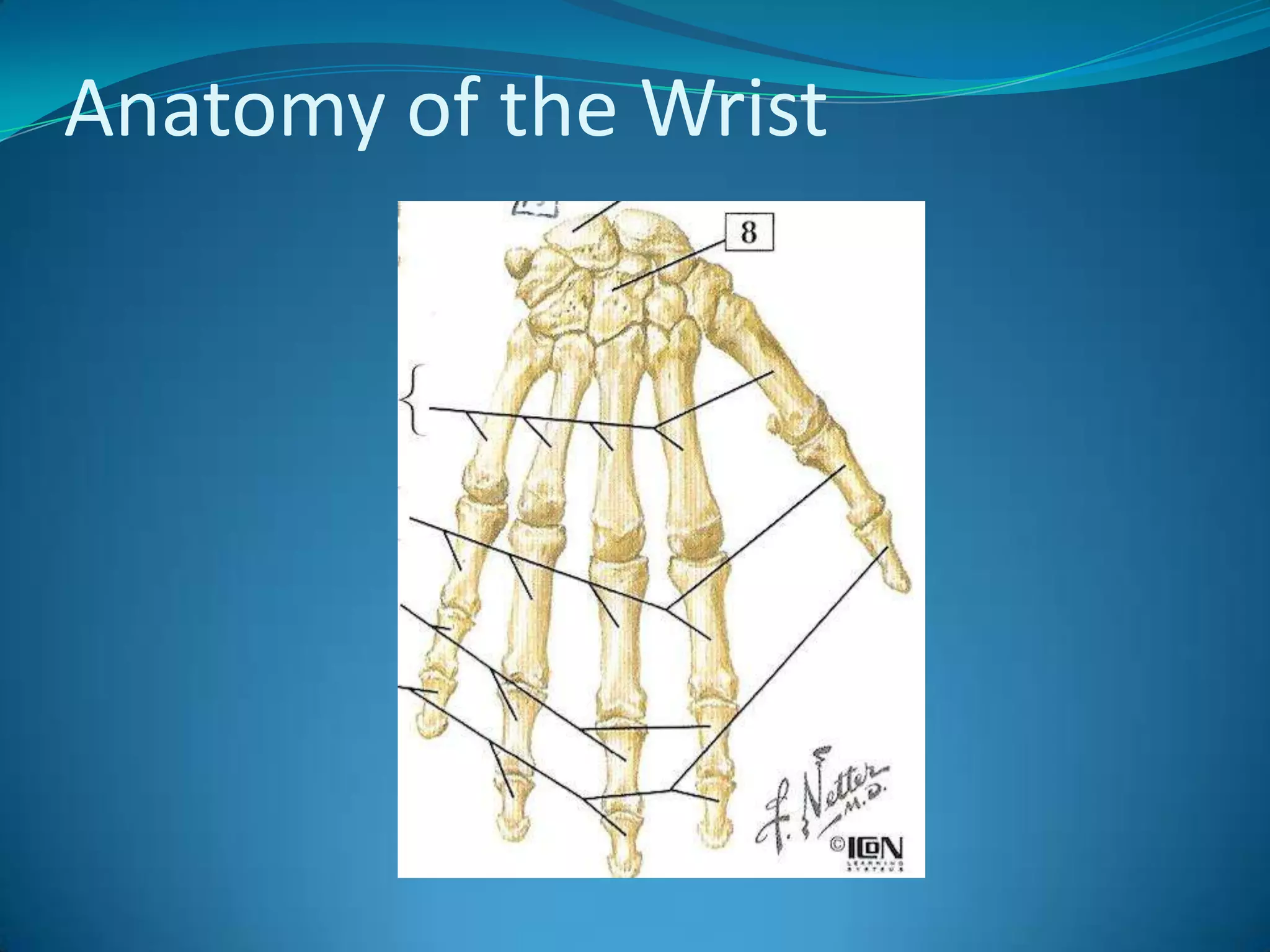
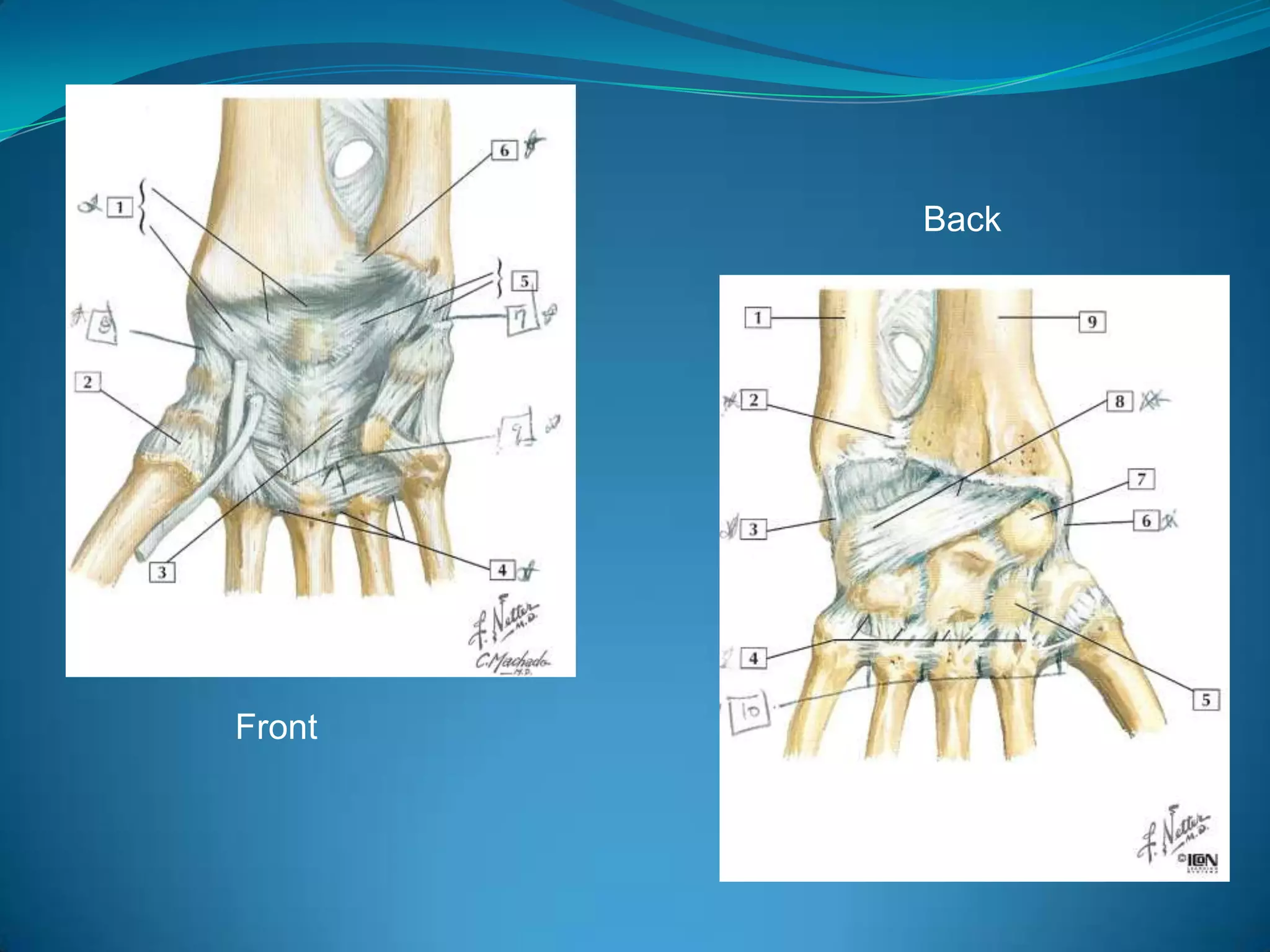
Anatomy of the Wrist
BackFront
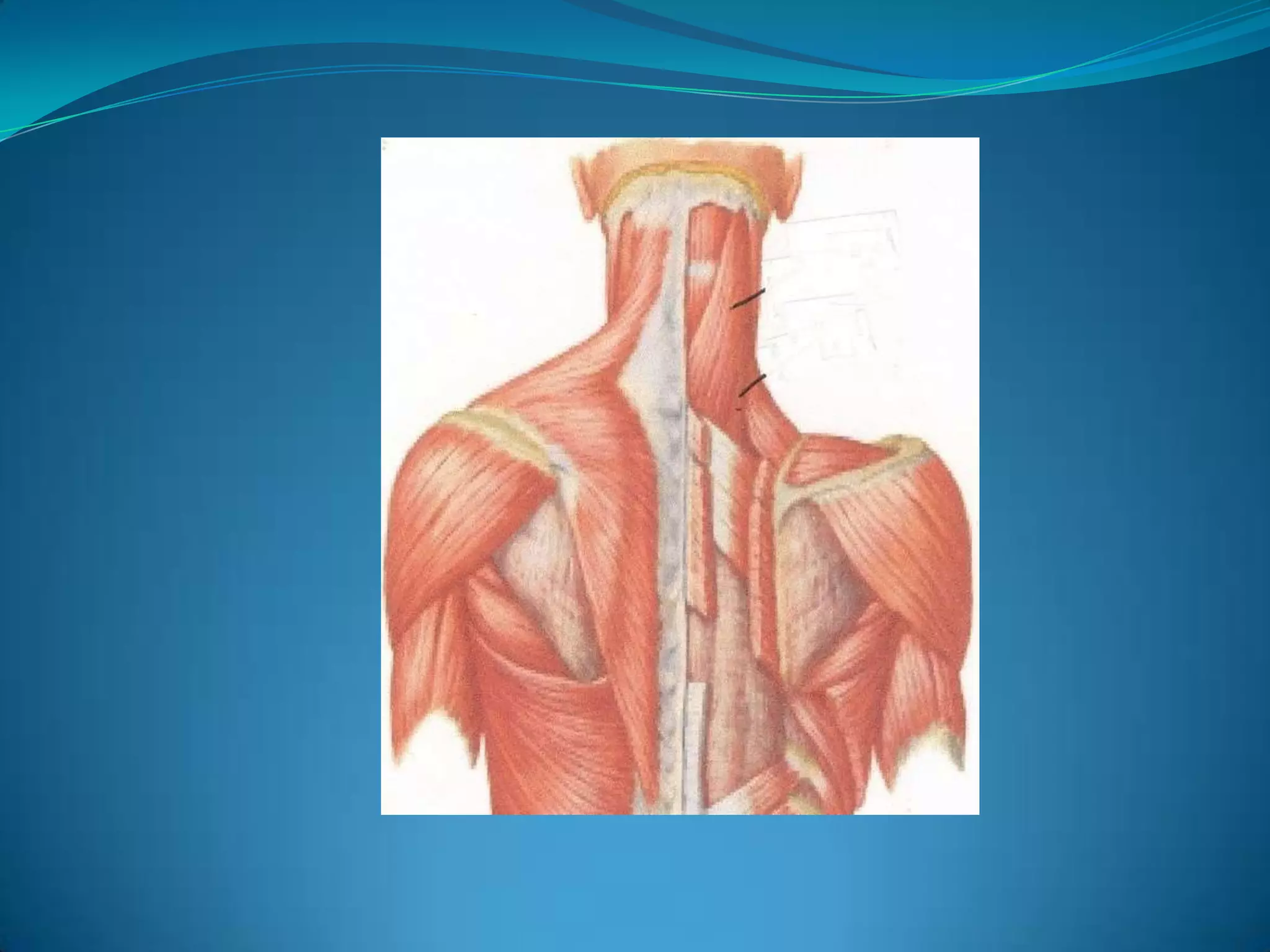
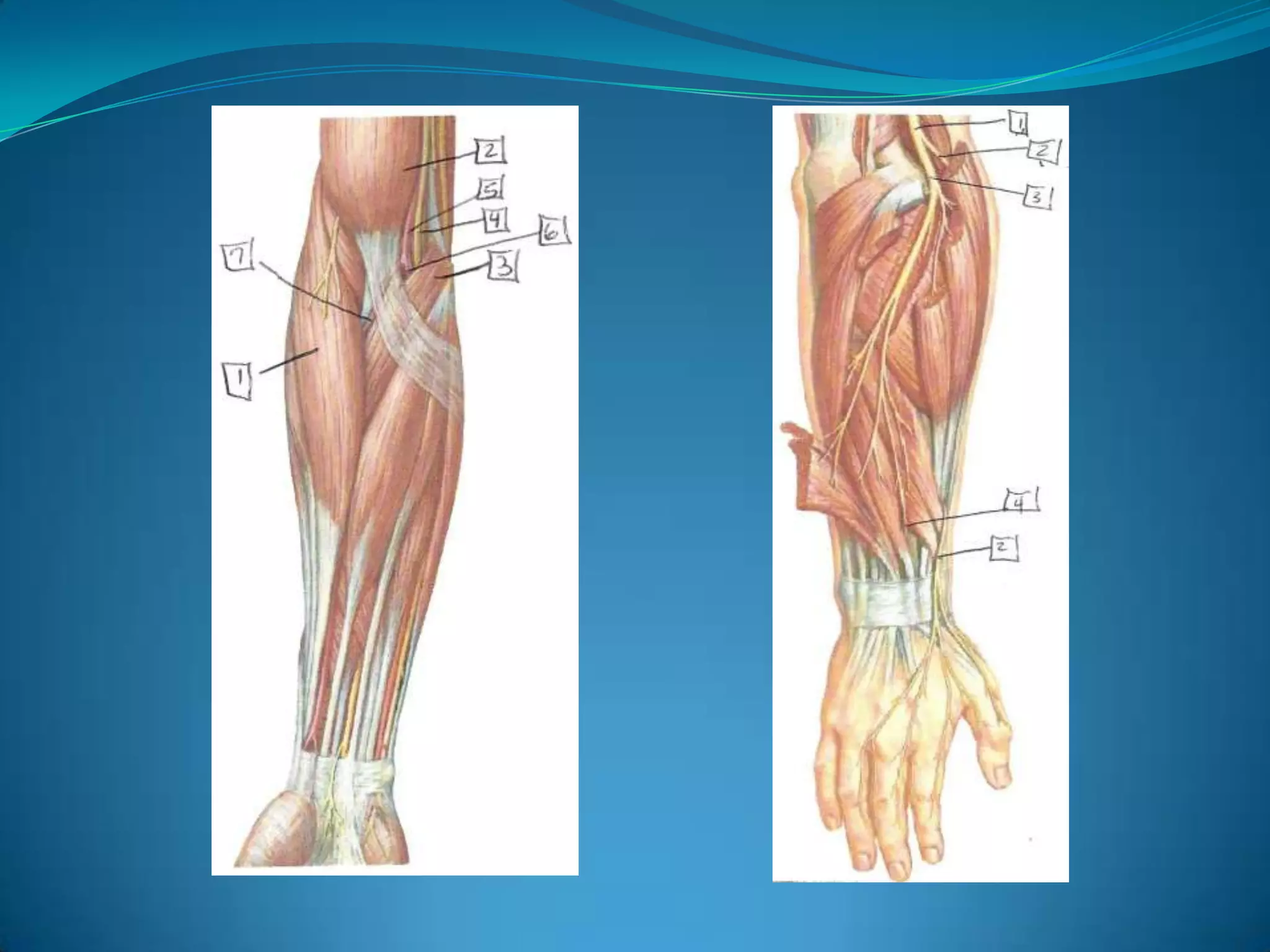
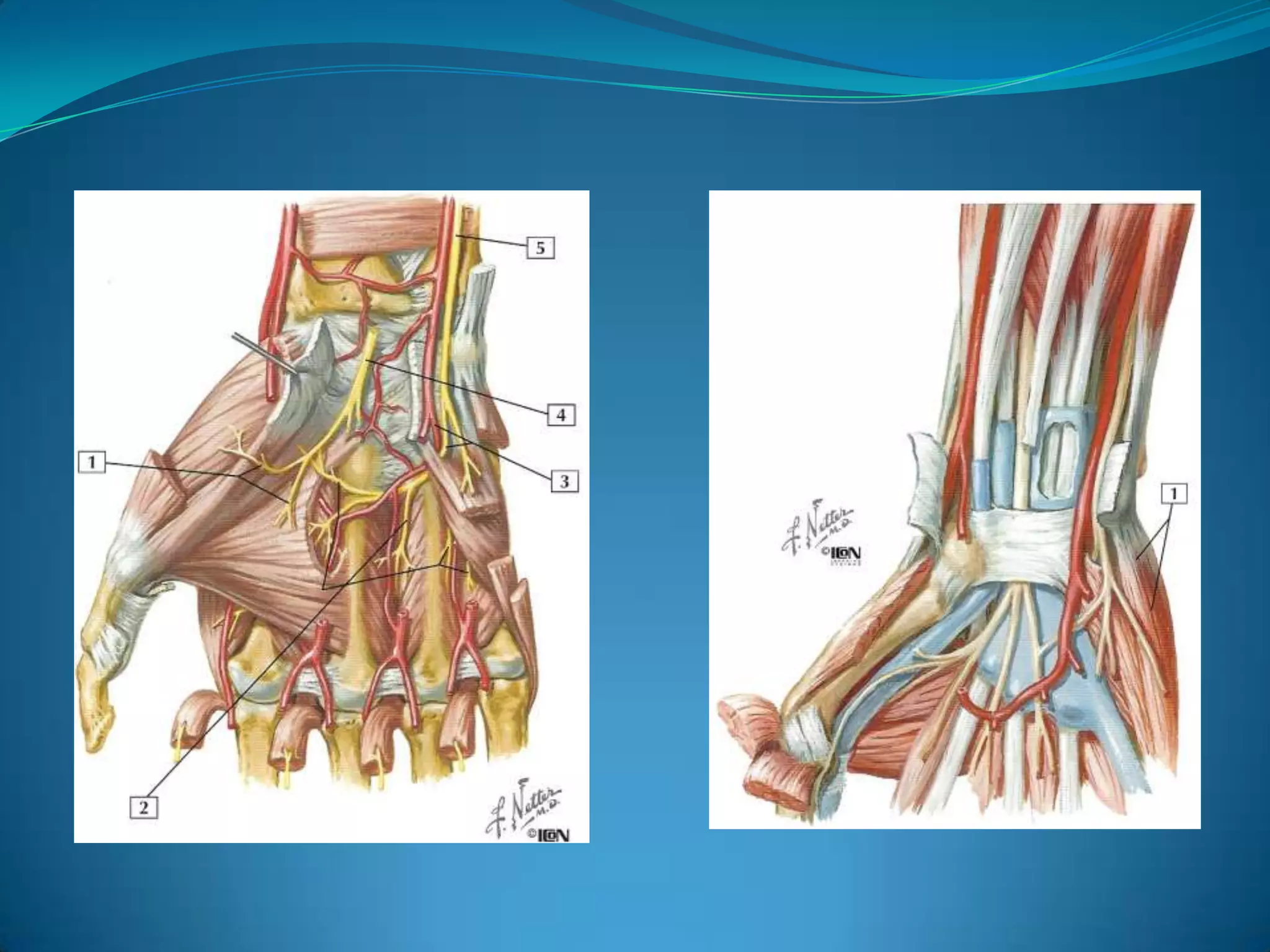
Anatomy cont’dAll these muscle provide stabilization for the wrist.If these muscles are not functioning properly increased stress will eventually lead to injury.
Muscle imbalancesSome muscles are strongWhile opposing muscles are weakSome muscles are stretched outWhile opposing muscles are too tight
Due to the stringent requirements placed on gymnast certain muscles tend to develop stronger than othersCertain muscles get weakOther muscles develop tightSome develop loose or stretched
Common muscle imbalancesPoor shoulder blade, arm, and wrist controlWeak shoulder blade and shoulder musclesExtensor Carpi Radialus Brevis (ECRB) doing too much and the other wrist extensors not doing enoughWeak hand intrinsic musclesTight pec and lat muscles
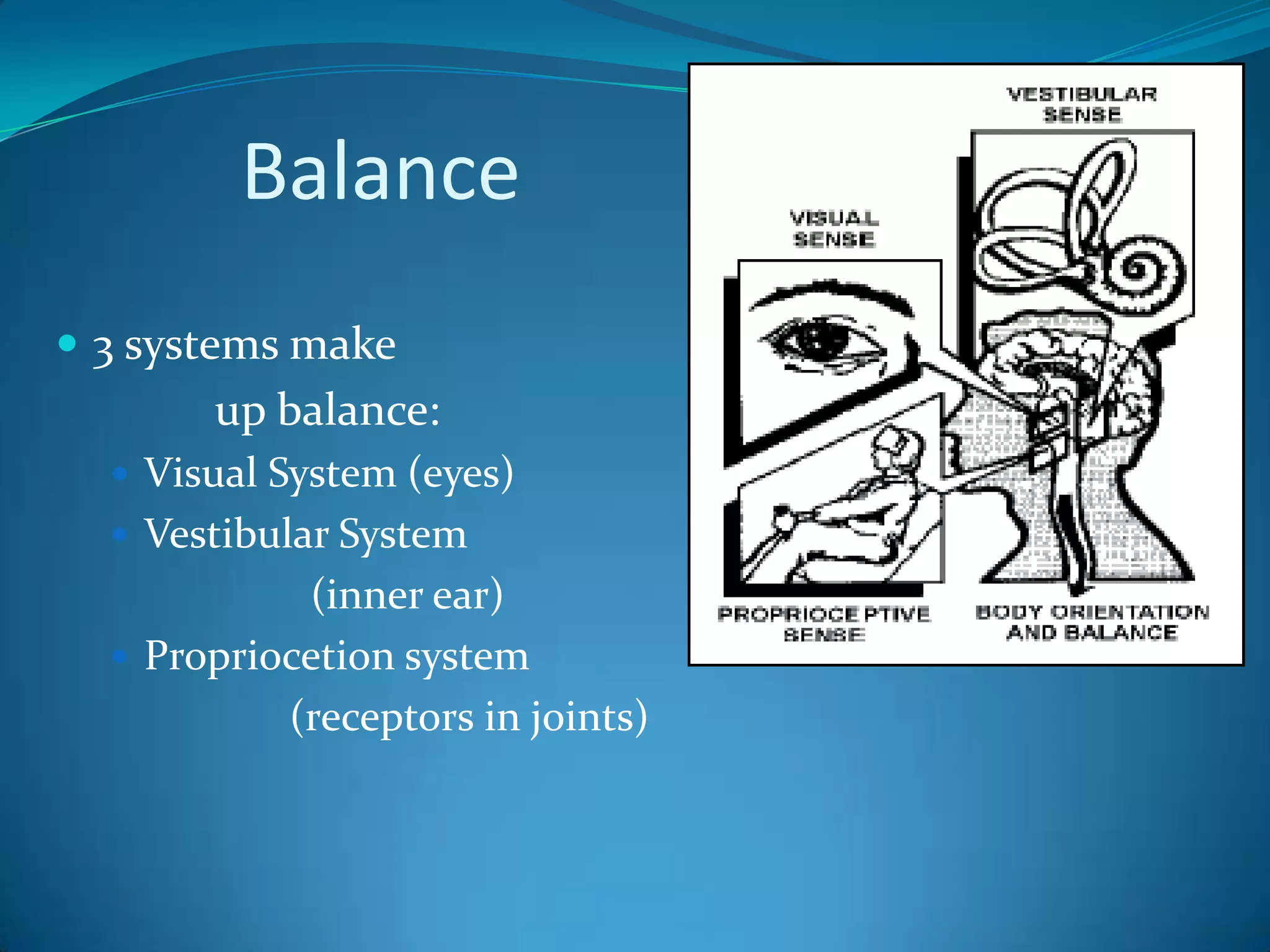
          Balance3 systems make               up balance:Visual System (eyes)Vestibular System                    (inner ear)Propriocetion system                  (receptors in joints)
Visual SystemEyes give input into the system indicating the environment around us and movements we are makingI have found gymnast tend to be visually dominantAny change in vision can   affect balance.
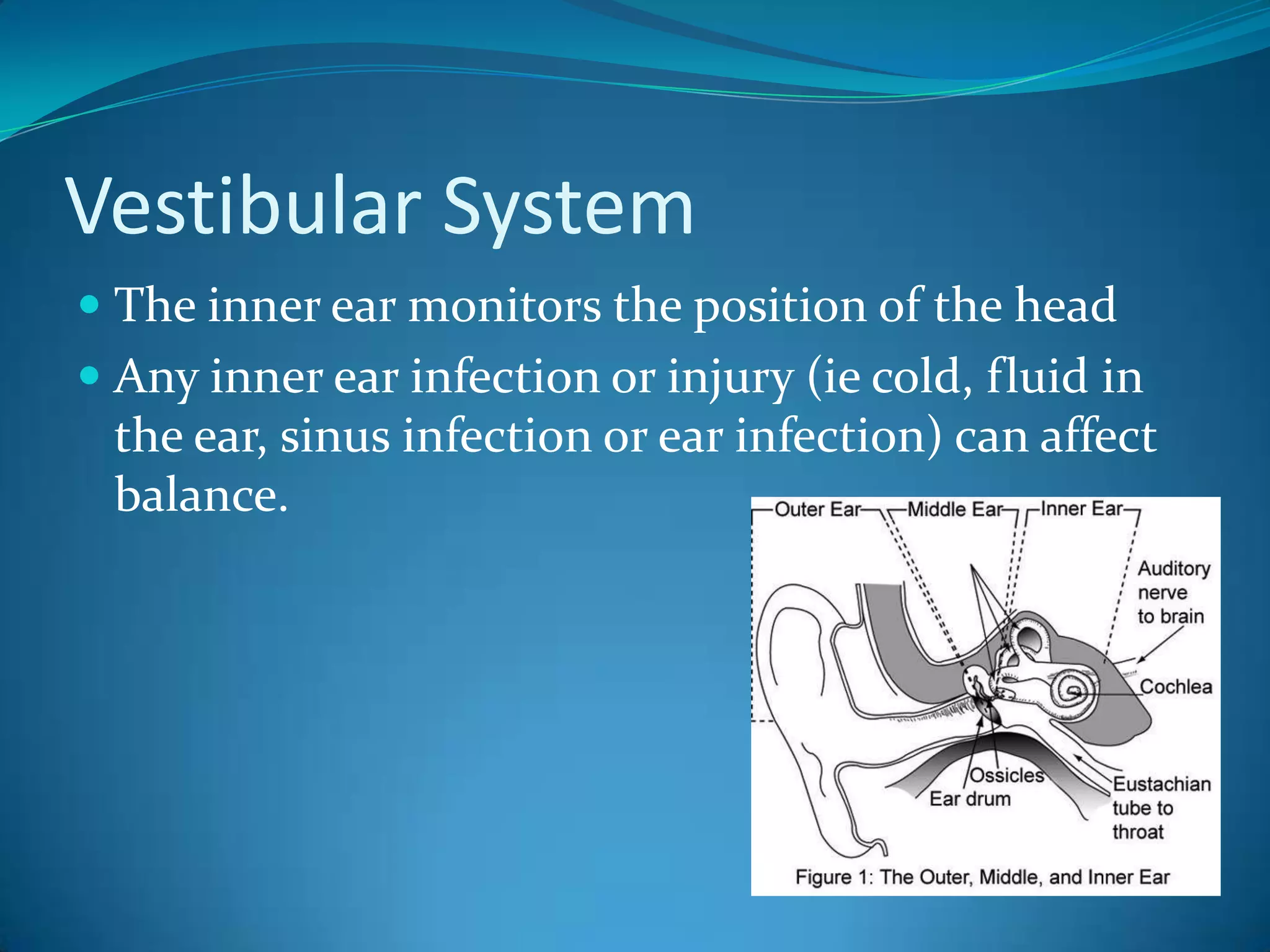
Vestibular SystemThe inner ear monitors the position of the headAny inner ear infection or injury (ie cold, fluid in the ear, sinus infection or ear infection) can affect balance.
Proprioception SystemThe receptors in our joints give sensory input from your upper extremities to give your brain feedback about the floorAny joint injury can cause    damage to these receptors   and affect balance (does    not have to be a major   injury)
Demonstration Time
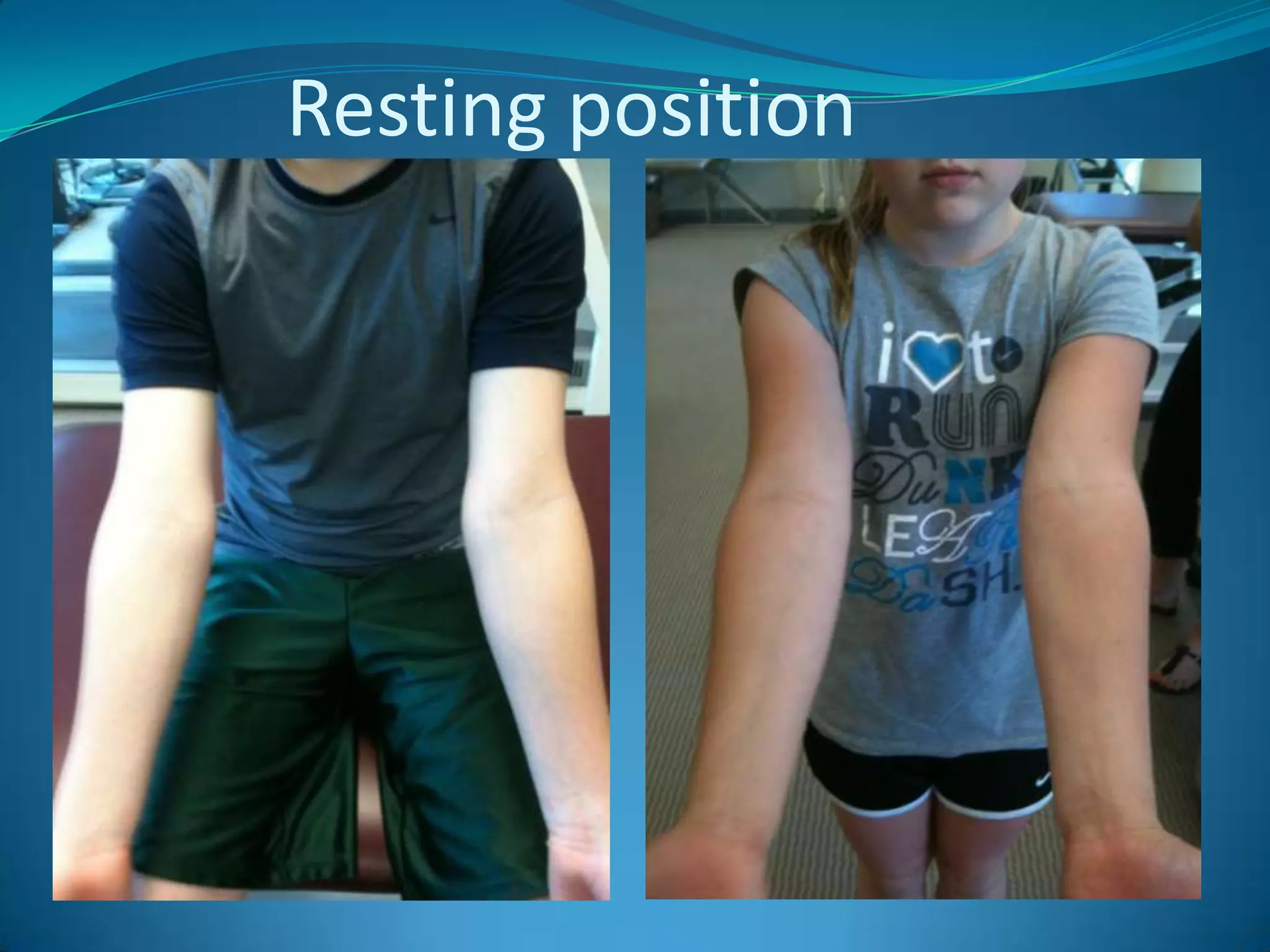
Resting position
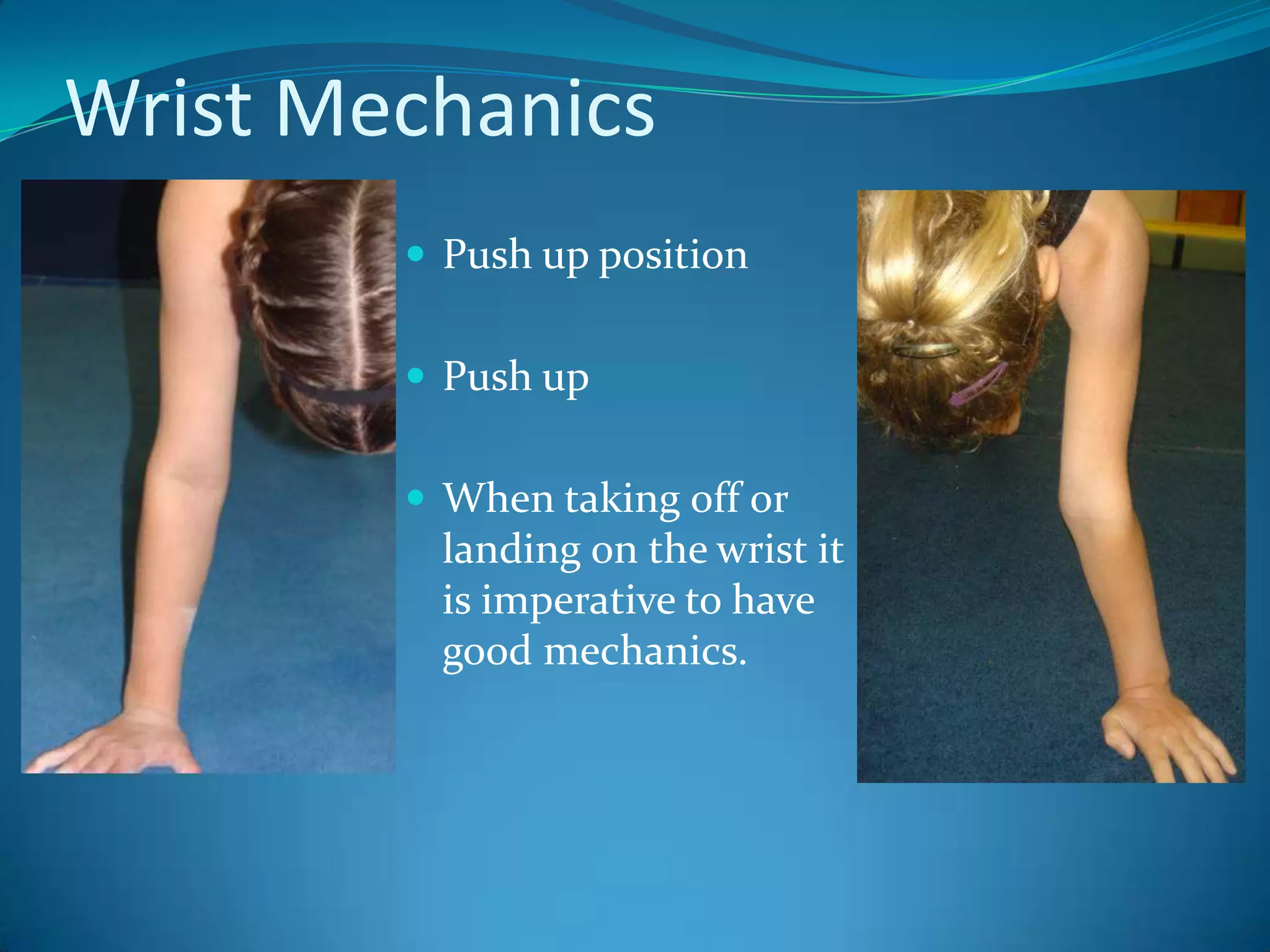
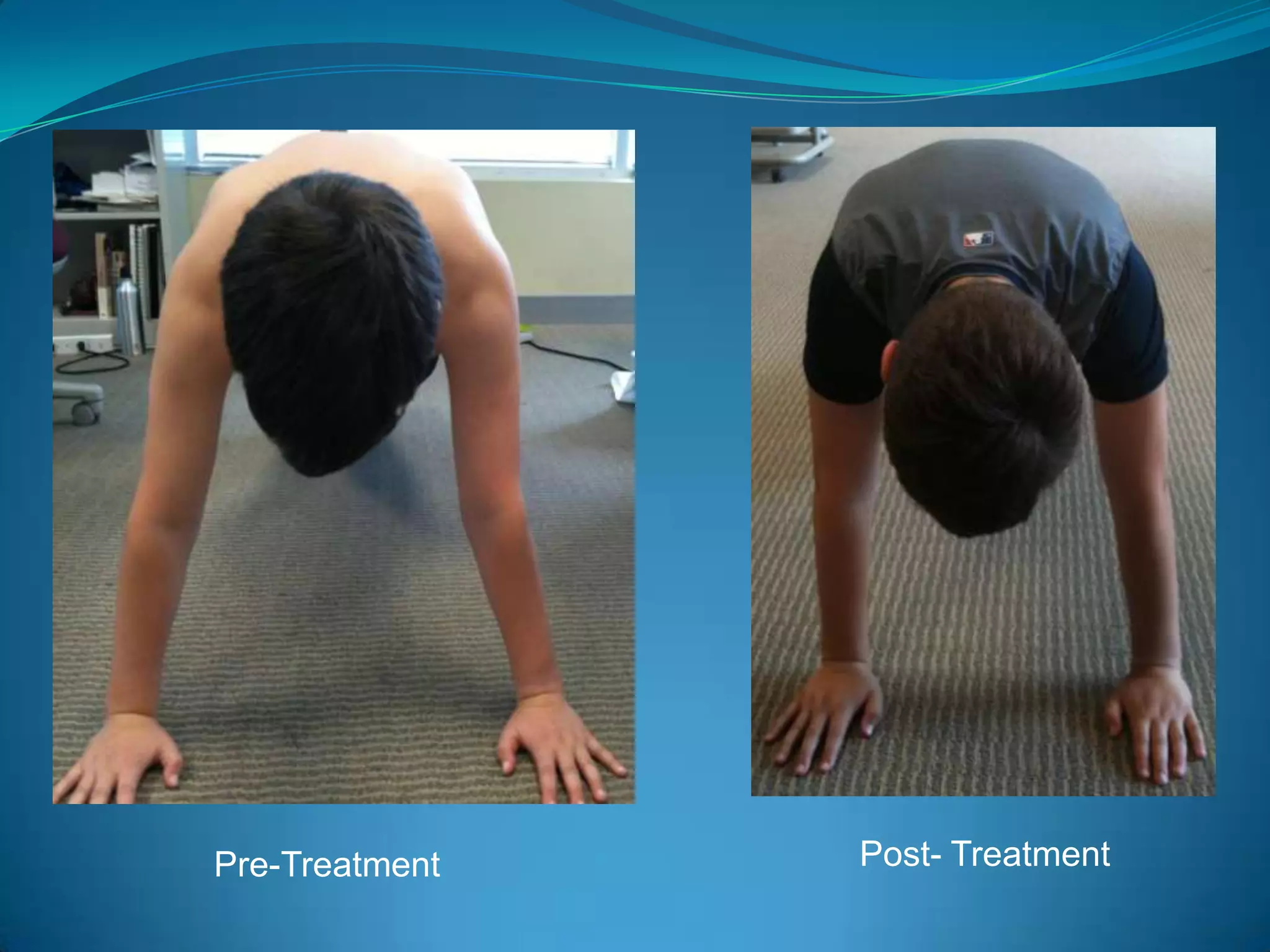
Wrist MechanicsPush up positionPush upWhen taking off or landing on the wrist it is imperative to have good mechanics.
Improper mechanics lead to repetitive abnormal stressLeads to inefficient performanceLeads to injury
Post- TreatmentPre-Treatment
Demonstrate Muscle testing Shoulder BladeWristHandFlexibility testingPecsLats
Proper wrist mechanics can be achieved byBalancing muscle imbalancesShoulder blade, shoulder, and wrist strength and flexibilityImproving balance or proprioceptionTraining proper loading mechanics
Strengthen Shoulder Blade musclesCat Pushes(serratus) (fig 1)On all foursSet shd blades down and back Push through the heel of the hands.Rounding out like a catMake sure to push till you can push no more. Keep head in.Hold 10 sec x10Figure 1
Cat Rocking (fig 2)Start in the Cat PushesOnce rounded, keep the upper back rounded by pushing through the heels of the hands as rock back toward heelsKeep rounded as return to the start position.Repeat x15Figure 2
Ts ph I (middle trap)(fig 3)Lay face down with arms in a “goal post” positionSet shoulder blades down and back. Keep there.Gently, lifting from the thumbs just high enough to slide a piece of paper under the arms.Make sure to relax the upper trap and only engage the middle trap.Hold 10 sec x5Figure 3
T ph IILaying face down with elbows slightly bent in a T position.Set shd blades down and back.Keep down & back as raise arms slightly off the floor 1-3”Make sure upper trap is relaxed.Hold 10 sec x5
T ph III (fig 4)Lay face down in a T position with  elbows straigth.Set shd blades down and back.Gently lift from the thumbs 1-3 inches off the floor.Make sure upper traps relaxed.Make sure not arching, engage abs.Hold 10 sec x10Figure 4
Y ph I (lower trap) (fig 5)Lay face down hands on headSet shd blades down & back.Gently lift from the elbows enough to slide a piece of paper underneathMake sure upper traps relaxed and shd blades stay down & backHold 10 sec x 5Figure 5
Y ph II(fig 6)Lay face down arms in a bent arm Y positionSet shd blades down & back.Gently lift from thumbs enough to slide a piece of paper underneathMake sure upper traps relaxed and shd blades stay down & back.Hold 10 sec x 5Figure 6
Y Ph III (fig 3)Lay face down arms in a Y position.Set shd blades down & back.Gently lift from the thumbs 1-3 inches from the floor.Make sure upper traps relaxed & shd blades stay down & back.Make sure not arching.Hold 10 sec x 5Figure 7
Wall Slides(upper trap) (fig 8)Standing 6” from wall, place elbows shd width apart on the wall.Raise arms up as high as possibleBreath  in as shrug everything up toward the ceiling.Shd blades toward ears.Hold as breath out, keeping the ribs expanded and the shd shrugged.Hold 10 sec x5Figure 8
Upper extremity controlPush upsCreate arch in wristElbows facing each otherBend straight downDon’t sag in shoulder bladesEven weight through wrist
Balance Training progressionPushup position weight shiftingWight shifting on ballBalance BoardBosu Ball
These exercises can lead up to tumbling and vaulting:Make sure the gymnast’s hand is not collapsing when loadedMay start with just fixing the position in push ups and then in handstands.Progress to tumbling, etc.
When doing pushups and other conditioning the key is for the gymnast to control their shoulder, elbow, and wrist .Do NOT allow the arch of the hand to collapse or the elbows to roll out and hyperextend.
Wrist strengthWrist Extension(fig 9)Set wrist in neutral.Actively lift wrist.Push with the other hand to the end range.Hold 10 sec x10DO NOT let the wrist move inward.May have to start with no weight. Progress to 1-3 lbs.Figure 9
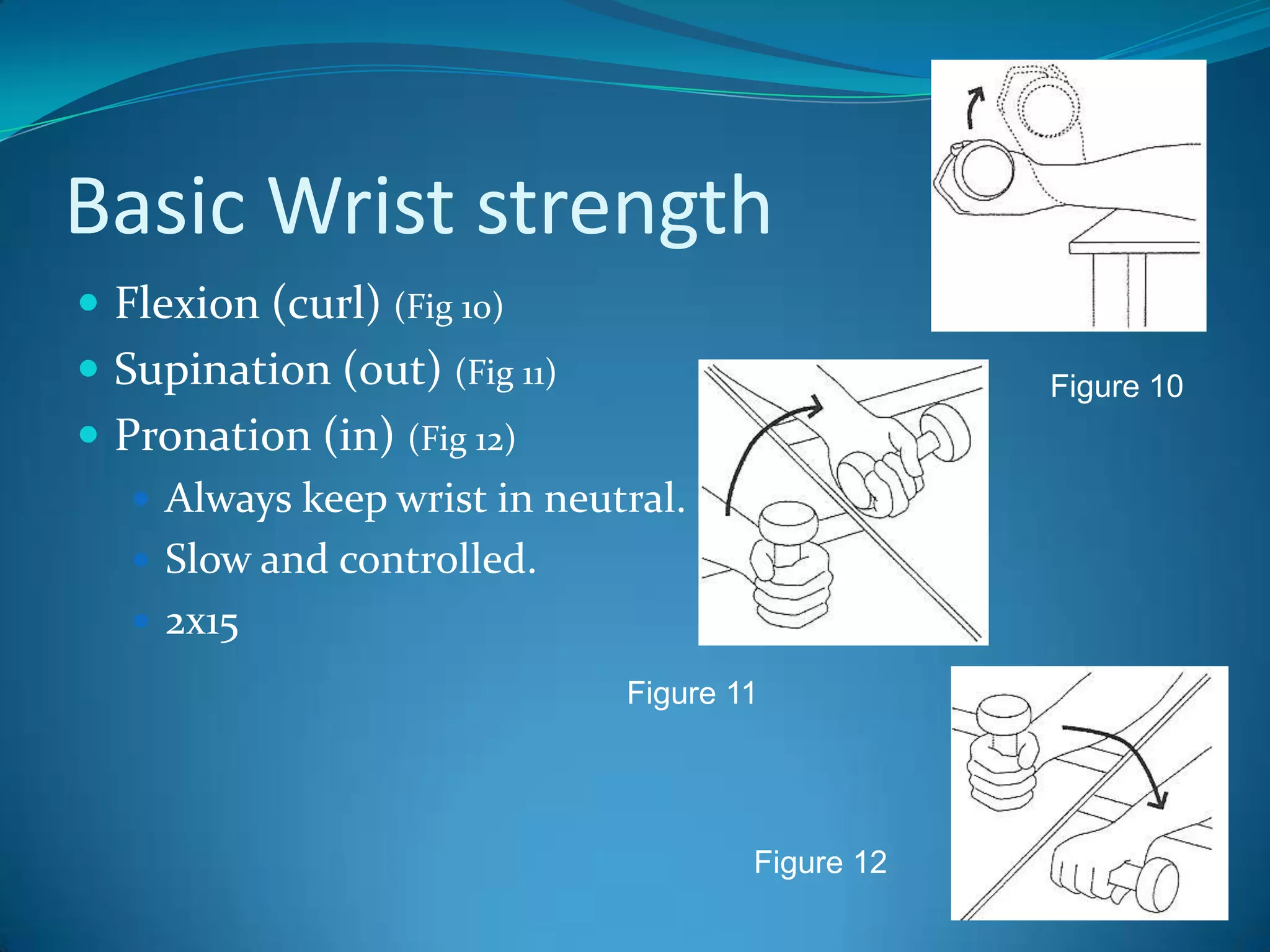
Basic Wrist strengthFlexion (curl) (Fig 10)Supination (out) (Fig 11)Pronation (in) (Fig 12)Always keep wrist in neutral.Slow and controlled.2x15Figure 10Figure 11Figure 12
Strengthen finger musclesPillow pickups or foam pickupsElbow at side and bent to 90 deg.Wrist in neutral.Pickup foam with straight fingers. (fig 13)X 2-3 minPick up foam with finger tips bent. (fig 14)X2-3 minFigure 13Figure 14
Stretch LatsRobots lat stretch (fig 15)Lie with knees bent.Pull ribs toward hips with abs.Elbows close together.Keep ribs down  and elbows in as reach toward the floor.Hold 10 sec repeat 5 timesFigure 15
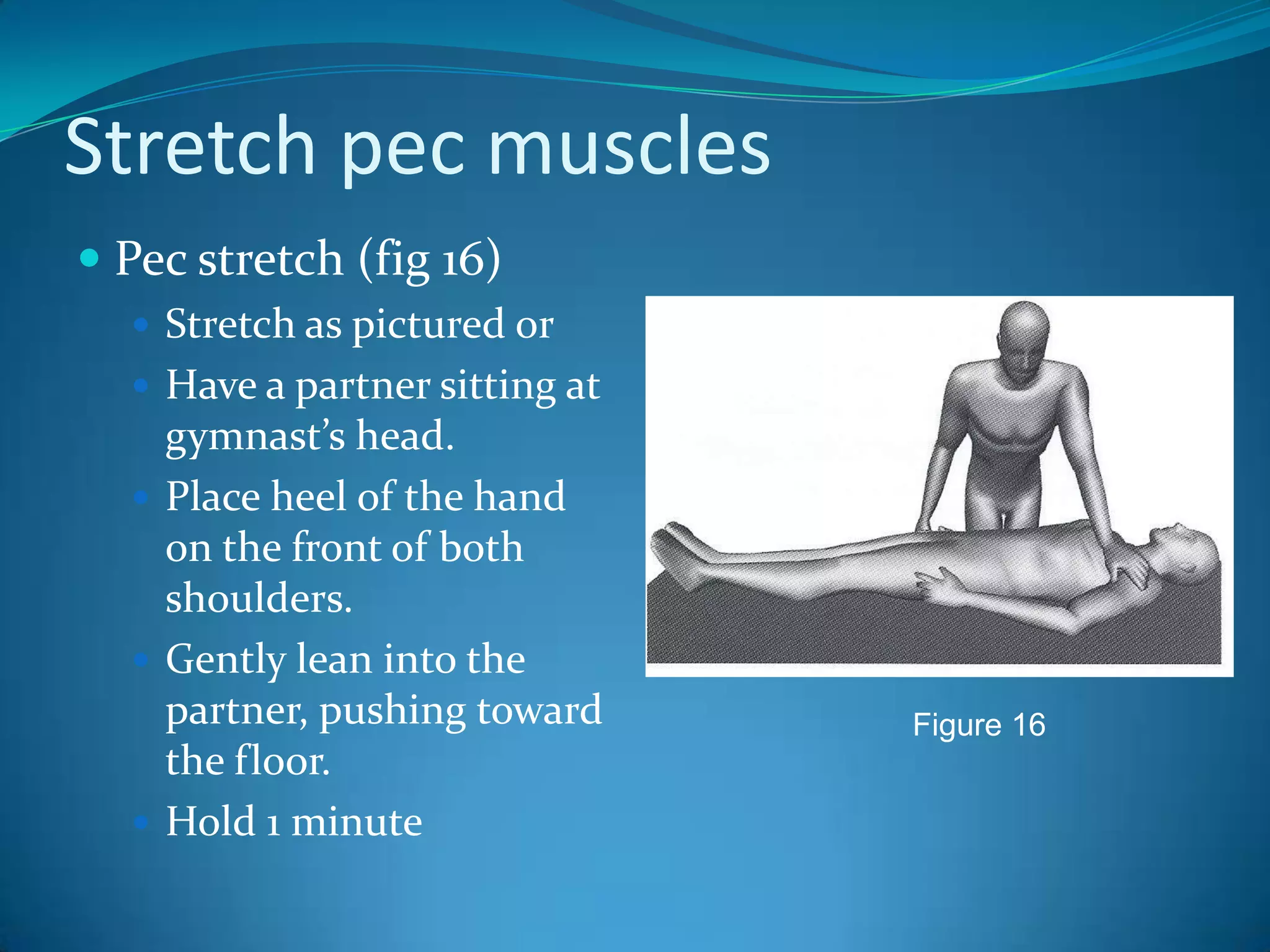
Stretch pec musclesPec stretch (fig 16)Stretch as pictured orHave a partner sitting at gymnast’s head.Place heel of the hand on the front of both shoulders.Gently lean into the partner, pushing toward the floor.Hold 1 minuteFigure 16
Contact InformationPerfect 10.0 Physical Therapy             & Performance Trainingwww.perfect10physicaltherapy.comperfect10pt@gmail.com512-426-6593Follow  Perfect10PT  on gymanstike, facebook, and twitter
All information from:The Manual Therapy Institutehttp://www.mtitx.com/Shirley Sahrmann.Diagnosis and Treatment of Movement Impairment Syndrome.

Wrist Injuries In Gymnast

  • 1.
    Wrist Injuries inGymnastBrandi Smith-Young, PTPerfect 10.0 Physical TherapyFellowship trained manual therapistBoard certified orthopedic specialistwww.perfect10physicaltherapy.comperfect10pt@gmail.com
  • 2.
    IntroductionCompetitive gymnastTwo time USAG Collegiate National Champions at TWUBachelors in Kinesiology at TWUMasters in Physical Therapy at Tx St
  • 3.
    Practicing for 5yearsFellowship trained in Orthopedic manual physical therapyBoard certified orthopedic specialist in PTOne of 300 therapist in the US with these certifications
  • 4.
    My passion:Bring sportspecific quality care to gymnastDecrease the number of injuries in gymnastImprove performance, recovery time, decrease time lost in the gym, and improve return to sport statusPerformance Enhancement
  • 5.
    Common ComplaintsPain onthe outside of the wristPain on the inside of the wristPain across the wristPain into the hand
  • 6.
    What plays arole in wrist injuriesWrist Injury can be caused by and cause:Decreased joint motion (rolling and gliding) Decreased range of motion (flexibility)Decreased strength (shd blade, shd, arm, wrist, hand )Balance and propriocetion deficits
  • 7.
  • 8.
  • 15.
    Anatomy cont’dAll thesemuscle provide stabilization for the wrist.If these muscles are not functioning properly increased stress will eventually lead to injury.
  • 16.
    Muscle imbalancesSome musclesare strongWhile opposing muscles are weakSome muscles are stretched outWhile opposing muscles are too tight
  • 17.
    Due to thestringent requirements placed on gymnast certain muscles tend to develop stronger than othersCertain muscles get weakOther muscles develop tightSome develop loose or stretched
  • 18.
    Common muscle imbalancesPoorshoulder blade, arm, and wrist controlWeak shoulder blade and shoulder musclesExtensor Carpi Radialus Brevis (ECRB) doing too much and the other wrist extensors not doing enoughWeak hand intrinsic musclesTight pec and lat muscles
  • 19.
    Balance3 systems make up balance:Visual System (eyes)Vestibular System (inner ear)Propriocetion system (receptors in joints)
  • 20.
    Visual SystemEyes giveinput into the system indicating the environment around us and movements we are makingI have found gymnast tend to be visually dominantAny change in vision can affect balance.
  • 21.
    Vestibular SystemThe innerear monitors the position of the headAny inner ear infection or injury (ie cold, fluid in the ear, sinus infection or ear infection) can affect balance.
  • 22.
    Proprioception SystemThe receptorsin our joints give sensory input from your upper extremities to give your brain feedback about the floorAny joint injury can cause damage to these receptors and affect balance (does not have to be a major injury)
  • 23.
  • 24.
  • 25.
    Wrist MechanicsPush uppositionPush upWhen taking off or landing on the wrist it is imperative to have good mechanics.
  • 26.
    Improper mechanics leadto repetitive abnormal stressLeads to inefficient performanceLeads to injury
  • 27.
  • 29.
    Demonstrate Muscle testingShoulder BladeWristHandFlexibility testingPecsLats
  • 30.
    Proper wrist mechanicscan be achieved byBalancing muscle imbalancesShoulder blade, shoulder, and wrist strength and flexibilityImproving balance or proprioceptionTraining proper loading mechanics
  • 31.
    Strengthen Shoulder BlademusclesCat Pushes(serratus) (fig 1)On all foursSet shd blades down and back Push through the heel of the hands.Rounding out like a catMake sure to push till you can push no more. Keep head in.Hold 10 sec x10Figure 1
  • 32.
    Cat Rocking (fig2)Start in the Cat PushesOnce rounded, keep the upper back rounded by pushing through the heels of the hands as rock back toward heelsKeep rounded as return to the start position.Repeat x15Figure 2
  • 33.
    Ts ph I(middle trap)(fig 3)Lay face down with arms in a “goal post” positionSet shoulder blades down and back. Keep there.Gently, lifting from the thumbs just high enough to slide a piece of paper under the arms.Make sure to relax the upper trap and only engage the middle trap.Hold 10 sec x5Figure 3
  • 34.
    T ph IILayingface down with elbows slightly bent in a T position.Set shd blades down and back.Keep down & back as raise arms slightly off the floor 1-3”Make sure upper trap is relaxed.Hold 10 sec x5
  • 35.
    T ph III(fig 4)Lay face down in a T position with elbows straigth.Set shd blades down and back.Gently lift from the thumbs 1-3 inches off the floor.Make sure upper traps relaxed.Make sure not arching, engage abs.Hold 10 sec x10Figure 4
  • 36.
    Y ph I(lower trap) (fig 5)Lay face down hands on headSet shd blades down & back.Gently lift from the elbows enough to slide a piece of paper underneathMake sure upper traps relaxed and shd blades stay down & backHold 10 sec x 5Figure 5
  • 37.
    Y ph II(fig6)Lay face down arms in a bent arm Y positionSet shd blades down & back.Gently lift from thumbs enough to slide a piece of paper underneathMake sure upper traps relaxed and shd blades stay down & back.Hold 10 sec x 5Figure 6
  • 38.
    Y Ph III(fig 3)Lay face down arms in a Y position.Set shd blades down & back.Gently lift from the thumbs 1-3 inches from the floor.Make sure upper traps relaxed & shd blades stay down & back.Make sure not arching.Hold 10 sec x 5Figure 7
  • 39.
    Wall Slides(upper trap)(fig 8)Standing 6” from wall, place elbows shd width apart on the wall.Raise arms up as high as possibleBreath in as shrug everything up toward the ceiling.Shd blades toward ears.Hold as breath out, keeping the ribs expanded and the shd shrugged.Hold 10 sec x5Figure 8
  • 40.
    Upper extremity controlPushupsCreate arch in wristElbows facing each otherBend straight downDon’t sag in shoulder bladesEven weight through wrist
  • 41.
    Balance Training progressionPushupposition weight shiftingWight shifting on ballBalance BoardBosu Ball
  • 42.
    These exercises canlead up to tumbling and vaulting:Make sure the gymnast’s hand is not collapsing when loadedMay start with just fixing the position in push ups and then in handstands.Progress to tumbling, etc.
  • 43.
    When doing pushupsand other conditioning the key is for the gymnast to control their shoulder, elbow, and wrist .Do NOT allow the arch of the hand to collapse or the elbows to roll out and hyperextend.
  • 44.
    Wrist strengthWrist Extension(fig9)Set wrist in neutral.Actively lift wrist.Push with the other hand to the end range.Hold 10 sec x10DO NOT let the wrist move inward.May have to start with no weight. Progress to 1-3 lbs.Figure 9
  • 45.
    Basic Wrist strengthFlexion(curl) (Fig 10)Supination (out) (Fig 11)Pronation (in) (Fig 12)Always keep wrist in neutral.Slow and controlled.2x15Figure 10Figure 11Figure 12
  • 46.
    Strengthen finger musclesPillowpickups or foam pickupsElbow at side and bent to 90 deg.Wrist in neutral.Pickup foam with straight fingers. (fig 13)X 2-3 minPick up foam with finger tips bent. (fig 14)X2-3 minFigure 13Figure 14
  • 47.
    Stretch LatsRobots latstretch (fig 15)Lie with knees bent.Pull ribs toward hips with abs.Elbows close together.Keep ribs down and elbows in as reach toward the floor.Hold 10 sec repeat 5 timesFigure 15
  • 48.
    Stretch pec musclesPecstretch (fig 16)Stretch as pictured orHave a partner sitting at gymnast’s head.Place heel of the hand on the front of both shoulders.Gently lean into the partner, pushing toward the floor.Hold 1 minuteFigure 16
  • 49.
    Contact InformationPerfect 10.0Physical Therapy & Performance Trainingwww.perfect10physicaltherapy.comperfect10pt@gmail.com512-426-6593Follow Perfect10PT on gymanstike, facebook, and twitter
  • 50.
    All information from:TheManual Therapy Institutehttp://www.mtitx.com/Shirley Sahrmann.Diagnosis and Treatment of Movement Impairment Syndrome.