What are the different ways of
separating mixtures?
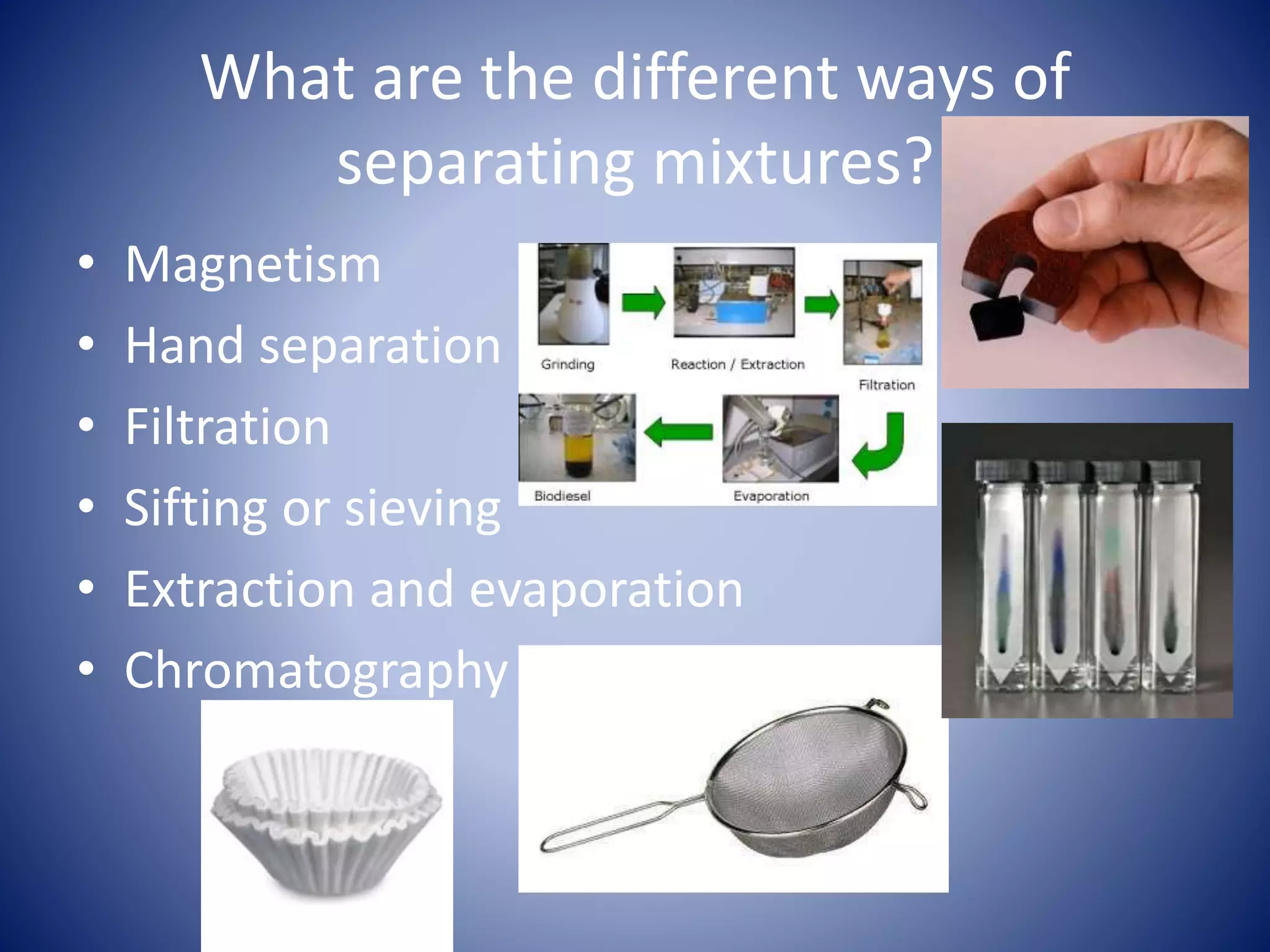
• Magnetism
• Hand separation
• Filtration
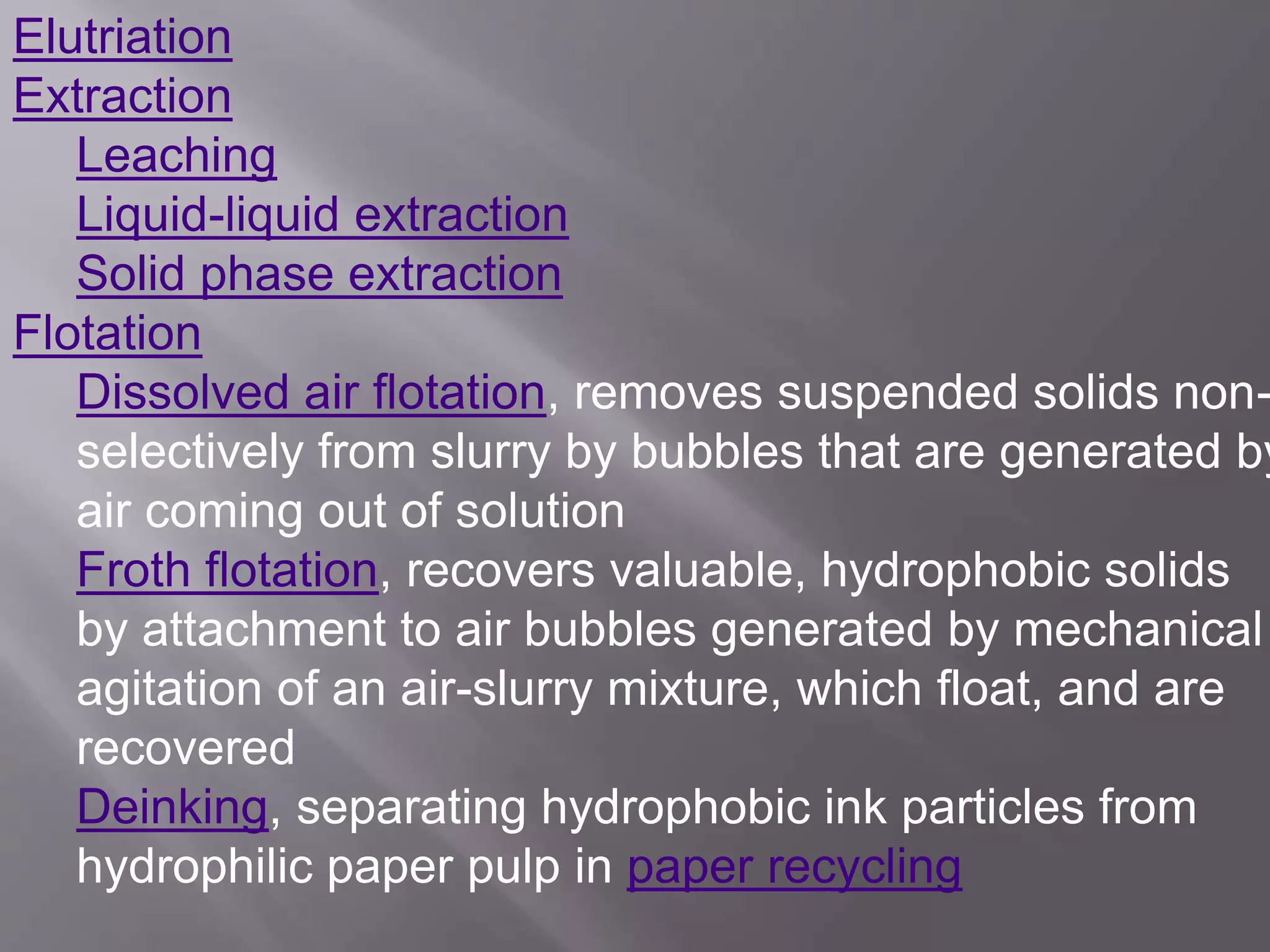
• Sifting or sieving
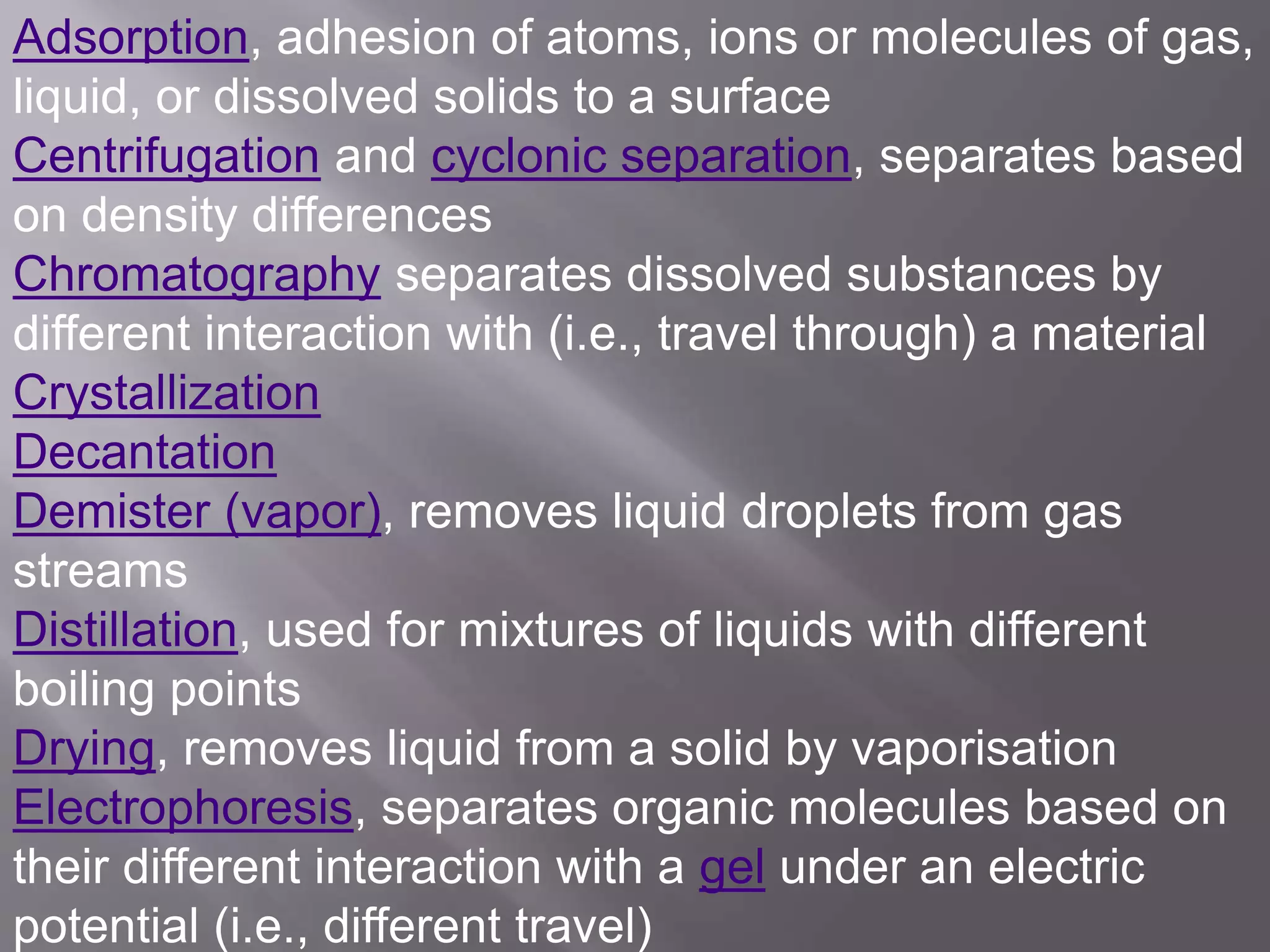
• Extraction and evaporation
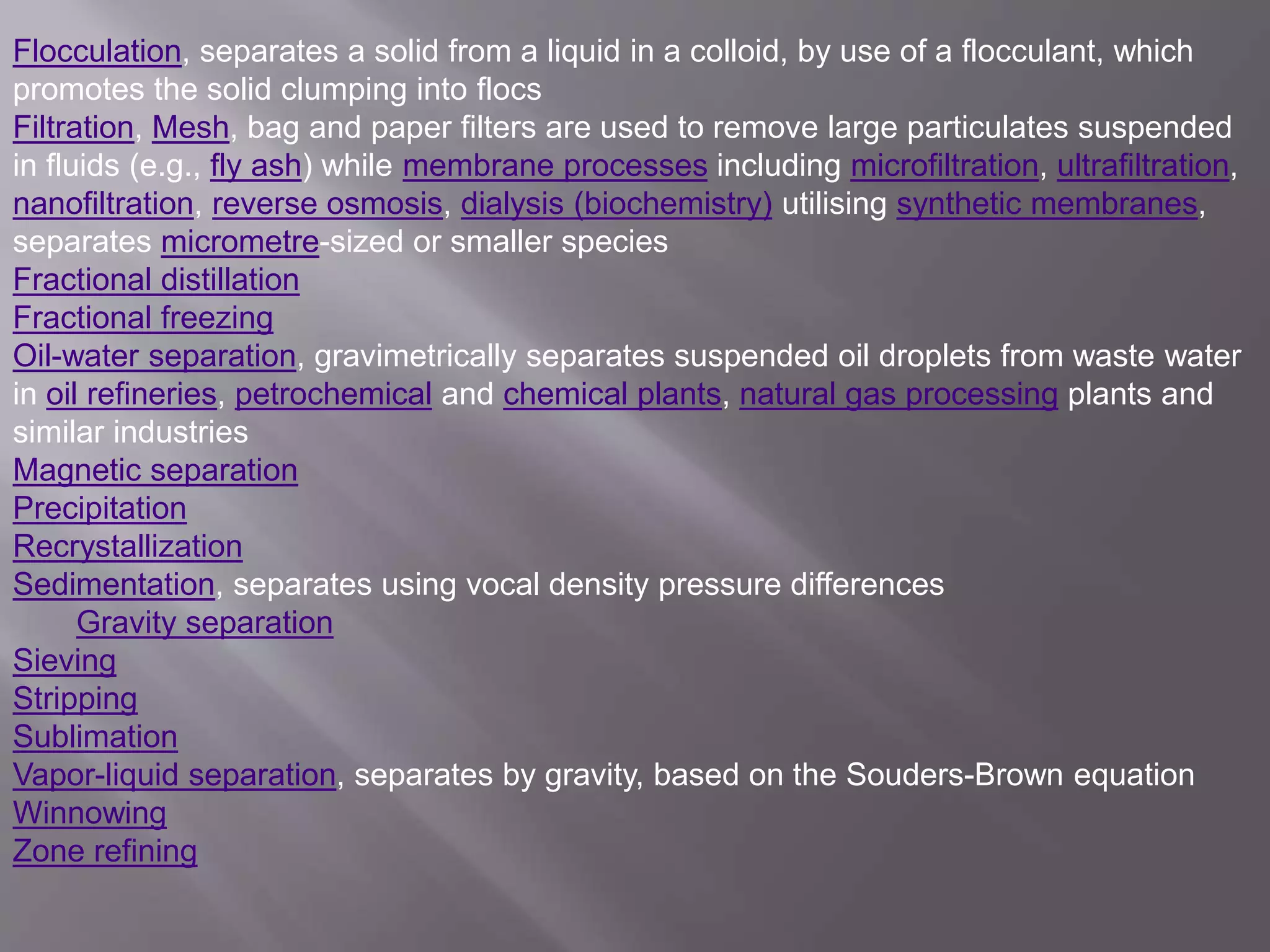
• Chromatography
Adsorption, adhesion of atoms, ions or molecules of gas,
liquid, or dissolved solids to a surface
Centrifugation and cyclonic separation, separates based
on density differences
Chromatography separates dissolved substances by
different interaction with (i.e., travel through) a material
Crystallization
Decantation
Demister (vapor), removes liquid droplets from gas
streams
Distillation, used for mixtures of liquids with different
boiling points
Drying, removes liquid from a solid by vaporisation
Electrophoresis, separates organic molecules based on
their different interaction with a gel under an electric
potential (i.e., different travel)
Elutriation
Extraction
Leaching
Liquid-liquid extraction
Solid phase extraction
Flotation
Dissolved air flotation, removes suspended solids non-
selectively from slurry by bubbles that are generated by
air coming out of solution
Froth flotation, recovers valuable, hydrophobic solids
by attachment to air bubbles generated by mechanical
agitation of an air-slurry mixture, which float, and are
recovered
Deinking, separating hydrophobic ink particles from
hydrophilic paper pulp in paper recycling
Flocculation, separates a solid from a liquid in a colloid, by use of a flocculant, which
promotes the solid clumping into flocs
Filtration, Mesh, bag and paper filters are used to remove large particulates suspended
in fluids (e.g., fly ash) while membrane processes including microfiltration, ultrafiltration,
nanofiltration, reverse osmosis, dialysis (biochemistry) utilising synthetic membranes,
separates micrometre-sized or smaller species
Fractional distillation
Fractional freezing
Oil-water separation, gravimetrically separates suspended oil droplets from waste water
in oil refineries, petrochemical and chemical plants, natural gas processing plants and
similar industries
Magnetic separation
Precipitation
Recrystallization
Sedimentation, separates using vocal density pressure differences
Gravity separation
Sieving
Stripping
Sublimation
Vapor-liquid separation, separates by gravity, based on the Souders-Brown equation
Winnowing
Zone refining
INTRODUCTION
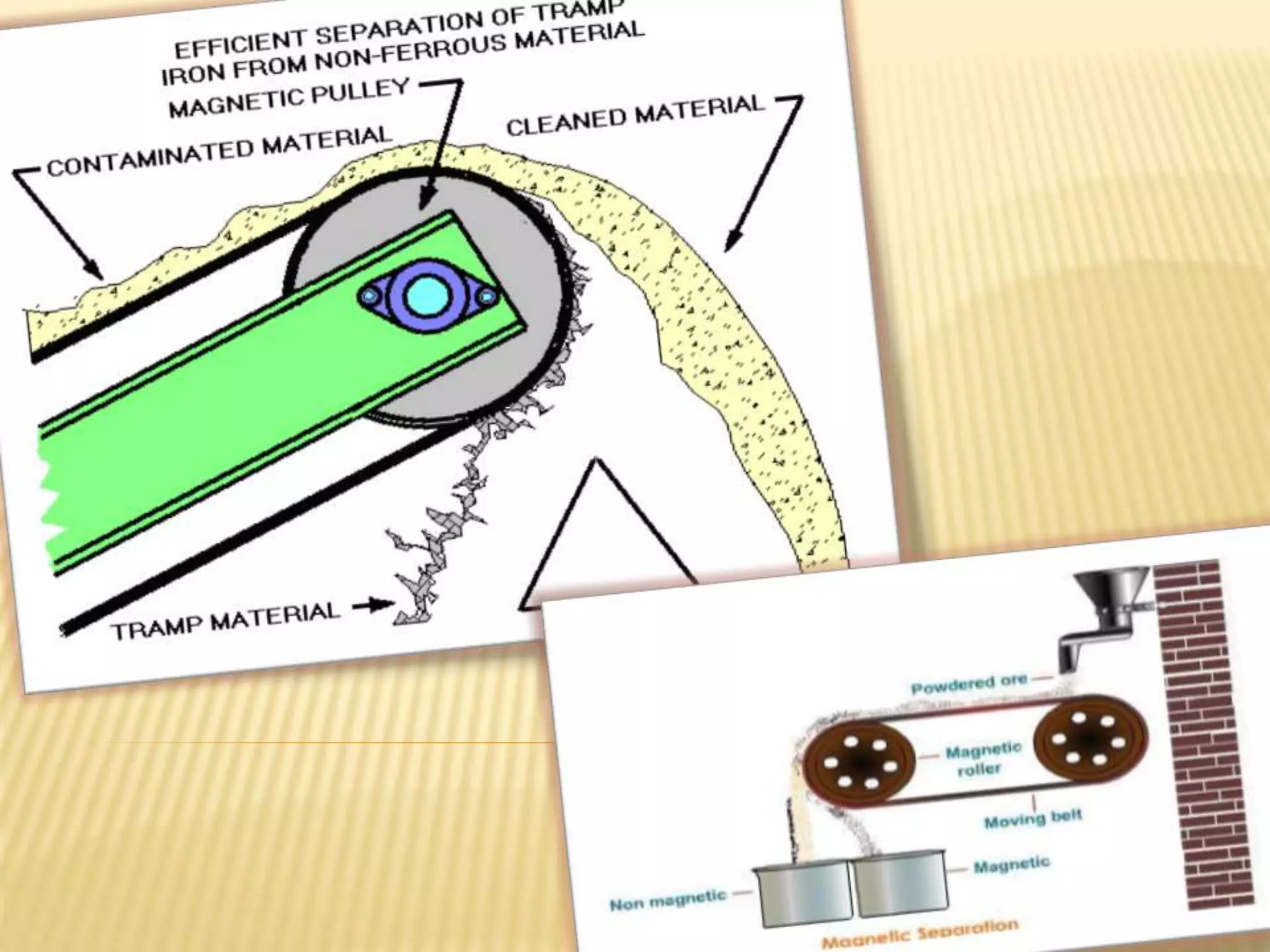
# Magnetic separation is a process in which
magnetically susceptible material is
extracted from a mixture using a magnetic
force.
# Since 19th century magnetic separation
processes have been used to concentrate and
separate minerals.
INTRODUCTION
# By combining the different forces of magnets with
gravitational or frictional forces a separation of
mineral particle is possible. Two or more products
are obtained depending on their commercial
value, these products are concentrates, middlings,
or tailings.
# Ferromagnetism, paramagnetism and
diamagnetism are the three important properties of
the minerals which is used for Magnetic separation.
APPLICATIONOF MAGNETISMAS SEPARATOR
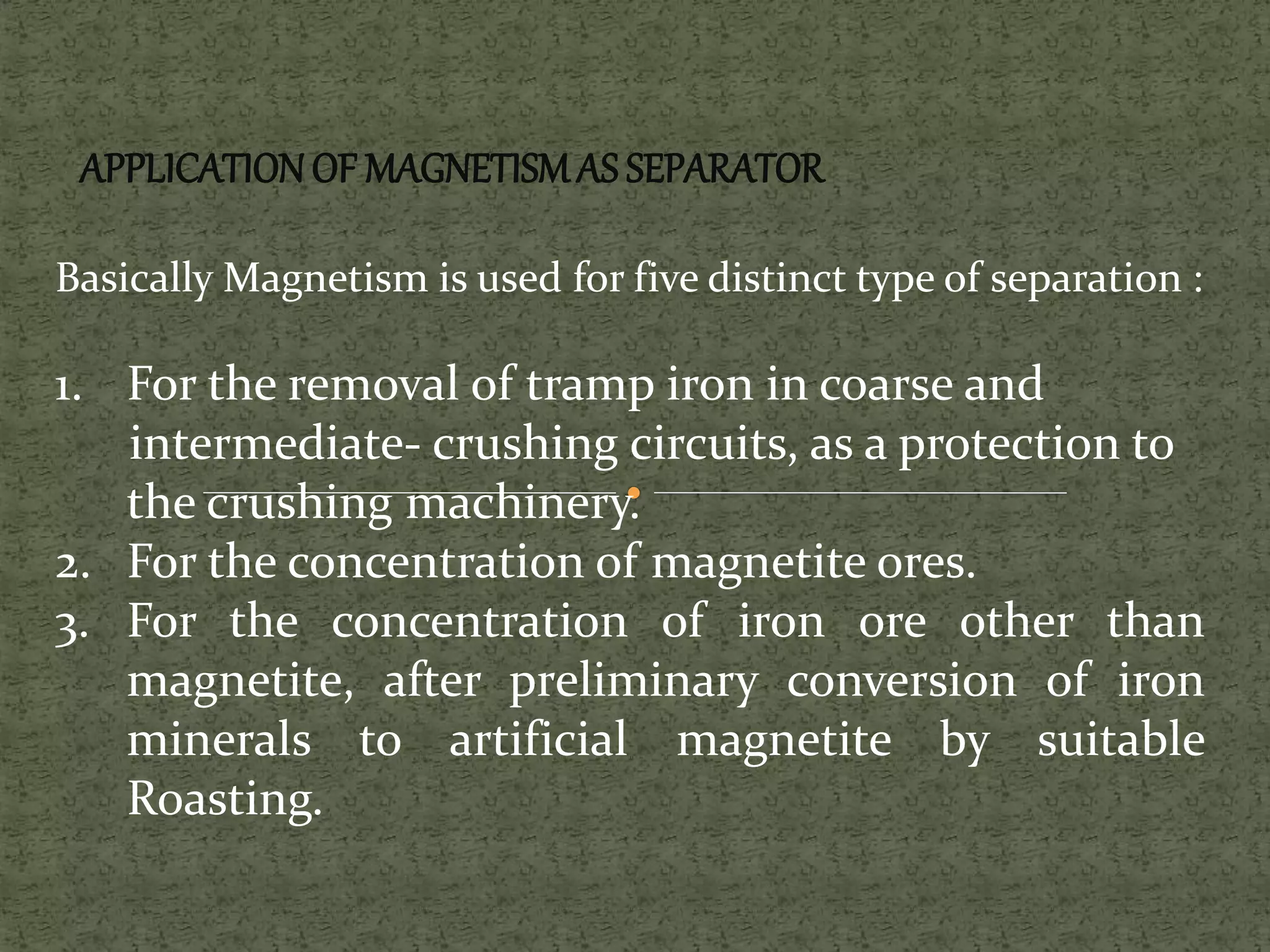
Basically Magnetism is used for five distinct type of separation :
1. For the removal of tramp iron in coarse and
intermediate- crushing circuits, as a protection to
the crushing machinery.
2. For the concentration of magnetite ores.
3. For the concentration of iron ore other than
magnetite, after preliminary conversion of iron
minerals to artificial magnetite by suitable
Roasting.
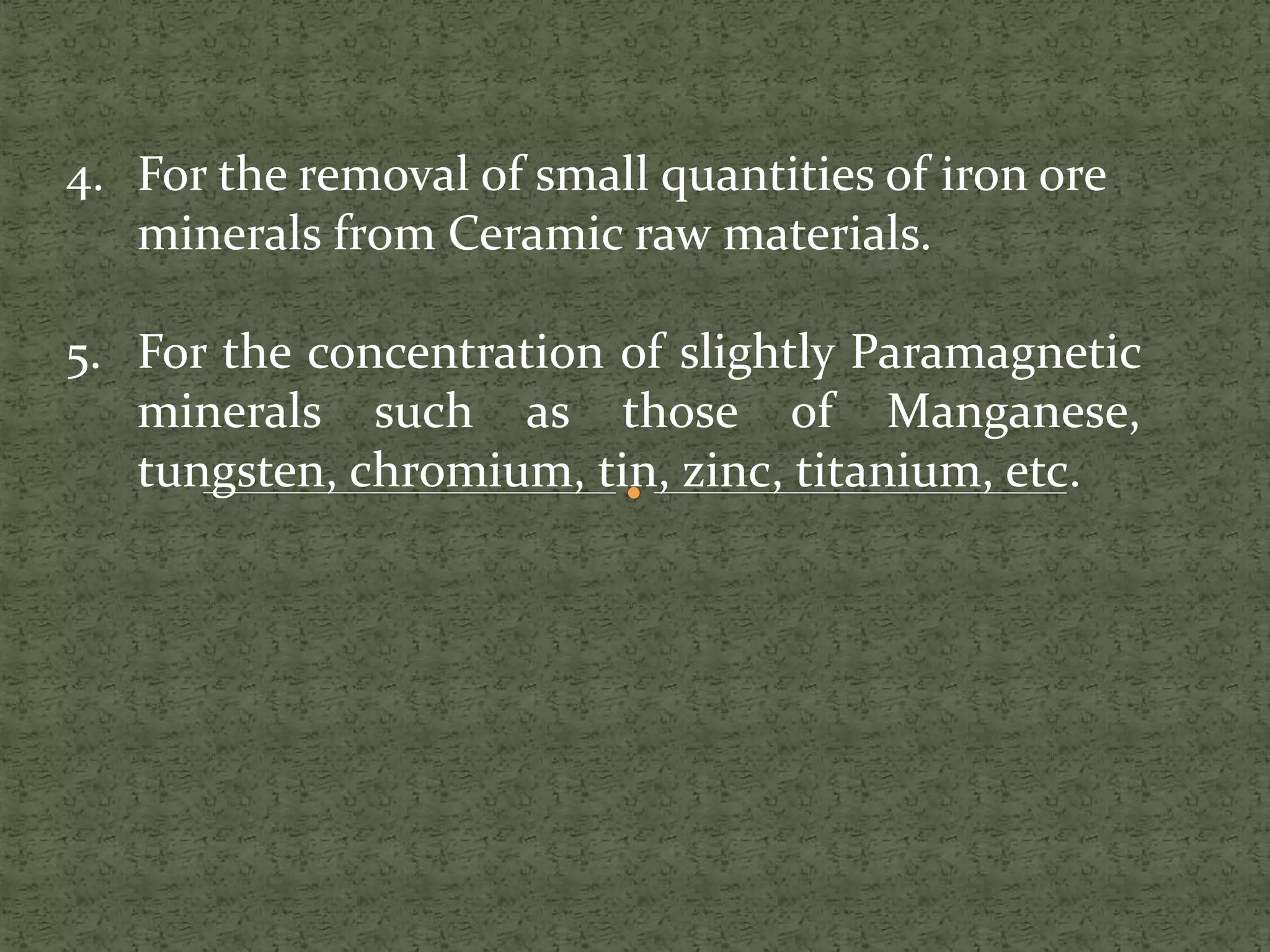
4. For the removal of small quantities of iron ore
minerals from Ceramic raw materials.
5. For the concentration of slightly Paramagnetic
minerals such as those of Manganese,
tungsten, chromium, tin, zinc, titanium, etc.
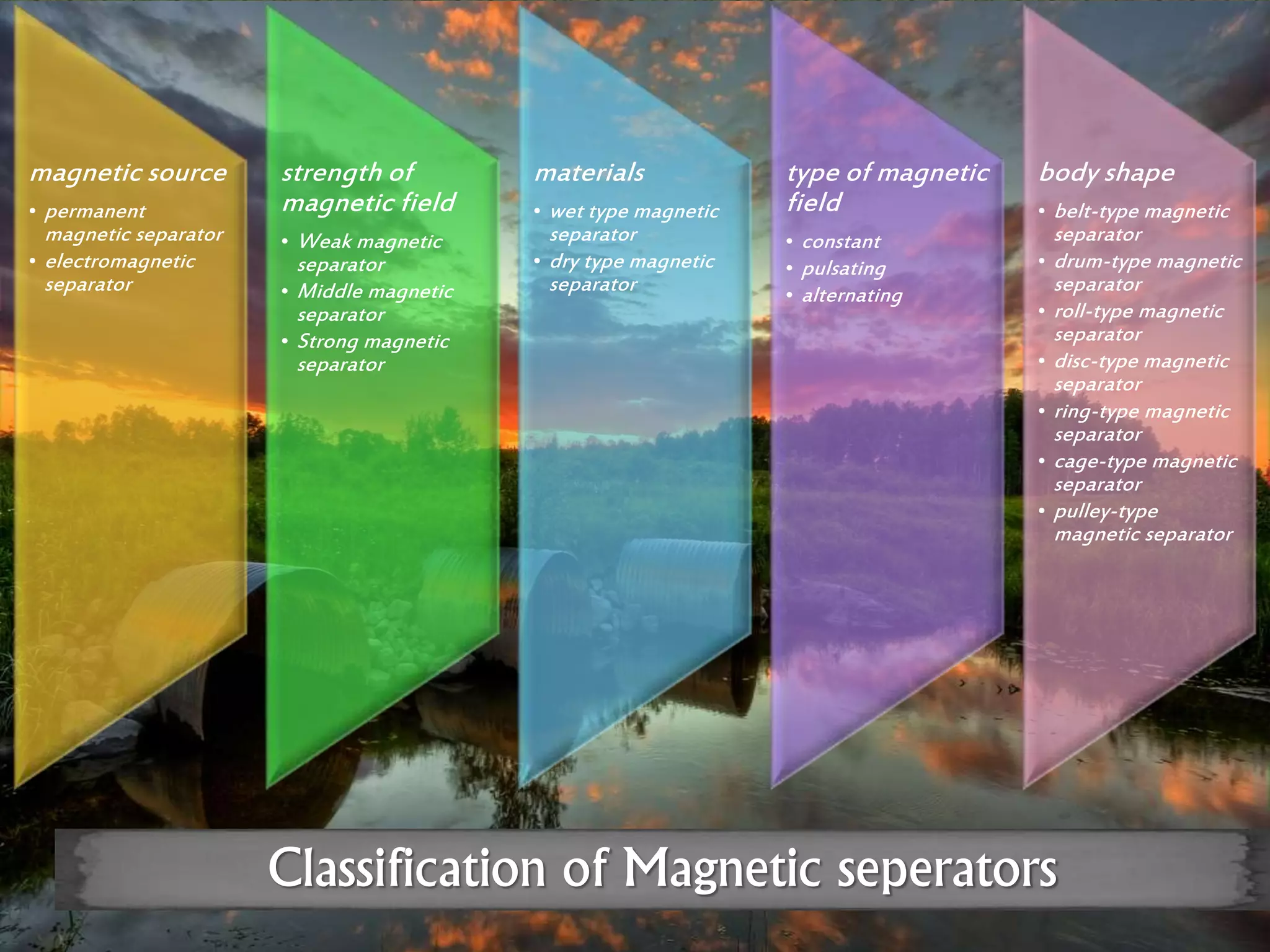
magnetic source
• permanent
magnetic separator
• electromagnetic
separator
strength of
magnetic field
• Weak magnetic
separator
• Middle magnetic
separator
• Strong magnetic
separator
materials
• wet type magnetic
separator
• dry type magnetic
separator
type of magnetic
field
• constant
• pulsating
• alternating
body shape
• belt-type magnetic
separator
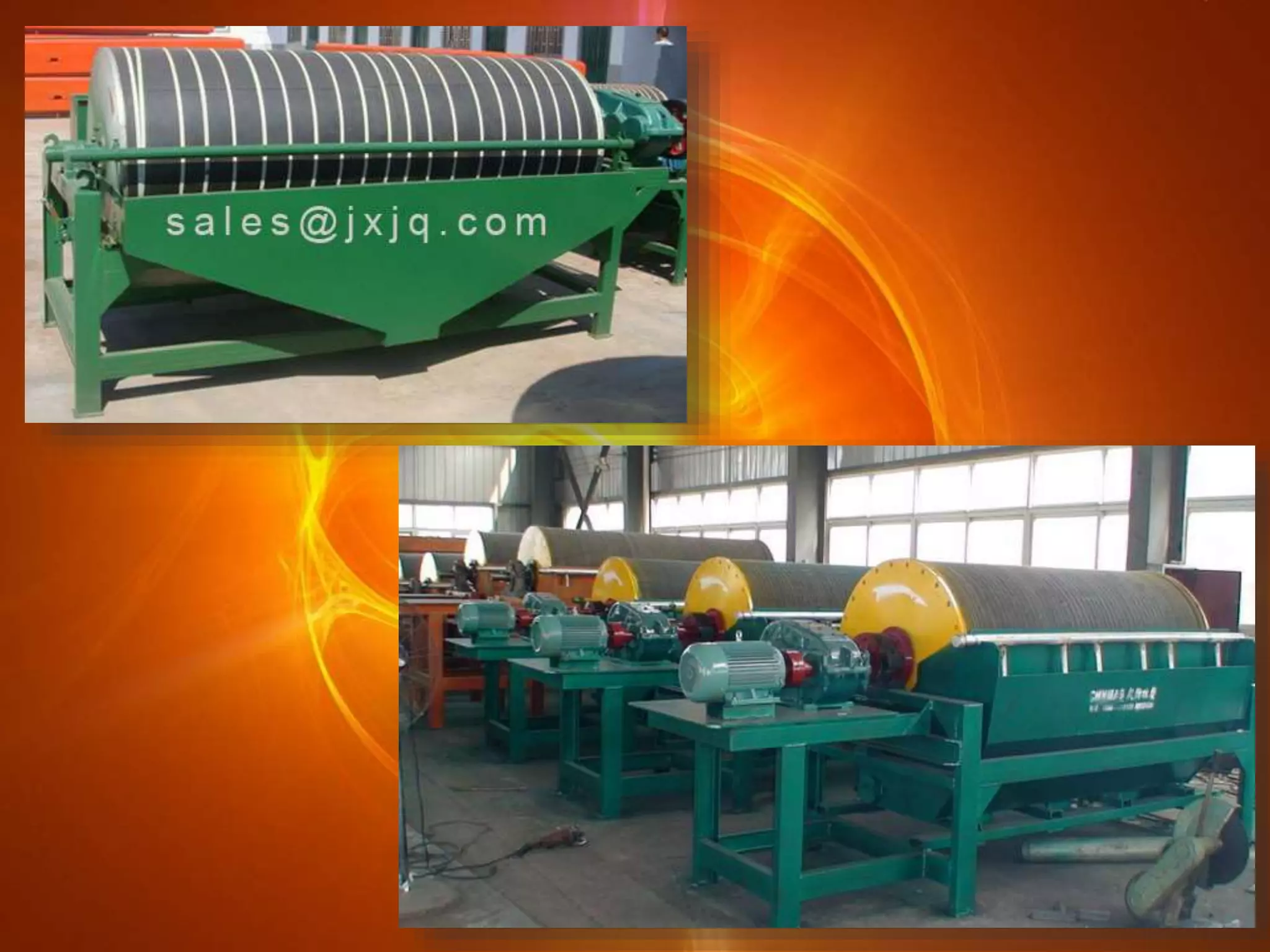
• drum-type magnetic
separator
• roll-type magnetic
separator
• disc-type magnetic
separator
• ring-type magnetic
separator
• cage-type magnetic
separator
• pulley-type
magnetic separator
Classification of Magnetic seperators
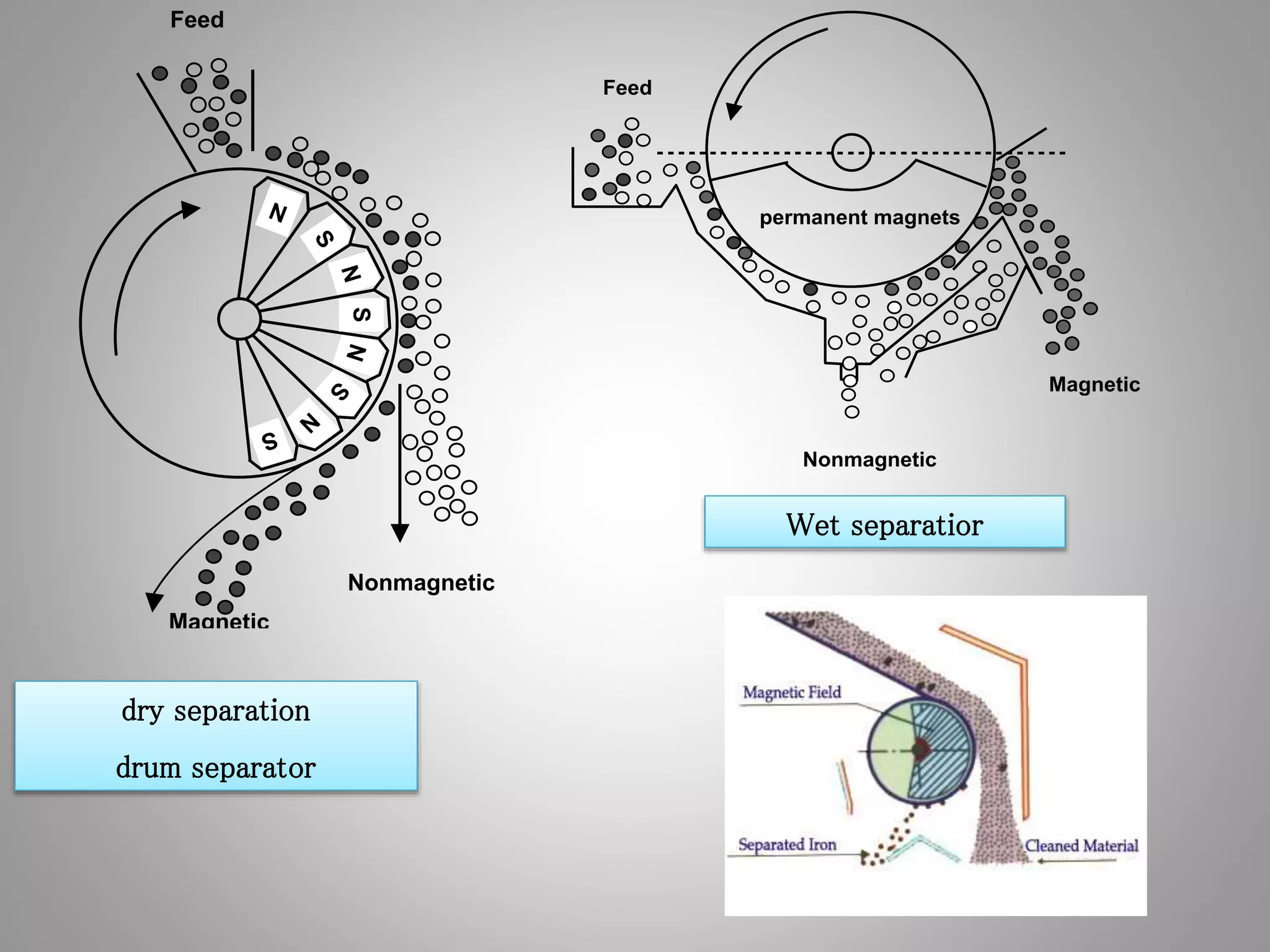
S
S
S
N
NN
Magnetic
Feed
N
S
Nonmagnetic
dry separation
drum separator
Feed
Magnetic
permanent magnets
Nonmagnetic
Wet separatior
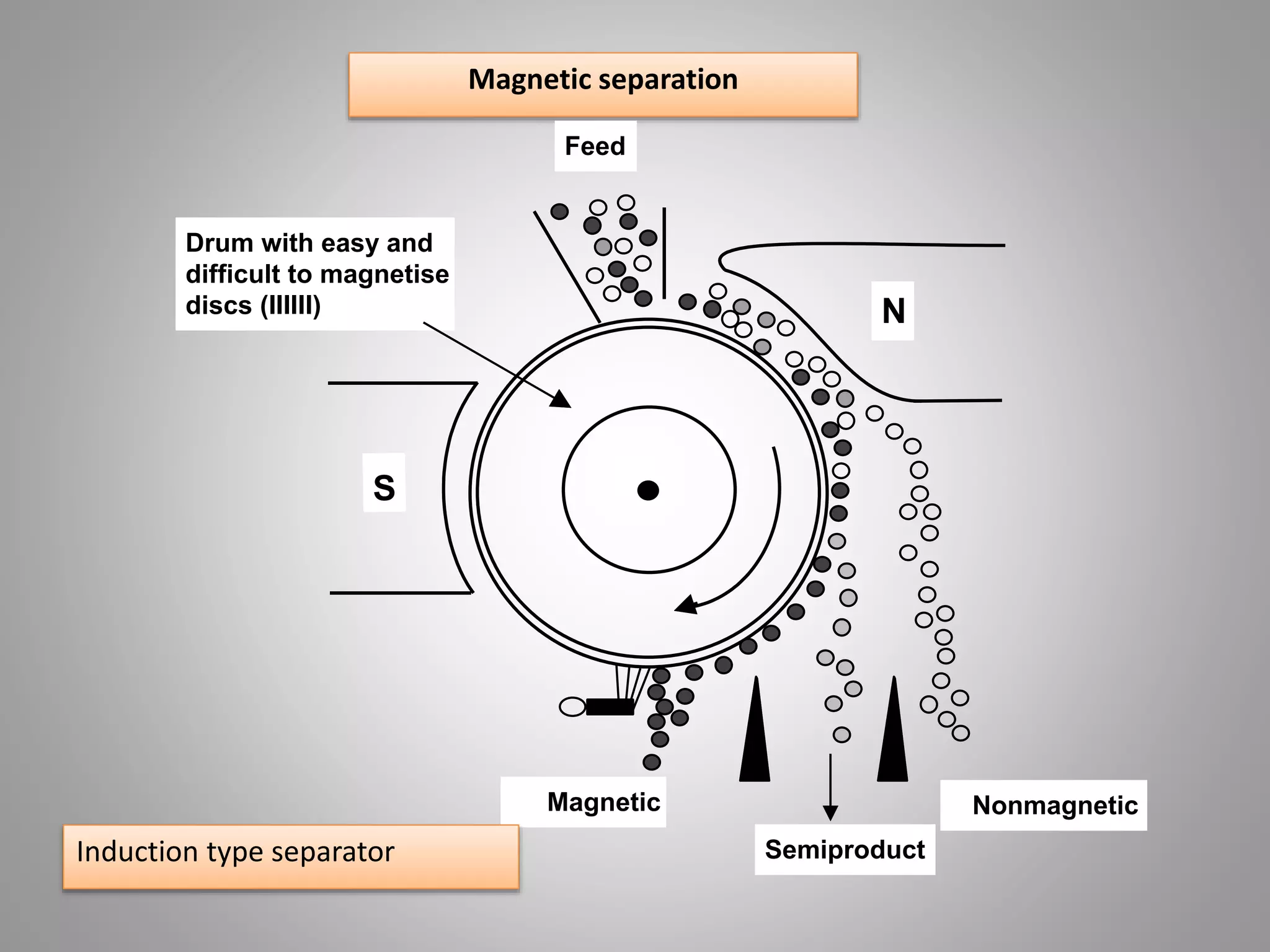
Magnetic separation
Magnetic
N
Nonmagnetic
Feed
S
Semiproduct
Drum with easy and
difficult to magnetise
discs (IIIIII)
Induction type separator
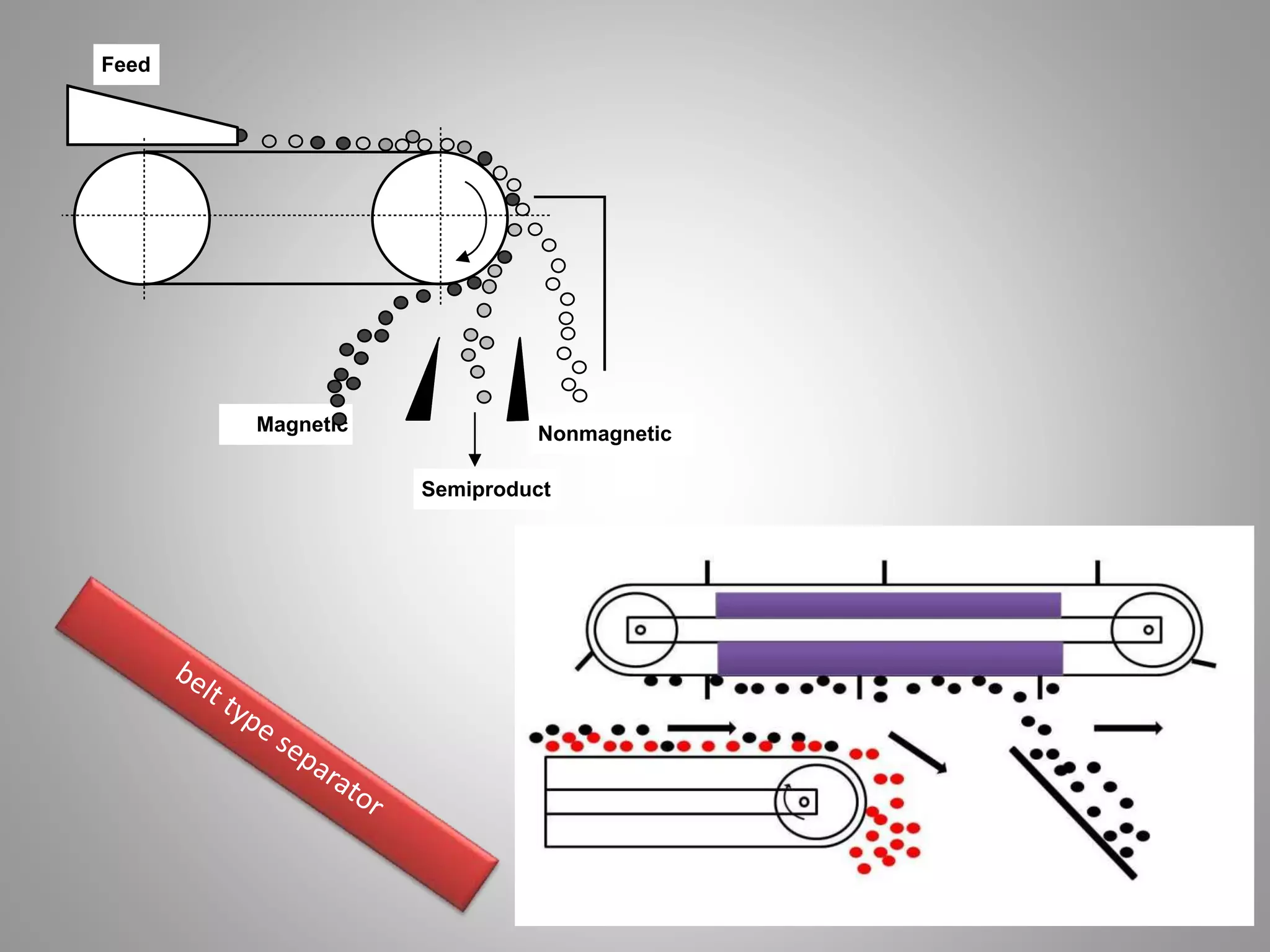
Magnetic Nonmagnetic
Semiproduct
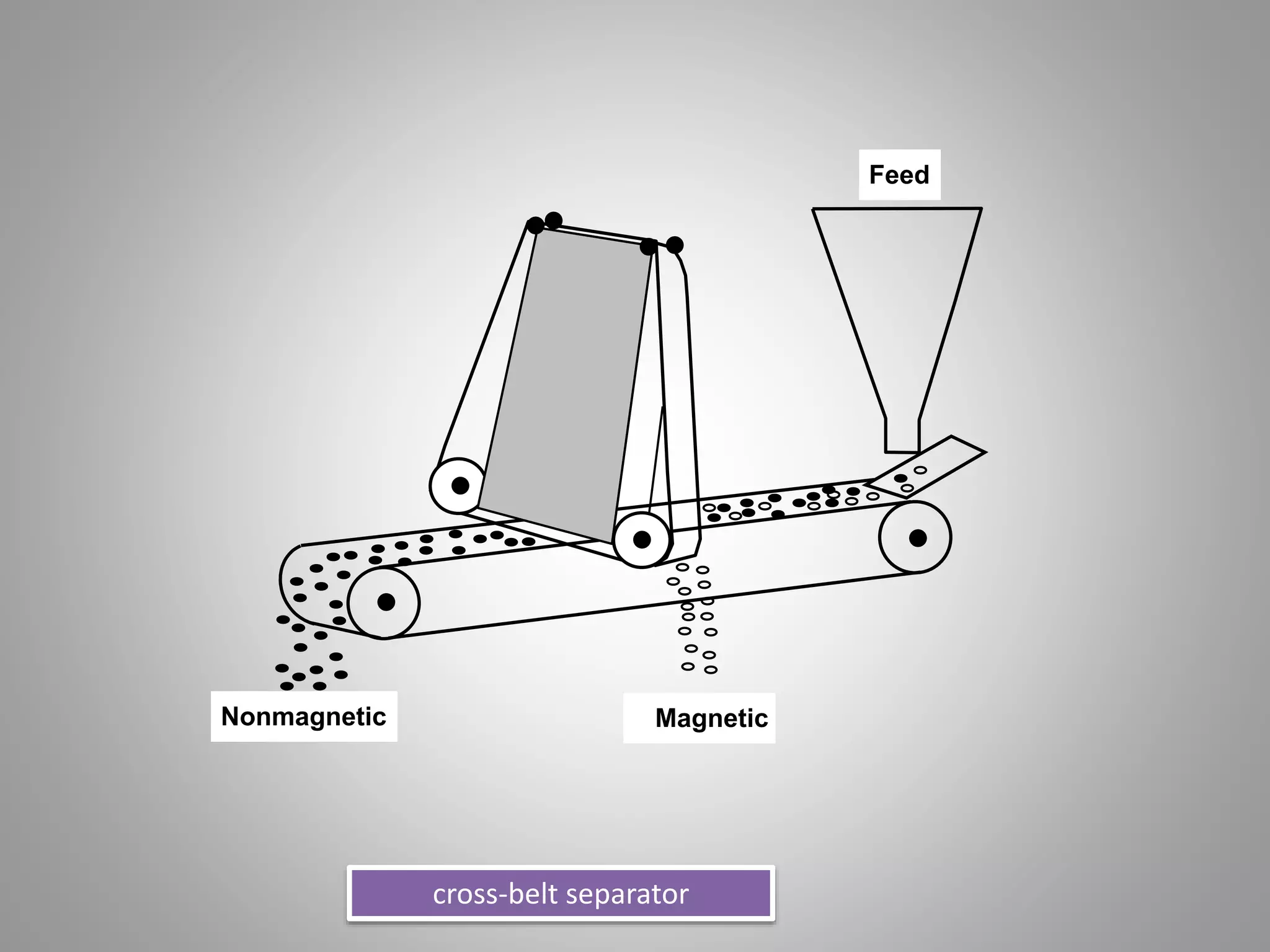
Feed
Magnetic
Feed
Nonmagnetic
cross-belt separator
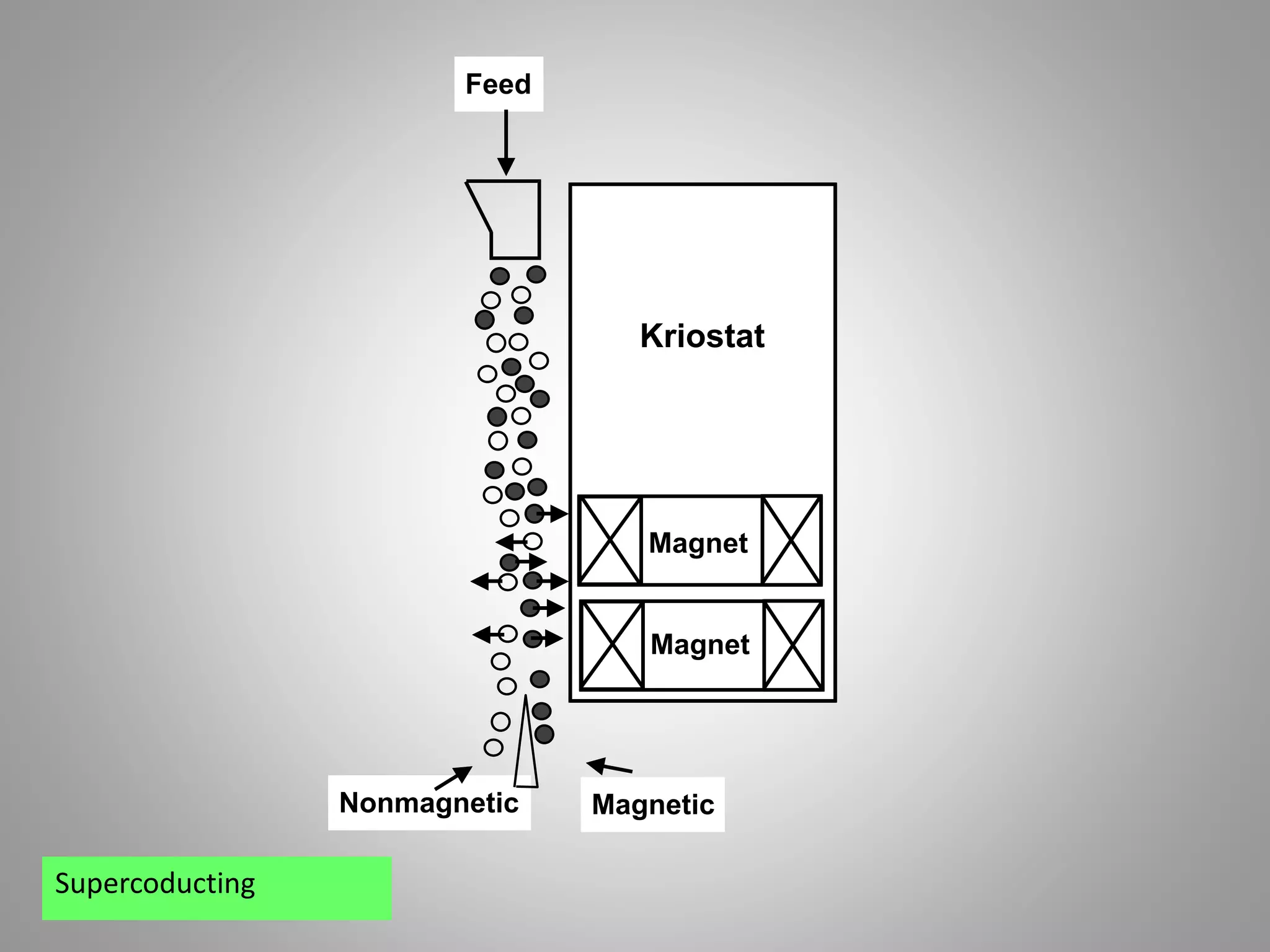
Kriostat
Magnet
Feed
Magnet
MagneticNonmagnetic
Supercoducting
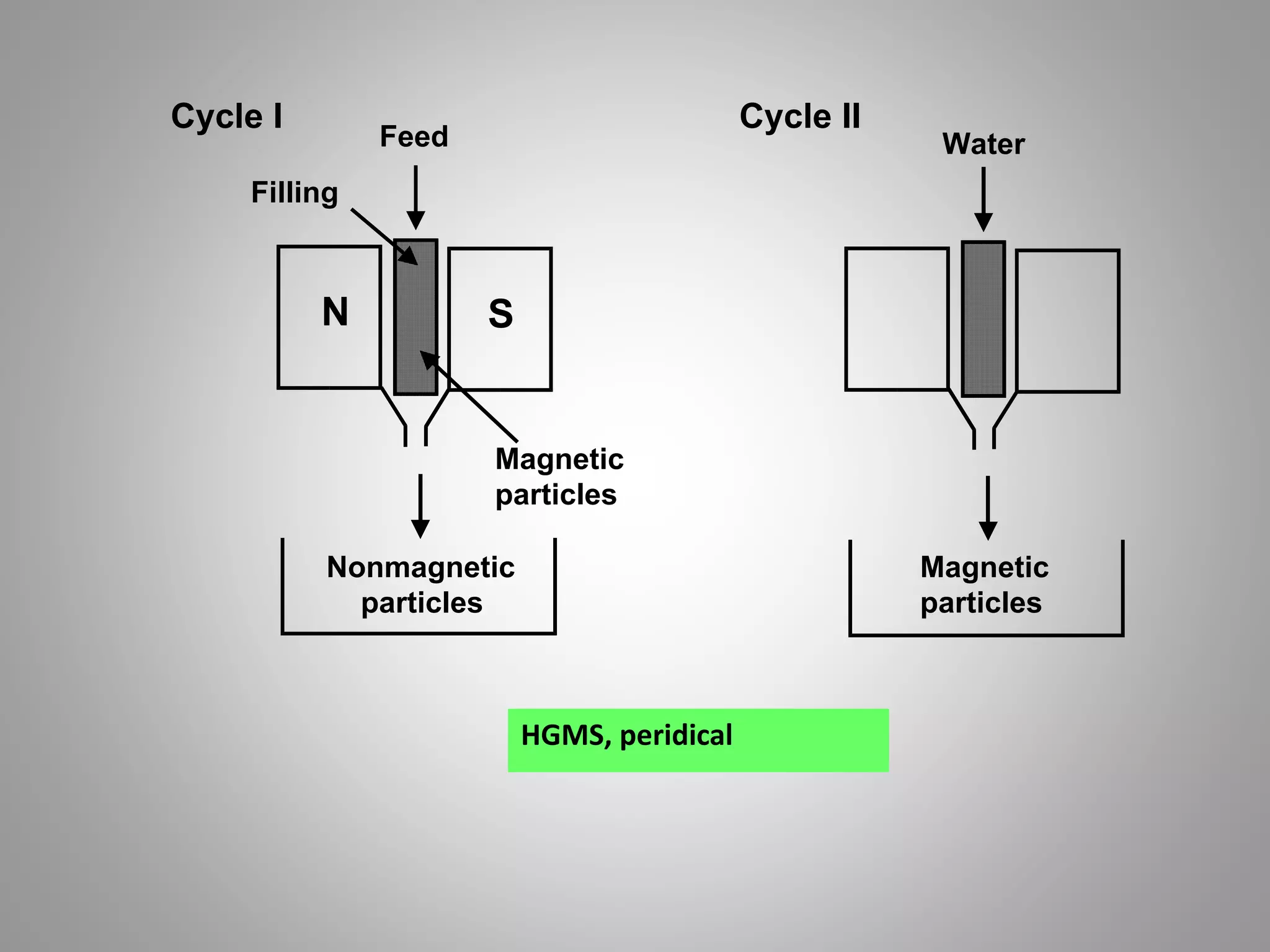
Feed
N S
Cycle I
Filling
Water
Cycle II
Magnetic
particles
Magnetic
particles
Nonmagnetic
particles
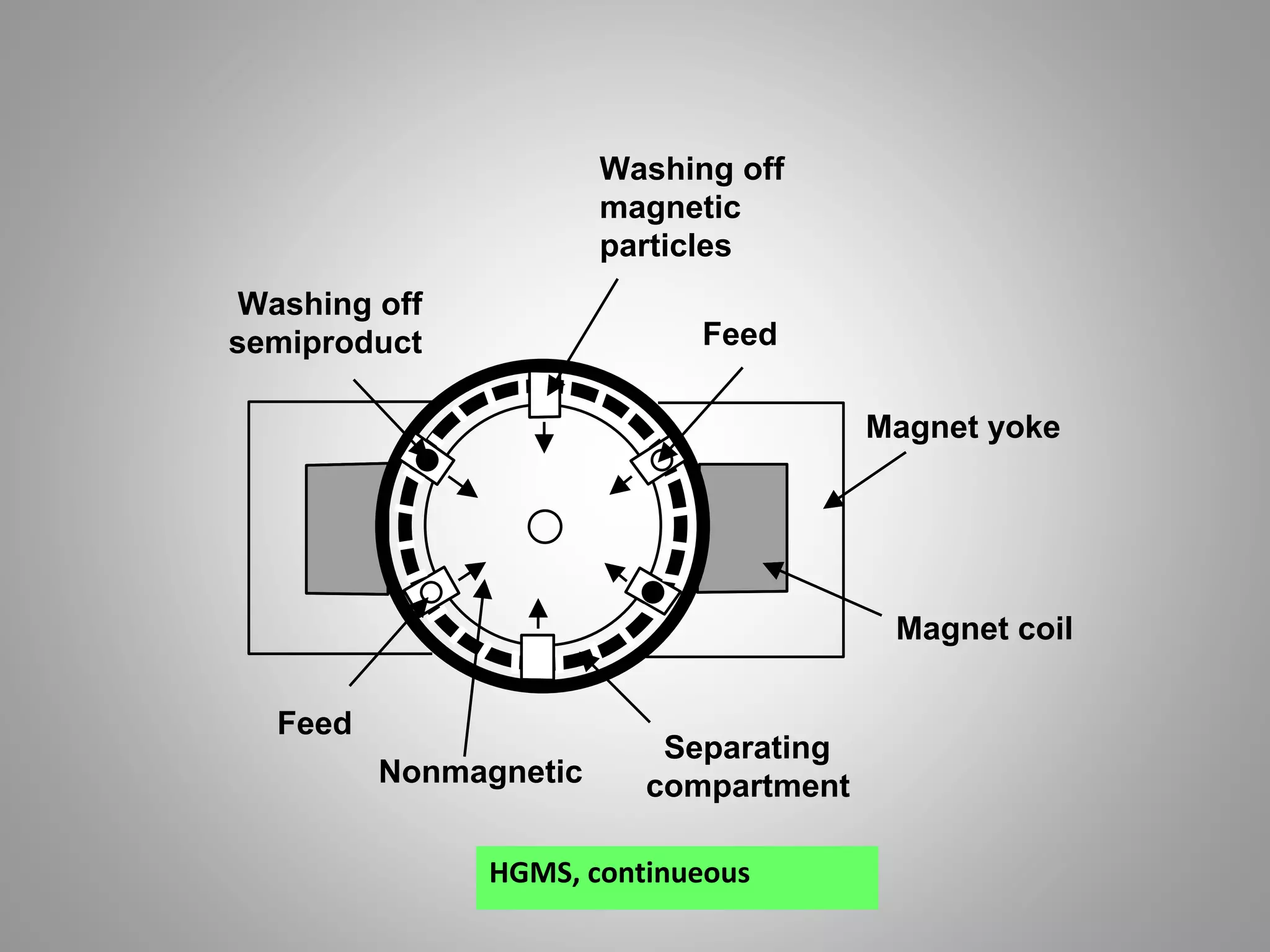
HGMS, peridical
HGMS, continueous
Feed
Feed
Nonmagnetic
Washing off
semiproduct
Separating
compartment
Washing off
magnetic
particles
Magnet coil
Magnet yoke
Magnetic seperation
Magnetic Seperation

Magnetic Seperation

  • 6.
    What are thedifferent ways of separating mixtures? • Magnetism • Hand separation • Filtration • Sifting or sieving • Extraction and evaporation • Chromatography
  • 7.
    Adsorption, adhesion ofatoms, ions or molecules of gas, liquid, or dissolved solids to a surface Centrifugation and cyclonic separation, separates based on density differences Chromatography separates dissolved substances by different interaction with (i.e., travel through) a material Crystallization Decantation Demister (vapor), removes liquid droplets from gas streams Distillation, used for mixtures of liquids with different boiling points Drying, removes liquid from a solid by vaporisation Electrophoresis, separates organic molecules based on their different interaction with a gel under an electric potential (i.e., different travel)
  • 8.
    Elutriation Extraction Leaching Liquid-liquid extraction Solid phaseextraction Flotation Dissolved air flotation, removes suspended solids non- selectively from slurry by bubbles that are generated by air coming out of solution Froth flotation, recovers valuable, hydrophobic solids by attachment to air bubbles generated by mechanical agitation of an air-slurry mixture, which float, and are recovered Deinking, separating hydrophobic ink particles from hydrophilic paper pulp in paper recycling
  • 9.
    Flocculation, separates asolid from a liquid in a colloid, by use of a flocculant, which promotes the solid clumping into flocs Filtration, Mesh, bag and paper filters are used to remove large particulates suspended in fluids (e.g., fly ash) while membrane processes including microfiltration, ultrafiltration, nanofiltration, reverse osmosis, dialysis (biochemistry) utilising synthetic membranes, separates micrometre-sized or smaller species Fractional distillation Fractional freezing Oil-water separation, gravimetrically separates suspended oil droplets from waste water in oil refineries, petrochemical and chemical plants, natural gas processing plants and similar industries Magnetic separation Precipitation Recrystallization Sedimentation, separates using vocal density pressure differences Gravity separation Sieving Stripping Sublimation Vapor-liquid separation, separates by gravity, based on the Souders-Brown equation Winnowing Zone refining
  • 11.
    INTRODUCTION # Magnetic separationis a process in which magnetically susceptible material is extracted from a mixture using a magnetic force. # Since 19th century magnetic separation processes have been used to concentrate and separate minerals.
  • 12.
    INTRODUCTION # By combiningthe different forces of magnets with gravitational or frictional forces a separation of mineral particle is possible. Two or more products are obtained depending on their commercial value, these products are concentrates, middlings, or tailings. # Ferromagnetism, paramagnetism and diamagnetism are the three important properties of the minerals which is used for Magnetic separation.
  • 16.
    APPLICATIONOF MAGNETISMAS SEPARATOR BasicallyMagnetism is used for five distinct type of separation : 1. For the removal of tramp iron in coarse and intermediate- crushing circuits, as a protection to the crushing machinery. 2. For the concentration of magnetite ores. 3. For the concentration of iron ore other than magnetite, after preliminary conversion of iron minerals to artificial magnetite by suitable Roasting.
  • 17.
    4. For theremoval of small quantities of iron ore minerals from Ceramic raw materials. 5. For the concentration of slightly Paramagnetic minerals such as those of Manganese, tungsten, chromium, tin, zinc, titanium, etc.
  • 18.
    magnetic source • permanent magneticseparator • electromagnetic separator strength of magnetic field • Weak magnetic separator • Middle magnetic separator • Strong magnetic separator materials • wet type magnetic separator • dry type magnetic separator type of magnetic field • constant • pulsating • alternating body shape • belt-type magnetic separator • drum-type magnetic separator • roll-type magnetic separator • disc-type magnetic separator • ring-type magnetic separator • cage-type magnetic separator • pulley-type magnetic separator Classification of Magnetic seperators
  • 19.
  • 20.
    Magnetic separation Magnetic N Nonmagnetic Feed S Semiproduct Drum witheasy and difficult to magnetise discs (IIIIII) Induction type separator
  • 21.
  • 22.
  • 23.
  • 24.
    Feed N S Cycle I Filling Water CycleII Magnetic particles Magnetic particles Nonmagnetic particles HGMS, peridical
  • 27.
  • 28.

Editor's Notes

  • #20 1, according to the magnetic source, the magnetic separator can be divided to permanent magnetic separator and electromagnetic separator. 2, according to the strength of magnetic field, it can be divided into:   (1) Weak magnetic separator, the surface magnetic strength HO=72-136 KA/m, magnetic force HgradH= (2.5-5.0) 1011 A/m.   (2) Middle magnetic separator, the surface magnetic strength HO=160-480 KA/m;   (3) Strong magnetic separator, the surface magnetic strength HO=480-1600 KA/m, magnetic force HgradH= (1.5-6.0) 1013 A/m. 3, according to the materials, it can be divided to wet type magnetic separator and dry type magnetic separator; 4, according to the type of magnetic field, it can be divided into constant, pulsating and alternating magnetic separator; 5, according to the body shape, it can be divided into belt-type magnetic separator, drum-type magnetic separator, roll-type magnetic separator, disc-type magnetic separator, ring-type magnetic separator, cage-type magnetic separator and pulley-type magnetic separator. In the past, the electromagnetic separator had widely used in the industrial; the body shape mainly was drum or belt type. Now, the commonly used separators are wet type and permanent magnetic separators. The weak magnetic separator is mainly used to process the ferromagnetic minerals such as magnetite, titanium magnetite and ferrosilicon. The middle magnetic separator was mainly used to process the partial oxidation and strong magnetic minerals. In the past, the strong magnetic separator was mainly used to process the coarse minerals. The dry-type strong magnetic separator was used to process the non-ferrous minerals or rare metal minerals. In the recent years, we have developed various forms of wet-type magnetic separator to process the low grade, complex composition and weak magnetic minerals, for example ring-type strong magnetic separator, cage-type and disc-type strong magnetic separator.