International Journal of Mechanical Engineering and Technology (IJMET), ISSN 0976 –
6340(Print), ISSN 0976 – 6359(Online) Volume 4, Issue 3, May - June (2013) © IAEME
191
FEM BASED MODELLING OF AMB CONTROL SYSTEM
Madhura.S†
, Pradeep B Jyoti††
, Dr.T.V.Govindaraju†††
,
†
lecturer, Mechanical Engineering Department, ShirdiSai Engineering College, Bangalore,
India
††
Head of The Electrical Engineering Department, ShirdiSai Engineering College, Bangalore,
India
†††
Principal, ShirdiSai Engineering College, Bangalore, India
ABSTRACT
Active Magnetic Bearing (AMB) sustains a rotor by magnetic attractive forces,
exclusive of any mechanical contact. This paper illustrates a field-circuit design of an active
magnetic bearing in conjunction with its control loop. The primary and underlying
specifications of the active magnetic system have been realized from a FEM study of a
magnetic bearing actuator. The position control system is grounded on working dynamics of
the local accustomed PID controller, which has been extensively employed in manufactories
oriented employment of the active magnetic bearing systems. The specifications of the
controller have been acquired by exploiting the root locus method. The realized simulation
and experimental outcomes are evaluated in event of lifting the rotor.
Keywords: Modelling, control system, magnetic bearing control system, Finite Element
Method, controller, simulation, rotor, levitation control algorithm, force, flux density transfer
function, transmittance.
1. INTRODUCTION
Active magnetic bearings assert employment in abstruse and industrial appliances to
sustain the contactless levitation of the rotor. Resolute working of apparatuses and machines,
which comprise of active magnetic bearings are realized by virtue of appurtenant magnetic
forces developed by the magnetic bearing actuator. Magnetic bearings have quite a few
leverages over mechanical and hydrostatic ones. The uttermost important improvements are
INTERNATIONAL JOURNAL OF MECHANICAL ENGINEERING
AND TECHNOLOGY (IJMET)
ISSN 0976 – 6340 (Print)
ISSN 0976 – 6359 (Online)
Volume 4, Issue 3, May - June (2013), pp. 191-202
© IAEME: www.iaeme.com/ijmet.asp
Journal Impact Factor (2013): 5.7731 (Calculated by GISI)
www.jifactor.com
IJMET
© I A E M E
International Journal of Mechanical Engineering and Technology (IJMET), ISSN 0976 –
6340(Print), ISSN 0976 – 6359(Online) Volume 4, Issue 3, May - June (2013) © IAEME
192
[9]: contactless dynamics and exemption from lubrication and contamination wear. The rotor
may be conceded to rotate at high speed; the immense circumferential speed is only
restrained by the tenacity and stableness of the rotor material and constituents. At high
operation speeds, friction losses are diminished by 5 to 20 times than in the prevailing ball or
journal bearings. Considering the dearth of mechanical wear, magnetic bearings have
superior life span and curtailed maintenance expenditure. Nonetheless, active magnetic
bearings also have its shortcomings. The contrivance of a magnetic bearing system for a
specialized employment necessitates proficiency in mechatronics, notably in mechanical and
electrical engineering and in information processing. Owing to the intricacies of the magnetic
bearing system, the expenses of procurement are considerably larger vis-a-vis conventional
bearings. Howbeit, on account of its many superiorities, active magnetic bearings have
asserted acceptance in many industrial applications, such as turbo-molecular vacuum pumps,
flywheel energy storage systems, gas turbines, compressors and machine tools.
With the aid of this thesis, the dynamic behavior of an active magnetic bearing has
been scrutinized. The illustrated dynamic model is grounded on the coil inductance, the
velocity-induced voltage coefficient and the radial force characteristic, which are computed
by the finite element method.
2. MODELLING OF THE ACTIVE MAGNETIC BEARING
2.1 Specification
The deliberate levitation actuator produces a 12-pole heteropolar bearing. The
magnetic system has been fabricated from laminated sheets of M270-50 silicon steel.
Organization of the 12-pole system is disparate from the 8-pole archetypical bearings. The
attractive force produced in y-axis is twice the force generated in the x-axis. The four control
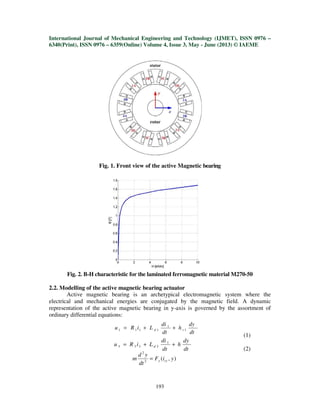
windings of the 12-pole bearing, exhibited in Figure 1, comprises of 12 coils connected
thusly: 1A-1B-1C-1D,2A-2B, 3A-3B-3C-3D and 4A-4B. The windings 1 and 3 generates the
attractiveforce along the y -axis, albeit windings 2 and 4 generate magnetic force in the x-
axis. The physical characteristics of the active magnetic bearing have been exhibited in Table
1.
TABLE 1
Specification of the radial active magneticbearing parameters
Property Value
Number of Poles 12
Stator axial length 56 mm
Stator outer diameter 104 mm
Stator inner diameter 29 mm
Rotor axial length 76 mm
Rotor diameter 28 mm
Nominal air gap 1 mm
Number of turns per pole 40
Copper wire gauge 1 mm2
Stator weight 2.6 kg
Current stiffness coefficient 13 N/A
Position Stiffness coefficient 42 N/mm
International Journal of Mechanical Engineering and Technology (IJMET), ISSN 0976 –
6340(Print), ISSN 0976 – 6359(Online) Volume 4, Issue 3, May - June (2013) © IAEME
193
Fig. 1. Front view of the active Magnetic bearing
Fig. 2. B-H characteristic for the laminated ferromagnetic material M270-50
2.2. Modelling of the active magnetic bearing actuator
Active magnetic bearing is an archetypical electromagnetic system where the
electrical and mechanical energies are conjugated by the magnetic field. A dynamic
representation of the active magnetic bearing in y-axis is governed by the assortment of
ordinary differential equations:
(1)
(2)
dt
dy
h
dt
di
LiRu vd 1
1
1111 ++=
dt
dy
h
dt
di
LiRu d ++= 1
3333
),(2
2
yiF
dt
yd
m cyy=
International Journal of Mechanical Engineering and Technology (IJMET), ISSN 0976
6340(Print), ISSN 0976 – 6359(Online) Volume 4, Issue 3, May
The voltage equations (1) actuates the electrical comportment of the active magnetic
bearing, wherein u1, u 3 are the sup
ones: i1 = iby + icy, i3 = iby - icy. R1, R3 are the winding’s resistances, Ld1, L d3 designate
the dynamic inductances of the windings and hv1, hv3 elucidates the velocity
voltage. The mechanical equations (2) actuates the dynamic model of the magnetically
suspended shaft.
An active magnetic bearing is identified by the nonlinear affiliation between the
attractive force and position of the rotor and windings currents.
Scrutinizing the opposing pair of the electromagnets the subsequent linear correlation for the
attractive force can be realized:
Fy= kiyicy
The current stiffness coefficient
as partial derivatives of the radial force
, )(
=
∂
∂
=
oycv
cvv
iv
i
yiF
k
The fundamental specifications of the active magnetic bearing actuator have been
enumerated using FEM analysis. Simulation of the magnetic bearing was actualized with
Matlab/Simulink software. The block diagram of the AMB model in the
circuit method is illustrated in Figure 3. The constituents of the block “Electromagnets 1 and
3” is shown in Figure 4.
Fig. 3. Block diagram
International Journal of Mechanical Engineering and Technology (IJMET), ISSN 0976
6359(Online) Volume 4, Issue 3, May - June (2013) © IAEME
194
The voltage equations (1) actuates the electrical comportment of the active magnetic
bearing, wherein u1, u 3 are the supply voltages, the currents i1, i3 consist of bias and control
icy. R1, R3 are the winding’s resistances, Ld1, L d3 designate
the dynamic inductances of the windings and hv1, hv3 elucidates the velocity
mechanical equations (2) actuates the dynamic model of the magnetically
An active magnetic bearing is identified by the nonlinear affiliation between the
attractive force and position of the rotor and windings currents.
pposing pair of the electromagnets the subsequent linear correlation for the
cy ksy y
The current stiffness coefficient kiy and position stiffness coefficient ksy
of the radial force Fy, [10]:
0
, )(
,
=∂
∂
=
cvi
cvv
sv
y
yiF
k
The fundamental specifications of the active magnetic bearing actuator have been
enumerated using FEM analysis. Simulation of the magnetic bearing was actualized with
link software. The block diagram of the AMB model in the y-axis for the field
circuit method is illustrated in Figure 3. The constituents of the block “Electromagnets 1 and
Fig. 3. Block diagram for the analysis of the AMB dynamics in y-axis
International Journal of Mechanical Engineering and Technology (IJMET), ISSN 0976 –
June (2013) © IAEME
The voltage equations (1) actuates the electrical comportment of the active magnetic
of bias and control
icy. R1, R3 are the winding’s resistances, Ld1, L d3 designate
the dynamic inductances of the windings and hv1, hv3 elucidates the velocity-induced
mechanical equations (2) actuates the dynamic model of the magnetically
An active magnetic bearing is identified by the nonlinear affiliation between the
pposing pair of the electromagnets the subsequent linear correlation for the
(3)
are construed
(4)
The fundamental specifications of the active magnetic bearing actuator have been
enumerated using FEM analysis. Simulation of the magnetic bearing was actualized with
axis for the field-
circuit method is illustrated in Figure 3. The constituents of the block “Electromagnets 1 and
axis
International Journal of Mechanical Engineering and Technology (IJMET), ISSN 0976
6340(Print), ISSN 0976 – 6359(Online) Volume 4, Issue 3, May
Fig. 4. The content
2.3. Finite element computation of AMB
Magneto static estimation of magnetic field distribution in the magnetic bearing was
executed by 2D Finite Element Method, employing the program FEMM 4.2 [8]. The problem
is formulated by Poisson’s equation:
Whereµ is the permeability of material,
potential in z direction, J is the current density. In the calcu
characteristics µ(B) of the ferromagnetic material, illustrated in
mock up of the active magnetic bearing has been discredited by 82356 standard triangular
International Journal of Mechanical Engineering and Technology (IJMET), ISSN 0976
6359(Online) Volume 4, Issue 3, May - June (2013) © IAEME
195
Fig. 4. The content of the block Electromagnets 1 and3"
2.3. Finite element computation of AMB
Magneto static estimation of magnetic field distribution in the magnetic bearing was
ecuted by 2D Finite Element Method, employing the program FEMM 4.2 [8]. The problem
is formulated by Poisson’s equation:
is the permeability of material, B is the magnetic flux density, A is the magnetic
is the current density. In the calcu- lation incorporates nonlinear
) of the ferromagnetic material, illustrated in Figure 2. A two
mock up of the active magnetic bearing has been discredited by 82356 standard triangular
JA
B
=








×∇×∇
µ
1
International Journal of Mechanical Engineering and Technology (IJMET), ISSN 0976 –
June (2013) © IAEME
Magneto static estimation of magnetic field distribution in the magnetic bearing was
ecuted by 2D Finite Element Method, employing the program FEMM 4.2 [8]. The problem
the magnetic vector
lation incorporates nonlinear
Figure 2. A two-dimensional
mock up of the active magnetic bearing has been discredited by 82356 standard triangular
International Journal of Mechanical Engineering and Technology (IJMET), ISSN 0976 –
6340(Print), ISSN 0976 – 6359(Online) Volume 4, Issue 3, May - June (2013) © IAEME
196
elements(Fig. 5a). Computation of the magnetic bearing forces by the Maxwell's stress tensor
method necessitates a closed surface that envelopes the rotor in free space [1]. For that
reason, the air gap area was split into two subareas amidst stator and rotor (Fig. 5b). In
consideration of solving equation (5) the boundary conditions have to be ascertained. As a
result, on the outer edges of the calculation area Dirichlet boundary conditions have been
assumed.
Fig. 5.Discretization of the model Fig. 6. The finite element mesh in the
subregions of stator and rotor
In light of equation (5) solution, the circulation of the Az component for magnetic vector
potential has been realized. Consequently, the vector of magnetic field distribution is
ascertained as:
(6)
Assuming the 2D field, the magnetic flux of the coils has been calculated from:
(7)
whereN connotes the number of turns of the coil, Az,i+ and Az,i- are the vector potentials on the
positive and negative sides of the coil turn, correspondingly.
The dynamic inductance is calculated as partial derivative of the flux with respect to
the current i:
ol
Ld
ψ∂
= (8)
y
z
x
z
x
A
y
A
B 11
∂
∂
−
∂
∂
=
)(.
1 1
1 −
= =
+ −==Ψ ∑∫ ∑ zj
N
i l
N
i
zj AAldlA
International Journal of Mechanical Engineering and Technology (IJMET), ISSN 0976 –
6340(Print), ISSN 0976 – 6359(Online) Volume 4, Issue 3, May - June (2013) © IAEME
197
while the velocity-induced voltage is derived as partial derivative of the flux with respect to
the displacement s:
os
hv
ψ∂
= (9)
The displacement "s" connotes "y" or "x" movement. The radial force is derived by
Maxwell's stress tensor method, in which the electromagneticforce is deduced as surface
integral:
dsBHnHnBBnHF )}.().().({
2
1
−+= ∫ (10)
where H is the magnetic field intensity and n is the unit surface perpendicular to S .
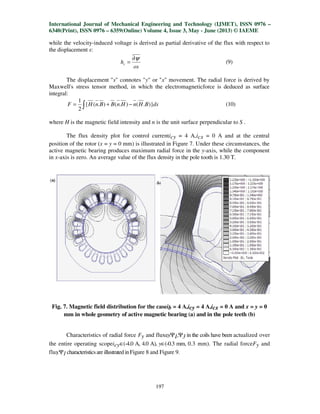
The flux density plot for control currenticy = 4 A,icx = 0 A and at the central
position of the rotor (x = y = 0 mm) is illustrated in Figure 7. Under these circumstances, the
active magnetic bearing produces maximum radial force in the y-axis, while the component
in x-axis is zero. An average value of the flux density in the pole tooth is 1.30 T.
Fig. 7. Magnetic field distribution for the caseib = 4 A,icy = 4 A,icx = 0 A and x = y = 0
mm in whole geometry of active magnetic bearing (a) and in the pole teeth (b)
Characteristics of radial force Fy and fluxesΨ1,Ψ3 in the coils have been actualized over
the entire operating scopeicy∈(-4.0 A, 4.0 A), y∈(-0.3 mm, 0.3 mm). The radial forceFy and
fluxΨ1characteristicsareillustratedinFigure 8 and Figure 9.
International Journal of Mechanical Engineering and Technology (IJMET), ISSN 0976 –
6340(Print), ISSN 0976 – 6359(Online) Volume 4, Issue 3, May - June (2013) © IAEME
198
Fig. 8. Radial force characteristicFy(icy,y) Fig. 9. Flux characteristicΨ1(icy,y)
Fig. 10. Dynamic inductance Fig. 11. The velocity-induced voltage
characteristicLd1(icy,y) char- acteristic hv1(icy,y)
2.4. Control system for the Active Magnetic Bearing
Lately there have been new developments and improvisation of various algorithms to
manipulate the active magnetic bearings. The most decisive and momentous ones are: PID
control [4], gain scheduled control [2], robust H∞ control [6], LQ control [11], fuzzy logic
control [5], feedback linearization control [7]. Regardless of comprehensive and accelerated
development of the advanced control algorithms for the active magnetic bearing, the
industrial applications of the magnetic bearing were generally grounded on digital or analog
PID controllers.
The transformation function of the current controlled active magnetic bearing in y-
axis is governed by the following equation:
sv
iv
AMB
kms
k
sG
−
= 2
)( (11)
International Journal of Mechanical Engineering and Technology (IJMET), ISSN 0976 –
6340(Print), ISSN 0976 – 6359(Online) Volume 4, Issue 3, May - June (2013) © IAEME
199
The poles of the transfer function exemplifies an unstable system, since one of the
poles has a positive value. Therefore, the active magnetic bearing necessitates a control
system. Stable fuctioning can be realized with decentralized PID controller, with the transfer
function [3]:
DIpPID sKKKsG s
++=)( (12)
The block diagram of the control system with PID controller for y-axis is illustrated
in Figure 12, whereyr(t) connotes the reference value of the rotor position (generally equal to
zero),icy(t) is the reference control current and y(t) is position of the rotor.
Fig. 12. Block diagram of the control system
Laplace transfer function of the closed loop is described by the transmittance:
(13)
The closed-loop system with the PID controller has three polesλ1,λ2,λ3. To deduce the
magnitude of KP, KI, KD, the coefficients of the denominator of GCL(s) in Eq. 13 should be
evaluated against coefficients of the polynomial form:
321313221
2
321
3
)()( λλλλλλλλλλλλ +++++++ sss (14)
As a result, the specifications of the PID controller are equal to:
iv
p
k
K
)( 133221 λλλλλλ ++
= (15)
iv
I
k
m
K 321 λλλ
=
iyD kmK }){( 321 λλλ −−−=
Position of the polesλ1,λ2,λ3 in the s-plane influences the characteristicsof the transients. According to
the pole placement method [4] two poles can be determined from:
21 1 ζωζωλ −+−= nn i
22 1 ζωζωλ −+−= nn i (16)
m
kK
S
m
Kpk
S
m
kK
S
m
kK
S
m
Kpk
S
m
kK
sG
iyIiyiyD
iyIiyiyD
CL
+++
++
=
23
2
)(
International Journal of Mechanical Engineering and Technology (IJMET), ISSN 0976 –
6340(Print), ISSN 0976 – 6359(Online) Volume 4, Issue 3, May - June (2013) © IAEME
200
Where inωnistheundamped naturalfrequency:
ζ
ω
s
n
t
6.4
= (17)
The third pole of transfer function of GCL(s) should be positioned outside the
dominant area. Subsiquently, the coefficients KP, KI, KD rely on the settling timetS and
damping ratioζ.
3. SIMULATION AND EXPERIMENTAL RESULTS
To stabilize the rotor two decoupled PID controllers were employed. The control
tasks have been accomplished with 32-bit microcontroller with very proficient ARM7TDMI-
S core. The sampling frequency of PID controllers are equal to 1 kHz. The location of the
rotor is measured by Turck contact-less inductive sensor with bandwidth 200 Hz. The analog to
digital converters resolution equals 2.44µm. The parameters of PID controllers were determined
accor- ding to the proposed method for the settling time tS = 50 ms and the damping
coefficientζ=0.5.The values of parameters of PID controllers are shown in Table 2.
TABLE 2
Parameters of the PID controller
KP[A/m] KI[A/ms] KD[ms/m]
11231 514080 45
Figures 13 and 14 illustrate the contrast of simulated and experimental outcomes
throughout rotor lifting. The curve characters of the properties are close to the measured ones.
It is evident that the current value in the steady state is marginally higher than in the real
system.
Fig. 13.Time response of currenti1 Fig. 14. Time response of the AMB shaft
displacement in y-axis
International Journal of Mechanical Engineering and Technology (IJMET), ISSN 0976 –
6340(Print), ISSN 0976 – 6359(Online) Volume 4, Issue 3, May - June (2013) © IAEME
201
The transient state for the rotor position for both systems diversifies, owing to the fact
that the settling time in the simulated system is shorter than in the real one. Contrarieties are
result of the simplified modelling of the magnetic bearing's actuator, specifically because of
overlooking the hysteresis phenomena and the fringing effect.
4. REMARKS AND CONCLUSION
This thesis demonstrates a modus-operandi for designing control systems for active
magnetic bearings. The dynamic behavior of active magnetic bearings has been realized from a
field-circuit model. The fundamental parameters of the active magnetic bearing actuator have
been deduced using FEM analysis .
The illustrated technique for designing PID controllers makes manipulating the
controller specifications simpler and promises acceptable damping.
LITERATURE
[1.] Antila M., Lantto E., Arkkio A.: Determination of Forces and Linearized Parameters
of Radial Active Magnetic Bearings by Finite Element Technique, IEEE Transaction
On Magnetics, Vol. 34, No. 3, 1998, pp. 684-694.
[2.] Betschon F., Knospe C.R.: Reducing magnetic bearing currents via gain scheduled
adaptive control, IEEE/ASME Transactions on Mechatronics, Vol. 6, No. 4, 12.2001,
pp. 437-443.
[3.] FranklinG.: Feedback control of dynamic systems, Prentice Hall, New Jersey, 2002.
[4.] Gosiewski Z., Falkowski K.: Wielofunkcyjneło yskamagnetyczne,
BibliotekaNaukowa InstytutuLotnictwa, Warszawa, 2003.
[5.] Hung. J.Y.: Magnetic bearing control using fuzzy logic, IEEE Transactions on
Industry Applications, Vol. 31, No. 6, 11.1995, pp. 1492-1497.
[6.] Lantto E.: Robust Control of Magnetic Bearings in Subcritical Machines, PhD thesis,
Espoo, 1999.
[7.] Lindlau J., Knospe C.: Feedback Linearization of an Active Magnetic Bearing With
Voltage Control, IEEE Transactions on Control Systems Technology, Vol. 10, No.1,
01.2002, pp. 21-31.
[8.] Meeker D.: Finite Element Method Magnetics Version 4.2, User's Manual, University
of Virginia, U.S.A, 2009.
[9.] Schweitzer G., Maslen E.: Magnetic Bearings, Theory, Design and Application to
Rotating Machinery, Springer, Berlin, 2009.
[10.] Tomczuk B., Zimon J.: Filed Determination and Calculation of Stiffness Parameters in
an Active Magnetic Bearing (AMB), Solid State Phenomena, Vol. 147-149, 2009, pp.
125-130.
[11.] Zhuravlyov Y.N.: On LQ-control of magnetic bearing, IEEE Transactions On Control
Systems Technology, Vol. 8, No. 2, 03.2000, pp. 344-355.
[12.] H. Mellah and K. E. Hemsas, “Design and Simulation Analysis of Outer Stator Inner
Rotor Dfig by 2d and 3d Finite Element Methods”, International Journal of Electrical
Engineering & Technology (IJEET), Volume 3, Issue 2, 2012, pp. 457 - 470,
ISSN Print : 0976-6545, ISSN Online: 0976-6553.
[13.] Siwani Adhikari, “Theoretical and Experimental Study of Rotor Bearing Systems for
Fault Diagnosis”, International Journal of Mechanical Engineering & Technology
(IJMET), Volume 4, Issue 2, 2013, pp. 383 - 391, ISSN Print: 0976 – 6340, ISSN
Online: 0976 – 6359.
International Journal of Mechanical Engineering and Technology (IJMET), ISSN 0976 –
6340(Print), ISSN 0976 – 6359(Online) Volume 4, Issue 3, May - June (2013) © IAEME
202
AUTHORS DETAIL
Madhura.S
Obtained her BE from Visveswaraya Technological University in the
year 2008, ME in Machine Design from Anna University. Coimbatore
in the year 2011.Currently Pursuing Ph.D – Failure analysis of Active
Magnetic Bearing and its correction using smart controller under the
guidance of Dr.T.V.Govindaraju.Field of interest Machine design,
FEM techniques and mechatronics.
Pradeep B Jyoti
Graduated from Karnataka University Dharwad, Karnataka in the year
1986, M.E from Gulbarga University, Gulbarga in the year 1989. He
is currently pursuing Ph.D at Jawaharlal Nehru Technological
University, Hyderabad, India. He is presently working as Professor &
Head in the Department of Electrical and Electronics ShirdiSai
Engineering College, Bangalore, Karnataka, India. His research areas
include SVPWM techniques, and Vector control of electrical drives &
machines.
Dr.T.V.Govindaraju
Obtained his Ph.D in the field of” experimental techniques (photo
elasticity)” in the year 2000 from Bangalore University. His current
field of interest are Machine design, FEM techniques and
Mechatronics. Presently involved in guiding Research scholars leading
to Ph.D program.

Fem based modelling of amb control system 2

  • 1.
    International Journal ofMechanical Engineering and Technology (IJMET), ISSN 0976 – 6340(Print), ISSN 0976 – 6359(Online) Volume 4, Issue 3, May - June (2013) © IAEME 191 FEM BASED MODELLING OF AMB CONTROL SYSTEM Madhura.S† , Pradeep B Jyoti†† , Dr.T.V.Govindaraju††† , † lecturer, Mechanical Engineering Department, ShirdiSai Engineering College, Bangalore, India †† Head of The Electrical Engineering Department, ShirdiSai Engineering College, Bangalore, India ††† Principal, ShirdiSai Engineering College, Bangalore, India ABSTRACT Active Magnetic Bearing (AMB) sustains a rotor by magnetic attractive forces, exclusive of any mechanical contact. This paper illustrates a field-circuit design of an active magnetic bearing in conjunction with its control loop. The primary and underlying specifications of the active magnetic system have been realized from a FEM study of a magnetic bearing actuator. The position control system is grounded on working dynamics of the local accustomed PID controller, which has been extensively employed in manufactories oriented employment of the active magnetic bearing systems. The specifications of the controller have been acquired by exploiting the root locus method. The realized simulation and experimental outcomes are evaluated in event of lifting the rotor. Keywords: Modelling, control system, magnetic bearing control system, Finite Element Method, controller, simulation, rotor, levitation control algorithm, force, flux density transfer function, transmittance. 1. INTRODUCTION Active magnetic bearings assert employment in abstruse and industrial appliances to sustain the contactless levitation of the rotor. Resolute working of apparatuses and machines, which comprise of active magnetic bearings are realized by virtue of appurtenant magnetic forces developed by the magnetic bearing actuator. Magnetic bearings have quite a few leverages over mechanical and hydrostatic ones. The uttermost important improvements are INTERNATIONAL JOURNAL OF MECHANICAL ENGINEERING AND TECHNOLOGY (IJMET) ISSN 0976 – 6340 (Print) ISSN 0976 – 6359 (Online) Volume 4, Issue 3, May - June (2013), pp. 191-202 © IAEME: www.iaeme.com/ijmet.asp Journal Impact Factor (2013): 5.7731 (Calculated by GISI) www.jifactor.com IJMET © I A E M E
  • 2.
    International Journal ofMechanical Engineering and Technology (IJMET), ISSN 0976 – 6340(Print), ISSN 0976 – 6359(Online) Volume 4, Issue 3, May - June (2013) © IAEME 192 [9]: contactless dynamics and exemption from lubrication and contamination wear. The rotor may be conceded to rotate at high speed; the immense circumferential speed is only restrained by the tenacity and stableness of the rotor material and constituents. At high operation speeds, friction losses are diminished by 5 to 20 times than in the prevailing ball or journal bearings. Considering the dearth of mechanical wear, magnetic bearings have superior life span and curtailed maintenance expenditure. Nonetheless, active magnetic bearings also have its shortcomings. The contrivance of a magnetic bearing system for a specialized employment necessitates proficiency in mechatronics, notably in mechanical and electrical engineering and in information processing. Owing to the intricacies of the magnetic bearing system, the expenses of procurement are considerably larger vis-a-vis conventional bearings. Howbeit, on account of its many superiorities, active magnetic bearings have asserted acceptance in many industrial applications, such as turbo-molecular vacuum pumps, flywheel energy storage systems, gas turbines, compressors and machine tools. With the aid of this thesis, the dynamic behavior of an active magnetic bearing has been scrutinized. The illustrated dynamic model is grounded on the coil inductance, the velocity-induced voltage coefficient and the radial force characteristic, which are computed by the finite element method. 2. MODELLING OF THE ACTIVE MAGNETIC BEARING 2.1 Specification The deliberate levitation actuator produces a 12-pole heteropolar bearing. The magnetic system has been fabricated from laminated sheets of M270-50 silicon steel. Organization of the 12-pole system is disparate from the 8-pole archetypical bearings. The attractive force produced in y-axis is twice the force generated in the x-axis. The four control windings of the 12-pole bearing, exhibited in Figure 1, comprises of 12 coils connected thusly: 1A-1B-1C-1D,2A-2B, 3A-3B-3C-3D and 4A-4B. The windings 1 and 3 generates the attractiveforce along the y -axis, albeit windings 2 and 4 generate magnetic force in the x- axis. The physical characteristics of the active magnetic bearing have been exhibited in Table 1. TABLE 1 Specification of the radial active magneticbearing parameters Property Value Number of Poles 12 Stator axial length 56 mm Stator outer diameter 104 mm Stator inner diameter 29 mm Rotor axial length 76 mm Rotor diameter 28 mm Nominal air gap 1 mm Number of turns per pole 40 Copper wire gauge 1 mm2 Stator weight 2.6 kg Current stiffness coefficient 13 N/A Position Stiffness coefficient 42 N/mm
  • 3.
    International Journal ofMechanical Engineering and Technology (IJMET), ISSN 0976 – 6340(Print), ISSN 0976 – 6359(Online) Volume 4, Issue 3, May - June (2013) © IAEME 193 Fig. 1. Front view of the active Magnetic bearing Fig. 2. B-H characteristic for the laminated ferromagnetic material M270-50 2.2. Modelling of the active magnetic bearing actuator Active magnetic bearing is an archetypical electromagnetic system where the electrical and mechanical energies are conjugated by the magnetic field. A dynamic representation of the active magnetic bearing in y-axis is governed by the assortment of ordinary differential equations: (1) (2) dt dy h dt di LiRu vd 1 1 1111 ++= dt dy h dt di LiRu d ++= 1 3333 ),(2 2 yiF dt yd m cyy=
  • 4.
    International Journal ofMechanical Engineering and Technology (IJMET), ISSN 0976 6340(Print), ISSN 0976 – 6359(Online) Volume 4, Issue 3, May The voltage equations (1) actuates the electrical comportment of the active magnetic bearing, wherein u1, u 3 are the sup ones: i1 = iby + icy, i3 = iby - icy. R1, R3 are the winding’s resistances, Ld1, L d3 designate the dynamic inductances of the windings and hv1, hv3 elucidates the velocity voltage. The mechanical equations (2) actuates the dynamic model of the magnetically suspended shaft. An active magnetic bearing is identified by the nonlinear affiliation between the attractive force and position of the rotor and windings currents. Scrutinizing the opposing pair of the electromagnets the subsequent linear correlation for the attractive force can be realized: Fy= kiyicy The current stiffness coefficient as partial derivatives of the radial force , )( = ∂ ∂ = oycv cvv iv i yiF k The fundamental specifications of the active magnetic bearing actuator have been enumerated using FEM analysis. Simulation of the magnetic bearing was actualized with Matlab/Simulink software. The block diagram of the AMB model in the circuit method is illustrated in Figure 3. The constituents of the block “Electromagnets 1 and 3” is shown in Figure 4. Fig. 3. Block diagram International Journal of Mechanical Engineering and Technology (IJMET), ISSN 0976 6359(Online) Volume 4, Issue 3, May - June (2013) © IAEME 194 The voltage equations (1) actuates the electrical comportment of the active magnetic bearing, wherein u1, u 3 are the supply voltages, the currents i1, i3 consist of bias and control icy. R1, R3 are the winding’s resistances, Ld1, L d3 designate the dynamic inductances of the windings and hv1, hv3 elucidates the velocity mechanical equations (2) actuates the dynamic model of the magnetically An active magnetic bearing is identified by the nonlinear affiliation between the attractive force and position of the rotor and windings currents. pposing pair of the electromagnets the subsequent linear correlation for the cy ksy y The current stiffness coefficient kiy and position stiffness coefficient ksy of the radial force Fy, [10]: 0 , )( , =∂ ∂ = cvi cvv sv y yiF k The fundamental specifications of the active magnetic bearing actuator have been enumerated using FEM analysis. Simulation of the magnetic bearing was actualized with link software. The block diagram of the AMB model in the y-axis for the field circuit method is illustrated in Figure 3. The constituents of the block “Electromagnets 1 and Fig. 3. Block diagram for the analysis of the AMB dynamics in y-axis International Journal of Mechanical Engineering and Technology (IJMET), ISSN 0976 – June (2013) © IAEME The voltage equations (1) actuates the electrical comportment of the active magnetic of bias and control icy. R1, R3 are the winding’s resistances, Ld1, L d3 designate the dynamic inductances of the windings and hv1, hv3 elucidates the velocity-induced mechanical equations (2) actuates the dynamic model of the magnetically An active magnetic bearing is identified by the nonlinear affiliation between the pposing pair of the electromagnets the subsequent linear correlation for the (3) are construed (4) The fundamental specifications of the active magnetic bearing actuator have been enumerated using FEM analysis. Simulation of the magnetic bearing was actualized with axis for the field- circuit method is illustrated in Figure 3. The constituents of the block “Electromagnets 1 and axis
  • 5.
    International Journal ofMechanical Engineering and Technology (IJMET), ISSN 0976 6340(Print), ISSN 0976 – 6359(Online) Volume 4, Issue 3, May Fig. 4. The content 2.3. Finite element computation of AMB Magneto static estimation of magnetic field distribution in the magnetic bearing was executed by 2D Finite Element Method, employing the program FEMM 4.2 [8]. The problem is formulated by Poisson’s equation: Whereµ is the permeability of material, potential in z direction, J is the current density. In the calcu characteristics µ(B) of the ferromagnetic material, illustrated in mock up of the active magnetic bearing has been discredited by 82356 standard triangular International Journal of Mechanical Engineering and Technology (IJMET), ISSN 0976 6359(Online) Volume 4, Issue 3, May - June (2013) © IAEME 195 Fig. 4. The content of the block Electromagnets 1 and3" 2.3. Finite element computation of AMB Magneto static estimation of magnetic field distribution in the magnetic bearing was ecuted by 2D Finite Element Method, employing the program FEMM 4.2 [8]. The problem is formulated by Poisson’s equation: is the permeability of material, B is the magnetic flux density, A is the magnetic is the current density. In the calcu- lation incorporates nonlinear ) of the ferromagnetic material, illustrated in Figure 2. A two mock up of the active magnetic bearing has been discredited by 82356 standard triangular JA B =         ×∇×∇ µ 1 International Journal of Mechanical Engineering and Technology (IJMET), ISSN 0976 – June (2013) © IAEME Magneto static estimation of magnetic field distribution in the magnetic bearing was ecuted by 2D Finite Element Method, employing the program FEMM 4.2 [8]. The problem the magnetic vector lation incorporates nonlinear Figure 2. A two-dimensional mock up of the active magnetic bearing has been discredited by 82356 standard triangular
  • 6.
    International Journal ofMechanical Engineering and Technology (IJMET), ISSN 0976 – 6340(Print), ISSN 0976 – 6359(Online) Volume 4, Issue 3, May - June (2013) © IAEME 196 elements(Fig. 5a). Computation of the magnetic bearing forces by the Maxwell's stress tensor method necessitates a closed surface that envelopes the rotor in free space [1]. For that reason, the air gap area was split into two subareas amidst stator and rotor (Fig. 5b). In consideration of solving equation (5) the boundary conditions have to be ascertained. As a result, on the outer edges of the calculation area Dirichlet boundary conditions have been assumed. Fig. 5.Discretization of the model Fig. 6. The finite element mesh in the subregions of stator and rotor In light of equation (5) solution, the circulation of the Az component for magnetic vector potential has been realized. Consequently, the vector of magnetic field distribution is ascertained as: (6) Assuming the 2D field, the magnetic flux of the coils has been calculated from: (7) whereN connotes the number of turns of the coil, Az,i+ and Az,i- are the vector potentials on the positive and negative sides of the coil turn, correspondingly. The dynamic inductance is calculated as partial derivative of the flux with respect to the current i: ol Ld ψ∂ = (8) y z x z x A y A B 11 ∂ ∂ − ∂ ∂ = )(. 1 1 1 − = = + −==Ψ ∑∫ ∑ zj N i l N i zj AAldlA
  • 7.
    International Journal ofMechanical Engineering and Technology (IJMET), ISSN 0976 – 6340(Print), ISSN 0976 – 6359(Online) Volume 4, Issue 3, May - June (2013) © IAEME 197 while the velocity-induced voltage is derived as partial derivative of the flux with respect to the displacement s: os hv ψ∂ = (9) The displacement "s" connotes "y" or "x" movement. The radial force is derived by Maxwell's stress tensor method, in which the electromagneticforce is deduced as surface integral: dsBHnHnBBnHF )}.().().({ 2 1 −+= ∫ (10) where H is the magnetic field intensity and n is the unit surface perpendicular to S . The flux density plot for control currenticy = 4 A,icx = 0 A and at the central position of the rotor (x = y = 0 mm) is illustrated in Figure 7. Under these circumstances, the active magnetic bearing produces maximum radial force in the y-axis, while the component in x-axis is zero. An average value of the flux density in the pole tooth is 1.30 T. Fig. 7. Magnetic field distribution for the caseib = 4 A,icy = 4 A,icx = 0 A and x = y = 0 mm in whole geometry of active magnetic bearing (a) and in the pole teeth (b) Characteristics of radial force Fy and fluxesΨ1,Ψ3 in the coils have been actualized over the entire operating scopeicy∈(-4.0 A, 4.0 A), y∈(-0.3 mm, 0.3 mm). The radial forceFy and fluxΨ1characteristicsareillustratedinFigure 8 and Figure 9.
  • 8.
    International Journal ofMechanical Engineering and Technology (IJMET), ISSN 0976 – 6340(Print), ISSN 0976 – 6359(Online) Volume 4, Issue 3, May - June (2013) © IAEME 198 Fig. 8. Radial force characteristicFy(icy,y) Fig. 9. Flux characteristicΨ1(icy,y) Fig. 10. Dynamic inductance Fig. 11. The velocity-induced voltage characteristicLd1(icy,y) char- acteristic hv1(icy,y) 2.4. Control system for the Active Magnetic Bearing Lately there have been new developments and improvisation of various algorithms to manipulate the active magnetic bearings. The most decisive and momentous ones are: PID control [4], gain scheduled control [2], robust H∞ control [6], LQ control [11], fuzzy logic control [5], feedback linearization control [7]. Regardless of comprehensive and accelerated development of the advanced control algorithms for the active magnetic bearing, the industrial applications of the magnetic bearing were generally grounded on digital or analog PID controllers. The transformation function of the current controlled active magnetic bearing in y- axis is governed by the following equation: sv iv AMB kms k sG − = 2 )( (11)
  • 9.
    International Journal ofMechanical Engineering and Technology (IJMET), ISSN 0976 – 6340(Print), ISSN 0976 – 6359(Online) Volume 4, Issue 3, May - June (2013) © IAEME 199 The poles of the transfer function exemplifies an unstable system, since one of the poles has a positive value. Therefore, the active magnetic bearing necessitates a control system. Stable fuctioning can be realized with decentralized PID controller, with the transfer function [3]: DIpPID sKKKsG s ++=)( (12) The block diagram of the control system with PID controller for y-axis is illustrated in Figure 12, whereyr(t) connotes the reference value of the rotor position (generally equal to zero),icy(t) is the reference control current and y(t) is position of the rotor. Fig. 12. Block diagram of the control system Laplace transfer function of the closed loop is described by the transmittance: (13) The closed-loop system with the PID controller has three polesλ1,λ2,λ3. To deduce the magnitude of KP, KI, KD, the coefficients of the denominator of GCL(s) in Eq. 13 should be evaluated against coefficients of the polynomial form: 321313221 2 321 3 )()( λλλλλλλλλλλλ +++++++ sss (14) As a result, the specifications of the PID controller are equal to: iv p k K )( 133221 λλλλλλ ++ = (15) iv I k m K 321 λλλ = iyD kmK }){( 321 λλλ −−−= Position of the polesλ1,λ2,λ3 in the s-plane influences the characteristicsof the transients. According to the pole placement method [4] two poles can be determined from: 21 1 ζωζωλ −+−= nn i 22 1 ζωζωλ −+−= nn i (16) m kK S m Kpk S m kK S m kK S m Kpk S m kK sG iyIiyiyD iyIiyiyD CL +++ ++ = 23 2 )(
  • 10.
    International Journal ofMechanical Engineering and Technology (IJMET), ISSN 0976 – 6340(Print), ISSN 0976 – 6359(Online) Volume 4, Issue 3, May - June (2013) © IAEME 200 Where inωnistheundamped naturalfrequency: ζ ω s n t 6.4 = (17) The third pole of transfer function of GCL(s) should be positioned outside the dominant area. Subsiquently, the coefficients KP, KI, KD rely on the settling timetS and damping ratioζ. 3. SIMULATION AND EXPERIMENTAL RESULTS To stabilize the rotor two decoupled PID controllers were employed. The control tasks have been accomplished with 32-bit microcontroller with very proficient ARM7TDMI- S core. The sampling frequency of PID controllers are equal to 1 kHz. The location of the rotor is measured by Turck contact-less inductive sensor with bandwidth 200 Hz. The analog to digital converters resolution equals 2.44µm. The parameters of PID controllers were determined accor- ding to the proposed method for the settling time tS = 50 ms and the damping coefficientζ=0.5.The values of parameters of PID controllers are shown in Table 2. TABLE 2 Parameters of the PID controller KP[A/m] KI[A/ms] KD[ms/m] 11231 514080 45 Figures 13 and 14 illustrate the contrast of simulated and experimental outcomes throughout rotor lifting. The curve characters of the properties are close to the measured ones. It is evident that the current value in the steady state is marginally higher than in the real system. Fig. 13.Time response of currenti1 Fig. 14. Time response of the AMB shaft displacement in y-axis
  • 11.
    International Journal ofMechanical Engineering and Technology (IJMET), ISSN 0976 – 6340(Print), ISSN 0976 – 6359(Online) Volume 4, Issue 3, May - June (2013) © IAEME 201 The transient state for the rotor position for both systems diversifies, owing to the fact that the settling time in the simulated system is shorter than in the real one. Contrarieties are result of the simplified modelling of the magnetic bearing's actuator, specifically because of overlooking the hysteresis phenomena and the fringing effect. 4. REMARKS AND CONCLUSION This thesis demonstrates a modus-operandi for designing control systems for active magnetic bearings. The dynamic behavior of active magnetic bearings has been realized from a field-circuit model. The fundamental parameters of the active magnetic bearing actuator have been deduced using FEM analysis . The illustrated technique for designing PID controllers makes manipulating the controller specifications simpler and promises acceptable damping. LITERATURE [1.] Antila M., Lantto E., Arkkio A.: Determination of Forces and Linearized Parameters of Radial Active Magnetic Bearings by Finite Element Technique, IEEE Transaction On Magnetics, Vol. 34, No. 3, 1998, pp. 684-694. [2.] Betschon F., Knospe C.R.: Reducing magnetic bearing currents via gain scheduled adaptive control, IEEE/ASME Transactions on Mechatronics, Vol. 6, No. 4, 12.2001, pp. 437-443. [3.] FranklinG.: Feedback control of dynamic systems, Prentice Hall, New Jersey, 2002. [4.] Gosiewski Z., Falkowski K.: Wielofunkcyjneło yskamagnetyczne, BibliotekaNaukowa InstytutuLotnictwa, Warszawa, 2003. [5.] Hung. J.Y.: Magnetic bearing control using fuzzy logic, IEEE Transactions on Industry Applications, Vol. 31, No. 6, 11.1995, pp. 1492-1497. [6.] Lantto E.: Robust Control of Magnetic Bearings in Subcritical Machines, PhD thesis, Espoo, 1999. [7.] Lindlau J., Knospe C.: Feedback Linearization of an Active Magnetic Bearing With Voltage Control, IEEE Transactions on Control Systems Technology, Vol. 10, No.1, 01.2002, pp. 21-31. [8.] Meeker D.: Finite Element Method Magnetics Version 4.2, User's Manual, University of Virginia, U.S.A, 2009. [9.] Schweitzer G., Maslen E.: Magnetic Bearings, Theory, Design and Application to Rotating Machinery, Springer, Berlin, 2009. [10.] Tomczuk B., Zimon J.: Filed Determination and Calculation of Stiffness Parameters in an Active Magnetic Bearing (AMB), Solid State Phenomena, Vol. 147-149, 2009, pp. 125-130. [11.] Zhuravlyov Y.N.: On LQ-control of magnetic bearing, IEEE Transactions On Control Systems Technology, Vol. 8, No. 2, 03.2000, pp. 344-355. [12.] H. Mellah and K. E. Hemsas, “Design and Simulation Analysis of Outer Stator Inner Rotor Dfig by 2d and 3d Finite Element Methods”, International Journal of Electrical Engineering & Technology (IJEET), Volume 3, Issue 2, 2012, pp. 457 - 470, ISSN Print : 0976-6545, ISSN Online: 0976-6553. [13.] Siwani Adhikari, “Theoretical and Experimental Study of Rotor Bearing Systems for Fault Diagnosis”, International Journal of Mechanical Engineering & Technology (IJMET), Volume 4, Issue 2, 2013, pp. 383 - 391, ISSN Print: 0976 – 6340, ISSN Online: 0976 – 6359.
  • 12.
    International Journal ofMechanical Engineering and Technology (IJMET), ISSN 0976 – 6340(Print), ISSN 0976 – 6359(Online) Volume 4, Issue 3, May - June (2013) © IAEME 202 AUTHORS DETAIL Madhura.S Obtained her BE from Visveswaraya Technological University in the year 2008, ME in Machine Design from Anna University. Coimbatore in the year 2011.Currently Pursuing Ph.D – Failure analysis of Active Magnetic Bearing and its correction using smart controller under the guidance of Dr.T.V.Govindaraju.Field of interest Machine design, FEM techniques and mechatronics. Pradeep B Jyoti Graduated from Karnataka University Dharwad, Karnataka in the year 1986, M.E from Gulbarga University, Gulbarga in the year 1989. He is currently pursuing Ph.D at Jawaharlal Nehru Technological University, Hyderabad, India. He is presently working as Professor & Head in the Department of Electrical and Electronics ShirdiSai Engineering College, Bangalore, Karnataka, India. His research areas include SVPWM techniques, and Vector control of electrical drives & machines. Dr.T.V.Govindaraju Obtained his Ph.D in the field of” experimental techniques (photo elasticity)” in the year 2000 from Bangalore University. His current field of interest are Machine design, FEM techniques and Mechatronics. Presently involved in guiding Research scholars leading to Ph.D program.