Magazine Textual
Analysis
PART 1: Total Film
Georgina Gilbey
A2 Media Studies
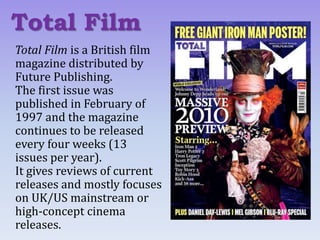
Total Film is a British film
magazine distributed by
Future Publishing.
The first issue was
published in February of
1997 and the magazine
continues to be released
every four weeks (13
issues per year).
It gives reviews of current
releases and mostly focuses
on UK/US mainstream or
high-concept cinema
releases.
Total Film
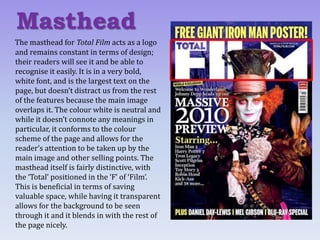
The masthead for Total Film acts as a logo
and remains constant in terms of design;
their readers will see it and be able to
recognise it easily. It is in a very bold,
white font, and is the largest text on the
page, but doesn’t distract us from the rest
of the features because the main image
overlaps it. The colour white is neutral and
while it doesn’t connote any meanings in
particular, it conforms to the colour
scheme of the page and allows for the
reader’s attention to be taken up by the
main image and other selling points. The
masthead itself is fairly distinctive, with
the ‘Total’ positioned in the ‘F’ of ‘Film’.
This is beneficial in terms of saving
valuable space, while having it transparent
allows for the background to be seen
through it and it blends in with the rest of
the page nicely.
Masthead
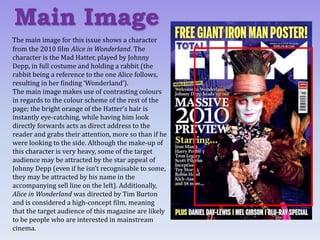
The main image for this issue shows a character
from the 2010 film Alice in Wonderland. The
character is the Mad Hatter, played by Johnny
Depp, in full costume and holding a rabbit (the
rabbit being a reference to the one Alice follows,
resulting in her finding ‘Wonderland’).
The main image makes use of contrasting colours
in regards to the colour scheme of the rest of the
page; the bright orange of the Hatter’s hair is
instantly eye-catching, while having him look
directly forwards acts as direct address to the
reader and grabs their attention, more so than if he
were looking to the side. Although the make-up of
this character is very heavy, some of the target
audience may be attracted by the star appeal of
Johnny Depp (even if he isn’t recognisable to some,
they may be attracted by his name in the
accompanying sell line on the left). Additionally,
Alice in Wonderland was directed by Tim Burton
and is considered a high-concept film, meaning
that the target audience of this magazine are likely
to be people who are interested in mainstream
cinema.
Main Image
The main sell line of a magazine cover
accompanies the main image and gives more
information about the primary feature of the
magazine. Above the sell line on this cover,
there is a banner that reads, “World
exclusive”, which implies to the audience
that the main story is only covered by this
magazine, therefore making it more
appealing in terms of its individuality and
implying that their readers are getting a
more exceptional experience if they choose
to purchase this one as opposed to its
competitors.
The line “Welcome to Wonderland! Johnny
Depp heads up our massive 2010 preview”
clarifies what the main image is related to
and makes use of star appeal, as Johnny
Depp is a very well-known and popular
actor.
Main Sell Line
[P1]
The use of the noun “preview” implies that
this is something that hasn’t been seen
before; readers of Total Film will get the
first look, again giving the magazine an
advantage over its competitors. The sell
line also lists other big-name films such as
Harry Potter and Tron Legacy, which helps
to attract potential buyers who may be
interested in other genres besides the
fantasy theme of Alice in Wonderland. It is
a fairly varied list with a mix of genres,
ensuring a wider potential reach in terms
of demographics (age, gender, etc, as all of
these films will have differing target
audiences). The added line below the list,
“and 38 more...” suggests that there is lots
of content and therefore the audience are
getting value for their money.
Main Sell Line
[P2]
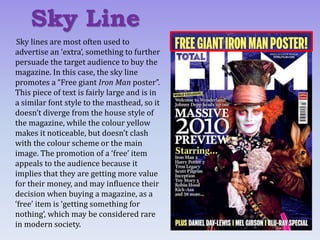
Sky lines are most often used to
advertise an ‘extra’, something to further
persuade the target audience to buy the
magazine. In this case, the sky line
promotes a “Free giant Iron Man poster”.
This piece of text is fairly large and is in
a similar font style to the masthead, so it
doesn’t diverge from the house style of
the magazine, while the colour yellow
makes it noticeable, but doesn’t clash
with the colour scheme or the main
image. The promotion of a ‘free’ item
appeals to the audience because it
implies that they are getting more value
for their money, and may influence their
decision when buying a magazine, as a
‘free’ item is ‘getting something for
nothing’, which may be considered rare
in modern society.
Sky Line
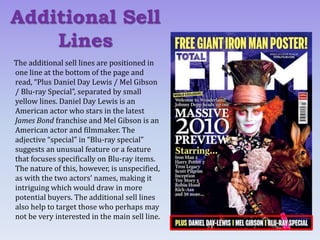
The additional sell lines are positioned in
one line at the bottom of the page and
read, “Plus Daniel Day Lewis / Mel Gibson
/ Blu-ray Special”, separated by small
yellow lines. Daniel Day Lewis is an
American actor who stars in the latest
James Bond franchise and Mel Gibson is an
American actor and filmmaker. The
adjective “special” in “Blu-ray special”
suggests an unusual feature or a feature
that focuses specifically on Blu-ray items.
The nature of this, however, is unspecified,
as with the two actors’ names, making it
intriguing which would draw in more
potential buyers. The additional sell lines
also help to target those who perhaps may
not be very interested in the main sell line.
Additional Sell
Lines
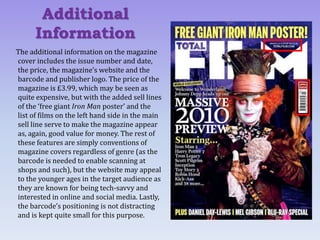
The additional information on the magazine
cover includes the issue number and date,
the price, the magazine’s website and the
barcode and publisher logo. The price of the
magazine is £3.99, which may be seen as
quite expensive, but with the added sell lines
of the ‘free giant Iron Man poster’ and the
list of films on the left hand side in the main
sell line serve to make the magazine appear
as, again, good value for money. The rest of
these features are simply conventions of
magazine covers regardless of genre (as the
barcode is needed to enable scanning at
shops and such), but the website may appeal
to the younger ages in the target audience as
they are known for being tech-savvy and
interested in online and social media. Lastly,
the barcode’s positioning is not distracting
and is kept quite small for this purpose.
Additional
Information
I think this magazine may influence my own (that will advertise my film) in terms of
style and additional sell lines, as from analysing Total Film I found that sell lines can
be used to persuade the target audience by advertising something ‘extra’ they will
receive if they buy the magazine, as it suggests good value for money. For instance, I
may advertise free promotional posters or a chance to win tickets to see my film,
which may have an influence on whether my target audience purchases the magazine.
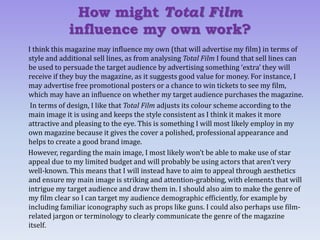
In terms of design, I like that Total Film adjusts its colour scheme according to the
main image it is using and keeps the style consistent as I think it makes it more
attractive and pleasing to the eye. This is something I will most likely employ in my
own magazine because it gives the cover a polished, professional appearance and
helps to create a good brand image.
However, regarding the main image, I most likely won’t be able to make use of star
appeal due to my limited budget and will probably be using actors that aren’t very
well-known. This means that I will instead have to aim to appeal through aesthetics
and ensure my main image is striking and attention-grabbing, with elements that will
intrigue my target audience and draw them in. I should also aim to make the genre of
my film clear so I can target my audience demographic efficiently, for example by
including familiar iconography such as props like guns. I could also perhaps use film-
related jargon or terminology to clearly communicate the genre of the magazine
itself.
How might Total Film
influence my own work?

Magazine Textual Analysis [Part 1]

  • 1.
    Magazine Textual Analysis PART 1:Total Film Georgina Gilbey A2 Media Studies
  • 2.
    Total Film isa British film magazine distributed by Future Publishing. The first issue was published in February of 1997 and the magazine continues to be released every four weeks (13 issues per year). It gives reviews of current releases and mostly focuses on UK/US mainstream or high-concept cinema releases. Total Film
  • 3.
    The masthead forTotal Film acts as a logo and remains constant in terms of design; their readers will see it and be able to recognise it easily. It is in a very bold, white font, and is the largest text on the page, but doesn’t distract us from the rest of the features because the main image overlaps it. The colour white is neutral and while it doesn’t connote any meanings in particular, it conforms to the colour scheme of the page and allows for the reader’s attention to be taken up by the main image and other selling points. The masthead itself is fairly distinctive, with the ‘Total’ positioned in the ‘F’ of ‘Film’. This is beneficial in terms of saving valuable space, while having it transparent allows for the background to be seen through it and it blends in with the rest of the page nicely. Masthead
  • 4.
    The main imagefor this issue shows a character from the 2010 film Alice in Wonderland. The character is the Mad Hatter, played by Johnny Depp, in full costume and holding a rabbit (the rabbit being a reference to the one Alice follows, resulting in her finding ‘Wonderland’). The main image makes use of contrasting colours in regards to the colour scheme of the rest of the page; the bright orange of the Hatter’s hair is instantly eye-catching, while having him look directly forwards acts as direct address to the reader and grabs their attention, more so than if he were looking to the side. Although the make-up of this character is very heavy, some of the target audience may be attracted by the star appeal of Johnny Depp (even if he isn’t recognisable to some, they may be attracted by his name in the accompanying sell line on the left). Additionally, Alice in Wonderland was directed by Tim Burton and is considered a high-concept film, meaning that the target audience of this magazine are likely to be people who are interested in mainstream cinema. Main Image
  • 5.
    The main sellline of a magazine cover accompanies the main image and gives more information about the primary feature of the magazine. Above the sell line on this cover, there is a banner that reads, “World exclusive”, which implies to the audience that the main story is only covered by this magazine, therefore making it more appealing in terms of its individuality and implying that their readers are getting a more exceptional experience if they choose to purchase this one as opposed to its competitors. The line “Welcome to Wonderland! Johnny Depp heads up our massive 2010 preview” clarifies what the main image is related to and makes use of star appeal, as Johnny Depp is a very well-known and popular actor. Main Sell Line [P1]
  • 6.
    The use ofthe noun “preview” implies that this is something that hasn’t been seen before; readers of Total Film will get the first look, again giving the magazine an advantage over its competitors. The sell line also lists other big-name films such as Harry Potter and Tron Legacy, which helps to attract potential buyers who may be interested in other genres besides the fantasy theme of Alice in Wonderland. It is a fairly varied list with a mix of genres, ensuring a wider potential reach in terms of demographics (age, gender, etc, as all of these films will have differing target audiences). The added line below the list, “and 38 more...” suggests that there is lots of content and therefore the audience are getting value for their money. Main Sell Line [P2]
  • 7.
    Sky lines aremost often used to advertise an ‘extra’, something to further persuade the target audience to buy the magazine. In this case, the sky line promotes a “Free giant Iron Man poster”. This piece of text is fairly large and is in a similar font style to the masthead, so it doesn’t diverge from the house style of the magazine, while the colour yellow makes it noticeable, but doesn’t clash with the colour scheme or the main image. The promotion of a ‘free’ item appeals to the audience because it implies that they are getting more value for their money, and may influence their decision when buying a magazine, as a ‘free’ item is ‘getting something for nothing’, which may be considered rare in modern society. Sky Line
  • 8.
    The additional selllines are positioned in one line at the bottom of the page and read, “Plus Daniel Day Lewis / Mel Gibson / Blu-ray Special”, separated by small yellow lines. Daniel Day Lewis is an American actor who stars in the latest James Bond franchise and Mel Gibson is an American actor and filmmaker. The adjective “special” in “Blu-ray special” suggests an unusual feature or a feature that focuses specifically on Blu-ray items. The nature of this, however, is unspecified, as with the two actors’ names, making it intriguing which would draw in more potential buyers. The additional sell lines also help to target those who perhaps may not be very interested in the main sell line. Additional Sell Lines
  • 9.
    The additional informationon the magazine cover includes the issue number and date, the price, the magazine’s website and the barcode and publisher logo. The price of the magazine is £3.99, which may be seen as quite expensive, but with the added sell lines of the ‘free giant Iron Man poster’ and the list of films on the left hand side in the main sell line serve to make the magazine appear as, again, good value for money. The rest of these features are simply conventions of magazine covers regardless of genre (as the barcode is needed to enable scanning at shops and such), but the website may appeal to the younger ages in the target audience as they are known for being tech-savvy and interested in online and social media. Lastly, the barcode’s positioning is not distracting and is kept quite small for this purpose. Additional Information
  • 10.
    I think thismagazine may influence my own (that will advertise my film) in terms of style and additional sell lines, as from analysing Total Film I found that sell lines can be used to persuade the target audience by advertising something ‘extra’ they will receive if they buy the magazine, as it suggests good value for money. For instance, I may advertise free promotional posters or a chance to win tickets to see my film, which may have an influence on whether my target audience purchases the magazine. In terms of design, I like that Total Film adjusts its colour scheme according to the main image it is using and keeps the style consistent as I think it makes it more attractive and pleasing to the eye. This is something I will most likely employ in my own magazine because it gives the cover a polished, professional appearance and helps to create a good brand image. However, regarding the main image, I most likely won’t be able to make use of star appeal due to my limited budget and will probably be using actors that aren’t very well-known. This means that I will instead have to aim to appeal through aesthetics and ensure my main image is striking and attention-grabbing, with elements that will intrigue my target audience and draw them in. I should also aim to make the genre of my film clear so I can target my audience demographic efficiently, for example by including familiar iconography such as props like guns. I could also perhaps use film- related jargon or terminology to clearly communicate the genre of the magazine itself. How might Total Film influence my own work?