I.F.D.C. LENGUAS VIVAS BARILOCHE
PRÁCTICA DOCENTE I
Alumno residente: María Silvia Maestromey
Institución Educativa: Jardín Munduna
Dirección: 25 de Mayo y Viamonte
Cantidad de alumnos: 24
Edad: 5 años
Unidad Temática: Toys: “Let’s Play”
Clase Nº: 111
Fecha: 11/10/2017
Hora: 16.20 hs
Duración de la clase: 40 minutos
Fecha de entrega de la planificación: 10/10/2017



Learning aims: 

During this lesson, learners will be able to:
- Identify and name 10 toys (doll, teddy bear, car, dinosaur, robot,
computer game, ball, train, puzzle, star)
- Develop their listening skills by listening to the teacher.
- Deepen their understanding of commands / instructions while
developing their skills.
- Learn / explore about the toys around them.
Learning focus:
- Vocabulary: toys.
- Language focus: What is it?
This is a car; this is a robot.
It’s a doll
Let’s play!
Look at my new…
Integration of skills: 
As children learn the new vocabulary, they will be able to start using it
in context and with known vocabulary, such as numbers and colours.
Multiple intelligences:
Linguistic intelligence: PowerPoint presentation with new vocabulary,
repetition of new words.
Spatial intelligence: (PowerPoint presentation, pictures from the book,
drawings)
Interpersonalintelligence : sharing with the rest of the children which is
their favourite toy.


Materials and resources:
- Mystery bag containing a teddy bear, a doll, a car and a
dinosaur.
- PowerPoint presentation (as a modern alternative to
flashcards) with images and new words in capital letters.
- Laptop to show the presentation.
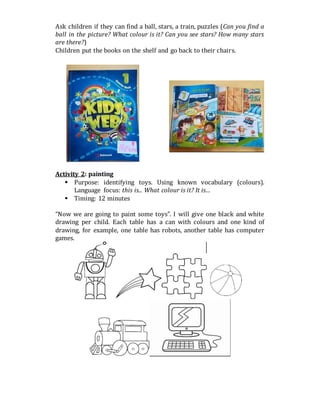
- Student’s book Kid’s Web 1 Richmond (this is the book they
have been using this year).
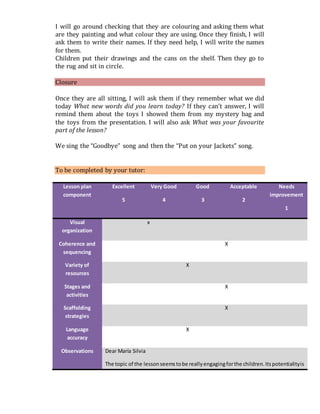
- Black and white drawings to colour.
- Coloured pencils, markers or crayons.
Possible contingencies:
Some children might start talking and not pay attention, I will
kindly ask them to listen in order to be able to understand what
we will do next. If they continue I would ask them to sit
separately.
Some children might start pushing and fighting. I would call their
attention and, if necessary, I would make one of them sit next to
me.
Some children might ask to go to the bathroom. I would give them
permission, as they are allowed to go by themselves.
A child might ask me to blow his/her nose, for that purpose I
would carry some tissue to be able to hand it immediately.
A child might hurt him/herself. I would stop and ask him/her
what happened and see if it is something serious or just a
common accident. In the first case, I would ask their teacher to
help him/her. In the second case, I would ask him/her if s/he
wants to continue playing of if s/he wants to stay with the teacher
for a while until s/he feels better.
Classroom management strategies:
At the beginning of the class the children are always very quiet and
attentive because they are with their regular teacher, so I would not
need to ask them to sit or stay still.
As the class develops, if I need to ask for silence I would ask nicely first,
and them I would count from 5 to 1 in a firm way, after that they usually
quiet down.
If I need to call a particular child’s attention, I would say his/her name
and ask him/her to be quiet and pay attention. If s/he continues with
the same attitude, I would ask him/her to sit next to me.
When they have to tidy up I would sing them the song “Time to tidy up,
tidy up. Time to tidy up, put your things away”
Assessment: collecting information and reporting your findings
During the class, I would ask them to show me, for example, in the book,
where some of the toys they just learned about.
At the end of the class, while the children are sitting in circle on the rug,
I would ask them (using the L1) if they can tell me what they have
learned today. If they can’t say anything, I would help them be asking
them to remember what I showed them at the beginning of the class,
what new words they learned and what they did at the tables.
Lesson stages:
Routine
At the beginning of the class, the children are always waiting for their
English teacher sitting in circle on the rug.
While sitting there they sing a welcome song, accompanying with hand
gestures.
Lead-in
 Purpose: introducing the subject
 Timing: 5 minutes
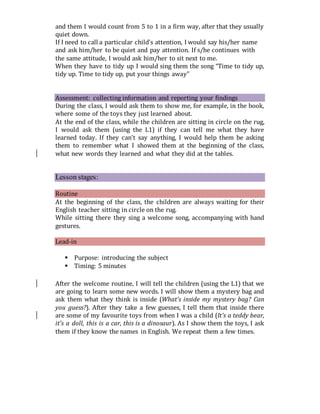
After the welcome routine, I will tell the children (using the L1) that we
are going to learn some new words. I will show them a mystery bag and
ask them what they think is inside (What’s inside my mystery bag? Can
you guess?). After they take a few guesses, I tell them that inside there
are some of my favourite toys from when I was a child (It’s a teddy bear,
it’s a doll, this is a car, this is a dinosaur). As I show them the toys, I ask
them if they know the names in English. We repeat them a few times.
Then I will ask them what their favourite toy is (What is your favourite
toy? Can you tell us?).
Presentation
 Purpose: introducing the subject
 Timing: 5 minutes
Ahora vamos a ver más juguetes. More toys!
I will introduce the new vocabulary by showing a PowerPoint
presentation with flashcards. Each time we see a new image, I will ask if
they know what it is. If they say it in Spanish I will ask: Do you know the
name in English? If they don’t, I say the word and ask them to repeat.
Development of the sequence of activities
 Purpose: identifying toys. Using known vocabulary (colours and
numbers)
 Timing: 12 minutes
Activity 1: working with the book
After the presentation I will ask the children to sit on their chairs and I
will start handing their books out. The books have a label with their
names on the cover. I will call the name out and hand it. Open your
books on page 34. Page 34. 3–4, repeating the number several times and
going around until I make sure everyone have their books open on the
correct page.
First I will ask the children to focus on the picture and see what it is.
Where are the children? What are they doing? Which toys and games can
you see in the picture?
Ask children if they can find a ball, stars, a train, puzzles (Can you find a
ball in the picture? What colour is it? Can you see stars? How many stars
are there?)
Children put the books on the shelf and go back to their chairs.
Activity 2: painting
 Purpose: identifying toys. Using known vocabulary (colours).
Language focus: this is... What colour is it? It is…
 Timing: 12 minutes
“Now we are going to paint some toys”. I will give one black and white
drawing per child. Each table has a can with colours and one kind of
drawing, for example, one table has robots, another table has computer
games.
I will go around checking that they are colouring and asking them what
are they painting and what colour they are using. Once they finish, I will
ask them to write their names. If they need help, I will write the names
for them.
Children put their drawings and the cans on the shelf. Then they go to
the rug and sit in circle.
Closure
Once they are all sitting, I will ask them if they remember what we did
today What new words did you learn today? If they can’t answer, I will
remind them about the toys I showed them from my mystery bag and
the toys from the presentation. I will also ask What was your favourite
part of the lesson?
We sing the “Goodbye” song and then the “Put on your Jackets” song.
To be completed by your tutor:
Lesson plan
component
Excellent
5
Very Good
4
Good
3
Acceptable
2
Needs
improvement
1
Visual
organization
x
Coherence and
sequencing
X
Variety of
resources
X
Stages and
activities
X
Scaffolding
strategies
X
Language
accuracy
X
Observations Dear María Silvia
The topic of the lessonseemstobe reallyengagingforthe children.Itspotentialityis
reflectedonthe use of realia.Playfullearningmayalsobe promoted.There are
certainconceptsthat need revisionandreflection,though,especiallyinconnection
withwhatyou have exploredinDidactics.The lessoncouldbe presentedwithina
meaningful context,suchasa storyabout toys,or a situation ina cartoon or bya
well knowncharacter. AsI said above,the lessonsshouldalsofocusonintegral
learning,social andcognitivedevelopment,interaction,play,emotional
developmentandvalues.How couldthese skillsbe promotedinyourfuture classes?
Please,answermyquestionsinthe commentboxesonthe side andinthisfinal
feedback,andresubmitthisplan.Youdon’tneedtochange the planitself,butI
wouldlike tolearnaboutyourviewsregardingthe differentareasthatneedfurther
development.
Take these commentsintoaccountfor yourfuture lessonplans.Anyquery,feel free
to contact me. I know youcan doit! Have a greatlesson1!
Ceci

Maestromey PD1 Lesson 1

  • 1.
    I.F.D.C. LENGUAS VIVASBARILOCHE PRÁCTICA DOCENTE I Alumno residente: María Silvia Maestromey Institución Educativa: Jardín Munduna Dirección: 25 de Mayo y Viamonte Cantidad de alumnos: 24 Edad: 5 años Unidad Temática: Toys: “Let’s Play” Clase Nº: 111 Fecha: 11/10/2017 Hora: 16.20 hs Duración de la clase: 40 minutos Fecha de entrega de la planificación: 10/10/2017    Learning aims:   During this lesson, learners will be able to: - Identify and name 10 toys (doll, teddy bear, car, dinosaur, robot, computer game, ball, train, puzzle, star) - Develop their listening skills by listening to the teacher. - Deepen their understanding of commands / instructions while developing their skills. - Learn / explore about the toys around them. Learning focus: - Vocabulary: toys. - Language focus: What is it? This is a car; this is a robot. It’s a doll Let’s play! Look at my new… Integration of skills:  As children learn the new vocabulary, they will be able to start using it in context and with known vocabulary, such as numbers and colours.
  • 2.
    Multiple intelligences: Linguistic intelligence:PowerPoint presentation with new vocabulary, repetition of new words. Spatial intelligence: (PowerPoint presentation, pictures from the book, drawings) Interpersonalintelligence : sharing with the rest of the children which is their favourite toy.   Materials and resources: - Mystery bag containing a teddy bear, a doll, a car and a dinosaur. - PowerPoint presentation (as a modern alternative to flashcards) with images and new words in capital letters. - Laptop to show the presentation. - Student’s book Kid’s Web 1 Richmond (this is the book they have been using this year). - Black and white drawings to colour. - Coloured pencils, markers or crayons. Possible contingencies: Some children might start talking and not pay attention, I will kindly ask them to listen in order to be able to understand what we will do next. If they continue I would ask them to sit separately. Some children might start pushing and fighting. I would call their attention and, if necessary, I would make one of them sit next to me. Some children might ask to go to the bathroom. I would give them permission, as they are allowed to go by themselves. A child might ask me to blow his/her nose, for that purpose I would carry some tissue to be able to hand it immediately. A child might hurt him/herself. I would stop and ask him/her what happened and see if it is something serious or just a common accident. In the first case, I would ask their teacher to help him/her. In the second case, I would ask him/her if s/he wants to continue playing of if s/he wants to stay with the teacher for a while until s/he feels better. Classroom management strategies: At the beginning of the class the children are always very quiet and attentive because they are with their regular teacher, so I would not need to ask them to sit or stay still. As the class develops, if I need to ask for silence I would ask nicely first,
  • 3.
    and them Iwould count from 5 to 1 in a firm way, after that they usually quiet down. If I need to call a particular child’s attention, I would say his/her name and ask him/her to be quiet and pay attention. If s/he continues with the same attitude, I would ask him/her to sit next to me. When they have to tidy up I would sing them the song “Time to tidy up, tidy up. Time to tidy up, put your things away” Assessment: collecting information and reporting your findings During the class, I would ask them to show me, for example, in the book, where some of the toys they just learned about. At the end of the class, while the children are sitting in circle on the rug, I would ask them (using the L1) if they can tell me what they have learned today. If they can’t say anything, I would help them be asking them to remember what I showed them at the beginning of the class, what new words they learned and what they did at the tables. Lesson stages: Routine At the beginning of the class, the children are always waiting for their English teacher sitting in circle on the rug. While sitting there they sing a welcome song, accompanying with hand gestures. Lead-in  Purpose: introducing the subject  Timing: 5 minutes After the welcome routine, I will tell the children (using the L1) that we are going to learn some new words. I will show them a mystery bag and ask them what they think is inside (What’s inside my mystery bag? Can you guess?). After they take a few guesses, I tell them that inside there are some of my favourite toys from when I was a child (It’s a teddy bear, it’s a doll, this is a car, this is a dinosaur). As I show them the toys, I ask them if they know the names in English. We repeat them a few times.
  • 4.
    Then I willask them what their favourite toy is (What is your favourite toy? Can you tell us?). Presentation  Purpose: introducing the subject  Timing: 5 minutes Ahora vamos a ver más juguetes. More toys! I will introduce the new vocabulary by showing a PowerPoint presentation with flashcards. Each time we see a new image, I will ask if they know what it is. If they say it in Spanish I will ask: Do you know the name in English? If they don’t, I say the word and ask them to repeat. Development of the sequence of activities  Purpose: identifying toys. Using known vocabulary (colours and numbers)  Timing: 12 minutes Activity 1: working with the book After the presentation I will ask the children to sit on their chairs and I will start handing their books out. The books have a label with their names on the cover. I will call the name out and hand it. Open your books on page 34. Page 34. 3–4, repeating the number several times and going around until I make sure everyone have their books open on the correct page. First I will ask the children to focus on the picture and see what it is. Where are the children? What are they doing? Which toys and games can you see in the picture?
  • 5.
    Ask children ifthey can find a ball, stars, a train, puzzles (Can you find a ball in the picture? What colour is it? Can you see stars? How many stars are there?) Children put the books on the shelf and go back to their chairs. Activity 2: painting  Purpose: identifying toys. Using known vocabulary (colours). Language focus: this is... What colour is it? It is…  Timing: 12 minutes “Now we are going to paint some toys”. I will give one black and white drawing per child. Each table has a can with colours and one kind of drawing, for example, one table has robots, another table has computer games.
  • 6.
    I will goaround checking that they are colouring and asking them what are they painting and what colour they are using. Once they finish, I will ask them to write their names. If they need help, I will write the names for them. Children put their drawings and the cans on the shelf. Then they go to the rug and sit in circle. Closure Once they are all sitting, I will ask them if they remember what we did today What new words did you learn today? If they can’t answer, I will remind them about the toys I showed them from my mystery bag and the toys from the presentation. I will also ask What was your favourite part of the lesson? We sing the “Goodbye” song and then the “Put on your Jackets” song. To be completed by your tutor: Lesson plan component Excellent 5 Very Good 4 Good 3 Acceptable 2 Needs improvement 1 Visual organization x Coherence and sequencing X Variety of resources X Stages and activities X Scaffolding strategies X Language accuracy X Observations Dear María Silvia The topic of the lessonseemstobe reallyengagingforthe children.Itspotentialityis
  • 7.
    reflectedonthe use ofrealia.Playfullearningmayalsobe promoted.There are certainconceptsthat need revisionandreflection,though,especiallyinconnection withwhatyou have exploredinDidactics.The lessoncouldbe presentedwithina meaningful context,suchasa storyabout toys,or a situation ina cartoon or bya well knowncharacter. AsI said above,the lessonsshouldalsofocusonintegral learning,social andcognitivedevelopment,interaction,play,emotional developmentandvalues.How couldthese skillsbe promotedinyourfuture classes? Please,answermyquestionsinthe commentboxesonthe side andinthisfinal feedback,andresubmitthisplan.Youdon’tneedtochange the planitself,butI wouldlike tolearnaboutyourviewsregardingthe differentareasthatneedfurther development. Take these commentsintoaccountfor yourfuture lessonplans.Anyquery,feel free to contact me. I know youcan doit! Have a greatlesson1! Ceci