I.F.D.C. LENGUAS VIVAS BARILOCHE
PRÁCTICA DOCENTE I
Alumno residente: Josefina Pilato
Institución Educativa: Aberdare College
Dirección: Av. Francia 1245, Bella Vista, BS.AS.
Cantidad de alumnos: 20
Edad: 5 años
Unidad Temática: Shapes and means of transportation
Clase Nº: 4
Fecha: 5 de noviembre de 2019
Hora: 13:15hs
Duración de la clase: 45 minutes
Fecha de entrega de la planificación: Viernes 1 de noviembre
Learning aims:
During this lesson, learners will be able to…
- Consolidate vocabulary from previous lessons about shapes and
means of transportation,
- To observe and recognize shapes: triangle, square, circle, rectangle,
diamond, train, rail, car, bus,
- To learn how to pronounce the name of these shapes and these
means of transportation,
- Develop intrapersonal skills,
- Develop interpersonal skills.
Learning focus:
The activities will focus on:
- Vocabulary related to shapes: circle, square, triangle, rectangle,
diamond.
- Means of transportation: train, rail, car, bus, bicycle.
- Skills: speaking, listening, interpersonal, creative skills.
Integration of skills:
In this lesson, the students are encouraged to develop:
- Listening skills: by listening to the story and the teacher.
- Speaking skills: by talking about shapes and means of transportation
and also by repetition.
- Spatial skills: by observing and identifying shapes and means of
transportation in the book or in the classroom.
- Interpersonal skills: by working in groups creating their buses or
trains.
- Creative skills: by creating an artwork with their classmates.
- Senso-motors skills: when doing the activity of guessing which shape
it is.
Multiple intelligences:
- Linguistic intelligence: talking about the shapes they know and the
means of transportation they know from the world.
- Interpersonal intelligence: when working in groups.
- Visual intelligence
- Spatial intelligence: when doing the crafts and guessing which shape
are they touching inside the box.
Materials and resources:
- Wooden shapes
- Box
- Puppets
- Board and chalks
- Buses or trains done with different materials
- Tempera
- Tennis ball
Possible contingencies:
- Children not engaged with the activities
- Children talking while the teacher needs to explain what to do
- Children who do not understand the activities
- Children refusing to sit down to work with the photocopies
- Children complaining because they are tired or bored
- Children getting distracted during story time
Classroom management strategies:
- Give clear and concise instructions.
- Use songs they already know to make them calm down and settle
in.
- Be positive and congratulate good behavior, by saying for example:
“Very good xxx!”. This makes other children imitate good attitude.
- Ask questions to the children who get distracted during the
activities.
- Tell the students who finish very quickly to read a book in silence,
in the place near the bookshelf.
- Use body and face gestures to engage them with what´s going on.
Assessment: collecting information and reporting your findings
- Walk around asking questions
- Observe the children working
- Check if the children use the new vocabulary while working with
their classmates
Lesson stages:
Routine
- Purpose: to make the children settle and calm down
- Timing: 5 minutes
- Activity description and instructions as they will be said to students:
1. “Everybody let’s make a circle, let’s make a circle, let’s make a
circle; everybody let’s make a circle, one, two, three, four five…”
2. Sing “Hello to everyone, and how are you today? Welcome to our
circle time to sing and laugh and play. And when you are up, you
are up, and when you are down you are down, and when you are
half way up you are neither up nor down. So, roll your hands so
slowly, roll them up so fast, give a little clap clap clap, and cross
them on your lap lap lap lap”, same as in lesson 1, 2 and 3, since
they are still learning it.
3. I´m going to ask 3 or 4 children “how are you feeling today?”.
They are going to answer in both L1 and L2, according to what
they need to say and if they know how to say it in L2 or not. I will
roll the tennis ball to mark whose turn is it to talk (they already
know how this works, we´ve done it in lesson 1, 2 and 3).
Lead-in
- Purpose: to continue working with the children some new vocabulary
related to shapes through an experimental and funny activity.
- Timing: 10/15 minutes
- Activity description and instructions as they will be said to students:
1. Sing a song they already know to make them settle down. When
they are ready and in silence, I will tell them: “okay! Look at that!
Who is coming?”. Here I´ll put the mice that we have used the
first lesson inside a wooden train, as if it were coming from far
away to visit us again. “Do you remember the shapes mouse?”
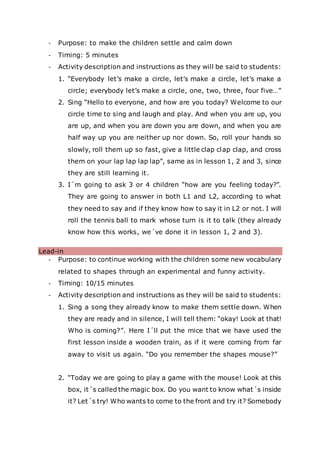
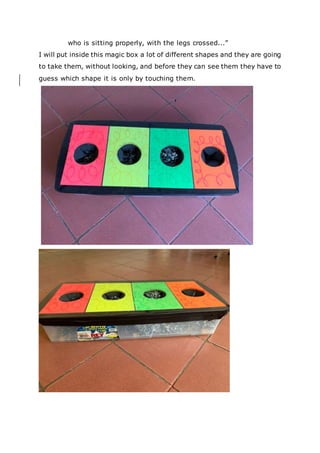
2. “Today we are going to play a game with the mouse! Look at this
box, it´s called the magic box. Do you want to know what´s inside
it? Let´s try! Who wants to come to the front and try it? Somebody
who is sitting properly, with the legs crossed...”
I will put inside this magic box a lot of different shapes and they are going
to take them, without looking, and before they can see them they have to
guess which shape it is only by touching them.
- Scaffolding strategies:
a. I´m going to ask the children: “which is this shape?” and they are
expected to answer, for example, “a circle!”.
b. I´m also going to ask questions like: “which shape do you think
you have in your hand?”, “what color are these circles?” “
- Transition comment: “Now we are going to do a wonderful activity!
Are you ready?”.
Presentation
- Purpose: explain to the children what they must do.
- Timing: 5 minutes
- Activity description and instructions as they will be said to students:
1. I am going to draw different means of transportation on the board
using shapes and they have to guess which one is it while I draw.
For example, I am going to draw a train, starting with the main
rectangle, and they have to guess.
2. I will ask: “Which transport is it?” “which is this shape?” and choose
a boy or a girl to answer, and count the points on the board.
- Scaffolding strategies:
Do the activity once as an example, without counting the points.
- Transition comment: “Now everybody go to your places!”
Development of the sequence of activities
- Purpose: let the children explore and incorporate the new vocabulary
by finishing an artwork all together.
- Timing: 10/15 minutes
- Activity description and instructions as they will be said to students:
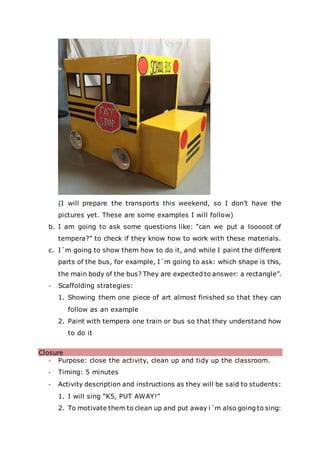
a. Okay! Now I am going to give you these lovely trains or buses that
I´ve done in my house and you will have to decorate them in groups.
We are going to use tempera and we are going to work in our places.
(I will prepare the transports this weekend, so I don’t have the
pictures yet. These are some examples I will follow)
b. I am going to ask some questions like: “can we put a looooot of
tempera?” to check if they know how to work with these materials.
c. I´m going to show them how to do it, and while I paint the different
parts of the bus, for example, I´m going to ask: which shape is this,
the main body of the bus? They are expected to answer: a rectangle”.
- Scaffolding strategies:
1. Showing them one piece of art almost finished so that they can
follow as an example
2. Paint with tempera one train or bus so that they understand how
to do it
Closure
- Purpose: close the activity, clean up and tidy up the classroom.
- Timing: 5 minutes
- Activity description and instructions as they will be said to students:
1. I will sing “K5, PUT AWAY!”
2. To motivate them to clean up and put away i´m also going to sing:
“Congratulations congratulations to PEPITO, because he´s
putting, away… paparaba”. (They already know this song and they
love it)
3. Finally, they are going to the toilette to wash their hand and get
ready to have their snack.
Each activity must be described in terms of the following components:
 Purpose
 Timing
 Activity description and instructions as they will be said to
students (include direct speech)
 Scaffolding strategies
 Transition comment to link each stage of the lesson with the next one
Lesson plan
component
Excellent
5
Very
Good
4
Good
3
Acceptable
2
Needs
improvement
1
Visual
organization
x
Coherence
and
sequencing
x
Variety of
resources
x
Stages and
activities
x
Scaffolding
strategies
x
Language
accuracy
x
Observations Congratulations, Jose! You did a very good job!
The integration of materials and activities promoted
meaningful learning throughout your practicum.
Best,
Ceci

Lesson 4

  • 1.
    I.F.D.C. LENGUAS VIVASBARILOCHE PRÁCTICA DOCENTE I Alumno residente: Josefina Pilato Institución Educativa: Aberdare College Dirección: Av. Francia 1245, Bella Vista, BS.AS. Cantidad de alumnos: 20 Edad: 5 años Unidad Temática: Shapes and means of transportation Clase Nº: 4 Fecha: 5 de noviembre de 2019 Hora: 13:15hs Duración de la clase: 45 minutes Fecha de entrega de la planificación: Viernes 1 de noviembre Learning aims: During this lesson, learners will be able to… - Consolidate vocabulary from previous lessons about shapes and means of transportation, - To observe and recognize shapes: triangle, square, circle, rectangle, diamond, train, rail, car, bus, - To learn how to pronounce the name of these shapes and these means of transportation, - Develop intrapersonal skills, - Develop interpersonal skills. Learning focus: The activities will focus on: - Vocabulary related to shapes: circle, square, triangle, rectangle, diamond.
  • 2.
    - Means oftransportation: train, rail, car, bus, bicycle. - Skills: speaking, listening, interpersonal, creative skills. Integration of skills: In this lesson, the students are encouraged to develop: - Listening skills: by listening to the story and the teacher. - Speaking skills: by talking about shapes and means of transportation and also by repetition. - Spatial skills: by observing and identifying shapes and means of transportation in the book or in the classroom. - Interpersonal skills: by working in groups creating their buses or trains. - Creative skills: by creating an artwork with their classmates. - Senso-motors skills: when doing the activity of guessing which shape it is. Multiple intelligences: - Linguistic intelligence: talking about the shapes they know and the means of transportation they know from the world. - Interpersonal intelligence: when working in groups. - Visual intelligence - Spatial intelligence: when doing the crafts and guessing which shape are they touching inside the box. Materials and resources: - Wooden shapes - Box - Puppets - Board and chalks - Buses or trains done with different materials
  • 3.
    - Tempera - Tennisball Possible contingencies: - Children not engaged with the activities - Children talking while the teacher needs to explain what to do - Children who do not understand the activities - Children refusing to sit down to work with the photocopies - Children complaining because they are tired or bored - Children getting distracted during story time Classroom management strategies: - Give clear and concise instructions. - Use songs they already know to make them calm down and settle in. - Be positive and congratulate good behavior, by saying for example: “Very good xxx!”. This makes other children imitate good attitude. - Ask questions to the children who get distracted during the activities. - Tell the students who finish very quickly to read a book in silence, in the place near the bookshelf. - Use body and face gestures to engage them with what´s going on. Assessment: collecting information and reporting your findings - Walk around asking questions - Observe the children working - Check if the children use the new vocabulary while working with their classmates Lesson stages: Routine
  • 4.
    - Purpose: tomake the children settle and calm down - Timing: 5 minutes - Activity description and instructions as they will be said to students: 1. “Everybody let’s make a circle, let’s make a circle, let’s make a circle; everybody let’s make a circle, one, two, three, four five…” 2. Sing “Hello to everyone, and how are you today? Welcome to our circle time to sing and laugh and play. And when you are up, you are up, and when you are down you are down, and when you are half way up you are neither up nor down. So, roll your hands so slowly, roll them up so fast, give a little clap clap clap, and cross them on your lap lap lap lap”, same as in lesson 1, 2 and 3, since they are still learning it. 3. I´m going to ask 3 or 4 children “how are you feeling today?”. They are going to answer in both L1 and L2, according to what they need to say and if they know how to say it in L2 or not. I will roll the tennis ball to mark whose turn is it to talk (they already know how this works, we´ve done it in lesson 1, 2 and 3). Lead-in - Purpose: to continue working with the children some new vocabulary related to shapes through an experimental and funny activity. - Timing: 10/15 minutes - Activity description and instructions as they will be said to students: 1. Sing a song they already know to make them settle down. When they are ready and in silence, I will tell them: “okay! Look at that! Who is coming?”. Here I´ll put the mice that we have used the first lesson inside a wooden train, as if it were coming from far away to visit us again. “Do you remember the shapes mouse?” 2. “Today we are going to play a game with the mouse! Look at this box, it´s called the magic box. Do you want to know what´s inside it? Let´s try! Who wants to come to the front and try it? Somebody
  • 5.
    who is sittingproperly, with the legs crossed...” I will put inside this magic box a lot of different shapes and they are going to take them, without looking, and before they can see them they have to guess which shape it is only by touching them.
  • 6.
    - Scaffolding strategies: a.I´m going to ask the children: “which is this shape?” and they are expected to answer, for example, “a circle!”. b. I´m also going to ask questions like: “which shape do you think you have in your hand?”, “what color are these circles?” “ - Transition comment: “Now we are going to do a wonderful activity! Are you ready?”. Presentation - Purpose: explain to the children what they must do. - Timing: 5 minutes - Activity description and instructions as they will be said to students: 1. I am going to draw different means of transportation on the board using shapes and they have to guess which one is it while I draw. For example, I am going to draw a train, starting with the main rectangle, and they have to guess. 2. I will ask: “Which transport is it?” “which is this shape?” and choose
  • 7.
    a boy ora girl to answer, and count the points on the board. - Scaffolding strategies: Do the activity once as an example, without counting the points. - Transition comment: “Now everybody go to your places!” Development of the sequence of activities - Purpose: let the children explore and incorporate the new vocabulary by finishing an artwork all together. - Timing: 10/15 minutes - Activity description and instructions as they will be said to students: a. Okay! Now I am going to give you these lovely trains or buses that I´ve done in my house and you will have to decorate them in groups. We are going to use tempera and we are going to work in our places.
  • 8.
    (I will preparethe transports this weekend, so I don’t have the pictures yet. These are some examples I will follow) b. I am going to ask some questions like: “can we put a looooot of tempera?” to check if they know how to work with these materials. c. I´m going to show them how to do it, and while I paint the different parts of the bus, for example, I´m going to ask: which shape is this, the main body of the bus? They are expected to answer: a rectangle”. - Scaffolding strategies: 1. Showing them one piece of art almost finished so that they can follow as an example 2. Paint with tempera one train or bus so that they understand how to do it Closure - Purpose: close the activity, clean up and tidy up the classroom. - Timing: 5 minutes - Activity description and instructions as they will be said to students: 1. I will sing “K5, PUT AWAY!” 2. To motivate them to clean up and put away i´m also going to sing:
  • 9.
    “Congratulations congratulations toPEPITO, because he´s putting, away… paparaba”. (They already know this song and they love it) 3. Finally, they are going to the toilette to wash their hand and get ready to have their snack. Each activity must be described in terms of the following components:  Purpose  Timing  Activity description and instructions as they will be said to students (include direct speech)  Scaffolding strategies  Transition comment to link each stage of the lesson with the next one Lesson plan component Excellent 5 Very Good 4 Good 3 Acceptable 2 Needs improvement 1 Visual organization x Coherence and sequencing x
  • 10.
    Variety of resources x Stages and activities x Scaffolding strategies x Language accuracy x ObservationsCongratulations, Jose! You did a very good job! The integration of materials and activities promoted meaningful learning throughout your practicum. Best, Ceci