I.F.D.C. LENGUAS VIVAS
TALLER DE PRÁCTICA DOCENTE
Tutora: Aurelia Velázquez
ALUMNO RESIDENTE: Yanina Servetto
Período de Práctica: Nivel Inicial
Institución Educativa: Jardín X
Dirección: XX
Sala / Grado / Año - sección: Sala de 5 años
Cantidad de alumnos: 25
Nivel lingüístico del curso: Principiantes
Tipo de Planificación: Clase
Unidad Temática: Partes del cuerpo
Clase Nº: 1
Fecha: XX
Hora: XX
Duración de la clase: 40’
Fecha de primera entrega: 4 de Abril
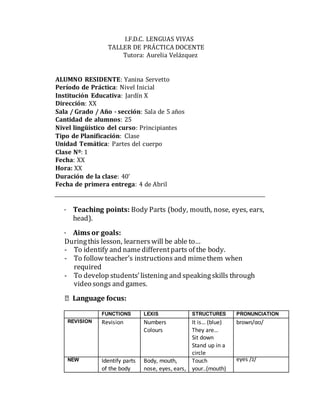
· Teaching points: Body Parts (body, mouth, nose, eyes, ears,
head).
· Aims or goals:
Duringthis lesson, learnerswill be able to…
- To identify and namedifferentparts of the body.
- To follow teacher’s instructions and mimethem when
required
- To develop students’listening and speakingskills through
video songs and games.
Language focus:
FUNCTIONS LEXIS STRUCTURES PRONUNCIATION
REVISION Revision Numbers
Colours
It is… (blue)
They are…
Sit down
Stand up in a
circle
brown/ɑʊ/
NEW Identify parts
of the body
Body, mouth,
nose, eyes, ears,
Touch
your..(mouth)
eyes /z/
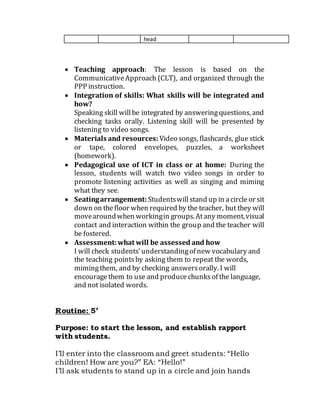
head
 Teaching approach: The lesson is based on the
CommunicativeApproach (CLT), and organized through the
PPP instruction.
 Integration of skills: What skills will be integrated and
how?
Speaking skill willbe integrated by answeringquestions, and
checking tasks orally. Listening skill will be presented by
listening to video songs.
 Materials and resources: Video songs, flashcards, glue stick
or tape, colored envelopes, puzzles, a worksheet
(homework).
 Pedagogical use of ICT in class or at home: During the
lesson, students will watch two video songs in order to
promote listening activities as well as singing and miming
what they see.
 Seatingarrangement: Studentswill stand up in acircle or sit
down on thefloor when required by the teacher, but they will
movearoundwhen workingin groups.Atany moment,visual
contact and interaction within the group and the teacher will
be fostered.
 Assessment:what will be assessed and how
I will check students’understandingof new vocabulary and
the teaching pointsby asking them to repeat the words,
mimingthem, and by checking answersorally. I will
encouragethem to use and producechunksof the language,
and not isolated words.
Routine: 5’
Purpose: to start the lesson, and establish rapport
with students.
I’ll enter into the classroom and greet students: “Hello
children! How are you?” EA: “Hello!”
I’ll ask students to stand up in a circle and join hands
and we’ll sing the usual welcome song:
“Hello, hello, how are you today?
Hello, hello, how are you today?
I’m happy, I’m happy
To see you again!”
Warm-up: 5’
Purpose: to introduce the topic and the teaching
points
The teacher invites students to stand up in circle and
watch a video song:
https://www.youtube.com/watch?v=3ZWtDfBoU-E
During the video song, the teacher encourages students
to mime her by singing and touching their own body
parts.
Then, she asks students to sit down on the floor in a
circle. She says:
“Well done kids! Now, let’s play! Touch your head”
(miming) “Perfect! Touch your eyes. Very good!”
T continues in the same way with the body, ears, mouth,
and nose. She asks some volunteers to say “Touch
your…” to another peer who has to do the action. She
helps them repeat the structure “Touch your..” as well as
helping the peers to touch the body parts if necessary.
Presentation: 10’
Purpose: to expose students to the target language.
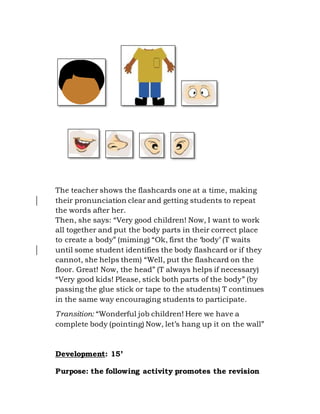
The teacher shows students some flashcards:
The teacher shows the flashcards one at a time, making
their pronunciation clear and getting students to repeat
the words after her.
Then, she says: “Very good children! Now, I want to work
all together and put the body parts in their correct place
to create a body” (miming) “Ok, first the ‘body’ (T waits
until some student identifies the body flashcard or if they
cannot, she helps them) “Well, put the flashcard on the
floor. Great! Now, the head” (T always helps if necessary)
“Very good kids! Please, stick both parts of the body” (by
passing the glue stick or tape to the students) T continues
in the same way encouraging students to participate.
Transition: “Wonderful job children! Here we have a
complete body (pointing) Now, let’s hang up it on the wall”
Development: 15’
Purpose: the following activity promotes the revision
of colours, and the use of the target language by
working collaboratively.
Activity:
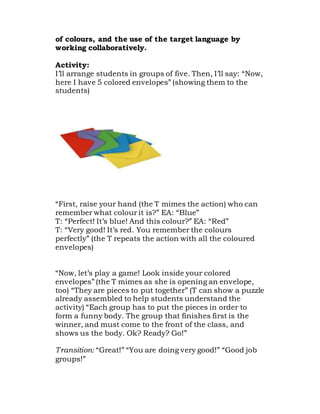
I’ll arrange students in groups of five. Then, I’ll say: “Now,
here I have 5 colored envelopes” (showing them to the
students)
“First, raise your hand (the T mimes the action) who can
remember what colour it is?” EA: “Blue”
T: “Perfect! It’s blue! And this colour?” EA: “Red”
T: “Very good! It’s red. You remember the colours
perfectly” (the T repeats the action with all the coloured
envelopes)
“Now, let’s play a game! Look inside your colored
envelopes” (the T mimes as she is opening an envelope,
too) “They are pieces to put together” (T can show a puzzle
already assembled to help students understand the
activity) “Each group has to put the pieces in order to
form a funny body. The group that finishes first is the
winner, and must come to the front of the class, and
shows us the body. Ok? Ready? Go!”
Transition: “Great!” “You are doing very good!” “Good job
groups!”
Closure: 5’
Purpose: to end the lesson by making students sing
and mime with a song.
I’ll invite students to watch a video, and then sing and
mime it while seeing the video for a second time.
https://www.youtube.com/watch?v=LoSu4FwFMwU
Transcript:
Touch your head.
Touch your nose.
Clap your hands.
Touch your toes.
Sit down, stand up.
Everybody turn around.
Put your hands up and put your hands down.
Let´s go faster!
Touch your head.
Touch your nose.
Clap your hands.
Touch your toes.
Sit down, stand up.
Everybody turn around.
Put your hands up and put your hands down.
Let´s go faster!
Touch your head.
Touch your nose.
Clap your hands.
Touch your toes.
Sit down, stand up.
Everybody turn around.
Put your hands up and put your hands down.
One more time!
Touch your head.
Touch your nose.
Clap your hands.
Touch your toes.
Sit down, stand up.
Everybody turn around.
Put your hands up and put your hands down.
Did you do it?
“Well done children!! Ok, it’s time to go home, but before
let’s sing the goodbye song:
“Goodbye, goodbye, it’s time to say goodbye
See you, see you, see you next time!”
Howework: The teacher gives students an activity to do
at home and continue practising the body parts.
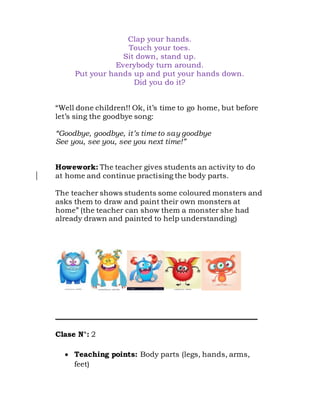
The teacher shows students some coloured monsters and
asks them to draw and paint their own monsters at
home” (the teacher can show them a monster she had
already drawn and painted to help understanding)
________________________________________________
Clase N°: 2
 Teaching points: Body parts (legs, hands, arms,
feet)
 Aims or goals: During this lesson, learners will be
able to..
- To revise parts of the body, colours, and numbers.
- To develop their creativity by making a poster
- To follow instructions and movements.
 Language focus:
 Teaching approach: I will use the PPP instruction
 Materials and resources: A worksheet (homework),
glue stick, a poster, a video song, worksheets (pairs),
posters, scissors, tape, colored pencils, parts of the
body.
 Seating arrangement: Students will work in their
seats when working with the board or in pairs, stand
up in a circle when watching the video, and working
in the floor while doing their posters.
 Assessment: I will help students by miming and
pointing. I will encourage them to speak and use
chunks, and reinforcing the pronunciation of words
which may be mispronounced. I will promote active
participation from the students, making them feel
less shy or nervous.
LEXIS FUNCTION STRUCTURE PRONUNCIATION
REVISION Body parts
Numbers
Colours
´
Identify body
parts
The eyes are..
The body is…
NEW Arms,
hands,
legs, feet
Create a
monster and
talk about it
Let’s count!
Move your…(arms)
Clap your..(hands)
Stomp your..(feet)
Monster /ˈmɒnstə/
Routine: 5’
I’ll enter into the classroom and greet students: “Hello
children! How are you?” EA: “Hello!”
I’ll ask students to stand up in a circle and join hands
and we’ll sing the usual welcome song:
“Hello, hello, how are you today?
Hello, hello, how are you today?
I’m happy, I’m happy
To see you again!”
I’ll ask students about homework: “I want you to show me
your homework, please” (pointing to her own drawing
which she had showed students at the end of the last
class)
“What about the colours you used?” (the T chooses some
volunteers) “The eyes are…”
EA: “Blue” T: “Good! Blue. The body is…” EA: “Brown” T:
“Yes! It’s brown!”
Once the teacher finishes checking homework with
students, she asks them to paste their monsters in their
notebooks.
Transition: “Very good children! Now, look at the board!
Warm-up: 5’
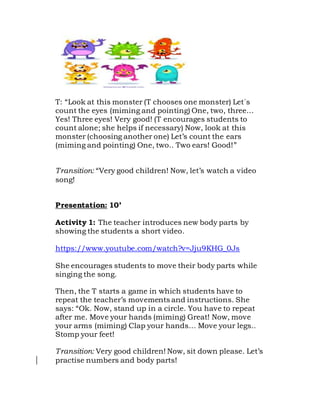
The teacher sticks on the board a poster with different
monsters in order to count together and review body
parts.
T: “Look at this monster (T chooses one monster) Let´s
count the eyes (miming and pointing) One, two, three…
Yes! Three eyes! Very good! (T encourages students to
count alone; she helps if necessary) Now, look at this
monster (choosing another one) Let’s count the ears
(miming and pointing) One, two.. Two ears! Good!”
Transition: “Very good children! Now, let’s watch a video
song!
Presentation: 10’
Activity 1: The teacher introduces new body parts by
showing the students a short video.
https://www.youtube.com/watch?v=Jju9KHG_0Js
She encourages students to move their body parts while
singing the song.
Then, the T starts a game in which students have to
repeat the teacher’s movements and instructions. She
says: “Ok. Now, stand up in a circle. You have to repeat
after me. Move your hands (miming) Great! Now, move
your arms (miming) Clap your hands… Move your legs..
Stomp your feet!
Transition: Very good children! Now, sit down please. Let’s
practise numbers and body parts!
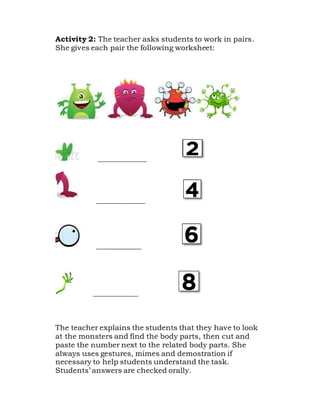
Activity 2: The teacher asks students to work in pairs.
She gives each pair the following worksheet:
_____________
_____________
____________
____________
The teacher explains the students that they have to look
at the monsters and find the body parts, then cut and
paste the number next to the related body parts. She
always uses gestures, mimes and demostration if
necessary to help students understand the task.
Students’ answers are checked orally.
Transition: “Very good pairs! Ok, now let’s join two or
three peers and work in groups!”
Development: 10’
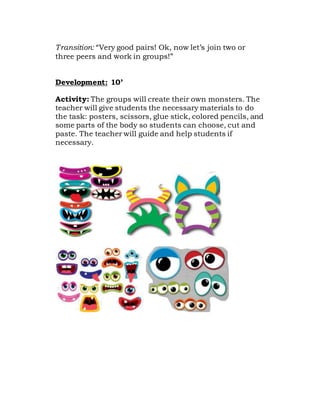
Activity: The groups will create their own monsters. The
teacher will give students the necessary materials to do
the task: posters, scissors, glue stick, colored pencils, and
some parts of the body so students can choose, cut and
paste. The teacher will guide and help students if
necessary.
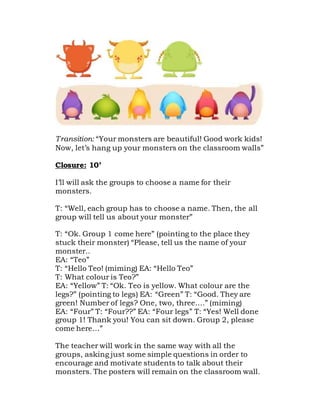
Transition: “Your monsters are beautiful! Good work kids!
Now, let’s hang up your monsters on the classroom walls”
Closure: 10’
I’ll will ask the groups to choose a name for their
monsters.
T: “Well, each group has to choose a name. Then, the all
group will tell us about your monster”
T: “Ok. Group 1 come here” (pointing to the place they
stuck their monster) “Please, tell us the name of your
monster..
EA: “Teo”
T: “Hello Teo! (miming) EA: “Hello Teo”
T: What colour is Teo?”
EA: “Yellow” T: “Ok. Teo is yellow. What colour are the
legs?” (pointing to legs) EA: “Green” T: “Good. They are
green! Number of legs? One, two, three….” (miming)
EA: “Four” T: “Four??” EA: “Four legs” T: “Yes! Well done
group 1! Thank you! You can sit down. Group 2, please
come here…”
The teacher will work in the same way with all the
groups, asking just some simple questions in order to
encourage and motivate students to talk about their
monsters. The posters will remain on the classroom wall.
T: “Good job children!! It’s time to go home. Let’s sing the
goodbye song:
“Goodbye, goodbye, it’s time to say goodbye
See you, see you, see you next time!”
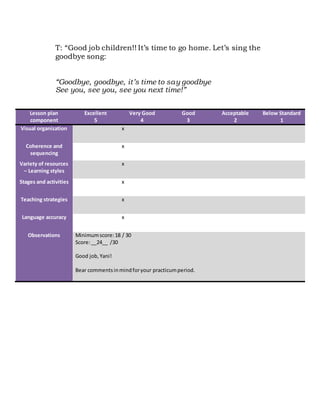
Lesson plan
component
Excellent
5
Very Good
4
Good
3
Acceptable
2
Below Standard
1
Visual organization x
Coherence and
sequencing
x
Variety of resources
– Learning styles
x
Stages and activities x
Teaching strategies x
Language accuracy x
Observations Minimumscore:18 / 30
Score:__24__ /30
Good job,Yani!
Bear commentsinmindforyour practicumperiod.
Mock Lesson Plans- Diagnosis

Mock Lesson Plans- Diagnosis

  • 1.
    I.F.D.C. LENGUAS VIVAS TALLERDE PRÁCTICA DOCENTE Tutora: Aurelia Velázquez ALUMNO RESIDENTE: Yanina Servetto Período de Práctica: Nivel Inicial Institución Educativa: Jardín X Dirección: XX Sala / Grado / Año - sección: Sala de 5 años Cantidad de alumnos: 25 Nivel lingüístico del curso: Principiantes Tipo de Planificación: Clase Unidad Temática: Partes del cuerpo Clase Nº: 1 Fecha: XX Hora: XX Duración de la clase: 40’ Fecha de primera entrega: 4 de Abril · Teaching points: Body Parts (body, mouth, nose, eyes, ears, head). · Aims or goals: Duringthis lesson, learnerswill be able to… - To identify and namedifferentparts of the body. - To follow teacher’s instructions and mimethem when required - To develop students’listening and speakingskills through video songs and games. Language focus: FUNCTIONS LEXIS STRUCTURES PRONUNCIATION REVISION Revision Numbers Colours It is… (blue) They are… Sit down Stand up in a circle brown/ɑʊ/ NEW Identify parts of the body Body, mouth, nose, eyes, ears, Touch your..(mouth) eyes /z/
  • 2.
    head  Teaching approach:The lesson is based on the CommunicativeApproach (CLT), and organized through the PPP instruction.  Integration of skills: What skills will be integrated and how? Speaking skill willbe integrated by answeringquestions, and checking tasks orally. Listening skill will be presented by listening to video songs.  Materials and resources: Video songs, flashcards, glue stick or tape, colored envelopes, puzzles, a worksheet (homework).  Pedagogical use of ICT in class or at home: During the lesson, students will watch two video songs in order to promote listening activities as well as singing and miming what they see.  Seatingarrangement: Studentswill stand up in acircle or sit down on thefloor when required by the teacher, but they will movearoundwhen workingin groups.Atany moment,visual contact and interaction within the group and the teacher will be fostered.  Assessment:what will be assessed and how I will check students’understandingof new vocabulary and the teaching pointsby asking them to repeat the words, mimingthem, and by checking answersorally. I will encouragethem to use and producechunksof the language, and not isolated words. Routine: 5’ Purpose: to start the lesson, and establish rapport with students. I’ll enter into the classroom and greet students: “Hello children! How are you?” EA: “Hello!” I’ll ask students to stand up in a circle and join hands
  • 3.
    and we’ll singthe usual welcome song: “Hello, hello, how are you today? Hello, hello, how are you today? I’m happy, I’m happy To see you again!” Warm-up: 5’ Purpose: to introduce the topic and the teaching points The teacher invites students to stand up in circle and watch a video song: https://www.youtube.com/watch?v=3ZWtDfBoU-E During the video song, the teacher encourages students to mime her by singing and touching their own body parts. Then, she asks students to sit down on the floor in a circle. She says: “Well done kids! Now, let’s play! Touch your head” (miming) “Perfect! Touch your eyes. Very good!” T continues in the same way with the body, ears, mouth, and nose. She asks some volunteers to say “Touch your…” to another peer who has to do the action. She helps them repeat the structure “Touch your..” as well as helping the peers to touch the body parts if necessary. Presentation: 10’ Purpose: to expose students to the target language. The teacher shows students some flashcards:
  • 4.
    The teacher showsthe flashcards one at a time, making their pronunciation clear and getting students to repeat the words after her. Then, she says: “Very good children! Now, I want to work all together and put the body parts in their correct place to create a body” (miming) “Ok, first the ‘body’ (T waits until some student identifies the body flashcard or if they cannot, she helps them) “Well, put the flashcard on the floor. Great! Now, the head” (T always helps if necessary) “Very good kids! Please, stick both parts of the body” (by passing the glue stick or tape to the students) T continues in the same way encouraging students to participate. Transition: “Wonderful job children! Here we have a complete body (pointing) Now, let’s hang up it on the wall” Development: 15’ Purpose: the following activity promotes the revision
  • 5.
    of colours, andthe use of the target language by working collaboratively. Activity: I’ll arrange students in groups of five. Then, I’ll say: “Now, here I have 5 colored envelopes” (showing them to the students) “First, raise your hand (the T mimes the action) who can remember what colour it is?” EA: “Blue” T: “Perfect! It’s blue! And this colour?” EA: “Red” T: “Very good! It’s red. You remember the colours perfectly” (the T repeats the action with all the coloured envelopes) “Now, let’s play a game! Look inside your colored envelopes” (the T mimes as she is opening an envelope, too) “They are pieces to put together” (T can show a puzzle already assembled to help students understand the activity) “Each group has to put the pieces in order to form a funny body. The group that finishes first is the winner, and must come to the front of the class, and shows us the body. Ok? Ready? Go!” Transition: “Great!” “You are doing very good!” “Good job groups!”
  • 6.
    Closure: 5’ Purpose: toend the lesson by making students sing and mime with a song. I’ll invite students to watch a video, and then sing and mime it while seeing the video for a second time. https://www.youtube.com/watch?v=LoSu4FwFMwU Transcript: Touch your head. Touch your nose. Clap your hands. Touch your toes. Sit down, stand up. Everybody turn around. Put your hands up and put your hands down. Let´s go faster! Touch your head. Touch your nose. Clap your hands. Touch your toes. Sit down, stand up. Everybody turn around. Put your hands up and put your hands down. Let´s go faster! Touch your head. Touch your nose. Clap your hands. Touch your toes. Sit down, stand up. Everybody turn around. Put your hands up and put your hands down. One more time! Touch your head. Touch your nose.
  • 7.
    Clap your hands. Touchyour toes. Sit down, stand up. Everybody turn around. Put your hands up and put your hands down. Did you do it? “Well done children!! Ok, it’s time to go home, but before let’s sing the goodbye song: “Goodbye, goodbye, it’s time to say goodbye See you, see you, see you next time!” Howework: The teacher gives students an activity to do at home and continue practising the body parts. The teacher shows students some coloured monsters and asks them to draw and paint their own monsters at home” (the teacher can show them a monster she had already drawn and painted to help understanding) ________________________________________________ Clase N°: 2  Teaching points: Body parts (legs, hands, arms, feet)
  • 8.
     Aims orgoals: During this lesson, learners will be able to.. - To revise parts of the body, colours, and numbers. - To develop their creativity by making a poster - To follow instructions and movements.  Language focus:  Teaching approach: I will use the PPP instruction  Materials and resources: A worksheet (homework), glue stick, a poster, a video song, worksheets (pairs), posters, scissors, tape, colored pencils, parts of the body.  Seating arrangement: Students will work in their seats when working with the board or in pairs, stand up in a circle when watching the video, and working in the floor while doing their posters.  Assessment: I will help students by miming and pointing. I will encourage them to speak and use chunks, and reinforcing the pronunciation of words which may be mispronounced. I will promote active participation from the students, making them feel less shy or nervous. LEXIS FUNCTION STRUCTURE PRONUNCIATION REVISION Body parts Numbers Colours ´ Identify body parts The eyes are.. The body is… NEW Arms, hands, legs, feet Create a monster and talk about it Let’s count! Move your…(arms) Clap your..(hands) Stomp your..(feet) Monster /ˈmɒnstə/
  • 9.
    Routine: 5’ I’ll enterinto the classroom and greet students: “Hello children! How are you?” EA: “Hello!” I’ll ask students to stand up in a circle and join hands and we’ll sing the usual welcome song: “Hello, hello, how are you today? Hello, hello, how are you today? I’m happy, I’m happy To see you again!” I’ll ask students about homework: “I want you to show me your homework, please” (pointing to her own drawing which she had showed students at the end of the last class) “What about the colours you used?” (the T chooses some volunteers) “The eyes are…” EA: “Blue” T: “Good! Blue. The body is…” EA: “Brown” T: “Yes! It’s brown!” Once the teacher finishes checking homework with students, she asks them to paste their monsters in their notebooks. Transition: “Very good children! Now, look at the board! Warm-up: 5’ The teacher sticks on the board a poster with different monsters in order to count together and review body parts.
  • 10.
    T: “Look atthis monster (T chooses one monster) Let´s count the eyes (miming and pointing) One, two, three… Yes! Three eyes! Very good! (T encourages students to count alone; she helps if necessary) Now, look at this monster (choosing another one) Let’s count the ears (miming and pointing) One, two.. Two ears! Good!” Transition: “Very good children! Now, let’s watch a video song! Presentation: 10’ Activity 1: The teacher introduces new body parts by showing the students a short video. https://www.youtube.com/watch?v=Jju9KHG_0Js She encourages students to move their body parts while singing the song. Then, the T starts a game in which students have to repeat the teacher’s movements and instructions. She says: “Ok. Now, stand up in a circle. You have to repeat after me. Move your hands (miming) Great! Now, move your arms (miming) Clap your hands… Move your legs.. Stomp your feet! Transition: Very good children! Now, sit down please. Let’s practise numbers and body parts!
  • 11.
    Activity 2: Theteacher asks students to work in pairs. She gives each pair the following worksheet: _____________ _____________ ____________ ____________ The teacher explains the students that they have to look at the monsters and find the body parts, then cut and paste the number next to the related body parts. She always uses gestures, mimes and demostration if necessary to help students understand the task. Students’ answers are checked orally.
  • 12.
    Transition: “Very goodpairs! Ok, now let’s join two or three peers and work in groups!” Development: 10’ Activity: The groups will create their own monsters. The teacher will give students the necessary materials to do the task: posters, scissors, glue stick, colored pencils, and some parts of the body so students can choose, cut and paste. The teacher will guide and help students if necessary.
  • 13.
    Transition: “Your monstersare beautiful! Good work kids! Now, let’s hang up your monsters on the classroom walls” Closure: 10’ I’ll will ask the groups to choose a name for their monsters. T: “Well, each group has to choose a name. Then, the all group will tell us about your monster” T: “Ok. Group 1 come here” (pointing to the place they stuck their monster) “Please, tell us the name of your monster.. EA: “Teo” T: “Hello Teo! (miming) EA: “Hello Teo” T: What colour is Teo?” EA: “Yellow” T: “Ok. Teo is yellow. What colour are the legs?” (pointing to legs) EA: “Green” T: “Good. They are green! Number of legs? One, two, three….” (miming) EA: “Four” T: “Four??” EA: “Four legs” T: “Yes! Well done group 1! Thank you! You can sit down. Group 2, please come here…” The teacher will work in the same way with all the groups, asking just some simple questions in order to encourage and motivate students to talk about their monsters. The posters will remain on the classroom wall.
  • 14.
    T: “Good jobchildren!! It’s time to go home. Let’s sing the goodbye song: “Goodbye, goodbye, it’s time to say goodbye See you, see you, see you next time!” Lesson plan component Excellent 5 Very Good 4 Good 3 Acceptable 2 Below Standard 1 Visual organization x Coherence and sequencing x Variety of resources – Learning styles x Stages and activities x Teaching strategies x Language accuracy x Observations Minimumscore:18 / 30 Score:__24__ /30 Good job,Yani! Bear commentsinmindforyour practicumperiod.