
PROJECT SCOPE
 MANAGEMENT
          TRAINING
[
TRAINING


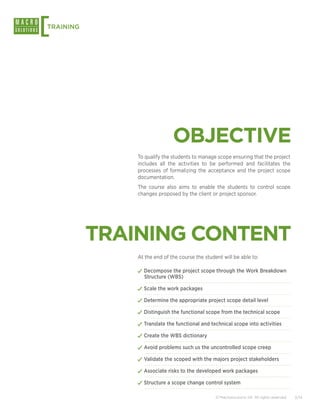
                              OBJECTIVE
               To qualify the students to manage scope ensuring that the project
               includes all the activities to be performed and facilitates the
               processes of formalizing the acceptance and the project scope
               documentation.
               The course also aims to enable the students to control scope
               changes proposed by the client or project sponsor.


           TRAINING CONTENT
               At the end of the course the student will be able to:

               ✓✓Decompose the project scope through the Work Breakdown
                 Structure (WBS)

               ✓✓Scale the work packages
               ✓✓Determine the appropriate project scope detail level
               ✓✓Distinguish the functional scope from the technical scope
               ✓✓Translate the functional and technical scope into activities
               ✓✓Create the WBS dictionary
               ✓✓Avoid problems such us the uncontrolled scope creep
               ✓✓Validate the scoped with the majors project stakeholders
               ✓✓Associate risks to the developed work packages
               ✓✓Structure a scope change control system

                                                 © Macrosolutions SA. All rights reserved.   2/14
[
TRAINING


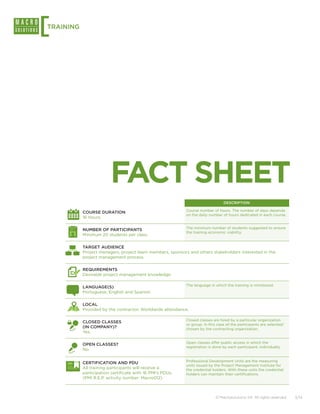
                         FACT SHEET
                                                                                DESCRIPTION

                                                           Course number of hours. The number of days depends
           COURSE DURATION
                                                           on the daily number of hours dedicated in each course.
           16 Hours.

                                                           The minimum number of students suggested to ensure
           NUMBER OF PARTICIPANTS
                                                           the training economic viability.
           Minimum 20 students per class.

           TARGET AUDIENCE
           Project managers, project team members, sponsors and others stakeholders interested in the
           project management process.

           REQUIREMENTS
           Desirable project management knowledge.

                                                           The language in which the training is ministered.
           LANGUAGE(S)
           Portuguese, English and Spanish.

           LOCAL
           Provided by the contractor. Worldwide attendance.

                                                           Closed classes are hired by a particular organization
           CLOSED CLASSES
                                                           or group. In this case all the participants are selected/
           (IN COMPANY)?                                   chosen by the contracting organization.
           Yes.

                                                           Open classes offer public access in which the
           OPEN CLASSES?
                                                           registration is done by each participant, individually.
           No.

                                                           Professional Development Units are the measuring
           CERTIFICATION AND PDU
                                                           units issued by the Project Management Institute for
           All training participants will receive a        the credential holders. With these units the credential
           participation certificate with 16 PMI’s PDUs.   holders can maintain their certifications.
           (PMI R.E.P. activity number: Macro012)


                                                                            © Macrosolutions SA. All rights reserved.   3/14
[
TRAINING


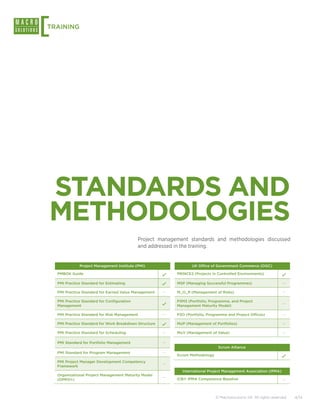
STANDARDS AND
METHODOLOGIES
                                              Project management standards and methodologies discussed
                                              and addressed in the training.


               Project Management Institute (PMI)                   UK Office of Government Commerce (OGC)

    PMBOK Guide                                              PRINCE2 (Projects in Controlled Environments)

    PMI Practice Standard for Estimating                     MSP (Managing Successful Programmes)                      —

    PMI Practice Standard for Earned Value Management    —   M_O_R (Management of Risks)                               —

    PMI Practice Standard for Configuration                  P3M3 (Portfolio, Programme, and Project
                                                                                                                       —
    Management                                               Management Maturity Model)

    PMI Practice Standard for Risk Management            —   P3O (Portfolio, Programme and Project Offices)            —

    PMI Practice Standard for Work Breakdown Structure       MoP (Management of Portfolios)                            —

    PMI Practice Standard for Scheduling                 —   MoV (Management of Value)                                 —

    PMI Standard for Portfolio Management                —
                                                                                  Scrum Alliance
    PMI Standard for Program Management                  —
                                                             Scrum Methodology
    PMI Project Manager Development Competency
                                                         —
    Framework
                                                               International Project Management Association (IPMA)
    Organizational Project Management Maturity Model
                                                         —   ICB® IPMA Competence Baseline
    (OPM3®)                                                                                                            —


                                                                                 © Macrosolutions SA. All rights reserved.   4/14
[
TRAINING


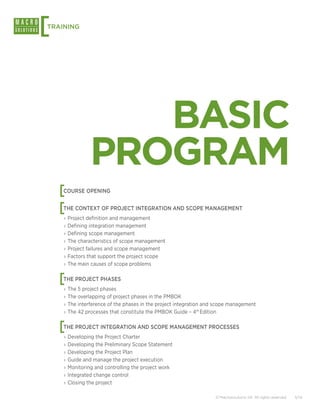
                  BASIC
               PROGRAM
    [
    COURSE OPENING


    [
    THE CONTEXT OF PROJECT INTEGRATION AND SCOPE MANAGEMENT
    ›› Project definition and management
    ›› Defining integration management
    ›› Defining scope management
    ›› The characteristics of scope management
    ›› Project failures and scope management
    ›› Factors that support the project scope
    ›› The main causes of scope problems


    [
    THE PROJECT PHASES
    ›› The 5 project phases
    ›› The overlapping of project phases in the PMBOK
    ›› The interference of the phases in the project integration and scope management
    ›› The 42 processes that constitute the PMBOK Guide – 4th Edition


    [
    THE PROJECT INTEGRATION AND SCOPE MANAGEMENT PROCESSES
    ›› Developing the Project Charter
    ›› Developing the Preliminary Scope Statement
    ›› Developing the Project Plan
    ›› Guide and manage the project execution
    ›› Monitoring and controlling the project work
    ›› Integrated change control
    ›› Closing the project

                                                                    © Macrosolutions SA. All rights reserved.   5/14
[
TRAINING
BASIC PROGRAM


    [
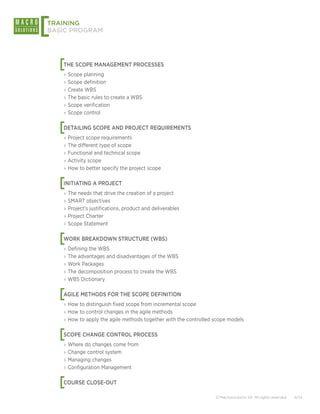
    THE SCOPE MANAGEMENT PROCESSES
    ›› Scope planning
    ›› Scope definition
    ›› Create WBS
    ›› The basic rules to create a WBS
    ›› Scope verification
    ›› Scope control


    [
    DETAILING SCOPE AND PROJECT REQUIREMENTS
    ›› Project scope requirements
    ›› The different type of scope
    ›› Functional and technical scope
    ›› Activity scope
    ›› How to better specify the project scope


    [
    INITIATING A PROJECT
    ›› The needs that drive the creation of a project
    ›› SMART objectives
    ›› Project’s justifications, product and deliverables
    ›› Project Charter
    ›› Scope Statement


    [
    WORK BREAKDOWN STRUCTURE (WBS)
    ›› Defining the WBS
    ›› The advantages and disadvantages of the WBS
    ›› Work Packages
    ›› The decomposition process to create the WBS
    ›› WBS Dictionary


    [
    AGILE METHODS FOR THE SCOPE DEFINITION
    ›› How to distinguish fixed scope from incremental scope
    ›› How to control changes in the agile methods
    ›› How to apply the agile methods together with the controlled scope models


    [
    SCOPE CHANGE CONTROL PROCESS
    ›› Where do changes come from
    ›› Change control system
    ›› Managing changes
    ›› Configuration Management


    [
    COURSE CLOSE-OUT

                                                                   © Macrosolutions SA. All rights reserved.   6/14
[
TRAINING


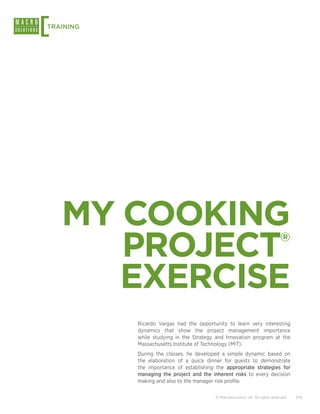
    MY COOKING
       PROJECT                                                                 ®


       EXERCISE
           Ricardo Vargas had the opportunity to learn very interesting
           dynamics that show the project management importance
           while studying in the Strategy and Innovation program at the
           Massachusetts Institute of Technology (MIT).
           During the classes, he developed a simple dynamic based on
           the elaboration of a quick dinner for guests to demonstrate
           the importance of establishing the appropriate strategies for
           managing the project and the inherent risks to every decision
           making and also to the manager risk profile.

                                          © Macrosolutions SA. All rights reserved.   7/14
[
TRAINING
MY COOKING PROJECT EXERCISE


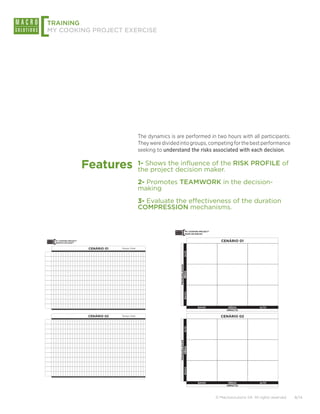
                                                                                                                                                                                                                                                                                                            The dynamics is are performed in two hours with all participants.
                                                                                                                                                                                                                                                                                                            They were divided into groups, competing for the best performance
                                                                                                                                                                                                                                                                                                            seeking to understand the risks associated with each decision.


                                                                                                         Features                                                                                                                                                                                           1- Shows the influence of the RISK PROFILE of
                                                                                                                                                                                                                                                                                                            the project decision maker.
                                                                                                                                                                                                                                                                                                            2- Promotes TEAMWORK in the decision-
                                                                                                                                                                                                                                                                                                            making
                                                                                                                                                                                                                                                                                                            3- Evaluate the effectiveness of the duration
                                                                                                                                                                                                                                                                                                            COMPRESSION mechanisms.


                                                                                                                                                                                                                                                                                                                                           [     MY COOKING PROJECT®
                                                                                                                                                                                                                                                                                                                                                 MAPA DE RISCOS


      [     MY COOKING PROJECT®
            GRÁFICO DE GANTT
                                                                                                                                                                                                                                                                                                                                                                          CENÁRIO 01

                                                                                                                                  CENÁRIO 01                                                                                                        Tempo Total:
                                                                                                                                                                                                                                                                                                                                               ALTA


    0-2   2-4   4-6   6-8   8 - 10   10 - 12   12 - 14   14 - 16   16 - 18   18 - 20 20 - 22 22 - 24 24 - 26 26 - 28 28 - 30 30 - 32 32 - 34 34 - 36 36 - 38 38 - 40 40 - 42 42 - 44 44 - 46 46 - 48 48 - 50 50 - 52 52 - 54 54 - 56 56 - 58 58 - 60 62 - 64 64 - 66 66 - 68 68 - 70 70 - 72 72 - 74   74 - 76 76 - 78 78 - 80 80 - 82
                                                                                                                                                                                                                                                                                                                                         PROBABILIDADE
                                                                                                                                                                                                                                                                                                                                             MÉDIA
                                                                                                                                                                                                                                                                                                                                               BAIXA


                                                                                                                                                                                                                                                                                                                                                           BAIXO              MÉDIO                                   ALTO
                                                                                                                                                                                                                                                                                                                                                                             IMPACTO
    0-2   2-4   4-6   6-8   8 - 10   10 - 12   12 - 14   14 - 16   16 - 18   18 - 20 20 - 22 22 - 24 24 - 26 26 - 28 28 - 30 30 - 32 32 - 34 34 - 36 36 - 38 38 - 40 40 - 42 42 - 44 44 - 46 46 - 48 48 - 50 50 - 52 52 - 54 54 - 56 56 - 58 58 - 60 62 - 64 64 - 66 66 - 68 68 - 70 70 - 72 72 - 74   74 - 76 76 - 78 78 - 80 80 - 82


    0-2   2-4   4-6   6-8   8 - 10   10 - 12   12 - 14   14 - 16   16 - 18
                                                                                                                                 CENÁRIO 02                                                                                                         Tempo Total:
                                                                             18 - 20 20 - 22 22 - 24 24 - 26 26 - 28 28 - 30 30 - 32 32 - 34 34 - 36 36 - 38 38 - 40 40 - 42 42 - 44 44 - 46 46 - 48 48 - 50 50 - 52 52 - 54 54 - 56 56 - 58 58 - 60 62 - 64 64 - 66 66 - 68 68 - 70 70 - 72 72 - 74   74 - 76 76 - 78 78 - 80 80 - 82
                                                                                                                                                                                                                                                                                                                                                                          CENÁRIO 02
                                                                                                                                                                                                                                                                                                                                               ALTA
                                                                                                                                                                                                                                                                                                                                         PROBABILIDADE
                                                                                                                                                                                                                                                                                                                                             MÉDIA
                                                                                                                                                                                                                                                                                                                                               BAIXA


    0-2   2-4   4-6   6-8   8 - 10   10 - 12   12 - 14   14 - 16   16 - 18   18 - 20 20 - 22 22 - 24 24 - 26 26 - 28 28 - 30 30 - 32 32 - 34 34 - 36 36 - 38 38 - 40 40 - 42 42 - 44 44 - 46 46 - 48 48 - 50 50 - 52 52 - 54 54 - 56 56 - 58 58 - 60 62 - 64 64 - 66 66 - 68 68 - 70 70 - 72 72 - 74   74 - 76 76 - 78 78 - 80 80 - 82


                                                                                                                                                                                                                                           © 2010 Ricardo Viana Vargas. Todos direitos reservados. Reprodução Proibida.


                                                                                                                                                                                                                                                                                                                                                           BAIXO              MÉDIO                                   ALTO
                                                                                                                                                                                                                                                                                                                                                                             IMPACTO
                                                                                                                                                                                                                                                                                                                                                                                          © 2010 Ricardo Viana Vargas. Todos direitos reservados. Reprodução Proibida.


                                                                                                                                                                                                                                                                                                                                                                       © Macrosolutions SA. All rights reserved.                                                         8/14
[
TRAINING


    PMCOASTER                                                                    ®


      DYNAMIC
                       It is a dynamics developed to simulate the real
                       projects environment.
                       Divided into teams, the participants will plan and
                       execute the construction of a functional high speed
                       roller coaster prototype for a theme park.
                        Students will define the work, evaluate the project
           feasible budget and time in order to execute it. They will do so
           concerning the time and costs constraints. Then, students will
           execute and monitor the project to demonstrate the effectiveness
           of the plan in adverse conditions.
           The approximate duration of the dynamics is 2 hours and its main
           objective is to show the interrelationship between the scope
           required, deadlines and available budget. In addition, the aspects
           related to the teamwork quality are directly addressed.

                                            © Macrosolutions SA. All rights reserved.   9/14
[
TRAINING
PMCOASTER DYNAMIC


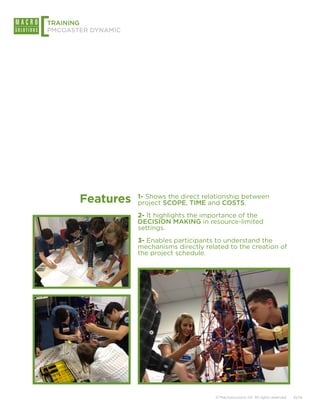
       Features     1- Shows the direct relationship between
                    project SCOPE, TIME and COSTS.
                    2- It highlights the importance of the
                    DECISION MAKING in resource-limited
                    settings.
                    3- Enables participants to understand the
                    mechanisms directly related to the creation of
                    the project schedule.


                                           © Macrosolutions SA. All rights reserved.   10/14
[
TRAINING


                                ADDITIONAL
                                 DYNAMICS
                                    As part of our methodology, in this course the following dynamics
                                    will be used:


    [
    CASE STUDIES
    › Ricardo Vargas and the Macrosolutions’ team have selected a relevant set of case studies and
      exercises that allow the participants to associate real and fictional cases the to daily work.
    › All case studies are appropriate to the nature of the client and the training audience.


    [
    VIDEOS SELECTION
    › In order to facilitate the student learning, videos that cover various parts of movies,
      commercials, home videos, etc. are used in the classroom environment to fix concepts and
      associate technical issues with the reality of work and also to introduce new concepts.
    › They are short videos with direct focus on specific topics, tools and cases.


    [
    GROUP WORK
    › Several studies and exercises will be proposed by the instructor in order to present a particular
      topic or discuss a particular approach to project management.
    › Throughout the training the teamwork will be encouraged and strengthened as a mean for the
      group to learn.


    [
    LEARNING EXERCISES
    › During the training, students perform concepts retaining quick exercises. Usually the exercises
      are quick and direct and involve some kind of mathematical calculation.

                                                                      © Macrosolutions SA. All rights reserved.   11/14
[
TRAINING


EXCLUSIVE STUDENT
     ACCESS AREA
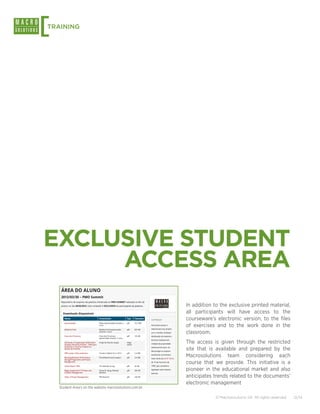
                                                          In addition to the exclusive printed material,
                                                          all participants will have access to the
                                                          courseware’s electronic version, to the files
                                                          of exercises and to the work done in the
                                                          classroom.
                                                          The access is given through the restricted
                                                          site that is available and prepared by the
                                                          Macrosolutions team considering each
                                                          course that we provide. This initiative is a
                                                          pioneer in the educational market and also
                                                          anticipates trends related to the documents’
                                                          electronic management
    Student Area’s on the website macrosolutions.com.br

                                                                       © Macrosolutions SA. All rights reserved.   12/14
[
TRAINING


            REQUIRED
           EQUIPMENT
            The equipment required for the proper realization of the course is:


           [ HIGH RESOLUTION PROJECTOR (1024X768)


           [ SOUND SYSTEM FOR VIDEO DISPLAY


           [ INTERNET ACCESS


           [ VARIABLE ILLUMINATION INSIDE THE CLASSROOM


           [ 01 TABLE FOR EACH GROUP OF FIVE STUDENTS


           [ 01 FLIP CHART FOR EACH GROUP OF FIVE STUDENTS

                                              © Macrosolutions SA. All rights reserved.   13/14
[
TRAINING


         FURTHER
     INFORMATION
           For further information about this course, please contact:


           Phone: +55 31 3024-3003
           Fax: +55 31 3024-3005
           email: info@macrosolutions.com.br

                                            © Macrosolutions SA. All rights reserved.   14/14

Macrosolutions Training: Project Scope Management

  • 1.
  • 2.
    [ TRAINING OBJECTIVE To qualify the students to manage scope ensuring that the project includes all the activities to be performed and facilitates the processes of formalizing the acceptance and the project scope documentation. The course also aims to enable the students to control scope changes proposed by the client or project sponsor. TRAINING CONTENT At the end of the course the student will be able to: ✓✓Decompose the project scope through the Work Breakdown Structure (WBS) ✓✓Scale the work packages ✓✓Determine the appropriate project scope detail level ✓✓Distinguish the functional scope from the technical scope ✓✓Translate the functional and technical scope into activities ✓✓Create the WBS dictionary ✓✓Avoid problems such us the uncontrolled scope creep ✓✓Validate the scoped with the majors project stakeholders ✓✓Associate risks to the developed work packages ✓✓Structure a scope change control system © Macrosolutions SA. All rights reserved. 2/14
  • 3.
    [ TRAINING FACT SHEET DESCRIPTION Course number of hours. The number of days depends COURSE DURATION on the daily number of hours dedicated in each course. 16 Hours. The minimum number of students suggested to ensure NUMBER OF PARTICIPANTS the training economic viability. Minimum 20 students per class. TARGET AUDIENCE Project managers, project team members, sponsors and others stakeholders interested in the project management process. REQUIREMENTS Desirable project management knowledge. The language in which the training is ministered. LANGUAGE(S) Portuguese, English and Spanish. LOCAL Provided by the contractor. Worldwide attendance. Closed classes are hired by a particular organization CLOSED CLASSES or group. In this case all the participants are selected/ (IN COMPANY)? chosen by the contracting organization. Yes. Open classes offer public access in which the OPEN CLASSES? registration is done by each participant, individually. No. Professional Development Units are the measuring CERTIFICATION AND PDU units issued by the Project Management Institute for All training participants will receive a the credential holders. With these units the credential participation certificate with 16 PMI’s PDUs. holders can maintain their certifications. (PMI R.E.P. activity number: Macro012) © Macrosolutions SA. All rights reserved. 3/14
  • 4.
    [ TRAINING STANDARDS AND METHODOLOGIES Project management standards and methodologies discussed and addressed in the training. Project Management Institute (PMI) UK Office of Government Commerce (OGC) PMBOK Guide PRINCE2 (Projects in Controlled Environments) PMI Practice Standard for Estimating MSP (Managing Successful Programmes) — PMI Practice Standard for Earned Value Management — M_O_R (Management of Risks) — PMI Practice Standard for Configuration P3M3 (Portfolio, Programme, and Project — Management Management Maturity Model) PMI Practice Standard for Risk Management — P3O (Portfolio, Programme and Project Offices) — PMI Practice Standard for Work Breakdown Structure MoP (Management of Portfolios) — PMI Practice Standard for Scheduling — MoV (Management of Value) — PMI Standard for Portfolio Management — Scrum Alliance PMI Standard for Program Management — Scrum Methodology PMI Project Manager Development Competency — Framework International Project Management Association (IPMA) Organizational Project Management Maturity Model — ICB® IPMA Competence Baseline (OPM3®) — © Macrosolutions SA. All rights reserved. 4/14
  • 5.
    [ TRAINING BASIC PROGRAM [ COURSE OPENING [ THE CONTEXT OF PROJECT INTEGRATION AND SCOPE MANAGEMENT ›› Project definition and management ›› Defining integration management ›› Defining scope management ›› The characteristics of scope management ›› Project failures and scope management ›› Factors that support the project scope ›› The main causes of scope problems [ THE PROJECT PHASES ›› The 5 project phases ›› The overlapping of project phases in the PMBOK ›› The interference of the phases in the project integration and scope management ›› The 42 processes that constitute the PMBOK Guide – 4th Edition [ THE PROJECT INTEGRATION AND SCOPE MANAGEMENT PROCESSES ›› Developing the Project Charter ›› Developing the Preliminary Scope Statement ›› Developing the Project Plan ›› Guide and manage the project execution ›› Monitoring and controlling the project work ›› Integrated change control ›› Closing the project © Macrosolutions SA. All rights reserved. 5/14
  • 6.
    [ TRAINING BASIC PROGRAM [ THE SCOPE MANAGEMENT PROCESSES ›› Scope planning ›› Scope definition ›› Create WBS ›› The basic rules to create a WBS ›› Scope verification ›› Scope control [ DETAILING SCOPE AND PROJECT REQUIREMENTS ›› Project scope requirements ›› The different type of scope ›› Functional and technical scope ›› Activity scope ›› How to better specify the project scope [ INITIATING A PROJECT ›› The needs that drive the creation of a project ›› SMART objectives ›› Project’s justifications, product and deliverables ›› Project Charter ›› Scope Statement [ WORK BREAKDOWN STRUCTURE (WBS) ›› Defining the WBS ›› The advantages and disadvantages of the WBS ›› Work Packages ›› The decomposition process to create the WBS ›› WBS Dictionary [ AGILE METHODS FOR THE SCOPE DEFINITION ›› How to distinguish fixed scope from incremental scope ›› How to control changes in the agile methods ›› How to apply the agile methods together with the controlled scope models [ SCOPE CHANGE CONTROL PROCESS ›› Where do changes come from ›› Change control system ›› Managing changes ›› Configuration Management [ COURSE CLOSE-OUT © Macrosolutions SA. All rights reserved. 6/14
  • 7.
    [ TRAINING MY COOKING PROJECT ® EXERCISE Ricardo Vargas had the opportunity to learn very interesting dynamics that show the project management importance while studying in the Strategy and Innovation program at the Massachusetts Institute of Technology (MIT). During the classes, he developed a simple dynamic based on the elaboration of a quick dinner for guests to demonstrate the importance of establishing the appropriate strategies for managing the project and the inherent risks to every decision making and also to the manager risk profile. © Macrosolutions SA. All rights reserved. 7/14
  • 8.
    [ TRAINING MY COOKING PROJECTEXERCISE The dynamics is are performed in two hours with all participants. They were divided into groups, competing for the best performance seeking to understand the risks associated with each decision. Features 1- Shows the influence of the RISK PROFILE of the project decision maker. 2- Promotes TEAMWORK in the decision- making 3- Evaluate the effectiveness of the duration COMPRESSION mechanisms. [ MY COOKING PROJECT® MAPA DE RISCOS [ MY COOKING PROJECT® GRÁFICO DE GANTT CENÁRIO 01 CENÁRIO 01 Tempo Total: ALTA 0-2 2-4 4-6 6-8 8 - 10 10 - 12 12 - 14 14 - 16 16 - 18 18 - 20 20 - 22 22 - 24 24 - 26 26 - 28 28 - 30 30 - 32 32 - 34 34 - 36 36 - 38 38 - 40 40 - 42 42 - 44 44 - 46 46 - 48 48 - 50 50 - 52 52 - 54 54 - 56 56 - 58 58 - 60 62 - 64 64 - 66 66 - 68 68 - 70 70 - 72 72 - 74 74 - 76 76 - 78 78 - 80 80 - 82 PROBABILIDADE MÉDIA BAIXA BAIXO MÉDIO ALTO IMPACTO 0-2 2-4 4-6 6-8 8 - 10 10 - 12 12 - 14 14 - 16 16 - 18 18 - 20 20 - 22 22 - 24 24 - 26 26 - 28 28 - 30 30 - 32 32 - 34 34 - 36 36 - 38 38 - 40 40 - 42 42 - 44 44 - 46 46 - 48 48 - 50 50 - 52 52 - 54 54 - 56 56 - 58 58 - 60 62 - 64 64 - 66 66 - 68 68 - 70 70 - 72 72 - 74 74 - 76 76 - 78 78 - 80 80 - 82 0-2 2-4 4-6 6-8 8 - 10 10 - 12 12 - 14 14 - 16 16 - 18 CENÁRIO 02 Tempo Total: 18 - 20 20 - 22 22 - 24 24 - 26 26 - 28 28 - 30 30 - 32 32 - 34 34 - 36 36 - 38 38 - 40 40 - 42 42 - 44 44 - 46 46 - 48 48 - 50 50 - 52 52 - 54 54 - 56 56 - 58 58 - 60 62 - 64 64 - 66 66 - 68 68 - 70 70 - 72 72 - 74 74 - 76 76 - 78 78 - 80 80 - 82 CENÁRIO 02 ALTA PROBABILIDADE MÉDIA BAIXA 0-2 2-4 4-6 6-8 8 - 10 10 - 12 12 - 14 14 - 16 16 - 18 18 - 20 20 - 22 22 - 24 24 - 26 26 - 28 28 - 30 30 - 32 32 - 34 34 - 36 36 - 38 38 - 40 40 - 42 42 - 44 44 - 46 46 - 48 48 - 50 50 - 52 52 - 54 54 - 56 56 - 58 58 - 60 62 - 64 64 - 66 66 - 68 68 - 70 70 - 72 72 - 74 74 - 76 76 - 78 78 - 80 80 - 82 © 2010 Ricardo Viana Vargas. Todos direitos reservados. Reprodução Proibida. BAIXO MÉDIO ALTO IMPACTO © 2010 Ricardo Viana Vargas. Todos direitos reservados. Reprodução Proibida. © Macrosolutions SA. All rights reserved. 8/14
  • 9.
    [ TRAINING PMCOASTER ® DYNAMIC It is a dynamics developed to simulate the real projects environment. Divided into teams, the participants will plan and execute the construction of a functional high speed roller coaster prototype for a theme park. Students will define the work, evaluate the project feasible budget and time in order to execute it. They will do so concerning the time and costs constraints. Then, students will execute and monitor the project to demonstrate the effectiveness of the plan in adverse conditions. The approximate duration of the dynamics is 2 hours and its main objective is to show the interrelationship between the scope required, deadlines and available budget. In addition, the aspects related to the teamwork quality are directly addressed. © Macrosolutions SA. All rights reserved. 9/14
  • 10.
    [ TRAINING PMCOASTER DYNAMIC Features 1- Shows the direct relationship between project SCOPE, TIME and COSTS. 2- It highlights the importance of the DECISION MAKING in resource-limited settings. 3- Enables participants to understand the mechanisms directly related to the creation of the project schedule. © Macrosolutions SA. All rights reserved. 10/14
  • 11.
    [ TRAINING ADDITIONAL DYNAMICS As part of our methodology, in this course the following dynamics will be used: [ CASE STUDIES › Ricardo Vargas and the Macrosolutions’ team have selected a relevant set of case studies and exercises that allow the participants to associate real and fictional cases the to daily work. › All case studies are appropriate to the nature of the client and the training audience. [ VIDEOS SELECTION › In order to facilitate the student learning, videos that cover various parts of movies, commercials, home videos, etc. are used in the classroom environment to fix concepts and associate technical issues with the reality of work and also to introduce new concepts. › They are short videos with direct focus on specific topics, tools and cases. [ GROUP WORK › Several studies and exercises will be proposed by the instructor in order to present a particular topic or discuss a particular approach to project management. › Throughout the training the teamwork will be encouraged and strengthened as a mean for the group to learn. [ LEARNING EXERCISES › During the training, students perform concepts retaining quick exercises. Usually the exercises are quick and direct and involve some kind of mathematical calculation. © Macrosolutions SA. All rights reserved. 11/14
  • 12.
    [ TRAINING EXCLUSIVE STUDENT ACCESS AREA In addition to the exclusive printed material, all participants will have access to the courseware’s electronic version, to the files of exercises and to the work done in the classroom. The access is given through the restricted site that is available and prepared by the Macrosolutions team considering each course that we provide. This initiative is a pioneer in the educational market and also anticipates trends related to the documents’ electronic management Student Area’s on the website macrosolutions.com.br © Macrosolutions SA. All rights reserved. 12/14
  • 13.
    [ TRAINING REQUIRED EQUIPMENT The equipment required for the proper realization of the course is: [ HIGH RESOLUTION PROJECTOR (1024X768) [ SOUND SYSTEM FOR VIDEO DISPLAY [ INTERNET ACCESS [ VARIABLE ILLUMINATION INSIDE THE CLASSROOM [ 01 TABLE FOR EACH GROUP OF FIVE STUDENTS [ 01 FLIP CHART FOR EACH GROUP OF FIVE STUDENTS © Macrosolutions SA. All rights reserved. 13/14
  • 14.
    [ TRAINING FURTHER INFORMATION For further information about this course, please contact: Phone: +55 31 3024-3003 Fax: +55 31 3024-3005 email: info@macrosolutions.com.br © Macrosolutions SA. All rights reserved. 14/14