July 2006 • cutting edge • 5
INDUSTRYALLIANCE
MACHINING MODELLING & SIMULATION: BEYOND NC
VERIFICATION
Smart machining adds intelligence to the cutter. NC simulation
knows the exact depth, width, and angle of each cut because
the software knows the exact shape of the material at every
point of the machining sequence.
Layered Manufacturing (LM) such
welding and cladding technologies.
Modeling and simulation of hybrid
MM and LM is essential for the
integration of various activities related to
product design, manufacturing process
planning, tool path generation, and
machine inspection. However, there is
still no satisfactory unified in-process
geometry model for MM and LM.
Modern manufacturing often
requires many fabrication processes, but
current modeling and simulation tools
only simulate a few unit processes based
on different geometry models. Working
towards a vision of pervasive modeling
and simulation, a unified in-process
geometry model for multiple machining
and layered manufacturing simulations is
developed for smart adaptive machining
and virtual training applications. This is
the foundation of next generation Smart
Adaptive Machining.
Smart Adaptive Machining of
Aerospace Components
In repairing aerospace components such
as turbine blade, the machining stock
geometry is not always ideal and subject
to changes such as warp and wear. The
repair process may build layer-by-layer
new material on the surface. Modeling
and simulating these warp geometry and
cladding or welding process is critical to
effective machining of the repaired parts.
Incorporating smart machining function
essentially adds intelligence to the
machine tool.
Based on the machining model and
measured geometry data, the software
knows the exact shape of the in-process
part at every instant of the machining
NC programmers are aware of the
importance of accurate workpiece
verification through NC simulation with
software such as SIMTech’s QuickSeeNC
which provides What-You-See-Is-What-
You-Cut. What some NC programmers
don’t realize, however, is that model and
simulation (M&S) could be used to help
in optimizing the performance of
machining process. SIMTech has built a
solid foundation of unified geometry
model that could be implemented
pervasively throughout the life cycle of
the manufacturing processes.
Unified Geometrical Model
Manufacturing advanced products with
heterogeneous materials such as in
aerospace part overhaul often requires
combining Multiple Machining (MM)
such as EDM, milling, grinding, and
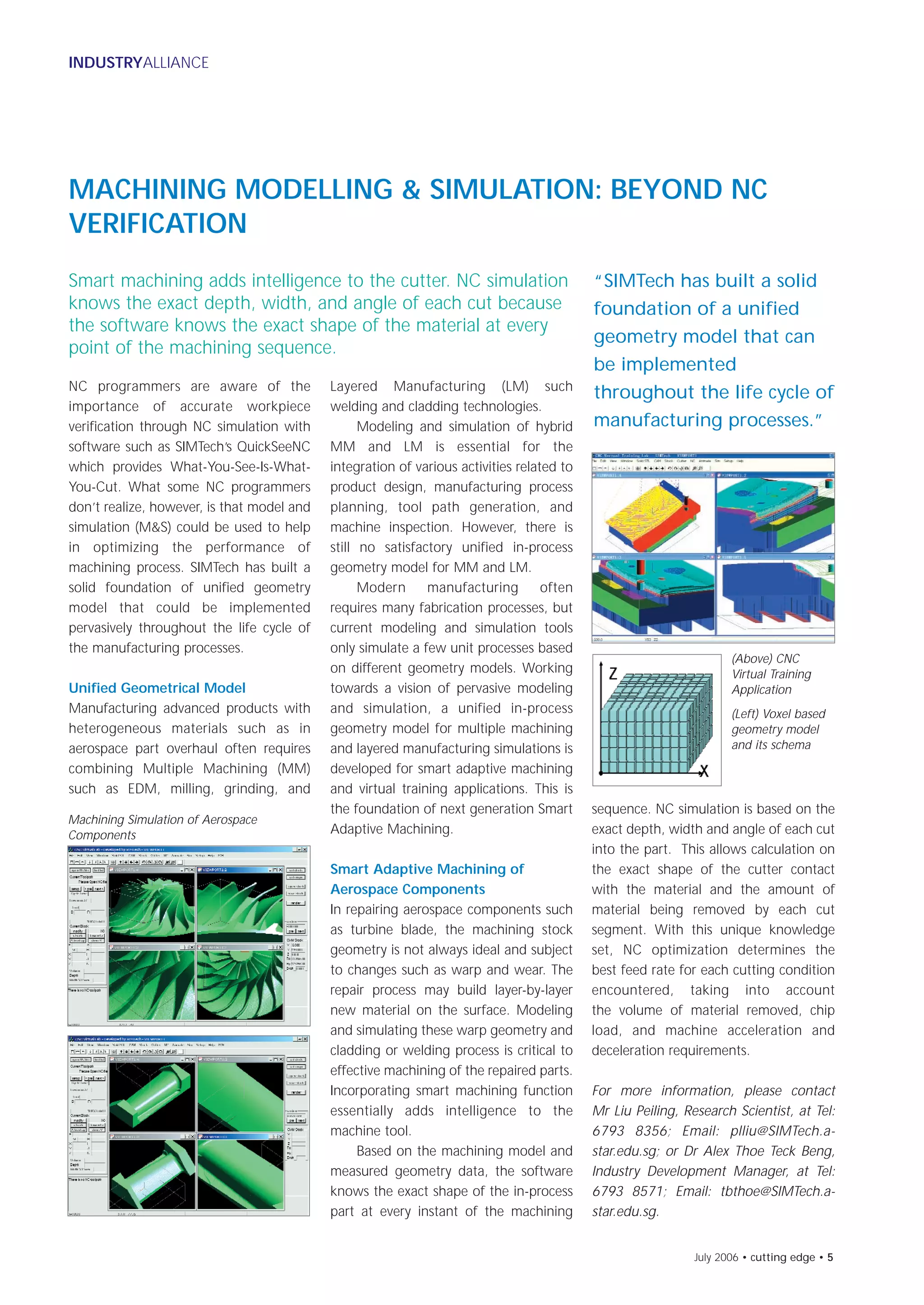
Machining Simulation of Aerospace
Components
(Above) CNC
Virtual Training
Application
(Left) Voxel based
geometry model
and its schema
sequence. NC simulation is based on the
exact depth, width and angle of each cut
into the part. This allows calculation on
the exact shape of the cutter contact
with the material and the amount of
material being removed by each cut
segment. With this unique knowledge
set, NC optimization determines the
best feed rate for each cutting condition
encountered, taking into account
the volume of material removed, chip
load, and machine acceleration and
deceleration requirements.
For more information, please contact
Mr Liu Peiling, Research Scientist, at Tel:
6793 8356; Email: plliu@SIMTech.a-
star.edu.sg; or Dr Alex Thoe Teck Beng,
Industry Development Manager, at Tel:
6793 8571; Email: tbthoe@SIMTech.a-
star.edu.sg.
“SIMTech has built a solid
foundation of a unified
geometry model that can
be implemented
throughout the life cycle of
manufacturing processes.”
cuttingedge iss47 vis2 7/18/06 6:10 PM Page 5

Machining modelling simulation beyond nc verification

  • 1.
    July 2006 •cutting edge • 5 INDUSTRYALLIANCE MACHINING MODELLING & SIMULATION: BEYOND NC VERIFICATION Smart machining adds intelligence to the cutter. NC simulation knows the exact depth, width, and angle of each cut because the software knows the exact shape of the material at every point of the machining sequence. Layered Manufacturing (LM) such welding and cladding technologies. Modeling and simulation of hybrid MM and LM is essential for the integration of various activities related to product design, manufacturing process planning, tool path generation, and machine inspection. However, there is still no satisfactory unified in-process geometry model for MM and LM. Modern manufacturing often requires many fabrication processes, but current modeling and simulation tools only simulate a few unit processes based on different geometry models. Working towards a vision of pervasive modeling and simulation, a unified in-process geometry model for multiple machining and layered manufacturing simulations is developed for smart adaptive machining and virtual training applications. This is the foundation of next generation Smart Adaptive Machining. Smart Adaptive Machining of Aerospace Components In repairing aerospace components such as turbine blade, the machining stock geometry is not always ideal and subject to changes such as warp and wear. The repair process may build layer-by-layer new material on the surface. Modeling and simulating these warp geometry and cladding or welding process is critical to effective machining of the repaired parts. Incorporating smart machining function essentially adds intelligence to the machine tool. Based on the machining model and measured geometry data, the software knows the exact shape of the in-process part at every instant of the machining NC programmers are aware of the importance of accurate workpiece verification through NC simulation with software such as SIMTech’s QuickSeeNC which provides What-You-See-Is-What- You-Cut. What some NC programmers don’t realize, however, is that model and simulation (M&S) could be used to help in optimizing the performance of machining process. SIMTech has built a solid foundation of unified geometry model that could be implemented pervasively throughout the life cycle of the manufacturing processes. Unified Geometrical Model Manufacturing advanced products with heterogeneous materials such as in aerospace part overhaul often requires combining Multiple Machining (MM) such as EDM, milling, grinding, and Machining Simulation of Aerospace Components (Above) CNC Virtual Training Application (Left) Voxel based geometry model and its schema sequence. NC simulation is based on the exact depth, width and angle of each cut into the part. This allows calculation on the exact shape of the cutter contact with the material and the amount of material being removed by each cut segment. With this unique knowledge set, NC optimization determines the best feed rate for each cutting condition encountered, taking into account the volume of material removed, chip load, and machine acceleration and deceleration requirements. For more information, please contact Mr Liu Peiling, Research Scientist, at Tel: 6793 8356; Email: plliu@SIMTech.a- star.edu.sg; or Dr Alex Thoe Teck Beng, Industry Development Manager, at Tel: 6793 8571; Email: tbthoe@SIMTech.a- star.edu.sg. “SIMTech has built a solid foundation of a unified geometry model that can be implemented throughout the life cycle of manufacturing processes.” cuttingedge iss47 vis2 7/18/06 6:10 PM Page 5