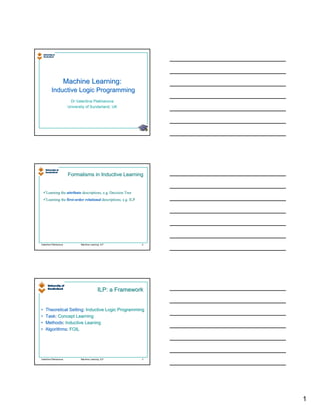
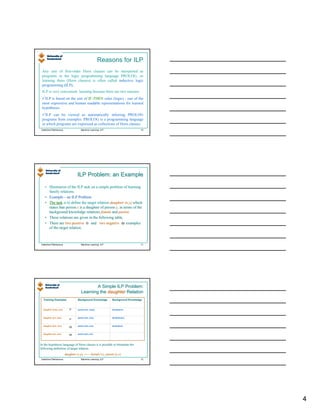
The document discusses inductive logic programming (ILP), which uses inductive learning techniques to learn logic programs from examples and background knowledge expressed in first-order logic. ILP aims to learn a target predicate by defining it in terms of known predicates from background knowledge. The FOIL algorithm is described, which searches for a hypothesis that covers all positive examples while avoiding negative examples by adding literals to rules to maximize information gain. ILP is useful because it can automatically infer logic programs from examples in the same way logic programming languages like Prolog represent programs as Horn clauses.


![INPUT: B, E+, E-, H=∅
R = p(X1,…,Xn) ← FOIL Algorithm
WHILE E+≠ ∅ DO
WHILE There are examples in E – , i.e. ∃ e ∈ E - ,
i.e. that are still covered by H∪ {R} DO
find the best Literal L (via FOIL_Gain) to add this Literal L to R
FOIL_Gain)
R =R←L
E - = E - {e ∈ E- | that does not satisfy R }
END
H = H ∪ {R}
E+ = E+ {e ∈ E + | H}
i.e. {The examples in E+ , that are covered by B, are removed}
END
OUTPUT: H
Valentina Plekhanova Machine Learning: ILP 13
FOIL Algorithm
Consider some rule R, and a candidate literal L that might be
added to the body of R. Let R′ be the new rule created by adding
literal L to R.
The value Foil_Gain (L, R) of adding L to R is defined as
Foil_Gain (L, R)=t { log2 [p1 / (p1+n1)]-log2 [p0 / (p0+n0)] }
)]-
where p0 is the number of positive bindings of rule R, n0 is the
number of negative bindings of R, p1 and n1 - for rule R′.
t is the number of positive bindings of rule R that are still
covered after adding literal L to R. Foil_Gain value has an
interpretation in terms of information theory ( -log2[p0 /(p0+n0)]
is the entropy).
Valentina Plekhanova Machine Learning: ILP 14
FOIL Algorithm: an Example
Rule1: daughter (X,Y) ←
T1: (Mary, Ann) + p1 = 2 L1 = female (X)
(Eve, Tom) + n1 = 2 Foil_Gain_L1 = …
Foil_Gain_L
(Tom, Ann) - t1 = … L2 = parent (Y,X)
(Eve, Ann) - Foil_Gain_L2 = …
Rule2: daughter (X,Y) ← female (X)
T2: (Mary, Ann) + p2 = 2 L2 = parent (Y,X)
(Eve, Tom) + n2 = 1 Foil_Gain_L2 = …
Foil_Gain_L
(Eve, Ann) - t2 = …
Rule3: daughter (X,Y) ← female (X), parent (Y,X)
T3: (Mary, Ann) + p3 = 2 Final rule - …?
rule
(Eve, Tom) + n3 = 0
t3 = …
Valentina Plekhanova Machine Learning: ILP 15
5](https://image.slidesharecdn.com/machine-learning-machine-learning4238/85/Machine-Learning-Machine-Learning-5-320.jpg)


![[ISDA'11] Towards integrating fuzzy logic capabilities into an ontology based...](https://cdn.slidesharecdn.com/ss_thumbnails/isda11towardsintegratingfuzzylogiccapabilitiesintoanontology-basedinductivelogicprogrammingframework-120611064531-phpapp02-thumbnail.jpg?width=640&height=640&fit=bounds)


