Question & Answer
for Interview Preparation
WWW.LEARNBAY.CO
Machine Learning
What is Linear Regression?
Linear regression is a linear approach to
modelling the relationship between a
scalar response (or dependent variable) and
one or more explanatory variables or
independent variables.
The case of one explanatory variable is
called simple linear regression, for more
than one explanatory variable, the process
is called multiple linear regression.
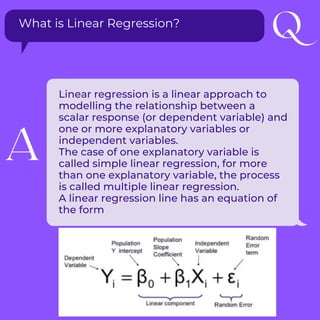
A linear regression line has an equation of
the form
Q
A
What are assumptions of Linear
Regression?
Short Trick: Assumptions can be
abbreviated as LINE in order to remember.
L : Linearity ( Relationship between x and y
is linear)
I : Independence (Observations are
independent of each other)
N : Normality (for any fix value of x, y is
normally distributed)
E : Equal Variance (homoscedasticity)
Q
A
What is Regularization? Explain
different types of Regularizations?
The L1 regularization (also called Lasso)
The L2 regularization (also called
Ridge)T
The L1/L2 regularization (also called
Elastic net)
Regularization is a technique which is used
to solve the overfitting problem of the
machine learning models.
The types of Regularization are as follows:
Q
A
How to choose the value of the
regularisation parameter (λ)?
Selecting the regularisation parameter is a
tricky business. If the value of λ is too high, it
will lead to extremely small values of the
regression coefficient β, which will lead to
the model underfitting (high bias – low
variance).
On the other hand, if the value of λ is 0 (very
small), the model will tend to overfit the
training data (low bias – high variance).
There is no proper way to select the value of
λ. What you can do is have a sub-sample of
data and run the algorithm multiple times
on different sets. Here, the person has to
decide how much variance can be tolerated.
Once the user is satisfied with the variance,
that value of λ can be chosen for the full
dataset.
Q
A
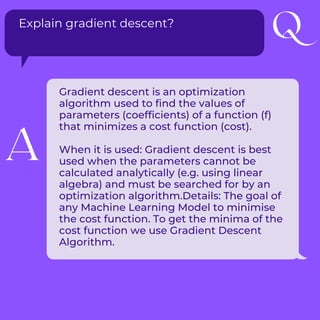
Explain gradient descent?
Gradient descent is an optimization
algorithm used to find the values of
parameters (coefficients) of a function (f)
that minimizes a cost function (cost).
When it is used: Gradient descent is best
used when the parameters cannot be
calculated analytically (e.g. using linear
algebra) and must be searched for by an
optimization algorithm.Details: The goal of
any Machine Learning Model to minimise
the cost function. To get the minima of the
cost function we use Gradient Descent
Algorithm.
Q
A

Machine Learning Interview Question and Answer

  • 1.
    Question & Answer forInterview Preparation WWW.LEARNBAY.CO Machine Learning
  • 2.
    What is LinearRegression? Linear regression is a linear approach to modelling the relationship between a scalar response (or dependent variable) and one or more explanatory variables or independent variables. The case of one explanatory variable is called simple linear regression, for more than one explanatory variable, the process is called multiple linear regression. A linear regression line has an equation of the form Q A
  • 3.
    What are assumptionsof Linear Regression? Short Trick: Assumptions can be abbreviated as LINE in order to remember. L : Linearity ( Relationship between x and y is linear) I : Independence (Observations are independent of each other) N : Normality (for any fix value of x, y is normally distributed) E : Equal Variance (homoscedasticity) Q A
  • 4.
    What is Regularization?Explain different types of Regularizations? The L1 regularization (also called Lasso) The L2 regularization (also called Ridge)T The L1/L2 regularization (also called Elastic net) Regularization is a technique which is used to solve the overfitting problem of the machine learning models. The types of Regularization are as follows: Q A
  • 5.
    How to choosethe value of the regularisation parameter (λ)? Selecting the regularisation parameter is a tricky business. If the value of λ is too high, it will lead to extremely small values of the regression coefficient β, which will lead to the model underfitting (high bias – low variance). On the other hand, if the value of λ is 0 (very small), the model will tend to overfit the training data (low bias – high variance). There is no proper way to select the value of λ. What you can do is have a sub-sample of data and run the algorithm multiple times on different sets. Here, the person has to decide how much variance can be tolerated. Once the user is satisfied with the variance, that value of λ can be chosen for the full dataset. Q A
  • 6.
    Explain gradient descent? Gradientdescent is an optimization algorithm used to find the values of parameters (coefficients) of a function (f) that minimizes a cost function (cost). When it is used: Gradient descent is best used when the parameters cannot be calculated analytically (e.g. using linear algebra) and must be searched for by an optimization algorithm.Details: The goal of any Machine Learning Model to minimise the cost function. To get the minima of the cost function we use Gradient Descent Algorithm. Q A