This document describes using genetic programming to solve chess problems related to the King-Rook-King (KRK) endgame. Specifically, it evaluates genetic programming's ability to learn basic chess rules and the number of moves to checkmate in various KRK positions without direct programming of chess knowledge. The author defines the "grand KRK problem" as predicting the number of moves to checkmate for any given KRK position, and "petite KRK problems" as classifying positions by number of moves to checkmate. Genetic programming is able to solve some petite KRK problems and shows promising but limited results for the grand problem, suggesting this approach may be able to learn chess-like rules from examples.
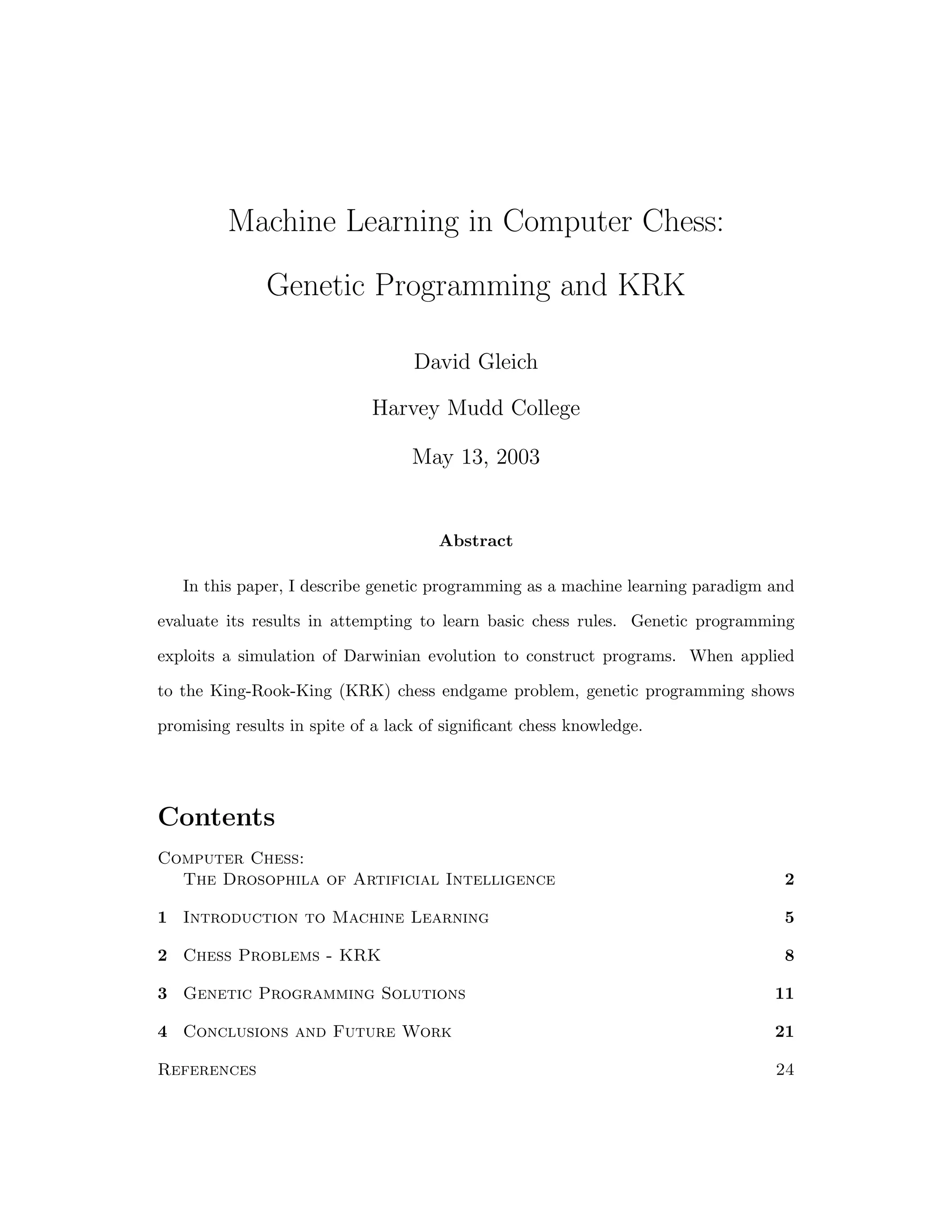
![Computer Chess:
The Drosophila of Artificial Intelligence
Since the inception of artificial intelligence (AI), researchers have often used chess
as an experimental method. Even before the field of AI formalized, pioneers such
as Wolfgang von Kempelen experimented with chess playing machines. Kempelen’s
mechanical automata, The Turk, fooled many into believing machines could play chess
in the 18th century.
However, it wasn’t until Claude Shannon published a paper entitled, “A Chess-
Playing Machine,” [Shannon] that the study of computer chess began in earnest. Shan-
non’s paper describes a chess program as a series of interlinked subprograms. He cor-
rectly observes that playing perfect chess is impossible, even for a machine – there are
an estimated 10120 nodes in a full-width chess tree. Even computers capable of eval-
uating 1016 positions in a second (which is eight orders of magnitude over the fastest
chess computer ever created) would need in excess of 1095 years to fully evaluate this
tree. Consequently, all chess programs are approximations.
Chess is, then, a problem of approximating, or simulating, the reasoning used by
chess masters to pick moves from an extremely large search space. The early objectives
of computer chess research were also very clear – to build a machine that would defeat
the best human player in the world. In 1997, the Deep Blue chess machine created by
IBM accomplished this goal, and defeated Gary Kasparov in a match at tournament
time controls. In tournament time controls, each player has two hours to make their
first forty moves, then one hour for the rest of the moves.
However, programs such as those described by Shannon and exemplified by Deep
Blue are essentially static. Human programmers invested massive amounts of time in
constructing the rule set of Deep Blue, in an attempt to approximate human position
evaluation. There is a vast body of literature on this problem; several references,
[Shannon], [Mar81], [Sch86], [Sch96], and [Hyatt], contain more information.
This report focuses, instead, on the problem of computer chess from a machine
2](https://image.slidesharecdn.com/machine-learning-in-computer-chess-genetic-programming-and-krk301/75/Machine-Learning-in-Computer-Chess-Genetic-Programming-and-KRK-2-2048.jpg)
![learning perspective. One of the objectives of the machine learning field of AI is to
provide an example data set, and to have the machine “learn” the rules from the
examples along some background knowledge. One example of this type of problem
is “teaching” a computer how to distinguish even and odd numbers, based solely on
arithmetic or other properties of the numbers.
Within this paradigm, chess is an excellent problem. Investigators have constructed
massive end-game tables that specify the appropriate move for every position. One
example of these sets is the king-rook-king (KRK) set from the University of California
Irvine machine learning database [BM98]. This dataset contains all the positions where
a sole black king stands against a white king and white rook with the black king’s turn
to play. Additionally, it contains the number of moves to checkmate for all of the
positions. In Figure 1, white will mate in four moves.
0Z0Z0Z0Z
Z0Z0Z0Z0
8
0Z0Z0S0Z
7
Z0Z0Z0Z0
6
0Z0Z0Z0Z
5
Z0Z0Z0Z0
4
0Z0J0Z0Z
3
j0Z0Z0Z0
2
1
a b c d e f g h
Figure 1: Black to move, but White to checkmate in 4 moves.
The precise mating sequence for Figure 1 follows.
1 ... Kb2
2 Rf3 Kb1
3 Kc3 Ka2
4 Rf1 Ka3
5 Ra1#
3](https://image.slidesharecdn.com/machine-learning-in-computer-chess-genetic-programming-and-krk301/75/Machine-Learning-in-Computer-Chess-Genetic-Programming-and-KRK-3-2048.jpg)
![1 Introduction to Machine Learning
There are many techniques and strategies used in machine learning. The following
are some of the formal machine learning systems or methods.
• Inductive Logic Programming
• Simulated Annealing
• Evolutionary Strategies (including genetic algorithms and genetic programming)
• Neural Nets
Each of these methods has slightly different advantages and disadvantages which
are outside the scope of this report. For one such analysis, see [KHFS]. Here, I will
simply focus on genetic programming.
1.1 Genetic Programming
According to Langdon and Poli, genetic programming is a type of evolutionary algo-
rithm [LP]. In general, evolutionary algorithms borrow from Darwinian evolutionary
concepts to solve search problems. The first type of evolutionary algorithms were called
genetic algorithms. Genetic programming later evolved as a generalization of genetic
algorithms.
All genetic programming (GP) experiments follow a general form. First, the GP al-
gorithm creates a random population of individuals. Next, the algorithm evaluates each
individual using a fitness function. After evaluating every individual, the algorithm
applies breeding operators to create the next generation. Together, this explanation
corresponds to the generational model from Langdon and Poli.
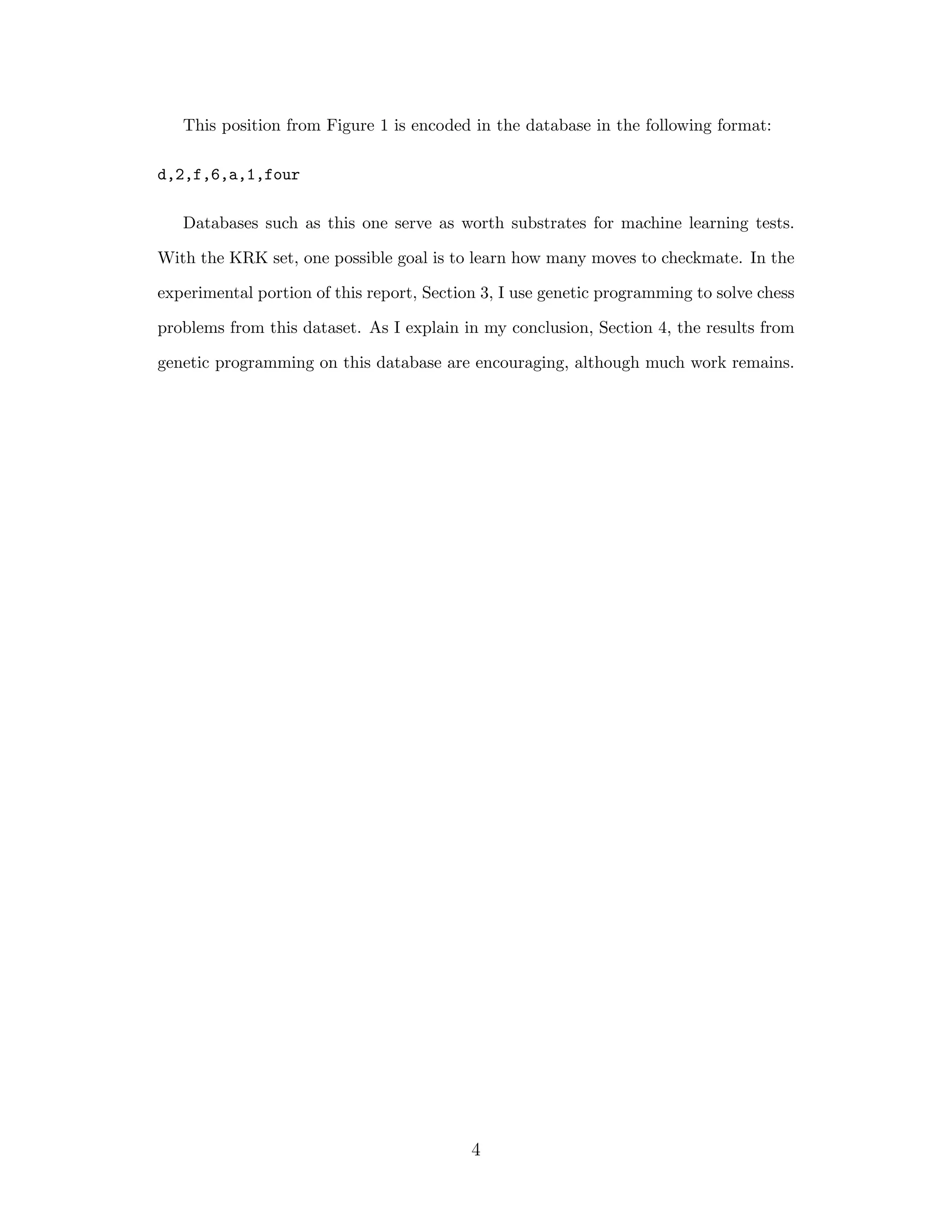
Since GP’s intention is to evolve programs, each individual in the population is a
program. Typically, these programs are represented as trees; an example is shown in
Figure 2.
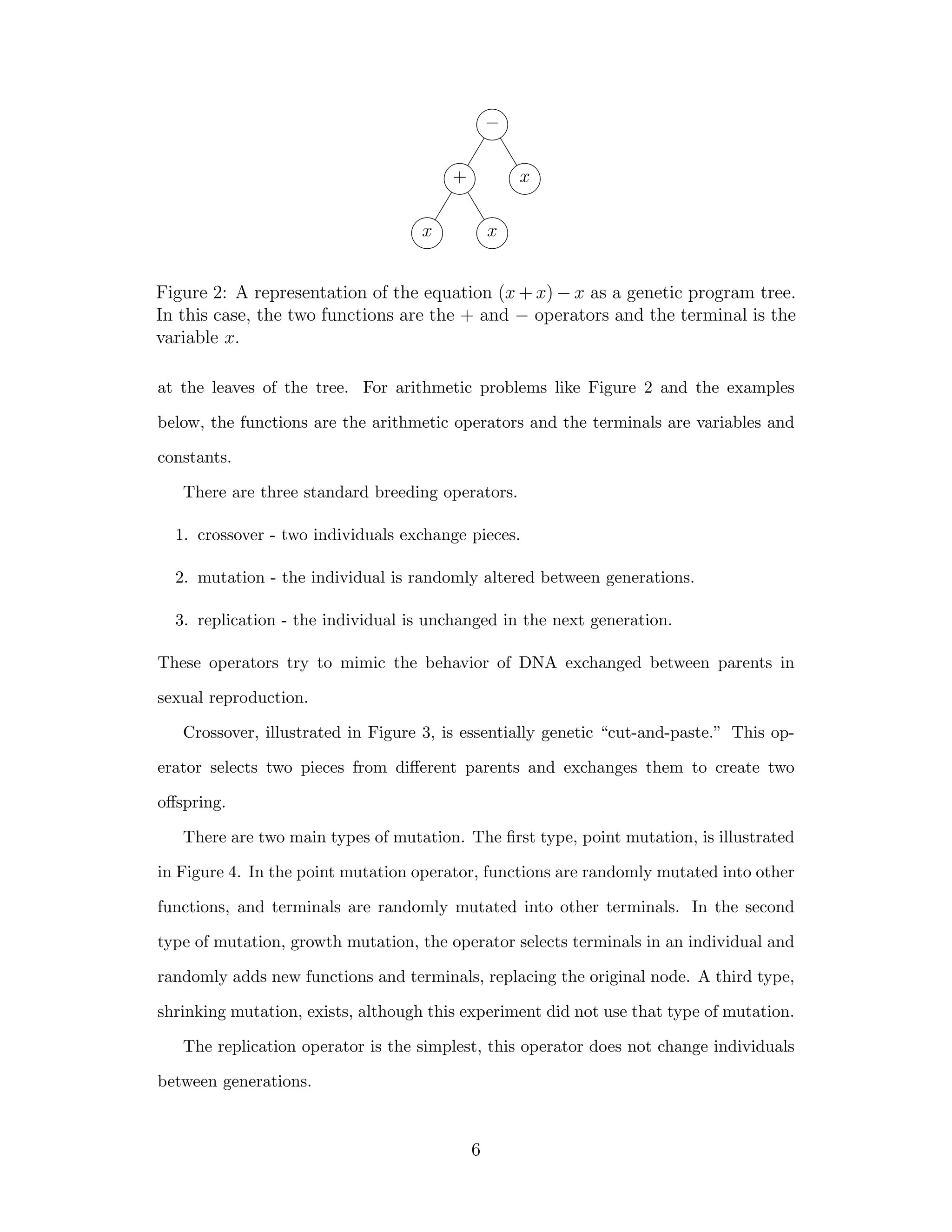
In order to represent a program as a tree, GP requires two sets: functions and
terminals. Functions occur at every interior node in the tree and terminals occur
5](https://image.slidesharecdn.com/machine-learning-in-computer-chess-genetic-programming-and-krk301/75/Machine-Learning-in-Computer-Chess-Genetic-Programming-and-KRK-5-2048.jpg)
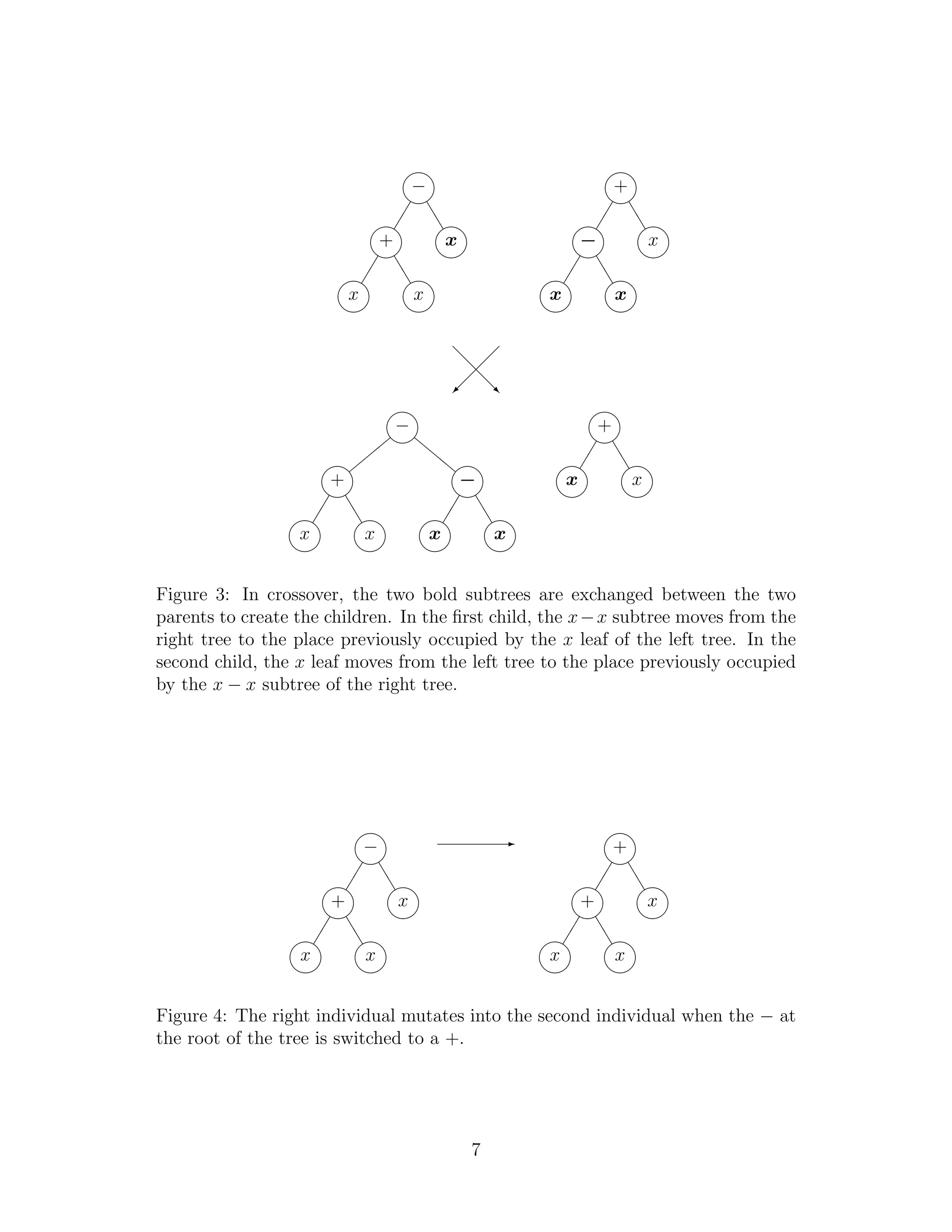
![2 Chess Problems - KRK
In this paper, I look at king-rook-king (KRK) chess end game problems. As I
mentioned in the introduction, the KRK endgame consists of positions involving only
a white king, a white rook, and a black king. See Figure 1 and Figure 5 for sample
positions. More specifically, I focus on the black to move positions in the KRK endgame
from the University of California Irvine’s Machine Learning database [BM98].
0Z0Z0Z0Z
Z0ZRZ0Z0
8
0Z0Z0Z0Z
7
Z0Z0Z0Z0
6
0Z0Z0Z0Z
5
Z0ZKZ0Z0
4
0Z0Z0Z0Z
3
Z0ZkZ0Z0
2
1
a b c d e f g h
Figure 5: Black to move, but White to checkmate in 2 moves.
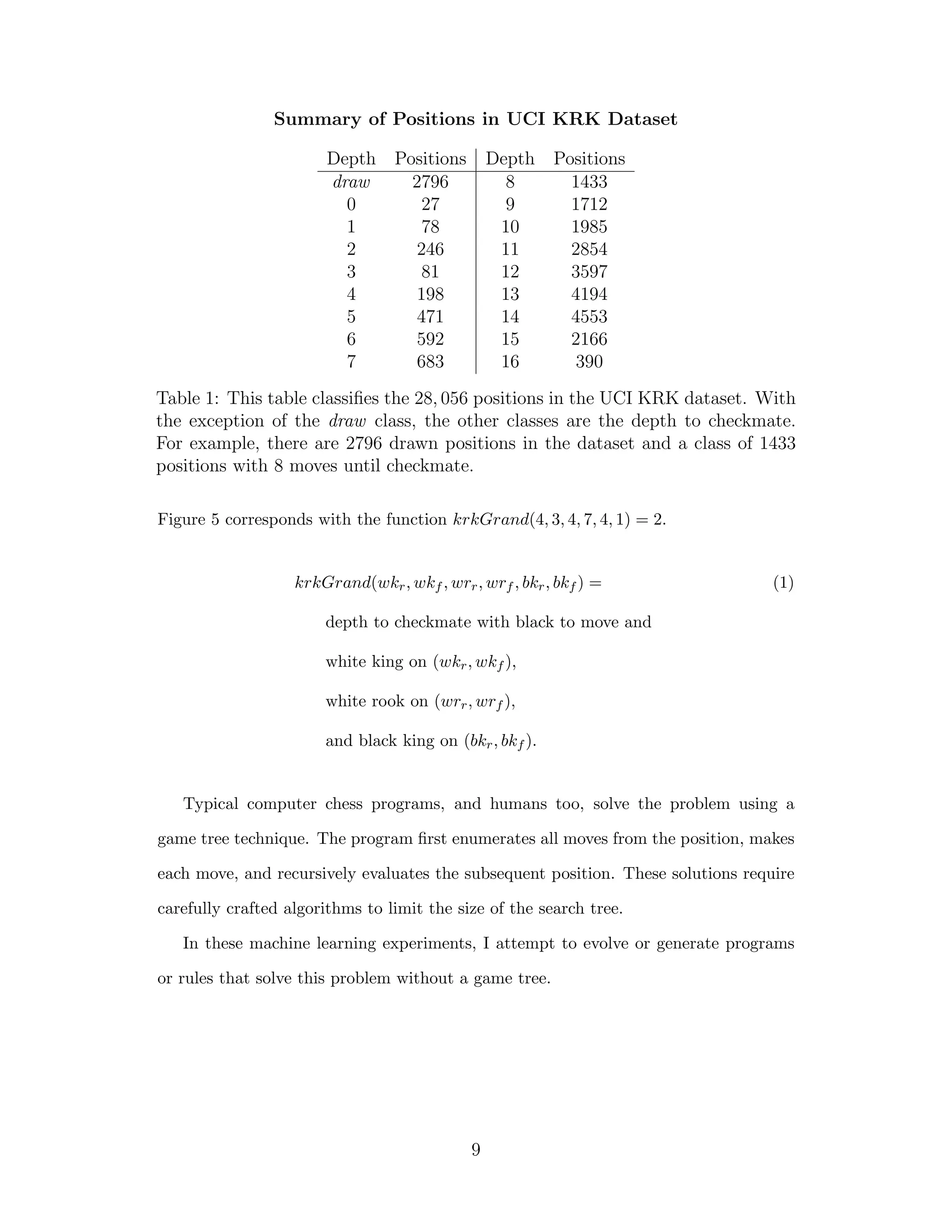
In total, the KRK dataset contains 28, 056 positions. Table 1 presents a summary
of these positions. For this problem, I only consider the non-drawn positions from the
dataset. With this restriction, there are 25, 361 positions in the seventeen depth to
checkmate classes.
2.1 The Grand KRK Problem
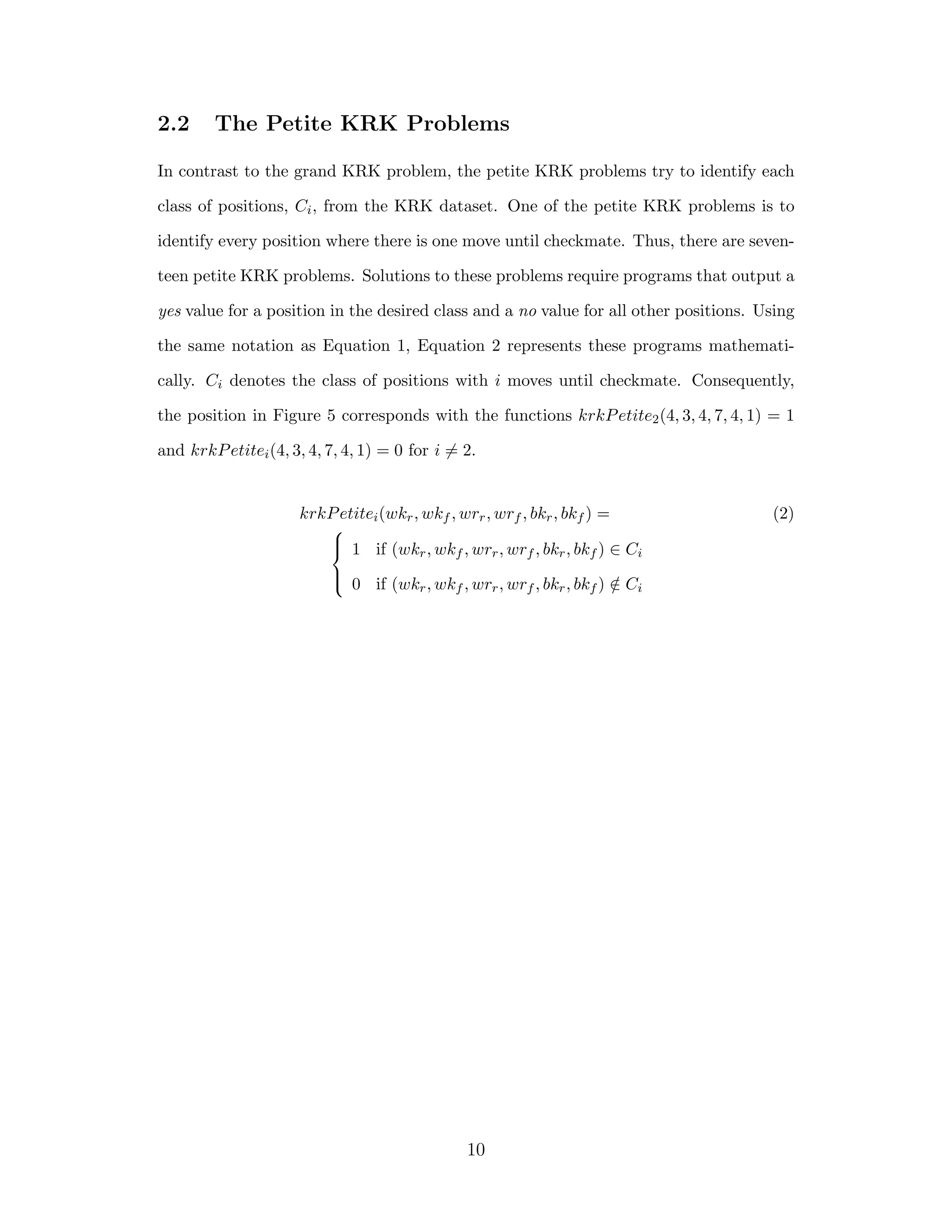
The grand KRK problem is ambitious. A complete solution to the problem requires
a program which takes a position from the KRK dataset and returns the number of
moves to checkmate. Equation 1 represents this program as a mathematical function.
In this equation, wkr is the integer rank of the white king where a = 1 and h = 8, wkf
is the integer file of the white king. Likewise, wrr and wrf are the rank and file of the
white rook and bkr and bkf are the rank and file of the black king. The position in
8](https://image.slidesharecdn.com/machine-learning-in-computer-chess-genetic-programming-and-krk301/75/Machine-Learning-in-Computer-Chess-Genetic-Programming-and-KRK-8-2048.jpg)
![3 Genetic Programming Solutions
In this section, I describe the use of genetic programming (GP) to solve the grand KRK
and petite KRK problems. The first section enumerates the functions and terminals
used for the programs. I then explain the results for the grand KRK problem and a
petite KRK problem.
3.1 Function and Terminal Set
The major goal when constructing function and terminal sets is to provide enough ex-
pressive power so that there is a solution without trivializing the problem by supplying
excessive background information. To balance these objectives, I use a set of functions
which encodes very little chess knowledge.
• edge(i) - returns 1 if i = 1 or i = 8, and returns 2 otherwise.
• distance(i, j) - returns the absolute value of i − j, that is, the distance between
i and j.
• if then(i, j, k) - if i = 1 then if then returns j, else, if then returns k.
• compare(i, j) - returns 1 if i j, and returns 2 otherwise.
The only chess knowledge represented in the set of functions is the edge function,
which responds if the input is an edge on a chessboard.
3.2 GP Systems
There are numerous genetic programming systems available. The web page [GPSoft]
lists 15 GP toolkits and frameworks. After initial trials using lil-gp [lilgp], which was
too slow, the jrgp system was used in the experiment [jrgp].
11](https://image.slidesharecdn.com/machine-learning-in-computer-chess-genetic-programming-and-krk301/75/Machine-Learning-in-Computer-Chess-Genetic-Programming-and-KRK-11-2048.jpg)
![3.3 Grand KRK Problem
The evolutionary conditions for the grand KRK problem were a population size of
5000, a crossover frequency of 75%, a mutation frequency of 15%, and a replication
frequency of 10%. Each individual had three automatically defined functions. An
automatically defined function is a separate function that the program can re-use. The
evolved individuals were evaluated over each of the 25, 361 positions from the UCI
KRK database.
3.3.1 Fitness
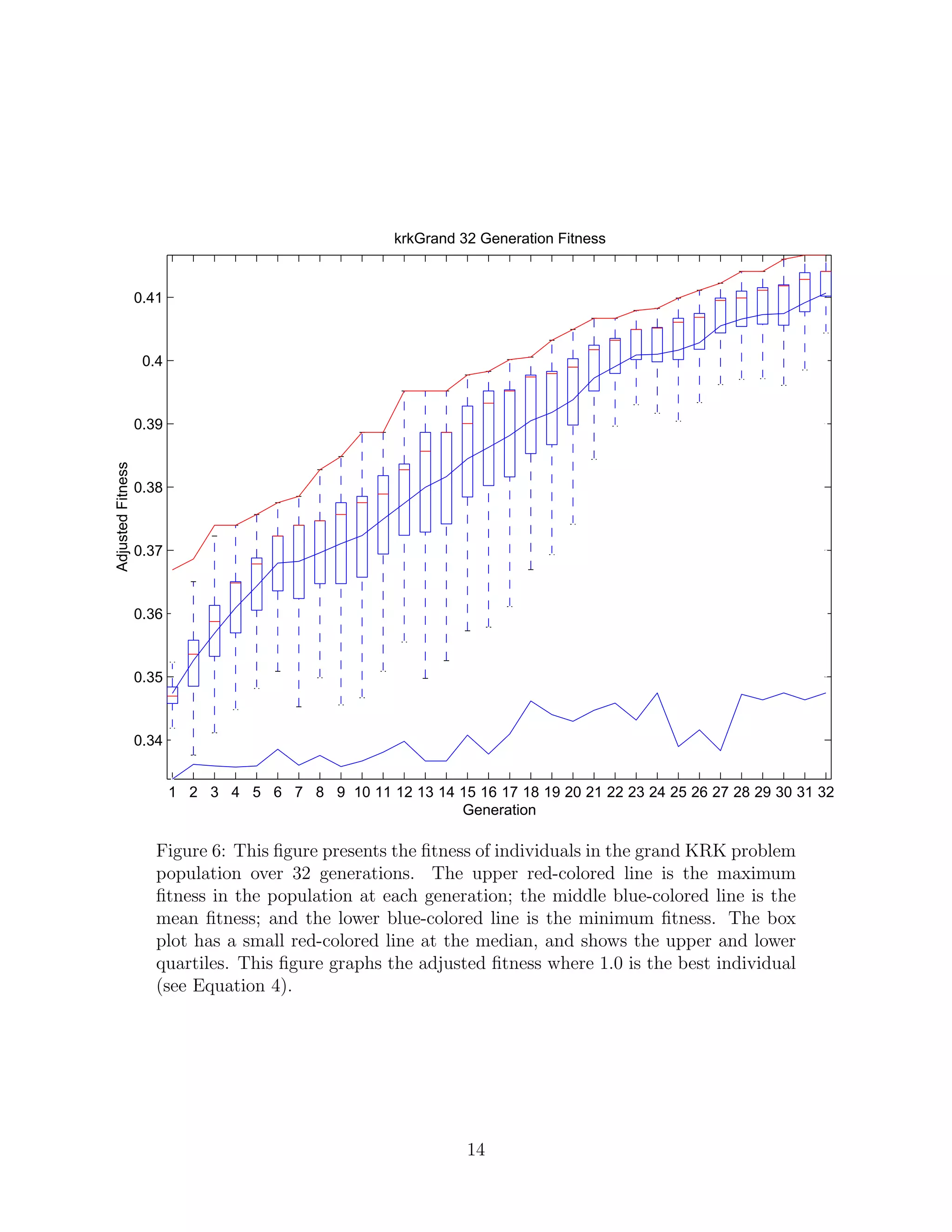
The standard fitness function for the grand KRK problem is Equation 3. In the stan-
dard fitness evaluation, the best individual occurs at 0.0. In that equation, correcti is
the number of correct answers in class Ci ; incorrecti is the number of incorrect answers
in class Ci ; and numi is the total number of positions in class Ci . (Recall that class
Ci contains all of the positions where the depth to checkmate is i.)
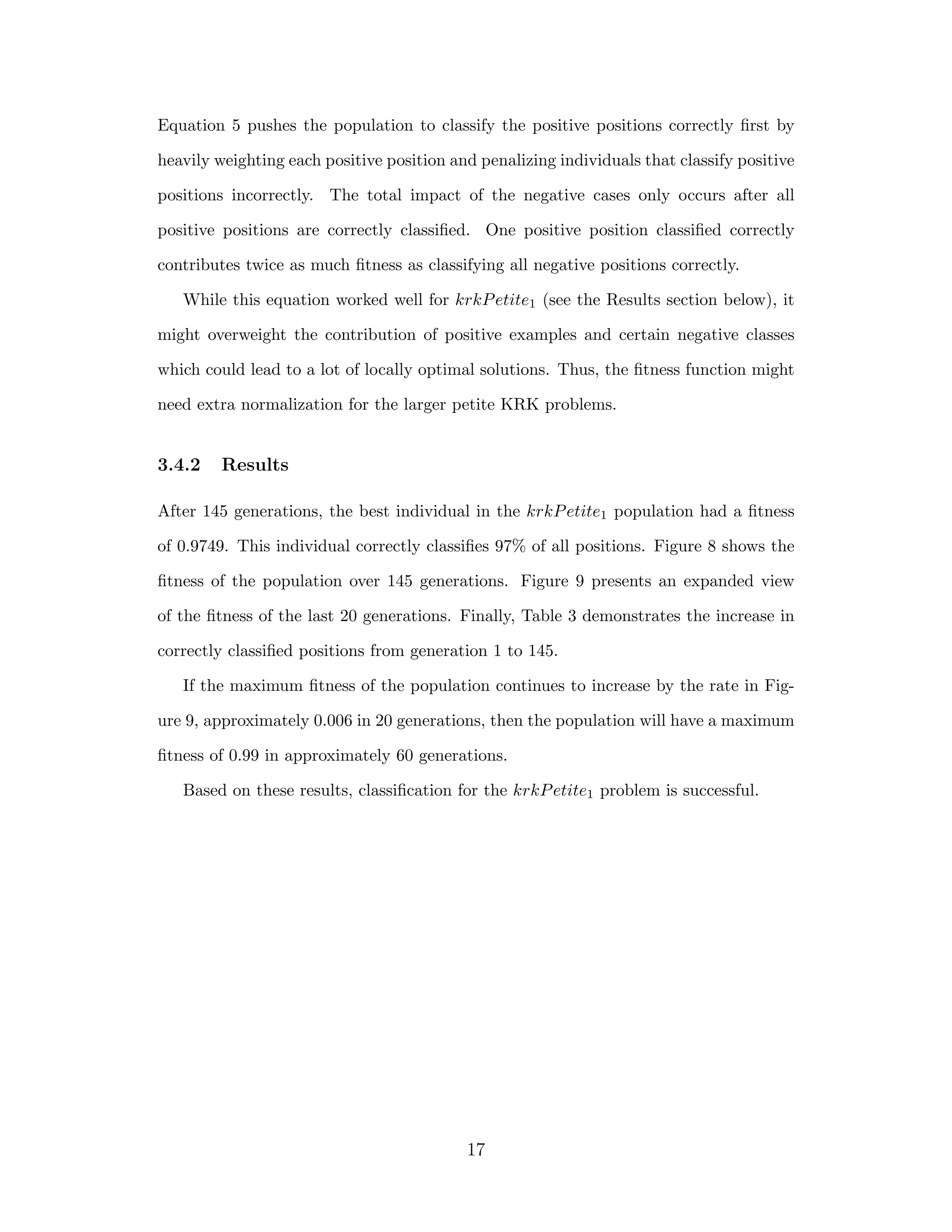
16 correcti −incorrecti
i=0 numi
krkGrandF it = 1 − (3)
17
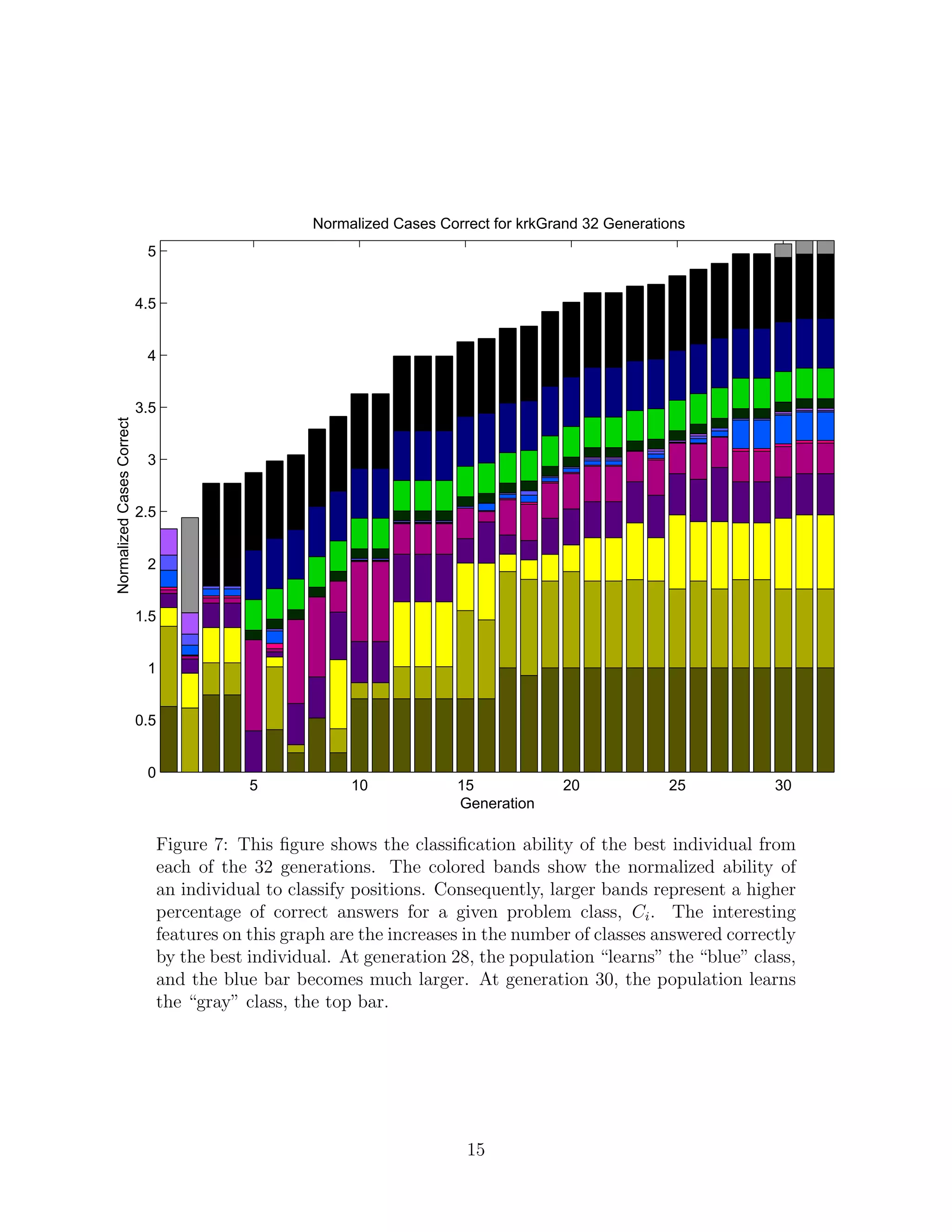
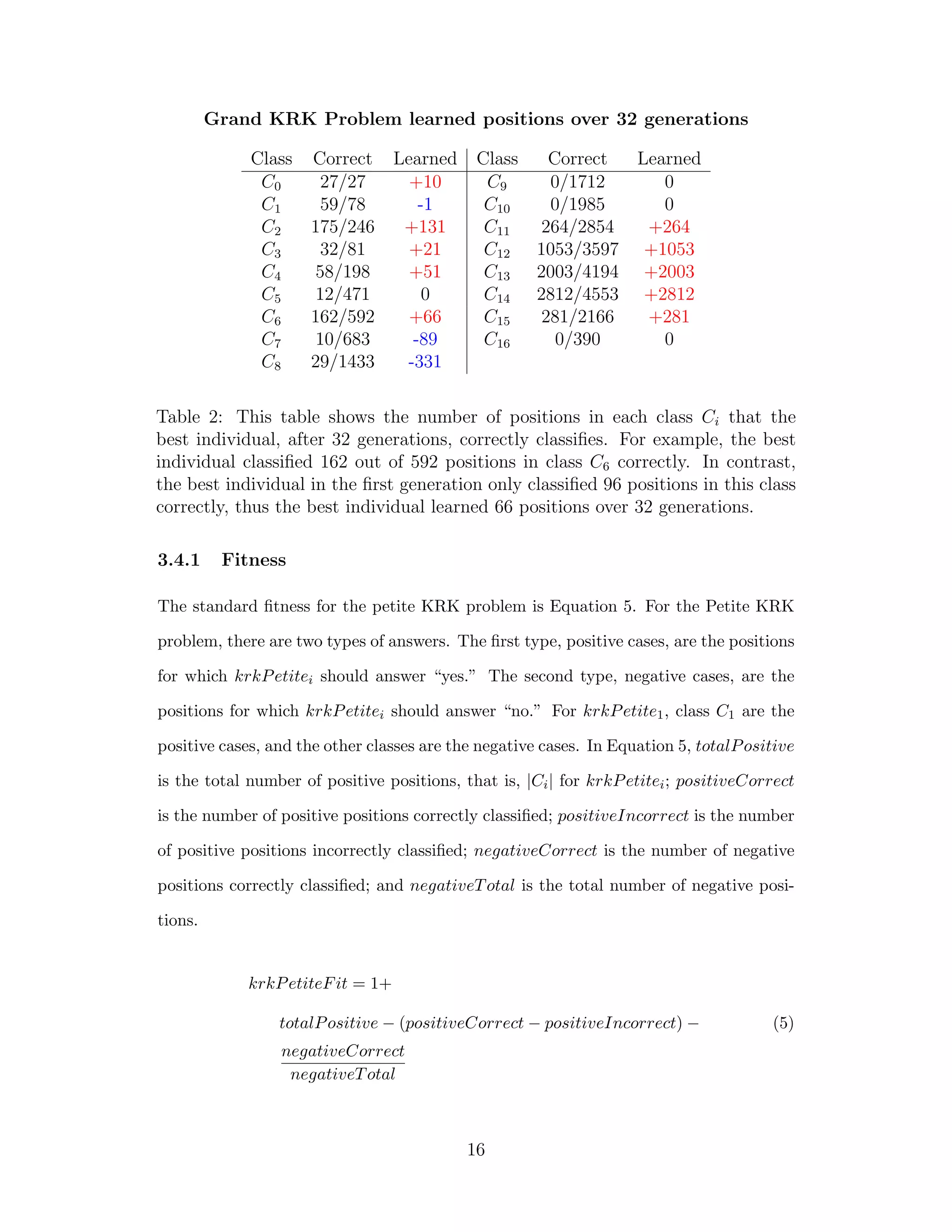
Essentially, Equation 3 normalizes the fitness benefit of each class Ci . Consequently,
class C1 can, in total, contribute as much fitness to the individual as class C14 , even
though C1 contains 78 positions and class C14 contains 4553 positions (over 50 times
as many). The normalization attempts to “smooth” the fitness function to eliminate
local optima for the large classes (e.g. C13 , C14 ).
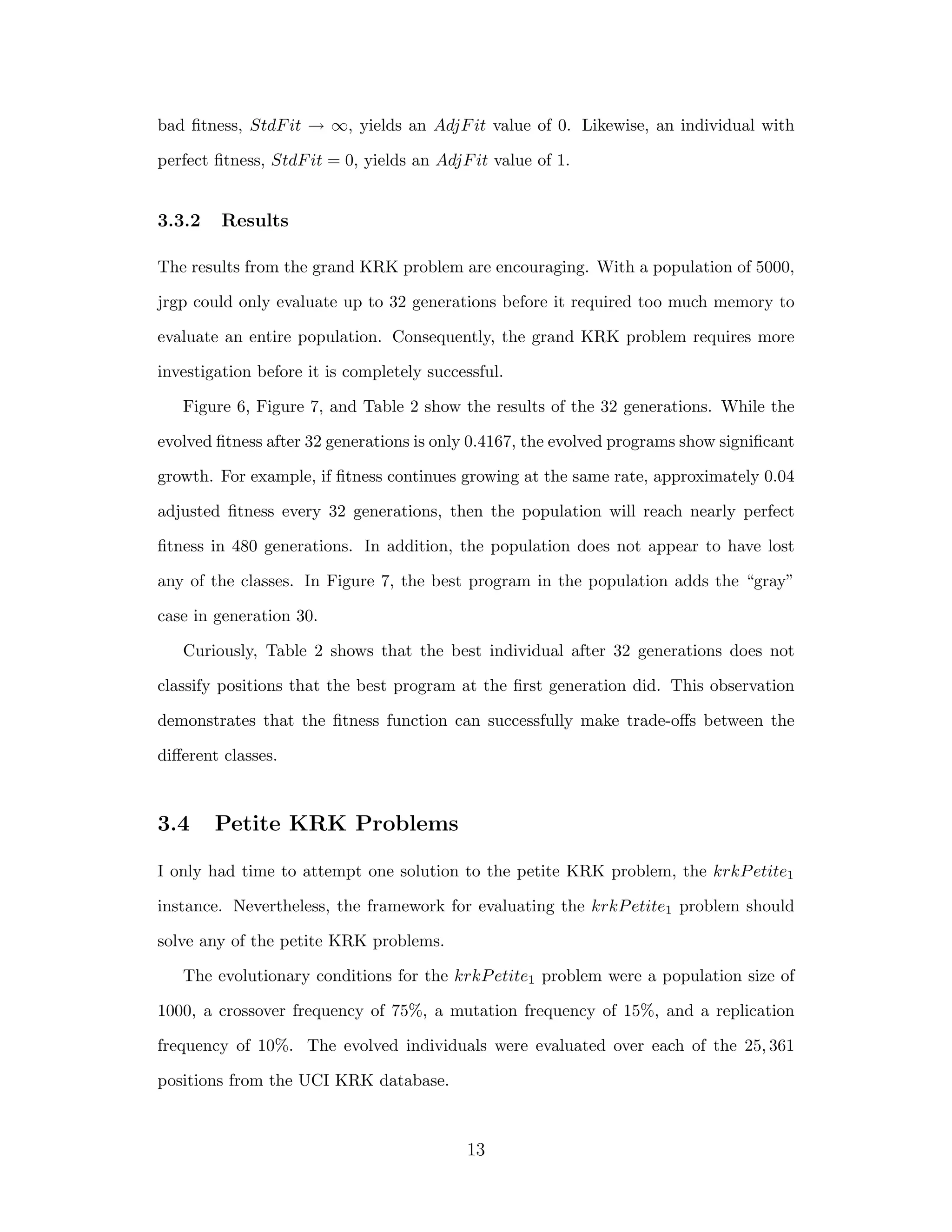
While the above equation calculates standard fitness, the figures in this section
plot adjusted fitness. On the adjusted fitness scale, 1.0 represents the best individual.
Adjusted fitness is calculated from standard fitness using Equation 4. StdF it is the
standard fitness value.
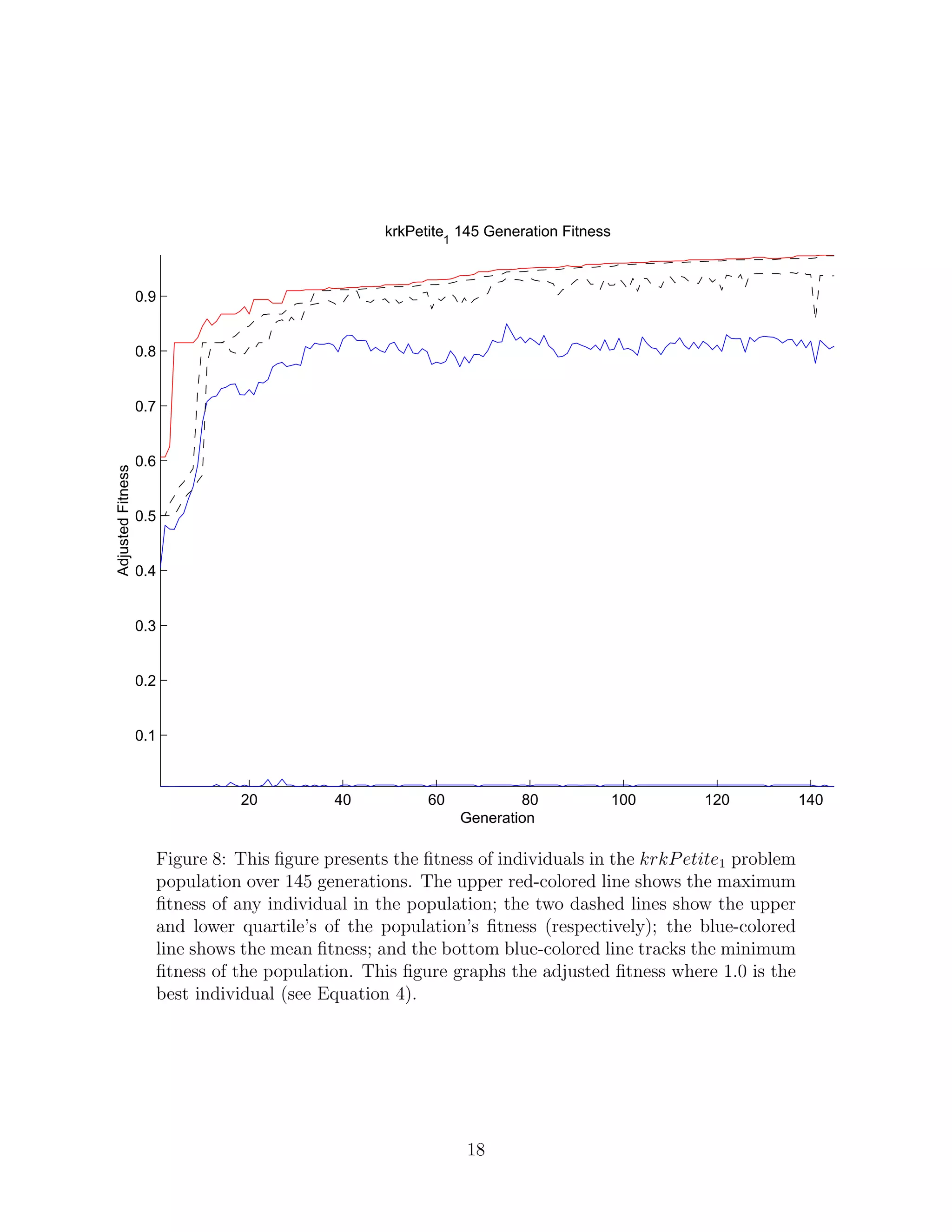
1
AdjF it = (4)
1 + StdF it
This equation scales any StdF it value to the (0, 1] range. An individual with infinitely
12](https://image.slidesharecdn.com/machine-learning-in-computer-chess-genetic-programming-and-krk301/75/Machine-Learning-in-Computer-Chess-Genetic-Programming-and-KRK-12-2048.jpg)
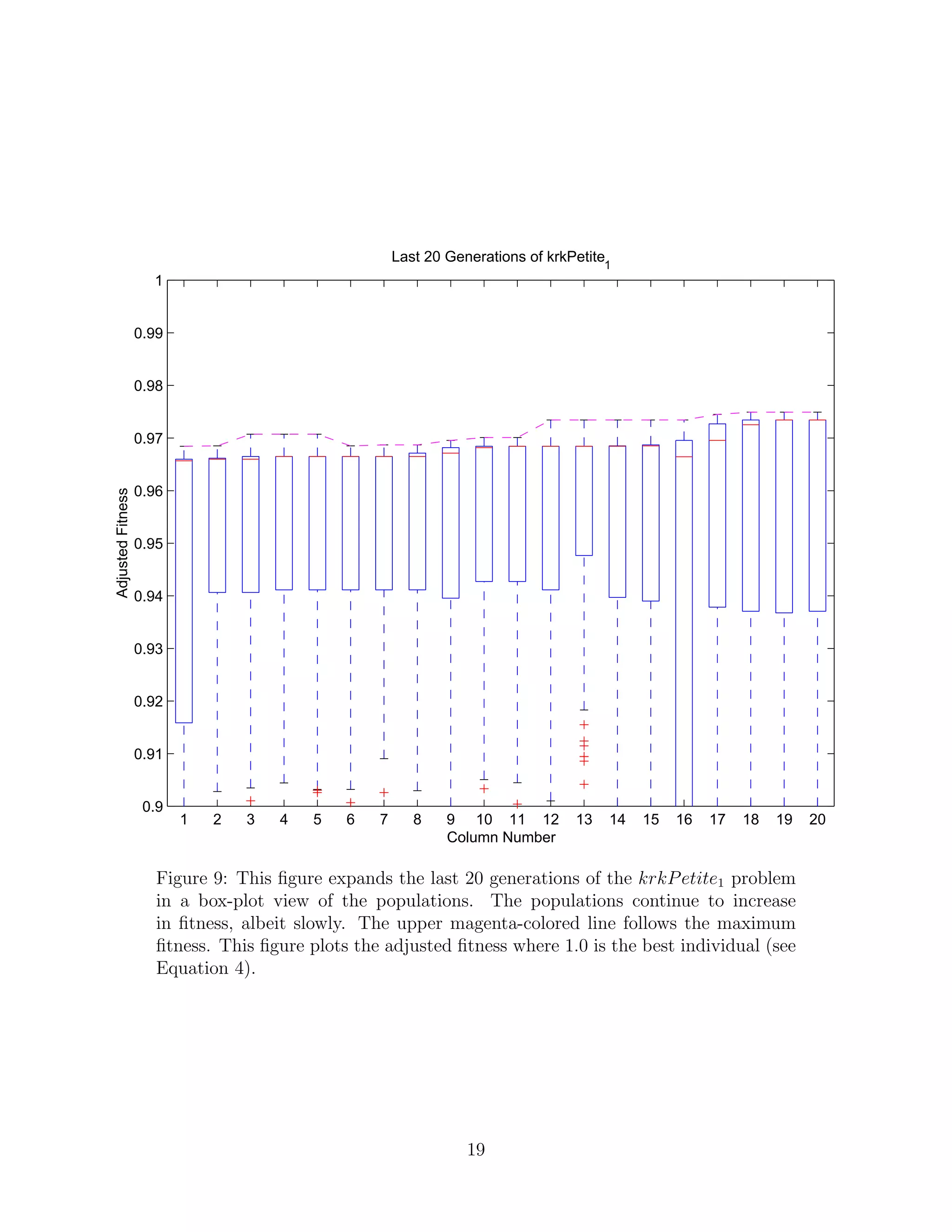
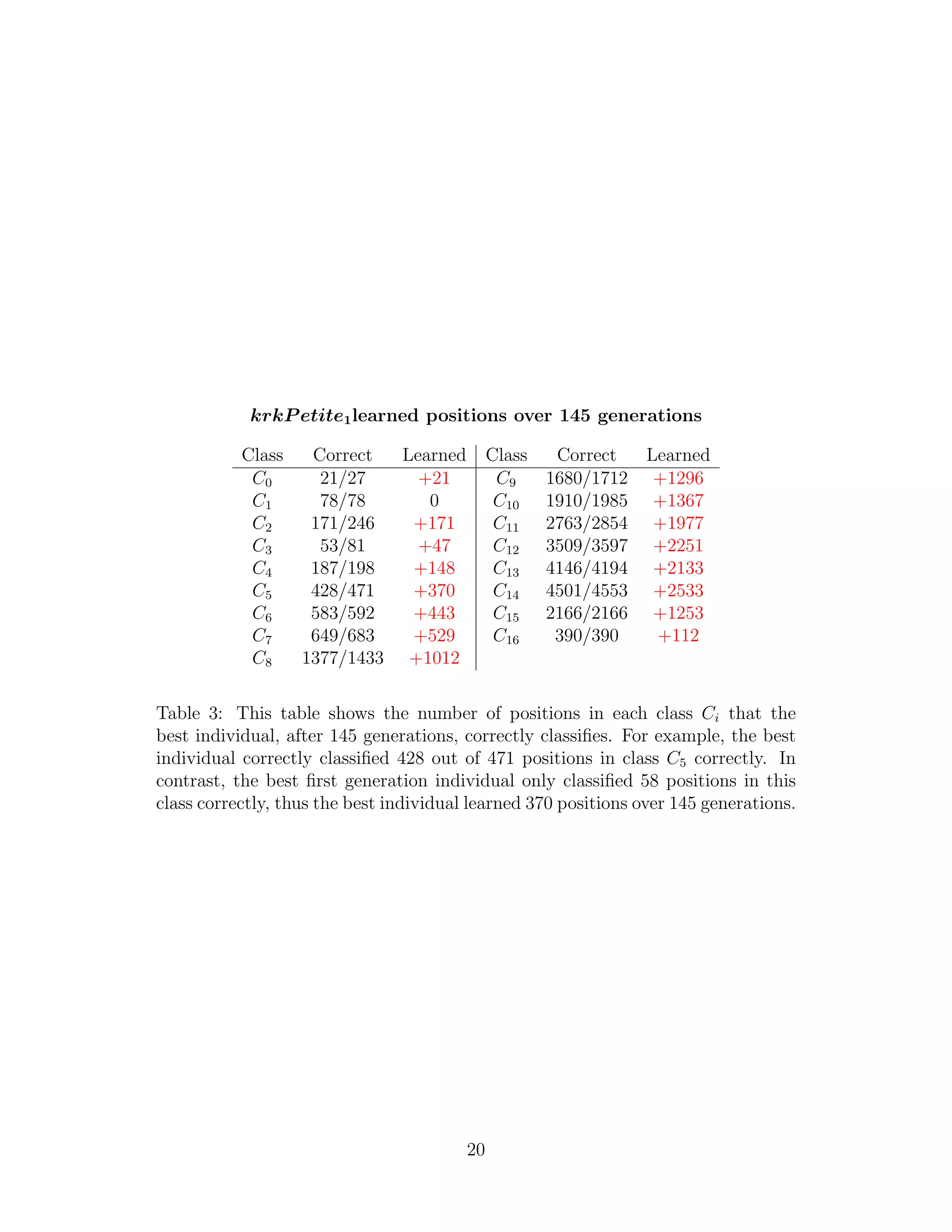
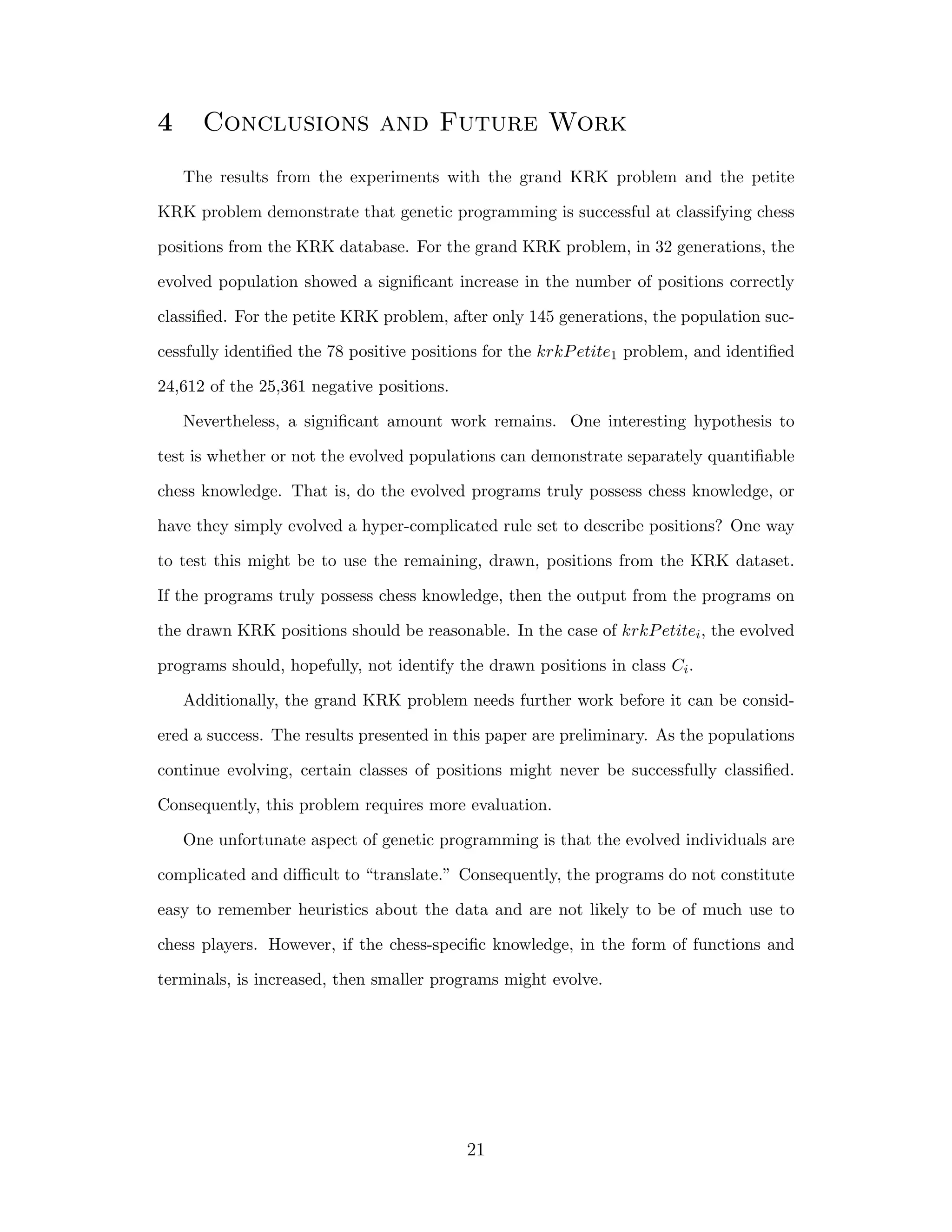
![4.1 Why GP on Chess?
Given the success of search based chess programs, such as Deep Blue [CHH], the idea
of applying genetic programming, or any machine learning paradigm, to create chess
programs appears odd. Machine learning strategies, however, may contribute valuable
information to understanding chess. Consider the position in Figure 10. As F¨rnkranz
u
notes, search based algorithms are unlikely to solve such a chess problem requiring a
depth of 270 moves (or 540 ply) [Fur95]. Even if there were only two moves for each
side, the search tree for such a result is 2540 ≈ 10163 nodes, in contrast, there are an
estimated 1080 atoms in the universe1 . Searching such an extreme tree is, then, likely
impossible.
0Z0Z0Z0Z
AkZ0ZpZp
8
0O0Z0o0Z
7
JPZ0m0Zp
6
0O0o0Z0Z
5
ZPo0ZpZ0
4
BZPZ0Z0Z
3
Z0Z0Z0ZB
2
1
a b c d e f g h
Figure 10: White to move, checkmate in 270 moves. From [Fur95].
The position in Figure 10 is, however, easily solved by humans. The key insight is
that if white can force the same position with black to move, instead, then black will
need to do something that harms his position. Note that black cannot prevent white
from queening a pawn if the black King leaves the a8, b7, or c8 squares. Also note that
black will lose if white can force the white King to the a6 square. To achieve one of
these ends, white marches the white King around to the e1 square, proceeds e1-f2-f1-e1,
and then returns to the a5 square. Since black can only move the black King to one
1
See http://www.sunspot.noao.edu/sunspot/pr/answerbook/universe.html for the calculation of
atoms in the universe.
22](https://image.slidesharecdn.com/machine-learning-in-computer-chess-genetic-programming-and-krk301/75/Machine-Learning-in-Computer-Chess-Genetic-Programming-and-KRK-22-2048.jpg)
![References
[BM94] M. Bain and S. Muggleton. Learning Optimal Chess Strageties. In K. Fu-
rukawa, D. Michie, and S. Muggleton, editors, Machine Intelligence, volume 13,
pages 291–310. Clarendon Press, 1994.
Bain and Muggleton present some of the results from Bain’s the-
sis [Bain94]. They describe an inductive logic system that correctly iden-
tifies positions from the KRK endgame where white has won, and where
white will win in one move. Their inductive logic system allows for the
invention of new predicates to describe the chess board. They gave each
predicate a human-understandable name and had a recognized human
chess-expert verify the knowledge inducted.
[Bain94] Michael Bain. Learning Logical Exceptions in Chess. PhD thesis, Turing
Institute / Strathclyde University, Scotland, 1994.
In his PhD thesis, Bain presents a number of results using machine learn-
ing induction on chess problems. He inducts complete solutions to the
KRK illegality problem, as well as the KRK-Mate-In-Zero, and KRK-
Mate-In-One (krkP etite0 , and krkP etite1 ) problems. The text of his
thesis is rich with theory and examples and is a good starting place for
research into computer induction of chess.
[Ber90] Hans Berliner, Danny Kopec, and Ed Northam. A taxonomy of concepts for
evaluating chess strength. In Proceedings of the 1990 conference on Supercomput-
ing, pages 336–343. IEEE Computer Society Press, 1990.
This paper describes a number of tests to evaluate the strength of a fully-
functional computer chess player. These tests are difficult positions with
only one correct move.
[BM98] C.L. Blake and C.J. Merz. UCI Repository of machine learning databases,
1998.
24](https://image.slidesharecdn.com/machine-learning-in-computer-chess-genetic-programming-and-krk301/75/Machine-Learning-in-Computer-Chess-Genetic-Programming-and-KRK-24-2048.jpg)
![The University of California, Irvine maintains a large repository of ma-
chine learning databases for various machine learning problems. The
dataset used in this report is the chess dataset for the king-rook-king
endgame.
[Cam99] Murray Campbell. Knowledge discovery in deep blue. Communications of
the ACM, 42(11):65–67, 1999.
[CHH] Murray Campbell, Jr. A. Joseph Hoane, and Feng hsiung Hsu. Deep Blue.
Artificial Intelligence, 134(1-2):57–83, 2002.
[Coles] L. Stephen Coles. Computer Chess: The Drosophila of AI. AI Expert Magazine,
April 1994.
Coles presents a brief overview of the history of computer chess. This
article is somewhat dated since Deep Blue did beat Kasparov in 1997, as
the author predicted. However, this article is strictly about search based
chess programs, not machine learning programs.
[Fur95] Johannes F¨rnkranz.
u A Brief Introduction to Knowledge Discovery in
¨
Databases. OGAI-Journal, 14(4):14–17, 1995.
F¨rnkranz explains the field of knowledge discovery. Knowledge discov-
u
ery is a method to discover patterns, or knowledge, within large datasets.
F¨rnkranz describes previous successful applications of knowledge dis-
u
covery in large astronomy, criminal, and telecommunications databases.
Also, he describes work on classification, association, and regression
rules.
[Fur97] Johannes F¨rnkranz. Knowledge Discovery in Chess Databases: A Research
u
Proposal. Technical Report OEFAI-TR-97-33, Austrian Research Institute for
Artificial Intelligence, 1997.
This is a research proposal by F¨rnkranz to study chess knowledge dis-
u
covery from databases. F¨rnkranz presents a number of reasons why
u
25](https://image.slidesharecdn.com/machine-learning-in-computer-chess-genetic-programming-and-krk301/75/Machine-Learning-in-Computer-Chess-Genetic-Programming-and-KRK-25-2048.jpg)
![chess is suited to this field. Chess contains numerous features that model
real world databases, such as irrelevant pieces in certain groups of posi-
tions. Also, the growth in chess endgame databases has left chess experts
without efficient ways of extrating useful information from these mam-
moth databases. Essentially, this paper justifies chess as a good problem
for machine learning and knowledge discovery.
[GPSoft] GP related software. http://www.geneticprogramming.com/GPpages/
software.html.
A list of genetic programming software.
[GAKB] R. Gross, K. Albrecht, W. Kantschik, and W. Banzhaf. Evolving Chess
Playing Programs. In W. B. Langdon, E. Cant´-Paz, and K. Mathias, editors,
u
GECCO 2002: Proceedings of the Genetic and Evolutionary Computation Con-
ference, pages 740–747, New York, 9-13 July 2002. Morgan Kaufmann Publishers.
The paper explores one approach to using genetic programming to con-
struct a computer chess player. The authors develop a massively dis-
tributed genetic programming and genetic algorithm framework on the
Internet. However, they only use genetic programming to order moves
within an existing alpha-beta chess search program. Their results show
that the results of the genetic programming are superior to the standard
move ordering algorithms, and that their alpha-beta chess program uses
nearly one-fourth the nodes to reach a depth of 9-ply. In this framework,
genetic programming is used to construct an optimized portion of a larger
chess program.
[Hyatt] Robert M. Hyatt and Harry L. Nelson. Chess and supercomputers: details
about optimizing Cray Blitz. In Proceedings of the 1990 conference on Supercom-
puting, pages 354–363. IEEE Computer Society Press, 1990.
[jrgp] jrgp Home. http://jrgp.sourceforge.net/.
26](https://image.slidesharecdn.com/machine-learning-in-computer-chess-genetic-programming-and-krk301/75/Machine-Learning-in-Computer-Chess-Genetic-Programming-and-KRK-26-2048.jpg)
![The web page for the jrgp genetic programming library. This software
was the genetic programming environment used in this experiment. Jrgp
is a GP framework written in java. The goals were an easy to use, flexible,
and efficient system.
[KHFS] R. D. King, R. Henery, C. Feng, and A. Sutherland. A Comparative Study
of Classification Algorithms: Statistical, Machine Learning, and Neural Network.
In K. Furukawa, D. Michie, and S. Muggleton, editors, Machine Intelligence, vol-
ume 13, pages 311–359. Clarendon Press, 1994.
This paper presents a preliminary comparative analysis of various ma-
chine learning systems and methods and describes their results on eight
classification problems. They describe machine learning systems as fast
and accurate on certain types of datasets.
[Kok01] G. K´kai. GeLog - A System Combining Genetic Algorithm with Inductive
o
Logic Programming. In Proceedings of the International Conference on Computa-
tional Intelligence, 7th Fuzzy Days, pages 326–345. Springer-Verlag, 2001.
This paper builds on previous work by Tveit [Tve97] and describes a
completed genetic algorithm and inductive logic programming hybrid
system. Building inductive logic programs is modeled using genetic op-
erations like mutation and crossover. Fitness is computed based on the
positive and negative examples provided for inductive logic program-
ming. K´kai concludes this method is promising.
o
[Lan98] William B. Langdon. Genetic Programming + Data Structures = Automatic
Programming! Kluwer Academic Press, 1998.
Langdon uses genetic programming to evolve data structures for a stack,
a queue, and a list. He then shows how these data structure allow ge-
netic programming to solve problems that require at least a push-down
automata model of computation.
27](https://image.slidesharecdn.com/machine-learning-in-computer-chess-genetic-programming-and-krk301/75/Machine-Learning-in-Computer-Chess-Genetic-Programming-and-KRK-27-2048.jpg)
![[LP] William B. Langdon and Riccardo Poli. Foundations of Genetic Programming.
Springer, 1998.
In Foundations of Genetic Programming, Landgon and Poli survey the
theoretical underpinnings of genetic programming and describe various
schemata to explain why genetic programming works.
[LF] Nada Lavraˇ and Peter A. Flach. An extended transformation approach to in-
c
ductive logic programming. ACM Transactions on Computational Logic, 2(4):458–
494, October 2001.
This is a large paper on inductive logic programming. It contains a thor-
ough review of the topic and discusses limitations in existing implemen-
tations of inductive logic programming systems. They present and prove
a method to address these limitations using systematic first-order feature
construction.
[lilgp] lil-gp 1.1 Beta. http://garage.cps.msu.edu/software/lil-gp/
lilgp-index.html.
The web page for the lil-gp genetic programming library. Written by
Bill Punch and Erik Goodman, lil-gp [lilgp], is a Unix based genetic
programming framework. Lil-gp was the original GP framework used
for this experiment. It is easy to use and tremendously flexible. Lil-gp
has options for almost every aspect of the genetic programming cycles.
However, lil-gp had efficiency issues on the Harvey Mudd College Unix
server (a SPARC system with 6 350 Mhz processors running Solaris 9).
For example, a single generation of 1000 individuals took over three hours
to evaluate.
[LK] Juliet J. Liu and James T. Kwok. An extended genetic rule induction algorithm.
In Proceedings of the Congress on Evolutionary Computation (CEC), pages 458–
463, 2000.
28](https://image.slidesharecdn.com/machine-learning-in-computer-chess-genetic-programming-and-krk301/75/Machine-Learning-in-Computer-Chess-Genetic-Programming-and-KRK-28-2048.jpg)
![This paper extends the genetic algorithm based SIA rule-induction by
adding new features, including mutation. Liu and Kwok conclude that
these extensions result in higher performance and produce smaller rule
sets.
[Mar81] T. A. Marsland and M. Campbell. A survey of enhancements to the alpha-beta
algorithm. In Proceedings of the ACM ’81 conference, pages 109–114, 1981.
[Mar73] T. A. Marsland and P. G. Rushton. Mechanisms for comparing chess pro-
grams. In Proceedings of the annual conference, pages 202–205, 1973.
[Mor97] Eduardo Morales. On Learning How to Play. In H. J. van den Herik and
J. W. H. M. Uiterwijk, editors, Advances in Computer Chess 8, pages 235–250.
Universiteit Maastricht, 1997.
Morales presents a pattern-learning analysis of the KRK endgame using
the Pal-2 system. This appears to be another way to view inductive logic
programming of chess where the human and computer construct the
final rules together. His results and approach closely model that taken
by application of inductive logic programming to chess.
[Mug90] S. Muggleton and C. Feng. Efficient induction of logic programs. In Pro-
ceedings of the 1st Conference on Algorithmic Learning Theory, pages 368–381.
Ohmsma, Tokyo, Japan, 1990.
Muggleton and Feng describe the relative-least-general-generalization
(RLGG) process and how to use it to efficiently perform inductive logic
programming. They apply their results to their inductive logic program-
ming system, GOLEM.
[Mug92] Stephen Muggleton, editor. Inductive Logic Programming. Academic Press,
1992.
Muggleton’s compendium presents an overview of the vast field of in-
ductive logic programming. Many of the papers contained within this
29](https://image.slidesharecdn.com/machine-learning-in-computer-chess-genetic-programming-and-krk301/75/Machine-Learning-in-Computer-Chess-Genetic-Programming-and-KRK-29-2048.jpg)
![collection apply inductive logic programming to chess
[Ox99] Learning rules from chess databases. World Wide Web. http://web.comlab.
ox.ac.uk/oucl/research/areas/machlearn/chess.html, 1999.
This website is a brief summary of a project to use inductive logic pro-
gramming to learn a depth-to-win rule from a chess dataset. The site has
links to a few relevant papers and a GOLEM dataset.
[Sam59] Arthur L. Samuel. Some Studies in Machine Learning Using the Game of
Checkers. I. In David Levy, editor, Computer Games, volume 1, pages 335–365.
Springer-Verlag, 1988.
Samuel wrote one of the first papers on applying machine learning to
games; in this case, Samuel applies machine learning to checkers. This
paper is largely of historical interest and illustrates the first attempt to
make a computer automatically improve itself.
[Sam67] Arthur L. Samuel. Some Studies in Machine Learning Using the Game of
Checkers. II – Recent Progress. In David Levy, editor, Computer Games, volume 1,
pages 366–400. Springer-Verlag, 1988.
In this paper, Samuel updates his previous work [Sam59] with more
results about attempts to improve book learning in checker programs.
[Sch86] Jonathan Schaeffer. Improved parallel alpha-beta search. In Proceedings of
1986 fall joint computer conference on Fall joint computer conference, pages 519–
527. IEEE Computer Society Press, 1986.
[Sch96] Jonathan Schaeffer and Aske Plaat. New advances in Alpha-Beta searching. In
Proceedings of the 1996 ACM 24th annual conference on Computer science, pages
124–130. ACM Press, 1996.
[Shannon] Claude E. Shannon. A Chess-Playing Machine. In David Levy, editor,
Computer Games, volume 1, pages 81–88. Springer-Verlag, 1988.
30](https://image.slidesharecdn.com/machine-learning-in-computer-chess-genetic-programming-and-krk301/75/Machine-Learning-in-Computer-Chess-Genetic-Programming-and-KRK-30-2048.jpg)
![Shannon describes a machine to play chess. He reasons that it is com-
putationally infeasible for a machine to play perfect chess based on the
size of the decision tree required, thus machines must merely play chess
“skillfully.” This is the first paper written about computer chess.
[Thr95] S. Thrun. Learning to Play the Game of Chess. In G. Tesauro, D. Touretzky,
and T. Leen, editors, Advances in Neural Information Processing Systems (NIPS)
7, Cambridge, MA, 1995. MIT Press.
This paper describes NeuroChess, a program which used a neural network
to learn the game of chess. The author uses a temporal difference method
to train the neural net on a database of games played by chess masters.
NeuroChess demonstrates that a neural net can learn the game of chess.
[Turing] Alan M. Turing. Chess. In David Levy, editor, Computer Chess Compendium,
pages 14–17. Springer-Verlag, 1953.
Turing explains some of the basics of search-based computer chess pro-
grams. He enumerates values for the different pieces and describes an
algorithm for a computer to pick moves while playing against a human.
[Tve97] A. Tveit. Genetic Inductive Logic Programming. Master’s thesis, Norwegian
University of Science and Technology, 1997.
This thesis describes a system which uses genetic programming to gener-
ate rules for inductive logic programming. It contains a useful summary
of various genetic algorithm and genetic programming stragedies and al-
gorithms. The author focuses his research on means of restricting the
search space of horn clauses, and discusses five techniques for pruning
this space. Due to time constraints, no implementation of this system
was completed, and no experimental results were presented.
[TH] A. van Tiggelen and H.J. van de Herik. ALEXS: An Optimization Approach for
the Endgame KNNKP(h). In D. F. Beal, editor, Advances in Computer Chess,
volume 6, pages 161–177. Ellis Horwood, 1991.
31](https://image.slidesharecdn.com/machine-learning-in-computer-chess-genetic-programming-and-krk301/75/Machine-Learning-in-Computer-Chess-Genetic-Programming-and-KRK-31-2048.jpg)
![Tiggelen and Herik describe their ALEXS system to optimize a utility
weighting function for the KNNKP (white king, two white knights, black
king, and black pawn) endgame. They evaluate a series of machine learn-
ing techniques including monte-carlo methods, linear regression analysis,
and genetic algorithms. They choose to use genetic algorithms to evolve
a series of weights for eight characteristics of the positions. The results of
the genetic algorithm experiment show evolution of near-optimal weights
with a population of 16 strings over 100 generations.
[Wyman] C. Wyman. Using Genetic Algorithms to Learn Weights for Simple King-
Pawn Chess Endgames. Technical report, University of Utah, 1999.
This website describes a project to learn weighting factors for a simple
KPK chess endgame. The author’s goal is to use a genetic algorithm and
a chess database as a fitness function to compute the weights. The results
indicate that simple genetic algorithm methods can produce close to ideal
behavior on the part of one player, however, the author concludes that a
simple genetic algorithm may not be able to develop the ideal behavior
for both players.
32](https://image.slidesharecdn.com/machine-learning-in-computer-chess-genetic-programming-and-krk301/75/Machine-Learning-in-Computer-Chess-Genetic-Programming-and-KRK-32-2048.jpg)


![[DL輪読会]Generative Models of Visually Grounded Imagination](https://cdn.slidesharecdn.com/ss_thumbnails/20170602-170602005505-thumbnail.jpg?width=640&height=640&fit=bounds)


