Kabul Polytechnic University
Final Project
Intelligent Chess Game
Author : Supervisor :
Mir Omranudin Abhar Asst.Prof.Gholam Sakhi Shokouh
miromran@gamil.com shokouh.sakhi@gmail.com
A final project submitted in fulfillment of the requirements
for the degree of bachelor
in the
Computer Engineering
November 15,2015
This page intentionally left blank.
Kabul Polytechnic University
Abstract
Faculty of Computer Engineering and Informatics
Department of Computer Engineering
Bachelor Degree
Intelligent Chess Game
by Mir Omranudin Abhar
Chess which do play between two players on a board is intellectual and
mental game, it has its own rules of play which help to enhance and im-
prove the mental and intellectual activities of the player, and this game
has a huge amount of players around the all world they have strongly
interested to have play it. This document deals with the fully computer-
ized Chess Game, first, the game computerizes for two player to do play
chess according all the valid rules of the chess on computer. Secondly,for
making the game more interesting that will make users to direct do play
against computer, computer intellectual force is added.
i
Acknowledgements
First of all, I would like to thank the most merciful and the most gra-
cious Allah who teaches and shows us the way of happiness of this and
next word by the agency of his messenger the owner of honor Mohammad
(peace be open him) and give command for learning the knowledge. I am
grateful from the all lectures especially my supervisor Asst.Prof.GHULAM
SAKHI SHOKOH for his valuable contributions, patience and guidance
through this study. I am grateful to my parents for their hidden help
in terms of prayers and faith in me, which actually empowered me to
fulfill this task. And last, I am grateful to all my entourage, classmates
and companions who helped me on the journey of university career and
made it easier.
I would also like to thank my entourage, classmates and companions es-
pecially from my partner Eng. Ismail Shenwari who helped me on the
journey of university career and made it easier.
And last but not least, I am grateful to my parents for their hidden help
in terms of prayers and faith in me, which actually empowered me to
fulfill this task.
iv
Contents
Abstract i
Acknowledgment iv
1 Introduction 2
1.1 introduction . . . . . . . . . . . . . . . . . . . . . . . . . . . . . . . . 2
2 Chess Game Introduction 5
2.1 Introduction . . . . . . . . . . . . . . . . . . . . . . . . . . . . . . . . 5
2.2 Chess Game Introduction . . . . . . . . . . . . . . . . . . . . . . . . 5
2.2.1 Rules in Chess Game . . . . . . . . . . . . . . . . . . . . . . . 8
2.3 Summary . . . . . . . . . . . . . . . . . . . . . . . . . . . . . . . . 13
3 Computerized Chess 14
3.1 Introduction . . . . . . . . . . . . . . . . . . . . . . . . . . . . . . . . 14
3.2 A Brief History of Computer Chess . . . . . . . . . . . . . . . . . . . 14
3.3 What we need for Computerized Chess . . . . . . . . . . . . . . . . . 14
3.3.1 Board Representation . . . . . . . . . . . . . . . . . . . . . . 15
3.3.2 Move Generation . . . . . . . . . . . . . . . . . . . . . . . . . 16
3.4 Summary . . . . . . . . . . . . . . . . . . . . . . . . . . . . . . . . 16
4 Intelligent Chess Game 18
4.1 Introduction . . . . . . . . . . . . . . . . . . . . . . . . . . . . . . . . 18
4.2 The Concept of Artificial Intelligence . . . . . . . . . . . . . . . . . . 18
4.3 Complexity intelligent chess game . . . . . . . . . . . . . . . . . . . . 20
4.4 What we needs for intelligent chess game . . . . . . . . . . . . . . . 22
4.4.1 Search Techniques . . . . . . . . . . . . . . . . . . . . . . . . 23
4.4.2 Evaluation . . . . . . . . . . . . . . . . . . . . . . . . . . . . 23
4.5 Algorithms . . . . . . . . . . . . . . . . . . . . . . . . . . . . . . . 24
4.5.1 MiniMax . . . . . . . . . . . . . . . . . . . . . . . . . . . . . 24
4.5.2 Alpha-Beta . . . . . . . . . . . . . . . . . . . . . . . . . . . 26
4.6 Summary . . . . . . . . . . . . . . . . . . . . . . . . . . . . . . . . 28
5 Development 29
5.1 Introduction . . . . . . . . . . . . . . . . . . . . . . . . . . . . . . . . 29
5.2 Design . . . . . . . . . . . . . . . . . . . . . . . . . . . . . . . . . . . 29
5.3 Classes . . . . . . . . . . . . . . . . . . . . . . . . . . . . . . . . . . . 29
v
5.3.1 MainClass.java Class . . . . . . . . . . . . . . . . . . . . . . . 29
5.3.2 King.java Class . . . . . . . . . . . . . . . . . . . . . . . . . . 30
5.3.3 Queen.java Class . . . . . . . . . . . . . . . . . . . . . . . . . 30
5.3.4 Knight.java Class . . . . . . . . . . . . . . . . . . . . . . . . . 30
5.3.5 Bishop.java Class . . . . . . . . . . . . . . . . . . . . . . . . . 30
5.3.6 Rook.java Class . . . . . . . . . . . . . . . . . . . . . . . . . . 30
5.3.7 Pawn.java Class . . . . . . . . . . . . . . . . . . . . . . . . . 30
5.3.8 Algorithm.java Class . . . . . . . . . . . . . . . . . . . . . . . 30
5.3.9 InterFace.java Class . . . . . . . . . . . . . . . . . . . . . . . 31
5.4 Outline of the Work Done . . . . . . . . . . . . . . . . . . . . . . . 31
5.5 Model . . . . . . . . . . . . . . . . . . . . . . . . . . . . . . . . . . . 31
5.6 Summary . . . . . . . . . . . . . . . . . . . . . . . . . . . . . . . . . 32
6 Implementation 36
6.1 Introduction . . . . . . . . . . . . . . . . . . . . . . . . . . . . . . . . 36
6.2 MainClass.java Class . . . . . . . . . . . . . . . . . . . . . . . . . . . 36
6.3 King.java Class . . . . . . . . . . . . . . . . . . . . . . . . . . . . . . 37
6.4 Queen.java Class . . . . . . . . . . . . . . . . . . . . . . . . . . . . . 37
6.5 Knight.java Class . . . . . . . . . . . . . . . . . . . . . . . . . . . . . 37
6.6 Bishop.java Class . . . . . . . . . . . . . . . . . . . . . . . . . . . . . 37
6.7 Rook.java Class . . . . . . . . . . . . . . . . . . . . . . . . . . . . . . 38
6.8 Pawn.java Class . . . . . . . . . . . . . . . . . . . . . . . . . . . . . . 38
6.9 InterFace.java class . . . . . . . . . . . . . . . . . . . . . . . . . . . . 38
6.10 Algorithm.java Class . . . . . . . . . . . . . . . . . . . . . . . . . . . 38
7 Conclusion 40
7.1 Conclusion and future enhancement . . . . . . . . . . . . . . . . . . 40
7.2 Future Enhancement . . . . . . . . . . . . . . . . . . . . . . . . . . . 40
Bibliography 43
Appendix A: Source Codes 47
vi
List of Figures
1 Building Block of Computer Chess . . . . . . . . . . . . . . . . . . . 3
2 History of Chess . . . . . . . . . . . . . . . . . . . . . . . . . . . . . 5
3 Chess Board with pieces . . . . . . . . . . . . . . . . . . . . . . . . 7
4 Chessman Table . . . . . . . . . . . . . . . . . . . . . . . . . . . . . 7
5 King Moves . . . . . . . . . . . . . . . . . . . . . . . . . . . . . . . . 8
6 Rook Moves . . . . . . . . . . . . . . . . . . . . . . . . . . . . . . . 8
7 Bishop Moves . . . . . . . . . . . . . . . . . . . . . . . . . . . . . . 9
8 Queen Moves . . . . . . . . . . . . . . . . . . . . . . . . . . . . . . . 9
9 Knight Moves . . . . . . . . . . . . . . . . . . . . . . . . . . . . . . 9
10 Pawn Moves . . . . . . . . . . . . . . . . . . . . . . . . . . . . . . . 10
11 En-passant capturing . . . . . . . . . . . . . . . . . . . . . . . . . . 11
12 Pawn promotion . . . . . . . . . . . . . . . . . . . . . . . . . . . . . 11
13 Castling . . . . . . . . . . . . . . . . . . . . . . . . . . . . . . . . . . 12
14 Check . . . . . . . . . . . . . . . . . . . . . . . . . . . . . . . . . . . 12
15 checkmate . . . . . . . . . . . . . . . . . . . . . . . . . . . . . . . . . 13
16 Stalemate . . . . . . . . . . . . . . . . . . . . . . . . . . . . . . . . . 13
17 The Mechanical Turk . . . . . . . . . . . . . . . . . . . . . . . . . . . 14
18 Playing steps(Human) . . . . . . . . . . . . . . . . . . . . . . . . . . 17
19 Artificial Intelligence . . . . . . . . . . . . . . . . . . . . . . . . . . . 18
20 Chess Tree . . . . . . . . . . . . . . . . . . . . . . . . . . . . . . . . 20
21 Playing steps(Computer) . . . . . . . . . . . . . . . . . . . . . . . . 21
22 MiniMax Node . . . . . . . . . . . . . . . . . . . . . . . . . . . . . . 25
23 MinMax with Alpha Beta Algorithm . . . . . . . . . . . . . . . . . 28
24 Chess Board with pieces . . . . . . . . . . . . . . . . . . . . . . . . . 29
25 Classes in Chess Game . . . . . . . . . . . . . . . . . . . . . . . . . . 32
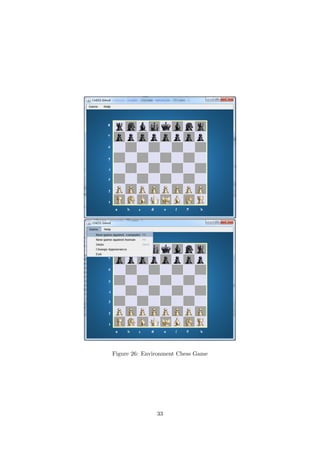
26 Environment Chess Game . . . . . . . . . . . . . . . . . . . . . . . . 33
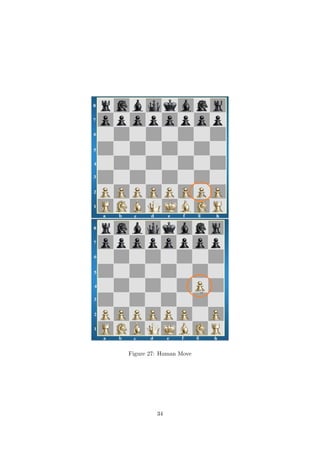
27 Human Move . . . . . . . . . . . . . . . . . . . . . . . . . . . . . . . 34
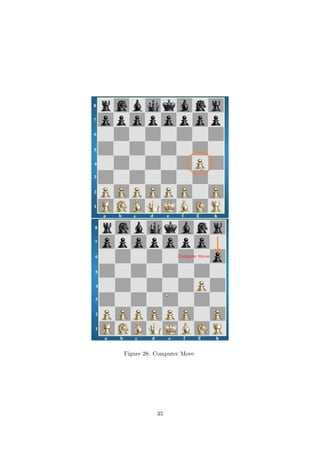
28 Computer Move . . . . . . . . . . . . . . . . . . . . . . . . . . . . . 35
1
1 Introduction
Introduction This part describes an overview of whole project which provides
an overarching theme of project to reader, but does not expand on specific
details.
1.1 introduction
Chess is a game for two players, dubbed White and Black. The goal is to
capture your opponent’s king. In the game, this is known as a checkmate.Chess
is played on a board with 64 squares. Each player begins with 16 pieces, lined
up in two rows. The first row is occupied by pieces called pawns. The next
row contains: a king, a queen, two rooks, two bishops, and two knights.
Chess is defined as a game of “perfect information”, because both players
are aware of the entire state of the game world at all times: just by looking
at the board, you can see which pieces are alive and where they are located.
Checkers, Go, Go-Moku,Backgammon and Othello are other members of the
category, but stud poker is not (you don’t know what cards your opponent is
holding in his hands).
Here that to able to change chess game from physical form to figurative form
fully realistic, Several things are needed to make chess game computerized and
intelligent.
• Some way to represent a chess board in memory, so that it knows what
the state of the game is.
• Rules to determine how to generate legal moves, so that it can play
without cheating (and verify that its human opponent is not trying to
pull a fast one on it !)
• A technique to choose the move to make amongst all legal possibilities, so
that it can choose a move instead of being forced to pick one at random.
• A way to compare moves and positions, so that it makes intelligent
choices.
• Some sort of user interface.
2
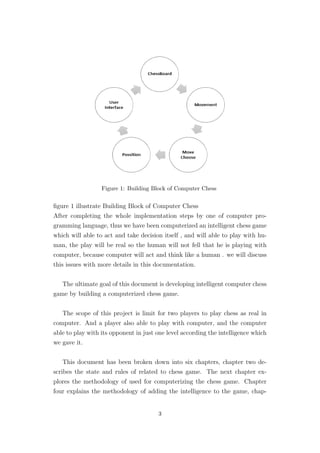
Figure 1: Building Block of Computer Chess
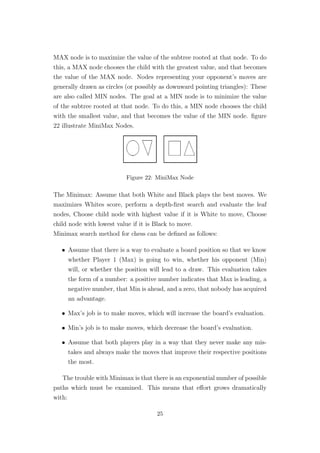
figure 1 illustrate Building Block of Computer Chess
After completing the whole implementation steps by one of computer pro-
gramming language, thus we have been computerized an intelligent chess game
which will able to act and take decision itself , and will able to play with hu-
man, the play will be real so the human will not fell that he is playing with
computer, because computer will act and think like a human . we will discuss
this issues with more details in this documentation.
The ultimate goal of this document is developing intelligent computer chess
game by building a computerized chess game.
The scope of this project is limit for two players to play chess as real in
computer. And a player also able to play with computer, and the computer
able to play with its opponent in just one level according the intelligence which
we gave it.
This document has been broken down into six chapters, chapter two de-
scribes the state and rules of related to chess game. The next chapter ex-
plores the methodology of used for computerizing the chess game. Chapter
four explains the methodology of adding the intelligence to the game, chap-
3
ter five and six explain the development and implementation of chess game
respectively while the last chapter dedicated to future enhancement and the
summary of the entire document. Java has been selected for implementation
of this project.
4
2 Chess Game Introduction
2.1 Introduction
In this section of document we pay all attention to introduce Chess fully de-
tailed.
2.2 Chess Game Introduction
Chess is an old game. It likely came to the Western world from India in the 6th
century A.D. Its a game, too, of royal origin: a test of someone’s intelligence
and acumen on the battlefield, yet today its everyone’s game. For one, chess
doesn’t require expensive equipment to play. And the game has another virtue,
which any player can explain: chess is fun.
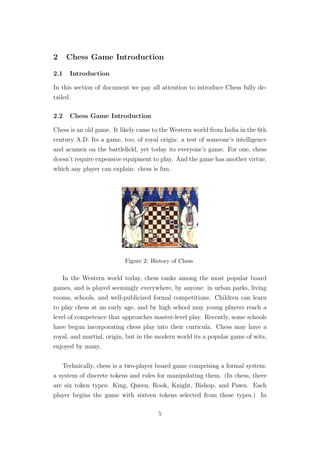
Figure 2: History of Chess
In the Western world today, chess ranks among the most popular board
games, and is played seemingly everywhere, by anyone: in urban parks, living
rooms, schools, and well-publicized formal competitions. Children can learn
to play chess at an early age, and by high school may young players reach a
level of competence that approaches master-level play. Recently, some schools
have begun incorporating chess play into their curricula. Chess may have a
royal, and martial, origin, but in the modern world its a popular game of wits,
enjoyed by many.
Technically, chess is a two-player board game comprising a formal system:
a system of discrete tokens and rules for manipulating them. (In chess, there
are six token types: King, Queen, Rook, Knight, Bishop, and Pawn. Each
player begins the game with sixteen tokens selected from these types.) In
5
games-theory parlance, chess is a zero-sum, perfect information game. Zero-
sum means that player As successful move is to player Bs detriment (a good
move for A is a bad consequence for B), and perfect information means that
all positions for each player are equally visible: the entire game at each step
of play is perfectly visible to each player.
Chess also has what’s called a “Markov” property, meaning that prior moves
are unnecessary to understand how to play the next move. In principle, each
discrete arrangement on the chess board can be viewed sui generis, and the
next move can be determined by inspection of the current arrangement of game
pieces. In computer science terms, chess is combinatorial, too: each successive
move generates a (typically large) combination of possibilities. And, further,
chess is a bounded branch problem in terms of search: computer scientists
view chess as a large set of branching possibilities, bounded by poor moves on
the “bottom” and good moves on the “top”. The roundedness of chess lends
itself to shortcuts, or “pruning”, where additional possibilities can be ignored
once one determines that a particular path along a branch is already poor,
relative to another branch.
For all the games theory analysis, though, human players see chess in terms
of tactics and strategy: thought. The ability for a human player to win at chess
requires some degree of intellectual skill. One must “see” what is happening
what the opponent moves signify in terms of a specific tactic, often part of a
long-term strategy for victory. Still, the game at root remains entirely deter-
mined by the position of its game pieces, and the rules telling each player how
they may be moved next.
The object of chess the goal of chess is to checkmate the opponent’s king.
Checkmate is when you attack the king, and the opponent cannot make a move
which removes that attack. The player who is mated, loses the game.
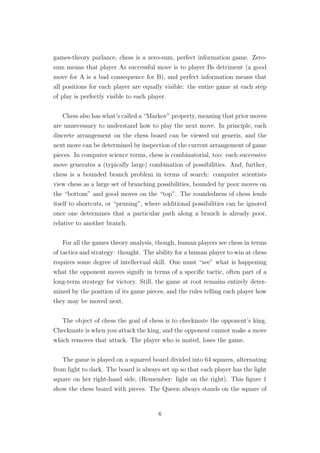
The game is played on a squared board divided into 64 squares, alternating
from light to dark. The board is always set up so that each player has the light
square on her right-hand side, (Remember: light on the right). This figure 1
show the chess board with pieces. The Queen always stands on the square of
6
her own color. Thus, the light colored Queen must stand on the light colored
square. A good way of remembering this is the saying: The Queen is a fash-
ionable lady. She likes her dress to match her shoes! figure 3 illustrate Chess
board with pieces
Figure 3: Chess Board with pieces
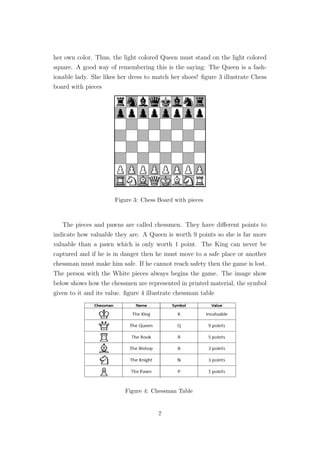
The pieces and pawns are called chessmen. They have different points to
indicate how valuable they are. A Queen is worth 9 points so she is far more
valuable than a pawn which is only worth 1 point. The King can never be
captured and if he is in danger then he must move to a safe place or another
chessman must make him safe. If he cannot reach safety then the game is lost.
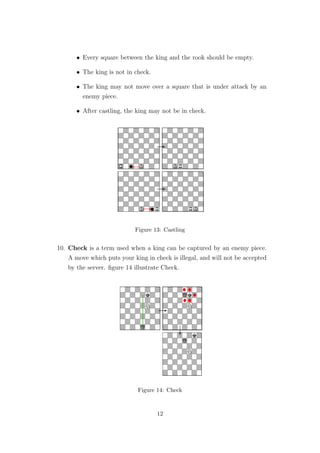
The person with the White pieces always begins the game. The image show
below shows how the chessmen are represented in printed material, the symbol
given to it and its value. figure 4 illustrate chessman table
Figure 4: Chessman Table
7
2.2.1 Rules in Chess Game
Chess game has its own special rules, which cases to make it more interesting
in the world.some of them listed bellow.
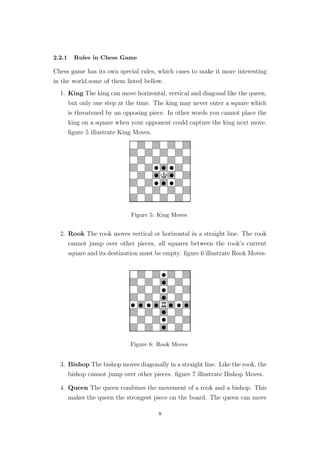
1. King The king can move horizontal, vertical and diagonal like the queen,
but only one step at the time. The king may never enter a square which
is threatened by an opposing piece. In other words you cannot place the
king on a square when your opponent could capture the king next move.
figure 5 illustrate King Moves.
Figure 5: King Moves
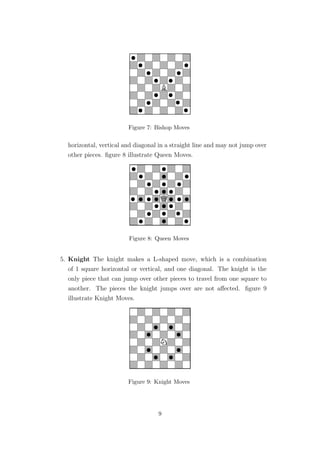
2. Rook The rook moves vertical or horizontal in a straight line. The rook
cannot jump over other pieces, all squares between the rook’s current
square and its destination must be empty. figure 6 illustrate Rook Moves.
Figure 6: Rook Moves
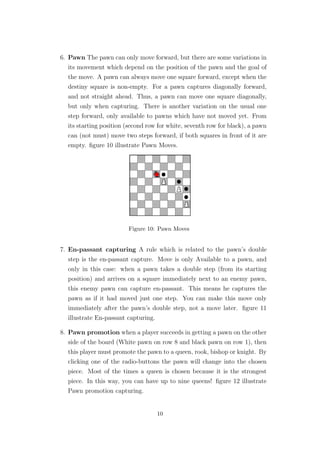
3. Bishop The bishop moves diagonally in a straight line. Like the rook, the
bishop cannot jump over other pieces. figure 7 illustrate Bishop Moves.
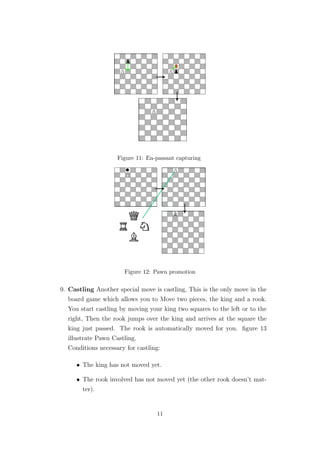
4. Queen The queen combines the movement of a rook and a bishop. This
makes the queen the strongest piece on the board. The queen can move
8
Figure 7: Bishop Moves
horizontal, vertical and diagonal in a straight line and may not jump over
other pieces. figure 8 illustrate Queen Moves.
Figure 8: Queen Moves
5. Knight The knight makes a L-shaped move, which is a combination
of 1 square horizontal or vertical, and one diagonal. The knight is the
only piece that can jump over other pieces to travel from one square to
another. The pieces the knight jumps over are not affected. figure 9
illustrate Knight Moves.
Figure 9: Knight Moves
9
6. Pawn The pawn can only move forward, but there are some variations in
its movement which depend on the position of the pawn and the goal of
the move. A pawn can always move one square forward, except when the
destiny square is non-empty. For a pawn captures diagonally forward,
and not straight ahead. Thus, a pawn can move one square diagonally,
but only when capturing. There is another variation on the usual one
step forward, only available to pawns which have not moved yet. From
its starting position (second row for white, seventh row for black), a pawn
can (not must) move two steps forward, if both squares in front of it are
empty. figure 10 illustrate Pawn Moves.
Figure 10: Pawn Moves
7. En-passant capturing A rule which is related to the pawn’s double
step is the en-passant capture. Move is only Available to a pawn, and
only in this case: when a pawn takes a double step (from its starting
position) and arrives on a square immediately next to an enemy pawn,
this enemy pawn can capture en-passant. This means he captures the
pawn as if it had moved just one step. You can make this move only
immediately after the pawn’s double step, not a move later. figure 11
illustrate En-passant capturing.
8. Pawn promotion when a player succeeds in getting a pawn on the other
side of the board (White pawn on row 8 and black pawn on row 1), then
this player must promote the pawn to a queen, rook, bishop or knight. By
clicking one of the radio-buttons the pawn will change into the chosen
piece. Most of the times a queen is chosen because it is the strongest
piece. In this way, you can have up to nine queens! figure 12 illustrate
Pawn promotion capturing.
10
Figure 11: En-passant capturing
Figure 12: Pawn promotion
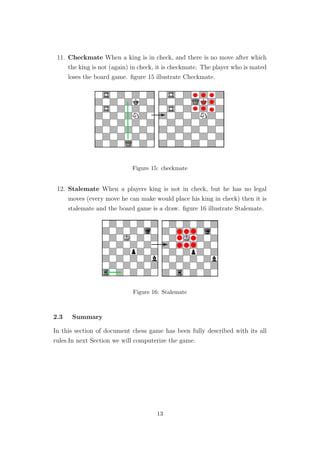
9. Castling Another special move is castling, This is the only move in the
board game which allows you to Move two pieces, the king and a rook.
You start castling by moving your king two squares to the left or to the
right, Then the rook jumps over the king and arrives at the square the
king just passed. The rook is automatically moved for you. figure 13
illustrate Pawn Castling.
Conditions necessary for castling:
• The king has not moved yet.
• The rook involved has not moved yet (the other rook doesn’t mat-
ter).
11
• Every square between the king and the rook should be empty.
• The king is not in check.
• The king may not move over a square that is under attack by an
enemy piece.
• After castling, the king may not be in check.
Figure 13: Castling
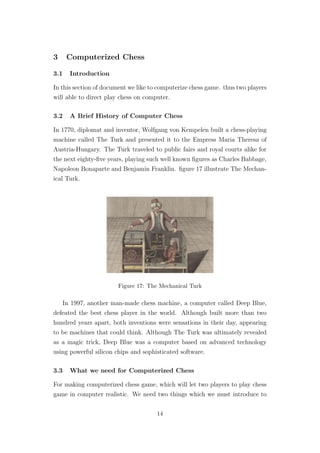
10. Check is a term used when a king can be captured by an enemy piece.
A move which puts your king in check is illegal, and will not be accepted
by the server. figure 14 illustrate Check.
Figure 14: Check
12
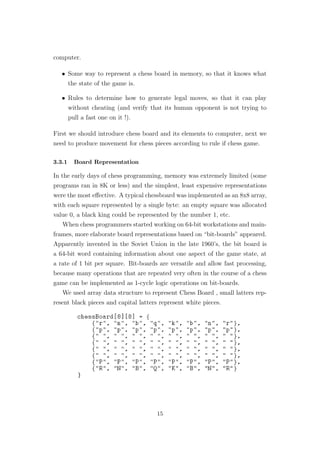
11. Checkmate When a king is in check, and there is no move after which
the king is not (again) in check, it is checkmate. The player who is mated
loses the board game. figure 15 illustrate Checkmate.
Figure 15: checkmate
12. Stalemate When a players king is not in check, but he has no legal
moves (every move he can make would place his king in check) then it is
stalemate and the board game is a draw. figure 16 illustrate Stalemate.
Figure 16: Stalemate
2.3 Summary
In this section of document chess game has been fully described with its all
rules.In next Section we will computerize the game.
13
3 Computerized Chess
3.1 Introduction
In this section of document we like to computerize chess game. thus two players
will able to direct play chess on computer.
3.2 A Brief History of Computer Chess
In 1770, diplomat and inventor, Wolfgang von Kempelen built a chess-playing
machine called The Turk and presented it to the Empress Maria Theresa of
Austria-Hungary. The Turk traveled to public fairs and royal courts alike for
the next eighty-five years, playing such well known figures as Charles Babbage,
Napoleon Bonaparte and Benjamin Franklin. figure 17 illustrate The Mechan-
ical Turk.
Figure 17: The Mechanical Turk
In 1997, another man-made chess machine, a computer called Deep Blue,
defeated the best chess player in the world. Although built more than two
hundred years apart, both inventions were sensations in their day, appearing
to be machines that could think. Although The Turk was ultimately revealed
as a magic trick, Deep Blue was a computer based on advanced technology
using powerful silicon chips and sophisticated software.
3.3 What we need for Computerized Chess
For making computerized chess game, which will let two players to play chess
game in computer realistic. We need two things which we must introduce to
14
computer.
• Some way to represent a chess board in memory, so that it knows what
the state of the game is.
• Rules to determine how to generate legal moves, so that it can play
without cheating (and verify that its human opponent is not trying to
pull a fast one on it !).
First we should introduce chess board and its elements to computer, next we
need to produce movement for chess pieces according to rule if chess game.
3.3.1 Board Representation
In the early days of chess programming, memory was extremely limited (some
programs ran in 8K or less) and the simplest, least expensive representations
were the most effective. A typical chessboard was implemented as an 8x8 array,
with each square represented by a single byte: an empty square was allocated
value 0, a black king could be represented by the number 1, etc.
When chess programmers started working on 64-bit workstations and main-
frames, more elaborate board representations based on “bit-boards” appeared.
Apparently invented in the Soviet Union in the late 1960’s, the bit board is
a 64-bit word containing information about one aspect of the game state, at
a rate of 1 bit per square. Bit-boards are versatile and allow fast processing,
because many operations that are repeated very often in the course of a chess
game can be implemented as 1-cycle logic operations on bit-boards.
We used array data structure to represent Chess Board , small latters rep-
resent black pieces and capital latters represent white pieces.
15
3.3.2 Move Generation
Once the board is represented we can shift to the move generator. Each piece
in Chess has its own list of moves, therefore for each piece is necessary to write
a specific function to generate the moves.
The rules of the game determine which moves (if any) the side to play is
allowed to make. In some games, it is easy to look at the board and deter-
mine the legal moves: for example, in tic-tac-toe, any empty square is a legal
move. For chess, however, things are more complicated: each piece has its own
movement rules, pawns capture diagonally and move along a file, it is illegal
to leave a king in check, and the “en-passant” captures, pawn promotions and
castling moves require very specific conditions to be legal.
In fact, it turns out that move generation is one of the most computation-
ally expensive and complicated aspects of chess programming. For generating
movement in computer we need to define a function which will called in each
turn a to identify and list the valid moves. Each move passes a bunch of steps
before accomplish by a player in computerized chess game, we refer to rep-
resent by flow chart for better understanding. figure 18 illustrate this Flow
Chart.
3.4 Summary
In this section after the representation of chess board and its element and
pieces movement generation, we make able two players to play chess direct in
computer. In next section we will give intelligence to the game.
16
Figure 18: Playing steps(Human)
17
4 Intelligent Chess Game
4.1 Introduction
Chess game has been computerize in previous section, thus two player were
able to direct play chess on computer. We will makes a player to play chess
with computer directly by adding intelligence to the gam in this section.
4.2 The Concept of Artificial Intelligence
Artificial Intelligence (AI) is a branch of Science which deals with helping ma-
chines finding solutions to complex problems in a more human-like fashion.
This generally involves borrowing characteristics from human intelligence, and
applying them as algorithms in a computer friendly way. A more or less flexible
or efficient approach can be taken depending on the requirements established,
which influences how artificial the intelligent behavior appears.
Figure 19: Artificial Intelligence
AI is generally associated with Computer Science, but it has many important
links with other fields such as Maths, Psychology, Cognition, Biology and Phi-
losophy, among many others. Our ability to combine knowledge from all these
fields will ultimately benefit our progress in the quest of creating an intelligent
artificial being. AI is one of the newest disciplines. It was formally initiated in
1956, when the name was coined, although at that point work had been under
way for about five years. However, the study of intelligence is one of the oldest
disciplines. For over 2000 years, philosophers have tried to understand how
seeing, learning, remembering, and reasoning could, or should, be done. The
18
advent of usable computers in the early 1950s turned the learned but arm-
chair speculation concerning these mental faculties into a real experimental
and theoretical discipline. Many felt that the new “Electronic Super-Brains”
had unlimited potential for intelligence. “ Faster Than Einstein ” was a typical
headline.
But as well as providing a vehicle for creating artificially intelligent enti-
ties, the computer provides a tool for testing theories of intelligence, and many
theories failed to withstand the test. AI has turned out to be more difficult
than many at first imagined, and modern ideas are much richer, more subtle,
and more interesting as a result.
AI currently encompasses a huge variety of subfields, from general-purpose
areas such as perception and logical reasoning, to specific tasks such as playing
chess, proving mathematical theorems, writing poetry, and diagnosing diseases.
Often, scientists in other fields move gradually into artificial intelligence, where
they find the tools and vocabulary to systematize and automate the intellec-
tual tasks on which they have been working all their lives. Similarly, workers
in AI can choose to apply their methods to any area of human intellectual
endeavor. In this sense, it is truly a universal field.
Definition of Artificial intelligence
It is often difficult to construct a definition of a discipline that is satisfying to
all of its practitioners. AI research encompasses a spectrum of related topics.
Broadly, AI is the computer-based exploration of methods for solving challeng-
ing tasks that have traditionally depended on people for solution. Such tasks
include complex logical inference, diagnosis, and visual recognition, compre-
hension of natural language, game playing, explanation, and planning.
four possible goals to pursue in artificial intelligence:
• Systems that think like humans
• Systems that act like humans
• Systems that think rationally. (A system is rational if it does the right
thing.)
• Systems that act rationally
19
4.3 Complexity intelligent chess game
For making the chess intelligent we should combat with a huge mount of com-
plexity.
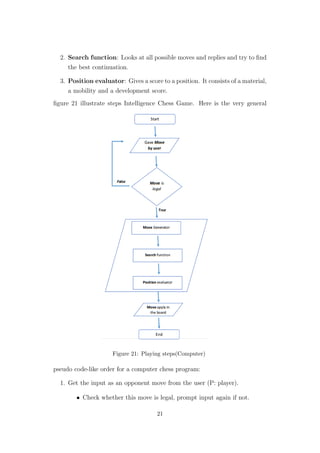
We start with a chessboard set up for the start of a game. Each player has 16
pieces. The white player starts the game all the time. At the beginning, white
has 20 possible moves:
• The white player can move any pawn forward one or two positions.
• The white player can move either knight in two different ways.
The white player chooses one of these 20 moves and plays it. For the black
player, the options are the same as 20 possible moves. So black chooses a
move among those as well. Now white player can move again. This next move
depends on the first move that white chose to make, but there are about 20
or so moves white can make given the current board position, and then black
has 20 or so moves it can make, and so on. Actually the number of the moves
both players can make usually increases as the game develops. This is how a
computer program looks at chess. It thinks about it in a world of “all possible
moves,” and it makes a very large tree (our search tree) for all of those moves.
It can be visualized as follows:
Figure 20: Chess Tree
A general computer chess program consists of three main parts:
1. Move generator: Generates all possible moves in a given position.
20
2. Search function: Looks at all possible moves and replies and try to find
the best continuation.
3. Position evaluator: Gives a score to a position. It consists of a material,
a mobility and a development score.
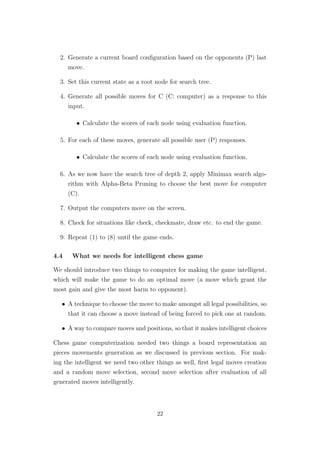
figure 21 illustrate steps Intelligence Chess Game. Here is the very general
Figure 21: Playing steps(Computer)
pseudo code-like order for a computer chess program:
1. Get the input as an opponent move from the user (P: player).
• Check whether this move is legal, prompt input again if not.
21
2. Generate a current board configuration based on the opponents (P) last
move.
3. Set this current state as a root node for search tree.
4. Generate all possible moves for C (C: computer) as a response to this
input.
• Calculate the scores of each node using evaluation function.
5. For each of these moves, generate all possible user (P) responses.
• Calculate the scores of each node using evaluation function.
6. As we now have the search tree of depth 2, apply Minimax search algo-
rithm with Alpha-Beta Pruning to choose the best move for computer
(C).
7. Output the computers move on the screen.
8. Check for situations like check, checkmate, draw etc. to end the game.
9. Repeat (1) to (8) until the game ends.
4.4 What we needs for intelligent chess game
We should introduce two things to computer for making the game intelligent,
which will make the game to do an optimal move (a move which grant the
most gain and give the most harm to opponent).
• A technique to choose the move to make amongst all legal possibilities, so
that it can choose a move instead of being forced to pick one at random.
• A way to compare moves and positions, so that it makes intelligent choices
Chess game computerization needed two things a board representation an
pieces movements generation as we discussed in previous section. For mak-
ing the intelligent we need two other things as well, first legal moves creation
and a random move selection, second move selection after evaluation of all
generated moves intelligently.
22
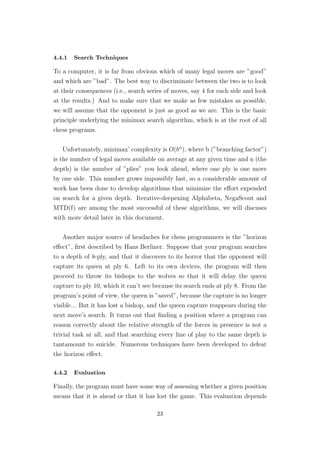
4.4.1 Search Techniques
To a computer, it is far from obvious which of many legal moves are ”good”
and which are ”bad”. The best way to discriminate between the two is to look
at their consequences (i.e., search series of moves, say 4 for each side and look
at the results.) And to make sure that we make as few mistakes as possible,
we will assume that the opponent is just as good as we are. This is the basic
principle underlying the minimax search algorithm, which is at the root of all
chess programs.
Unfortunately, minimax’ complexity is O(bn
), where b (”branching factor”)
is the number of legal moves available on average at any given time and n (the
depth) is the number of ”plies” you look ahead, where one ply is one move
by one side. This number grows impossibly fast, so a considerable amount of
work has been done to develop algorithms that minimize the effort expended
on search for a given depth. Iterative-deepening Alphabeta, NegaScout and
MTD(f) are among the most successful of these algorithms, we will discuses
with more detail later in this document.
Another major source of headaches for chess programmers is the ”horizon
effect”, first described by Hans Berliner. Suppose that your program searches
to a depth of 8-ply, and that it discovers to its horror that the opponent will
capture its queen at ply 6. Left to its own devices, the program will then
proceed to throw its bishops to the wolves so that it will delay the queen
capture to ply 10, which it can’t see because its search ends at ply 8. From the
program’s point of view, the queen is ”saved”, because the capture is no longer
visible... But it has lost a bishop, and the queen capture reappears during the
next move’s search. It turns out that finding a position where a program can
reason correctly about the relative strength of the forces in presence is not a
trivial task at all, and that searching every line of play to the same depth is
tantamount to suicide. Numerous techniques have been developed to defeat
the horizon effect.
4.4.2 Evaluation
Finally, the program must have some way of assessing whether a given position
means that it is ahead or that it has lost the game. This evaluation depends
23
heavily upon the rules of the game: while ”material balance” (i.e., the number
and value of the pieces on the board) is the dominant factor in chess, because
being ahead by as little as a single pawn can often guarantee a victory for a
strong player, it is of no significance in Go-Moku and downright misleading in
Othello, where you are often better off with fewer pieces on the board until
the very last moment.
4.5 Algorithms
The ordered list of the sub-tasks which is used to perform the functional and
conditional steps to solve a task is called Algorithm, or Algorithm is a set
of commands that solve a task/problem step by step and should have the
following conditions:
• It has to be precise and clear
• It has to be described with details
• The execution of the commands should be ordered
• The execution should have an end
Algorithm is used to divide a complicated function into smaller functions.
To give the intelligence to computer chess game which will form and make
it able to think, take decision, do an optimal movement and compete against
its opponents (human) automatically as real, in other words to make the chess
game intelligent which will able to do optimal moves to gain the most profit
and give the most damage to its opponent(human),for doing this task we need
to implement Minimax with the Alpha Beta pruning algorithm which uses
evaluation function to generate optimal moves and make the chess intelligent
the relate to this issues discussed in this section.
4.5.1 MiniMax
The minimax algorithm is a way of finding an optimal move in a two player
game. In the search tree for a two-player game, there are two kinds of nodes,
nodes representing your moves and nodes representing your opponent’s moves.
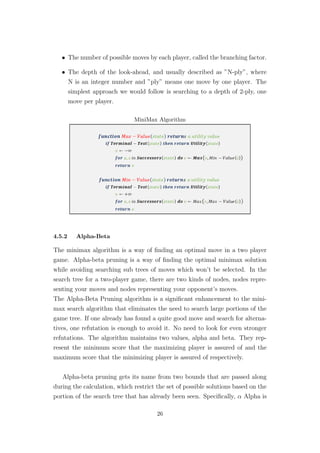
Nodes representing your moves are generally drawn as squares (or possibly
upward pointing triangles): These are also called MAX nodes. The goal at a
24
MAX node is to maximize the value of the subtree rooted at that node. To do
this, a MAX node chooses the child with the greatest value, and that becomes
the value of the MAX node. Nodes representing your opponent’s moves are
generally drawn as circles (or possibly as downward pointing triangles): These
are also called MIN nodes. The goal at a MIN node is to minimize the value
of the subtree rooted at that node. To do this, a MIN node chooses the child
with the smallest value, and that becomes the value of the MIN node. figure
22 illustrate MiniMax Nodes.
Figure 22: MiniMax Node
The Minimax: Assume that both White and Black plays the best moves. We
maximizes Whites score, perform a depth-first search and evaluate the leaf
nodes, Choose child node with highest value if it is White to move, Choose
child node with lowest value if it is Black to move.
Minimax search method for chess can be defined as follows:
• Assume that there is a way to evaluate a board position so that we know
whether Player 1 (Max) is going to win, whether his opponent (Min)
will, or whether the position will lead to a draw. This evaluation takes
the form of a number: a positive number indicates that Max is leading, a
negative number, that Min is ahead, and a zero, that nobody has acquired
an advantage.
• Max’s job is to make moves, which will increase the board’s evaluation.
• Min’s job is to make moves, which decrease the board’s evaluation.
• Assume that both players play in a way that they never make any mis-
takes and always make the moves that improve their respective positions
the most.
The trouble with Minimax is that there is an exponential number of possible
paths which must be examined. This means that effort grows dramatically
with:
25
• The number of possible moves by each player, called the branching factor.
• The depth of the look-ahead, and usually described as ”N-ply”, where
N is an integer number and ”ply” means one move by one player. The
simplest approach we would follow is searching to a depth of 2-ply, one
move per player.
MiniMax Algorithm
4.5.2 Alpha-Beta
The minimax algorithm is a way of finding an optimal move in a two player
game. Alpha-beta pruning is a way of finding the optimal minimax solution
while avoiding searching sub trees of moves which won’t be selected. In the
search tree for a two-player game, there are two kinds of nodes, nodes repre-
senting your moves and nodes representing your opponent’s moves.
The Alpha-Beta Pruning algorithm is a significant enhancement to the mini-
max search algorithm that eliminates the need to search large portions of the
game tree. If one already has found a quite good move and search for alterna-
tives, one refutation is enough to avoid it. No need to look for even stronger
refutations. The algorithm maintains two values, alpha and beta. They rep-
resent the minimum score that the maximizing player is assured of and the
maximum score that the minimizing player is assured of respectively.
Alpha-beta pruning gets its name from two bounds that are passed along
during the calculation, which restrict the set of possible solutions based on the
portion of the search tree that has already been seen. Specifically, α Alpha is
26
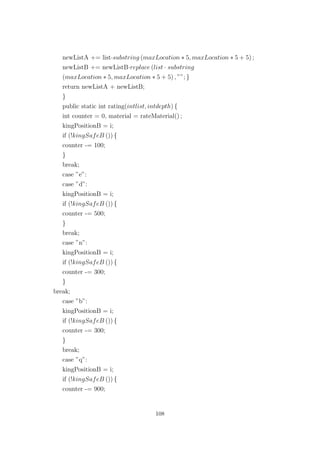
Alpha BetaPruning Algorithm
the maximum lower bound of possible solutions β Beta is the minimum upper
bound of possible solutions , Thus, when any new node is being considered as
a possible path to the solution, it can only work if: α ≤ N ≤ β where Nis the
current estimate of the value of the node.
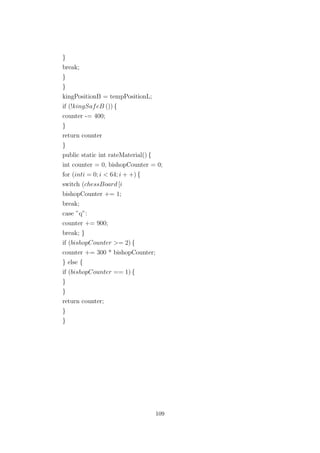
To visualize this, we can use a number line. At any point in time, alpha
and beta are lower and upper bounds on the set of possible solution values, like
so: As the problem progresses, we can assume restrictions about the range of
possible solutions based on min nodes (which may place an upper bound) and
max nodes (which may place a lower bound). As we move through the search
tree, these bounds typically get closer and closer together: This convergence
is not a problem as long as there is some overlap in the ranges of alpha and
beta. At some point in evaluating a node, we may find that it has moved one
of the bounds such that there is no longer any overlap between the ranges of
27
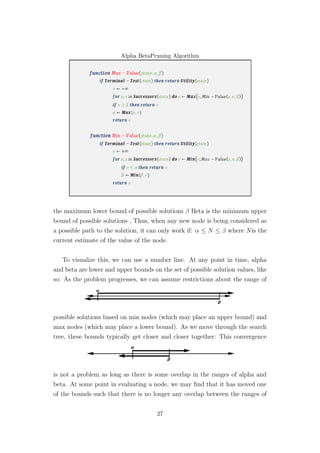
alpha and beta: At this point, we know that this node could never result in a
solution path that we will consider, so we may stop processing this node. In
other words, we stop generating its children and move back to its parent node.
For the value of this node, we should pass to the parent the value we changed
which exceeded the other bound.
Example :
Figure 23: MinMax with Alpha Beta Algorithm
4.6 Summary
We discussed making game cautious and intelligent by implementing Minimax
with the Alpha beta pruning algorithm in this section. Next section will explain
development of chess game.
28
5 Development
5.1 Introduction
In this section, a more detailed explanation of the design of our project will
be given.
5.2 Design
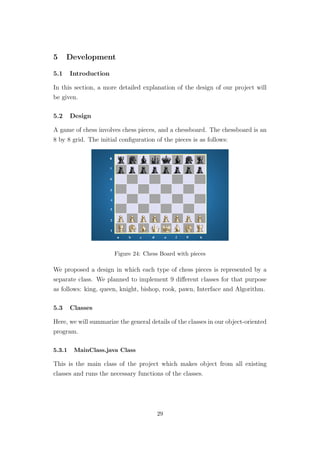
A game of chess involves chess pieces, and a chessboard. The chessboard is an
8 by 8 grid. The initial configuration of the pieces is as follows:
Figure 24: Chess Board with pieces
We proposed a design in which each type of chess pieces is represented by a
separate class. We planned to implement 9 different classes for that purpose
as follows: king, queen, knight, bishop, rook, pawn, Interface and Algorithm.
5.3 Classes
Here, we will summarize the general details of the classes in our object-oriented
program.
5.3.1 MainClass.java Class
This is the main class of the project which makes object from all existing
classes and runs the necessary functions of the classes.
29
5.3.2 King.java Class
This is the class of depend to the king movement and its rules in chess, that is
to say where can the king move in chess board? What is the valid moves for
the king? How it wakes the move? This class explain all this issues.
5.3.3 Queen.java Class
This is the class of depend to the queen movement and its rules in chess, that
is to say where can the queen move in chess board? What is the valid moves
for the queen? How it wakes the move? This class explain all this issues.
5.3.4 Knight.java Class
This is the class of depend to the knight movement and its rules in chess, that
is to say where can the knight move in chess board? What is the valid moves
for the knight? How it wakes the move? This class explain all this issues.
5.3.5 Bishop.java Class
This is the class of depend to the bishop movement and its rules in chess, that
is to say where can the bishop move in chess board? What is the valid moves
for the bishop? How it wakes the move? This class explain all this issues.
5.3.6 Rook.java Class
This is the class of depend to the rook movement and its rules in chess, that
is to say where can the rook move in chess board? What is the valid moves
for the rook? How it wakes the move? This class explain all this issues.
5.3.7 Pawn.java Class
This is the class of depend to the pawn movement and its rules in chess, that
is to say where can the pawn move in chess board? What is the valid moves
for the pawn? How it wakes the move? This class explain all this issues.
5.3.8 Algorithm.java Class
This is the class which make the chess perception and intelligent, this class
consist in the Minimax with the alpha beta pruning algorithm and evaluation
30
function.
5.3.9 InterFace.java Class
As we design chess graphically, thus we created this class for graphically user
functions.
5.4 Outline of the Work Done
Whereas the ultimate goal of project is to design the chess computerized and
intelligent, for achieving this goal, first of all we developed the game for two
players to play the game according to rules of the chess as real as possible. For
this seven classes has been create in java computer programing language, they
consist in: MainClass.java, King.java, Queen.java, Knight.java, Rook.java,
Bishop.java, Pawn.java.
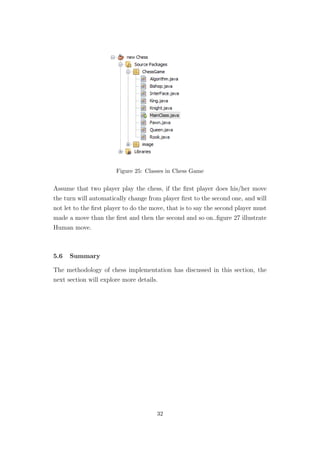
The ultimate function of the MainClass.java consist in: creating chess board
and its elements: producing pieces movement on the board and implement the
whole rules of the chess by creating object from existing six classes (King.java,
Queen.java, Knight.java, Rook.java, Bishop.java, and Pawn.java).figure 25 il-
lustrate Classes in Chess game
After retrieving the outcome and the result of the project. We have success-
fully achieved to create a graphically environment for user, for this we create
a class name InterFace.java.
Finally, we create a class named Algorithm.java which includes the whole in-
telligent functions that has been used for the intelligence in the game.
5.5 Model
We designed chess game fully in graphically environment, that makes the users
to make the move relax and ease.figure 26 illustrate Environment Chess Game.
For doing the move user recommended to select the piece on the chess board
by pressing and keeping the mouse key and drug or transform the selected
piece to the specific and valid cell of the move.
If a player play against computer after a move a little delay will be gen-
erate by computer to search the valid and optimal move. figure 28 illustrate
computer move.
31
Figure 25: Classes in Chess Game
Assume that two player play the chess, if the first player does his/her move
the turn will automatically change from player first to the second one, and will
not let to the first player to do the move, that is to say the second player must
made a move than the first and then the second and so on..figure 27 illustrate
Human move.
5.6 Summary
The methodology of chess implementation has discussed in this section, the
next section will explore more details.
32
Figure 26: Environment Chess Game
33
Figure 27: Human Move
34
Figure 28: Computer Move
35
6 Implementation
6.1 Introduction
This section explores fully chess implementation details, we tried to explain
the whole implementation classes and their methods.
As we mentioned in previous section intelligent chess in graphically user
interface needed a computer programing language for implementation, there-
fore we have selected java which is full object oriented and runs in any plate
form that will lead the chess to runs in any plate form.
After chosen the programing language for making the program and the
codes manageable and flexible we need to define and create the classes first
of all we computerize the chess, second we are going to create the graphically
user interface and finally and the intelligence to the game. The classes are:
MainClass.java, King.java, Queen.java, Knight.java, Rook.java, Bishop.java,
Pawn.java, interface.java, Algorithm.java.
We gave some information in the last section about these classes, this section
will focus with more details especially the function and methods of the classes.
6.2 MainClass.java Class
This is the first class of the project which consist in:
• main(String[] args) Is the first function of the main class, that makes
the bases of the program, in other words this is the starting function of
the project.
• posibleMovesW() This function is for returning the valid moves of
white pieces.
• PosibleMovesB() This is the same above functions and generating the
valid moves for Black pieces.
• makeMoveB(String move) This is function is for doing a move for
Black Pieces.
• makeMoveW(String move) this is the same as the last function it
does a move for White Piece.
36
• undoMoveB(String move) this function doing the undo action for
Black pieces.
• undoMoveW(String move) this function doing the same thing as the
last function for white pieces.
6.3 King.java Class
This class include the whole valid rules for the piece of king in the game.
• posibleKW(int i) this function return the all valid moves for white
pieces.
• posibleKB(int i) this function return the all valid moves for black
pieces.
• kingSafeW() this function is for checking the state of the white king.
• kingSafeB() this function is for checking the state of the black king.
6.4 Queen.java Class
This class includes the entire functions depend to the Queen in the project.
• posibleQW(int i) this function return all the valid moves for the queen.
• posibleQB(int i) this function return all the valid moves for the queen.
6.5 Knight.java Class
This class includes the whole rules concerning to the knight.
• posibleNW(int i) this function return all possible and valid moves of
the whit knight.
• posibleNB(int i) this function return all possible and valid moves of
the black knight.
6.6 Bishop.java Class
This class consist the all rules of the Bishop.
• posibleBW(int i) this function return the all valid moves of the white
Bishop.
37
• posibleBB(int i) this function return the all valid moves of the black
Bishop.
6.7 Rook.java Class
This class explore the whole rules related to Rook.
• posibleRW(int i) the white rooks all valid move returns by this func-
tion.
• posibleRB(int i) this is the same function for the black.
6.8 Pawn.java Class
This class include the all rules related to the pawn.
• posiblePW(int i) this function returns the whole valid moves for the
white pawn.
• posiblePB(int i) this function returns the whole valid moves for the
black pawn.
6.9 InterFace.java class
This class consists the whole materials concerning to the graphical environment
of the project.
• paintComponent(Graphics g) this function generate the chess board
and its elements for graphically user interface.
6.10 Algorithm.java Class
This class includes the all functions related to the intelligency of the chess
game.
• alphaBeta(int depth,int beta,int aplha,String move,in player)
this function implement the alpha beta pruning algorithm.
• rateAttack() this function is for evaluation and identification of risks.
• rateMaterial() this function for identification of the remaining pieces
on the board.
38
• rateMoveablity(int listLength,int depth ,int material) this func-
tion is for identifying all the move related to the computer game.
• ratePositional(int material) this is for finding the location of com-
puter movement pieces.
• rating(int list,int depth) This function rates the whole piece in each
possible moves of computer.
39
7 Conclusion
7.1 Conclusion and future enhancement
The main focus of this chapter is on the work has done and future enhance-
ment of the project, the first section discuss the conclusion and summary of
the whole Final Project and the second section is dedicated to the future en-
hancement of the project. Conclusion This Final Project aimed to create a
practical and useable product, which can be considered as software and even
an educational tool. A real life situation, which is a chess game in the current
case, was modeled without any restrictions and based on its modelers personal
understanding. Another aim of this Final Project was to analyze two agent
base approaches. It was a fascinating and quite helpful experience for us to
observe the differences between the two approaches by producing a practical
work rather than conducting just a theoretical research. The users will ob-
serve and realize the fact that it is a very open-ended model, allowing users to
interact with it using their own imagination, which was the main idea behind
all this effort. Hopefully, however, it has managed to lay the groundwork for
further study of narrative in video games.
7.2 Future Enhancement
In this section suggestions for the future research are given. These suggestions
can be categorized into seven categories.
1. Evaluation function: Additional work can be performed on the evaluation
function to increase the playing strength. Although the evaluation func-
tion used in the program has more than 10 features, even more features
can be implemented. For regular Chess there are many features that can
be adapted to multi-player Chess to increase the playing strength. Espe-
cially, features representing endgame knowledge can be beneficial because
no such feature is included in the current evaluation function. Addition-
ally, experts for multi-player Chess can be searched to retrieve domain
knowledge that can be used to add some more features to the evaluation
function. Currently, the evaluation function uses two features for the
opening. The performance in this part of the game can be increased by
building and using opening books. The weights of the different features
40
are tuned by hand or by just a few experiments. Therefore the playing
strength can be increased by using machine learning techniques to tune
the existing parameters of the evaluation function
2. Forward pruning: Forward pruning techniques are not used in the pro-
gram. In quite some regular Chess programs, forward pruning techniques
are applied. Therefore, it can be investigated whether applying forward
pruning techniques like Null Move (Donninger, 1993), ProbCut (Buro,
1995) and MultiCut (Bjornsson and Marsland, 1999) can increase the
playing strength.
3. Faster framework: As part of this document, a framework was imple-
mented from scratch. This was the first time that the author of this
document implemented a framework for playing a multi-player game. A
few weeks were spent to optimize the framework, but nevertheless the
framework can be even more efficient by changing some implementation
details like using bitboards (Heinz, 1997; Hyatt, 1999; Reul, 2009) to
represent the board.
4. Static move ordering: As explained in Subsection 4.3.5, the static move
ordering is quite important for the performance of the proposed algo-
rithms. The static more ordering in the program is quite simple. Spend-
ing more time to enhance the static move ordering could even increase
the performance of BRS1,C1. One improvement can be to consider check
moves. This is not considered in the program because it cost some com-
putation time to identify check moves. But for the static move ordering
for the non-searching opponents, this can be a promising approach to im-
prove the quality of the move ordering. Another approach to improve the
static move ordering can be the use of piece-square tables. Piece-square
tables can be used to evaluate the position of the piece to move with
respect to the kind of the moved piece.
5. Allow non-searching opponents to investigate more than one: move In
the proposed algorithm BRS1,C1 all but one opponents play the best
move regarding the static move ordering. When check moves are also
considered in the static move ordering as proposed above, the question
arises whether it is better to expect the opponent to play a good cap-
ture move or a check move. It could be a promising idea to propose an
41
algorithm where the non-searching opponents are allowed to perform a
search with a small branching factor like 2 or 3. In such an algorithm it
would be possible to consider check moves and also capture moves for the
non-searching opponents. This modification would increase the complex-
ity of the tree, but it would still be much smaller than a paranoid-tree.
It has to be tested whether the better estimation of the opponents moves
is worth the higher complexity of the tree.
6. Other domains: The proposed algorithms are only tested in the domain of
multi-player Chess. It has to be tested whether the best of the proposed
algorithms, BRS1,C1, is also able to outperform the existing algorithms
in other domains. The algorithm can be tested in other capture games
and also in non-capture games. Additionally, it can be tested in games
with imperfect information. It is from special interest to see how the
properties of the different games have an influence on the performance
of BRS1,C1. In multi-player Chess, the evaluation function is more time
consuming than the move generation. In other games where the move
generation is more complex or the board position is quite easy to evaluate,
the larger number of internal nodes compared to best-reply can be such
a disadvantage that it is not worth to let the non-searching opponents
play a move. Moreover, in multi-player Chess the opponents moves have
a quite large influence on the position of the root player. Thus, it is quite
important to let each opponent play a move. For other games where the
opponents moves does not have such a large influence on the root players
position, for instance racing-games, it has to be tested whether BRS1,C1
is also able to outperform best-reply.
42
Bibliography
References
[1] Artificial Intelligence (FORSYTH PONCE Computer Vision: A Modern
Approach GRAHAM ANSI Common Lisp JURAFSKY MARTIN speech
and Language; Processing NEAPOLITAN Learning Bayesian Networks
RUSSELL NORVIG Artificial Intelligence: A Modern Approach)
[2] COMPUTER CHESS: EXPLORING SPEED AND INTELLIGENCE
(PAUL RAYMOND STEVENS A Final Project Submitted to The Hon-
ors College in Partial Fulfillment of the Bachelors degree With Honors in
Computer Science THE UNIVERSITY OF ARIZONA May 2009).
[3] DEVELOPMENT OF AN ADAPTIVE CHESS PROGRAM (Eda Okur
Selin Kavuzlu Boazii University June 2011).
[4] CSE 212 Final Pro ject: Chess Game (Rebecca Oehmen; Cecilia Hopkins;
Ryan Lichtenwalter).
[5] Algorithms for solving sequential (zero-sum) games Main case in these
slides: chess (Tuomas Sandholm).
[6] Bertsekas, D. and Tsitsiklis, J. N. (2002). Introduc- tion to Probability.
Athena Scientific, Belmont, Mas- sachusetts.
[7] Cournot, A. (Ed.). (1838). Recherches sur les principes math6matiques de
la the’orie des richesses. L. Hachette, Paris.
[8] Berliner, H. J. and Ebeling, C. (1989). Pattern knowledge and search: The
SUPREM architecture. Artificial Intelligence.
[9] , M. R. B. (Ed.). (1977). Advances in Computer Chess 1. Edinburgh Uni-
versity Press, Edinburgh, Scotland.
[10] Brooks, R. A. (1990). Elephants don’t play chess. Autonomous Robots.
[11] Bernstein, A. and Roberts, M. (1958). Computer vs. chess player. Sci-
entc9c Americaiz.
43
[12] Beal, D. F. (1980). An analysis of minimax. In Clarke, M. R. B. (Ed.),
Advances in Computer Chess.
Web reference
https://www.cs.tcd.ie/Glenn.Strong/3d5/minimax-notes
http://www.cs.swarthmore.edu/ meeden/Minimax/Minimax.html
http://www.chess.com/learn-how-to-play-chess
http://www.code2learn.com/2012/01/minimax-algorithm-tutorial.html
http://www.gamedev.net/page/resources//technical/artificial−intelligence/
chess-programming-part-i-getting-started-r1014
http://www.gamedev.net/page/resources//technical/artificial−intelligence/
chess-programming-part-ii-data-structures-r1046
http://www.gamedev.net/page/resources//technical/artificial−intelligence/
chess-programming-part-iii-move-generation-r1126
http://www.gamedev.net/page/resources//technical/artificial−intelligence/
chess-programming-part-iv-basic-search-r1171
http://www.gamedev.net/page/resources//technical/artificial−intelligence/
chess-programming-part-vi-evaluation-functions-r1208
http://www.gamedev.net/page/resources//technical/artificial−intelligence/
chess-programming-part-v-advanced-search-r1197
https://www.youtube.com/watch?v=a-2uSg4Kvb0list=PLQV5moz
THmaffB0rBsD6m9VN1azgo5wXl
https://www.youtube.com/watch?v=jwRRJmsWFn4list=PLQV5moz
THmaffB0rBsD6m9VN1azgo5wXlindex=2
https://www.youtube.com/watch?v=NMAdwramt1glist=PLQV5moz
THmaffB0rBsD6m9VN1azgo5wXlindex=3
https://www.youtube.com/watch?v=1PzDYwDsXzslist=PLQV5moz
THmaffB0rBsD6m9VN1azgo5wXlindex=4
https://www.youtube.com/watch?v=LNEGkBxlpSUlist=PLQV5moz
THmaffB0rBsD6m9VN1azgo5wXlindex=5
https://www.youtube.com/watch?v=HkuqmWzE08Alist=PLQV5moz
THmaffB0rBsD6m9VN1azgo5wXlindex=6
https://www.youtube.com/watch?v=ShenZF9Kmykindex=7list=PLQV5moz
THmaffB0rBsD6m9VN1azgo5wXl
https://www.youtube.com/watch?v=6jPE0aAWsvYlist=PLQV5mozTHmaffB0r
BsD6m9VN1azgo5wXlindex=8
44
https://www.youtube.com/watch?v=Fy3ABsBktUindex = 9list = PLQV 5moz
THmaffB0rBsD6m9VN1azgo5wXl
https://www.youtube.com/watch?v=46V7mBRVwXYlist=PLQV5mozTHmaffB0r
BsD6m9VN1azgo5wXlindex=10
https://www.youtube.com/watch?v=kWLO7HG9MIlist = PLQV 5mozTHmaffB0r
BsD6m9VN1azgo5wXlindex=11
https://www.youtube.com/watch?v=cZOdExE1NaUindex=12list=PLQV5moz
THmaffB0rBsD6m9VN1azgo5wXl
https://www.youtube.com/watch?v=P-qGwTNBwdQindex=13list=PLQV5moz
THmaffB0rBsD6m9VN1azgo5wXl
https://www.youtube.com/watch?v=dK0Jjy9BXMindex = 14list = PLQV 5moz
THmaffB0rBsD6m9VN1azgo5wXl
https://www.youtube.com/watch?v=ks4MaF90Jaklist=PLQV5mozTHmaffB0rBs
D6m9VN1azgo5wXlindex=15
https://www.youtube.com/watch?v=h4nHxLC8pp4index=16list=PLQV5moz
THmaffB0rBsD6m9VN1azgo5wXl
https://www.youtube.com/watch?v=ngO6j5FYdG8index=17list=PLQV5moz
THmaffB0rBsD6m9VN1azgo5wXl
https://www.youtube.com/watch?v=fJ4uQpkn9V0list=PLQV5mozTHmaffB0rBs
D6m9VN1azgo5wXlindex=18
https://www.youtube.com/watch?v=UZLnDvdeNo8list=PLQV5mozTHmaffB0rBs
D6m9VN1azgo5wXlindex=19
https://www.youtube.com/watch?v=Wyh-5P5-7U8list=PLQV5mozTHmaffB0rBs
D6m9VN1azgo5wXlindex=20
https://www.youtube.com/watch?v=8xBjxYHVwxMindex=21list=PLQV5moz
THmaffB0rBsD6m9VN1azgo5wXl
https://www.youtube.com/watch?v=tjsciMjqixAlist=PLQV5mozTHmaffB0rBs
D6m9VN1azgo5wXlindex=22
https://www.youtube.com/watch?v=1iisYlFdh6sindex=23list=PLQV5moz
THmaffB0rBsD6m9VN1azgo5wXl
https://www.youtube.com/watch?v=s6wqQV8s96slist=PLQV5mozTHmaffB0rBs
D6m9VN1azgo5wXlindex=24
https://www.youtube.com/watch?v=3SiyqU7JXeUlist=PLQV5mozTHmaffB0rBs
D6m9VN1azgo5wXlindex=25
https://www.youtube.com/watch?v=cDz2u8tawQslist=PLQV5mozTHmaffB0rBs
45
D6m9VN1azgo5wXlindex=26
https://www.youtube.com/watch?v=akfcmosZvoindex = 27list = PLQV 5moz
THmaffB0rBsD6m9VN1azgo5wXl
https://www.youtube.com/watch?v=fyD1Fa7-y-Yindex=28list=PLQV5moz
THmaffB0rBsD6m9VN1azgo5wXl
https://www.youtube.com/watch?v=w-7GKtTsG3Yindex=29list=PLQV5moz
THmaffB0rBsD6m9VN1azgo5wXl
https://www.youtube.com/watch?v=I1J1UJ3yMXQindex=30list=PLQV5moz
THmaffB0rBsD6m9VN1azgo5wXl
https://www.youtube.com/watch?v=dqL0L6tNzM list = PLQV 5mozTHmaffB0rBs
D6m9VN1azgo5wXlindex=31
46
Appendix A: Source Codes
MainClass.java class
package ChessGame;
import static ChessGame·InterFace · window;
importjava · awt · BorderLayout;
importjava · awt · Color;
importjava · awt · FlowLayout;
importjava · awt · Font;
importjava · awt · TextArea;
importjava · awt · Toolkit;
importjava · awt · event · ActionEvent;
importjava · awt · event · ActionListener;
importjava · util · Stack;
importjavax · swing · Box;
importjavax · swing · ButtonGroup;
importjavax · swing · Icon;
importjavax · swing · ImageIcon;
importjavax · swing · JButton;
importjavax · swing · JFrame;
importjavax · swing · JLabel;
importjavax · swing · JMenu;
importjavax · swing · JMenuBar;
importjavax · swing · JMenuItem;
importjavax · swing · JOptionPane;
importjavax · swing · JRadioButton;
importjavax · swing · KeyStroke;
importjavax · swing · border · LineBorder;
importjavax · swing · border · TitledBorder;
∗
∗ @authorabhar
∗
staticStringchessBoard [] [] = {
{”d”, ”n”, ”b”, ”q”, ”k”, ”b”, ”n”, ”e”},
47
{”s”, ”t”, ”u”, ”v”, ”w”, ”x”, ”y”, ”z”},
{””, ””, ””, ””, ””, ””, ””, ””},
{””, ””, ””, ””, ””, ””, ””, ””},
{””, ””, ””, ””, ””, ””, ””, ””},
{””, ””, ””, ””, ””, ””, ””, ””},
{”S”, ”T”, ”U”, ”V ”, ”W”, ”X”, ”Y ”, ”Z”},
{”D”, ”N”, ”B”, ”Q”, ”K”, ”B”, ”N”, ”E”}
};
static int countRowW = 0, countColW = 0, countRowB = 0, countColB
= 1;
static int kingPositionB, kingPositionW;
kingPositionB = 0;
kingPositionW = 0;
while (”K” · equals (chessBoard [kingPositionW
kingPositionW++;
}
while (”k” · equals (chessBoard [kingPositionB
kingPositionB++;
}
jfarme n1 = new jfarme() ;
System·out · println (” : white”) ;
}
public static String posibleMovesW() {
String list = ””;
for (inti = 0; i < 64; i + +) {
if (Character · isUpperCase (chessBoard [i
switch (chessBoard [i
case ”S”:
list += Pawn·posiblePSW (i) ;
break;
case ”T”:
list += Pawn·posiblePTW (i) ;
break;
case ”U”:
list += Pawn·posiblePUW (i) ;
48
break;
case ”V”:
break;
}
}
}
return list·replaceAll (” · . · .k”, ””) ;
}
public static String posibleMovesB() {
String list = ””;
for (inti = 63; i > −1; i− = 1) {
if (Character · isLowerCase (chessBoard [i
switch (chessBoard [i
case ”s”:
list += Pawn·posiblePSB (i) ;
break;
case ”t”:
list += Pawn·posiblePTB (i) ;
list += Pawn·posiblePZB (i) ;
break;
case ”d”:
list += Rook·posibleRDB (i) ;
break;
case ”e”:
list += Rook·posibleREB (i) ;
break;
case ”n”:
list += Knight·posibleNB (i) ;
break;
case ”b”:
list += Bishop·posibleBB (i) ;
break;
case ”q”:
list += Queen·posibleQB (i) ;
break;
49
case ”k”:
list += King·posibleKB (i) ;
break;
}
}
}
return list·replaceAll (” · . · .K”, ””) ;
}
public static void makeMoveW(Stringmove) {
if (move · charAt (4)= C &move · charAt (4)= P &move · charAt (4)
= ’T’ & move·charAt (4)= S &move · charAt (4
)= ’U’ & move·charAt (4)= V &move·charAt (4)= W &move·charAt (4)
= ’X’ & move·charAt (4)= Y &move · charAt (4)= Z {
if (choseS == false) {
captuerW(move) ;
undoMove·push (move) ;
}
cou = 1;
chessBoard[Character · getNumericV alue (move · charAt (2))] [
Character·getNumericV alue (move · charAt (3))] = chessBoard [
Character·getNumericV alue (move · charAt (0))] [
Character·getNumericV alue (move · charAt (1))] ;
chessBoard[Character · getNumericV alue (move · charAt (0))] [
Character·getNumericV alue (move · charAt (1))] = ””;
if (”K” · equals (chessBoard [Character · getNumericV alue (
move·charAt (2)) [
Character·getNumericV alue (move · charAt (3))
) {
kingPositionW = 8 * Character·getNumericV alue (move · charAt (2))
+ Character·getNumericV alue (
move·charAt (3));
}
if (chessBoard [Character · getNumericV alue (move · charAt (2))] [
Character·getNumericV alue (move · charAt (3))] · equals (
chessBoard[Character · getNumericV alue (move · charAt (0)) − 1]
50
left[Character·getNumericV alue (
move·charAt (1)) + Pawn · jState) {Stringarray [] =
{”S”, ”T”, ”U”, ”V ”, ”X”, ”Y ”, ”Z”, ”W”};
for (inti = 0; i < array · length; i + +) {
String P = array[i] ;
if (P · equals ((chessBoard [Character · getNumericV alue
left(move·charAt (2)) [
Character·getNumericV alue (move · charAt (3))])
& Pawn·statepT == false {
String pawnP = chessBoard[Character · getNumericV alue (
move·charAt (0)) [
Character·getNumericV alue (move · charAt (1)) + Pawn · jState] ;
countColW = 1;
countRowW = 0;
} else {
countRowW++;
countColW = 1;
countRowW = 0;
} else {
countRowW++;
}
}
chessBoard[Character · getNumericV alue (move · charAt (0))] [
Character·getNumericV alue (move · charAt (1)) + Pawn · jState] = ””;
} else if (P · equals ((chessBoard [Character · getNumericV alue (
move·charAt (2)) [Character · getNumericV alue (
move·charAt (3)))&Pawn · statepV == false {
String pawnP = chessBoard[Character · getNumericV alue (
move·charAt (0)) [
Character·getNumericV alue (move · charAt (1)) + Pawn · jState] ;
if (”” · equals (pawnP)) {
caputerB[countRowW] [countColW] = pawnP;
if (countRowW == 7) {
51
countColW = 1;
countRowW = 0;
} else {
countRowW++;
}
}
chessBoard[Character · getNumericV alue (move · charAt (0))] [
Character·getNumericV alue (move · charAt (1)) + Pawn · jState] = ””;
} else if (P · equals ((chessBoard [Character · getNumericV alue (
move·charAt (2)) [Character · getNumericV alue (
move·charAt (3)))&Pawn · statepW == false {
String pawnP = chessBoard[Character · getNumericV alue (
move·charAt (0)) [
Character·getNumericV alue (move · charAt (1))+
Pawn·jState;
if (”” · equals (pawnP)) {
caputerB[countRowW] [countColW] = pawnP;
if (countRowW == 7) {
countColW = 1;
countRowW = 0;
} else {
countRowW++;
}
}
chessBoard[Character · getNumericV alue (move · charAt (0))] [
Character·getNumericV alue (move · charAt (1)) + Pawn · jState] = ””;
} else if (P · equals ((chessBoard [Character · getNumericV alue (
move·charAt (2)) [Character · getNumericV alue (
move·charAt (3)))&Pawn · statepX == false {
String pawnP = chessBoard[Character · getNumericV alue (
move·charAt (0)) [
Character·getNumericV alue (move · charAt (1))+
Pawn·jState;
if (”” · equals (pawnP)) {
caputerB[countRowW] [countColW] = pawnP;
52
if (countRowW == 7) {
countColW = 1;
countRowW = 0;
} else {
countRowW++;
}
}
chessBoard[Character · getNumericV alue (move · charAt (0))] [
Character·getNumericV alue (move · charAt (1)) + Pawn · jState] = ””;
} else if (P · equals ((chessBoard [Character · getNumericV alue (
move·charAt (2)) [Character · getNumericV alue (
move·charAt (3)))&Pawn · statepY == false {
String pawnP = chessBoard[Character · getNumericV alue (
move·charAt (0)) [
Character·getNumericV alue (move · charAt (1))+
Pawn·jState;
if (”” · equals (pawnP)) {
caputerB[countRowW] [countColW] = pawnP;
if (countRowW == 7) {
countColW = 1;
countRowW = 0;
} else {
countRowW++;
}
}
chessBoard[Character · getNumericV alue (move · charAt (0))] [Character · getNumericV alue
(move · charAt (1)) + Pawn · jState] = ””;
} else if (P · equals ((chessBoard [Character · getNumericV alue (
move·charAt (2)) [Character · getNumericV alue (
move·charAt (3)))&Pawn · statepZ == false {
String pawnP = chessBoard[Character · getNumericV alue (move · charAt (0))]
[Character · getNumericV alue (move · charAt (1))+
Pawn·jState;
if (”” · equals (pawnP)) {
caputerB[countRowW] [countColW] = pawnP;
53
if (countRowW == 7) {
countColW = 1;
countRowW = 0;
} else {
countRowW++;
}
}
if (”” · equals (pawnP)) {
caputerB[countRowW] [countColW] = pawnP;
if (countRowW == 7) {
countColW = 1;
countRowW = 0;
} else {
countRowW++;
}
}
chessBoard[1] [Character · getNumericV alue (move · charAt (0))] = ””;
pState = false;
} else {
if (choseS == false) {chessBoard [7] [Character · getNumericV alue (move · charAt (3))] = ”
chessBoard[7] [Character · getNumericV alue (move · charAt (3))] = ”E”;
kingPositionW = 56 + Character·getNumericV alue (move · charAt (2));
}
}
public static void undoMoveW(Stringmove) {
cou = 0;
if (move · charAt (4)= C &move · charAt (4)= P ) {
chessBoard[Character · getNumericV alue (move · charAt (0))] [
Character·getNumericV alue (move · charAt (1))] = chessBoard [
Character·getNumericV alue (move · charAt (2))] [
Character·getNumericV alue (move · charAt (3))] ;
chessBoard[Character · getNumericV alue (move · charAt (2))] [
Character·getNumericV alue (move · charAt (3))] = String·valueOf (move · charAt (4));
if (”K” · equals (chessBoard [Character · getNumericV alue (move · charAt (0))] [
Character·getNumericV alue (move · charAt (1))]) {
54
kingPositionW = 8 * Character·getNumericV alue (move · charAt (0))+
Character·getNumericV alue (move · charAt (1));
}
} else if (move · charAt (4) == P ) {
chessBoard[1] [Character · getNumericV alue (move · charAt (0))] = ”S”;
chessBoard[0] [Character · getNumericV alue (move · charAt (1))] =
String·valueOf (move · charAt (2));
} else {
chessBoard[7] [Character · getNumericV alue (move · charAt (0))] = ”K”;
chessBoard[7] [Character · getNumericV alue (move · charAt (1))] = ”D”;
chessBoard[7] [Character · getNumericV alue (move · charAt (1))] = ”E”;
chessBoard[7] [Character · getNumericV alue (move · charAt (2))] = ””;
chessBoard[7] [Character · getNumericV alue (move · charAt (3))] = ””;
kingPositionW = 56 + Character·getNumericV alue (move · charAt (0));
}
}
public static void makeMoveB(Stringmove) {
if (move · charAt (4)= c &move · charAt (4)= p &move · charAt (4)= t
& move·charAt (4)= s &move · charAt (4)= u &move · charAt (4)= v
& move·charAt (4)= w &move · charAt (4)= x &move · charAt (4)= y
& move·charAt (4)= z {
if (MainClass · choseS == true) {
if (”s” · equals (chessBoard [Character · getNumericV alue (move · charAt
(0)) [Character · getNumericV alue (move · charAt (1))])) {
if (Math · abs (Character · getNumericV alue (move · charAt (0))−
Character·getNumericV alue (move · charAt (2))) == 2
& Math·abs (Character · getNumericV alue (move · charAt (1))
- Character·getNumericV alue (move · charAt (3))) == 0 {
Pawn·statepS = false;
}
} else {
Pawn·statepS = true;
}
if (”t” · equals (chessBoard [Character · getNumericV alue (move · charAt (
0) [Character · getNumericV alue (move · charAt (1))])) {
55
if (Math · abs (Character · getNumericV alue (move · charAt (0))
- Character·getNumericV alue (move · charAt (2))) == 2
& Math·abs (Character · getNumericV alue (
move·charAt (1)) − Character · getNumericV alue
(move · charAt (3))) == 0
{
Pawn·statepT = false;
}
} else {
Pawn·statepT = true;
}
if (”u” · equals (chessBoard [Character · getNumericV alue (
move·charAt (0)) [
Character·getNumericV alue (move · charAt (1))]) {if (Math · abs (
Character·getNumericV alue (move · charAt (0)) − Character·
getNumericValue(move · charAt (2))) == 2
& Math·abs (Character · getNumericV alue (move · charAt (1))
- Character·getNumericV alue (
move·charAt (3)) == 0
{
Pawn·statepU = false;
}
} else {
Pawn·statepU = true;
}
if (”v” · equals (chessBoard [Character · getNumericV alue (move · charAt (0))] [
Character·getNumericV alue (move · charAt (1))]) {
if (Math · abs (Character · getNumericV alue (move · charAt (0))−
Character·getNumericV alue (
move·charAt (2)) == 2
& Math·abs (Character · getNumericV alue (move · charAt (1))−
Character·getNumericV alue (
move·charAt (3)) == 0
{
Pawn·statepV = false;
56
if (”x” · equals (chessBoard [Character · getNumericV alue (Pawn · statepX = true;
}
if (”y” · equals (chessBoard [Character · getNumericV alue (move · charAt (0))] [
Character·getNumericV alue (move · charAt (1))]) {
if (Math · abs (Character · getNumericV alue (move · charAt (0))
- Character·getNumericV alue (move · charAt (2))) == 2
& Math·abs (Character · getNumericV alue (move · charAt (1))
- Character·getNumericV alue (move · charAt (3))) == 0 {
Pawn·statepY = false;
}
} else {
Pawn·statepY = true;
}
if (”z” · equals (chessBoard [Character · getNumericV alue (move · charAt (0))] [
Character·getNumericV alue (move · charAt (1))]) {
if (Math · abs (Character · getNumericV alue (move · charAt (0))
- Character·getNumericV alue (move · charAt (2))) == 2
& Math·abs (Character · getNumericV alue (move · charAt (1))
- Character·getNumericV alue (move · charAt (3))) == 0 {
Pawn·statepZ = false;
}
} else {
Pawn·statepZ = true;
}
}
if (choseS == false) {
captuerB(move) ;
cou = 0;
undoMove·push (move) ;
}
chessBoard[Character · getNumericV alue (move · charAt (2))] [
Character·getNumericV alue (move · charAt (3))] = chessBoard [Character · getNumericV al
(move · charAt (0))] [Character · getNumericV alue
(move·charAt (1));
chessBoard[Character · getNumericV alue (move · charAt (0))] [
57
Character·getNumericV alue (move · charAt (1))] = ””;
if (”k” · equals (chessBoard [Character · getNumericV alue (move · charAt
(2)) [Character · getNumericV alue (move · charAt (3))])) {
kingPositionB = 8 * Character·getNumericV alue (move · charAt (2))+
Character·getNumericV alue (move · charAt (3)); }
String array[] = {”s”, ”t”, ”u”, ”v”, ”x”, ”y”, ”z”, ”w”};
if (chessBoard [Character · getNumericV alue (
move·charAt (2)) [Character · getNumericV alue
(move · charAt (3))] · equals (chessBoard [
Character·getNumericV alue (move · charAt (0)) + 1] [
Character·getNumericV alue (move · charAt (1)) − Pawn · jState]) {
for (inti = 0; i < 8; i + +) {
String p = array[i] ;
if (p · equals ((chessBoard [Character · getNumericV alue (move · charAt
(2)) [Character · getNumericV alue (move · charAt (3))]))&
Pawn·statePT == false {
String pawnP = chessBoard[Character · getNumericV alue (move · charAt
(0)) [Character · getNumericV alue (move · charAt (1)) − Pawn · jState] ;
if (”” · equals (pawnP)) {
caputerW[countRowB] [countColB] = pawnP;
if (countRowB == 7) {
countColB = 0;
countRowB = 0;
} else {
countRowW++;
}
}
cState = false;
chessBoard[Character · getNumericV alue (move · charAt (0))] [
Character·getNumericV alue (move · charAt (1)) − Pawn · jState] = ””;
} else if (p · equals ((chessBoard [Character · getNumericV alue
(move · charAt (2))] [Character · getNumericV alue (move · charAt (3))]))
& Pawn·statePS == false {
String pawnP = chessBoard[Character · getNumericV alue (move · charAt
(0)) [Character · getNumericV alue (move · charAt (1)) − Pawn · jState] ;
58
if (”” · equals (caputerW [countRowB] [countColB])) {
caputerW[countRowB] [countColB] = pawnP;
if (countRowB == 7) {
countRowB = 0;
} else {
countRowW++;
}
}
cState = false;
chessBoard[Character · getNumericV alue (move · charAt (0))] [
Character·getNumericV alue (move · charAt (1)) − Pawn · jState] = ””;
} else if (p · equals ((chessB
caputerW[countRowB] [countColB] = pawnP;
if (countRowB == 7) {
countColB = 0;
countRowB = 0;
} else {
countRowW++;
}
}
cState = false;
chessBoard[Character · getNumericV alue (move · charAt (0))] [
Character·getNumericV alue (move · charAt (1)) − Pawn · jState] = ””;
} else if (p · equals ((chessBoard [Character · getNumericV alue (
move·charAt (2)) [Character · getNumericV alue (move · charAt (3))]))
}
cState = false;
chessBoard[Character · getNumericV alue (move · charAt (0))] [
Character·getNumericV alue (move · charAt (1)) − Pawn · jState] = ””;
} else if (p · equals ((chessBoard [Character · getNumericV alue
(move · charAt (2))] [Character · getNumericV alue (move · charAt (3))]))
& Pawn·statePX == false {
String pawnP = chessBoard[Character · getNumericV alue (move · charAt
(0)) [Character · getNumericV alue (move · charAt (1)) − Pawn · jState] ;
if (”” · equals (pawnP)) {
59
caputerW[countRowB] [countColB] = pawnP;
if (countRowB == 7) {
countColB = 0;
countRowB = 0;
} else {
countRowW++;
}
}
cState = false;
chessBoard[Character · getNumericV alue (move · charAt (0))] [
Character·getNumericV alue (move · charAt (1)) − Pawn · jState] = ””;
} else if (p · equals ((chessBoard [Character · getNumericV alue (
move·charAt (2)) [Character · getNumericV alue (move · charAt (3))]))
& Pawn·statePZ == false {
String pawnP = chessBoard[Character · getNumericV alue (move · charAt (0))
[Character · getNumericV alue (move · charAt (1)) − Pawn · jState] ;
if (”” · equals (pawnP)) {
caputerW[countRowB] [countColB] = pawnP;
if (countRowB == 7) {
countColB = 0;
countRowB = 0;
} else {
countRowW++;
}
}
cState = false;
chessBoard[Character · getNumericV alue (move · charAt (0))] [
Character·getNumericV alue (move · charAt (1)) − Pawn · jState] = ””;
} else {
}
}
if (countRowB == 7) {
countColB = 0;
countRowB = 0;
60
} else {
countRowW++;
}
}
chessBoard[6] [Character · getNumericV alue (move · charAt (0))] = ””;
chessBoard[7] [Character · getNumericV alue (move · charAt (1))]
= String·valueOf (move · charAt (3));
cState = true;
} else {
if (choseS == false) {
captuerB(move) ;
cou = 0;
undoMove·push (move) ;
}
chessBoard[0] [Character · getNumericV alue (move · charAt (0))] = ””;
chessBoard[0] [Character · getNumericV alue (move · charAt (1))] = ””;
chessBoard[0] l
System·exit (0) ;
window() ;
}
};
if (MainClass · posibleMovesW () · length () == 0) {
if (King · kingSafeW ()) {
JOptionPane·showOptionDialog (null, ”GameEnd”, ”GameOver”,
JOptionPane·DEFAULTOPTION,
JOptionPane·PLAINM ESSAGE, null, newObject []
{playagain, exitgame}, playagain) ;
} else {
JOptionPane·showOptionDialog (null, ”BlackWON”, ”GameOver”,
JOptionPane·DEFAULTOPTION,
JOptionPane·PLAINM ESSAGE, null, newObject []
{playagain, exitgame}, playagain) ;
}
}
}
61
public static void undoMoveB(Stringmove) {
cou = 1;
if (move · charAt (4)= c &move · charAt (4)= p ) {
chessBoard[Character · getNumericV alue (move · charAt (0))] [
Character·getNumericV alue (
move·charAt (1)) = chessBoard [
Character·getNumericV alue (move · charAt (2))] [
Character·getNumericV alue (move · charAt (3))] ;
chessBoard[Character · getNumericV alue (move · charAt (2))] [
Character·getNumericV alue (
move·charAt (3)) = String · valueOf (
move·charAt (4));
if (”k” · equals (chessBoard [Character · getNumericV alue (
move·charAt (0)) [
Character·getNumericV alue (move · charAt (1))
) {
kingPositionB = 8 * Character·getNumericV alue (move · charAt (0))
+ Character·getNumericV alue (
move·charAt (1));
}
} else if (move · charAt (4) == p ) {
chessBoard[6] [Character · getNumericV alue (move · charAt (0))] = ””;
chessBoard[7] [Character · getNumericV alue (move · charAt (1))] =
String·valueOf (move · charAt (2));
} else {
chessBoard[0] [Character · getNumericV alue (move · charAt (0))] = ”k”;
chessBoard[0] [Character · getNumericV alue (move · charAt (1))] = ”d”;
chessBoard[0] [Character · getNumericV alue (move · charAt (1))] = ”e”;
chessBoard[0] [Character · getNumericV alue (move · charAt (2))] = ””;
chessBoard[0] [Character · getNumericV alue (move · charAt (3))] = ””;
kingPositionB = 0 + Character·getNumericV alue (move · charAt (0));
}
}
public static void makeMoveBP(Stringmove) {
if (move · charAt (4) == p move · charAt (4) == t move · charAt (4)
62
== ’s’ move · charAt (4) == u move · charAt (4) == v move ·
charAt (4) == w move · charAt (4)
== ’x’ move · charAt (4) == y
move · charAt (4) == z {
if (choseS == false) {
cou = 0;
undoMove·push (move) ;
}
String pawnP = chessBoard[7] [Character · getNumericV alue (move · charAt (1))] ;
if (”” · equals (pawnP)) {
caputerW[countRowB] [countColB] = pawnP;
if (countRowB == 7) {
countColB = 0;
countRowB = 0;
} else {
countRowW++;
}
}
chessBoard[7] [Character · getNumericV alue (move · charAt (1))] =
String·valueOf (move · charAt (3));
chessBoard[6] [Character · getNumericV alue (move · charAt (0))] = ””;
cState = false;
}
}
public static class jfarme extends JFrame {
jfarme() {
super(””) ;
setLayout(newFlowLayout ());
JFrame f = new JFrame(”ChESSGAmE”) ;
final jfarme thisFrame1 = this;
JMenu fileMenu = new JMenu(”Game”) ;
JMenu Help = new JMenu(”Help”) ;
JMenuItem New1 = new JMenuItem(”Newgameagainstcomputer”) ;
JMenuItem New = new JMenuItem(”Newgameagainsthuman”) ;
JMenuItem undo = new JMenuItem(”Undo”) ;
63
JMenuItem change = new JMenuItem(”ChangeAppearance”) ;
New·setAccelerator (KeyStroke · getKeyStroke (”F3”));
New1·setAccelerator (KeyStroke · getKeyStroke (”F2”));
undo·setAccelerator (KeyStroke · getKeyStroke ( Z , Toolkit · getDefaultToolkit () ·
getMenuShortcutKeyMask());
New1·addActionListener (newActionListener () {
@Override
public void actionPerformed(ActionEventae) {
if (in == 1) {
InterFace·back = ”background1 · jpg”;
InterFace·bbak = ”imf1 · png”;
InterFace·red = 224;
InterFace·green = 224;
InterFace·blue = 224;
back = ”background1·jpg”;
in = 0;
} else if (in == 0) {
InterFace·back = ”background3 · jpg”;
InterFace·bbak = ”imb3 · png”;
InterFace·red = 179;
InterFace·green = 204;
InterFace·blue = 218;
in = 1;
}
newGAME() ;
choseS = true;
}
};
New·addActionListener (newActionListener () {
@Override
public void actionPerformed(ActionEventae) {
Algorithm·humanAsWhite = 1;
if (in == 1) {
InterFace·back = ”background1 · jpg”;
InterFace·bbak = ”imf1 · png”;
64
InterFace·red = 224;
InterFace·green = 224;
InterFace·blue = 224;
back = ”background1·jpg”;
in = 0;
} else if (in == 0) {
JMenuItem exit = new JMenuItem(”Exit”) ;
JMenuItem about = new JMenuItem(”About”) ;
JMenuItem help = new JMenuItem(”Help”) ;
final Icon iconn = new ImageIcon(getClass () · getClassLoader () ·
getResource(”image
about·addActionListener (newActionListener () {
@Override
public void actionPerformed(ActionEventae) {
JOptionPane·showMessageDialog (null, ””, ”About”,
JOptionPane·OKOPTION, iconn;
}
};
help·addActionListener (newActionListener () {
@Override
public void actionPerformed(ActionEventae) {
jhelpfarme jl = new jhelpfarme() ;
}
};
change·addActionListener (newActionListener () {
@Override
public void actionPerformed(ActionEventae) {
setLayout(newFlowLayout ());
JLabel lab = new JLabel(””) ;
Icon pieceStyle1a = new ImageIcon(getClass () · getClassLoader () ·
getResource(”image
Icon pieceStyle1b = new ImageIcon(getClass () · getClassLoader () ·
getResource(”image
Icon pieceStyle2a = new ImageIcon(getClass () · getClassLoader () ·
getResource(”image
65
Icon pieceStyle2b = new ImageIcon(getClass () · getClassLoader () ·
getResource(”image
Icon blanka = new ImageIcon(getClass () · getClassLoader () ·
getResource(”image
Box box = Box·createHorizontalBox () ;
box·setBorder (newTitledBorder (newLineBorder (Color · DARKGRAY ) ,
” Select Piece Style ”);
ButtonGroup group = new ButtonGroup() ;
JRadioButton blank = new JRadioButton(””, blanka) ;
JRadioButton blank1 = new JRadioButton(””, blanka) ;
JRadioButton BlackGold = newJRadioButton (””, pieceStyle1a) ;
JRadioButton BlackW hite = newJRadioButton (””, pieceStyle2a) ;
BlackGold · addActionListener (newActionListener () {
@Override
public void actionPerformed(ActionEventae) {
piece = ”BlackGold · png”;
}
};
BlackW hite · addActionListener (newActionListener () {
@Override
public void actionPerformed(ActionEventae) {
piece = ”BlackW hite · png”;
}
};
group·add (BlackGold) ;
group·add (BlackW hite) ;
BlackGold · setRolloverEnabled (true) ;
BlackGold · setRolloverIcon (pieceStyle1b) ;
BlackGold · setSelectedIcon (pieceStyle1b) ;
Box box2 = Box·createHorizontalBox () ;
box2·add (lab) ;
Box box3 = Box·createHorizontalBox () ;
box3·setBorder (newTitledBorder (newLineBorder
(Color · DARKGRAY ) , ”SelectBoard”);
Icon board1 = new ImageIcon(getClass () · getClassLoader () ·
66
getResource(”image
Icon board2 = new ImageIcon(getClass () · getClassLoader () ·
getResource(”image
Icon board3 = new ImageIcon(getClass () · getClassLoader () ·
boardS1·addActionListener (newActionListener () {
@Override
public void actionPerformed(ActionEventae) {
back = ”background1·jpg”;
sq = ”imf1·png”;
red1 = 224;
green1 = 224;
blue1 = 244;
}
};
boardS2·addActionListener (newActionListener () {
@Override
public void actionPerformed(ActionEventae) {
back = ”background2·jpg”;
sq = ”a·png”;
red1 = 120;
green1 = 190;
blue1 = 229;
}
};
boardS3·addActionListener (newActionListener () {
@Override
public void actionPerformed(ActionEventae) {
back = ”background3·jpg”;
sq = ”imb3·png”;
red1 = 179;
green1 = 204;
blue1 = 218;
}
};
group1·add (boardS1) ;
67
group1·add (boardS2) ;
group1·add (boardS3) ;
box3·add (boardS1) ;
box3·add (boardS2) ;
box3·add (boardS3) ;
boardS1·setRolloverEnabled (true) ;
boardS1·setRolloverIcon (board1a) ;
boardS1·setSelectedIcon (board1a) ;
boardS2·setRolloverEnabled (true) ;
boardS2·setRolloverIcon (board2a) ;
boardS2·setSelectedIcon (board2a) ;
boardS3·setRolloverEnabled (true) ;
boardS3·setRolloverIcon (board3a) ;
boardS3·setSelectedIcon (board3a) ;
Box box4 = Box·createHorizontalBox () ;
JButton button1 = new JButton(”Ok”) ;
JButton button2 = new JButton(”Cancel”) ;
button1·addActionListener (newActionListener () {
@Override
public void actionPerformed(ActionEventae) {
InterFace·pieceimage = piece;
InterFace·back = back;
InterFace·bbak = sq;
InterFace·red = red1;
InterFace·green
box4·add (button2) ;
Box box1 = Box·createV erticalBox () ;
box1·add (box) ;
box1·add (box2) ;
box1·add (box3) ;
box1·add (box2) ;
box1·add (box4) ;
JOptionPane·showOptionDialog (thisFrame1, null, ”ChangeAppearance”,
JOptionPane·DEFAULTOPTION, JOptionPane · PLAINM ESSAGE,
null, new Object[] {box1}, null) ;
68
int orgH = (700 − frameH)
int orgW = (50 − frameW)
try {
f·setV isible (true) ;
f·setLocation (0, 0) ;
InterFace ui = new InterFace() ;
f·add (bar, BorderLayout · NORTH) ;
f·add (ui, BorderLayout · CENTER) ;
int x = Toolkit·getDefaultToolkit () · getScreenSize () · width;
int y = Toolkit·getDefaultToolkit () · getScreenSize () · height − 37;
f·setSize (x, y) ;
f·setMinimumSize (newjava · awt · Dimension (560, 500));
f·setMaximumSize (newjava · awt · Dimension (x, y));
f·setDefaultCloseOperation (JFrame · EXITONCLOSE) ;
} catch (Exceptione) {
}
try {
for (javax · swing · UIManager · LookAndFeelInfoinfo : javax · swing · UIManager·
getInstalledLookAndFeels()) {
if (”Windows” · equals (info · getName ())) {
javax·swing · UIManager · setLookAndFeel (info · getClassName ());
break;
}
}
} catch (ClassNotFoundException|InstantiationException|
IllegalAccessException — javax·swing·UnsupportedLookAndFeelExceptionex {
java·util · logging · Logger · getLogger (MainClass · class · getName
()) · log (java · util · logging · Level · SEV ERE, null, ex) ; }
}
}
King.java Class
package ChessGame;
import static ChessGame·King · kingSafeW;
import static ChessGame·MainClass · chessBoard;
import static ChessGame·MainClass · kingPositionW;
69
import static ChessGame·MainClass · kingPositionB;
*
* @author a b h a r
*
public class King {
static boolean stateRD = true, stateRE = true, stateRd = true, stateRe
= true;
static boolean stateKW = false, stateKB = false;
static boolean castleWhiteLong = true, castleWhiteShort = true, castle-
BlackLong = true,
castleBlackShort = true;
public static String posibleKW(inti) {
String list = ””, oldPiece;
int r = i
for (intj = 0; j < 9; j + +) {
if (j! = 4) {
try {
if (Character · isLowerCase (chessBoard [r − 1 + j
”” · equals (chessBoard [r − 1 + j
oldPiece = chessBoard[r − 1 + j
chessBoard[r] [c] = ””;
chessBoard[r − 1 + j
int kingTemp = kingPositionW;
kingPositionW = i + (j
if (kingSafeW ()) {
list = list + r + c + (r − 1 + j
}
chessBoard[r] [c] = ”K”;
chessBoard[r − 1 + j
kingPositionW = kingTemp;
}
} catch (Exceptione) {
}
}
}
70
rookNewColumn,C
if (”K” · equals (chessBoard [7] [4]) &&stateRD&&castleWhiteLong&&”D” · equals (
chessBoard[7] [0] &&”” · equals
(chessBoard [7] [1]) &&””·equals (chessBoard [7] [2]) &&””·equals (chessBoard [7] [3]) {
boolean temp = false;
for (intj = 1; j <= 2; j + +) {
MainClass·makeMoveW (”747” + j + ””) ;
temp = (temp !kingSafeW ()) ;
MainClass·undoMoveW (”747” + j + ””) ;
}
if (!temp) {
list += ”4023C”; }
}
if (”K” · equals (chessBoard [7] [4]) &&stateRE&&castleWhiteShort&&”E” · equals (
chessBoard[7] [7] &&”” · equals
(chessBoard [7] [5]) &&”” · equals (chessBoard [7] [6]) {
boolean temp = false;
for (intj = 5; j <= 6; j + +) {
MainClass·makeMoveW (”747” + j + ””) ;
temp = (temp !kingSafeW ()) ;
MainClass·undoMoveW (”747” + j + ””) ;
}
if (!temp) {
list += ”4765C”;
}
}
return list;
}
public static String posibleKB(inti) {
String list = ””, oldPiece;
int r = i
for (intj = 0; j < 9; j + +) {
if (j! = 4) {
try {if (Character · isUpperCase (chessBoard [r − 1 + j
[c − 1 + j%3] · charAt (0)
71
”” · equals (chessBoard
[r − 1 + j
oldPiece = chessBoard[r − 1 + j
chessBoard[r] [c] = ””;
chessBoard[r − 1 + j
int kingTemp = kingPositionB;
kingPositionB = i + (j
if (kingSafeB ()) {
list = list + r + c + (r − 1 + j
}
chessBoard[r] [c] = ”k”;
chessBoard[r − 1 + j
kingPositionB = kingTemp;
}
} catch (Exceptione) {
}
}
}
}
}
if (”k” · equals (chessBoard [0] [4]) &&stateRe&&castleBlackShort&&”e” · equals (
chessBoard[0] [7] &&”” · equals
(chessBoard [0] [5]) &&”” · equals (chessBoard [0] [6]) {
boolean temp = false;
for (intj = 5; j <= 6; j + +) {
MainClass·makeMoveB (”040” + j + ””) ;
temp = (temp !kingSafeB ()) ;
MainClass·undoMoveB (”040” + j + ””) ;
}
if (!temp) {
list += ”4765c”;
}
}
return list;
}
72
public static boolean kingSafeW() {
int temp = 1;
for (inti = −1; i <= 1; i+ = 2) {
for (intj = −1; j <= 1; j+ = 2) {
try {
while (”” · equals (chessBoard [kingPositionW
% 8 + temp * j{
temp++;
}
if (”b” · equals (chessBoard [kingPositionW
% 8 + temp * j
”q” · equals (chessBoard [kingPositionW
% 8 + temp * j{
stateKW = true;
return false;
}
} catch (Exceptione) {
}
temp = 1;
}
}
temp = 1;
for (inti = −1; i <= 1; i+ = 2) {
try {
while (”” · equals (chessBoard [kingPositionW
temp++;
}
if (”d” · equals (chessBoard [kingPositionW
”e” · equals (chessBoard [kingPositionW
”q” · equals (chessBoard [kingPositionW
stateKW = true;
return false;
}
} catch (Exceptione) {
}
73
temp = 1;
try {
while (”” · equals (chessBoard [kingPositionW
temp++;
}
if (”d” · equals (chessBoard [kingPositionW
”e” · equals (chessBoard [kingPositionW
”q” · equals (chessBoard [kingPositionW
stateKW = true;
return false;
}
} catch (Exceptione) {
}
temp = 1;
}
for (inti = −1; i <= 1; i+ = 2) {
for (intj = −1; j <= 1; j+ = 2) {
try {
if (”n” · equals (chessBoard [kingPositionW
stateKW = true;
return false;
}
} catch (Exceptione) {
}
try {
if (”n” · equals (chessBoard [kingPositionW
stateKW = true;
return false;
}
} catch (Exceptione) {
}
}
}
}
} catch (Exceptione) {
74
}
try {
if (”s” · equals (chessBoard [kingPositionW
”t” · equals (chessBoard [kingPositionW
”u” · equals (chessBoard [kingPositionW
”v” · equals (chessBoard [kingPositionW
”w” · equals (chessBoard [kingPositionW
”x” · equals (chessBoard [kingPositionW
”y” · equals (chessBoard [kingPositionW
”z” · equals (chessBoard [kingPositionW
stateKW = true;
return false;
}
} catch (Exceptione) {
}
}
for (inti = −1; i <= 1; i + +) {
for (intj = −1; j <= 1; j + +) {
if (i! = 0 j! = 0) {
try {
if (”k” · equals (chessBoard [kingPositionW
stateKW = true;
return false;
}
} catch (Exceptione) {
}
}
}
}
stateKW = false;
return true;
}
public static boolean kingSafeB() {
int temp = 1;
for (inti = −1; i <= 1; i+ = 2) {
75
for (intj = −1; j <= 1; j+ = 2) {
try {
while (”” · equals (chessBoard [kingPositionB
temp++;
}
if (”B” · equals (chessBoard [kingPositionB
”Q” · equals (chessBoard [kingPositionB
stateKB = true;
return false;
}
} catch (Exceptione) {
}
temp = 1;
}
}
temp = 1;
for (inti = −1; i <= 1; i+ = 2) {
try {
while (”” · equals (chessBoard [kingPositionB
temp++;
}
if (”D” · equals (chessBoard [kingPositionB
”E” · equals (chessBoard [kingPositionB
”Q” · equals (chessBoard [kingPositionB
stateKB = true;
return false;
}
} catch (Exceptione) {
}
temp = 1; } catch (Exceptione) {
}
temp = 1;
}
for (inti = −1; i <= 1; i+ = 2) {
for (intj = −1; j <= 1; j+ = 2) {
76
try {
if (”N” · equals (chessBoard [kingPositionB
stateKB = true;
return false;
}
} catch (Exceptione) {
}
try {
if (”N” · equals (chessBoard [kingPositionB
stateKB = true;
return false;
}
} catch (Exceptione) {
}
}
}
if (kingPositionB <= 47) {
try {if (”S” · equals (chessBoard [kingPositionB
”T” · equals (chessBoard [kingPositionB
”U” · equals (chessBoard [kingPositionB
”V ” · equals (chessBoard [kingPositionB
”W” · equals (chessBoard [kingPositionB
”X” · equals (chessBoard [kingPositionB
”Y ” · equals (chessBoard [kingPositionB
”Z” · equals (chessBoard [kingPositionB
stateKB = true;
return false;
}
} catch (Exceptione) {
}
try {
if (”S” · equals (chessBoard [kingPositionB
”T” · equals (chessBoard [kingPositionB
”U” · equals (chessBoard [kingPositionB
”V ” · equals (chessBoard [kingPositionB
77
”W” · equals (chessBoard [kingPositionB
”X” · equals (chessBoard [kingPositionB
”Y ” · equals (chessBoard [kingPositionB
”X” · equals (chessBoard [kingPositionB
stateKB = true;
return false; }
} catch (Exceptione) {
}
}
for (inti = −1; i <= 1; i + +) {
for (intj = −1; j <= 1; j + +) {
if (i! = 0 j! = 0) {
try {
if (”K” · equals (chessBoard [kingPositionB
stateKB = true;
return false;
}
} catch (Exceptione) {
}
}
}
}
stateKB = false;
return true;
}
}
Queen
package ChessGame;
import static ChessGame·MainClass · chessBoard;
*
* @author a b h a r
*
public class Queen {
public static String posibleQW(inti) {
String list = ””, oldPiece;
78
int r = i
int temp = 1;
for (intj = −1; j <= 1; j + +) {
for (intk = −1; k <= 1; k + +) {
if (j = 0 k= 0) {
try {
while (”” · equals (chessBoard[r + temp ∗ j] [c + temp ∗ k] {
oldPiece = chessBoard[r + temp * j[c + temp ∗ k;
chessBoard[r[c = ””;
chessBoard[r + temp * j[c + temp ∗ k = ”Q”;
if (King · kingSafeW ()) {
list = list + r + c + (r + temp ∗ j) + (c + temp ∗ k) + oldPiece;
}
chessBoard[r[c = ”Q”;
temp = 1;
}
}
}
return list;
}
public static String posibleQB(inti) {
String list = ””, oldPiece;
int r = i
int temp = 1;
for (intj = −1; j <= 1; j + +) {
for (intk = −1; k <= 1; k + +) {
if (j = 0 k= 0) {
try {
while (”” · equals (chessBoard[r − temp ∗ j] [c − temp ∗ k] {
oldPiece = chessBoard[r - temp * j[c − temp ∗ k;
chessBoard[r[c = ””;
chessBoard[r - temp * j[c − temp ∗ k = ”q”;
if (King · kingSafeB ()) {
list = list + r + c + (r − temp ∗ j) + (c − temp ∗ k) + oldPiece;
}
79
chessBoard[r[c = ”q”;
chessBoard[r - temp * j[c − temp ∗ k = oldPiece;
temp++;
}
if (Character · isUpperCase (chessBoard[r − temp ∗ j]
·charAt (0) &&”K” · equals
(chessBoard[r − temp ∗ j] [c − temp ∗ k {
oldPiece = chessBoard[r - temp * j[c − temp ∗ k;
}
knight.java class
package ChessGame;
import static ChessGame·MainClass · chessBoard;
*
* @author a b h a r
*
public class Knight {
public static String posibleNW(inti) {
String list = ””, oldPiece;
int r = i
for (intj = −1; j <= 1; j+ = 2) {
for (intk = −1; k <= 1; k+ = 2) {
try {
if (Character · isLowerCase (chessBoard[r + j]
·charAt (0) ”” · equals (
chessBoard[r + j[c + k ∗ 2 {
oldPiece = chessBoard[r + j[c + k ∗ 2;
chessBoard[r[c = ””;
chessBoard[r + j[c + k ∗ 2 = ”N”;
if (King · kingSafeW ()) {
list = list + r + c + (r + j) + (c + k ∗ 2) + oldPiece;
}
chessBoard[r[c = ”N”;
chessBoard[r + j[c + k ∗ 2 = oldPiece;
}
} catch (Exceptione) {
80
}
try {
if (Character · isLowerCase (chessBoard[r + j ∗ 2]
·charAt (0) ”” · equals (chessBoard
[c + k{oldPiece = chessBoard[r + j ∗ 2] [c + k;
chessBoard[r[c = ””;
chessBoard[r + j * 2[c + k = ”N”;
if (King · kingSafeW ()) {
list = list + r + c + (r + j ∗ 2) + (c + k) + oldPiece; }
chessBoard[r[c = ”N”;
chessBoard[r + j * 2[c + k = oldPiece; }
} catch (Exceptione) {
}
}
}
return list;
}
public static String posibleNB(inti) {
String list = ””, oldPiece;
int r = i
for (intj = −1; j <= 1; j+ = 2) {
for (intk = −1; k <= 1; k+ = 2) {
try {
if ((Character · isUpperCase (chessBoard[r − j]
·charAt (0) ”” · equals (chessBoard[r − j]
&&”K” · equals (chessBoard[r − j] [c − k ∗ 2 {
oldPiece = chessBoard[r - j[c − k ∗ 2;
if ((Character · isUpperCase (chessBoard[r − j ∗ 2]
·charAt (0) ”” · equals (chessBoard[r − j ∗ 2]
&&”K” · equals (chessBoard[r − j ∗ 2] [c − k {
oldPiece = chessBoard[r - j * 2[c − k;
chessBoard[r[c = ””;
chessBoard[r - j * 2[c − k = ”n”;
if (King · kingSafeB ()) {
list = list + r + c + (r − j ∗ 2) + (c − k) + oldPiece;
81
}
chessBoard[r[c = ”n”;
chessBoard[r - j * 2[c − k = oldPiece;
}
} catch (Exceptione) {
}
}
}
return list;
}
}
Bishop.java class
package ChessGame;
import static ChessGame·MainClass · chessBoard;
*
* @author a b h a r
*
public class Bishop {
public static String posibleBW(inti) {
String list = ””, oldPiece;
int r = i
int temp = 1;
for (intj = −1; j <= 1; j+ = 2) {
for (intk = −1; k <= 1; k+ = 2) {
try {
while (”” · equals (chessBoard[r + temp ∗ j] [c + temp ∗ k] {
oldPiece = chessBoard[r + temp * j[c + temp ∗ k;
chessBoard[r[c = ””;
chessBoard[r + temp * j[c + temp ∗ k = ”B”;
if (King · kingSafeW ()) {
list = list + r + c + (r + temp ∗ j) + (c + temp ∗ k) + oldPiece;
}
chessBoard[r[c = ”B”;
chessBoard[r + temp * j[c + temp ∗ k = oldPiece;
temp++;
82
}
if (Character · isLowerCase (chessBoard[r + temp ∗ j]
·charAt (0)
&& ”k”·equals (chessBoard[r + temp ∗ j] [c + temp ∗ k {
oldPiece = chessBoard[r + temp * j[c + temp ∗ k;
chessBoard[r[c = ””;
chessBoard[r + temp * j[c + temp ∗ k = ”B”;
if (King · kingSafeW ()) {
list = list + r + c + (r + temp ∗ j) + (c + temp ∗ k) + oldPiece;
}
chessBoard[r[c = ”B”;
chessBoard[r + temp * j[c + temp ∗ k = oldPiece;
}
} catch (Exceptione) {
}
temp = 1;
}
}
return list;
}
}
chessBoard[r[c = ”b”;
chessBoard[r - temp * j[c − temp ∗ k = oldPiece;
temp++;
}
if ((Character · isUpperCase (chessBoard[r − temp ∗ j]
·charAt (0) &&”K” · equals
(chessBoard[r − temp ∗ j] [c − temp ∗ k {
oldPiece = chessBoard[r - temp * j[c − temp ∗ k;
chessBoard[r[c = ””;
chessBoard[r - temp * j[c − temp ∗ k = ”b”;
if (King · kingSafeB ()) {
list = list + r + c + (r − temp ∗ j) + (c − temp ∗ k) + oldPiece;
}
chessBoard[r[c = ”b”;
83
chessBoard[r - temp * j[c − temp ∗ k = oldPiece;
}
} catch (Exceptione) {
}
temp = 1;
}
public class Rook {
public static String posibleRDW(inti) {
String r = ”D”;
String list = rookW(r, i) ;
return list;
}
public static String posibleREW(inti) {
String r = ”E”;
String list = rookW(r, i) ;
return list;
}
public static String rookW(Stringrook, inti) {
String R = rook;
String list = ””, oldPiece;
int r = i
int temp = 1;
for (intj = −1; j <= 1; j+ = 2) {
try {
while (”” · equals (chessBoard[r] [c + temp ∗ j] {
oldPiece = chessBoard[r[c + temp ∗ j;
chessBoard[r[c = ””;
chessBoard[r[c + temp ∗ j = R;
if (King · kingSafeW ()) {
list = list + r + c + r + (c + temp ∗ j) + oldPiece;
}
chessBoard[r[c = R;
chessBoard[r[c + temp ∗ j = oldPiece; temp + +;
}
if (Character · isLowerCase (chessBoard[r] [c + temp ∗ j] ·
84
charAt(0) &&”k” · equals
(chessBoard[r] [c + temp ∗ j {
oldPiece = chessBoard[r[c + temp ∗ j;
chessBoard[r[c = ””;
chessBoard[r[c + temp ∗ j = R;
if (King · kingSafeW ()) {
list = list + r + c + r + (c + temp ∗ j) + oldPiece;
}
chessBoard[r[c = R;
chessBoard[r + temp * j[c = oldPiece;
temp++;
}
if (Character · isLowerCase (chessBoard[r + temp ∗ j] [c] ·
charAt(0) &&”k” · equals
(chessBoard[r + temp ∗ j] [c {
oldPiece = chessBoard[r + temp * j[c;
chessBoard[r[c = ””;
chessBoard[r + temp * j[c = R;
if (King · kingSafeW ()) {
list = list + r + c + (r + temp ∗ j) + c + oldPiece;
}
chessBoard[r[c = R;
chessBoard[r + temp * j[c = oldPiece;
}
} catch (Exceptione) {
}
temp = 1;
}
return list;
}
public static String posibleREB(inti) {
String r = ”e”;
String list = rookB(r, i) ;
return list;
}
85
public static String posibleRDB(inti) {
String r = ”d”;
String list = rookB(r, i) ;
return list;
}
public static String rookB(Stringrook, inti) {
String R = rook;
String list = ””, oldPiece;
while (”” · equals (chessBoard[r + temp ∗ j] [c] {
oldPiece = chessBoard[r + temp * j[c;
chessBoard[r[c = ””;
chessBoard[r + temp * j[c = R;
if (King · kingSafeB ()) {
list = list + r + c + (r + temp ∗ j) + c + oldPiece;
}
chessBoard[r[c = R;
chessBoard[r + temp * j[c = oldPiece;
temp++;
}
if (Character · isUpperCase (chessBoard[r + temp ∗ j]
·charAt (0) &&”K” · equals (chessBoard[r + temp ∗ j]
{
}
} catch (Exceptione) {
}
temp = 1;
}
return list;
}
}
pawn.java class
package ChessGame;
import static ChessGame·MainClass · chessBoard;
*
* @author a b h a r
86
*
public class Pawn {
static boolean statePT = true, statePS = true, statePU = true,
statePV = true,
statePW = true, statePX = true, statePY = true, statePZ = true;
static boolean statepT = true, statepS = true, statepU = true,
statepV = true,
statepW = true, statepX = true, statepY = true, statepZ = true;
static boolean qu = true;
static int jState;
public static String posiblePSW(inti) {
String p = ”S”;
String list = pawnW(p, i) ;
return list;
}
public static String posiblePTW(inti) {
String p = ”T”;
String list = pawnW(p, i) ;
return list;
}
public static String posiblePUW(inti) {
String p = ”U”;
String list = pawnW(p, i) ;
return list;
}
}
public static String pawnW(Stringpawn, inti) {
String P = pawn;
String list = ””, oldPiece;
int r = i
for (intj = −1; j <= 1; j+ = 2) {
try {
if (Character · isLowerCase (chessBoard[r − 1] [c + j] ·
charAt(0) &&i >= 16 {
oldPiece = chessBoard[r - 1[c + j;
87
chessBoard[r[c = ””;
chessBoard[r - 1[c + j = P;
if (King chessBoard[r − 1] [c + j = ””;
}
if (”” · equals (chessBoard[r − 1] [c + j] &&”s”·
equals(chessBoard[r] [c + j&&statepS == false {
oldPiece = chessBoard[r - 1[c + j;
chessBoard[r[c = ””;
chessBoard[r[c + j = ””;
chessBoard[r - 1[c + j = P;
jState = j;
if (King · kingSafeW ()) {
list = list + r + c + (r − 1) + (c + j) + oldPiece;
}
chessBoard[r[c = P;
chessBoard[r[c + j = ”s”;
chessBoard[r - 1[c + j = ””;
}
if (”” · equals (chessBoard[r − 1] [c + j] &&”u”·
equals(chessBoard[r] [c + j&&statepU == false {
oldPiece = chessBoard[r - 1[c + j;
chessBoard[r[c = ””;
chessBoard[r[c + j = ””;
chessBoard[r - 1[c + j = P;
jState = j;
if (King · kingSafeW ()) {
}
if (”” · equals (chessBoard[r − 1] [c + j] &&”x”·
equals(chessBoard[r] [c + j&&statepX == false {
oldPiece = chessBoard[r - 1[c + j;
chessBoard[r[c = ””;
chessBoard[r[c + j = ””;
chessBoard[r - 1[c + j = P;
jState = j;
if (King · kingSafeW ()) {
88
list = list + r + c + (r − 1) + (c + j) + oldPiece;
}
chessBoard[r[c = P;
chessBoard[r[c + j = ”x”;
chessBoard[r - 1[c + j = ””;
} if (”” · equals (chessBoard[r − 1] [c + j] &&”y”·
equals(chessBoard[r] [c + j&&statepY == false {
oldPiece = chessBoard[r - 1[c + j;
chessBoard[r[c = ””;
chessBoard[r[c + j = ””;
chessBoard[r - 1[c + j = P;
jState = j;
if (King · kingSafeW ()) {
list = list + r + c + (r − 1) + (c + j) + oldPiece;
}
chessBoard[r[c = P;
chessBoard[r[c + j = ”y”;
chessBoard[r - 1[c + j = ””;
}
} catch (Exceptione) {
}
try {
if (Character · isLowerCase (chessBoard[r − 1] [c + j] ·
charAt(0) &&i < 16 {
String[temp = {”Q”, ”D”, ”B”, ”N”, ”S”};
for (intk = 0; k < 5; k + +) {
oldPiece = chessBoard[r - 1[c + j;
chessBoard[r[c = ””;
chessBoard[r - 1[c + j = temp[k;
if (King · kingSafeW ()) {
captured-piece,new-piece,P
list = list + c + (c + j) + oldPiece + temp[k + P;
}
chessBoard[r[c = P;
89
chessBoard[r - 1[c + j = oldPiece;
}
}
} catch (Exceptione) {
}
}
try {
if (”” · equals (chessBoard[r − 1] [c] &&i >= 16 {
oldPiece = chessBoard[r - 1[c;
chessBoard[r[c = ””;
chessBoard[r - 1[c = P;
if (King · kingSafeW ()) {
list = list + r + c + (r − 1) + c + oldPiece;
}
chessBoard[r[c = P;
chessBoard[r - 1[c = oldPiece;
}
} catch (Exceptione) {
}
try {
if (”” · equals (chessBoard[r − 1] [c] &&i < 16 {
chessBoard[r[c = P;
chessBoard[r - 2[c = oldPiece;
}
} catch (Exceptione) {
}
return list;
}
public static String posiblePSB(inti) {
String p = ”s”;
String list = pawnB(p, i) ;
return list;
}
public static String posiblePTB(inti) {
String p = ”t”;
90
String list = pawnB(p, i) ;
return list;
}
public static String posiblePUB(inti) {
String p = ”u”;
String list = pawnB(p, i) ;
return list;
}
public static String posiblePVB(inti) {
String p = ”v”;
String list = pawnB(p, i) ;
return list;
}
public static String posiblePWB(inti) {
String p = ”w”;
String list = pawnB(p, i) ;
return list;
}
public static String posiblePXB(inti) {
oldPiece = chessBoard[r + 1[c − j; chessBoard[r[c = ””;
chessBoard[r + 1[c − j = p;
if (King · kingSafeB ()) {
list = list + r + c + (r + 1) + (
chessBoard[r[c = p;
chessBoard[r[c − j = ”T”;
chessBoard[r + 1[c − j = ””; }
if (”” · equals (chessBoard[r + 1] [c − j] &&”S”·
equals(chessBoard[r] [c − j&&statePS == false {
oldPiece = chessBoard[r + 1[c − j;
chessBoard[r[c = ””;
chessBoard[r[c − j = ””;
chessBoard[r + 1[c − j = p;
jState = j;
if (King · kingSafeB ()) {
list = list + r + c + (r + 1) + (c − j) + oldPiece;
91
}
chessBoard[r[c = p;
chessBoard[r[c − j = ”S”;
chessBoard[r + 1[c − j = ””;
}
if (”” · equals (chessBoard[r + 1] [c − j] &&”U”·
equals(chessBoard[r] [c − j&&statePU == false {
oldPiece = chessBoard[r + 1[c − j;
chessBoard[r[c − j = ””;
chessBoard[r + 1[c − j = p;
jState = j;
if (King · kingSafeB ()) {
list = list + r + c + (r + 1) + (c − j) + oldPiece;
}
chessBoard[r[c = p;
chessBoard[r[c − j = ”X”;
chessBoard[r + 1[c − j = ””;
}
if (”” · equals (chessBoard[r + 1] [c − j] &&”Y ”·
equals(chessBoard[r] [c − j&&statePY == false {
oldPiece = chessBoard[r + 1[c − j;
chessBoard[r[c = ””;
chessBoard[r[c − j = ””;
chessBoard[r + 1[c − j = p;
jState = j;
if (King · kingSafeB ()) {
list = list + r + c + (r + 1) + (c − j) + oldPiece;
}
chessBoard[r[c = p;
chessBoard[r[c − j = ”Y ”;
chessBoard[r + 1[c − j = ””;
}
if (”” · equals (chessBoard[r + 1] [c − j] &&”Z”·
equals(chessBoard[r] [c − j&&statePZ == false {
oldPiece = chessBoard[r + 1[c − j; chessBoard[r[c = ””;
92
for (intk = 0; k < 4; k + +) {
oldPiece = chessBoard[r + 1[c + j;
chessBoard[r[c = ””;
chessBoard[r + 1[c + j = temp[k;
if (King · kingSafeB ()) {
captured-piece,new-piece,P
list = list + c + (c + j) + oldPiece + temp[k + p;
}
chessBoard[r[c = p;
chessBoard[r + 1[c + j = oldPiece;
}
}
} catch (Exceptione) {
}
}
try {
if (”” · equals (chessBoard[r + 1] [c] &&i >= 8&&i < 48 {
oldPiece = chessBoard[r + 1[c;
chessBoard[r[c = ””;
chessBoard[r + 1[c = p;
if (King · kingSafeB ()) {
list = list + r + c + (r + 1) + c + oldPiece;
} chessBoard[r[c = p;
chessBoard[r + 1[c = oldPiece;
}
} catch (Exceptione) {
}
try {
if (”” · equals (chessBoard[r + 1] [c] &&i > 47 {
String[temp = {”q”, ”d”, ”b”, ”n”};
for (intk = 0; k < 4; k + +) {
oldPiece = chessBoard[r + 1[c;
chessBoard[r[c = ””;
chessBoard[r + 1[c = temp[k;
ht][c;
93
chessBoard[r[c = ””;
chessBoard[r + 2[c = p;
if (King · kingSafeB ()) {
list = list + r + c + (r + 2) + c + oldPiece;
}
chessBoard[r[c = p;
chessBoard[r + 2[c = oldPiece;
}
} catch (Exceptione) {
}
return list;
}
}
Interface.java class
package ChessGame;
import java·awt · ∗;
import java·awt · event · ∗;
import javax·swing · ∗;
*
* @author a b h a r
*
public class InterFace extends JPanel implements ActionListener {
static boolean info = false;
static String infoAdd;
InterFace thisFrame = this;
static boolean state = true;
Timer tm = new Timer(10, this) ;
int aniV1 = -630, aniV for (inti = 0; i < 64; i+ = 2) {
g·setColor (newColor (red, green, blue)) ;
g·fillRect ((i%8 + (i
squareSize + sizeY, squareSize, squareSize;
g·setColor (newColor (255, 255, 255)) ;
g·drawRect ((i%8 + (i
squareSize + sizeY, squareSize, squareSize;
Image im1 = new ImageIcon(getClass () · getClassLoader () ·
94
getResource(”image
g·drawImage (im1, ((i + 1) %8 − ((i + 1)
squareSize + sizeX, ((i + 1)
g·setColor (newColor (255, 255, 255)) ;
g·drawRect (((i + 1) %8 − ((i + 1)
squareSize + sizeX, ((i + 1)
g·setColor (newColor (255, 255, 255)) ;
g·drawRect ((i%8 + (i
(i}
} } else if (King · kingSafeB ()) {
int i = MainClass·kingPositionB;
for (intq = 0; q < 64; q+ = 2) {
if (i == q) {
g·drawImage (im1, (i%8 + (i
(i
g·setColor (newColor (255, 255, 255)) ;
g·drawRect ((i%8 + (i
(i}
}
for (intl = 1; l < 64; l+ = 2) {
if (i == l) {
g·drawImage (im1, (i%8 + (i
(ig · setColor (newColor (255, 255, 255)) ;
g·drawRect ((i%8 + (i
(i}
}
}
Image chessPieceImage;
chessPieceImage = new ImageIcon(getClass () · getClassLoader () ·
getResource(”image
for (inti = 0; i < 64; i + +) {
case ”v”:
case ”w”:
case ”x”:
case ”y”:
95
case ”z”:
j = 5;
k = Algorithm·humanAsWhite;
break;
case ”K”:
j = 0;
k = 1 - Algorithm·humanAsWhite;
break;
case ”k”:
j = 0;
k = Algorithm·humanAsWhite;
break;
}
if (j = −1&&k= −1) {
g·drawImage (chessPieceImage, (i%8) ∗ squareSize + sizeX+
mouseDrag[i
sizeY + mouseDrag[i
mouseDrag[i
sizeY + mouseDrag[i
j = 4;
k = 1;
break;
case ”b”:
j = 3;
k = 1;
break;
break;
case ”B”:
j = 3;
k = 0;
break;
case ”Q”:
j = 1;
k = 0;
96
break;
case ”K”:
j = 0;
k = 0;
break;
}
if (j = −1&&k= −1) {
g·drawImage (chessPieceImage, (i%2) ∗ squareSize + sizeX − 2
squareSize - 10, (i
, (i%2 + 1) ∗ squareSize + sizeX − 2 ∗ squareSize − 10, (i
squareSize + sizeY, j * 64, k * 64, (j + 1) ∗ 64, (k + 1) ∗ 64, this;
}
}
if (info == true) {
Image image1 = new ImageIcon(getClass () · getClassLoader () ·
getResource(”image
int heightSize = image1·getHeight (this) + 5;
g·drawImage (image1, 5, getHeight () − heightSize, this) ;
}
}
package ChessGame;
import static ChessGame·MainClass · chessBoard;
*
* @author a b h a r
*
public class Queen {
public static String posibleQW(inti) {
String list = ””, oldPiece;
int r = i
int temp = 1;
for (intj = −1; j <= 1; j + +) {
for (intk = −1; k <= 1; k + +) {
if (j = 0 k= 0) {
try {
while (”” · equals (chessBoard [r + temp ∗ j] [c + temp ∗ k])) {
97
oldPiece = chessBoard[r + temp ∗ j] [c + temp ∗ k] ;
chessBoard[r] [c] = ””;
chessBoard[r + temp ∗ j] [c + temp ∗ k] = ”Q”;
if (King · kingSafeW ()) {
list = list + r + c + (r + temp ∗ j) + (c + temp ∗ k) + oldPiece;
}
chessBoard[r] [c] = ”Q”;
chessBoard[r + temp ∗ j] [c + temp ∗ k] = oldPiece;
temp++;
}
if (Character · isLowerCase (chessBoard [r + temp ∗ j]
[c + temp ∗ k] · charAt (0) {
oldPiece = chessBoard[r + temp ∗ j] [c + temp ∗ k] ;
chessBoard[r] [c] = ””;
chessBoard[r + temp ∗ j] [c + temp ∗ k] = ”Q”;
if (King · kingSafeW ()) {
list = list + r + c + (r + temp ∗ j) + (c + temp ∗ k) + oldPiece;
}
chessBoard[r] [c] = ”Q”;
chessBoard[r + temp ∗ j] [c + temp ∗ k] = oldPiece;
}
} catch (Exceptione) {
}
temp = 1;
}
}
}
return list;
}
public static String posibleQB(inti) {
String list = ””, oldPiece;
int r = i
int temp = 1;
for (intj = −1; j <= 1; j + +) {
for (intk = −1; k <= 1; k + +) {
98
if (j = 0 k= 0) {
try {
while (”” · equals (chessBoard [r − temp ∗ j] [c − temp ∗ k])) {
oldPiece = chessBoard[r − temp ∗ j] [c − temp ∗ k] ;
chessBoard[r] [c] = ””;
chessBoard[r − temp ∗ j] [c − temp ∗ k] = ”q”;
if (King · kingSafeB ()) {
list = list + r + c + (r − temp ∗ j) + (c − temp ∗ k) + oldPiece;
}
chessBoard[r] [c] = ”q”;
}
return list;
}
}
Interface
package ChessGame;
import java·awt · ∗;
import java·awt · event · ∗;
import javax·swing · ∗;
*
* @author a b h a r
*
public class InterFace extends JPanel implements ActionListener {
static boolean info = false;
static String infoAdd;
InterFace thisFrame = this;
static boolean state = true;
Timer tm = new Timer(10, this) ;
int aniV1 = -630, aniV2 = 0, aniV3 = 4, aniV5 = -10, aniV6 = 589;
static int mouseX = 50, mouseY = 50, newMouseX, newMouseY;
static int squareSize = 70;
static int mouseDrag[] [] [] = newint [8] [8] [2] ;
static int border = 20;
}
};
99
Image im11 = new ImageIcon(getClass () · getClassLoader () ·
getResource(”image
g·drawImage (im11, 0, 0, getWidth () , getHeight () , this) ;
Image im12 = new ImageIcon(getClass () · getClassLoader () ·
getResource(”image
;
g·drawImage (im12, (0%8 + (0
squareSize + sizeY - 18, 8 * squareSize + 33, 8 * squareSize + 47, this;
g·setColor (newColor (250, 245, 162)) ;
g·fillRect ((0%8 + (0
squareSize + sizeY - 3, 8 * squareSize + 7, 8 * squareSize + 7;
for (inti = 0; i < 64; i+ = 2) {
g·setColor (newColor (red, green, blue)) ;
g·fillRect ((i%8 + (i
squareSize + sizeY, squareSize, squareSize;
g·setColor (newColor (255, 255, 255)) ;
g·drawRect ((i%8 + (i
squareSize + sizeY, squareSize, squareSize;
Image im1 = new ImageIcon(getClass () · getClassLoader () ·
getResource(”image
g·drawImage (im1, ((i + 1) %8 − ((i + 1)
for (intl = 1; l < 64; l+ = 2) {
if (i == l) {
g·drawImage (im1, (i%8 + (i
(i
g·setColor (newColor (255, 255, 255)) ;
g·drawRect ((i%8 + (i
(i}
} } else if (King · kingSafeB ()) {
int i = MainClass·kingPositionB;
for (intq = 0; q < 64; q+ = 2) {
if (i == q) {
g·drawImage (im1, (i%8 + (i
(i
g·setColor (newColor (255, 255, 255)) ;
100
g·drawRect ((i%8 + (i
(i}
}
for (intl = 1; l < 64; l+ = 2) {
if (i == l) {
g·drawImage (im1, (i%8 + (i
(ig · setColor (newColor (255, 255, 255)) ;
g·drawRect ((i%8 + (i
(i}
}
}
Image chessPieceImage;
chessPieceImage = new ImageIcon(getClass () · getClassLoader () ·
getResource(”image
for (inti = 0; i < 64; i + +) {
case ”u”:
case ”v”:
case ”w”:
case ”x”:
case ”y”:
case ”z”:
j = 5;
k = Algorithm·humanAsWhite;
break;
case ”D”:
case ”E”:
j = 2;
k = 1 - Algorithm·humanAsWhite;
break;
case ”d”:
case ”e”:
j = 2;
k = Algorithm·humanAsWhite;
break;
case ”N”:
101
j = 4;
k = 1 - Algorithm·humanAsWhite;
break;
case ”n”:
j = 4;
k = Algorithm·humanAsWhite;
break;
case ”B”:
j = 3;
k = 1 - Algorithm·humanAsWhite;
break;
case ”b”:
j = 3;
k = Algorithm·humanAsWhite;
break;
case ”Q”:
j = 1;
k = 1 - Algorithm·humanAsWhite;
break;
case ”q”:
j = 1;
k = Algorithm·humanAsWhite;
break;
case ”K”:
j = 0;
k = 1 - Algorithm·humanAsWhite;
break;
case ”k”:
j = 0;
k = Algorithm·humanAsWhite;
break;
}
if (j = −1&&k= −1) {
g·drawImage (chessPieceImage, (i%8) ∗ squareSize + sizeX+
mouseDrag[i
102
sizeY + mouseDrag[i
mouseDrag[i
sizeY + mouseDrag[i
}
Image image = new ImageIcon(getClass () · getClassLoader () ·
getResource(”image
Image image1 = new ImageIcon(getClass () · getClassLoader () ·
getResource(”image
g·drawImage (image, aniV 2, 0, getWidth () , getHeight () , this) ;
j = 5;
k = 1;
break;
case ”d”:
case ”e”:
j = 2;
k = 1;
break;
case ”n”:
j = 4;
k = 1;
break;
case ”b”:
j = 3;
k = 1;
break;
case ”q”:
j = 1;
k = 1;
break;
case ”k”:
j = 0;
k = 1;
break;
}
if (j = −1&&k= −1) {
103
g·drawImage (chessPieceImage, (i%2) ∗ squareSize + sizeX + 8∗
squareSize + 10, (i
squareSize + +sizeX + 8 * squareSize + 10, (i
squareSize + sizeY, j * 64, k * 64, (j + 1) ∗ 64, (k + 1) ∗ 64, this;
}
}
for (inti = 0;
i ¡ 16; i++{
int j = -1, k = -1;
switch (MainClass · caputerW [i
case ”S”:
case ”T”:
case ”U”:
case ”V”:
case ”W”:
case ”X”:
case ”Y”:
case ”Z”:
j = 5;
k = 0;
break;
case ”D”:
case ”E”:
j = 2;
k = 0;
break;
case ”N”:
j = 4;
k = 0;
break;
case ”B”:
j = 3;
k = 0;
import static ChessGame·MainClass · makeMoveB;
import static ChessGame·MainClass · undoMoveB;
104
import static ChessGame·King · kingSafeB;
import static ChessGame·King · posibleKB;
*
* @author a b h a r
*
public class Algorithm {
static int humanAsWhite = 1;
as white , 0= human as black
static int globalDepth = 1;
static int pawnBoard[] [] = {
{0, 0, 0, 0, 0, 0, 0, 0},
{50, 50, 50, 50, 50, 50, 50, 50},
{10, 10, 20, 30, 30, 20, 10, 10},
{5, 5, 10, 25, 25, 10, 5, 5},
{0, 0, 0, 20, 20, 0, 0, 0},
{5, −5, −10, 0, 0, −10, −5, 5},
{5, 10, 10, −20, −20, 10, 10, 5},
{0, 0, 0, 0, 0, 0, 0, 0}} ;
static int rookBoard[] [] = {
{0, 0, 0, 0, 0, 0, 0, 0},
{5, 10, 10, 10, 10, 10, 10, 5},
{−5, 0, 0, 0, 0, 0, 0, −5},
{−5, 0, 0, 0, 0, 0, 0, −5},
{−5, 0, 0, 0, 0, 0, 0, −5},
{−5, 0, 0, 0, 0, 0, 0, −5},
{−5, 0, 0, 0, 0, 0, 0, −5},
{0, 0, 0, 5, 5, 0, 0, 0}} ;
static int knightBoard[] [] = {
{−50, −40, −30, −30, −30, −30, −40, −50},
{−40, −20, 0, 0, 0, 0, −20, −40},
{−30, 0, 10, 15, 15, 10, 0, −30},
{−30, 5, 15, 20, 20, 15, 5, −30},
{−30, 0, 15, 20, 20, 15, 0, −30},
{−30, 5, 10, 15, 15, 10, 5, −30},
{−40, −20, 0, 5, 5, 0, −20, −40},
105
{−50, −40, −30, −30, −30, −30, −40, −50}} ;
static int bishopBoard[] [] = {
{−20, −10, −10, −10, −10, −10, −10, −20},
{−10, 0, 0, 0, 0, 0, 0, −10},
{−10, 0, 5, 10, 10, 5, 0, −10},
{−10, 5, 5, 10, 10, 5, 5, −10},
{−10, 0, 10, 10, 10, 10, 0, −10},
{−10, 10, 10, 10, 10, 10, 10, −10},
{−10, 5, 0, 0, 0, 0, 5, −10},
{−20, −10, −10, −10, −10, −10, −10, −20}} ;
static int queenBoard[] [] = {
{−20, −10, −10, −5, −5, −10, −10, −20},
{−10, 0, 0, 0, 0, 0, 0, −10},
{−10, 0, 5, 5, 5, 5, 0, −10},
{−5, 0, 5, 5, 5, 5, 0, −5},
{0, 0, 5, 5, 5, 5, 0, −5},
{−10, 5, 5, 5, 5, 5, 0, −10},
{−10, 0, 5, 0, 0, 0, 0, −10},
{−20, −10, −10, −5, −5, −10, −10, −20}} ;
static int kingMidBoard[] [] = {
String returnString = alphaBeta(depth − 1, beta, alpha,
list·substring (i, i + 5) , player; intvalue = Integer·valueOf (returnString · substring
(5, returnString · length ()) ;
undoMoveB(list · substring (i, i + 5)) ;
if (player == 0) {
if (value <= beta) {
beta = value;
if (depth == globalDepth) {
move = returnString·substring (0, 5) ;
}
}
} else {
if (value > alpha) {
alpha = value;
if (depth == globalDepth) {
106
move = returnString·substring (0, 5) ;
}
}
}
if (alpha >= beta) {
if (player == 0) {
return move + beta;
} else {
return move + alpha;
}
}
}
if (player == 0) {
return move + beta;
} else {
return move + alpha;
}
}
public static String sortMoves(Stringlist) {
int[] score = newint [list · length ()
for (inti = 0; i < list · length () ; i+ = 5) {
makeMoveB(list · substring (i, i + 5)) ;
score[i
undoMoveB(list · substring (i, i + 5)) ;
}
String newListA = ””, newListB = list;
for (inti = 0; i < Math · min (6, list · length ()) ; i + +) {
int max = -1000000, maxLocation = 0;
for (intj = 0; j < list · length ()
if (score [j] > max) {
max = score[j] ;
maxLocation = j;
}
}
score[maxLocation] = −1000000;
107
newListA += list·substring (maxLocation ∗ 5, maxLocation ∗ 5 + 5) ;
newListB += newListB·replace (list · substring
(maxLocation ∗ 5, maxLocation ∗ 5 + 5) , ””; }
return newListA + newListB;
}
public static int rating(intlist, intdepth) {
int counter = 0, material = rateMaterial() ;
kingPositionB = i;
if (!kingSafeB ()) {
counter -= 100;
}
break;
case ”e”:
case ”d”:
kingPositionB = i;
if (!kingSafeB ()) {
counter -= 500;
}
break;
case ”n”:
kingPositionB = i;
if (!kingSafeB ()) {
counter -= 300;
}
break;
case ”b”:
kingPositionB = i;
if (!kingSafeB ()) {
counter -= 300;
}
break;
case ”q”:
kingPositionB = i;
if (!kingSafeB ()) {
counter -= 900;
108
}
break;
}
}
kingPositionB = tempPositionL;
if (!kingSafeB ()) {
counter -= 400;
}
return counter
}
public static int rateMaterial() {
int counter = 0, bishopCounter = 0;
for (inti = 0; i < 64; i + +) {
switch (chessBoard [i
bishopCounter += 1;
break;
case ”q”:
counter += 900;
break; }
if (bishopCounter >= 2) {
counter += 300 * bishopCounter;
} else {
if (bishopCounter == 1) {
}
}
return counter;
}
}
109

intelligent Chess game

  • 1.
    Kabul Polytechnic University FinalProject Intelligent Chess Game Author : Supervisor : Mir Omranudin Abhar Asst.Prof.Gholam Sakhi Shokouh miromran@gamil.com shokouh.sakhi@gmail.com A final project submitted in fulfillment of the requirements for the degree of bachelor in the Computer Engineering November 15,2015
  • 2.
  • 3.
    Kabul Polytechnic University Abstract Facultyof Computer Engineering and Informatics Department of Computer Engineering Bachelor Degree Intelligent Chess Game by Mir Omranudin Abhar Chess which do play between two players on a board is intellectual and mental game, it has its own rules of play which help to enhance and im- prove the mental and intellectual activities of the player, and this game has a huge amount of players around the all world they have strongly interested to have play it. This document deals with the fully computer- ized Chess Game, first, the game computerizes for two player to do play chess according all the valid rules of the chess on computer. Secondly,for making the game more interesting that will make users to direct do play against computer, computer intellectual force is added. i
  • 6.
    Acknowledgements First of all,I would like to thank the most merciful and the most gra- cious Allah who teaches and shows us the way of happiness of this and next word by the agency of his messenger the owner of honor Mohammad (peace be open him) and give command for learning the knowledge. I am grateful from the all lectures especially my supervisor Asst.Prof.GHULAM SAKHI SHOKOH for his valuable contributions, patience and guidance through this study. I am grateful to my parents for their hidden help in terms of prayers and faith in me, which actually empowered me to fulfill this task. And last, I am grateful to all my entourage, classmates and companions who helped me on the journey of university career and made it easier. I would also like to thank my entourage, classmates and companions es- pecially from my partner Eng. Ismail Shenwari who helped me on the journey of university career and made it easier. And last but not least, I am grateful to my parents for their hidden help in terms of prayers and faith in me, which actually empowered me to fulfill this task. iv
  • 7.
    Contents Abstract i Acknowledgment iv 1Introduction 2 1.1 introduction . . . . . . . . . . . . . . . . . . . . . . . . . . . . . . . . 2 2 Chess Game Introduction 5 2.1 Introduction . . . . . . . . . . . . . . . . . . . . . . . . . . . . . . . . 5 2.2 Chess Game Introduction . . . . . . . . . . . . . . . . . . . . . . . . 5 2.2.1 Rules in Chess Game . . . . . . . . . . . . . . . . . . . . . . . 8 2.3 Summary . . . . . . . . . . . . . . . . . . . . . . . . . . . . . . . . 13 3 Computerized Chess 14 3.1 Introduction . . . . . . . . . . . . . . . . . . . . . . . . . . . . . . . . 14 3.2 A Brief History of Computer Chess . . . . . . . . . . . . . . . . . . . 14 3.3 What we need for Computerized Chess . . . . . . . . . . . . . . . . . 14 3.3.1 Board Representation . . . . . . . . . . . . . . . . . . . . . . 15 3.3.2 Move Generation . . . . . . . . . . . . . . . . . . . . . . . . . 16 3.4 Summary . . . . . . . . . . . . . . . . . . . . . . . . . . . . . . . . 16 4 Intelligent Chess Game 18 4.1 Introduction . . . . . . . . . . . . . . . . . . . . . . . . . . . . . . . . 18 4.2 The Concept of Artificial Intelligence . . . . . . . . . . . . . . . . . . 18 4.3 Complexity intelligent chess game . . . . . . . . . . . . . . . . . . . . 20 4.4 What we needs for intelligent chess game . . . . . . . . . . . . . . . 22 4.4.1 Search Techniques . . . . . . . . . . . . . . . . . . . . . . . . 23 4.4.2 Evaluation . . . . . . . . . . . . . . . . . . . . . . . . . . . . 23 4.5 Algorithms . . . . . . . . . . . . . . . . . . . . . . . . . . . . . . . 24 4.5.1 MiniMax . . . . . . . . . . . . . . . . . . . . . . . . . . . . . 24 4.5.2 Alpha-Beta . . . . . . . . . . . . . . . . . . . . . . . . . . . 26 4.6 Summary . . . . . . . . . . . . . . . . . . . . . . . . . . . . . . . . 28 5 Development 29 5.1 Introduction . . . . . . . . . . . . . . . . . . . . . . . . . . . . . . . . 29 5.2 Design . . . . . . . . . . . . . . . . . . . . . . . . . . . . . . . . . . . 29 5.3 Classes . . . . . . . . . . . . . . . . . . . . . . . . . . . . . . . . . . . 29 v
  • 8.
    5.3.1 MainClass.java Class. . . . . . . . . . . . . . . . . . . . . . . 29 5.3.2 King.java Class . . . . . . . . . . . . . . . . . . . . . . . . . . 30 5.3.3 Queen.java Class . . . . . . . . . . . . . . . . . . . . . . . . . 30 5.3.4 Knight.java Class . . . . . . . . . . . . . . . . . . . . . . . . . 30 5.3.5 Bishop.java Class . . . . . . . . . . . . . . . . . . . . . . . . . 30 5.3.6 Rook.java Class . . . . . . . . . . . . . . . . . . . . . . . . . . 30 5.3.7 Pawn.java Class . . . . . . . . . . . . . . . . . . . . . . . . . 30 5.3.8 Algorithm.java Class . . . . . . . . . . . . . . . . . . . . . . . 30 5.3.9 InterFace.java Class . . . . . . . . . . . . . . . . . . . . . . . 31 5.4 Outline of the Work Done . . . . . . . . . . . . . . . . . . . . . . . 31 5.5 Model . . . . . . . . . . . . . . . . . . . . . . . . . . . . . . . . . . . 31 5.6 Summary . . . . . . . . . . . . . . . . . . . . . . . . . . . . . . . . . 32 6 Implementation 36 6.1 Introduction . . . . . . . . . . . . . . . . . . . . . . . . . . . . . . . . 36 6.2 MainClass.java Class . . . . . . . . . . . . . . . . . . . . . . . . . . . 36 6.3 King.java Class . . . . . . . . . . . . . . . . . . . . . . . . . . . . . . 37 6.4 Queen.java Class . . . . . . . . . . . . . . . . . . . . . . . . . . . . . 37 6.5 Knight.java Class . . . . . . . . . . . . . . . . . . . . . . . . . . . . . 37 6.6 Bishop.java Class . . . . . . . . . . . . . . . . . . . . . . . . . . . . . 37 6.7 Rook.java Class . . . . . . . . . . . . . . . . . . . . . . . . . . . . . . 38 6.8 Pawn.java Class . . . . . . . . . . . . . . . . . . . . . . . . . . . . . . 38 6.9 InterFace.java class . . . . . . . . . . . . . . . . . . . . . . . . . . . . 38 6.10 Algorithm.java Class . . . . . . . . . . . . . . . . . . . . . . . . . . . 38 7 Conclusion 40 7.1 Conclusion and future enhancement . . . . . . . . . . . . . . . . . . 40 7.2 Future Enhancement . . . . . . . . . . . . . . . . . . . . . . . . . . . 40 Bibliography 43 Appendix A: Source Codes 47 vi
  • 9.
    List of Figures 1Building Block of Computer Chess . . . . . . . . . . . . . . . . . . . 3 2 History of Chess . . . . . . . . . . . . . . . . . . . . . . . . . . . . . 5 3 Chess Board with pieces . . . . . . . . . . . . . . . . . . . . . . . . 7 4 Chessman Table . . . . . . . . . . . . . . . . . . . . . . . . . . . . . 7 5 King Moves . . . . . . . . . . . . . . . . . . . . . . . . . . . . . . . . 8 6 Rook Moves . . . . . . . . . . . . . . . . . . . . . . . . . . . . . . . 8 7 Bishop Moves . . . . . . . . . . . . . . . . . . . . . . . . . . . . . . 9 8 Queen Moves . . . . . . . . . . . . . . . . . . . . . . . . . . . . . . . 9 9 Knight Moves . . . . . . . . . . . . . . . . . . . . . . . . . . . . . . 9 10 Pawn Moves . . . . . . . . . . . . . . . . . . . . . . . . . . . . . . . 10 11 En-passant capturing . . . . . . . . . . . . . . . . . . . . . . . . . . 11 12 Pawn promotion . . . . . . . . . . . . . . . . . . . . . . . . . . . . . 11 13 Castling . . . . . . . . . . . . . . . . . . . . . . . . . . . . . . . . . . 12 14 Check . . . . . . . . . . . . . . . . . . . . . . . . . . . . . . . . . . . 12 15 checkmate . . . . . . . . . . . . . . . . . . . . . . . . . . . . . . . . . 13 16 Stalemate . . . . . . . . . . . . . . . . . . . . . . . . . . . . . . . . . 13 17 The Mechanical Turk . . . . . . . . . . . . . . . . . . . . . . . . . . . 14 18 Playing steps(Human) . . . . . . . . . . . . . . . . . . . . . . . . . . 17 19 Artificial Intelligence . . . . . . . . . . . . . . . . . . . . . . . . . . . 18 20 Chess Tree . . . . . . . . . . . . . . . . . . . . . . . . . . . . . . . . 20 21 Playing steps(Computer) . . . . . . . . . . . . . . . . . . . . . . . . 21 22 MiniMax Node . . . . . . . . . . . . . . . . . . . . . . . . . . . . . . 25 23 MinMax with Alpha Beta Algorithm . . . . . . . . . . . . . . . . . 28 24 Chess Board with pieces . . . . . . . . . . . . . . . . . . . . . . . . . 29 25 Classes in Chess Game . . . . . . . . . . . . . . . . . . . . . . . . . . 32 26 Environment Chess Game . . . . . . . . . . . . . . . . . . . . . . . . 33 27 Human Move . . . . . . . . . . . . . . . . . . . . . . . . . . . . . . . 34 28 Computer Move . . . . . . . . . . . . . . . . . . . . . . . . . . . . . 35 1
  • 10.
    1 Introduction Introduction Thispart describes an overview of whole project which provides an overarching theme of project to reader, but does not expand on specific details. 1.1 introduction Chess is a game for two players, dubbed White and Black. The goal is to capture your opponent’s king. In the game, this is known as a checkmate.Chess is played on a board with 64 squares. Each player begins with 16 pieces, lined up in two rows. The first row is occupied by pieces called pawns. The next row contains: a king, a queen, two rooks, two bishops, and two knights. Chess is defined as a game of “perfect information”, because both players are aware of the entire state of the game world at all times: just by looking at the board, you can see which pieces are alive and where they are located. Checkers, Go, Go-Moku,Backgammon and Othello are other members of the category, but stud poker is not (you don’t know what cards your opponent is holding in his hands). Here that to able to change chess game from physical form to figurative form fully realistic, Several things are needed to make chess game computerized and intelligent. • Some way to represent a chess board in memory, so that it knows what the state of the game is. • Rules to determine how to generate legal moves, so that it can play without cheating (and verify that its human opponent is not trying to pull a fast one on it !) • A technique to choose the move to make amongst all legal possibilities, so that it can choose a move instead of being forced to pick one at random. • A way to compare moves and positions, so that it makes intelligent choices. • Some sort of user interface. 2
  • 11.
    Figure 1: BuildingBlock of Computer Chess figure 1 illustrate Building Block of Computer Chess After completing the whole implementation steps by one of computer pro- gramming language, thus we have been computerized an intelligent chess game which will able to act and take decision itself , and will able to play with hu- man, the play will be real so the human will not fell that he is playing with computer, because computer will act and think like a human . we will discuss this issues with more details in this documentation. The ultimate goal of this document is developing intelligent computer chess game by building a computerized chess game. The scope of this project is limit for two players to play chess as real in computer. And a player also able to play with computer, and the computer able to play with its opponent in just one level according the intelligence which we gave it. This document has been broken down into six chapters, chapter two de- scribes the state and rules of related to chess game. The next chapter ex- plores the methodology of used for computerizing the chess game. Chapter four explains the methodology of adding the intelligence to the game, chap- 3
  • 12.
    ter five andsix explain the development and implementation of chess game respectively while the last chapter dedicated to future enhancement and the summary of the entire document. Java has been selected for implementation of this project. 4
  • 13.
    2 Chess GameIntroduction 2.1 Introduction In this section of document we pay all attention to introduce Chess fully de- tailed. 2.2 Chess Game Introduction Chess is an old game. It likely came to the Western world from India in the 6th century A.D. Its a game, too, of royal origin: a test of someone’s intelligence and acumen on the battlefield, yet today its everyone’s game. For one, chess doesn’t require expensive equipment to play. And the game has another virtue, which any player can explain: chess is fun. Figure 2: History of Chess In the Western world today, chess ranks among the most popular board games, and is played seemingly everywhere, by anyone: in urban parks, living rooms, schools, and well-publicized formal competitions. Children can learn to play chess at an early age, and by high school may young players reach a level of competence that approaches master-level play. Recently, some schools have begun incorporating chess play into their curricula. Chess may have a royal, and martial, origin, but in the modern world its a popular game of wits, enjoyed by many. Technically, chess is a two-player board game comprising a formal system: a system of discrete tokens and rules for manipulating them. (In chess, there are six token types: King, Queen, Rook, Knight, Bishop, and Pawn. Each player begins the game with sixteen tokens selected from these types.) In 5
  • 14.
    games-theory parlance, chessis a zero-sum, perfect information game. Zero- sum means that player As successful move is to player Bs detriment (a good move for A is a bad consequence for B), and perfect information means that all positions for each player are equally visible: the entire game at each step of play is perfectly visible to each player. Chess also has what’s called a “Markov” property, meaning that prior moves are unnecessary to understand how to play the next move. In principle, each discrete arrangement on the chess board can be viewed sui generis, and the next move can be determined by inspection of the current arrangement of game pieces. In computer science terms, chess is combinatorial, too: each successive move generates a (typically large) combination of possibilities. And, further, chess is a bounded branch problem in terms of search: computer scientists view chess as a large set of branching possibilities, bounded by poor moves on the “bottom” and good moves on the “top”. The roundedness of chess lends itself to shortcuts, or “pruning”, where additional possibilities can be ignored once one determines that a particular path along a branch is already poor, relative to another branch. For all the games theory analysis, though, human players see chess in terms of tactics and strategy: thought. The ability for a human player to win at chess requires some degree of intellectual skill. One must “see” what is happening what the opponent moves signify in terms of a specific tactic, often part of a long-term strategy for victory. Still, the game at root remains entirely deter- mined by the position of its game pieces, and the rules telling each player how they may be moved next. The object of chess the goal of chess is to checkmate the opponent’s king. Checkmate is when you attack the king, and the opponent cannot make a move which removes that attack. The player who is mated, loses the game. The game is played on a squared board divided into 64 squares, alternating from light to dark. The board is always set up so that each player has the light square on her right-hand side, (Remember: light on the right). This figure 1 show the chess board with pieces. The Queen always stands on the square of 6
  • 15.
    her own color.Thus, the light colored Queen must stand on the light colored square. A good way of remembering this is the saying: The Queen is a fash- ionable lady. She likes her dress to match her shoes! figure 3 illustrate Chess board with pieces Figure 3: Chess Board with pieces The pieces and pawns are called chessmen. They have different points to indicate how valuable they are. A Queen is worth 9 points so she is far more valuable than a pawn which is only worth 1 point. The King can never be captured and if he is in danger then he must move to a safe place or another chessman must make him safe. If he cannot reach safety then the game is lost. The person with the White pieces always begins the game. The image show below shows how the chessmen are represented in printed material, the symbol given to it and its value. figure 4 illustrate chessman table Figure 4: Chessman Table 7
  • 16.
    2.2.1 Rules inChess Game Chess game has its own special rules, which cases to make it more interesting in the world.some of them listed bellow. 1. King The king can move horizontal, vertical and diagonal like the queen, but only one step at the time. The king may never enter a square which is threatened by an opposing piece. In other words you cannot place the king on a square when your opponent could capture the king next move. figure 5 illustrate King Moves. Figure 5: King Moves 2. Rook The rook moves vertical or horizontal in a straight line. The rook cannot jump over other pieces, all squares between the rook’s current square and its destination must be empty. figure 6 illustrate Rook Moves. Figure 6: Rook Moves 3. Bishop The bishop moves diagonally in a straight line. Like the rook, the bishop cannot jump over other pieces. figure 7 illustrate Bishop Moves. 4. Queen The queen combines the movement of a rook and a bishop. This makes the queen the strongest piece on the board. The queen can move 8
  • 17.
    Figure 7: BishopMoves horizontal, vertical and diagonal in a straight line and may not jump over other pieces. figure 8 illustrate Queen Moves. Figure 8: Queen Moves 5. Knight The knight makes a L-shaped move, which is a combination of 1 square horizontal or vertical, and one diagonal. The knight is the only piece that can jump over other pieces to travel from one square to another. The pieces the knight jumps over are not affected. figure 9 illustrate Knight Moves. Figure 9: Knight Moves 9
  • 18.
    6. Pawn Thepawn can only move forward, but there are some variations in its movement which depend on the position of the pawn and the goal of the move. A pawn can always move one square forward, except when the destiny square is non-empty. For a pawn captures diagonally forward, and not straight ahead. Thus, a pawn can move one square diagonally, but only when capturing. There is another variation on the usual one step forward, only available to pawns which have not moved yet. From its starting position (second row for white, seventh row for black), a pawn can (not must) move two steps forward, if both squares in front of it are empty. figure 10 illustrate Pawn Moves. Figure 10: Pawn Moves 7. En-passant capturing A rule which is related to the pawn’s double step is the en-passant capture. Move is only Available to a pawn, and only in this case: when a pawn takes a double step (from its starting position) and arrives on a square immediately next to an enemy pawn, this enemy pawn can capture en-passant. This means he captures the pawn as if it had moved just one step. You can make this move only immediately after the pawn’s double step, not a move later. figure 11 illustrate En-passant capturing. 8. Pawn promotion when a player succeeds in getting a pawn on the other side of the board (White pawn on row 8 and black pawn on row 1), then this player must promote the pawn to a queen, rook, bishop or knight. By clicking one of the radio-buttons the pawn will change into the chosen piece. Most of the times a queen is chosen because it is the strongest piece. In this way, you can have up to nine queens! figure 12 illustrate Pawn promotion capturing. 10
  • 19.
    Figure 11: En-passantcapturing Figure 12: Pawn promotion 9. Castling Another special move is castling, This is the only move in the board game which allows you to Move two pieces, the king and a rook. You start castling by moving your king two squares to the left or to the right, Then the rook jumps over the king and arrives at the square the king just passed. The rook is automatically moved for you. figure 13 illustrate Pawn Castling. Conditions necessary for castling: • The king has not moved yet. • The rook involved has not moved yet (the other rook doesn’t mat- ter). 11
  • 20.
    • Every squarebetween the king and the rook should be empty. • The king is not in check. • The king may not move over a square that is under attack by an enemy piece. • After castling, the king may not be in check. Figure 13: Castling 10. Check is a term used when a king can be captured by an enemy piece. A move which puts your king in check is illegal, and will not be accepted by the server. figure 14 illustrate Check. Figure 14: Check 12
  • 21.
    11. Checkmate Whena king is in check, and there is no move after which the king is not (again) in check, it is checkmate. The player who is mated loses the board game. figure 15 illustrate Checkmate. Figure 15: checkmate 12. Stalemate When a players king is not in check, but he has no legal moves (every move he can make would place his king in check) then it is stalemate and the board game is a draw. figure 16 illustrate Stalemate. Figure 16: Stalemate 2.3 Summary In this section of document chess game has been fully described with its all rules.In next Section we will computerize the game. 13
  • 22.
    3 Computerized Chess 3.1Introduction In this section of document we like to computerize chess game. thus two players will able to direct play chess on computer. 3.2 A Brief History of Computer Chess In 1770, diplomat and inventor, Wolfgang von Kempelen built a chess-playing machine called The Turk and presented it to the Empress Maria Theresa of Austria-Hungary. The Turk traveled to public fairs and royal courts alike for the next eighty-five years, playing such well known figures as Charles Babbage, Napoleon Bonaparte and Benjamin Franklin. figure 17 illustrate The Mechan- ical Turk. Figure 17: The Mechanical Turk In 1997, another man-made chess machine, a computer called Deep Blue, defeated the best chess player in the world. Although built more than two hundred years apart, both inventions were sensations in their day, appearing to be machines that could think. Although The Turk was ultimately revealed as a magic trick, Deep Blue was a computer based on advanced technology using powerful silicon chips and sophisticated software. 3.3 What we need for Computerized Chess For making computerized chess game, which will let two players to play chess game in computer realistic. We need two things which we must introduce to 14
  • 23.
    computer. • Some wayto represent a chess board in memory, so that it knows what the state of the game is. • Rules to determine how to generate legal moves, so that it can play without cheating (and verify that its human opponent is not trying to pull a fast one on it !). First we should introduce chess board and its elements to computer, next we need to produce movement for chess pieces according to rule if chess game. 3.3.1 Board Representation In the early days of chess programming, memory was extremely limited (some programs ran in 8K or less) and the simplest, least expensive representations were the most effective. A typical chessboard was implemented as an 8x8 array, with each square represented by a single byte: an empty square was allocated value 0, a black king could be represented by the number 1, etc. When chess programmers started working on 64-bit workstations and main- frames, more elaborate board representations based on “bit-boards” appeared. Apparently invented in the Soviet Union in the late 1960’s, the bit board is a 64-bit word containing information about one aspect of the game state, at a rate of 1 bit per square. Bit-boards are versatile and allow fast processing, because many operations that are repeated very often in the course of a chess game can be implemented as 1-cycle logic operations on bit-boards. We used array data structure to represent Chess Board , small latters rep- resent black pieces and capital latters represent white pieces. 15
  • 24.
    3.3.2 Move Generation Oncethe board is represented we can shift to the move generator. Each piece in Chess has its own list of moves, therefore for each piece is necessary to write a specific function to generate the moves. The rules of the game determine which moves (if any) the side to play is allowed to make. In some games, it is easy to look at the board and deter- mine the legal moves: for example, in tic-tac-toe, any empty square is a legal move. For chess, however, things are more complicated: each piece has its own movement rules, pawns capture diagonally and move along a file, it is illegal to leave a king in check, and the “en-passant” captures, pawn promotions and castling moves require very specific conditions to be legal. In fact, it turns out that move generation is one of the most computation- ally expensive and complicated aspects of chess programming. For generating movement in computer we need to define a function which will called in each turn a to identify and list the valid moves. Each move passes a bunch of steps before accomplish by a player in computerized chess game, we refer to rep- resent by flow chart for better understanding. figure 18 illustrate this Flow Chart. 3.4 Summary In this section after the representation of chess board and its element and pieces movement generation, we make able two players to play chess direct in computer. In next section we will give intelligence to the game. 16
  • 25.
    Figure 18: Playingsteps(Human) 17
  • 26.
    4 Intelligent ChessGame 4.1 Introduction Chess game has been computerize in previous section, thus two player were able to direct play chess on computer. We will makes a player to play chess with computer directly by adding intelligence to the gam in this section. 4.2 The Concept of Artificial Intelligence Artificial Intelligence (AI) is a branch of Science which deals with helping ma- chines finding solutions to complex problems in a more human-like fashion. This generally involves borrowing characteristics from human intelligence, and applying them as algorithms in a computer friendly way. A more or less flexible or efficient approach can be taken depending on the requirements established, which influences how artificial the intelligent behavior appears. Figure 19: Artificial Intelligence AI is generally associated with Computer Science, but it has many important links with other fields such as Maths, Psychology, Cognition, Biology and Phi- losophy, among many others. Our ability to combine knowledge from all these fields will ultimately benefit our progress in the quest of creating an intelligent artificial being. AI is one of the newest disciplines. It was formally initiated in 1956, when the name was coined, although at that point work had been under way for about five years. However, the study of intelligence is one of the oldest disciplines. For over 2000 years, philosophers have tried to understand how seeing, learning, remembering, and reasoning could, or should, be done. The 18
  • 27.
    advent of usablecomputers in the early 1950s turned the learned but arm- chair speculation concerning these mental faculties into a real experimental and theoretical discipline. Many felt that the new “Electronic Super-Brains” had unlimited potential for intelligence. “ Faster Than Einstein ” was a typical headline. But as well as providing a vehicle for creating artificially intelligent enti- ties, the computer provides a tool for testing theories of intelligence, and many theories failed to withstand the test. AI has turned out to be more difficult than many at first imagined, and modern ideas are much richer, more subtle, and more interesting as a result. AI currently encompasses a huge variety of subfields, from general-purpose areas such as perception and logical reasoning, to specific tasks such as playing chess, proving mathematical theorems, writing poetry, and diagnosing diseases. Often, scientists in other fields move gradually into artificial intelligence, where they find the tools and vocabulary to systematize and automate the intellec- tual tasks on which they have been working all their lives. Similarly, workers in AI can choose to apply their methods to any area of human intellectual endeavor. In this sense, it is truly a universal field. Definition of Artificial intelligence It is often difficult to construct a definition of a discipline that is satisfying to all of its practitioners. AI research encompasses a spectrum of related topics. Broadly, AI is the computer-based exploration of methods for solving challeng- ing tasks that have traditionally depended on people for solution. Such tasks include complex logical inference, diagnosis, and visual recognition, compre- hension of natural language, game playing, explanation, and planning. four possible goals to pursue in artificial intelligence: • Systems that think like humans • Systems that act like humans • Systems that think rationally. (A system is rational if it does the right thing.) • Systems that act rationally 19
  • 28.
    4.3 Complexity intelligentchess game For making the chess intelligent we should combat with a huge mount of com- plexity. We start with a chessboard set up for the start of a game. Each player has 16 pieces. The white player starts the game all the time. At the beginning, white has 20 possible moves: • The white player can move any pawn forward one or two positions. • The white player can move either knight in two different ways. The white player chooses one of these 20 moves and plays it. For the black player, the options are the same as 20 possible moves. So black chooses a move among those as well. Now white player can move again. This next move depends on the first move that white chose to make, but there are about 20 or so moves white can make given the current board position, and then black has 20 or so moves it can make, and so on. Actually the number of the moves both players can make usually increases as the game develops. This is how a computer program looks at chess. It thinks about it in a world of “all possible moves,” and it makes a very large tree (our search tree) for all of those moves. It can be visualized as follows: Figure 20: Chess Tree A general computer chess program consists of three main parts: 1. Move generator: Generates all possible moves in a given position. 20
  • 29.
    2. Search function:Looks at all possible moves and replies and try to find the best continuation. 3. Position evaluator: Gives a score to a position. It consists of a material, a mobility and a development score. figure 21 illustrate steps Intelligence Chess Game. Here is the very general Figure 21: Playing steps(Computer) pseudo code-like order for a computer chess program: 1. Get the input as an opponent move from the user (P: player). • Check whether this move is legal, prompt input again if not. 21
  • 30.
    2. Generate acurrent board configuration based on the opponents (P) last move. 3. Set this current state as a root node for search tree. 4. Generate all possible moves for C (C: computer) as a response to this input. • Calculate the scores of each node using evaluation function. 5. For each of these moves, generate all possible user (P) responses. • Calculate the scores of each node using evaluation function. 6. As we now have the search tree of depth 2, apply Minimax search algo- rithm with Alpha-Beta Pruning to choose the best move for computer (C). 7. Output the computers move on the screen. 8. Check for situations like check, checkmate, draw etc. to end the game. 9. Repeat (1) to (8) until the game ends. 4.4 What we needs for intelligent chess game We should introduce two things to computer for making the game intelligent, which will make the game to do an optimal move (a move which grant the most gain and give the most harm to opponent). • A technique to choose the move to make amongst all legal possibilities, so that it can choose a move instead of being forced to pick one at random. • A way to compare moves and positions, so that it makes intelligent choices Chess game computerization needed two things a board representation an pieces movements generation as we discussed in previous section. For mak- ing the intelligent we need two other things as well, first legal moves creation and a random move selection, second move selection after evaluation of all generated moves intelligently. 22
  • 31.
    4.4.1 Search Techniques Toa computer, it is far from obvious which of many legal moves are ”good” and which are ”bad”. The best way to discriminate between the two is to look at their consequences (i.e., search series of moves, say 4 for each side and look at the results.) And to make sure that we make as few mistakes as possible, we will assume that the opponent is just as good as we are. This is the basic principle underlying the minimax search algorithm, which is at the root of all chess programs. Unfortunately, minimax’ complexity is O(bn ), where b (”branching factor”) is the number of legal moves available on average at any given time and n (the depth) is the number of ”plies” you look ahead, where one ply is one move by one side. This number grows impossibly fast, so a considerable amount of work has been done to develop algorithms that minimize the effort expended on search for a given depth. Iterative-deepening Alphabeta, NegaScout and MTD(f) are among the most successful of these algorithms, we will discuses with more detail later in this document. Another major source of headaches for chess programmers is the ”horizon effect”, first described by Hans Berliner. Suppose that your program searches to a depth of 8-ply, and that it discovers to its horror that the opponent will capture its queen at ply 6. Left to its own devices, the program will then proceed to throw its bishops to the wolves so that it will delay the queen capture to ply 10, which it can’t see because its search ends at ply 8. From the program’s point of view, the queen is ”saved”, because the capture is no longer visible... But it has lost a bishop, and the queen capture reappears during the next move’s search. It turns out that finding a position where a program can reason correctly about the relative strength of the forces in presence is not a trivial task at all, and that searching every line of play to the same depth is tantamount to suicide. Numerous techniques have been developed to defeat the horizon effect. 4.4.2 Evaluation Finally, the program must have some way of assessing whether a given position means that it is ahead or that it has lost the game. This evaluation depends 23
  • 32.
    heavily upon therules of the game: while ”material balance” (i.e., the number and value of the pieces on the board) is the dominant factor in chess, because being ahead by as little as a single pawn can often guarantee a victory for a strong player, it is of no significance in Go-Moku and downright misleading in Othello, where you are often better off with fewer pieces on the board until the very last moment. 4.5 Algorithms The ordered list of the sub-tasks which is used to perform the functional and conditional steps to solve a task is called Algorithm, or Algorithm is a set of commands that solve a task/problem step by step and should have the following conditions: • It has to be precise and clear • It has to be described with details • The execution of the commands should be ordered • The execution should have an end Algorithm is used to divide a complicated function into smaller functions. To give the intelligence to computer chess game which will form and make it able to think, take decision, do an optimal movement and compete against its opponents (human) automatically as real, in other words to make the chess game intelligent which will able to do optimal moves to gain the most profit and give the most damage to its opponent(human),for doing this task we need to implement Minimax with the Alpha Beta pruning algorithm which uses evaluation function to generate optimal moves and make the chess intelligent the relate to this issues discussed in this section. 4.5.1 MiniMax The minimax algorithm is a way of finding an optimal move in a two player game. In the search tree for a two-player game, there are two kinds of nodes, nodes representing your moves and nodes representing your opponent’s moves. Nodes representing your moves are generally drawn as squares (or possibly upward pointing triangles): These are also called MAX nodes. The goal at a 24
  • 33.
    MAX node isto maximize the value of the subtree rooted at that node. To do this, a MAX node chooses the child with the greatest value, and that becomes the value of the MAX node. Nodes representing your opponent’s moves are generally drawn as circles (or possibly as downward pointing triangles): These are also called MIN nodes. The goal at a MIN node is to minimize the value of the subtree rooted at that node. To do this, a MIN node chooses the child with the smallest value, and that becomes the value of the MIN node. figure 22 illustrate MiniMax Nodes. Figure 22: MiniMax Node The Minimax: Assume that both White and Black plays the best moves. We maximizes Whites score, perform a depth-first search and evaluate the leaf nodes, Choose child node with highest value if it is White to move, Choose child node with lowest value if it is Black to move. Minimax search method for chess can be defined as follows: • Assume that there is a way to evaluate a board position so that we know whether Player 1 (Max) is going to win, whether his opponent (Min) will, or whether the position will lead to a draw. This evaluation takes the form of a number: a positive number indicates that Max is leading, a negative number, that Min is ahead, and a zero, that nobody has acquired an advantage. • Max’s job is to make moves, which will increase the board’s evaluation. • Min’s job is to make moves, which decrease the board’s evaluation. • Assume that both players play in a way that they never make any mis- takes and always make the moves that improve their respective positions the most. The trouble with Minimax is that there is an exponential number of possible paths which must be examined. This means that effort grows dramatically with: 25
  • 34.
    • The numberof possible moves by each player, called the branching factor. • The depth of the look-ahead, and usually described as ”N-ply”, where N is an integer number and ”ply” means one move by one player. The simplest approach we would follow is searching to a depth of 2-ply, one move per player. MiniMax Algorithm 4.5.2 Alpha-Beta The minimax algorithm is a way of finding an optimal move in a two player game. Alpha-beta pruning is a way of finding the optimal minimax solution while avoiding searching sub trees of moves which won’t be selected. In the search tree for a two-player game, there are two kinds of nodes, nodes repre- senting your moves and nodes representing your opponent’s moves. The Alpha-Beta Pruning algorithm is a significant enhancement to the mini- max search algorithm that eliminates the need to search large portions of the game tree. If one already has found a quite good move and search for alterna- tives, one refutation is enough to avoid it. No need to look for even stronger refutations. The algorithm maintains two values, alpha and beta. They rep- resent the minimum score that the maximizing player is assured of and the maximum score that the minimizing player is assured of respectively. Alpha-beta pruning gets its name from two bounds that are passed along during the calculation, which restrict the set of possible solutions based on the portion of the search tree that has already been seen. Specifically, α Alpha is 26
  • 35.
    Alpha BetaPruning Algorithm themaximum lower bound of possible solutions β Beta is the minimum upper bound of possible solutions , Thus, when any new node is being considered as a possible path to the solution, it can only work if: α ≤ N ≤ β where Nis the current estimate of the value of the node. To visualize this, we can use a number line. At any point in time, alpha and beta are lower and upper bounds on the set of possible solution values, like so: As the problem progresses, we can assume restrictions about the range of possible solutions based on min nodes (which may place an upper bound) and max nodes (which may place a lower bound). As we move through the search tree, these bounds typically get closer and closer together: This convergence is not a problem as long as there is some overlap in the ranges of alpha and beta. At some point in evaluating a node, we may find that it has moved one of the bounds such that there is no longer any overlap between the ranges of 27
  • 36.
    alpha and beta:At this point, we know that this node could never result in a solution path that we will consider, so we may stop processing this node. In other words, we stop generating its children and move back to its parent node. For the value of this node, we should pass to the parent the value we changed which exceeded the other bound. Example : Figure 23: MinMax with Alpha Beta Algorithm 4.6 Summary We discussed making game cautious and intelligent by implementing Minimax with the Alpha beta pruning algorithm in this section. Next section will explain development of chess game. 28
  • 37.
    5 Development 5.1 Introduction Inthis section, a more detailed explanation of the design of our project will be given. 5.2 Design A game of chess involves chess pieces, and a chessboard. The chessboard is an 8 by 8 grid. The initial configuration of the pieces is as follows: Figure 24: Chess Board with pieces We proposed a design in which each type of chess pieces is represented by a separate class. We planned to implement 9 different classes for that purpose as follows: king, queen, knight, bishop, rook, pawn, Interface and Algorithm. 5.3 Classes Here, we will summarize the general details of the classes in our object-oriented program. 5.3.1 MainClass.java Class This is the main class of the project which makes object from all existing classes and runs the necessary functions of the classes. 29
  • 38.
    5.3.2 King.java Class Thisis the class of depend to the king movement and its rules in chess, that is to say where can the king move in chess board? What is the valid moves for the king? How it wakes the move? This class explain all this issues. 5.3.3 Queen.java Class This is the class of depend to the queen movement and its rules in chess, that is to say where can the queen move in chess board? What is the valid moves for the queen? How it wakes the move? This class explain all this issues. 5.3.4 Knight.java Class This is the class of depend to the knight movement and its rules in chess, that is to say where can the knight move in chess board? What is the valid moves for the knight? How it wakes the move? This class explain all this issues. 5.3.5 Bishop.java Class This is the class of depend to the bishop movement and its rules in chess, that is to say where can the bishop move in chess board? What is the valid moves for the bishop? How it wakes the move? This class explain all this issues. 5.3.6 Rook.java Class This is the class of depend to the rook movement and its rules in chess, that is to say where can the rook move in chess board? What is the valid moves for the rook? How it wakes the move? This class explain all this issues. 5.3.7 Pawn.java Class This is the class of depend to the pawn movement and its rules in chess, that is to say where can the pawn move in chess board? What is the valid moves for the pawn? How it wakes the move? This class explain all this issues. 5.3.8 Algorithm.java Class This is the class which make the chess perception and intelligent, this class consist in the Minimax with the alpha beta pruning algorithm and evaluation 30
  • 39.
    function. 5.3.9 InterFace.java Class Aswe design chess graphically, thus we created this class for graphically user functions. 5.4 Outline of the Work Done Whereas the ultimate goal of project is to design the chess computerized and intelligent, for achieving this goal, first of all we developed the game for two players to play the game according to rules of the chess as real as possible. For this seven classes has been create in java computer programing language, they consist in: MainClass.java, King.java, Queen.java, Knight.java, Rook.java, Bishop.java, Pawn.java. The ultimate function of the MainClass.java consist in: creating chess board and its elements: producing pieces movement on the board and implement the whole rules of the chess by creating object from existing six classes (King.java, Queen.java, Knight.java, Rook.java, Bishop.java, and Pawn.java).figure 25 il- lustrate Classes in Chess game After retrieving the outcome and the result of the project. We have success- fully achieved to create a graphically environment for user, for this we create a class name InterFace.java. Finally, we create a class named Algorithm.java which includes the whole in- telligent functions that has been used for the intelligence in the game. 5.5 Model We designed chess game fully in graphically environment, that makes the users to make the move relax and ease.figure 26 illustrate Environment Chess Game. For doing the move user recommended to select the piece on the chess board by pressing and keeping the mouse key and drug or transform the selected piece to the specific and valid cell of the move. If a player play against computer after a move a little delay will be gen- erate by computer to search the valid and optimal move. figure 28 illustrate computer move. 31
  • 40.
    Figure 25: Classesin Chess Game Assume that two player play the chess, if the first player does his/her move the turn will automatically change from player first to the second one, and will not let to the first player to do the move, that is to say the second player must made a move than the first and then the second and so on..figure 27 illustrate Human move. 5.6 Summary The methodology of chess implementation has discussed in this section, the next section will explore more details. 32
  • 41.
  • 42.
  • 43.
  • 44.
    6 Implementation 6.1 Introduction Thissection explores fully chess implementation details, we tried to explain the whole implementation classes and their methods. As we mentioned in previous section intelligent chess in graphically user interface needed a computer programing language for implementation, there- fore we have selected java which is full object oriented and runs in any plate form that will lead the chess to runs in any plate form. After chosen the programing language for making the program and the codes manageable and flexible we need to define and create the classes first of all we computerize the chess, second we are going to create the graphically user interface and finally and the intelligence to the game. The classes are: MainClass.java, King.java, Queen.java, Knight.java, Rook.java, Bishop.java, Pawn.java, interface.java, Algorithm.java. We gave some information in the last section about these classes, this section will focus with more details especially the function and methods of the classes. 6.2 MainClass.java Class This is the first class of the project which consist in: • main(String[] args) Is the first function of the main class, that makes the bases of the program, in other words this is the starting function of the project. • posibleMovesW() This function is for returning the valid moves of white pieces. • PosibleMovesB() This is the same above functions and generating the valid moves for Black pieces. • makeMoveB(String move) This is function is for doing a move for Black Pieces. • makeMoveW(String move) this is the same as the last function it does a move for White Piece. 36
  • 45.
    • undoMoveB(String move)this function doing the undo action for Black pieces. • undoMoveW(String move) this function doing the same thing as the last function for white pieces. 6.3 King.java Class This class include the whole valid rules for the piece of king in the game. • posibleKW(int i) this function return the all valid moves for white pieces. • posibleKB(int i) this function return the all valid moves for black pieces. • kingSafeW() this function is for checking the state of the white king. • kingSafeB() this function is for checking the state of the black king. 6.4 Queen.java Class This class includes the entire functions depend to the Queen in the project. • posibleQW(int i) this function return all the valid moves for the queen. • posibleQB(int i) this function return all the valid moves for the queen. 6.5 Knight.java Class This class includes the whole rules concerning to the knight. • posibleNW(int i) this function return all possible and valid moves of the whit knight. • posibleNB(int i) this function return all possible and valid moves of the black knight. 6.6 Bishop.java Class This class consist the all rules of the Bishop. • posibleBW(int i) this function return the all valid moves of the white Bishop. 37
  • 46.
    • posibleBB(int i)this function return the all valid moves of the black Bishop. 6.7 Rook.java Class This class explore the whole rules related to Rook. • posibleRW(int i) the white rooks all valid move returns by this func- tion. • posibleRB(int i) this is the same function for the black. 6.8 Pawn.java Class This class include the all rules related to the pawn. • posiblePW(int i) this function returns the whole valid moves for the white pawn. • posiblePB(int i) this function returns the whole valid moves for the black pawn. 6.9 InterFace.java class This class consists the whole materials concerning to the graphical environment of the project. • paintComponent(Graphics g) this function generate the chess board and its elements for graphically user interface. 6.10 Algorithm.java Class This class includes the all functions related to the intelligency of the chess game. • alphaBeta(int depth,int beta,int aplha,String move,in player) this function implement the alpha beta pruning algorithm. • rateAttack() this function is for evaluation and identification of risks. • rateMaterial() this function for identification of the remaining pieces on the board. 38
  • 47.
    • rateMoveablity(int listLength,intdepth ,int material) this func- tion is for identifying all the move related to the computer game. • ratePositional(int material) this is for finding the location of com- puter movement pieces. • rating(int list,int depth) This function rates the whole piece in each possible moves of computer. 39
  • 48.
    7 Conclusion 7.1 Conclusionand future enhancement The main focus of this chapter is on the work has done and future enhance- ment of the project, the first section discuss the conclusion and summary of the whole Final Project and the second section is dedicated to the future en- hancement of the project. Conclusion This Final Project aimed to create a practical and useable product, which can be considered as software and even an educational tool. A real life situation, which is a chess game in the current case, was modeled without any restrictions and based on its modelers personal understanding. Another aim of this Final Project was to analyze two agent base approaches. It was a fascinating and quite helpful experience for us to observe the differences between the two approaches by producing a practical work rather than conducting just a theoretical research. The users will ob- serve and realize the fact that it is a very open-ended model, allowing users to interact with it using their own imagination, which was the main idea behind all this effort. Hopefully, however, it has managed to lay the groundwork for further study of narrative in video games. 7.2 Future Enhancement In this section suggestions for the future research are given. These suggestions can be categorized into seven categories. 1. Evaluation function: Additional work can be performed on the evaluation function to increase the playing strength. Although the evaluation func- tion used in the program has more than 10 features, even more features can be implemented. For regular Chess there are many features that can be adapted to multi-player Chess to increase the playing strength. Espe- cially, features representing endgame knowledge can be beneficial because no such feature is included in the current evaluation function. Addition- ally, experts for multi-player Chess can be searched to retrieve domain knowledge that can be used to add some more features to the evaluation function. Currently, the evaluation function uses two features for the opening. The performance in this part of the game can be increased by building and using opening books. The weights of the different features 40
  • 49.
    are tuned byhand or by just a few experiments. Therefore the playing strength can be increased by using machine learning techniques to tune the existing parameters of the evaluation function 2. Forward pruning: Forward pruning techniques are not used in the pro- gram. In quite some regular Chess programs, forward pruning techniques are applied. Therefore, it can be investigated whether applying forward pruning techniques like Null Move (Donninger, 1993), ProbCut (Buro, 1995) and MultiCut (Bjornsson and Marsland, 1999) can increase the playing strength. 3. Faster framework: As part of this document, a framework was imple- mented from scratch. This was the first time that the author of this document implemented a framework for playing a multi-player game. A few weeks were spent to optimize the framework, but nevertheless the framework can be even more efficient by changing some implementation details like using bitboards (Heinz, 1997; Hyatt, 1999; Reul, 2009) to represent the board. 4. Static move ordering: As explained in Subsection 4.3.5, the static move ordering is quite important for the performance of the proposed algo- rithms. The static more ordering in the program is quite simple. Spend- ing more time to enhance the static move ordering could even increase the performance of BRS1,C1. One improvement can be to consider check moves. This is not considered in the program because it cost some com- putation time to identify check moves. But for the static move ordering for the non-searching opponents, this can be a promising approach to im- prove the quality of the move ordering. Another approach to improve the static move ordering can be the use of piece-square tables. Piece-square tables can be used to evaluate the position of the piece to move with respect to the kind of the moved piece. 5. Allow non-searching opponents to investigate more than one: move In the proposed algorithm BRS1,C1 all but one opponents play the best move regarding the static move ordering. When check moves are also considered in the static move ordering as proposed above, the question arises whether it is better to expect the opponent to play a good cap- ture move or a check move. It could be a promising idea to propose an 41
  • 50.
    algorithm where thenon-searching opponents are allowed to perform a search with a small branching factor like 2 or 3. In such an algorithm it would be possible to consider check moves and also capture moves for the non-searching opponents. This modification would increase the complex- ity of the tree, but it would still be much smaller than a paranoid-tree. It has to be tested whether the better estimation of the opponents moves is worth the higher complexity of the tree. 6. Other domains: The proposed algorithms are only tested in the domain of multi-player Chess. It has to be tested whether the best of the proposed algorithms, BRS1,C1, is also able to outperform the existing algorithms in other domains. The algorithm can be tested in other capture games and also in non-capture games. Additionally, it can be tested in games with imperfect information. It is from special interest to see how the properties of the different games have an influence on the performance of BRS1,C1. In multi-player Chess, the evaluation function is more time consuming than the move generation. In other games where the move generation is more complex or the board position is quite easy to evaluate, the larger number of internal nodes compared to best-reply can be such a disadvantage that it is not worth to let the non-searching opponents play a move. Moreover, in multi-player Chess the opponents moves have a quite large influence on the position of the root player. Thus, it is quite important to let each opponent play a move. For other games where the opponents moves does not have such a large influence on the root players position, for instance racing-games, it has to be tested whether BRS1,C1 is also able to outperform best-reply. 42
  • 51.
    Bibliography References [1] Artificial Intelligence(FORSYTH PONCE Computer Vision: A Modern Approach GRAHAM ANSI Common Lisp JURAFSKY MARTIN speech and Language; Processing NEAPOLITAN Learning Bayesian Networks RUSSELL NORVIG Artificial Intelligence: A Modern Approach) [2] COMPUTER CHESS: EXPLORING SPEED AND INTELLIGENCE (PAUL RAYMOND STEVENS A Final Project Submitted to The Hon- ors College in Partial Fulfillment of the Bachelors degree With Honors in Computer Science THE UNIVERSITY OF ARIZONA May 2009). [3] DEVELOPMENT OF AN ADAPTIVE CHESS PROGRAM (Eda Okur Selin Kavuzlu Boazii University June 2011). [4] CSE 212 Final Pro ject: Chess Game (Rebecca Oehmen; Cecilia Hopkins; Ryan Lichtenwalter). [5] Algorithms for solving sequential (zero-sum) games Main case in these slides: chess (Tuomas Sandholm). [6] Bertsekas, D. and Tsitsiklis, J. N. (2002). Introduc- tion to Probability. Athena Scientific, Belmont, Mas- sachusetts. [7] Cournot, A. (Ed.). (1838). Recherches sur les principes math6matiques de la the’orie des richesses. L. Hachette, Paris. [8] Berliner, H. J. and Ebeling, C. (1989). Pattern knowledge and search: The SUPREM architecture. Artificial Intelligence. [9] , M. R. B. (Ed.). (1977). Advances in Computer Chess 1. Edinburgh Uni- versity Press, Edinburgh, Scotland. [10] Brooks, R. A. (1990). Elephants don’t play chess. Autonomous Robots. [11] Bernstein, A. and Roberts, M. (1958). Computer vs. chess player. Sci- entc9c Americaiz. 43
  • 52.
    [12] Beal, D.F. (1980). An analysis of minimax. In Clarke, M. R. B. (Ed.), Advances in Computer Chess. Web reference https://www.cs.tcd.ie/Glenn.Strong/3d5/minimax-notes http://www.cs.swarthmore.edu/ meeden/Minimax/Minimax.html http://www.chess.com/learn-how-to-play-chess http://www.code2learn.com/2012/01/minimax-algorithm-tutorial.html http://www.gamedev.net/page/resources//technical/artificial−intelligence/ chess-programming-part-i-getting-started-r1014 http://www.gamedev.net/page/resources//technical/artificial−intelligence/ chess-programming-part-ii-data-structures-r1046 http://www.gamedev.net/page/resources//technical/artificial−intelligence/ chess-programming-part-iii-move-generation-r1126 http://www.gamedev.net/page/resources//technical/artificial−intelligence/ chess-programming-part-iv-basic-search-r1171 http://www.gamedev.net/page/resources//technical/artificial−intelligence/ chess-programming-part-vi-evaluation-functions-r1208 http://www.gamedev.net/page/resources//technical/artificial−intelligence/ chess-programming-part-v-advanced-search-r1197 https://www.youtube.com/watch?v=a-2uSg4Kvb0list=PLQV5moz THmaffB0rBsD6m9VN1azgo5wXl https://www.youtube.com/watch?v=jwRRJmsWFn4list=PLQV5moz THmaffB0rBsD6m9VN1azgo5wXlindex=2 https://www.youtube.com/watch?v=NMAdwramt1glist=PLQV5moz THmaffB0rBsD6m9VN1azgo5wXlindex=3 https://www.youtube.com/watch?v=1PzDYwDsXzslist=PLQV5moz THmaffB0rBsD6m9VN1azgo5wXlindex=4 https://www.youtube.com/watch?v=LNEGkBxlpSUlist=PLQV5moz THmaffB0rBsD6m9VN1azgo5wXlindex=5 https://www.youtube.com/watch?v=HkuqmWzE08Alist=PLQV5moz THmaffB0rBsD6m9VN1azgo5wXlindex=6 https://www.youtube.com/watch?v=ShenZF9Kmykindex=7list=PLQV5moz THmaffB0rBsD6m9VN1azgo5wXl https://www.youtube.com/watch?v=6jPE0aAWsvYlist=PLQV5mozTHmaffB0r BsD6m9VN1azgo5wXlindex=8 44
  • 53.
    https://www.youtube.com/watch?v=Fy3ABsBktUindex = 9list= PLQV 5moz THmaffB0rBsD6m9VN1azgo5wXl https://www.youtube.com/watch?v=46V7mBRVwXYlist=PLQV5mozTHmaffB0r BsD6m9VN1azgo5wXlindex=10 https://www.youtube.com/watch?v=kWLO7HG9MIlist = PLQV 5mozTHmaffB0r BsD6m9VN1azgo5wXlindex=11 https://www.youtube.com/watch?v=cZOdExE1NaUindex=12list=PLQV5moz THmaffB0rBsD6m9VN1azgo5wXl https://www.youtube.com/watch?v=P-qGwTNBwdQindex=13list=PLQV5moz THmaffB0rBsD6m9VN1azgo5wXl https://www.youtube.com/watch?v=dK0Jjy9BXMindex = 14list = PLQV 5moz THmaffB0rBsD6m9VN1azgo5wXl https://www.youtube.com/watch?v=ks4MaF90Jaklist=PLQV5mozTHmaffB0rBs D6m9VN1azgo5wXlindex=15 https://www.youtube.com/watch?v=h4nHxLC8pp4index=16list=PLQV5moz THmaffB0rBsD6m9VN1azgo5wXl https://www.youtube.com/watch?v=ngO6j5FYdG8index=17list=PLQV5moz THmaffB0rBsD6m9VN1azgo5wXl https://www.youtube.com/watch?v=fJ4uQpkn9V0list=PLQV5mozTHmaffB0rBs D6m9VN1azgo5wXlindex=18 https://www.youtube.com/watch?v=UZLnDvdeNo8list=PLQV5mozTHmaffB0rBs D6m9VN1azgo5wXlindex=19 https://www.youtube.com/watch?v=Wyh-5P5-7U8list=PLQV5mozTHmaffB0rBs D6m9VN1azgo5wXlindex=20 https://www.youtube.com/watch?v=8xBjxYHVwxMindex=21list=PLQV5moz THmaffB0rBsD6m9VN1azgo5wXl https://www.youtube.com/watch?v=tjsciMjqixAlist=PLQV5mozTHmaffB0rBs D6m9VN1azgo5wXlindex=22 https://www.youtube.com/watch?v=1iisYlFdh6sindex=23list=PLQV5moz THmaffB0rBsD6m9VN1azgo5wXl https://www.youtube.com/watch?v=s6wqQV8s96slist=PLQV5mozTHmaffB0rBs D6m9VN1azgo5wXlindex=24 https://www.youtube.com/watch?v=3SiyqU7JXeUlist=PLQV5mozTHmaffB0rBs D6m9VN1azgo5wXlindex=25 https://www.youtube.com/watch?v=cDz2u8tawQslist=PLQV5mozTHmaffB0rBs 45
  • 54.
    D6m9VN1azgo5wXlindex=26 https://www.youtube.com/watch?v=akfcmosZvoindex = 27list= PLQV 5moz THmaffB0rBsD6m9VN1azgo5wXl https://www.youtube.com/watch?v=fyD1Fa7-y-Yindex=28list=PLQV5moz THmaffB0rBsD6m9VN1azgo5wXl https://www.youtube.com/watch?v=w-7GKtTsG3Yindex=29list=PLQV5moz THmaffB0rBsD6m9VN1azgo5wXl https://www.youtube.com/watch?v=I1J1UJ3yMXQindex=30list=PLQV5moz THmaffB0rBsD6m9VN1azgo5wXl https://www.youtube.com/watch?v=dqL0L6tNzM list = PLQV 5mozTHmaffB0rBs D6m9VN1azgo5wXlindex=31 46
  • 55.
    Appendix A: SourceCodes MainClass.java class package ChessGame; import static ChessGame·InterFace · window; importjava · awt · BorderLayout; importjava · awt · Color; importjava · awt · FlowLayout; importjava · awt · Font; importjava · awt · TextArea; importjava · awt · Toolkit; importjava · awt · event · ActionEvent; importjava · awt · event · ActionListener; importjava · util · Stack; importjavax · swing · Box; importjavax · swing · ButtonGroup; importjavax · swing · Icon; importjavax · swing · ImageIcon; importjavax · swing · JButton; importjavax · swing · JFrame; importjavax · swing · JLabel; importjavax · swing · JMenu; importjavax · swing · JMenuBar; importjavax · swing · JMenuItem; importjavax · swing · JOptionPane; importjavax · swing · JRadioButton; importjavax · swing · KeyStroke; importjavax · swing · border · LineBorder; importjavax · swing · border · TitledBorder; ∗ ∗ @authorabhar ∗ staticStringchessBoard [] [] = { {”d”, ”n”, ”b”, ”q”, ”k”, ”b”, ”n”, ”e”}, 47
  • 56.
    {”s”, ”t”, ”u”,”v”, ”w”, ”x”, ”y”, ”z”}, {””, ””, ””, ””, ””, ””, ””, ””}, {””, ””, ””, ””, ””, ””, ””, ””}, {””, ””, ””, ””, ””, ””, ””, ””}, {””, ””, ””, ””, ””, ””, ””, ””}, {”S”, ”T”, ”U”, ”V ”, ”W”, ”X”, ”Y ”, ”Z”}, {”D”, ”N”, ”B”, ”Q”, ”K”, ”B”, ”N”, ”E”} }; static int countRowW = 0, countColW = 0, countRowB = 0, countColB = 1; static int kingPositionB, kingPositionW; kingPositionB = 0; kingPositionW = 0; while (”K” · equals (chessBoard [kingPositionW kingPositionW++; } while (”k” · equals (chessBoard [kingPositionB kingPositionB++; } jfarme n1 = new jfarme() ; System·out · println (” : white”) ; } public static String posibleMovesW() { String list = ””; for (inti = 0; i < 64; i + +) { if (Character · isUpperCase (chessBoard [i switch (chessBoard [i case ”S”: list += Pawn·posiblePSW (i) ; break; case ”T”: list += Pawn·posiblePTW (i) ; break; case ”U”: list += Pawn·posiblePUW (i) ; 48
  • 57.
    break; case ”V”: break; } } } return list·replaceAll(” · . · .k”, ””) ; } public static String posibleMovesB() { String list = ””; for (inti = 63; i > −1; i− = 1) { if (Character · isLowerCase (chessBoard [i switch (chessBoard [i case ”s”: list += Pawn·posiblePSB (i) ; break; case ”t”: list += Pawn·posiblePTB (i) ; list += Pawn·posiblePZB (i) ; break; case ”d”: list += Rook·posibleRDB (i) ; break; case ”e”: list += Rook·posibleREB (i) ; break; case ”n”: list += Knight·posibleNB (i) ; break; case ”b”: list += Bishop·posibleBB (i) ; break; case ”q”: list += Queen·posibleQB (i) ; break; 49
  • 58.
    case ”k”: list +=King·posibleKB (i) ; break; } } } return list·replaceAll (” · . · .K”, ””) ; } public static void makeMoveW(Stringmove) { if (move · charAt (4)= C &move · charAt (4)= P &move · charAt (4) = ’T’ & move·charAt (4)= S &move · charAt (4 )= ’U’ & move·charAt (4)= V &move·charAt (4)= W &move·charAt (4) = ’X’ & move·charAt (4)= Y &move · charAt (4)= Z { if (choseS == false) { captuerW(move) ; undoMove·push (move) ; } cou = 1; chessBoard[Character · getNumericV alue (move · charAt (2))] [ Character·getNumericV alue (move · charAt (3))] = chessBoard [ Character·getNumericV alue (move · charAt (0))] [ Character·getNumericV alue (move · charAt (1))] ; chessBoard[Character · getNumericV alue (move · charAt (0))] [ Character·getNumericV alue (move · charAt (1))] = ””; if (”K” · equals (chessBoard [Character · getNumericV alue ( move·charAt (2)) [ Character·getNumericV alue (move · charAt (3)) ) { kingPositionW = 8 * Character·getNumericV alue (move · charAt (2)) + Character·getNumericV alue ( move·charAt (3)); } if (chessBoard [Character · getNumericV alue (move · charAt (2))] [ Character·getNumericV alue (move · charAt (3))] · equals ( chessBoard[Character · getNumericV alue (move · charAt (0)) − 1] 50
  • 59.
    left[Character·getNumericV alue ( move·charAt(1)) + Pawn · jState) {Stringarray [] = {”S”, ”T”, ”U”, ”V ”, ”X”, ”Y ”, ”Z”, ”W”}; for (inti = 0; i < array · length; i + +) { String P = array[i] ; if (P · equals ((chessBoard [Character · getNumericV alue left(move·charAt (2)) [ Character·getNumericV alue (move · charAt (3))]) & Pawn·statepT == false { String pawnP = chessBoard[Character · getNumericV alue ( move·charAt (0)) [ Character·getNumericV alue (move · charAt (1)) + Pawn · jState] ; countColW = 1; countRowW = 0; } else { countRowW++; countColW = 1; countRowW = 0; } else { countRowW++; } } chessBoard[Character · getNumericV alue (move · charAt (0))] [ Character·getNumericV alue (move · charAt (1)) + Pawn · jState] = ””; } else if (P · equals ((chessBoard [Character · getNumericV alue ( move·charAt (2)) [Character · getNumericV alue ( move·charAt (3)))&Pawn · statepV == false { String pawnP = chessBoard[Character · getNumericV alue ( move·charAt (0)) [ Character·getNumericV alue (move · charAt (1)) + Pawn · jState] ; if (”” · equals (pawnP)) { caputerB[countRowW] [countColW] = pawnP; if (countRowW == 7) { 51
  • 60.
    countColW = 1; countRowW= 0; } else { countRowW++; } } chessBoard[Character · getNumericV alue (move · charAt (0))] [ Character·getNumericV alue (move · charAt (1)) + Pawn · jState] = ””; } else if (P · equals ((chessBoard [Character · getNumericV alue ( move·charAt (2)) [Character · getNumericV alue ( move·charAt (3)))&Pawn · statepW == false { String pawnP = chessBoard[Character · getNumericV alue ( move·charAt (0)) [ Character·getNumericV alue (move · charAt (1))+ Pawn·jState; if (”” · equals (pawnP)) { caputerB[countRowW] [countColW] = pawnP; if (countRowW == 7) { countColW = 1; countRowW = 0; } else { countRowW++; } } chessBoard[Character · getNumericV alue (move · charAt (0))] [ Character·getNumericV alue (move · charAt (1)) + Pawn · jState] = ””; } else if (P · equals ((chessBoard [Character · getNumericV alue ( move·charAt (2)) [Character · getNumericV alue ( move·charAt (3)))&Pawn · statepX == false { String pawnP = chessBoard[Character · getNumericV alue ( move·charAt (0)) [ Character·getNumericV alue (move · charAt (1))+ Pawn·jState; if (”” · equals (pawnP)) { caputerB[countRowW] [countColW] = pawnP; 52
  • 61.
    if (countRowW ==7) { countColW = 1; countRowW = 0; } else { countRowW++; } } chessBoard[Character · getNumericV alue (move · charAt (0))] [ Character·getNumericV alue (move · charAt (1)) + Pawn · jState] = ””; } else if (P · equals ((chessBoard [Character · getNumericV alue ( move·charAt (2)) [Character · getNumericV alue ( move·charAt (3)))&Pawn · statepY == false { String pawnP = chessBoard[Character · getNumericV alue ( move·charAt (0)) [ Character·getNumericV alue (move · charAt (1))+ Pawn·jState; if (”” · equals (pawnP)) { caputerB[countRowW] [countColW] = pawnP; if (countRowW == 7) { countColW = 1; countRowW = 0; } else { countRowW++; } } chessBoard[Character · getNumericV alue (move · charAt (0))] [Character · getNumericV alue (move · charAt (1)) + Pawn · jState] = ””; } else if (P · equals ((chessBoard [Character · getNumericV alue ( move·charAt (2)) [Character · getNumericV alue ( move·charAt (3)))&Pawn · statepZ == false { String pawnP = chessBoard[Character · getNumericV alue (move · charAt (0))] [Character · getNumericV alue (move · charAt (1))+ Pawn·jState; if (”” · equals (pawnP)) { caputerB[countRowW] [countColW] = pawnP; 53
  • 62.
    if (countRowW ==7) { countColW = 1; countRowW = 0; } else { countRowW++; } } if (”” · equals (pawnP)) { caputerB[countRowW] [countColW] = pawnP; if (countRowW == 7) { countColW = 1; countRowW = 0; } else { countRowW++; } } chessBoard[1] [Character · getNumericV alue (move · charAt (0))] = ””; pState = false; } else { if (choseS == false) {chessBoard [7] [Character · getNumericV alue (move · charAt (3))] = ” chessBoard[7] [Character · getNumericV alue (move · charAt (3))] = ”E”; kingPositionW = 56 + Character·getNumericV alue (move · charAt (2)); } } public static void undoMoveW(Stringmove) { cou = 0; if (move · charAt (4)= C &move · charAt (4)= P ) { chessBoard[Character · getNumericV alue (move · charAt (0))] [ Character·getNumericV alue (move · charAt (1))] = chessBoard [ Character·getNumericV alue (move · charAt (2))] [ Character·getNumericV alue (move · charAt (3))] ; chessBoard[Character · getNumericV alue (move · charAt (2))] [ Character·getNumericV alue (move · charAt (3))] = String·valueOf (move · charAt (4)); if (”K” · equals (chessBoard [Character · getNumericV alue (move · charAt (0))] [ Character·getNumericV alue (move · charAt (1))]) { 54
  • 63.
    kingPositionW = 8* Character·getNumericV alue (move · charAt (0))+ Character·getNumericV alue (move · charAt (1)); } } else if (move · charAt (4) == P ) { chessBoard[1] [Character · getNumericV alue (move · charAt (0))] = ”S”; chessBoard[0] [Character · getNumericV alue (move · charAt (1))] = String·valueOf (move · charAt (2)); } else { chessBoard[7] [Character · getNumericV alue (move · charAt (0))] = ”K”; chessBoard[7] [Character · getNumericV alue (move · charAt (1))] = ”D”; chessBoard[7] [Character · getNumericV alue (move · charAt (1))] = ”E”; chessBoard[7] [Character · getNumericV alue (move · charAt (2))] = ””; chessBoard[7] [Character · getNumericV alue (move · charAt (3))] = ””; kingPositionW = 56 + Character·getNumericV alue (move · charAt (0)); } } public static void makeMoveB(Stringmove) { if (move · charAt (4)= c &move · charAt (4)= p &move · charAt (4)= t & move·charAt (4)= s &move · charAt (4)= u &move · charAt (4)= v & move·charAt (4)= w &move · charAt (4)= x &move · charAt (4)= y & move·charAt (4)= z { if (MainClass · choseS == true) { if (”s” · equals (chessBoard [Character · getNumericV alue (move · charAt (0)) [Character · getNumericV alue (move · charAt (1))])) { if (Math · abs (Character · getNumericV alue (move · charAt (0))− Character·getNumericV alue (move · charAt (2))) == 2 & Math·abs (Character · getNumericV alue (move · charAt (1)) - Character·getNumericV alue (move · charAt (3))) == 0 { Pawn·statepS = false; } } else { Pawn·statepS = true; } if (”t” · equals (chessBoard [Character · getNumericV alue (move · charAt ( 0) [Character · getNumericV alue (move · charAt (1))])) { 55
  • 64.
    if (Math ·abs (Character · getNumericV alue (move · charAt (0)) - Character·getNumericV alue (move · charAt (2))) == 2 & Math·abs (Character · getNumericV alue ( move·charAt (1)) − Character · getNumericV alue (move · charAt (3))) == 0 { Pawn·statepT = false; } } else { Pawn·statepT = true; } if (”u” · equals (chessBoard [Character · getNumericV alue ( move·charAt (0)) [ Character·getNumericV alue (move · charAt (1))]) {if (Math · abs ( Character·getNumericV alue (move · charAt (0)) − Character· getNumericValue(move · charAt (2))) == 2 & Math·abs (Character · getNumericV alue (move · charAt (1)) - Character·getNumericV alue ( move·charAt (3)) == 0 { Pawn·statepU = false; } } else { Pawn·statepU = true; } if (”v” · equals (chessBoard [Character · getNumericV alue (move · charAt (0))] [ Character·getNumericV alue (move · charAt (1))]) { if (Math · abs (Character · getNumericV alue (move · charAt (0))− Character·getNumericV alue ( move·charAt (2)) == 2 & Math·abs (Character · getNumericV alue (move · charAt (1))− Character·getNumericV alue ( move·charAt (3)) == 0 { Pawn·statepV = false; 56
  • 65.
    if (”x” ·equals (chessBoard [Character · getNumericV alue (Pawn · statepX = true; } if (”y” · equals (chessBoard [Character · getNumericV alue (move · charAt (0))] [ Character·getNumericV alue (move · charAt (1))]) { if (Math · abs (Character · getNumericV alue (move · charAt (0)) - Character·getNumericV alue (move · charAt (2))) == 2 & Math·abs (Character · getNumericV alue (move · charAt (1)) - Character·getNumericV alue (move · charAt (3))) == 0 { Pawn·statepY = false; } } else { Pawn·statepY = true; } if (”z” · equals (chessBoard [Character · getNumericV alue (move · charAt (0))] [ Character·getNumericV alue (move · charAt (1))]) { if (Math · abs (Character · getNumericV alue (move · charAt (0)) - Character·getNumericV alue (move · charAt (2))) == 2 & Math·abs (Character · getNumericV alue (move · charAt (1)) - Character·getNumericV alue (move · charAt (3))) == 0 { Pawn·statepZ = false; } } else { Pawn·statepZ = true; } } if (choseS == false) { captuerB(move) ; cou = 0; undoMove·push (move) ; } chessBoard[Character · getNumericV alue (move · charAt (2))] [ Character·getNumericV alue (move · charAt (3))] = chessBoard [Character · getNumericV al (move · charAt (0))] [Character · getNumericV alue (move·charAt (1)); chessBoard[Character · getNumericV alue (move · charAt (0))] [ 57
  • 66.
    Character·getNumericV alue (move· charAt (1))] = ””; if (”k” · equals (chessBoard [Character · getNumericV alue (move · charAt (2)) [Character · getNumericV alue (move · charAt (3))])) { kingPositionB = 8 * Character·getNumericV alue (move · charAt (2))+ Character·getNumericV alue (move · charAt (3)); } String array[] = {”s”, ”t”, ”u”, ”v”, ”x”, ”y”, ”z”, ”w”}; if (chessBoard [Character · getNumericV alue ( move·charAt (2)) [Character · getNumericV alue (move · charAt (3))] · equals (chessBoard [ Character·getNumericV alue (move · charAt (0)) + 1] [ Character·getNumericV alue (move · charAt (1)) − Pawn · jState]) { for (inti = 0; i < 8; i + +) { String p = array[i] ; if (p · equals ((chessBoard [Character · getNumericV alue (move · charAt (2)) [Character · getNumericV alue (move · charAt (3))]))& Pawn·statePT == false { String pawnP = chessBoard[Character · getNumericV alue (move · charAt (0)) [Character · getNumericV alue (move · charAt (1)) − Pawn · jState] ; if (”” · equals (pawnP)) { caputerW[countRowB] [countColB] = pawnP; if (countRowB == 7) { countColB = 0; countRowB = 0; } else { countRowW++; } } cState = false; chessBoard[Character · getNumericV alue (move · charAt (0))] [ Character·getNumericV alue (move · charAt (1)) − Pawn · jState] = ””; } else if (p · equals ((chessBoard [Character · getNumericV alue (move · charAt (2))] [Character · getNumericV alue (move · charAt (3))])) & Pawn·statePS == false { String pawnP = chessBoard[Character · getNumericV alue (move · charAt (0)) [Character · getNumericV alue (move · charAt (1)) − Pawn · jState] ; 58
  • 67.
    if (”” ·equals (caputerW [countRowB] [countColB])) { caputerW[countRowB] [countColB] = pawnP; if (countRowB == 7) { countRowB = 0; } else { countRowW++; } } cState = false; chessBoard[Character · getNumericV alue (move · charAt (0))] [ Character·getNumericV alue (move · charAt (1)) − Pawn · jState] = ””; } else if (p · equals ((chessB caputerW[countRowB] [countColB] = pawnP; if (countRowB == 7) { countColB = 0; countRowB = 0; } else { countRowW++; } } cState = false; chessBoard[Character · getNumericV alue (move · charAt (0))] [ Character·getNumericV alue (move · charAt (1)) − Pawn · jState] = ””; } else if (p · equals ((chessBoard [Character · getNumericV alue ( move·charAt (2)) [Character · getNumericV alue (move · charAt (3))])) } cState = false; chessBoard[Character · getNumericV alue (move · charAt (0))] [ Character·getNumericV alue (move · charAt (1)) − Pawn · jState] = ””; } else if (p · equals ((chessBoard [Character · getNumericV alue (move · charAt (2))] [Character · getNumericV alue (move · charAt (3))])) & Pawn·statePX == false { String pawnP = chessBoard[Character · getNumericV alue (move · charAt (0)) [Character · getNumericV alue (move · charAt (1)) − Pawn · jState] ; if (”” · equals (pawnP)) { 59
  • 68.
    caputerW[countRowB] [countColB] =pawnP; caputerW[countRowB] [countColB] = pawnP; if (countRowB == 7) { countColB = 0; countRowB = 0; } else { countRowW++; } } cState = false; chessBoard[Character · getNumericV alue (move · charAt (0))] [ Character·getNumericV alue (move · charAt (1)) − Pawn · jState] = ””; } else if (p · equals ((chessBoard [Character · getNumericV alue ( move·charAt (2)) [Character · getNumericV alue (move · charAt (3))])) & Pawn·statePZ == false { String pawnP = chessBoard[Character · getNumericV alue (move · charAt (0)) [Character · getNumericV alue (move · charAt (1)) − Pawn · jState] ; if (”” · equals (pawnP)) { caputerW[countRowB] [countColB] = pawnP; if (countRowB == 7) { countColB = 0; countRowB = 0; } else { countRowW++; } } cState = false; chessBoard[Character · getNumericV alue (move · charAt (0))] [ Character·getNumericV alue (move · charAt (1)) − Pawn · jState] = ””; } else { } } if (countRowB == 7) { countColB = 0; countRowB = 0; 60
  • 69.
    } else { countRowW++; } } chessBoard[6][Character · getNumericV alue (move · charAt (0))] = ””; chessBoard[7] [Character · getNumericV alue (move · charAt (1))] = String·valueOf (move · charAt (3)); cState = true; } else { if (choseS == false) { captuerB(move) ; cou = 0; undoMove·push (move) ; } chessBoard[0] [Character · getNumericV alue (move · charAt (0))] = ””; chessBoard[0] [Character · getNumericV alue (move · charAt (1))] = ””; chessBoard[0] l System·exit (0) ; window() ; } }; if (MainClass · posibleMovesW () · length () == 0) { if (King · kingSafeW ()) { JOptionPane·showOptionDialog (null, ”GameEnd”, ”GameOver”, JOptionPane·DEFAULTOPTION, JOptionPane·PLAINM ESSAGE, null, newObject [] {playagain, exitgame}, playagain) ; } else { JOptionPane·showOptionDialog (null, ”BlackWON”, ”GameOver”, JOptionPane·DEFAULTOPTION, JOptionPane·PLAINM ESSAGE, null, newObject [] {playagain, exitgame}, playagain) ; } } } 61
  • 70.
    public static voidundoMoveB(Stringmove) { cou = 1; if (move · charAt (4)= c &move · charAt (4)= p ) { chessBoard[Character · getNumericV alue (move · charAt (0))] [ Character·getNumericV alue ( move·charAt (1)) = chessBoard [ Character·getNumericV alue (move · charAt (2))] [ Character·getNumericV alue (move · charAt (3))] ; chessBoard[Character · getNumericV alue (move · charAt (2))] [ Character·getNumericV alue ( move·charAt (3)) = String · valueOf ( move·charAt (4)); if (”k” · equals (chessBoard [Character · getNumericV alue ( move·charAt (0)) [ Character·getNumericV alue (move · charAt (1)) ) { kingPositionB = 8 * Character·getNumericV alue (move · charAt (0)) + Character·getNumericV alue ( move·charAt (1)); } } else if (move · charAt (4) == p ) { chessBoard[6] [Character · getNumericV alue (move · charAt (0))] = ””; chessBoard[7] [Character · getNumericV alue (move · charAt (1))] = String·valueOf (move · charAt (2)); } else { chessBoard[0] [Character · getNumericV alue (move · charAt (0))] = ”k”; chessBoard[0] [Character · getNumericV alue (move · charAt (1))] = ”d”; chessBoard[0] [Character · getNumericV alue (move · charAt (1))] = ”e”; chessBoard[0] [Character · getNumericV alue (move · charAt (2))] = ””; chessBoard[0] [Character · getNumericV alue (move · charAt (3))] = ””; kingPositionB = 0 + Character·getNumericV alue (move · charAt (0)); } } public static void makeMoveBP(Stringmove) { if (move · charAt (4) == p move · charAt (4) == t move · charAt (4) 62
  • 71.
    == ’s’ move· charAt (4) == u move · charAt (4) == v move · charAt (4) == w move · charAt (4) == ’x’ move · charAt (4) == y move · charAt (4) == z { if (choseS == false) { cou = 0; undoMove·push (move) ; } String pawnP = chessBoard[7] [Character · getNumericV alue (move · charAt (1))] ; if (”” · equals (pawnP)) { caputerW[countRowB] [countColB] = pawnP; if (countRowB == 7) { countColB = 0; countRowB = 0; } else { countRowW++; } } chessBoard[7] [Character · getNumericV alue (move · charAt (1))] = String·valueOf (move · charAt (3)); chessBoard[6] [Character · getNumericV alue (move · charAt (0))] = ””; cState = false; } } public static class jfarme extends JFrame { jfarme() { super(””) ; setLayout(newFlowLayout ()); JFrame f = new JFrame(”ChESSGAmE”) ; final jfarme thisFrame1 = this; JMenu fileMenu = new JMenu(”Game”) ; JMenu Help = new JMenu(”Help”) ; JMenuItem New1 = new JMenuItem(”Newgameagainstcomputer”) ; JMenuItem New = new JMenuItem(”Newgameagainsthuman”) ; JMenuItem undo = new JMenuItem(”Undo”) ; 63
  • 72.
    JMenuItem change =new JMenuItem(”ChangeAppearance”) ; New·setAccelerator (KeyStroke · getKeyStroke (”F3”)); New1·setAccelerator (KeyStroke · getKeyStroke (”F2”)); undo·setAccelerator (KeyStroke · getKeyStroke ( Z , Toolkit · getDefaultToolkit () · getMenuShortcutKeyMask()); New1·addActionListener (newActionListener () { @Override public void actionPerformed(ActionEventae) { if (in == 1) { InterFace·back = ”background1 · jpg”; InterFace·bbak = ”imf1 · png”; InterFace·red = 224; InterFace·green = 224; InterFace·blue = 224; back = ”background1·jpg”; in = 0; } else if (in == 0) { InterFace·back = ”background3 · jpg”; InterFace·bbak = ”imb3 · png”; InterFace·red = 179; InterFace·green = 204; InterFace·blue = 218; in = 1; } newGAME() ; choseS = true; } }; New·addActionListener (newActionListener () { @Override public void actionPerformed(ActionEventae) { Algorithm·humanAsWhite = 1; if (in == 1) { InterFace·back = ”background1 · jpg”; InterFace·bbak = ”imf1 · png”; 64
  • 73.
    InterFace·red = 224; InterFace·green= 224; InterFace·blue = 224; back = ”background1·jpg”; in = 0; } else if (in == 0) { JMenuItem exit = new JMenuItem(”Exit”) ; JMenuItem about = new JMenuItem(”About”) ; JMenuItem help = new JMenuItem(”Help”) ; final Icon iconn = new ImageIcon(getClass () · getClassLoader () · getResource(”image about·addActionListener (newActionListener () { @Override public void actionPerformed(ActionEventae) { JOptionPane·showMessageDialog (null, ””, ”About”, JOptionPane·OKOPTION, iconn; } }; help·addActionListener (newActionListener () { @Override public void actionPerformed(ActionEventae) { jhelpfarme jl = new jhelpfarme() ; } }; change·addActionListener (newActionListener () { @Override public void actionPerformed(ActionEventae) { setLayout(newFlowLayout ()); JLabel lab = new JLabel(””) ; Icon pieceStyle1a = new ImageIcon(getClass () · getClassLoader () · getResource(”image Icon pieceStyle1b = new ImageIcon(getClass () · getClassLoader () · getResource(”image Icon pieceStyle2a = new ImageIcon(getClass () · getClassLoader () · getResource(”image 65
  • 74.
    Icon pieceStyle2b =new ImageIcon(getClass () · getClassLoader () · getResource(”image Icon blanka = new ImageIcon(getClass () · getClassLoader () · getResource(”image Box box = Box·createHorizontalBox () ; box·setBorder (newTitledBorder (newLineBorder (Color · DARKGRAY ) , ” Select Piece Style ”); ButtonGroup group = new ButtonGroup() ; JRadioButton blank = new JRadioButton(””, blanka) ; JRadioButton blank1 = new JRadioButton(””, blanka) ; JRadioButton BlackGold = newJRadioButton (””, pieceStyle1a) ; JRadioButton BlackW hite = newJRadioButton (””, pieceStyle2a) ; BlackGold · addActionListener (newActionListener () { @Override public void actionPerformed(ActionEventae) { piece = ”BlackGold · png”; } }; BlackW hite · addActionListener (newActionListener () { @Override public void actionPerformed(ActionEventae) { piece = ”BlackW hite · png”; } }; group·add (BlackGold) ; group·add (BlackW hite) ; BlackGold · setRolloverEnabled (true) ; BlackGold · setRolloverIcon (pieceStyle1b) ; BlackGold · setSelectedIcon (pieceStyle1b) ; Box box2 = Box·createHorizontalBox () ; box2·add (lab) ; Box box3 = Box·createHorizontalBox () ; box3·setBorder (newTitledBorder (newLineBorder (Color · DARKGRAY ) , ”SelectBoard”); Icon board1 = new ImageIcon(getClass () · getClassLoader () · 66
  • 75.
    getResource(”image Icon board2 =new ImageIcon(getClass () · getClassLoader () · getResource(”image Icon board3 = new ImageIcon(getClass () · getClassLoader () · boardS1·addActionListener (newActionListener () { @Override public void actionPerformed(ActionEventae) { back = ”background1·jpg”; sq = ”imf1·png”; red1 = 224; green1 = 224; blue1 = 244; } }; boardS2·addActionListener (newActionListener () { @Override public void actionPerformed(ActionEventae) { back = ”background2·jpg”; sq = ”a·png”; red1 = 120; green1 = 190; blue1 = 229; } }; boardS3·addActionListener (newActionListener () { @Override public void actionPerformed(ActionEventae) { back = ”background3·jpg”; sq = ”imb3·png”; red1 = 179; green1 = 204; blue1 = 218; } }; group1·add (boardS1) ; 67
  • 76.
    group1·add (boardS2) ; group1·add(boardS3) ; box3·add (boardS1) ; box3·add (boardS2) ; box3·add (boardS3) ; boardS1·setRolloverEnabled (true) ; boardS1·setRolloverIcon (board1a) ; boardS1·setSelectedIcon (board1a) ; boardS2·setRolloverEnabled (true) ; boardS2·setRolloverIcon (board2a) ; boardS2·setSelectedIcon (board2a) ; boardS3·setRolloverEnabled (true) ; boardS3·setRolloverIcon (board3a) ; boardS3·setSelectedIcon (board3a) ; Box box4 = Box·createHorizontalBox () ; JButton button1 = new JButton(”Ok”) ; JButton button2 = new JButton(”Cancel”) ; button1·addActionListener (newActionListener () { @Override public void actionPerformed(ActionEventae) { InterFace·pieceimage = piece; InterFace·back = back; InterFace·bbak = sq; InterFace·red = red1; InterFace·green box4·add (button2) ; Box box1 = Box·createV erticalBox () ; box1·add (box) ; box1·add (box2) ; box1·add (box3) ; box1·add (box2) ; box1·add (box4) ; JOptionPane·showOptionDialog (thisFrame1, null, ”ChangeAppearance”, JOptionPane·DEFAULTOPTION, JOptionPane · PLAINM ESSAGE, null, new Object[] {box1}, null) ; 68
  • 77.
    int orgH =(700 − frameH) int orgW = (50 − frameW) try { f·setV isible (true) ; f·setLocation (0, 0) ; InterFace ui = new InterFace() ; f·add (bar, BorderLayout · NORTH) ; f·add (ui, BorderLayout · CENTER) ; int x = Toolkit·getDefaultToolkit () · getScreenSize () · width; int y = Toolkit·getDefaultToolkit () · getScreenSize () · height − 37; f·setSize (x, y) ; f·setMinimumSize (newjava · awt · Dimension (560, 500)); f·setMaximumSize (newjava · awt · Dimension (x, y)); f·setDefaultCloseOperation (JFrame · EXITONCLOSE) ; } catch (Exceptione) { } try { for (javax · swing · UIManager · LookAndFeelInfoinfo : javax · swing · UIManager· getInstalledLookAndFeels()) { if (”Windows” · equals (info · getName ())) { javax·swing · UIManager · setLookAndFeel (info · getClassName ()); break; } } } catch (ClassNotFoundException|InstantiationException| IllegalAccessException — javax·swing·UnsupportedLookAndFeelExceptionex { java·util · logging · Logger · getLogger (MainClass · class · getName ()) · log (java · util · logging · Level · SEV ERE, null, ex) ; } } } King.java Class package ChessGame; import static ChessGame·King · kingSafeW; import static ChessGame·MainClass · chessBoard; import static ChessGame·MainClass · kingPositionW; 69
  • 78.
    import static ChessGame·MainClass· kingPositionB; * * @author a b h a r * public class King { static boolean stateRD = true, stateRE = true, stateRd = true, stateRe = true; static boolean stateKW = false, stateKB = false; static boolean castleWhiteLong = true, castleWhiteShort = true, castle- BlackLong = true, castleBlackShort = true; public static String posibleKW(inti) { String list = ””, oldPiece; int r = i for (intj = 0; j < 9; j + +) { if (j! = 4) { try { if (Character · isLowerCase (chessBoard [r − 1 + j ”” · equals (chessBoard [r − 1 + j oldPiece = chessBoard[r − 1 + j chessBoard[r] [c] = ””; chessBoard[r − 1 + j int kingTemp = kingPositionW; kingPositionW = i + (j if (kingSafeW ()) { list = list + r + c + (r − 1 + j } chessBoard[r] [c] = ”K”; chessBoard[r − 1 + j kingPositionW = kingTemp; } } catch (Exceptione) { } } } 70
  • 79.
    rookNewColumn,C if (”K” ·equals (chessBoard [7] [4]) &&stateRD&&castleWhiteLong&&”D” · equals ( chessBoard[7] [0] &&”” · equals (chessBoard [7] [1]) &&””·equals (chessBoard [7] [2]) &&””·equals (chessBoard [7] [3]) { boolean temp = false; for (intj = 1; j <= 2; j + +) { MainClass·makeMoveW (”747” + j + ””) ; temp = (temp !kingSafeW ()) ; MainClass·undoMoveW (”747” + j + ””) ; } if (!temp) { list += ”4023C”; } } if (”K” · equals (chessBoard [7] [4]) &&stateRE&&castleWhiteShort&&”E” · equals ( chessBoard[7] [7] &&”” · equals (chessBoard [7] [5]) &&”” · equals (chessBoard [7] [6]) { boolean temp = false; for (intj = 5; j <= 6; j + +) { MainClass·makeMoveW (”747” + j + ””) ; temp = (temp !kingSafeW ()) ; MainClass·undoMoveW (”747” + j + ””) ; } if (!temp) { list += ”4765C”; } } return list; } public static String posibleKB(inti) { String list = ””, oldPiece; int r = i for (intj = 0; j < 9; j + +) { if (j! = 4) { try {if (Character · isUpperCase (chessBoard [r − 1 + j [c − 1 + j%3] · charAt (0) 71
  • 80.
    ”” · equals(chessBoard [r − 1 + j oldPiece = chessBoard[r − 1 + j chessBoard[r] [c] = ””; chessBoard[r − 1 + j int kingTemp = kingPositionB; kingPositionB = i + (j if (kingSafeB ()) { list = list + r + c + (r − 1 + j } chessBoard[r] [c] = ”k”; chessBoard[r − 1 + j kingPositionB = kingTemp; } } catch (Exceptione) { } } } } } if (”k” · equals (chessBoard [0] [4]) &&stateRe&&castleBlackShort&&”e” · equals ( chessBoard[0] [7] &&”” · equals (chessBoard [0] [5]) &&”” · equals (chessBoard [0] [6]) { boolean temp = false; for (intj = 5; j <= 6; j + +) { MainClass·makeMoveB (”040” + j + ””) ; temp = (temp !kingSafeB ()) ; MainClass·undoMoveB (”040” + j + ””) ; } if (!temp) { list += ”4765c”; } } return list; } 72
  • 81.
    public static booleankingSafeW() { int temp = 1; for (inti = −1; i <= 1; i+ = 2) { for (intj = −1; j <= 1; j+ = 2) { try { while (”” · equals (chessBoard [kingPositionW % 8 + temp * j{ temp++; } if (”b” · equals (chessBoard [kingPositionW % 8 + temp * j ”q” · equals (chessBoard [kingPositionW % 8 + temp * j{ stateKW = true; return false; } } catch (Exceptione) { } temp = 1; } } temp = 1; for (inti = −1; i <= 1; i+ = 2) { try { while (”” · equals (chessBoard [kingPositionW temp++; } if (”d” · equals (chessBoard [kingPositionW ”e” · equals (chessBoard [kingPositionW ”q” · equals (chessBoard [kingPositionW stateKW = true; return false; } } catch (Exceptione) { } 73
  • 82.
    temp = 1; try{ while (”” · equals (chessBoard [kingPositionW temp++; } if (”d” · equals (chessBoard [kingPositionW ”e” · equals (chessBoard [kingPositionW ”q” · equals (chessBoard [kingPositionW stateKW = true; return false; } } catch (Exceptione) { } temp = 1; } for (inti = −1; i <= 1; i+ = 2) { for (intj = −1; j <= 1; j+ = 2) { try { if (”n” · equals (chessBoard [kingPositionW stateKW = true; return false; } } catch (Exceptione) { } try { if (”n” · equals (chessBoard [kingPositionW stateKW = true; return false; } } catch (Exceptione) { } } } } } catch (Exceptione) { 74
  • 83.
    } try { if (”s”· equals (chessBoard [kingPositionW ”t” · equals (chessBoard [kingPositionW ”u” · equals (chessBoard [kingPositionW ”v” · equals (chessBoard [kingPositionW ”w” · equals (chessBoard [kingPositionW ”x” · equals (chessBoard [kingPositionW ”y” · equals (chessBoard [kingPositionW ”z” · equals (chessBoard [kingPositionW stateKW = true; return false; } } catch (Exceptione) { } } for (inti = −1; i <= 1; i + +) { for (intj = −1; j <= 1; j + +) { if (i! = 0 j! = 0) { try { if (”k” · equals (chessBoard [kingPositionW stateKW = true; return false; } } catch (Exceptione) { } } } } stateKW = false; return true; } public static boolean kingSafeB() { int temp = 1; for (inti = −1; i <= 1; i+ = 2) { 75
  • 84.
    for (intj =−1; j <= 1; j+ = 2) { try { while (”” · equals (chessBoard [kingPositionB temp++; } if (”B” · equals (chessBoard [kingPositionB ”Q” · equals (chessBoard [kingPositionB stateKB = true; return false; } } catch (Exceptione) { } temp = 1; } } temp = 1; for (inti = −1; i <= 1; i+ = 2) { try { while (”” · equals (chessBoard [kingPositionB temp++; } if (”D” · equals (chessBoard [kingPositionB ”E” · equals (chessBoard [kingPositionB ”Q” · equals (chessBoard [kingPositionB stateKB = true; return false; } } catch (Exceptione) { } temp = 1; } catch (Exceptione) { } temp = 1; } for (inti = −1; i <= 1; i+ = 2) { for (intj = −1; j <= 1; j+ = 2) { 76
  • 85.
    try { if (”N”· equals (chessBoard [kingPositionB stateKB = true; return false; } } catch (Exceptione) { } try { if (”N” · equals (chessBoard [kingPositionB stateKB = true; return false; } } catch (Exceptione) { } } } if (kingPositionB <= 47) { try {if (”S” · equals (chessBoard [kingPositionB ”T” · equals (chessBoard [kingPositionB ”U” · equals (chessBoard [kingPositionB ”V ” · equals (chessBoard [kingPositionB ”W” · equals (chessBoard [kingPositionB ”X” · equals (chessBoard [kingPositionB ”Y ” · equals (chessBoard [kingPositionB ”Z” · equals (chessBoard [kingPositionB stateKB = true; return false; } } catch (Exceptione) { } try { if (”S” · equals (chessBoard [kingPositionB ”T” · equals (chessBoard [kingPositionB ”U” · equals (chessBoard [kingPositionB ”V ” · equals (chessBoard [kingPositionB 77
  • 86.
    ”W” · equals(chessBoard [kingPositionB ”X” · equals (chessBoard [kingPositionB ”Y ” · equals (chessBoard [kingPositionB ”X” · equals (chessBoard [kingPositionB stateKB = true; return false; } } catch (Exceptione) { } } for (inti = −1; i <= 1; i + +) { for (intj = −1; j <= 1; j + +) { if (i! = 0 j! = 0) { try { if (”K” · equals (chessBoard [kingPositionB stateKB = true; return false; } } catch (Exceptione) { } } } } stateKB = false; return true; } } Queen package ChessGame; import static ChessGame·MainClass · chessBoard; * * @author a b h a r * public class Queen { public static String posibleQW(inti) { String list = ””, oldPiece; 78
  • 87.
    int r =i int temp = 1; for (intj = −1; j <= 1; j + +) { for (intk = −1; k <= 1; k + +) { if (j = 0 k= 0) { try { while (”” · equals (chessBoard[r + temp ∗ j] [c + temp ∗ k] { oldPiece = chessBoard[r + temp * j[c + temp ∗ k; chessBoard[r[c = ””; chessBoard[r + temp * j[c + temp ∗ k = ”Q”; if (King · kingSafeW ()) { list = list + r + c + (r + temp ∗ j) + (c + temp ∗ k) + oldPiece; } chessBoard[r[c = ”Q”; temp = 1; } } } return list; } public static String posibleQB(inti) { String list = ””, oldPiece; int r = i int temp = 1; for (intj = −1; j <= 1; j + +) { for (intk = −1; k <= 1; k + +) { if (j = 0 k= 0) { try { while (”” · equals (chessBoard[r − temp ∗ j] [c − temp ∗ k] { oldPiece = chessBoard[r - temp * j[c − temp ∗ k; chessBoard[r[c = ””; chessBoard[r - temp * j[c − temp ∗ k = ”q”; if (King · kingSafeB ()) { list = list + r + c + (r − temp ∗ j) + (c − temp ∗ k) + oldPiece; } 79
  • 88.
    chessBoard[r[c = ”q”; chessBoard[r- temp * j[c − temp ∗ k = oldPiece; temp++; } if (Character · isUpperCase (chessBoard[r − temp ∗ j] ·charAt (0) &&”K” · equals (chessBoard[r − temp ∗ j] [c − temp ∗ k { oldPiece = chessBoard[r - temp * j[c − temp ∗ k; } knight.java class package ChessGame; import static ChessGame·MainClass · chessBoard; * * @author a b h a r * public class Knight { public static String posibleNW(inti) { String list = ””, oldPiece; int r = i for (intj = −1; j <= 1; j+ = 2) { for (intk = −1; k <= 1; k+ = 2) { try { if (Character · isLowerCase (chessBoard[r + j] ·charAt (0) ”” · equals ( chessBoard[r + j[c + k ∗ 2 { oldPiece = chessBoard[r + j[c + k ∗ 2; chessBoard[r[c = ””; chessBoard[r + j[c + k ∗ 2 = ”N”; if (King · kingSafeW ()) { list = list + r + c + (r + j) + (c + k ∗ 2) + oldPiece; } chessBoard[r[c = ”N”; chessBoard[r + j[c + k ∗ 2 = oldPiece; } } catch (Exceptione) { 80
  • 89.
    } try { if (Character· isLowerCase (chessBoard[r + j ∗ 2] ·charAt (0) ”” · equals (chessBoard [c + k{oldPiece = chessBoard[r + j ∗ 2] [c + k; chessBoard[r[c = ””; chessBoard[r + j * 2[c + k = ”N”; if (King · kingSafeW ()) { list = list + r + c + (r + j ∗ 2) + (c + k) + oldPiece; } chessBoard[r[c = ”N”; chessBoard[r + j * 2[c + k = oldPiece; } } catch (Exceptione) { } } } return list; } public static String posibleNB(inti) { String list = ””, oldPiece; int r = i for (intj = −1; j <= 1; j+ = 2) { for (intk = −1; k <= 1; k+ = 2) { try { if ((Character · isUpperCase (chessBoard[r − j] ·charAt (0) ”” · equals (chessBoard[r − j] &&”K” · equals (chessBoard[r − j] [c − k ∗ 2 { oldPiece = chessBoard[r - j[c − k ∗ 2; if ((Character · isUpperCase (chessBoard[r − j ∗ 2] ·charAt (0) ”” · equals (chessBoard[r − j ∗ 2] &&”K” · equals (chessBoard[r − j ∗ 2] [c − k { oldPiece = chessBoard[r - j * 2[c − k; chessBoard[r[c = ””; chessBoard[r - j * 2[c − k = ”n”; if (King · kingSafeB ()) { list = list + r + c + (r − j ∗ 2) + (c − k) + oldPiece; 81
  • 90.
    } chessBoard[r[c = ”n”; chessBoard[r- j * 2[c − k = oldPiece; } } catch (Exceptione) { } } } return list; } } Bishop.java class package ChessGame; import static ChessGame·MainClass · chessBoard; * * @author a b h a r * public class Bishop { public static String posibleBW(inti) { String list = ””, oldPiece; int r = i int temp = 1; for (intj = −1; j <= 1; j+ = 2) { for (intk = −1; k <= 1; k+ = 2) { try { while (”” · equals (chessBoard[r + temp ∗ j] [c + temp ∗ k] { oldPiece = chessBoard[r + temp * j[c + temp ∗ k; chessBoard[r[c = ””; chessBoard[r + temp * j[c + temp ∗ k = ”B”; if (King · kingSafeW ()) { list = list + r + c + (r + temp ∗ j) + (c + temp ∗ k) + oldPiece; } chessBoard[r[c = ”B”; chessBoard[r + temp * j[c + temp ∗ k = oldPiece; temp++; 82
  • 91.
    } if (Character ·isLowerCase (chessBoard[r + temp ∗ j] ·charAt (0) && ”k”·equals (chessBoard[r + temp ∗ j] [c + temp ∗ k { oldPiece = chessBoard[r + temp * j[c + temp ∗ k; chessBoard[r[c = ””; chessBoard[r + temp * j[c + temp ∗ k = ”B”; if (King · kingSafeW ()) { list = list + r + c + (r + temp ∗ j) + (c + temp ∗ k) + oldPiece; } chessBoard[r[c = ”B”; chessBoard[r + temp * j[c + temp ∗ k = oldPiece; } } catch (Exceptione) { } temp = 1; } } return list; } } chessBoard[r[c = ”b”; chessBoard[r - temp * j[c − temp ∗ k = oldPiece; temp++; } if ((Character · isUpperCase (chessBoard[r − temp ∗ j] ·charAt (0) &&”K” · equals (chessBoard[r − temp ∗ j] [c − temp ∗ k { oldPiece = chessBoard[r - temp * j[c − temp ∗ k; chessBoard[r[c = ””; chessBoard[r - temp * j[c − temp ∗ k = ”b”; if (King · kingSafeB ()) { list = list + r + c + (r − temp ∗ j) + (c − temp ∗ k) + oldPiece; } chessBoard[r[c = ”b”; 83
  • 92.
    chessBoard[r - temp* j[c − temp ∗ k = oldPiece; } } catch (Exceptione) { } temp = 1; } public class Rook { public static String posibleRDW(inti) { String r = ”D”; String list = rookW(r, i) ; return list; } public static String posibleREW(inti) { String r = ”E”; String list = rookW(r, i) ; return list; } public static String rookW(Stringrook, inti) { String R = rook; String list = ””, oldPiece; int r = i int temp = 1; for (intj = −1; j <= 1; j+ = 2) { try { while (”” · equals (chessBoard[r] [c + temp ∗ j] { oldPiece = chessBoard[r[c + temp ∗ j; chessBoard[r[c = ””; chessBoard[r[c + temp ∗ j = R; if (King · kingSafeW ()) { list = list + r + c + r + (c + temp ∗ j) + oldPiece; } chessBoard[r[c = R; chessBoard[r[c + temp ∗ j = oldPiece; temp + +; } if (Character · isLowerCase (chessBoard[r] [c + temp ∗ j] · 84
  • 93.
    charAt(0) &&”k” ·equals (chessBoard[r] [c + temp ∗ j { oldPiece = chessBoard[r[c + temp ∗ j; chessBoard[r[c = ””; chessBoard[r[c + temp ∗ j = R; if (King · kingSafeW ()) { list = list + r + c + r + (c + temp ∗ j) + oldPiece; } chessBoard[r[c = R; chessBoard[r + temp * j[c = oldPiece; temp++; } if (Character · isLowerCase (chessBoard[r + temp ∗ j] [c] · charAt(0) &&”k” · equals (chessBoard[r + temp ∗ j] [c { oldPiece = chessBoard[r + temp * j[c; chessBoard[r[c = ””; chessBoard[r + temp * j[c = R; if (King · kingSafeW ()) { list = list + r + c + (r + temp ∗ j) + c + oldPiece; } chessBoard[r[c = R; chessBoard[r + temp * j[c = oldPiece; } } catch (Exceptione) { } temp = 1; } return list; } public static String posibleREB(inti) { String r = ”e”; String list = rookB(r, i) ; return list; } 85
  • 94.
    public static StringposibleRDB(inti) { String r = ”d”; String list = rookB(r, i) ; return list; } public static String rookB(Stringrook, inti) { String R = rook; String list = ””, oldPiece; while (”” · equals (chessBoard[r + temp ∗ j] [c] { oldPiece = chessBoard[r + temp * j[c; chessBoard[r[c = ””; chessBoard[r + temp * j[c = R; if (King · kingSafeB ()) { list = list + r + c + (r + temp ∗ j) + c + oldPiece; } chessBoard[r[c = R; chessBoard[r + temp * j[c = oldPiece; temp++; } if (Character · isUpperCase (chessBoard[r + temp ∗ j] ·charAt (0) &&”K” · equals (chessBoard[r + temp ∗ j] { } } catch (Exceptione) { } temp = 1; } return list; } } pawn.java class package ChessGame; import static ChessGame·MainClass · chessBoard; * * @author a b h a r 86
  • 95.
    * public class Pawn{ static boolean statePT = true, statePS = true, statePU = true, statePV = true, statePW = true, statePX = true, statePY = true, statePZ = true; static boolean statepT = true, statepS = true, statepU = true, statepV = true, statepW = true, statepX = true, statepY = true, statepZ = true; static boolean qu = true; static int jState; public static String posiblePSW(inti) { String p = ”S”; String list = pawnW(p, i) ; return list; } public static String posiblePTW(inti) { String p = ”T”; String list = pawnW(p, i) ; return list; } public static String posiblePUW(inti) { String p = ”U”; String list = pawnW(p, i) ; return list; } } public static String pawnW(Stringpawn, inti) { String P = pawn; String list = ””, oldPiece; int r = i for (intj = −1; j <= 1; j+ = 2) { try { if (Character · isLowerCase (chessBoard[r − 1] [c + j] · charAt(0) &&i >= 16 { oldPiece = chessBoard[r - 1[c + j; 87
  • 96.
    chessBoard[r[c = ””; chessBoard[r- 1[c + j = P; if (King chessBoard[r − 1] [c + j = ””; } if (”” · equals (chessBoard[r − 1] [c + j] &&”s”· equals(chessBoard[r] [c + j&&statepS == false { oldPiece = chessBoard[r - 1[c + j; chessBoard[r[c = ””; chessBoard[r[c + j = ””; chessBoard[r - 1[c + j = P; jState = j; if (King · kingSafeW ()) { list = list + r + c + (r − 1) + (c + j) + oldPiece; } chessBoard[r[c = P; chessBoard[r[c + j = ”s”; chessBoard[r - 1[c + j = ””; } if (”” · equals (chessBoard[r − 1] [c + j] &&”u”· equals(chessBoard[r] [c + j&&statepU == false { oldPiece = chessBoard[r - 1[c + j; chessBoard[r[c = ””; chessBoard[r[c + j = ””; chessBoard[r - 1[c + j = P; jState = j; if (King · kingSafeW ()) { } if (”” · equals (chessBoard[r − 1] [c + j] &&”x”· equals(chessBoard[r] [c + j&&statepX == false { oldPiece = chessBoard[r - 1[c + j; chessBoard[r[c = ””; chessBoard[r[c + j = ””; chessBoard[r - 1[c + j = P; jState = j; if (King · kingSafeW ()) { 88
  • 97.
    list = list+ r + c + (r − 1) + (c + j) + oldPiece; } chessBoard[r[c = P; chessBoard[r[c + j = ”x”; chessBoard[r - 1[c + j = ””; } if (”” · equals (chessBoard[r − 1] [c + j] &&”y”· equals(chessBoard[r] [c + j&&statepY == false { oldPiece = chessBoard[r - 1[c + j; chessBoard[r[c = ””; chessBoard[r[c + j = ””; chessBoard[r - 1[c + j = P; jState = j; if (King · kingSafeW ()) { list = list + r + c + (r − 1) + (c + j) + oldPiece; } chessBoard[r[c = P; chessBoard[r[c + j = ”y”; chessBoard[r - 1[c + j = ””; chessBoard[r - 1[c + j = ””; } } catch (Exceptione) { } try { if (Character · isLowerCase (chessBoard[r − 1] [c + j] · charAt(0) &&i < 16 { String[temp = {”Q”, ”D”, ”B”, ”N”, ”S”}; for (intk = 0; k < 5; k + +) { oldPiece = chessBoard[r - 1[c + j; chessBoard[r[c = ””; chessBoard[r - 1[c + j = temp[k; if (King · kingSafeW ()) { captured-piece,new-piece,P list = list + c + (c + j) + oldPiece + temp[k + P; } chessBoard[r[c = P; 89
  • 98.
    chessBoard[r - 1[c+ j = oldPiece; } } } catch (Exceptione) { } } try { if (”” · equals (chessBoard[r − 1] [c] &&i >= 16 { oldPiece = chessBoard[r - 1[c; chessBoard[r[c = ””; chessBoard[r - 1[c = P; if (King · kingSafeW ()) { list = list + r + c + (r − 1) + c + oldPiece; } chessBoard[r[c = P; chessBoard[r - 1[c = oldPiece; } } catch (Exceptione) { } try { if (”” · equals (chessBoard[r − 1] [c] &&i < 16 { chessBoard[r[c = P; chessBoard[r - 2[c = oldPiece; } } catch (Exceptione) { } return list; } public static String posiblePSB(inti) { String p = ”s”; String list = pawnB(p, i) ; return list; } public static String posiblePTB(inti) { String p = ”t”; 90
  • 99.
    String list =pawnB(p, i) ; return list; } public static String posiblePUB(inti) { String p = ”u”; String list = pawnB(p, i) ; return list; } public static String posiblePVB(inti) { String p = ”v”; String list = pawnB(p, i) ; return list; } public static String posiblePWB(inti) { String p = ”w”; String list = pawnB(p, i) ; return list; } public static String posiblePXB(inti) { oldPiece = chessBoard[r + 1[c − j; chessBoard[r[c = ””; chessBoard[r + 1[c − j = p; if (King · kingSafeB ()) { list = list + r + c + (r + 1) + ( chessBoard[r[c = p; chessBoard[r[c − j = ”T”; chessBoard[r + 1[c − j = ””; } if (”” · equals (chessBoard[r + 1] [c − j] &&”S”· equals(chessBoard[r] [c − j&&statePS == false { oldPiece = chessBoard[r + 1[c − j; chessBoard[r[c = ””; chessBoard[r[c − j = ””; chessBoard[r + 1[c − j = p; jState = j; if (King · kingSafeB ()) { list = list + r + c + (r + 1) + (c − j) + oldPiece; 91
  • 100.
    } chessBoard[r[c = p; chessBoard[r[c− j = ”S”; chessBoard[r + 1[c − j = ””; } if (”” · equals (chessBoard[r + 1] [c − j] &&”U”· equals(chessBoard[r] [c − j&&statePU == false { oldPiece = chessBoard[r + 1[c − j; chessBoard[r[c − j = ””; chessBoard[r + 1[c − j = p; jState = j; if (King · kingSafeB ()) { list = list + r + c + (r + 1) + (c − j) + oldPiece; } chessBoard[r[c = p; chessBoard[r[c − j = ”X”; chessBoard[r + 1[c − j = ””; } if (”” · equals (chessBoard[r + 1] [c − j] &&”Y ”· equals(chessBoard[r] [c − j&&statePY == false { oldPiece = chessBoard[r + 1[c − j; chessBoard[r[c = ””; chessBoard[r[c − j = ””; chessBoard[r + 1[c − j = p; jState = j; if (King · kingSafeB ()) { list = list + r + c + (r + 1) + (c − j) + oldPiece; } chessBoard[r[c = p; chessBoard[r[c − j = ”Y ”; chessBoard[r + 1[c − j = ””; } if (”” · equals (chessBoard[r + 1] [c − j] &&”Z”· equals(chessBoard[r] [c − j&&statePZ == false { oldPiece = chessBoard[r + 1[c − j; chessBoard[r[c = ””; 92
  • 101.
    for (intk =0; k < 4; k + +) { oldPiece = chessBoard[r + 1[c + j; chessBoard[r[c = ””; chessBoard[r + 1[c + j = temp[k; if (King · kingSafeB ()) { captured-piece,new-piece,P list = list + c + (c + j) + oldPiece + temp[k + p; } chessBoard[r[c = p; chessBoard[r + 1[c + j = oldPiece; } } } catch (Exceptione) { } } try { if (”” · equals (chessBoard[r + 1] [c] &&i >= 8&&i < 48 { oldPiece = chessBoard[r + 1[c; chessBoard[r[c = ””; chessBoard[r + 1[c = p; if (King · kingSafeB ()) { list = list + r + c + (r + 1) + c + oldPiece; } chessBoard[r[c = p; chessBoard[r + 1[c = oldPiece; } } catch (Exceptione) { } try { if (”” · equals (chessBoard[r + 1] [c] &&i > 47 { String[temp = {”q”, ”d”, ”b”, ”n”}; for (intk = 0; k < 4; k + +) { oldPiece = chessBoard[r + 1[c; chessBoard[r[c = ””; chessBoard[r + 1[c = temp[k; ht][c; 93
  • 102.
    chessBoard[r[c = ””; chessBoard[r+ 2[c = p; if (King · kingSafeB ()) { list = list + r + c + (r + 2) + c + oldPiece; } chessBoard[r[c = p; chessBoard[r + 2[c = oldPiece; } } catch (Exceptione) { } return list; } } Interface.java class package ChessGame; import java·awt · ∗; import java·awt · event · ∗; import javax·swing · ∗; * * @author a b h a r * public class InterFace extends JPanel implements ActionListener { static boolean info = false; static String infoAdd; InterFace thisFrame = this; static boolean state = true; Timer tm = new Timer(10, this) ; int aniV1 = -630, aniV for (inti = 0; i < 64; i+ = 2) { g·setColor (newColor (red, green, blue)) ; g·fillRect ((i%8 + (i squareSize + sizeY, squareSize, squareSize; g·setColor (newColor (255, 255, 255)) ; g·drawRect ((i%8 + (i squareSize + sizeY, squareSize, squareSize; Image im1 = new ImageIcon(getClass () · getClassLoader () · 94
  • 103.
    getResource(”image g·drawImage (im1, ((i+ 1) %8 − ((i + 1) squareSize + sizeX, ((i + 1) g·setColor (newColor (255, 255, 255)) ; g·drawRect (((i + 1) %8 − ((i + 1) squareSize + sizeX, ((i + 1) g·setColor (newColor (255, 255, 255)) ; g·drawRect ((i%8 + (i (i} } } else if (King · kingSafeB ()) { int i = MainClass·kingPositionB; for (intq = 0; q < 64; q+ = 2) { if (i == q) { g·drawImage (im1, (i%8 + (i (i g·setColor (newColor (255, 255, 255)) ; g·drawRect ((i%8 + (i (i} } for (intl = 1; l < 64; l+ = 2) { if (i == l) { g·drawImage (im1, (i%8 + (i (ig · setColor (newColor (255, 255, 255)) ; g·drawRect ((i%8 + (i (i} } } Image chessPieceImage; chessPieceImage = new ImageIcon(getClass () · getClassLoader () · getResource(”image for (inti = 0; i < 64; i + +) { case ”v”: case ”w”: case ”x”: case ”y”: 95
  • 104.
    case ”z”: j =5; k = Algorithm·humanAsWhite; k = Algorithm·humanAsWhite; break; case ”K”: j = 0; k = 1 - Algorithm·humanAsWhite; break; case ”k”: j = 0; k = Algorithm·humanAsWhite; break; } if (j = −1&&k= −1) { g·drawImage (chessPieceImage, (i%8) ∗ squareSize + sizeX+ mouseDrag[i sizeY + mouseDrag[i mouseDrag[i sizeY + mouseDrag[i j = 4; k = 1; break; case ”b”: j = 3; k = 1; break; break; case ”B”: j = 3; k = 0; break; case ”Q”: j = 1; k = 0; 96
  • 105.
    break; case ”K”: j =0; k = 0; break; } if (j = −1&&k= −1) { g·drawImage (chessPieceImage, (i%2) ∗ squareSize + sizeX − 2 squareSize - 10, (i , (i%2 + 1) ∗ squareSize + sizeX − 2 ∗ squareSize − 10, (i squareSize + sizeY, j * 64, k * 64, (j + 1) ∗ 64, (k + 1) ∗ 64, this; } } if (info == true) { Image image1 = new ImageIcon(getClass () · getClassLoader () · getResource(”image int heightSize = image1·getHeight (this) + 5; g·drawImage (image1, 5, getHeight () − heightSize, this) ; } } package ChessGame; import static ChessGame·MainClass · chessBoard; * * @author a b h a r * public class Queen { public static String posibleQW(inti) { String list = ””, oldPiece; int r = i int temp = 1; for (intj = −1; j <= 1; j + +) { for (intk = −1; k <= 1; k + +) { if (j = 0 k= 0) { try { while (”” · equals (chessBoard [r + temp ∗ j] [c + temp ∗ k])) { 97
  • 106.
    oldPiece = chessBoard[r+ temp ∗ j] [c + temp ∗ k] ; chessBoard[r] [c] = ””; chessBoard[r + temp ∗ j] [c + temp ∗ k] = ”Q”; if (King · kingSafeW ()) { list = list + r + c + (r + temp ∗ j) + (c + temp ∗ k) + oldPiece; } chessBoard[r] [c] = ”Q”; chessBoard[r + temp ∗ j] [c + temp ∗ k] = oldPiece; temp++; } if (Character · isLowerCase (chessBoard [r + temp ∗ j] [c + temp ∗ k] · charAt (0) { oldPiece = chessBoard[r + temp ∗ j] [c + temp ∗ k] ; chessBoard[r] [c] = ””; chessBoard[r + temp ∗ j] [c + temp ∗ k] = ”Q”; if (King · kingSafeW ()) { list = list + r + c + (r + temp ∗ j) + (c + temp ∗ k) + oldPiece; } chessBoard[r] [c] = ”Q”; chessBoard[r + temp ∗ j] [c + temp ∗ k] = oldPiece; } } catch (Exceptione) { } temp = 1; } } } return list; } public static String posibleQB(inti) { String list = ””, oldPiece; int r = i int temp = 1; for (intj = −1; j <= 1; j + +) { for (intk = −1; k <= 1; k + +) { 98
  • 107.
    if (j =0 k= 0) { try { while (”” · equals (chessBoard [r − temp ∗ j] [c − temp ∗ k])) { oldPiece = chessBoard[r − temp ∗ j] [c − temp ∗ k] ; chessBoard[r] [c] = ””; chessBoard[r − temp ∗ j] [c − temp ∗ k] = ”q”; if (King · kingSafeB ()) { list = list + r + c + (r − temp ∗ j) + (c − temp ∗ k) + oldPiece; } chessBoard[r] [c] = ”q”; } return list; } } Interface package ChessGame; import java·awt · ∗; import java·awt · event · ∗; import javax·swing · ∗; * * @author a b h a r * public class InterFace extends JPanel implements ActionListener { static boolean info = false; static String infoAdd; InterFace thisFrame = this; static boolean state = true; Timer tm = new Timer(10, this) ; int aniV1 = -630, aniV2 = 0, aniV3 = 4, aniV5 = -10, aniV6 = 589; static int mouseX = 50, mouseY = 50, newMouseX, newMouseY; static int squareSize = 70; static int mouseDrag[] [] [] = newint [8] [8] [2] ; static int border = 20; } }; 99
  • 108.
    Image im11 =new ImageIcon(getClass () · getClassLoader () · getResource(”image g·drawImage (im11, 0, 0, getWidth () , getHeight () , this) ; Image im12 = new ImageIcon(getClass () · getClassLoader () · getResource(”image ; g·drawImage (im12, (0%8 + (0 squareSize + sizeY - 18, 8 * squareSize + 33, 8 * squareSize + 47, this; g·setColor (newColor (250, 245, 162)) ; g·fillRect ((0%8 + (0 squareSize + sizeY - 3, 8 * squareSize + 7, 8 * squareSize + 7; for (inti = 0; i < 64; i+ = 2) { g·setColor (newColor (red, green, blue)) ; g·fillRect ((i%8 + (i squareSize + sizeY, squareSize, squareSize; g·setColor (newColor (255, 255, 255)) ; g·drawRect ((i%8 + (i squareSize + sizeY, squareSize, squareSize; Image im1 = new ImageIcon(getClass () · getClassLoader () · getResource(”image g·drawImage (im1, ((i + 1) %8 − ((i + 1) for (intl = 1; l < 64; l+ = 2) { if (i == l) { g·drawImage (im1, (i%8 + (i (i g·setColor (newColor (255, 255, 255)) ; g·drawRect ((i%8 + (i (i} } } else if (King · kingSafeB ()) { int i = MainClass·kingPositionB; for (intq = 0; q < 64; q+ = 2) { if (i == q) { g·drawImage (im1, (i%8 + (i (i g·setColor (newColor (255, 255, 255)) ; 100
  • 109.
    g·drawRect ((i%8 +(i (i} } for (intl = 1; l < 64; l+ = 2) { if (i == l) { g·drawImage (im1, (i%8 + (i (ig · setColor (newColor (255, 255, 255)) ; g·drawRect ((i%8 + (i (i} } } Image chessPieceImage; chessPieceImage = new ImageIcon(getClass () · getClassLoader () · getResource(”image for (inti = 0; i < 64; i + +) { case ”u”: case ”v”: case ”w”: case ”x”: case ”y”: case ”z”: j = 5; k = Algorithm·humanAsWhite; break; case ”D”: case ”E”: j = 2; k = 1 - Algorithm·humanAsWhite; break; case ”d”: case ”e”: j = 2; k = Algorithm·humanAsWhite; break; case ”N”: 101
  • 110.
    j = 4; k= 1 - Algorithm·humanAsWhite; break; case ”n”: j = 4; k = Algorithm·humanAsWhite; break; case ”B”: j = 3; k = 1 - Algorithm·humanAsWhite; break; case ”b”: j = 3; k = Algorithm·humanAsWhite; break; case ”Q”: j = 1; k = 1 - Algorithm·humanAsWhite; break; case ”q”: j = 1; k = Algorithm·humanAsWhite; break; case ”K”: j = 0; k = 1 - Algorithm·humanAsWhite; break; case ”k”: j = 0; k = Algorithm·humanAsWhite; break; } if (j = −1&&k= −1) { g·drawImage (chessPieceImage, (i%8) ∗ squareSize + sizeX+ mouseDrag[i 102
  • 111.
    sizeY + mouseDrag[i mouseDrag[i sizeY+ mouseDrag[i } Image image = new ImageIcon(getClass () · getClassLoader () · getResource(”image Image image1 = new ImageIcon(getClass () · getClassLoader () · getResource(”image g·drawImage (image, aniV 2, 0, getWidth () , getHeight () , this) ; j = 5; k = 1; break; case ”d”: case ”e”: j = 2; k = 1; break; case ”n”: j = 4; k = 1; break; case ”b”: j = 3; k = 1; break; case ”q”: j = 1; k = 1; break; case ”k”: j = 0; k = 1; break; } if (j = −1&&k= −1) { 103
  • 112.
    g·drawImage (chessPieceImage, (i%2)∗ squareSize + sizeX + 8∗ squareSize + 10, (i squareSize + +sizeX + 8 * squareSize + 10, (i squareSize + sizeY, j * 64, k * 64, (j + 1) ∗ 64, (k + 1) ∗ 64, this; } } for (inti = 0; i ¡ 16; i++{ int j = -1, k = -1; switch (MainClass · caputerW [i case ”S”: case ”T”: case ”U”: case ”V”: case ”W”: case ”X”: case ”Y”: case ”Z”: j = 5; k = 0; break; case ”D”: case ”E”: j = 2; k = 0; break; case ”N”: j = 4; k = 0; break; case ”B”: j = 3; k = 0; import static ChessGame·MainClass · makeMoveB; import static ChessGame·MainClass · undoMoveB; 104
  • 113.
    import static ChessGame·King· kingSafeB; import static ChessGame·King · posibleKB; * * @author a b h a r * public class Algorithm { static int humanAsWhite = 1; as white , 0= human as black static int globalDepth = 1; static int pawnBoard[] [] = { {0, 0, 0, 0, 0, 0, 0, 0}, {50, 50, 50, 50, 50, 50, 50, 50}, {10, 10, 20, 30, 30, 20, 10, 10}, {5, 5, 10, 25, 25, 10, 5, 5}, {0, 0, 0, 20, 20, 0, 0, 0}, {5, −5, −10, 0, 0, −10, −5, 5}, {5, 10, 10, −20, −20, 10, 10, 5}, {0, 0, 0, 0, 0, 0, 0, 0}} ; static int rookBoard[] [] = { {0, 0, 0, 0, 0, 0, 0, 0}, {5, 10, 10, 10, 10, 10, 10, 5}, {−5, 0, 0, 0, 0, 0, 0, −5}, {−5, 0, 0, 0, 0, 0, 0, −5}, {−5, 0, 0, 0, 0, 0, 0, −5}, {−5, 0, 0, 0, 0, 0, 0, −5}, {−5, 0, 0, 0, 0, 0, 0, −5}, {0, 0, 0, 5, 5, 0, 0, 0}} ; static int knightBoard[] [] = { {−50, −40, −30, −30, −30, −30, −40, −50}, {−40, −20, 0, 0, 0, 0, −20, −40}, {−30, 0, 10, 15, 15, 10, 0, −30}, {−30, 5, 15, 20, 20, 15, 5, −30}, {−30, 0, 15, 20, 20, 15, 0, −30}, {−30, 5, 10, 15, 15, 10, 5, −30}, {−40, −20, 0, 5, 5, 0, −20, −40}, 105
  • 114.
    {−50, −40, −30,−30, −30, −30, −40, −50}} ; static int bishopBoard[] [] = { {−20, −10, −10, −10, −10, −10, −10, −20}, {−10, 0, 0, 0, 0, 0, 0, −10}, {−10, 0, 5, 10, 10, 5, 0, −10}, {−10, 5, 5, 10, 10, 5, 5, −10}, {−10, 0, 10, 10, 10, 10, 0, −10}, {−10, 10, 10, 10, 10, 10, 10, −10}, {−10, 5, 0, 0, 0, 0, 5, −10}, {−20, −10, −10, −10, −10, −10, −10, −20}} ; static int queenBoard[] [] = { {−20, −10, −10, −5, −5, −10, −10, −20}, {−10, 0, 0, 0, 0, 0, 0, −10}, {−10, 0, 5, 5, 5, 5, 0, −10}, {−5, 0, 5, 5, 5, 5, 0, −5}, {0, 0, 5, 5, 5, 5, 0, −5}, {−10, 5, 5, 5, 5, 5, 0, −10}, {−10, 0, 5, 0, 0, 0, 0, −10}, {−20, −10, −10, −5, −5, −10, −10, −20}} ; static int kingMidBoard[] [] = { String returnString = alphaBeta(depth − 1, beta, alpha, list·substring (i, i + 5) , player; intvalue = Integer·valueOf (returnString · substring (5, returnString · length ()) ; undoMoveB(list · substring (i, i + 5)) ; if (player == 0) { if (value <= beta) { beta = value; if (depth == globalDepth) { move = returnString·substring (0, 5) ; } } } else { if (value > alpha) { alpha = value; if (depth == globalDepth) { 106
  • 115.
    move = returnString·substring(0, 5) ; } } } if (alpha >= beta) { if (player == 0) { return move + beta; } else { return move + alpha; } } } if (player == 0) { return move + beta; } else { return move + alpha; } } public static String sortMoves(Stringlist) { int[] score = newint [list · length () for (inti = 0; i < list · length () ; i+ = 5) { makeMoveB(list · substring (i, i + 5)) ; score[i undoMoveB(list · substring (i, i + 5)) ; } String newListA = ””, newListB = list; for (inti = 0; i < Math · min (6, list · length ()) ; i + +) { int max = -1000000, maxLocation = 0; for (intj = 0; j < list · length () if (score [j] > max) { max = score[j] ; maxLocation = j; } } score[maxLocation] = −1000000; 107
  • 116.
    newListA += list·substring(maxLocation ∗ 5, maxLocation ∗ 5 + 5) ; newListB += newListB·replace (list · substring (maxLocation ∗ 5, maxLocation ∗ 5 + 5) , ””; } return newListA + newListB; } public static int rating(intlist, intdepth) { int counter = 0, material = rateMaterial() ; kingPositionB = i; if (!kingSafeB ()) { counter -= 100; } break; case ”e”: case ”d”: kingPositionB = i; if (!kingSafeB ()) { counter -= 500; } break; case ”n”: kingPositionB = i; if (!kingSafeB ()) { counter -= 300; } break; case ”b”: kingPositionB = i; if (!kingSafeB ()) { counter -= 300; } break; case ”q”: kingPositionB = i; if (!kingSafeB ()) { counter -= 900; 108
  • 117.
    } break; } } kingPositionB = tempPositionL; if(!kingSafeB ()) { counter -= 400; } return counter } public static int rateMaterial() { int counter = 0, bishopCounter = 0; for (inti = 0; i < 64; i + +) { switch (chessBoard [i bishopCounter += 1; break; case ”q”: counter += 900; break; } if (bishopCounter >= 2) { counter += 300 * bishopCounter; } else { if (bishopCounter == 1) { } } return counter; } } 109