Decision Tree
DataScience Program
Bangalore
Introduction
Given an event, predict is category.
Examples:
Who won a given ball game?
How should we file a given email?
What word sense was intended for a
givenoccurrence of a word?
Event =list of features.
Examples:Ball game: Which players were on
offense?
Email: Who sent theemail?
Disambiguation: What was the
precedingword?
2
Introduction
Use a decision tree to predict categories for new events.
Use training data to build the decision tree.
3
New
Events
Decision
Tree
Category
Training
Events and
Categories
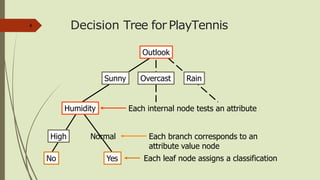
Decision Tree for PlayTennis4
Outlook
Sunny Overcast Rain
Humidity
High Normal
No Yes
Each internal node tests an attribute
Each branch corresponds to an
attribute value node
Each leaf node assigns a classification
Word Sense Disambiguation
Given an occurrence of a word, decide which sense, or meaning, was
intended.
Example: "run"
run1: move swiftly (Iran to the store.)
run2: operate (Irun a store.)
run3: flow (Water runs from the spring.)
run4: length of torn stitches (Her stockings had a run.)
etc.
5
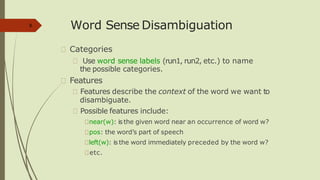
Word Sense Disambiguation
Categories
Use word sense labels (run1, run2, etc.) to name
the possible categories.
Features
Features describe the context of the word we want to
disambiguate.
Possible features include:
near(w): is the given word near an occurrence of word w?
pos: the word’s part of speech
left(w): is the word immediately preceded by the word w?
etc.
6
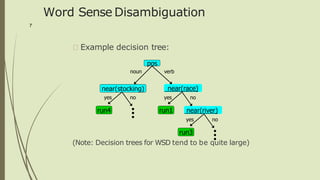
Word Sense Disambiguation
7
near(stocking)
yes no
run4
Example decision tree:
pos
noun verb
run3
(Note: Decision trees for WSD tend to be quite large)
near(race)
yes no
run1 near(river)
yes no
WSD:Sample Training Data
Features Word
Sensepos near(race) near(river) near(stockings)
noun no no no run4
verb no no no run1
verb no yes no run3
noun yes yes yes run4
verb no no yes run1
verb yes yes no run2
verb no yes yes run3
8
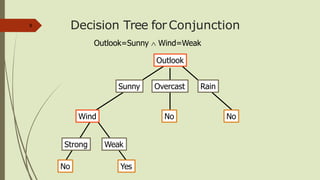
Decision Tree for Conjunction9
Outlook
Sunny Overcast Rain
Wind
Strong Weak
No Yes
No
Outlook=Sunny  Wind=Weak
No
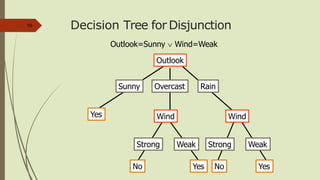
Decision Tree for Disjunction10
Outlook
Sunny Overcast Rain
Yes
Outlook=Sunny  Wind=Weak
Wind
Strong Weak
No Yes
Wind
Strong Weak
No Yes
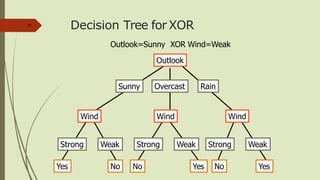
Decision Tree for XOR11
Outlook
Sunny Overcast Rain
Wind
Strong Weak
Yes No
Outlook=Sunny XOR Wind=Weak
Wind
Strong Weak
No Yes
Wind
Strong Weak
No Yes
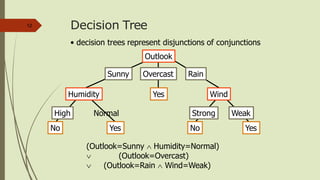
Decision Tree12
Outlook
Sunny Overcast Rain
Humidity
High Normal
Wind
Strong Weak
No Yes
Yes
YesNo
• decision trees represent disjunctions of conjunctions
(Outlook=Sunny  Humidity=Normal)
 (Outlook=Overcast)
 (Outlook=Rain  Wind=Weak)
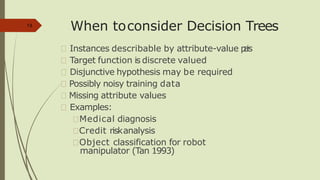
When toconsider Decision Trees
Instances describable by attribute-value pairs
Target function is discrete valued
Disjunctive hypothesis may be required
Possibly noisy training data
Missing attribute values
Examples:
Medical diagnosis
Credit riskanalysis
Object classification for robot
manipulator (Tan 1993)
13
Top-Down Induction of Decision
Trees ID3
14
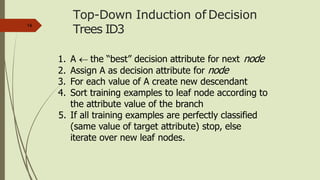
1. A  the “best” decision attribute for next node
2. Assign A as decision attribute for node
3. For each value of A create new descendant
4. Sort training examples to leaf node according to
the attribute value of the branch
5. If all training examples are perfectly classified
(same value of target attribute) stop, else
iterate over new leaf nodes.
Which attribute isbest?15
A1=?
G H
[21+, 5-] [8+, 30-]
[29+,35-] A2=?
L M
[18+, 33-] [11+, 2-]
[29+,35-]
Entropy
Sis a sample of training examples
p+ is the proportion of positive examples
p- is the proportion of negative
examples
Entropy measures the impurity of S
Entropy(S) =-p+ log2 p+ -p- log2 p-
16
Entropy
Entropy(S)= expected number of bits needed to
encode class (+or -)of randomly drawn members
of S(under the optimal, shortestlength-code)
Why?
Information theory optimal length code assign
–log2 p bits to messages having probability p.
So the expected number of bits to encode
(+or -)of random member ofS:
-p+log2 p+ -p- log2 p-
17
Information Gain (S=E)
Gain(S,A): expected reduction in entropy due to
sorting Son attributeA
18
G H
[21+, 5-] [8+, 30-]
[29+,35-] A1=?
True False
[18+, 33-] [11+, 2-]
A2=? [29+,35-]
Entropy([29+,35-]) = -29/64 log2 29/64 – 35/64 log2 35/64
= 0.99
Information Gain19
True False
[21+, 5-] [8+, 30-]
Entropy([21+,5-]) =0.71
Entropy([8+,30-]) =0.74
Gain(S,A1)=Entropy(S)
-26/64*Entropy([21+,5-])
-38/64*Entropy([8+,30-])
=0.27
[29+,35-] A1=?
Entropy([18+,33-]) = 0.94
Entropy([11+,2-]) = 0.62
Gain(S,A2)=Entropy(S)
-51/64*Entropy([18+,33-])
-13/64*Entropy([11+,2-])
=0.12
A2=?
True False
[18+, 33-] [11+, 2-]
[29+,35-]
Training Examples20
Day Outlook Temp. Humidity Wind Play Tennis
D1 Sunny Hot High Weak No
D2 Sunny Hot High Strong No
D3 Overcast Hot High Weak Yes
D4 Rain Mild High Weak Yes
D5 Rain Cool Normal Weak Yes
D6 Rain Cool Normal Strong No
D7 Overcast Cool Normal Weak Yes
D8 Sunny Mild High Weak No
D9 Sunny Cold Normal Weak Yes
D10 Rain Mild Normal Strong Yes
D11 Sunny Mild Normal Strong Yes
D12 Overcast Mild High Strong Yes
D13 Overcast Hot Normal Weak Yes
D14 Rain Mild High Strong No
Selecting the NextAttribute21
Humidity
High Normal
[3+, 4-] [6+, 1-]
S=[9+,5-]
E=0.940
Gain(S,Humidity)
=0.940-(7/14)*0.985
– (7/14)*0.592
=0.151
E=0.985 E=0.592
Wind
Weak Strong
[6+, 2-] [3+, 3-]
S=[9+,5-]
E=0.940
E=0.811 E=1.0
Gain(S,Wind)
=0.940-(8/14)*0.811
– (6/14)*1.0
=0.048
Humidity provides greater info. gain than Wind, w.r.t target classification.
Selecting the NextAttribute22
Outlook
Sunny Rain
[2+, 3-] [3+, 2-]
S=[9+,5-]
E=0.940
Over
cast
[4+, 0]
E=0.971 E=0.0 E=0.971
Gain(S,Outlook)
=0.940-(5/14)*0.971
-(4/14)*0.0 – (5/14)*0.0971
=0.247
Selecting the NextAttribute23
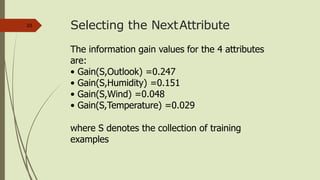
The information gain values for the 4 attributes
are:
• Gain(S,Outlook) =0.247
• Gain(S,Humidity) =0.151
• Gain(S,Wind) =0.048
• Gain(S,Temperature) =0.029
where S denotes the collection of training
examples
ID3 Algorithm24
Outlook
Sunny Overcast Rain
Yes
[D1,D2,…,D14]
[9+,5-]
? ?
Ssunny =[D1,D2,D8,D9,D11] [D3,D7,D12,D13] [D4,D5,D6,D10,D14]
[2+,3-] [4+,0-] [3+,2-]
Gain(Ssunny, Humidity)=0.970-(3/5)0.0 – 2/5(0.0) = 0.970
Gain(Ssunny, Temp.)=0.970-(2/5)0.0 –2/5(1.0)-(1/5)0.0 = 0.570
Gain(Ssunny, Wind)=0.970= -(2/5)1.0 – 3/5(0.918) = 0.019
ID3 Algorithm25
Outlook
Sunny Overcast Rain
Humidity
High Normal
Wind
Strong Weak
No Yes
Yes
YesNo
[D3,D7,D12,D13]
[D8,D9,D11]
[mistake]
[D6,D14][D1,D2] [D4,D5,D10]
Occam’s Razor
”If two theories explain the facts equally weel, then the
simpler theory isto be preferred”
Arguments in favor:
Fewer short hypotheses than long
hypothesesA short hypothesis that fits the data is unlikely to be
a coincidence
A long hypothesis that fits the data might be a
coincidence
Arguments opposed:
There are many ways to define small sets of
hypotheses
26
Overfitting
One of the biggest problems with decision
trees
is Overfitting
27
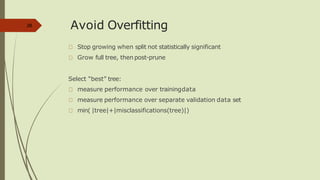
Avoid Overfitting
Stop growing when split not statistically significant
Grow full tree, then post-prune
Select “best” tree:
measure performance over trainingdata
measure performance over separate validation data set
min( |tree|+|misclassifications(tree)|)
28
Effect of Reduced Error Pruning29
Converting a Tree to Rules30
Outlook
Sunny Overcast Rain
Humidity
High Normal
Wind
Strong Weak
No Yes
Yes
YesNo
R1: If (Outlook=Sunny)  (Humidity=High) Then PlayTennis=No
R2: If (Outlook=Sunny)  (Humidity=Normal) Then PlayTennis=Yes
R3: If (Outlook=Overcast) Then PlayTennis=Yes
R4: If (Outlook=Rain)  (Wind=Strong) Then PlayTennis=No
R5: If (Outlook=Rain)  (Wind=Weak) Then PlayTennis=Yes
Continuous Valued Attributes
Create a discrete attribute to test continuous
Temperature =24.50C
(Temperature >20.00C) ={true, false}
Where to set thethreshold?
31
Temperature 150C 180C 190C 220C 240C 270C
PlayTennis No No Yes Yes Yes No
Random forest classifier
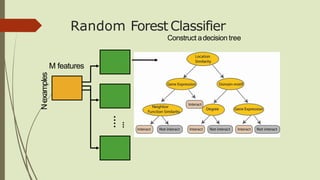
Random forest classifier, an extension to bagging which uses de-correlated
trees.
To say it in simple words: Random forest builds multiple decision trees and
merges them together to get a more accurate and stable prediction
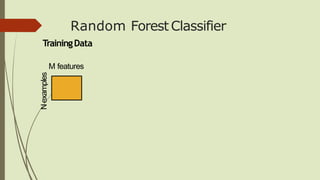
Random Forest Classifier
NexamplesTrainingData
M features
Random Forest Classifier
Nexamples
....
…
Create bootstrap samples
from the trainingdata
M features
Nexamples
Random Forest Classifier
Construct adecision tree
....
…
M features
Nexamples
....
…
M features
Random Forest Classifier
At eachnode in choosingthe split feature
choose only among m<Mfeatures
Random Forest Classifier
Createdecision tree
from each bootstrapsample
Nexamples
....
…
....
…
M features
Random Forest Classifier
Nexamples
....
…
....
…
Takethe
majority
vote
M features
Unknown Attribute Values
What if some examples have missing values of A?
Use training example anyway sort through tree
If node n tests A, assign most common value of A
among other examples sorted to node n.
Assign most common value of A among other
examples with same target value
Assign probability pi to each possible value vi of A
Assign fraction pi of example to each descendantin
tree
Classify new examples in the same fashion
39
Cross-Validation
Estimate the accuracy of an hypothesis induced by a supervised
learning algorithm
Predict the accuracy of an hypothesis over future unseen
instances
Select the optimal hypothesis from a given set of alternative
hypotheses
Pruning decision trees
Model selection
Feature selection
Combining multiple classifiers(boosting)
40

Decision Tree

  • 1.
  • 2.
    Introduction Given an event,predict is category. Examples: Who won a given ball game? How should we file a given email? What word sense was intended for a givenoccurrence of a word? Event =list of features. Examples:Ball game: Which players were on offense? Email: Who sent theemail? Disambiguation: What was the precedingword? 2
  • 3.
    Introduction Use a decisiontree to predict categories for new events. Use training data to build the decision tree. 3 New Events Decision Tree Category Training Events and Categories
  • 4.
    Decision Tree forPlayTennis4 Outlook Sunny Overcast Rain Humidity High Normal No Yes Each internal node tests an attribute Each branch corresponds to an attribute value node Each leaf node assigns a classification
  • 5.
    Word Sense Disambiguation Givenan occurrence of a word, decide which sense, or meaning, was intended. Example: "run" run1: move swiftly (Iran to the store.) run2: operate (Irun a store.) run3: flow (Water runs from the spring.) run4: length of torn stitches (Her stockings had a run.) etc. 5
  • 6.
    Word Sense Disambiguation Categories Useword sense labels (run1, run2, etc.) to name the possible categories. Features Features describe the context of the word we want to disambiguate. Possible features include: near(w): is the given word near an occurrence of word w? pos: the word’s part of speech left(w): is the word immediately preceded by the word w? etc. 6
  • 7.
    Word Sense Disambiguation 7 near(stocking) yesno run4 Example decision tree: pos noun verb run3 (Note: Decision trees for WSD tend to be quite large) near(race) yes no run1 near(river) yes no
  • 8.
    WSD:Sample Training Data FeaturesWord Sensepos near(race) near(river) near(stockings) noun no no no run4 verb no no no run1 verb no yes no run3 noun yes yes yes run4 verb no no yes run1 verb yes yes no run2 verb no yes yes run3 8
  • 9.
    Decision Tree forConjunction9 Outlook Sunny Overcast Rain Wind Strong Weak No Yes No Outlook=Sunny  Wind=Weak No
  • 10.
    Decision Tree forDisjunction10 Outlook Sunny Overcast Rain Yes Outlook=Sunny  Wind=Weak Wind Strong Weak No Yes Wind Strong Weak No Yes
  • 11.
    Decision Tree forXOR11 Outlook Sunny Overcast Rain Wind Strong Weak Yes No Outlook=Sunny XOR Wind=Weak Wind Strong Weak No Yes Wind Strong Weak No Yes
  • 12.
    Decision Tree12 Outlook Sunny OvercastRain Humidity High Normal Wind Strong Weak No Yes Yes YesNo • decision trees represent disjunctions of conjunctions (Outlook=Sunny  Humidity=Normal)  (Outlook=Overcast)  (Outlook=Rain  Wind=Weak)
  • 13.
    When toconsider DecisionTrees Instances describable by attribute-value pairs Target function is discrete valued Disjunctive hypothesis may be required Possibly noisy training data Missing attribute values Examples: Medical diagnosis Credit riskanalysis Object classification for robot manipulator (Tan 1993) 13
  • 14.
    Top-Down Induction ofDecision Trees ID3 14 1. A  the “best” decision attribute for next node 2. Assign A as decision attribute for node 3. For each value of A create new descendant 4. Sort training examples to leaf node according to the attribute value of the branch 5. If all training examples are perfectly classified (same value of target attribute) stop, else iterate over new leaf nodes.
  • 15.
    Which attribute isbest?15 A1=? GH [21+, 5-] [8+, 30-] [29+,35-] A2=? L M [18+, 33-] [11+, 2-] [29+,35-]
  • 16.
    Entropy Sis a sampleof training examples p+ is the proportion of positive examples p- is the proportion of negative examples Entropy measures the impurity of S Entropy(S) =-p+ log2 p+ -p- log2 p- 16
  • 17.
    Entropy Entropy(S)= expected numberof bits needed to encode class (+or -)of randomly drawn members of S(under the optimal, shortestlength-code) Why? Information theory optimal length code assign –log2 p bits to messages having probability p. So the expected number of bits to encode (+or -)of random member ofS: -p+log2 p+ -p- log2 p- 17
  • 18.
    Information Gain (S=E) Gain(S,A):expected reduction in entropy due to sorting Son attributeA 18 G H [21+, 5-] [8+, 30-] [29+,35-] A1=? True False [18+, 33-] [11+, 2-] A2=? [29+,35-] Entropy([29+,35-]) = -29/64 log2 29/64 – 35/64 log2 35/64 = 0.99
  • 19.
    Information Gain19 True False [21+,5-] [8+, 30-] Entropy([21+,5-]) =0.71 Entropy([8+,30-]) =0.74 Gain(S,A1)=Entropy(S) -26/64*Entropy([21+,5-]) -38/64*Entropy([8+,30-]) =0.27 [29+,35-] A1=? Entropy([18+,33-]) = 0.94 Entropy([11+,2-]) = 0.62 Gain(S,A2)=Entropy(S) -51/64*Entropy([18+,33-]) -13/64*Entropy([11+,2-]) =0.12 A2=? True False [18+, 33-] [11+, 2-] [29+,35-]
  • 20.
    Training Examples20 Day OutlookTemp. Humidity Wind Play Tennis D1 Sunny Hot High Weak No D2 Sunny Hot High Strong No D3 Overcast Hot High Weak Yes D4 Rain Mild High Weak Yes D5 Rain Cool Normal Weak Yes D6 Rain Cool Normal Strong No D7 Overcast Cool Normal Weak Yes D8 Sunny Mild High Weak No D9 Sunny Cold Normal Weak Yes D10 Rain Mild Normal Strong Yes D11 Sunny Mild Normal Strong Yes D12 Overcast Mild High Strong Yes D13 Overcast Hot Normal Weak Yes D14 Rain Mild High Strong No
  • 21.
    Selecting the NextAttribute21 Humidity HighNormal [3+, 4-] [6+, 1-] S=[9+,5-] E=0.940 Gain(S,Humidity) =0.940-(7/14)*0.985 – (7/14)*0.592 =0.151 E=0.985 E=0.592 Wind Weak Strong [6+, 2-] [3+, 3-] S=[9+,5-] E=0.940 E=0.811 E=1.0 Gain(S,Wind) =0.940-(8/14)*0.811 – (6/14)*1.0 =0.048 Humidity provides greater info. gain than Wind, w.r.t target classification.
  • 22.
    Selecting the NextAttribute22 Outlook SunnyRain [2+, 3-] [3+, 2-] S=[9+,5-] E=0.940 Over cast [4+, 0] E=0.971 E=0.0 E=0.971 Gain(S,Outlook) =0.940-(5/14)*0.971 -(4/14)*0.0 – (5/14)*0.0971 =0.247
  • 23.
    Selecting the NextAttribute23 Theinformation gain values for the 4 attributes are: • Gain(S,Outlook) =0.247 • Gain(S,Humidity) =0.151 • Gain(S,Wind) =0.048 • Gain(S,Temperature) =0.029 where S denotes the collection of training examples
  • 24.
    ID3 Algorithm24 Outlook Sunny OvercastRain Yes [D1,D2,…,D14] [9+,5-] ? ? Ssunny =[D1,D2,D8,D9,D11] [D3,D7,D12,D13] [D4,D5,D6,D10,D14] [2+,3-] [4+,0-] [3+,2-] Gain(Ssunny, Humidity)=0.970-(3/5)0.0 – 2/5(0.0) = 0.970 Gain(Ssunny, Temp.)=0.970-(2/5)0.0 –2/5(1.0)-(1/5)0.0 = 0.570 Gain(Ssunny, Wind)=0.970= -(2/5)1.0 – 3/5(0.918) = 0.019
  • 25.
    ID3 Algorithm25 Outlook Sunny OvercastRain Humidity High Normal Wind Strong Weak No Yes Yes YesNo [D3,D7,D12,D13] [D8,D9,D11] [mistake] [D6,D14][D1,D2] [D4,D5,D10]
  • 26.
    Occam’s Razor ”If twotheories explain the facts equally weel, then the simpler theory isto be preferred” Arguments in favor: Fewer short hypotheses than long hypothesesA short hypothesis that fits the data is unlikely to be a coincidence A long hypothesis that fits the data might be a coincidence Arguments opposed: There are many ways to define small sets of hypotheses 26
  • 27.
    Overfitting One of thebiggest problems with decision trees is Overfitting 27
  • 28.
    Avoid Overfitting Stop growingwhen split not statistically significant Grow full tree, then post-prune Select “best” tree: measure performance over trainingdata measure performance over separate validation data set min( |tree|+|misclassifications(tree)|) 28
  • 29.
    Effect of ReducedError Pruning29
  • 30.
    Converting a Treeto Rules30 Outlook Sunny Overcast Rain Humidity High Normal Wind Strong Weak No Yes Yes YesNo R1: If (Outlook=Sunny)  (Humidity=High) Then PlayTennis=No R2: If (Outlook=Sunny)  (Humidity=Normal) Then PlayTennis=Yes R3: If (Outlook=Overcast) Then PlayTennis=Yes R4: If (Outlook=Rain)  (Wind=Strong) Then PlayTennis=No R5: If (Outlook=Rain)  (Wind=Weak) Then PlayTennis=Yes
  • 31.
    Continuous Valued Attributes Createa discrete attribute to test continuous Temperature =24.50C (Temperature >20.00C) ={true, false} Where to set thethreshold? 31 Temperature 150C 180C 190C 220C 240C 270C PlayTennis No No Yes Yes Yes No
  • 32.
    Random forest classifier Randomforest classifier, an extension to bagging which uses de-correlated trees. To say it in simple words: Random forest builds multiple decision trees and merges them together to get a more accurate and stable prediction
  • 33.
  • 34.
    Random Forest Classifier Nexamples .... … Createbootstrap samples from the trainingdata M features
  • 35.
    Nexamples Random Forest Classifier Constructadecision tree .... … M features
  • 36.
    Nexamples .... … M features Random ForestClassifier At eachnode in choosingthe split feature choose only among m<Mfeatures
  • 37.
    Random Forest Classifier Createdecisiontree from each bootstrapsample Nexamples .... … .... … M features
  • 38.
  • 39.
    Unknown Attribute Values Whatif some examples have missing values of A? Use training example anyway sort through tree If node n tests A, assign most common value of A among other examples sorted to node n. Assign most common value of A among other examples with same target value Assign probability pi to each possible value vi of A Assign fraction pi of example to each descendantin tree Classify new examples in the same fashion 39
  • 40.
    Cross-Validation Estimate the accuracyof an hypothesis induced by a supervised learning algorithm Predict the accuracy of an hypothesis over future unseen instances Select the optimal hypothesis from a given set of alternative hypotheses Pruning decision trees Model selection Feature selection Combining multiple classifiers(boosting) 40