Clustering
Cluster analysis
• Cluster analysis or simply clustering is the process of partitioning a set
of data objects (or observations) into subsets.
• Each subset is a cluster, such that objects in a cluster are similar to
one another, yet dissimilar to objects in other clusters.
• The set of clusters resulting from a cluster analysis can be referred to
as a clustering.
• Cluster analysis has been widely used in many applications, such as
business intelligence, image pattern recognition, Web search, biology,
and security.
Advantages of clustering
• Because a cluster is a collection of data objects that are similar to one another within
the cluster and dissimilar to objects in other clusters, a cluster of data objects can be
treated as an implicit class. In this sense, clustering is sometimes called automatic
classification.
• Again, a critical difference here is that clustering can automatically find the groupings.
This is a distinct advantage of cluster analysis.
• Clustering is also called data segmentation in some applications because clustering
partitions large data sets into groups according to their similarity.
• Clustering can also be used for outlier detection, where outliers (values that are “far
away” from any cluster) may be more interesting than common cases.
• Applications of outlier detection include the detection of credit card fraud and the
monitoring of criminal activities in electronic commerce.
Unsupervised learning
• Clustering is known as unsupervised learning because the class label
information is not present. For this reason, clustering is a form of
learning by observation, rather than learning by examples.
Requirements for Cluster Analysis
• Scalability: Clustering on a sample of a given large data set may lead to biased results.
Therefore, highly scalable clustering algorithms are needed.
• Ability to deal with different types of attributes:Many algorithms are designed to
cluster numeric (interval-based) data. However, applications may require clustering
other types of data, such as binary, nominal (categorical), and ordinal data, or
mixtures of these data types. Recently., more and more applications need clustering
techniques for complex data types such as graphs, sequences, images, and
documents.
• Discovery of clusters with arbitrary shape: Algorithms based on such distance
measures tend to find spherical clusters with similar size and density. We may want to
use clustering to find the frontier of a running forest fire, which is often not spherical.
It is important to develop algorithms that can detect clusters of arbitrary shape.
Requirements for Cluster Analysis
• Requirements for domain knowledge to determine input parameters:
Requiring the specification of domain knowledge not only burdens
users, but also makes the quality of clustering difficult to control.
• Ability to deal with noisy data: Clustering methods that are robust to
noise are highly desirable.
• Incremental clustering and insensitivity to input order
• Capability of clustering data of high dimensionality
• Constraint-based clustering
• Interpretability and usability
Partitioning methods:
• Given a set of n objects, a partitioning method constructs k partitions of the data, where
each partition represents a cluster and k ≤ n. That is, it divides the data into k groups such
that each group must contain at least one object.
• In other words, partitioning methods conduct one-level partitioning on data sets. The basic
partitioning methods typically adopt exclusive cluster separation.
• That is, each object must belong to exactly one group.
• Most partitioning methods are distance-based. Given k, the number of partitions to
construct, a partitioning method creates an initial partitioning.
• It then uses an iterative relocation technique that attempts to improve the partitioning by
moving objects from one group to another.
• The general criterion of a good partitioning is that objects in the same cluster are “close” or
related to each other, whereas objects in different clusters are “far apart” or very different.
Partitioning methods:
• Achieving global optimality in partitioning-based clustering is often
computationally prohibitive, potentially requiring an exhaustive
enumeration of all of the possible partitions.
• Instead, most applications adopt popular heuristic methods, such as greedy
approaches like the k-means and the k-medoids algorithms, which
progressively improve the clustering quality and approach a local optimum.
• These heuristic clustering methods work well for finding spherical-shaped
clusters in small to medium-sized databases.
• To find clusters with complex shapes and for very large data sets,
partitioning-based methods need to be extended.
K means Clustering
• Algorithm: k-means. The k-means algorithm for partitioning, where each cluster’s center is represented by the
mean value of the objects in the cluster.
• Input:
• • k: the number of clusters,
• • D: a data set containing n objects.
• Output: A set of k clusters.
• Method:
• (1) arbitrarily choose k objects from D as the initial cluster centers;
• (2) repeat
• (3) (re)assign each object to the cluster to which the object is the most similar,
• based on the mean value of the objects in the cluster;
• (4) update the cluster means, i.e., calculate the mean value of the objects for
• each cluster;
• (5) until no change;
• The time complexity of the k-means algorithm is O(nkt), where n is the total number of objects,
k is the number of clusters, and t is the number of iterations. Normally, k n and t n.
≪ ≪
• Therefore, the method is relatively scalable and efficient in processing large data sets.
• There are quite a few variants of the k-means method. These can differ in the selection of the
initial k means, the calculation of dissimilarity, and the strategies for calculating cluster means.
• The k-means method, can be applied only when the mean of a set of objects is defined. This
may not be the case in some applications, such as when data with nominal attributes are
involved. The k-modes method is a variant of k-means, which extends the k-means paradigm to
cluster nominal data by replacing the means of clusters with modes.
• It uses new dissimilarity measures to deal with nominal objects and a frequency-based method
to update modes of clusters.
• The k-means and the k-modes methods can be integrated to cluster data with mixed numeric
and nominal values
KMod
• K-modes is an extension of the K-means algorithm designed to handle
categorical data. Unlike K-means, which uses Euclidean distance and
mean, K-modes uses:
• Hamming distance to measure dissimilarity between categorical
values.
• Mode instead of mean for centroid calculation.
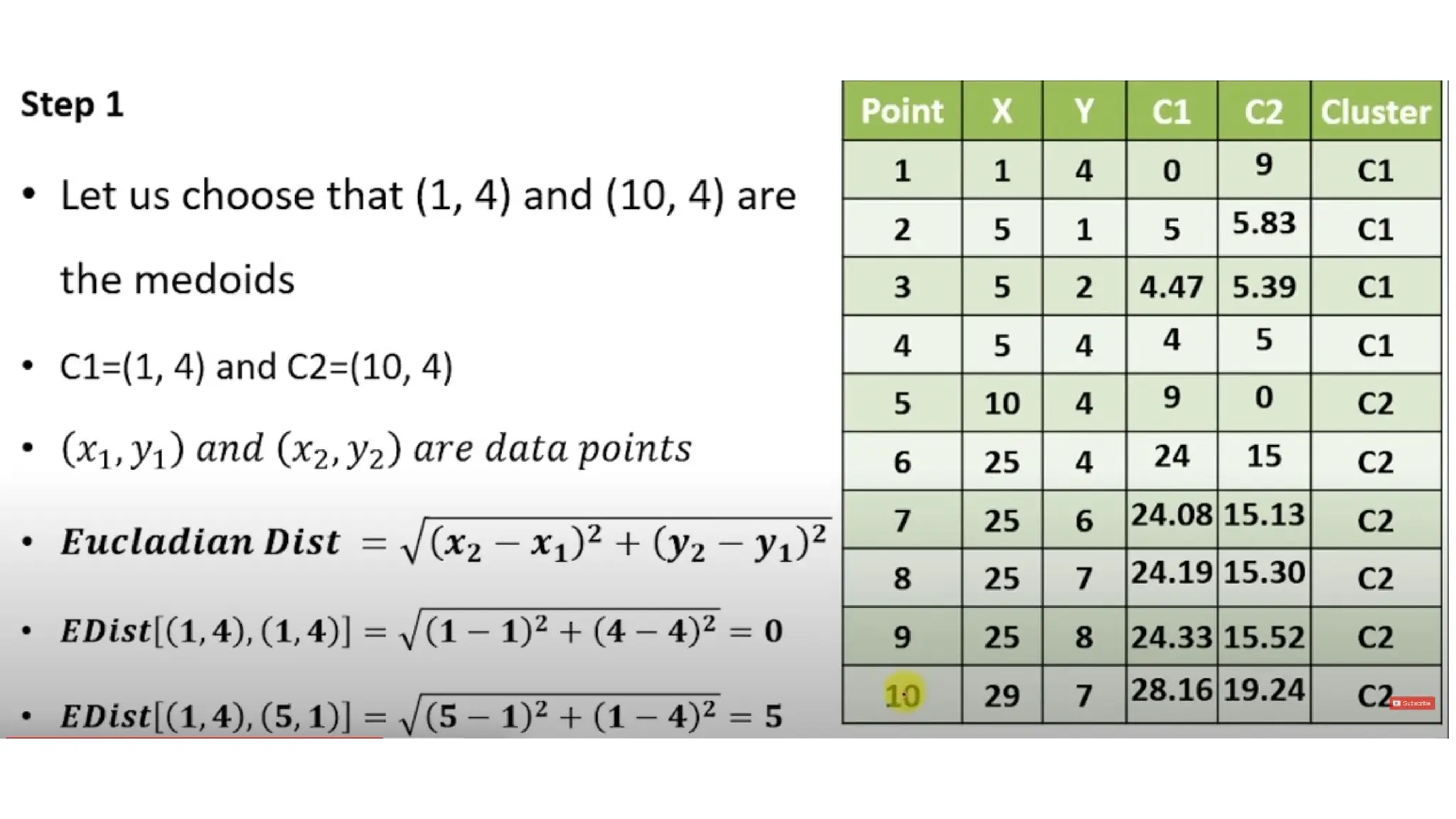
K medoid
CLARA (Clustering Large Applications)
• Approach: CLARA is an extension of K-medoids designed to handle
large datasets more efficiently by using sampling. Instead of applying
K-medoids to the entire dataset, it:
• Takes random samples (subsets) of the data (typically 5–10 samples, each
with a few thousand points).
• Applies the K-medoids algorithm on each subset.
• Evaluates the quality of the clustering on the entire dataset using the
medoids derived from the samples.
• Chooses the best clustering from these samples based on total dissimilarity.
CLARANS (Clustering Large Applications based on Randomized Search)
• Approach: CLARANS improves upon K-medoids and CLARA by using
randomized search to explore possible medoids. It doesn’t restrict
itself to samples like CLARA but:
• Starts with an initial set of medoids.
• Randomly selects a neighboring medoid (a new set of medoids differing by
one point) rather than exhaustively checking all possible medoids like K-
medoids.
• Evaluates the cost of the new medoid configuration. If the new configuration
reduces the cost, it adopts the new medoids.
• Repeats the process for a predefined number of iterations or until no better
configuration is found.
Hierarchical clustering
Cluster distance measure
Machine Learning : Clustering - Cluster analysis.pptx

Machine Learning : Clustering - Cluster analysis.pptx

  • 1.
  • 2.
    Cluster analysis • Clusteranalysis or simply clustering is the process of partitioning a set of data objects (or observations) into subsets. • Each subset is a cluster, such that objects in a cluster are similar to one another, yet dissimilar to objects in other clusters. • The set of clusters resulting from a cluster analysis can be referred to as a clustering. • Cluster analysis has been widely used in many applications, such as business intelligence, image pattern recognition, Web search, biology, and security.
  • 3.
    Advantages of clustering •Because a cluster is a collection of data objects that are similar to one another within the cluster and dissimilar to objects in other clusters, a cluster of data objects can be treated as an implicit class. In this sense, clustering is sometimes called automatic classification. • Again, a critical difference here is that clustering can automatically find the groupings. This is a distinct advantage of cluster analysis. • Clustering is also called data segmentation in some applications because clustering partitions large data sets into groups according to their similarity. • Clustering can also be used for outlier detection, where outliers (values that are “far away” from any cluster) may be more interesting than common cases. • Applications of outlier detection include the detection of credit card fraud and the monitoring of criminal activities in electronic commerce.
  • 4.
    Unsupervised learning • Clusteringis known as unsupervised learning because the class label information is not present. For this reason, clustering is a form of learning by observation, rather than learning by examples.
  • 5.
    Requirements for ClusterAnalysis • Scalability: Clustering on a sample of a given large data set may lead to biased results. Therefore, highly scalable clustering algorithms are needed. • Ability to deal with different types of attributes:Many algorithms are designed to cluster numeric (interval-based) data. However, applications may require clustering other types of data, such as binary, nominal (categorical), and ordinal data, or mixtures of these data types. Recently., more and more applications need clustering techniques for complex data types such as graphs, sequences, images, and documents. • Discovery of clusters with arbitrary shape: Algorithms based on such distance measures tend to find spherical clusters with similar size and density. We may want to use clustering to find the frontier of a running forest fire, which is often not spherical. It is important to develop algorithms that can detect clusters of arbitrary shape.
  • 6.
    Requirements for ClusterAnalysis • Requirements for domain knowledge to determine input parameters: Requiring the specification of domain knowledge not only burdens users, but also makes the quality of clustering difficult to control. • Ability to deal with noisy data: Clustering methods that are robust to noise are highly desirable. • Incremental clustering and insensitivity to input order • Capability of clustering data of high dimensionality • Constraint-based clustering • Interpretability and usability
  • 7.
    Partitioning methods: • Givena set of n objects, a partitioning method constructs k partitions of the data, where each partition represents a cluster and k ≤ n. That is, it divides the data into k groups such that each group must contain at least one object. • In other words, partitioning methods conduct one-level partitioning on data sets. The basic partitioning methods typically adopt exclusive cluster separation. • That is, each object must belong to exactly one group. • Most partitioning methods are distance-based. Given k, the number of partitions to construct, a partitioning method creates an initial partitioning. • It then uses an iterative relocation technique that attempts to improve the partitioning by moving objects from one group to another. • The general criterion of a good partitioning is that objects in the same cluster are “close” or related to each other, whereas objects in different clusters are “far apart” or very different.
  • 8.
    Partitioning methods: • Achievingglobal optimality in partitioning-based clustering is often computationally prohibitive, potentially requiring an exhaustive enumeration of all of the possible partitions. • Instead, most applications adopt popular heuristic methods, such as greedy approaches like the k-means and the k-medoids algorithms, which progressively improve the clustering quality and approach a local optimum. • These heuristic clustering methods work well for finding spherical-shaped clusters in small to medium-sized databases. • To find clusters with complex shapes and for very large data sets, partitioning-based methods need to be extended.
  • 9.
    K means Clustering •Algorithm: k-means. The k-means algorithm for partitioning, where each cluster’s center is represented by the mean value of the objects in the cluster. • Input: • • k: the number of clusters, • • D: a data set containing n objects. • Output: A set of k clusters. • Method: • (1) arbitrarily choose k objects from D as the initial cluster centers; • (2) repeat • (3) (re)assign each object to the cluster to which the object is the most similar, • based on the mean value of the objects in the cluster; • (4) update the cluster means, i.e., calculate the mean value of the objects for • each cluster; • (5) until no change;
  • 19.
    • The timecomplexity of the k-means algorithm is O(nkt), where n is the total number of objects, k is the number of clusters, and t is the number of iterations. Normally, k n and t n. ≪ ≪ • Therefore, the method is relatively scalable and efficient in processing large data sets. • There are quite a few variants of the k-means method. These can differ in the selection of the initial k means, the calculation of dissimilarity, and the strategies for calculating cluster means. • The k-means method, can be applied only when the mean of a set of objects is defined. This may not be the case in some applications, such as when data with nominal attributes are involved. The k-modes method is a variant of k-means, which extends the k-means paradigm to cluster nominal data by replacing the means of clusters with modes. • It uses new dissimilarity measures to deal with nominal objects and a frequency-based method to update modes of clusters. • The k-means and the k-modes methods can be integrated to cluster data with mixed numeric and nominal values
  • 20.
    KMod • K-modes isan extension of the K-means algorithm designed to handle categorical data. Unlike K-means, which uses Euclidean distance and mean, K-modes uses: • Hamming distance to measure dissimilarity between categorical values. • Mode instead of mean for centroid calculation.
  • 22.
  • 47.
    CLARA (Clustering LargeApplications) • Approach: CLARA is an extension of K-medoids designed to handle large datasets more efficiently by using sampling. Instead of applying K-medoids to the entire dataset, it: • Takes random samples (subsets) of the data (typically 5–10 samples, each with a few thousand points). • Applies the K-medoids algorithm on each subset. • Evaluates the quality of the clustering on the entire dataset using the medoids derived from the samples. • Chooses the best clustering from these samples based on total dissimilarity.
  • 48.
    CLARANS (Clustering LargeApplications based on Randomized Search) • Approach: CLARANS improves upon K-medoids and CLARA by using randomized search to explore possible medoids. It doesn’t restrict itself to samples like CLARA but: • Starts with an initial set of medoids. • Randomly selects a neighboring medoid (a new set of medoids differing by one point) rather than exhaustively checking all possible medoids like K- medoids. • Evaluates the cost of the new medoid configuration. If the new configuration reduces the cost, it adopts the new medoids. • Repeats the process for a predefined number of iterations or until no better configuration is found.
  • 50.
  • 56.