Seminar on :
“Solar Operated wheel chair
for
handicap or disable person”
Presented by : Guided
by:
[1]Mayur mendhe Prof.V.V.
Sable
[2]Suraj nindekar
[3]Shubham jiwtode
[4]Avinash thool
 Introduction
 Aim
 Objective of System
 Current System
 Problem Definition
 Proposed System
 Mechanism / Diagram
 Statistical Analysis
 Advantages
 Conclusion
 Bibliography
Contains
IntroductionIntroduction
 In this project solar panel generates electricity.
Disable or Handicap person can able to use this system
anywhere on their workplace.
 this project can be useful for old persons and physically
weak persons also person who injured from accident.
 The present world the medical field is very much focuses
about to care the patients, and the patient/ handicapped one
are like to leave individually without the help of any others
so, this proposed product will be very effective for the
them.
AimAim
 Redesigning the existing system.
 To generate the energy from existing system and utilised
variously mainly when the power cuts.
Objective of SystemObjective of System
 Analysis of present system.
 To develop a vehicle that use renewable energy,
environmentally friendly and cheap.
 To develop an electrical tricycle that can charge the
battery when it is not in used.
To develop low speed, but for a longer distance.
Current systemCurrent system
 In the current system, there is only use of lift is to lift
from down to up and vise versa. These mechanical motion
is unutilized.
 The current system does not have any mechanism to
utilized the power generated by the lift motion.
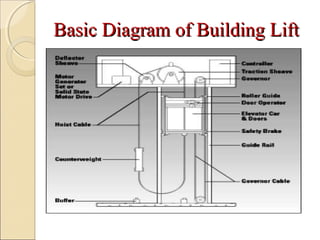
Basic Diagram of Building LiftBasic Diagram of Building Lift
Problem DefinitionProblem Definition
 In the present system there is not any arrangement to
utilized the mechanical energy for power generation.
 The energy produced in existing process is not define.
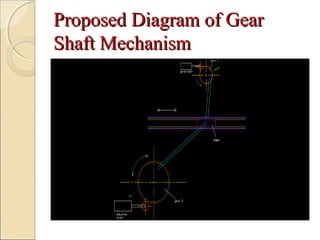
Proposed SystemProposed System
The invention and the preferred modes of use will best be
understood by reference to the following detailed
description of an illustrative embodiment. A control block
diagram of a self generating elevator emergency power
source for an elevator system using a reciprocating and an
electrical generator. A control block diagram of self
generating elevator emergency power source for an elevator
system using a reciprocating and an elevator motor in
generator mode.
ProposedProposed DiagramDiagram ofof GearGear
ShaftShaft MechanismMechanism
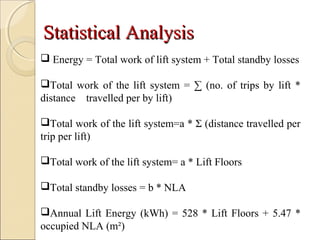
StatisticalStatistical AnalysisAnalysis
 Energy = Total work of lift system + Total standby losses
Total work of the lift system = ∑ (no. of trips by lift *
distance travelled per by lift)
Total work of the lift system=a * Σ (distance travelled per
trip per lift)
Total work of the lift system= a * Lift Floors
Total standby losses = b * NLA
Annual Lift Energy (kWh) = 528 * Lift Floors + 5.47 *
occupied NLA (m²)
AdvantagesAdvantages
 Generate the power from lift and use these for various
things (i.e fan, lights) in no cost.
 When the power cuts the energy saves in the battery will
utilized.
 The assembly is very easy and cheaper in rate so power
generation rate is low.
 Maintenance cost of the project is also low.
ConclusionConclusion
Various modifications of the disclosed embodiments as well
as alternative embodiments of the invention will become
apparent to persons skilled in the art upon reference to the
description of the invention. It is therefore contemplated that
the appended claims will cover any such modifications or
embodiments that fall within the true scope of the invention.
BibliographyBibliography
[1 ] Thanit Punprayoong and Boonyong Plangklang, energy
saving elevators by in Building a case study: RMUTT,
Conference on Energy Network of Thailand 8. 2-4 May 2555,
Maha Sarakham : 4, 2555.
[2] H. Inaba, S.T. Nara, H. Takahashi$M. Nakazato, High
speed elevators controlled by current source inverter system
with sinusoidal input and output.
[3]http://www.danahermotion.com/education_training/motor/
four-quadrant operation (August, 2012).
[4] Rajamangala of Physics, Department of Physics Faculty
of Science Rajamangala, University of Technology
Thanyaburi.
[5] Pirote Brikapkul., The design of the feedback controller in
integral self-adjusting for permanent magnet synchronous motors,
Master degree thesis, Electrical Engineering, KMUTNB Thailand,
2546.
[6] Ashok B. Kulkarni, Hien Hguyen and E.W. Gaudet “A
Comparative Evaluation of line Regenerative and Non-
Regenerative Vector Controlled Drives for AC Gearless
Elevator”,IEEE 1431-1437 .
[7] Masaki Nomura, Hiroyu Ikejima, Shigetaka Morita and Eiki
Watanabe, Regenerative Power Control For VVVF Motor Drive
(Critical Braking Method Applied To The Elevator), IEEE 97-105 .
[8] EMPIRICAL PREDICTION OF OFFICE BUILDING LIFT
ENERGY CONSUMPTION by Dr Paul Bannister, Chris
Bloomfield, and Haibo Chen Exergy Australia Pty Ltd, Canberra,
Australia.
16

Mac mendhe

  • 1.
    Seminar on : “SolarOperated wheel chair for handicap or disable person” Presented by : Guided by: [1]Mayur mendhe Prof.V.V. Sable [2]Suraj nindekar [3]Shubham jiwtode [4]Avinash thool
  • 2.
     Introduction  Aim Objective of System  Current System  Problem Definition  Proposed System  Mechanism / Diagram  Statistical Analysis  Advantages  Conclusion  Bibliography Contains
  • 3.
    IntroductionIntroduction  In thisproject solar panel generates electricity. Disable or Handicap person can able to use this system anywhere on their workplace.  this project can be useful for old persons and physically weak persons also person who injured from accident.  The present world the medical field is very much focuses about to care the patients, and the patient/ handicapped one are like to leave individually without the help of any others so, this proposed product will be very effective for the them.
  • 4.
    AimAim  Redesigning theexisting system.  To generate the energy from existing system and utilised variously mainly when the power cuts.
  • 5.
    Objective of SystemObjectiveof System  Analysis of present system.  To develop a vehicle that use renewable energy, environmentally friendly and cheap.  To develop an electrical tricycle that can charge the battery when it is not in used. To develop low speed, but for a longer distance.
  • 6.
    Current systemCurrent system In the current system, there is only use of lift is to lift from down to up and vise versa. These mechanical motion is unutilized.  The current system does not have any mechanism to utilized the power generated by the lift motion.
  • 7.
    Basic Diagram ofBuilding LiftBasic Diagram of Building Lift
  • 8.
    Problem DefinitionProblem Definition In the present system there is not any arrangement to utilized the mechanical energy for power generation.  The energy produced in existing process is not define.
  • 9.
    Proposed SystemProposed System Theinvention and the preferred modes of use will best be understood by reference to the following detailed description of an illustrative embodiment. A control block diagram of a self generating elevator emergency power source for an elevator system using a reciprocating and an electrical generator. A control block diagram of self generating elevator emergency power source for an elevator system using a reciprocating and an elevator motor in generator mode.
  • 10.
    ProposedProposed DiagramDiagram ofofGearGear ShaftShaft MechanismMechanism
  • 11.
    StatisticalStatistical AnalysisAnalysis  Energy= Total work of lift system + Total standby losses Total work of the lift system = ∑ (no. of trips by lift * distance travelled per by lift) Total work of the lift system=a * Σ (distance travelled per trip per lift) Total work of the lift system= a * Lift Floors Total standby losses = b * NLA Annual Lift Energy (kWh) = 528 * Lift Floors + 5.47 * occupied NLA (m²)
  • 12.
    AdvantagesAdvantages  Generate thepower from lift and use these for various things (i.e fan, lights) in no cost.  When the power cuts the energy saves in the battery will utilized.  The assembly is very easy and cheaper in rate so power generation rate is low.  Maintenance cost of the project is also low.
  • 13.
    ConclusionConclusion Various modifications ofthe disclosed embodiments as well as alternative embodiments of the invention will become apparent to persons skilled in the art upon reference to the description of the invention. It is therefore contemplated that the appended claims will cover any such modifications or embodiments that fall within the true scope of the invention.
  • 14.
    BibliographyBibliography [1 ] ThanitPunprayoong and Boonyong Plangklang, energy saving elevators by in Building a case study: RMUTT, Conference on Energy Network of Thailand 8. 2-4 May 2555, Maha Sarakham : 4, 2555. [2] H. Inaba, S.T. Nara, H. Takahashi$M. Nakazato, High speed elevators controlled by current source inverter system with sinusoidal input and output. [3]http://www.danahermotion.com/education_training/motor/ four-quadrant operation (August, 2012). [4] Rajamangala of Physics, Department of Physics Faculty of Science Rajamangala, University of Technology Thanyaburi.
  • 15.
    [5] Pirote Brikapkul.,The design of the feedback controller in integral self-adjusting for permanent magnet synchronous motors, Master degree thesis, Electrical Engineering, KMUTNB Thailand, 2546. [6] Ashok B. Kulkarni, Hien Hguyen and E.W. Gaudet “A Comparative Evaluation of line Regenerative and Non- Regenerative Vector Controlled Drives for AC Gearless Elevator”,IEEE 1431-1437 . [7] Masaki Nomura, Hiroyu Ikejima, Shigetaka Morita and Eiki Watanabe, Regenerative Power Control For VVVF Motor Drive (Critical Braking Method Applied To The Elevator), IEEE 97-105 . [8] EMPIRICAL PREDICTION OF OFFICE BUILDING LIFT ENERGY CONSUMPTION by Dr Paul Bannister, Chris Bloomfield, and Haibo Chen Exergy Australia Pty Ltd, Canberra, Australia.
  • 16.