International Research Journal of Engineering and Technology (IRJET) e-ISSN: 2395-0056
Volume: 07 Issue: 01 | Jan 2020 www.irjet.net p-ISSN: 2395-0072
© 2020, IRJET | Impact Factor value: 7.34 | ISO 9001:2008 Certified Journal | Page 1518
Railway Track Based Electrical Power Generation
Aishwarya D. Jolhe1, Bhavika D. Goware2, P.V. Raut3
1,2Student, Dept. of Electrical Engineering, DES’S COET, Dhamangaon Rly
3Professor, Dept. of Electrical Engineering, DES’S COET, Dhamangaon Rly
----------------------------------------------------------------------***---------------------------------------------------------------------
Abstract – Power Generation from railway tracks is an
important in today’s life because its carries large number of
trains moving over it. This paper is made to design a
mechanism which able tocarryloadandgeneratepower using
simple mechanical elements. Nowadays there is a need of non
conventional energy system to our country. The energyobtain
from railway track is one of the suitable source of generating
non-conventional energy because there is no need of fuel as a
input to generate the output in the form electrical power and
this is done by using simple gear drive mechanism. This
mechanism carries the rack, pinion, flaps, gears, freewheel,
flywheel, DC generator, battery, etc. Rack & pinion, D.C
generator, battery and inverter are used as control
mechanism, so that we can implement this arrangement to all
railway track system and the large power generation is
obtained but this type of arrangement have high initial cost.
Key Words: Energy Harvesting, Non-Conventional
Method, Railway Tracks.
1. INTRODUCTION
Railway is one of the most commonly used platform
of transportation in the world, which is used to carry heavy
loads next to shipping. The loads may be in the form of
passengers or goods. Railway becomes a largest popular
public transportation. Railways are always choose for
passenger convenient systems and are developing various
comforts and are inventing easy operation for safety.
Usageoftrackingtechnology solutionsimplemented
by Indian railways, shipping companiesandotherindustries
and general public have recently begun to utilize Indian
railways and rely on it more than earlier. Generally the non-
renewable sources of energy are the conventional source of
energy, which are being used since a long time. For the
improvement of the power generation technologies and to
make them more convenient, non –conventional
technologies have been discovered. Non-conventional
energy sources are the energy sources which are
continuously replenished by natural processes. All these
sources are natural, renewable or inexhaustible and do not
cause any environmental pollution and is eco-friendly.
Moreover they do not require more expenditure. The non-
conventional sources of energy are available in a large
quantity in nature. With further demand for energy, man
began to use the wind for gliding ships and for driving
windmills, and the power of falling water to turn water for
sailing ships and for driving windmills. Thesunfulfillsall the
energy needs of man either directly or indirectly.
When train moves over the railway track, the track
deflects vertically due to load exerted by the train’s coaches.
The vertical displacement of the track under the weight of a
movement of train can connect regenerative devices i.e. a
vibration energy harvester. Thegeneratedoutputpower can
be stored into the battery. World is developing at the faster
rate with regards to consumption of fuel and so theshortage
of energy as the sources producing them are deplorable in
nature. The large amount of usage of energy has resulted in
an energy crisis and there is a need to generate more
methods of optimal utilization which will not only ease the
crisis but also conserve the environment.
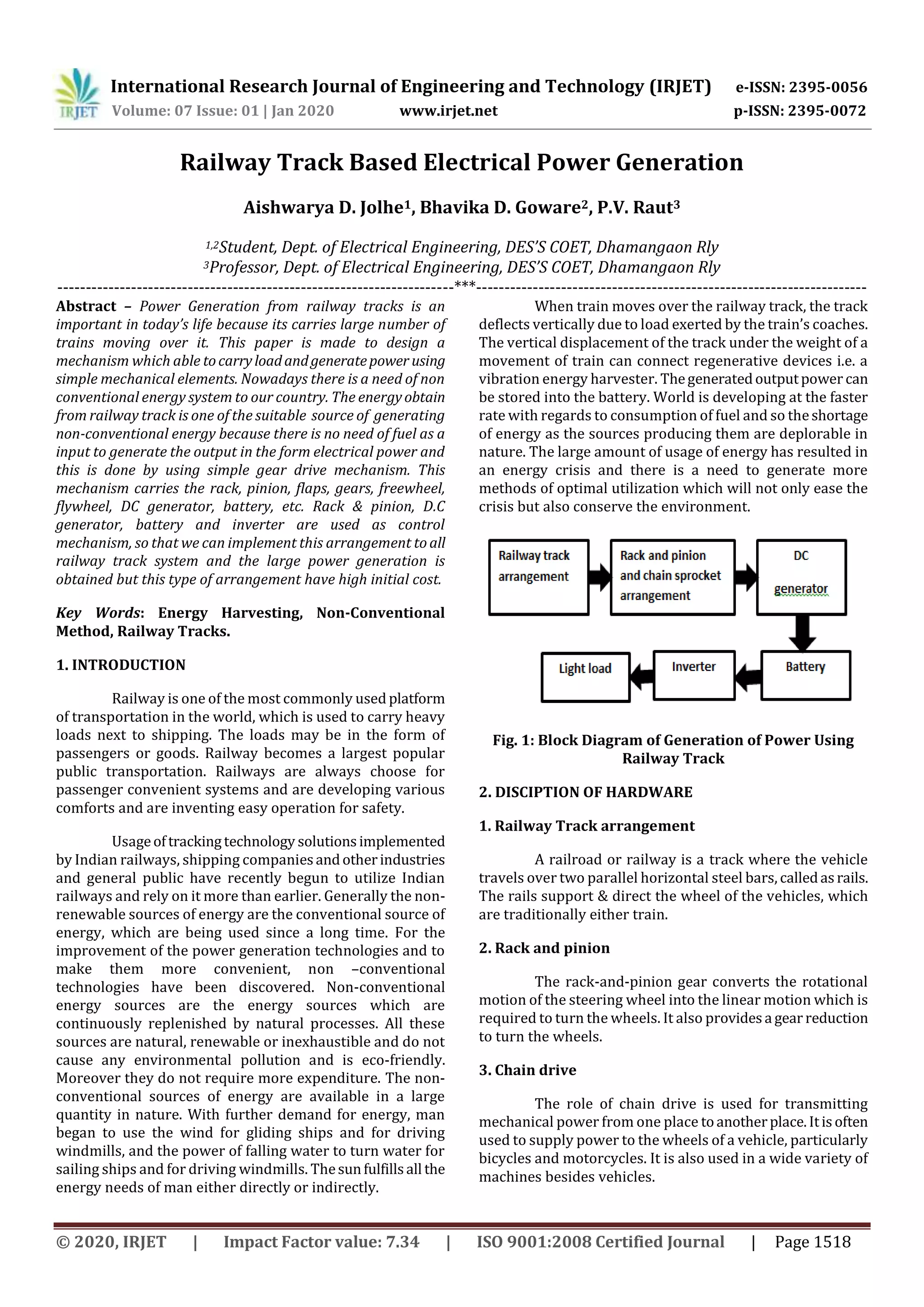
Fig. 1: Block Diagram of Generation of Power Using
Railway Track
2. DISCIPTION OF HARDWARE
1. Railway Track arrangement
A railroad or railway is a track where the vehicle
travels over two parallel horizontal steel bars, calledasrails.
The rails support & direct the wheel of the vehicles, which
are traditionally either train.
2. Rack and pinion
The rack-and-pinion gear converts the rotational
motion of the steering wheel into the linear motion which is
required to turn the wheels. It also providesa gear reduction
to turn the wheels.
3. Chain drive
The role of chain drive is used for transmitting
mechanical power from one place toanotherplace.Itisoften
used to supply power to the wheels of a vehicle, particularly
bicycles and motorcycles. It is also used in a wide variety of
machines besides vehicles.
International Research Journal of Engineering and Technology (IRJET) e-ISSN: 2395-0056
Volume: 07 Issue: 01 | Jan 2020 www.irjet.net p-ISSN: 2395-0072
© 2020, IRJET | Impact Factor value: 7.34 | ISO 9001:2008 Certified Journal | Page 1519
4. Flywheel
A flywheel is a mechanical device which is used to
store rotational energy (kinetic energy). A flywheel opposes
changes in rotational speed by their moment of inertia.
5. Dc generator
A DC generator is a device which is used to convert
mechanical energy generated by the mechanical
arrangement of the system into electrical energy.
6. Battery
Battery is a device which is used to store energy in
the form of dc output. The output of DC generator is
connected to the battery.
7. Inverter
Inverter is a device which is used to convert dc
energy generated by the dc generator into AC. The output of
battery is connected to the inverter.
3. METHODOLOGY
3.1 Principle
The energy generated from railway track is convenient
source of generating non-conventional energy becausethere
is no need of fuel as a input to generate the output in the
form electrical energy and these isdone byusingsimplegear
drive mechanism.
3.1.1 Operation:
This paper is proposing to make the railway track of length
10 ft on which the train can be moved by manual pushing.
The train frame is of approximately length of 3 ft with 2 sets
of wheels at front & back of strip which is aligned to put
pressure on roller. At the center of the track length, this
power generation mechanism which comprises of a rubber
roller which is coated by a rubber ring held nearby the axle
which is also holding a gear which will drive the driven gear
held on another axle between bearings and housings and a
drive pulley which drives the driven pulley of the generator.
The steering shaft is connected to pinion gear. When you
change the direction of the steering wheel, the gear spins,
moving the rack. The tie rod at end of the rack connects to
the steering arm on the spindle. It is used to convert the
rotational motion of the steering wheel into the linear
motion needed to turn the wheels. It gives a gear reduction,
making it easier to turn the wheels. Our design uses
extremely simple ideas and mechanisms to achieve a
complex set of actions and is intended to imitate the actions
of the operators. Here, we have used small prototype of
steering system with material like Steel rod, Aluminum
strips, Rack Pinion Gear. When train is running on the track,
the flat strip of the train will be rubbing the roller which
makes the roller to rotate continuouslyandwhichultimately
rolls the gears to finally rotate the generator to generate the
electricity which can be shown by glowing a set of 15 LEDs
Here the power generated will beapproximately8to12volts
depending on the speed of the rotation of the rollers. The
output voltage is depending upon the number of dynamos.
Then this charged battery is used for various appliances.
3.1.2 Methodology:
The track is divided into two parts, one main track of length
2140mm and another additional track of length 1840 mm;
both are joined by bolts and nuts. The main track is
connected with the power generation unit comprising of
gear assembly, roller, the drive and drive pulleys and
generator. The train unit consists with the train engine and
bogies being made in zinc steel sheetof1.5mmthick withthe
requisite shape which are fixed on the tubular frame of
width 130mm and length 1090mm. this train frame is fixed
with the wheels being held on the axles and these axles are
held within ball bearings and housings which are fixed.
4. CONCLUSION
It is assured that the electric power is in nice demand; we
tend to as applied scientist ought to be in discovered for
brand spanking new plan of power generation. As the
conventional sources are exhausting very fast, then it’s time
to think of other alternatives. There is a need to save the
power gained from the conventional sources for efficient
use. So this concept not only provides alternative but also
adds to the economy of the country. Now, traffic of t is
increasing, we can utilize this for power generation by
means of train track power generation. It has merits that it
does not utilize any external source. Now the time has come
to think about these types of innovativeideasandresearches
should be done to upgrade their implication.
REFERENCES
[1] MingAsad and JianxinWang, "Investigation of butanol-
fuelled HCCI combustion on a high efficiency diesel
engine", EnergyConservationAndManagement,vol98,1
july 2015, pages 215-224.
[2] T.Karthikeya SharmaG.Amba Prasad Rao and K.Madhu
Murthy, "Effective reduction of NOx emissions of a HCCI
(Homogeneous charge compression ignition) engine by
enhanced rate of heat transfer under varyingconditions
of operation", Energy, vol93, part2 , 15 dec 2015, pages
2102-2115.
[3] Mohamed Djermouni and Ahmed Ouadha
,
Thermodynamic analysis of an HCCI engine based
system running on natural gas
",
Energy Conservation
and Management, vol88, dec 2014, pages 723-731.
International Research Journal of Engineering and Technology (IRJET) e-ISSN: 2395-0056
Volume: 07 Issue: 01 | Jan 2020 www.irjet.net p-ISSN: 2395-0072
© 2020, IRJET | Impact Factor value: 7.34 | ISO 9001:2008 Certified Journal | Page 1520
[4] HarisankarBenduandS.Murugan."Homogeneouscharge
compression ignition (HCCI) combustion: Mixture
preparation and control strategies in diesel engines”,
Renewable And Sustainable Energy Reviews, vol 38, oct
2014, pages 732- 746.
[5] E.Aboelela, W. Edberg, C. Papakonstantinou, and V.
Vokkarane, “Wireless Sensor Network Based Model for
Secure Railway Operations”, Proc. of the IEEE IPCCC,
2006, pp. 623–626.
[6] Gatin and B. Lhenoret, “WSN and Energy Harvesting for
RailwayApplications”, Presentation at Energy
Harvesting & Storage USA, Denver, CO., 2009.
[7] H. Abramarich, E. Harash, Milogram, Amit, Azilay,
“Power Harvesting from railways; apparatus, system
and method”, US patent 7812508, 2008.
[8] John J wang, G.P Penamalli and Lei Zuo,
“ElectromagneticEnergyHarvestingfromTrainInduced
Railway Track Vibrations”, IEEE, 2012, pp.29-34.
[9] P. Zhang, Masterthesis,“Study of Road Energy and
Regenerative Electromagnetic Shock Absorber”, SUNY
Stony Brook, 2010.

IRJET- Railway Track based Electrical Power Generation

  • 1.
    International Research Journalof Engineering and Technology (IRJET) e-ISSN: 2395-0056 Volume: 07 Issue: 01 | Jan 2020 www.irjet.net p-ISSN: 2395-0072 © 2020, IRJET | Impact Factor value: 7.34 | ISO 9001:2008 Certified Journal | Page 1518 Railway Track Based Electrical Power Generation Aishwarya D. Jolhe1, Bhavika D. Goware2, P.V. Raut3 1,2Student, Dept. of Electrical Engineering, DES’S COET, Dhamangaon Rly 3Professor, Dept. of Electrical Engineering, DES’S COET, Dhamangaon Rly ----------------------------------------------------------------------***--------------------------------------------------------------------- Abstract – Power Generation from railway tracks is an important in today’s life because its carries large number of trains moving over it. This paper is made to design a mechanism which able tocarryloadandgeneratepower using simple mechanical elements. Nowadays there is a need of non conventional energy system to our country. The energyobtain from railway track is one of the suitable source of generating non-conventional energy because there is no need of fuel as a input to generate the output in the form electrical power and this is done by using simple gear drive mechanism. This mechanism carries the rack, pinion, flaps, gears, freewheel, flywheel, DC generator, battery, etc. Rack & pinion, D.C generator, battery and inverter are used as control mechanism, so that we can implement this arrangement to all railway track system and the large power generation is obtained but this type of arrangement have high initial cost. Key Words: Energy Harvesting, Non-Conventional Method, Railway Tracks. 1. INTRODUCTION Railway is one of the most commonly used platform of transportation in the world, which is used to carry heavy loads next to shipping. The loads may be in the form of passengers or goods. Railway becomes a largest popular public transportation. Railways are always choose for passenger convenient systems and are developing various comforts and are inventing easy operation for safety. Usageoftrackingtechnology solutionsimplemented by Indian railways, shipping companiesandotherindustries and general public have recently begun to utilize Indian railways and rely on it more than earlier. Generally the non- renewable sources of energy are the conventional source of energy, which are being used since a long time. For the improvement of the power generation technologies and to make them more convenient, non –conventional technologies have been discovered. Non-conventional energy sources are the energy sources which are continuously replenished by natural processes. All these sources are natural, renewable or inexhaustible and do not cause any environmental pollution and is eco-friendly. Moreover they do not require more expenditure. The non- conventional sources of energy are available in a large quantity in nature. With further demand for energy, man began to use the wind for gliding ships and for driving windmills, and the power of falling water to turn water for sailing ships and for driving windmills. Thesunfulfillsall the energy needs of man either directly or indirectly. When train moves over the railway track, the track deflects vertically due to load exerted by the train’s coaches. The vertical displacement of the track under the weight of a movement of train can connect regenerative devices i.e. a vibration energy harvester. Thegeneratedoutputpower can be stored into the battery. World is developing at the faster rate with regards to consumption of fuel and so theshortage of energy as the sources producing them are deplorable in nature. The large amount of usage of energy has resulted in an energy crisis and there is a need to generate more methods of optimal utilization which will not only ease the crisis but also conserve the environment. Fig. 1: Block Diagram of Generation of Power Using Railway Track 2. DISCIPTION OF HARDWARE 1. Railway Track arrangement A railroad or railway is a track where the vehicle travels over two parallel horizontal steel bars, calledasrails. The rails support & direct the wheel of the vehicles, which are traditionally either train. 2. Rack and pinion The rack-and-pinion gear converts the rotational motion of the steering wheel into the linear motion which is required to turn the wheels. It also providesa gear reduction to turn the wheels. 3. Chain drive The role of chain drive is used for transmitting mechanical power from one place toanotherplace.Itisoften used to supply power to the wheels of a vehicle, particularly bicycles and motorcycles. It is also used in a wide variety of machines besides vehicles.
  • 2.
    International Research Journalof Engineering and Technology (IRJET) e-ISSN: 2395-0056 Volume: 07 Issue: 01 | Jan 2020 www.irjet.net p-ISSN: 2395-0072 © 2020, IRJET | Impact Factor value: 7.34 | ISO 9001:2008 Certified Journal | Page 1519 4. Flywheel A flywheel is a mechanical device which is used to store rotational energy (kinetic energy). A flywheel opposes changes in rotational speed by their moment of inertia. 5. Dc generator A DC generator is a device which is used to convert mechanical energy generated by the mechanical arrangement of the system into electrical energy. 6. Battery Battery is a device which is used to store energy in the form of dc output. The output of DC generator is connected to the battery. 7. Inverter Inverter is a device which is used to convert dc energy generated by the dc generator into AC. The output of battery is connected to the inverter. 3. METHODOLOGY 3.1 Principle The energy generated from railway track is convenient source of generating non-conventional energy becausethere is no need of fuel as a input to generate the output in the form electrical energy and these isdone byusingsimplegear drive mechanism. 3.1.1 Operation: This paper is proposing to make the railway track of length 10 ft on which the train can be moved by manual pushing. The train frame is of approximately length of 3 ft with 2 sets of wheels at front & back of strip which is aligned to put pressure on roller. At the center of the track length, this power generation mechanism which comprises of a rubber roller which is coated by a rubber ring held nearby the axle which is also holding a gear which will drive the driven gear held on another axle between bearings and housings and a drive pulley which drives the driven pulley of the generator. The steering shaft is connected to pinion gear. When you change the direction of the steering wheel, the gear spins, moving the rack. The tie rod at end of the rack connects to the steering arm on the spindle. It is used to convert the rotational motion of the steering wheel into the linear motion needed to turn the wheels. It gives a gear reduction, making it easier to turn the wheels. Our design uses extremely simple ideas and mechanisms to achieve a complex set of actions and is intended to imitate the actions of the operators. Here, we have used small prototype of steering system with material like Steel rod, Aluminum strips, Rack Pinion Gear. When train is running on the track, the flat strip of the train will be rubbing the roller which makes the roller to rotate continuouslyandwhichultimately rolls the gears to finally rotate the generator to generate the electricity which can be shown by glowing a set of 15 LEDs Here the power generated will beapproximately8to12volts depending on the speed of the rotation of the rollers. The output voltage is depending upon the number of dynamos. Then this charged battery is used for various appliances. 3.1.2 Methodology: The track is divided into two parts, one main track of length 2140mm and another additional track of length 1840 mm; both are joined by bolts and nuts. The main track is connected with the power generation unit comprising of gear assembly, roller, the drive and drive pulleys and generator. The train unit consists with the train engine and bogies being made in zinc steel sheetof1.5mmthick withthe requisite shape which are fixed on the tubular frame of width 130mm and length 1090mm. this train frame is fixed with the wheels being held on the axles and these axles are held within ball bearings and housings which are fixed. 4. CONCLUSION It is assured that the electric power is in nice demand; we tend to as applied scientist ought to be in discovered for brand spanking new plan of power generation. As the conventional sources are exhausting very fast, then it’s time to think of other alternatives. There is a need to save the power gained from the conventional sources for efficient use. So this concept not only provides alternative but also adds to the economy of the country. Now, traffic of t is increasing, we can utilize this for power generation by means of train track power generation. It has merits that it does not utilize any external source. Now the time has come to think about these types of innovativeideasandresearches should be done to upgrade their implication. REFERENCES [1] MingAsad and JianxinWang, "Investigation of butanol- fuelled HCCI combustion on a high efficiency diesel engine", EnergyConservationAndManagement,vol98,1 july 2015, pages 215-224. [2] T.Karthikeya SharmaG.Amba Prasad Rao and K.Madhu Murthy, "Effective reduction of NOx emissions of a HCCI (Homogeneous charge compression ignition) engine by enhanced rate of heat transfer under varyingconditions of operation", Energy, vol93, part2 , 15 dec 2015, pages 2102-2115. [3] Mohamed Djermouni and Ahmed Ouadha , Thermodynamic analysis of an HCCI engine based system running on natural gas ", Energy Conservation and Management, vol88, dec 2014, pages 723-731.
  • 3.
    International Research Journalof Engineering and Technology (IRJET) e-ISSN: 2395-0056 Volume: 07 Issue: 01 | Jan 2020 www.irjet.net p-ISSN: 2395-0072 © 2020, IRJET | Impact Factor value: 7.34 | ISO 9001:2008 Certified Journal | Page 1520 [4] HarisankarBenduandS.Murugan."Homogeneouscharge compression ignition (HCCI) combustion: Mixture preparation and control strategies in diesel engines”, Renewable And Sustainable Energy Reviews, vol 38, oct 2014, pages 732- 746. [5] E.Aboelela, W. Edberg, C. Papakonstantinou, and V. Vokkarane, “Wireless Sensor Network Based Model for Secure Railway Operations”, Proc. of the IEEE IPCCC, 2006, pp. 623–626. [6] Gatin and B. Lhenoret, “WSN and Energy Harvesting for RailwayApplications”, Presentation at Energy Harvesting & Storage USA, Denver, CO., 2009. [7] H. Abramarich, E. Harash, Milogram, Amit, Azilay, “Power Harvesting from railways; apparatus, system and method”, US patent 7812508, 2008. [8] John J wang, G.P Penamalli and Lei Zuo, “ElectromagneticEnergyHarvestingfromTrainInduced Railway Track Vibrations”, IEEE, 2012, pp.29-34. [9] P. Zhang, Masterthesis,“Study of Road Energy and Regenerative Electromagnetic Shock Absorber”, SUNY Stony Brook, 2010.