EDIT 3318
Blended Learning
Personalized Learning
Module 7
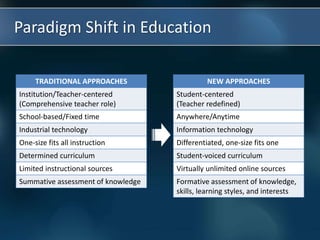
Paradigm Shift in Education
TRADITIONAL APPROACHES
Institution/Teacher-centered
(Comprehensive teacher role)
School-based/Fixed time
Industrial technology
One-size fits all instruction
Determined curriculum
Limited instructional sources
Summative assessment of knowledge
NEW APPROACHES
Student-centered
(Teacher redefined)
Anywhere/Anytime
Information technology
Differentiated, one-size fits one
Student-voiced curriculum
Virtually unlimited online sources
Formative assessment of knowledge,
skills, learning styles, and interests
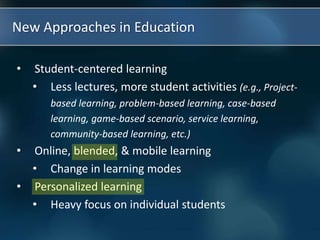
New Approaches in Education
• Student-centered learning
• Less lectures, more student activities (e.g., Project-
based learning, problem-based learning, case-based
learning, game-based scenario, service learning,
community-based learning, etc.)
• Online, blended, & mobile learning
• Change in learning modes
• Personalized learning
• Heavy focus on individual students
Blended Learning
“Blended learning is a formal
education program in which a
student learns at least in part
through online delivery of
content and instruction with
some element of student
control over time, place, path,
and/or pace and at least in
part at a supervised brick-and-
mortar location away from
home.” (Horn & Staker, 2012)
Blended Learning: What Makes It Blended?
1. At least in part through online learning, with some
element of student control over time, place, path,
and/or place.
2. At least in part in a supervised brick-and-mortar
location away from home.
3. The modalities along each student’s learning path
within course or subject are connected to provide an
integrated learning experience.
(Clayton Christensen Institute, Blended Learning)
Personalized Learning
“Personalization refers to
instruction that is paced to
learning needs (i.e.,
individualized), tailored to learning
preferences (i.e., differentiated),
and tailored to the specific
interests of different learners. In
an environment that is fully
personalized, the learning
objectives and content as well as
the method and pace may ALL
vary.” (Department of Education, 2010)
Personalized Learning: What Makes It Personalized?
1. One-size instruction fits “ONE” student.
2. Students drive learning – include their “voice” and “choice.”
3. Analyses of a student’s interests, talents, aspirations, goals, etc.
needed.
4. Students participate in designing learning experiences.
5. Students “own” and are responsible for their learning.
6. Students become a “self-directed, expert learner” who monitor
their own progress.
7. Students build a network of peers, experts, and teachers to
guide and support their own learning.
Personalized Learning: What Makes It Personalized?
1. Teachers play multiple roles such as “coaches” and “facilitators”
to support individual students.
2. Teachers are also learning partners with students.
3. Teachers support students’ mastery of content in a
“competency-based system.”
4. Teachers involve everyone (i.e., colleagues, school
administrators, parents, community experts, international
experts, etc.) to meet individual students’ needs and provide
more authentic learning experiences.
Four Models for BL (and PL)
1. Rotation (Station Rotation, Lab Rotation,
Flipped Classroom, & Individual Rotation)
2. Flex Model
3. A La Carte Model
4. Enriched Virtual Model
(Retrieved from Clayton Christensen Institute)
Rotation Models: Station Rotation
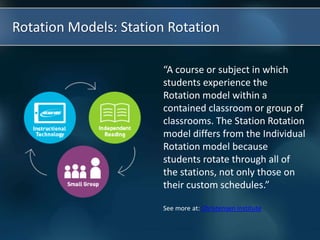
“A course or subject in which
students experience the
Rotation model within a
contained classroom or group of
classrooms. The Station Rotation
model differs from the Individual
Rotation model because
students rotate through all of
the stations, not only those on
their custom schedules.”
See more at: Christensen Institute
Rotation Models: Lab Rotation
Retrieved from Clayton Christensen Institute
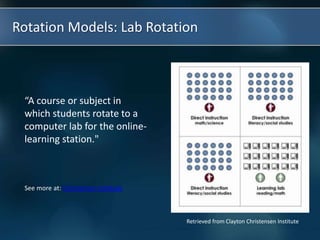
“A course or subject in
which students rotate to a
computer lab for the online-
learning station."
See more at: Christensen Institute
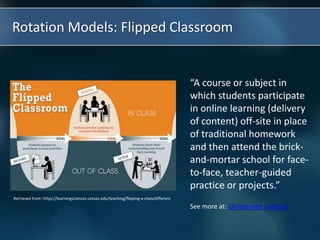
Rotation Models: Flipped Classroom
Retrieved from: https://learningsciences.utexas.edu/teaching/flipping-a-class/different
“A course or subject in
which students participate
in online learning (delivery
of content) off-site in place
of traditional homework
and then attend the brick-
and-mortar school for face-
to-face, teacher-guided
practice or projects.”
See more at: Christensen Institute
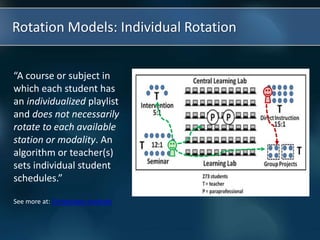
Rotation Models: Individual Rotation
“A course or subject in
which each student has
an individualized playlist
and does not necessarily
rotate to each available
station or modality. An
algorithm or teacher(s)
sets individual student
schedules.”
See more at: Christensen Institute
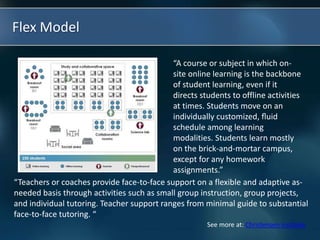
Flex Model
“A course or subject in which on-
site online learning is the backbone
of student learning, even if it
directs students to offline activities
at times. Students move on an
individually customized, fluid
schedule among learning
modalities. Students learn mostly
on the brick-and-mortar campus,
except for any homework
assignments.”
“Teachers or coaches provide face-to-face support on a flexible and adaptive as-
needed basis through activities such as small group instruction, group projects,
and individual tutoring. Teacher support ranges from minimal guide to substantial
face-to-face tutoring. “
See more at: Christensen Institute
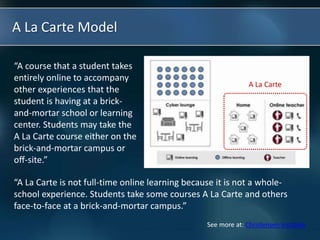
A La Carte Model
“A course that a student takes
entirely online to accompany
other experiences that the
student is having at a brick-
and-mortar school or learning
center. Students may take the
A La Carte course either on the
brick-and-mortar campus or
off-site.”
“A La Carte is not full-time online learning because it is not a whole-
school experience. Students take some courses A La Carte and others
face-to-face at a brick-and-mortar campus.”
See more at: Christensen Institute
A La Carte
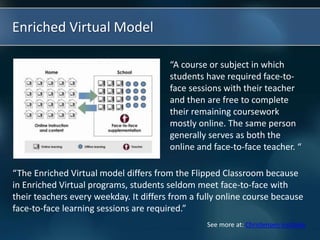
Enriched Virtual Model
“A course or subject in which
students have required face-to-
face sessions with their teacher
and then are free to complete
their remaining coursework
mostly online. The same person
generally serves as both the
online and face-to-face teacher. “
“The Enriched Virtual model differs from the Flipped Classroom because
in Enriched Virtual programs, students seldom meet face-to-face with
their teachers every weekday. It differs from a fully online course because
face-to-face learning sessions are required.”
See more at: Christensen Institute

M7 presentation1

  • 1.
  • 2.
    Paradigm Shift inEducation TRADITIONAL APPROACHES Institution/Teacher-centered (Comprehensive teacher role) School-based/Fixed time Industrial technology One-size fits all instruction Determined curriculum Limited instructional sources Summative assessment of knowledge NEW APPROACHES Student-centered (Teacher redefined) Anywhere/Anytime Information technology Differentiated, one-size fits one Student-voiced curriculum Virtually unlimited online sources Formative assessment of knowledge, skills, learning styles, and interests
  • 3.
    New Approaches inEducation • Student-centered learning • Less lectures, more student activities (e.g., Project- based learning, problem-based learning, case-based learning, game-based scenario, service learning, community-based learning, etc.) • Online, blended, & mobile learning • Change in learning modes • Personalized learning • Heavy focus on individual students
  • 4.
    Blended Learning “Blended learningis a formal education program in which a student learns at least in part through online delivery of content and instruction with some element of student control over time, place, path, and/or pace and at least in part at a supervised brick-and- mortar location away from home.” (Horn & Staker, 2012)
  • 5.
    Blended Learning: WhatMakes It Blended? 1. At least in part through online learning, with some element of student control over time, place, path, and/or place. 2. At least in part in a supervised brick-and-mortar location away from home. 3. The modalities along each student’s learning path within course or subject are connected to provide an integrated learning experience. (Clayton Christensen Institute, Blended Learning)
  • 6.
    Personalized Learning “Personalization refersto instruction that is paced to learning needs (i.e., individualized), tailored to learning preferences (i.e., differentiated), and tailored to the specific interests of different learners. In an environment that is fully personalized, the learning objectives and content as well as the method and pace may ALL vary.” (Department of Education, 2010)
  • 7.
    Personalized Learning: WhatMakes It Personalized? 1. One-size instruction fits “ONE” student. 2. Students drive learning – include their “voice” and “choice.” 3. Analyses of a student’s interests, talents, aspirations, goals, etc. needed. 4. Students participate in designing learning experiences. 5. Students “own” and are responsible for their learning. 6. Students become a “self-directed, expert learner” who monitor their own progress. 7. Students build a network of peers, experts, and teachers to guide and support their own learning.
  • 8.
    Personalized Learning: WhatMakes It Personalized? 1. Teachers play multiple roles such as “coaches” and “facilitators” to support individual students. 2. Teachers are also learning partners with students. 3. Teachers support students’ mastery of content in a “competency-based system.” 4. Teachers involve everyone (i.e., colleagues, school administrators, parents, community experts, international experts, etc.) to meet individual students’ needs and provide more authentic learning experiences.
  • 9.
    Four Models forBL (and PL) 1. Rotation (Station Rotation, Lab Rotation, Flipped Classroom, & Individual Rotation) 2. Flex Model 3. A La Carte Model 4. Enriched Virtual Model (Retrieved from Clayton Christensen Institute)
  • 10.
    Rotation Models: StationRotation “A course or subject in which students experience the Rotation model within a contained classroom or group of classrooms. The Station Rotation model differs from the Individual Rotation model because students rotate through all of the stations, not only those on their custom schedules.” See more at: Christensen Institute
  • 11.
    Rotation Models: LabRotation Retrieved from Clayton Christensen Institute “A course or subject in which students rotate to a computer lab for the online- learning station." See more at: Christensen Institute
  • 12.
    Rotation Models: FlippedClassroom Retrieved from: https://learningsciences.utexas.edu/teaching/flipping-a-class/different “A course or subject in which students participate in online learning (delivery of content) off-site in place of traditional homework and then attend the brick- and-mortar school for face- to-face, teacher-guided practice or projects.” See more at: Christensen Institute
  • 13.
    Rotation Models: IndividualRotation “A course or subject in which each student has an individualized playlist and does not necessarily rotate to each available station or modality. An algorithm or teacher(s) sets individual student schedules.” See more at: Christensen Institute
  • 14.
    Flex Model “A courseor subject in which on- site online learning is the backbone of student learning, even if it directs students to offline activities at times. Students move on an individually customized, fluid schedule among learning modalities. Students learn mostly on the brick-and-mortar campus, except for any homework assignments.” “Teachers or coaches provide face-to-face support on a flexible and adaptive as- needed basis through activities such as small group instruction, group projects, and individual tutoring. Teacher support ranges from minimal guide to substantial face-to-face tutoring. “ See more at: Christensen Institute
  • 15.
    A La CarteModel “A course that a student takes entirely online to accompany other experiences that the student is having at a brick- and-mortar school or learning center. Students may take the A La Carte course either on the brick-and-mortar campus or off-site.” “A La Carte is not full-time online learning because it is not a whole- school experience. Students take some courses A La Carte and others face-to-face at a brick-and-mortar campus.” See more at: Christensen Institute A La Carte
  • 16.
    Enriched Virtual Model “Acourse or subject in which students have required face-to- face sessions with their teacher and then are free to complete their remaining coursework mostly online. The same person generally serves as both the online and face-to-face teacher. “ “The Enriched Virtual model differs from the Flipped Classroom because in Enriched Virtual programs, students seldom meet face-to-face with their teachers every weekday. It differs from a fully online course because face-to-face learning sessions are required.” See more at: Christensen Institute

Editor's Notes

  • #3 Ongoing, embedded, dynamic assessment Formative assessment of knowledge, skills, learning styles, and interests
  • #4  The majority of blended-learning programs resemble one of four models: Rotation, Flex, A La Carte, and Enriched Virtual. The Rotation model includes four sub-models: Station Rotation, Lab Rotation, Flipped Classroom, and Individual Rotation. This taxonomy will evolve as the practice of blended learning matures. - See more at: http://www.christenseninstitute.org/key-concepts/blended-learning-2/#sthash.ZzHYq8Xa.dpuf
  • #6  The majority of blended-learning programs resemble one of four models: Rotation, Flex, A La Carte, and Enriched Virtual. The Rotation model includes four sub-models: Station Rotation, Lab Rotation, Flipped Classroom, and Individual Rotation. This taxonomy will evolve as the practice of blended learning matures. - See more at: http://www.christenseninstitute.org/key-concepts/blended-learning-2/#sthash.ZzHYq8Xa.dpuf
  • #7 DoE (2010): “Personalization refers to instruction that is paced to learning needs [i.e., individualized], tailored to learning preferences [i.e., differentiated], and tailored to the specific interests of different learners. In an environment that is fully personalized, the learning objectives and content as well as the method and pace may all vary,” (p. 12)
  • #11 https://www.youtube.com/watch?v=awA9T225be0 The majority of blended-learning programs resemble one of four models: Rotation, Flex, A La Carte, and Enriched Virtual. The Rotation model includes four sub-models: Station Rotation, Lab Rotation, Flipped Classroom, and Individual Rotation. This taxonomy will evolve as the practice of blended learning matures. - See more at: http://www.christenseninstitute.org/key-concepts/blended-learning-2/#sthash.ZzHYq8Xa.dpuf
  • #12 https://www.youtube.com/watch?v=awA9T225be0 The majority of blended-learning programs resemble one of four models: Rotation, Flex, A La Carte, and Enriched Virtual. The Rotation model includes four sub-models: Station Rotation, Lab Rotation, Flipped Classroom, and Individual Rotation. This taxonomy will evolve as the practice of blended learning matures. - See more at: http://www.christenseninstitute.org/key-concepts/blended-learning-2/#sthash.ZzHYq8Xa.dpuf
  • #13 https://www.youtube.com/watch?v=awA9T225be0 The majority of blended-learning programs resemble one of four models: Rotation, Flex, A La Carte, and Enriched Virtual. The Rotation model includes four sub-models: Station Rotation, Lab Rotation, Flipped Classroom, and Individual Rotation. This taxonomy will evolve as the practice of blended learning matures. - See more at: http://www.christenseninstitute.org/key-concepts/blended-learning-2/#sthash.ZzHYq8Xa.dpuf
  • #14 https://www.youtube.com/watch?v=awA9T225be0 The majority of blended-learning programs resemble one of four models: Rotation, Flex, A La Carte, and Enriched Virtual. The Rotation model includes four sub-models: Station Rotation, Lab Rotation, Flipped Classroom, and Individual Rotation. This taxonomy will evolve as the practice of blended learning matures. - See more at: http://www.christenseninstitute.org/key-concepts/blended-learning-2/#sthash.ZzHYq8Xa.dpuf
  • #15 https://www.youtube.com/watch?v=awA9T225be0 The majority of blended-learning programs resemble one of four models: Rotation, Flex, A La Carte, and Enriched Virtual. The Rotation model includes four sub-models: Station Rotation, Lab Rotation, Flipped Classroom, and Individual Rotation. This taxonomy will evolve as the practice of blended learning matures. - See more at: http://www.christenseninstitute.org/key-concepts/blended-learning-2/#sthash.ZzHYq8Xa.dpuf
  • #16 https://www.youtube.com/watch?v=awA9T225be0 The majority of blended-learning programs resemble one of four models: Rotation, Flex, A La Carte, and Enriched Virtual. The Rotation model includes four sub-models: Station Rotation, Lab Rotation, Flipped Classroom, and Individual Rotation. This taxonomy will evolve as the practice of blended learning matures. - See more at: http://www.christenseninstitute.org/key-concepts/blended-learning-2/#sthash.ZzHYq8Xa.dpuf
  • #17 https://www.youtube.com/watch?v=awA9T225be0 The majority of blended-learning programs resemble one of four models: Rotation, Flex, A La Carte, and Enriched Virtual. The Rotation model includes four sub-models: Station Rotation, Lab Rotation, Flipped Classroom, and Individual Rotation. This taxonomy will evolve as the practice of blended learning matures. - See more at: http://www.christenseninstitute.org/key-concepts/blended-learning-2/#sthash.ZzHYq8Xa.dpuf