
30th WEDC International Conference, Vientiane, Lao PDR, 2004

  PEOPLE-CENTRED APPROACHES TO WATER AND ENVIRONMENTAL SANITATION

       The long term sustainability of household bio-sand filtration

                      Eric Fewster, Adriaan Mol and Cleo Wiessent–Brandsma, Kenya.


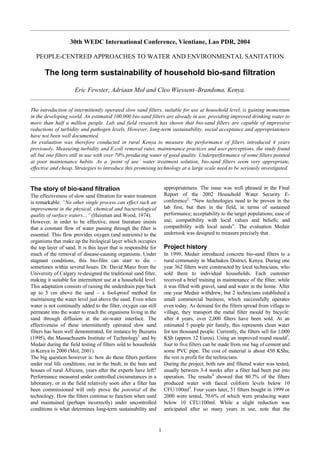
The introduction of intermittently operated slow sand filters, suitable for use at household level, is gaining momentum
in the developing world. An estimated 100,000 bio-sand filters are already in use, providing improved drinking water to
more than half a million people. Lab and field research has shown that bio-sand filters are capable of impressive
reductions of turbidity and pathogen levels. However, long-term sustainability, social acceptance and appropriateness
have not been well documented.
An evaluation was therefore conducted in rural Kenya to measure the performance of filters introduced 4 years
previously. Measuring turbidity and E.coli removal rates, maintenance practices and user perceptions, the study found
all but one filters still in use with over 70% producing water of good quality. Underperformance of some filters pointed
at poor maintenance habits. As a ‘point of use’ water treatment solution, bio-sand filters seem very appropriate,
effective and cheap. Strategies to introduce this promising technology at a large scale need to be seriously investigated.


The story of bio-sand filtration                                      appropriateness. The issue was well phrased in the Final
The effectiveness of slow sand filtration for water treatment         Report of the 2002 Household Water Security E-
is remarkable: “No other single process can effect such an            conference2: “New technologies need to be proven in the
improvement in the physical, chemical and bacteriological             lab first, but then in the field, in terms of sustained
quality of surface waters…” (Huisman and Wood, 1974).                 performance; acceptability to the target populations; ease of
However, in order to be effective, most literature insists            use; compatibility with local values and beliefs; and
that a constant flow of water passing through the filter is           compatibility with local needs”. The evaluation Medair
essential. This flow provides oxygen (and nutrients) to the           undertook was designed to measure precisely that.
organisms that make up the biological layer which occupies
the top layer of sand. It is this layer that is responsible for       Project history
much of the removal of disease-causing organisms. Under               In 1999, Medair introduced concrete bio-sand filters to a
stagnant conditions, this bio-film can start to die –                 rural community in Machakos District, Kenya. During one
sometimes within several hours. Dr. David Manz from the               year 362 filters were constructed by local technicians, who
University of Calgary re-designed the traditional sand filter,        sold them to individual households. Each customer
making it suitable for intermittent use at a household level.         received a brief training in maintenance of the filter, while
This adaptation consists of raising the underdrain pipe back          it was filled with gravel, sand and water in the home. After
up to 5 cm above the sand – a fool-proof method for                   one year Medair withdrew, but 2 technicians established a
maintaining the water level just above the sand. Even when            small commercial business, which successfully operates
water is not continually added to the filter, oxygen can still        even today. As demand for the filters spread from village to
permeate into the water to reach the organisms living in the          village, they transport the metal filter mould by bicycle:
sand through diffusion at the air-water interface. The                after 4 years, over 2,000 filters have been sold. At an
effectiveness of these intermittently operated slow sand              estimated 5 people per family, this represents clean water
filters has been well demonstrated, for instance by Buzunis           for ten thousand people. Currently, the filters sell for 1,000
(1995), the Massachusetts Institute of Technology1 and by             KSh (approx 12 Euros). Using an improved round mould3,
Medair during the field testing of filters sold to households         four to five filters can be made from one bag of cement and
in Kenya in 2000 (Mol, 2001).                                         some PVC pipe. The cost of material is about 450 KShs;
The big question however is: how do these filters perform             the rest is profit for the technicians.
under real life conditions; out in the bush, in the huts and          During the project, both raw and filtered water was tested,
houses of rural Africans, years after the experts have left?          usually between 3-4 weeks after a filter had been put into
Performance measured under controlled circumstances in a              operation. The results4 showed that 80.7% of the filters
laboratory, or in the field relatively soon after a filter has        produced water with faecal coliform levels below 10
been commissioned will only prove the potential of the                CFU/100ml5. Four years later, 51 filters bought in 1999 or
technology. How the filters continue to function when used            2000 were tested, 70.6% of which were producing water
and maintained (perhaps incorrectly) under uncontrolled               below 10 CFU/100ml. While a slight reduction was
conditions is what determines long-term sustainability and            anticipated after so many years in use, note that the


                                                                  1
ERIC FEWSTER, ADRIAAN MOL AND CLEO WIESSENT–BRANDSMA


difference is not large and statistically not significant6. It is           Risks affecting filter performance
therefore accurate to conclude that the filters perform as                  Laboratory studies show that the intermittent bio-sand filter
good now as 4 years ago.                                                    can easily be expected to remove in excess of 96% of
                                                                            faecal coliforms (Buzunis, 1995). Further investigation was
Evaluation results                                                          therefore required to determine the possible cause of poor
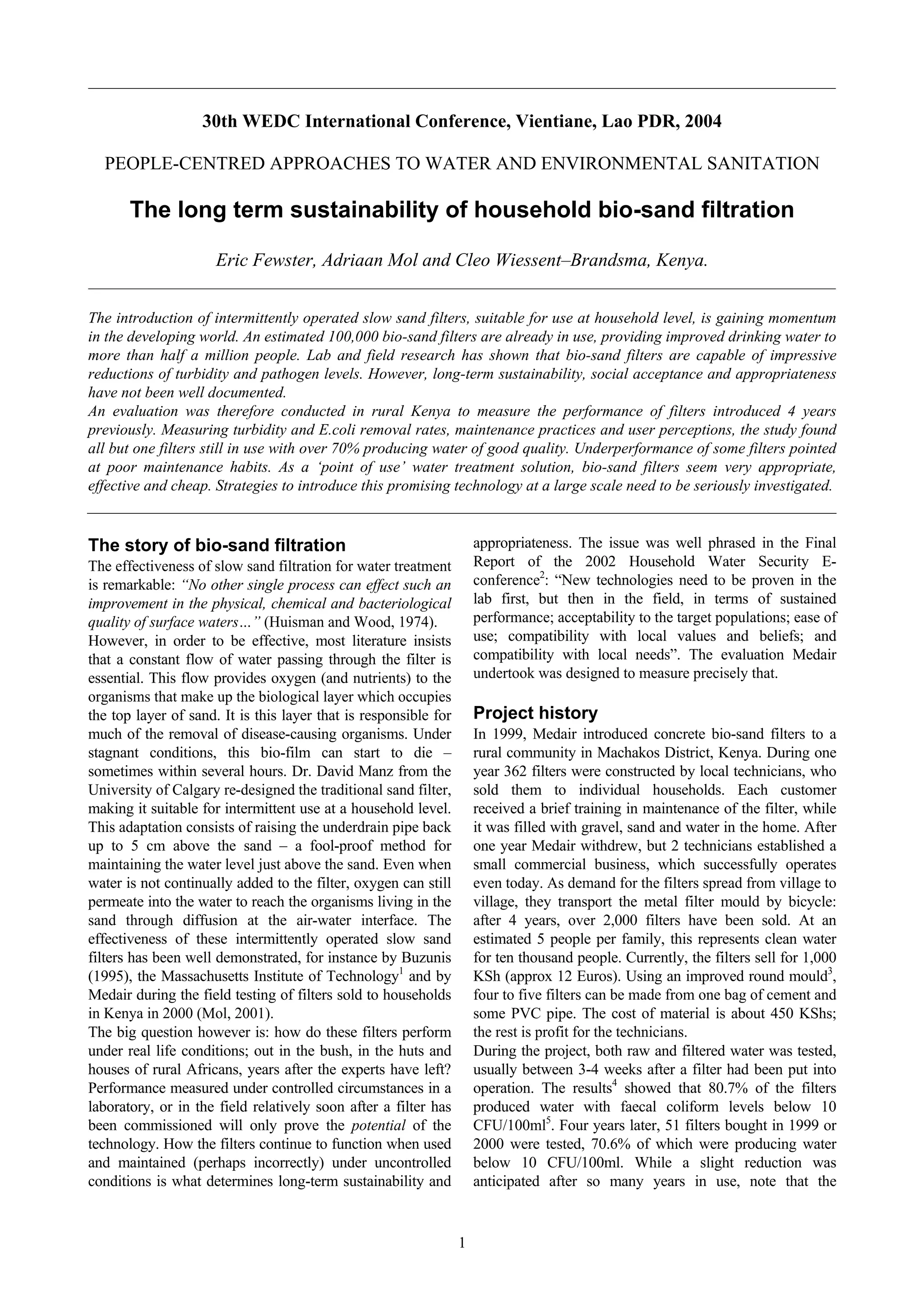
The study measured turbidity and bacteriological removal                    filter performance in certain households, since all filters
rates of 51 filters. The table below lists turbidity removal.               were still structurally sound. Prior to the evaluation, the
                                                                            team assumed that environmental factors, poor operation of
Table 1. Turbidity removal rates                                            the filter and faulty maintenance practices were likely
                                                                            contributors. The risk factors were as follows:
 Turbidity removal              Acceptable       Unacceptable                    Whether the filter had been cleaned or moved within 1
                                (< 10 NTU)        (> 10 NTU)                     month of the test, or had been brought out of
                                                                                 hibernation7 without having been drained during its
 Percentage filters                82.4%              17.6%
                                                                                 inactive period;
                                                                                 Whether children or animals had access to the filter;
Regarding bacteria removal, the evaluation recorded an                           Whether heavily contaminated raw water was used
average CFU of 462 in raw water for all filters, while 66                        (from dams/wells/spring, rather than rain water), in
CFU was recorded as the average for filtered water.                              combination with a depth of fine sand in the filter of
Regarding filtered water, out of 51 households:                                  less than 46 cm;
   36 showed acceptable coliform levels (0-10 CFU/100                            Other reasons, such as cleaning of the spout with a
   ml) regardless of an overall decrease, increase or no                         toothbrush, or a generally bad state of hygiene in the
   change in coliform levels from raw water (70.6%);                             house.
   12 showed unacceptable coliform levels despite overall
   decrease in coliform numbers from raw water (23.5%);                     Remembering that 70.6% of the examined filters produced
   3 showed unacceptable coliform levels with no change                     water with acceptable coliform levels, the evaluation team
   or an overall increase in coliform numbers from raw                      observed that only 19% of these had been cleaned in the
   water (5.9%).                                                            previous month, compared to 40% of filters showing
                                                                            unacceptable levels. The use of heavily contaminated water
                                                                            in combination with low sand levels also produced
         Coliform counts in filtrate         Acceptable levels (0-10
                                             CFU/100ml) regardless          remarkable differences, with 25% and 60% respectively for
                                             of an overall decrease,
                                             increase or no change in
                                                                            filters showing acceptable and unacceptable coliform
                 6%                          coliform numbers from          levels. Access by children to the filters compared 6% to
                                             raw water levels
                                                                            27% for filters showing acceptable and unacceptable
                                             Unacceptable coliform
      24%                                    levels despite overall         coliform levels. There was not enough data to show the
                                             decrease in coliform
                                             numbers from raw water
                                                                            effect on performance of the following factors: moving of
                                             levels                         the filter, access by animals, and recent hibernation of the
                                                                            filter.
                                             Unacceptable coliform
                                             levels with no change or       From this analysis then, it appears likely that cleaning of
                                  70%
                                             an overall increase in
                                             coliform numbers from
                                                                            the filters within a month prior to the test, access by
                                             raw water levels               children and depths of fine sand that had fallen lower than
                                                                            46 cm in combination with raw water quality all contribute
                                                                            to filtrate water of unacceptable quality. This idea was
Based on these results it is interesting to discuss the relation            based on an increased proportion of filters with
between levels of pathogen reduction and the risk of                        unacceptable filtrate given these factors, in comparison to
catching water-borne disease. Developing an illness                         filters with acceptable filtrate. Admittedly other factors
depends on many factors, such as the general health of a                    could well have played a role, such as sand of a different
person and his level of immunity. In addition, exposure to a                size having been initially installed.
significant ‘infectious dose’ is often needed. Therefore, if a              Since various factors may interact, and filtrate quality may
poorly functioning filter removes a significant proportion                  not be the result of only one factor, an attempt was made to
of the pathogens present in raw water, but not all, the                     analyse this further using a risk scoring system. The
owner nevertheless would need to drink more water than                      percentage of acceptable or unacceptable filtrate results
before in order to ingest an infectious dose. If this increased             could then be viewed in relation to a sum of risks:
quantity of water is more than his normal consumption,
then it is unlikely that this person will fall ill.


                                                                        2
ERIC FEWSTER, ADRIAAN MOL AND CLEO WIESSENT–BRANDSMA


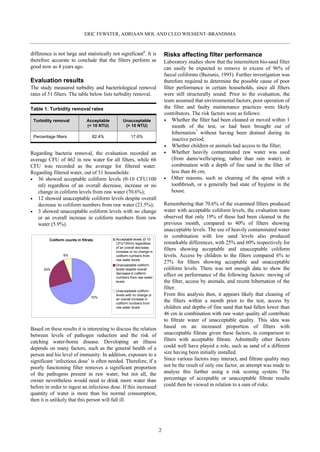
                                                                     Better teaching of correct maintenance could therefore be
Table 2. Risk scoring system                                         an effective and simple method to improve the quality of
                                                                     water produced by a large percentage of filters.
 For the 70.6% that had         For the 29.4% that had               More than half of all households experienced a flow rate
 acceptable coliform levels:    unacceptable coliform
                                levels:
                                                                     that was slower than convenient. However, the evaluation
                                                                     coincided with the rainy season, and consequently the
 20 households had a risk       3 households had a risk              quality of the raw water for many households using dam
 score of 0 (55.6%)             score of 0 (20%)                     water was considerably more turbid than normal due to
                                                                     run-off. Some households specifically mentioned that the
 16 households showed one       12 households showed one
 or more risks (44.4%), of      or more risks (80%), of which:       flow rate problem was seasonal. It seems that during this
 which:                                                              time, blockages can occur in the filters every few months.

     14 households had a risk       5 households had a risk
     score of 1 (38.9%)             score of 1 (33.3%)                     Box 1. Using ‘convenience’ to measure filter
                                                                                      maintenance interval
     1 household had a risk         4 households had a risk           It is important to remember that a ‘dirty’ filter actually
     score of 2 (2.8%)              score of 2 (26.7 %)               can produce water of better quality. Due to a reduced
                                                                      flow rate better filtration takes place, while there is an
     1 household had a risk         3 households had a risk           increased contact time with a mature biological layer.
     score of 3 (2.8%)              score of 3 (20%)                  Cleaning should therefore only take place when the
                                                                      outflow of water has become inconveniently slow.
These figures indicate that the cumulative effect of risks            While a bio-sand filter ideally produces 1 litre per minute,
can contribute to filtrate water of unacceptable quality. In          filling a 20-litre jerry can in 2 hours can still be very
fact, there is a 4 times higher risk for water to be                  convenient to an African family, even though this equals
contaminated (more than 10 coliforms per 100ml) in filters            a flow rate of only 0.16 litres per minute.
with 2 or 3 risks, in comparison to the group with 0 and/or
1 risks present. In order to better understand these results,        The following cleaning procedures were used:
user habits and perceptions were measured.                              Stirring the water on top of the sand with hands and
                                                                        removing the dirty water (no sand removed): (12.3%);
Cleaning of the filters                                                 Stirring with hands and collecting dirty water, with a
When the flow rate becomes unacceptably low, the filter                 scraping of sand removed and washed: (3.5%);
can be cleaned by removing accumulated dirt from the top                Up to 5cm sand removed and washed: (7%);
few centimetres of sand. Various methods are possible, but              Between 5 - 30cm sand removed and washed: (42.1%);
all disturb the biological layer, which results in less                 All fine sand (average 46cm) removed and washed:
effective filtration for some time. Some methods however                (28.1%);
are less disruptive than others, so an analysis of filter               All fine sand and some/all of coarse sand/gravel
cleaning methods and frequency is of interest:                          removed and washed: (4%).
    24.6% were cleaned irregularly once in the last 3 years;
    35.1% were cleaned irregularly 2 – 4 times in the last 3         Interestingly, 12.3% had figured out that wet harrowing
    years;                                                           worked very well. This technique is effective, needs less
    7% were cleaned regularly once per 9 – 12 months for             work and disturbs the biological layer less (Lukacs, 2002),
    the last 3 years;                                                allowing water to be drunk after a shorter time than where
    26.3% were cleaned regularly between 2 – 6 months for            other techniques are used. It should therefore be promoted
    the last 2 – 3 years;                                            by future projects.
    7% were cleaned regularly monthly or bi-monthly.                 About 74% of households washed large amounts of sand
                                                                     per cleaning. Usually this is unnecessary, as most particles
One third of households cleaned their filters anywhere               get trapped in the top few centimetres only. Furthermore,
between twice a month and every 6 months. Most of these              excessive cleaning can lead to sand loss. The evaluation
households (79%) did so because of flow problems,                    found that 47.4% of filters contained a sand column of less
meaning the rest did it out of routine rather than necessity.        than the recommended 46cm, which might negatively
Interviews confirmed this. Some filter owners stated they            affect filtration.
clean their filter out of routine, rather than because of            After cleaning:
blockage or inconveniently reduced flow rate. This                       39.3% of filter owners immediately drank water with
conclusion is important, because this category of filters                no run-to-waste time;
unnecessarily produces water of less than perfect quality,               34% let water run to waste from 1-13 days before
since their bio-layer is disturbed more often than necessary.            drinking;


                                                                 3
ERIC FEWSTER, ADRIAAN MOL AND CLEO WIESSENT–BRANDSMA


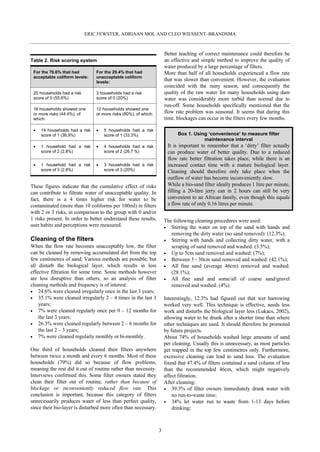
   26.7% let water run to waste for 14-21 days before                inside. 94% of households perceived a decrease in
   drinking.                                                         temperature from raw to filtered water, which was
                                                                     generally considered an advantage.
Those who waited between 2 and 3 weeks before drinking
did so almost entirely because of what they were initially
                                                                     References
taught by project staff 3 years previously, rather than based
                                                                     Buzunis, B.J. (1995). Intermittently Operated Slow Sand
on improving clarity of the water, taste or other factors. For
                                                                      Filtration: A new water treatment process. pp.44-5.
the three-quarters of households that did not wait more than
                                                                      MSc Thesis, University of Calgary, Canada.
13 days before drinking, 84.2% of them did not base their
                                                                     Huisman, L.; Wood, W.E., 1974, Slow Sand Filtration,
decision on what they had been taught by technicians, and
                                                                      World Health Organisation, Geneva.
over half of them based this decision on sight / taste alone.
                                                                     Lukacs, H. (2002). Appropriate Drinking Water
The evaluation did not find out what alternative sources of
                                                                      Treatment: A Framework for Point-of-Use Technology
water were used during the waiting period.
                                                                      Evaluation.                 Available                 at:
                                                                      http://web.mit.edu/11.479/www/Lukacs.doc
These findings have implications for the implementation of
                                                                     Mol, A. (2001). The success of household sand filtration,
slow sand filter projects. If the majority of households will
                                                                      Waterlines, Vol.20, No.1.
either forget or ignore cleaning advice, bio-sand filters
cannot be considered a 100% failsafe method of water
                                                                     Note/s
purification despite their potential, but rather as a ‘better-
                                                                     1. Find several studies, evaluations and project reports on
than-nothing’ interim method of water treatment. However,
                                                                        household water treatment, including bio-sand filtration
the original project did not use intensive teaching methods
                                                                        at: http://ceemeng.mit.edu/~water/.
and it is likely that better information, teaching of cleaning
                                                                     2. UNICEF, WHO and HTN, Final Report on Household
methods, or improved or more frequent follow-up will lead
                                                                        Water Security E-Conference, Oct. 14 to Nov. 1, 2002.
to much better results.
                                                                        See: www.unicef.org/programme/wes/econf.htm
                                                                     3. Blueprints, construction guidelines and photo guide for
Procurement and marketing                                               this improved sand filter mould are available free of
97% of all households were generally satisfied with the                 charge at: www.biosandfilter.org.
filter, while 100% thought the filter had been a worthwhile          4. Data taken from: Medair (2000). Evaluation/Final
purchase. In fact, only one family had permanently stopped              Report. Family Bio-Sand Filtration Project in
using the filter for a reason unrelated to filter performance,          Machakos District June 1999 – September 2000.
which proves an amazing level of social sustainability.                 Project report, Medair East Africa, Nairobi, Kenya.
Generally, the filtered water was much appreciated. 6% of            5. CFU = Colony Forming Units of faecal coliforms. Data
the owners considered the taste of raw water to be good,                was analysed against Sphere Standards that stipulate
compared to 51% for filtered water. There were no bad                   acceptable levels of 0-10 for un-disinfected supplies.
perceptions of filtered water, only one case of rainwater            6. Calculated using Chi a Square test, with a result of 2
becoming tasteless where it had been sweet before.                      and a P value of 0.15. Statistics by Dr. David Sauter of
Perceptions of colour also changed dramatically: 35% of                 Medair.
raw water was considered clear, compared to 92% of                   7. In this case, hibernation describes the time when a filter
filtered water.                                                         remains unused for periods over 1 week.

In Machakos, it seems that there is a high level of                  Contact addresses
awareness of health benefits associated with the filter. Out         Eric Fewster is a water and sanitation expert with extensive
of all households, 67% cited health reasons and awareness            experience in both the relief and development setting. He
as their main reason for purchasing a filter. The other major        is the technical director of BushProof and co-owner of
argument cited by 40% of users was that the use of the               BioSandFilter.org. Email: ericfewster@biosandfilter.org.
filters saves firewood that would otherwise be needed to
boil the water. If the filters were to be introduced in areas        Adriaan Mol is an experienced manager of relief and
where people are generally less aware of the links between           development programmes, with extensive technical
clean water and good health, other convincing reasons                expertise in bio-sand filter technology. Currently working
should be found to market the technology. For instance,              with Medair, he is also co-owner of BioSandFilter.org.
where bacteriological improvement of the water is not                Email: adriaanmol@biosandfilter.org.
understood or accepted as a reason to purchase a filter,
colour improvement can be used as a marketing message.               Cleo Brandsma is a BushProof consultant and bio-sand
The same applies to temperature. Since these filters are             filter   expert.    Email:     cleo@bushproof.com.
made from concrete, some ‘sweating’ through the walls
occurs. Evaporation then cools the filter and the water


                                                                 4
AUTHOR 1, AUTHOR 2 & AUTHOR 3


              1

Kenya; The Long Term Sustainability Of Household Bio-Sand Filtration

  • 1.
    30th WEDC InternationalConference, Vientiane, Lao PDR, 2004 PEOPLE-CENTRED APPROACHES TO WATER AND ENVIRONMENTAL SANITATION The long term sustainability of household bio-sand filtration Eric Fewster, Adriaan Mol and Cleo Wiessent–Brandsma, Kenya. The introduction of intermittently operated slow sand filters, suitable for use at household level, is gaining momentum in the developing world. An estimated 100,000 bio-sand filters are already in use, providing improved drinking water to more than half a million people. Lab and field research has shown that bio-sand filters are capable of impressive reductions of turbidity and pathogen levels. However, long-term sustainability, social acceptance and appropriateness have not been well documented. An evaluation was therefore conducted in rural Kenya to measure the performance of filters introduced 4 years previously. Measuring turbidity and E.coli removal rates, maintenance practices and user perceptions, the study found all but one filters still in use with over 70% producing water of good quality. Underperformance of some filters pointed at poor maintenance habits. As a ‘point of use’ water treatment solution, bio-sand filters seem very appropriate, effective and cheap. Strategies to introduce this promising technology at a large scale need to be seriously investigated. The story of bio-sand filtration appropriateness. The issue was well phrased in the Final The effectiveness of slow sand filtration for water treatment Report of the 2002 Household Water Security E- is remarkable: “No other single process can effect such an conference2: “New technologies need to be proven in the improvement in the physical, chemical and bacteriological lab first, but then in the field, in terms of sustained quality of surface waters…” (Huisman and Wood, 1974). performance; acceptability to the target populations; ease of However, in order to be effective, most literature insists use; compatibility with local values and beliefs; and that a constant flow of water passing through the filter is compatibility with local needs”. The evaluation Medair essential. This flow provides oxygen (and nutrients) to the undertook was designed to measure precisely that. organisms that make up the biological layer which occupies the top layer of sand. It is this layer that is responsible for Project history much of the removal of disease-causing organisms. Under In 1999, Medair introduced concrete bio-sand filters to a stagnant conditions, this bio-film can start to die – rural community in Machakos District, Kenya. During one sometimes within several hours. Dr. David Manz from the year 362 filters were constructed by local technicians, who University of Calgary re-designed the traditional sand filter, sold them to individual households. Each customer making it suitable for intermittent use at a household level. received a brief training in maintenance of the filter, while This adaptation consists of raising the underdrain pipe back it was filled with gravel, sand and water in the home. After up to 5 cm above the sand – a fool-proof method for one year Medair withdrew, but 2 technicians established a maintaining the water level just above the sand. Even when small commercial business, which successfully operates water is not continually added to the filter, oxygen can still even today. As demand for the filters spread from village to permeate into the water to reach the organisms living in the village, they transport the metal filter mould by bicycle: sand through diffusion at the air-water interface. The after 4 years, over 2,000 filters have been sold. At an effectiveness of these intermittently operated slow sand estimated 5 people per family, this represents clean water filters has been well demonstrated, for instance by Buzunis for ten thousand people. Currently, the filters sell for 1,000 (1995), the Massachusetts Institute of Technology1 and by KSh (approx 12 Euros). Using an improved round mould3, Medair during the field testing of filters sold to households four to five filters can be made from one bag of cement and in Kenya in 2000 (Mol, 2001). some PVC pipe. The cost of material is about 450 KShs; The big question however is: how do these filters perform the rest is profit for the technicians. under real life conditions; out in the bush, in the huts and During the project, both raw and filtered water was tested, houses of rural Africans, years after the experts have left? usually between 3-4 weeks after a filter had been put into Performance measured under controlled circumstances in a operation. The results4 showed that 80.7% of the filters laboratory, or in the field relatively soon after a filter has produced water with faecal coliform levels below 10 been commissioned will only prove the potential of the CFU/100ml5. Four years later, 51 filters bought in 1999 or technology. How the filters continue to function when used 2000 were tested, 70.6% of which were producing water and maintained (perhaps incorrectly) under uncontrolled below 10 CFU/100ml. While a slight reduction was conditions is what determines long-term sustainability and anticipated after so many years in use, note that the 1
  • 2.
    ERIC FEWSTER, ADRIAANMOL AND CLEO WIESSENT–BRANDSMA difference is not large and statistically not significant6. It is Risks affecting filter performance therefore accurate to conclude that the filters perform as Laboratory studies show that the intermittent bio-sand filter good now as 4 years ago. can easily be expected to remove in excess of 96% of faecal coliforms (Buzunis, 1995). Further investigation was Evaluation results therefore required to determine the possible cause of poor The study measured turbidity and bacteriological removal filter performance in certain households, since all filters rates of 51 filters. The table below lists turbidity removal. were still structurally sound. Prior to the evaluation, the team assumed that environmental factors, poor operation of Table 1. Turbidity removal rates the filter and faulty maintenance practices were likely contributors. The risk factors were as follows: Turbidity removal Acceptable Unacceptable Whether the filter had been cleaned or moved within 1 (< 10 NTU) (> 10 NTU) month of the test, or had been brought out of hibernation7 without having been drained during its Percentage filters 82.4% 17.6% inactive period; Whether children or animals had access to the filter; Regarding bacteria removal, the evaluation recorded an Whether heavily contaminated raw water was used average CFU of 462 in raw water for all filters, while 66 (from dams/wells/spring, rather than rain water), in CFU was recorded as the average for filtered water. combination with a depth of fine sand in the filter of Regarding filtered water, out of 51 households: less than 46 cm; 36 showed acceptable coliform levels (0-10 CFU/100 Other reasons, such as cleaning of the spout with a ml) regardless of an overall decrease, increase or no toothbrush, or a generally bad state of hygiene in the change in coliform levels from raw water (70.6%); house. 12 showed unacceptable coliform levels despite overall decrease in coliform numbers from raw water (23.5%); Remembering that 70.6% of the examined filters produced 3 showed unacceptable coliform levels with no change water with acceptable coliform levels, the evaluation team or an overall increase in coliform numbers from raw observed that only 19% of these had been cleaned in the water (5.9%). previous month, compared to 40% of filters showing unacceptable levels. The use of heavily contaminated water in combination with low sand levels also produced Coliform counts in filtrate Acceptable levels (0-10 CFU/100ml) regardless remarkable differences, with 25% and 60% respectively for of an overall decrease, increase or no change in filters showing acceptable and unacceptable coliform 6% coliform numbers from levels. Access by children to the filters compared 6% to raw water levels 27% for filters showing acceptable and unacceptable Unacceptable coliform 24% levels despite overall coliform levels. There was not enough data to show the decrease in coliform numbers from raw water effect on performance of the following factors: moving of levels the filter, access by animals, and recent hibernation of the filter. Unacceptable coliform levels with no change or From this analysis then, it appears likely that cleaning of 70% an overall increase in coliform numbers from the filters within a month prior to the test, access by raw water levels children and depths of fine sand that had fallen lower than 46 cm in combination with raw water quality all contribute to filtrate water of unacceptable quality. This idea was Based on these results it is interesting to discuss the relation based on an increased proportion of filters with between levels of pathogen reduction and the risk of unacceptable filtrate given these factors, in comparison to catching water-borne disease. Developing an illness filters with acceptable filtrate. Admittedly other factors depends on many factors, such as the general health of a could well have played a role, such as sand of a different person and his level of immunity. In addition, exposure to a size having been initially installed. significant ‘infectious dose’ is often needed. Therefore, if a Since various factors may interact, and filtrate quality may poorly functioning filter removes a significant proportion not be the result of only one factor, an attempt was made to of the pathogens present in raw water, but not all, the analyse this further using a risk scoring system. The owner nevertheless would need to drink more water than percentage of acceptable or unacceptable filtrate results before in order to ingest an infectious dose. If this increased could then be viewed in relation to a sum of risks: quantity of water is more than his normal consumption, then it is unlikely that this person will fall ill. 2
  • 3.
    ERIC FEWSTER, ADRIAANMOL AND CLEO WIESSENT–BRANDSMA Better teaching of correct maintenance could therefore be Table 2. Risk scoring system an effective and simple method to improve the quality of water produced by a large percentage of filters. For the 70.6% that had For the 29.4% that had More than half of all households experienced a flow rate acceptable coliform levels: unacceptable coliform levels: that was slower than convenient. However, the evaluation coincided with the rainy season, and consequently the 20 households had a risk 3 households had a risk quality of the raw water for many households using dam score of 0 (55.6%) score of 0 (20%) water was considerably more turbid than normal due to run-off. Some households specifically mentioned that the 16 households showed one 12 households showed one or more risks (44.4%), of or more risks (80%), of which: flow rate problem was seasonal. It seems that during this which: time, blockages can occur in the filters every few months. 14 households had a risk 5 households had a risk score of 1 (38.9%) score of 1 (33.3%) Box 1. Using ‘convenience’ to measure filter maintenance interval 1 household had a risk 4 households had a risk It is important to remember that a ‘dirty’ filter actually score of 2 (2.8%) score of 2 (26.7 %) can produce water of better quality. Due to a reduced flow rate better filtration takes place, while there is an 1 household had a risk 3 households had a risk increased contact time with a mature biological layer. score of 3 (2.8%) score of 3 (20%) Cleaning should therefore only take place when the outflow of water has become inconveniently slow. These figures indicate that the cumulative effect of risks While a bio-sand filter ideally produces 1 litre per minute, can contribute to filtrate water of unacceptable quality. In filling a 20-litre jerry can in 2 hours can still be very fact, there is a 4 times higher risk for water to be convenient to an African family, even though this equals contaminated (more than 10 coliforms per 100ml) in filters a flow rate of only 0.16 litres per minute. with 2 or 3 risks, in comparison to the group with 0 and/or 1 risks present. In order to better understand these results, The following cleaning procedures were used: user habits and perceptions were measured. Stirring the water on top of the sand with hands and removing the dirty water (no sand removed): (12.3%); Cleaning of the filters Stirring with hands and collecting dirty water, with a When the flow rate becomes unacceptably low, the filter scraping of sand removed and washed: (3.5%); can be cleaned by removing accumulated dirt from the top Up to 5cm sand removed and washed: (7%); few centimetres of sand. Various methods are possible, but Between 5 - 30cm sand removed and washed: (42.1%); all disturb the biological layer, which results in less All fine sand (average 46cm) removed and washed: effective filtration for some time. Some methods however (28.1%); are less disruptive than others, so an analysis of filter All fine sand and some/all of coarse sand/gravel cleaning methods and frequency is of interest: removed and washed: (4%). 24.6% were cleaned irregularly once in the last 3 years; 35.1% were cleaned irregularly 2 – 4 times in the last 3 Interestingly, 12.3% had figured out that wet harrowing years; worked very well. This technique is effective, needs less 7% were cleaned regularly once per 9 – 12 months for work and disturbs the biological layer less (Lukacs, 2002), the last 3 years; allowing water to be drunk after a shorter time than where 26.3% were cleaned regularly between 2 – 6 months for other techniques are used. It should therefore be promoted the last 2 – 3 years; by future projects. 7% were cleaned regularly monthly or bi-monthly. About 74% of households washed large amounts of sand per cleaning. Usually this is unnecessary, as most particles One third of households cleaned their filters anywhere get trapped in the top few centimetres only. Furthermore, between twice a month and every 6 months. Most of these excessive cleaning can lead to sand loss. The evaluation households (79%) did so because of flow problems, found that 47.4% of filters contained a sand column of less meaning the rest did it out of routine rather than necessity. than the recommended 46cm, which might negatively Interviews confirmed this. Some filter owners stated they affect filtration. clean their filter out of routine, rather than because of After cleaning: blockage or inconveniently reduced flow rate. This 39.3% of filter owners immediately drank water with conclusion is important, because this category of filters no run-to-waste time; unnecessarily produces water of less than perfect quality, 34% let water run to waste from 1-13 days before since their bio-layer is disturbed more often than necessary. drinking; 3
  • 4.
    ERIC FEWSTER, ADRIAANMOL AND CLEO WIESSENT–BRANDSMA 26.7% let water run to waste for 14-21 days before inside. 94% of households perceived a decrease in drinking. temperature from raw to filtered water, which was generally considered an advantage. Those who waited between 2 and 3 weeks before drinking did so almost entirely because of what they were initially References taught by project staff 3 years previously, rather than based Buzunis, B.J. (1995). Intermittently Operated Slow Sand on improving clarity of the water, taste or other factors. For Filtration: A new water treatment process. pp.44-5. the three-quarters of households that did not wait more than MSc Thesis, University of Calgary, Canada. 13 days before drinking, 84.2% of them did not base their Huisman, L.; Wood, W.E., 1974, Slow Sand Filtration, decision on what they had been taught by technicians, and World Health Organisation, Geneva. over half of them based this decision on sight / taste alone. Lukacs, H. (2002). Appropriate Drinking Water The evaluation did not find out what alternative sources of Treatment: A Framework for Point-of-Use Technology water were used during the waiting period. Evaluation. Available at: http://web.mit.edu/11.479/www/Lukacs.doc These findings have implications for the implementation of Mol, A. (2001). The success of household sand filtration, slow sand filter projects. If the majority of households will Waterlines, Vol.20, No.1. either forget or ignore cleaning advice, bio-sand filters cannot be considered a 100% failsafe method of water Note/s purification despite their potential, but rather as a ‘better- 1. Find several studies, evaluations and project reports on than-nothing’ interim method of water treatment. However, household water treatment, including bio-sand filtration the original project did not use intensive teaching methods at: http://ceemeng.mit.edu/~water/. and it is likely that better information, teaching of cleaning 2. UNICEF, WHO and HTN, Final Report on Household methods, or improved or more frequent follow-up will lead Water Security E-Conference, Oct. 14 to Nov. 1, 2002. to much better results. See: www.unicef.org/programme/wes/econf.htm 3. Blueprints, construction guidelines and photo guide for Procurement and marketing this improved sand filter mould are available free of 97% of all households were generally satisfied with the charge at: www.biosandfilter.org. filter, while 100% thought the filter had been a worthwhile 4. Data taken from: Medair (2000). Evaluation/Final purchase. In fact, only one family had permanently stopped Report. Family Bio-Sand Filtration Project in using the filter for a reason unrelated to filter performance, Machakos District June 1999 – September 2000. which proves an amazing level of social sustainability. Project report, Medair East Africa, Nairobi, Kenya. Generally, the filtered water was much appreciated. 6% of 5. CFU = Colony Forming Units of faecal coliforms. Data the owners considered the taste of raw water to be good, was analysed against Sphere Standards that stipulate compared to 51% for filtered water. There were no bad acceptable levels of 0-10 for un-disinfected supplies. perceptions of filtered water, only one case of rainwater 6. Calculated using Chi a Square test, with a result of 2 becoming tasteless where it had been sweet before. and a P value of 0.15. Statistics by Dr. David Sauter of Perceptions of colour also changed dramatically: 35% of Medair. raw water was considered clear, compared to 92% of 7. In this case, hibernation describes the time when a filter filtered water. remains unused for periods over 1 week. In Machakos, it seems that there is a high level of Contact addresses awareness of health benefits associated with the filter. Out Eric Fewster is a water and sanitation expert with extensive of all households, 67% cited health reasons and awareness experience in both the relief and development setting. He as their main reason for purchasing a filter. The other major is the technical director of BushProof and co-owner of argument cited by 40% of users was that the use of the BioSandFilter.org. Email: ericfewster@biosandfilter.org. filters saves firewood that would otherwise be needed to boil the water. If the filters were to be introduced in areas Adriaan Mol is an experienced manager of relief and where people are generally less aware of the links between development programmes, with extensive technical clean water and good health, other convincing reasons expertise in bio-sand filter technology. Currently working should be found to market the technology. For instance, with Medair, he is also co-owner of BioSandFilter.org. where bacteriological improvement of the water is not Email: adriaanmol@biosandfilter.org. understood or accepted as a reason to purchase a filter, colour improvement can be used as a marketing message. Cleo Brandsma is a BushProof consultant and bio-sand The same applies to temperature. Since these filters are filter expert. Email: cleo@bushproof.com. made from concrete, some ‘sweating’ through the walls occurs. Evaporation then cools the filter and the water 4
  • 5.
    AUTHOR 1, AUTHOR2 & AUTHOR 3 1