Module
                2
Analysis of Statically
      Indeterminate
  Structures by the
Matrix Force Method
             Version 2 CE IIT, Kharagpur
Lesson
               8
The Force Method of
   Analysis: Beams
           Version 2 CE IIT, Kharagpur
Instructional Objectives
After reading this chapter the student will be able to
1.   Solve statically indeterminate beams of degree more than one.
2.   To solve the problem in matrix notation.
3.   To compute reactions at all the supports.
4.   To compute internal resisting bending moment at any section of the
     continuous beam.


8.1 Introduction
In the last lesson, a general introduction to the force method of analysis is given.
Only, beams, which are statically indeterminate to first degree, were considered.
If the structure is statically indeterminate to a degree more than one, then the
approach presented in the previous example needs to be organized properly. In
the present lesson, a general procedure for analyzing statically indeterminate
beams is discussed.


8.2 Formalization of Procedure
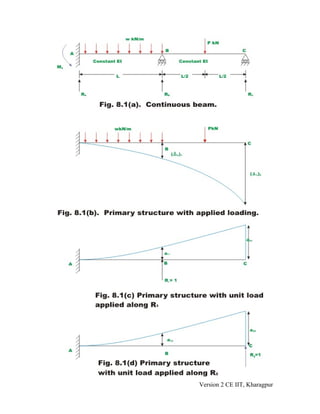
Towards this end, consider a two-span continuous beam as shown in Fig. 8.1a.
The flexural rigidity of this continuous beam is assumed to be constant and is
taken as EI . Since, the beam is statically indeterminate to second degree, it is
required to identify two redundant reaction components, which need be released
to make the beam statically determinate.


                                                         Version 2 CE IIT, Kharagpur
Version 2 CE IIT, Kharagpur
The redundant reactions at A and B are denoted by R1 and R2 respectively.
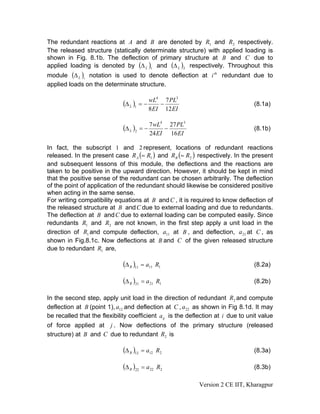
The released structure (statically determinate structure) with applied loading is
shown in Fig. 8.1b. The deflection of primary structure at B and C due to
applied loading is denoted by (Δ L )1 and (Δ L )2 respectively. Throughout this
module (Δ L )i notation is used to denote deflection at i th redundant due to
applied loads on the determinate structure.

                                                4
                                                         7 PL3
                              (Δ L )1 = − wL         −                                    (8.1a)
                                          8 EI           12 EI

                                                    4
                                                             27 PL3
                              (Δ L )2 = − 7 wL           −                                (8.1b)
                                           24 EI             16 EI

In fact, the subscript 1 and 2 represent, locations of redundant reactions
released. In the present case R A (= R1 ) and RB (= R2 ) respectively. In the present
and subsequent lessons of this module, the deflections and the reactions are
taken to be positive in the upward direction. However, it should be kept in mind
that the positive sense of the redundant can be chosen arbitrarily. The deflection
of the point of application of the redundant should likewise be considered positive
when acting in the same sense.
For writing compatibility equations at B and C , it is required to know deflection of
the released structure at B and C due to external loading and due to redundants.
The deflection at B and C due to external loading can be computed easily. Since
redundants R1 and R2 are not known, in the first step apply a unit load in the
direction of R1 and compute deflection, a11 at B , and deflection, a 21 at C , as
shown in Fig.8.1c. Now deflections at B and C of the given released structure
due to redundant R1 are,

                              (Δ R )11 = a11    R1                                        (8.2a)

                              (Δ R )21 = a 21   R1                                        (8.2b)

In the second step, apply unit load in the direction of redundant R2 and compute
deflection at B (point 1), a12 and deflection at C , a 22 as shown in Fig 8.1d. It may
be recalled that the flexibility coefficient a ij is the deflection at i due to unit value
of force applied at j . Now deflections of the primary structure (released
structure) at B and C due to redundant R2 is

                              (Δ R )12 = a12    R2                                        (8.3a)

                              (Δ R )22 = a 22   R2                                        (8.3b)

                                                                      Version 2 CE IIT, Kharagpur
It is observed that, in the actual structure, the deflections at joints B and C is
zero. Now the total deflections at B and C of the primary structure due to applied
external loading and redundants R1 and R2 is,

                       Δ 1 = (Δ L )1 + a11 R1 + a12 R2                                  (8.4a)

                       Δ 2 = (Δ L )2 + a 21 R1 + a 22 R2                                (8.4b)

The equation (8.4a) represents the total displacement at B and is obtained by
superposition of three terms:

   1) Deflection at B due to actual load acting on the statically determinate
      structure,
   2) Displacement at B due to the redundant reaction R1 acting in the positive
      direction at B (point 1) and
   3) Displacement at B due to the redundant reaction R2 acting in the positive
      direction at C .

The second equation (8.4b) similarly represents the total deflection at C . From
the physics of the problem, the compatibility condition can be written as,

                       Δ 1 = (Δ L )1 + a11 R1 + a12 R2 = 0                              (8.5a)

                       Δ 2 = (Δ L )2 + a 21 R1 + a 22 R2 = 0                            (8.5b)

The equation (8.5a) and (8.5b) may be written in matrix notation as follows,

                       ⎧ (Δ L )1 ⎫ ⎡ a11    a12 ⎤ ⎧ R1 ⎫ ⎧0⎫
                       ⎨         ⎬+                ⎨ ⎬=⎨ ⎬
                        (Δ L )2 ⎭ ⎢a 21     a 22 ⎥ ⎩ R2 ⎭ ⎩0⎭
                                                                                        (8.6a)
                       ⎩            ⎣            ⎦

                       {(Δ L )1 } + [A]{R} = {0}                                        (8.6b)

In which,

                        ⎧( Δ ) ⎫          ⎡a            a12 ⎤           ⎧ R1 ⎫
             {( Δ ) } = ⎪( Δ ) ⎪ ; [ A] = ⎢a
                 L 1    ⎨
                               L 1
                               ⎬
                                                  11
                                                            ⎥ and {R} = ⎨ R ⎬
                          ⎪
                          ⎩    L 2   ⎪
                                     ⎭        ⎣    21   a22 ⎦           ⎩ 2⎭

Solving the above set of algebraic equations, one could obtain the values of
redundants, R1 and R2 .

                                {R} = −[A]−1 {Δ L }                                     (8.7)


                                                                    Version 2 CE IIT, Kharagpur
In the above equation the vectors {Δ L } contains the displacement values of the
primary structure at point 1 and 2, [A] is the flexibility matrix and {R} is column
vector of redundants required to be evaluated. In equation (8.7) the inverse of the
flexibility matrix is denoted by [A] . In the above example, the structure is
                                      −1


indeterminate to second degree and the size of flexibility matrix is 2 × 2 . In
general, if the structure is redundant to a degree n , then the flexibility matrix is of
the order n × n . To demonstrate the procedure to evaluate deflection, consider
the problem given in Fig. 8.1a, with loading as given below

                      w=w;                                   P = wL                        (8.8a)

Now, the deflection (Δ L )1 and (Δ L )2 of the released structure can be evaluated
from the equations (8.1a) and (8.1b) respectively. Then,

                                         4
                                                 7 wL4    17 wL4
                      (Δ L )1 = − wL         −         =−                                  (8.8b)
                                    8 EI         12 EI     24 EI

                                   7 wL4 27 wL4    95wL4
                      (Δ L )2   =−      −       =−                                         (8.8c)
                                   24 EI 16 EI      48EI

The negative sign indicates that both deflections are downwards. Hence the
vector {Δ L } is given by

                                            wL4       ⎧34⎫
                                 {Δ L } = −           ⎨ ⎬                                  (8.8d)
                                            48 EI     ⎩95⎭

The flexibility matrix is determined from referring to figures 8.1c and 8.1d. Thus,
when the unit load corresponding to R1 is acting at B , the deflections are,

                                 L3                                   5 L3
                      a11 =         ,                        a 21 =                        (8.8e)
                                3EI                                   6 EI

Similarly when the unit load is acting at C ,

                                5L3                                   8L3
                      a12 =          ,                       a 22 =                        (8.8f)
                                6 EI                                  3EI

The flexibility matrix can be written as,

                                          L3     ⎡2 5 ⎤
                                 [A] =           ⎢5 16⎥                                    (8.8g)
                                         6 EI    ⎣    ⎦


                                                                       Version 2 CE IIT, Kharagpur
The inverse of the flexibility matrix can be evaluated by any of the standard
method. Thus,

                                  16 − 5⎤
                     [A]−1 = 6 EI ⎡
                                3 ⎢     ⎥                                   (8.8h)
                             7 L ⎣− 5 2 ⎦

Now using equation (8.7) the redundants are evaluated. Thus,

              ⎧ R1 ⎫ 6 EI wL4     ⎡ 16 − 5⎤ ⎧34⎫
              ⎨ ⎬= 3 ×            ⎢− 5 2 ⎥ ⎨95⎬
              ⎩ R2 ⎭ 7 L 48 EI    ⎣       ⎦⎩ ⎭

              69             20
Hence, R1 =      wL and R2 =    wL                                          (8.8i)
              56             56

Once the redundants are evaluated, the other reaction components can be
evaluated by static equations of equilibrium.

Example 8.1
Calculate the support reactions in the continuous beam ABC due to loading as
shown in Fig. 8.2a. Assume EI to be constant throughout.


                                                        Version 2 CE IIT, Kharagpur
Select two reactions viz, at B(R1 ) and C (R2 ) as redundants, since the given beam
is statically indeterminate to second degree. In this case the primary structure is
a cantilever beam AC . The primary structure with a given loading is shown in Fig.
8.2b.

In the present case, the deflections (Δ L )1 , and (Δ L )2 of the released structure at
 B and C can be readily calculated by moment-area method. Thus,


                               (Δ L )1 = − 819.16
                                             EI
and                            (Δ L )2   =−
                                            2311.875
                                                                                   (1)
                                               EI

For the present problem the flexibility matrix is,

                              125                  625
                      a11 =               a 21 =
                              3EI                  6 EI

                              625                  1000
                      a12 =               a 22 =                                   (2)
                              6 EI                 3EI


In the actual problem the displacements at B and C are zero. Thus the
compatibility conditions for the problem may be written as,

                      a11 R1 + a12 R2 + (Δ L )1 = 0
                                                                                   (3)
                      a 21 R1 + a 22 R2 + (Δ L )2 = 0

              ⎧ R1 ⎫   3EI ⎡ 1000 − 312.5⎤ 1               ⎧ 819.16 ⎫
              ⎨ ⎬=            ⎢              ×             ⎨        ⎬
                                       125 ⎥ EI
                                                                                   (5)
              ⎩ R2 ⎭ 27343.75 ⎣− 312.5     ⎦               ⎩2311.875⎭


Substituting the value of E and I in the above equation,

                      R1 = 10.609kN          and R2 = 3.620 kN

Using equations of static equilibrium,

              R3 = 0.771 kN                   and R4 = −0.755 kN.m


                                                             Version 2 CE IIT, Kharagpur
Example 8.2
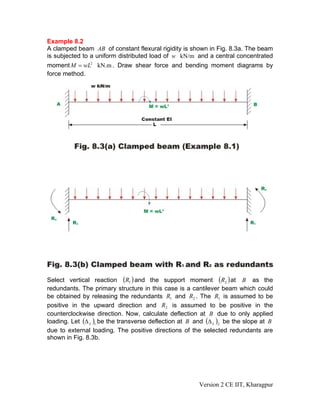
A clamped beam AB of constant flexural rigidity is shown in Fig. 8.3a. The beam
is subjected to a uniform distributed load of w kN/m and a central concentrated
moment M = wL2 kN.m . Draw shear force and bending moment diagrams by
force method.


Select vertical reaction (R1 ) and the support moment (R2 ) at B as the
redundants. The primary structure in this case is a cantilever beam which could
be obtained by releasing the redundants R1 and R2 . The R1 is assumed to be
positive in the upward direction and R2 is assumed to be positive in the
counterclockwise direction. Now, calculate deflection at B due to only applied
loading. Let (Δ L )1 be the transverse deflection at B and (Δ L )2 be the slope at B
due to external loading. The positive directions of the selected redundants are
shown in Fig. 8.3b.


                                                        Version 2 CE IIT, Kharagpur
Version 2 CE IIT, Kharagpur
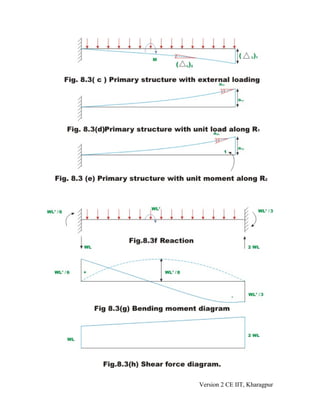
The deflection (Δ L )1 and (Δ L )2 of the released structure can be evaluated from
unit load method. Thus,

                                       4
                                                3wL4    wL4
                      (Δ L )1 = − wL        −        =−                                         (1)
                                     8EI         8EI    2 EI


                                        3
                                                wL3     2 wL3
and                   (Δ L )2 = − wL        −        =−                                        (2)
                                     6 EI       2 EI     3EI


The negative sign indicates that                 (Δ L )1 is   downwards and rotation      (Δ L )2    is
clockwise. Hence the vector {Δ L } is given by

                                          wL3        ⎧3L ⎫
                               {Δ L } = −            ⎨ ⎬                                        (3)
                                          6 EI       ⎩4⎭

The flexibility matrix is evaluated by first applying unit load along redundant R1
and determining the deflections a11 and a 21 corresponding to redundants R1 and
R2 respectively (see Fig. 8.3d). Thus,

                             L3                                   L2
                      a11 =                           and a 21 =                                (4)
                            3EI                                  2 EI


Similarly, applying unit load in the direction of redundant R2 , one could evaluate
flexibility coefficients a12 and a 22 as shown in Fig. 8.3c.

                               L2                                  L
                      a12 =                           and a 22 =                                (5)
                              2 EI                                 EI


Now the flexibility matrix is formulated as,

                                          L ⎡2 L2        3L ⎤
                               [A] =         ⎢              ⎥                                   (6)
                                        6 EI ⎣ 3L         6⎦

The inverse of flexibility matrix is formulated as,


                                                                        Version 2 CE IIT, Kharagpur
− 3L ⎤
                     [A]−1 = 6 EI ⎡
                                   6
                                3 ⎢        ⎥
                             3L ⎣− 3L 2 L2 ⎦

The redundants are evaluated from equation (8.7). Hence,

                     ⎧ R1 ⎫   6 EI ⎡ 6 − 3L ⎤ ⎛ wL3 ⎞⎧3L ⎫
                     ⎨ ⎬    =− 3 ⎢          ⎥ ×⎜−    ⎟⎨ ⎬
                     ⎩ R2 ⎭   3L ⎣− 3L 2 L2 ⎦ ⎜ 6 EI ⎟⎩ 4 ⎭
                                               ⎝     ⎠


                                 w ⎧ 6L ⎫
                             =     ⎨     ⎬
                                 3 ⎩− L2 ⎭


                                                   wL2
              R1 = 2wL                and R2 = −                               (7)
                                                    3


The other two reactions ( R3 and R4 ) can be evaluated by equations of statics.
Thus,
                         wL2
            R4 = M A = −                and R1 = R A = − wL               (8)
                          6

The bending moment and shear force diagrams are shown in Fig. 8.3g and
Fig.8.3h respectively.


Summary
In this lesson, statically indeterminate beams of degree more than one is solved
systematically using flexibility matrix method. Towards this end matrix notation is
adopted. Few illustrative examples are solved to illustrate the procedure. After
analyzing the continuous beam, reactions are calculated and bending moment
diagrams are drawn.


                                                         Version 2 CE IIT, Kharagpur

M2l8

  • 1.
    Module 2 Analysis of Statically Indeterminate Structures by the Matrix Force Method Version 2 CE IIT, Kharagpur
  • 2.
    Lesson 8 The Force Method of Analysis: Beams Version 2 CE IIT, Kharagpur
  • 3.
    Instructional Objectives After readingthis chapter the student will be able to 1. Solve statically indeterminate beams of degree more than one. 2. To solve the problem in matrix notation. 3. To compute reactions at all the supports. 4. To compute internal resisting bending moment at any section of the continuous beam. 8.1 Introduction In the last lesson, a general introduction to the force method of analysis is given. Only, beams, which are statically indeterminate to first degree, were considered. If the structure is statically indeterminate to a degree more than one, then the approach presented in the previous example needs to be organized properly. In the present lesson, a general procedure for analyzing statically indeterminate beams is discussed. 8.2 Formalization of Procedure Towards this end, consider a two-span continuous beam as shown in Fig. 8.1a. The flexural rigidity of this continuous beam is assumed to be constant and is taken as EI . Since, the beam is statically indeterminate to second degree, it is required to identify two redundant reaction components, which need be released to make the beam statically determinate. Version 2 CE IIT, Kharagpur
  • 4.
    Version 2 CEIIT, Kharagpur
  • 5.
    The redundant reactionsat A and B are denoted by R1 and R2 respectively. The released structure (statically determinate structure) with applied loading is shown in Fig. 8.1b. The deflection of primary structure at B and C due to applied loading is denoted by (Δ L )1 and (Δ L )2 respectively. Throughout this module (Δ L )i notation is used to denote deflection at i th redundant due to applied loads on the determinate structure. 4 7 PL3 (Δ L )1 = − wL − (8.1a) 8 EI 12 EI 4 27 PL3 (Δ L )2 = − 7 wL − (8.1b) 24 EI 16 EI In fact, the subscript 1 and 2 represent, locations of redundant reactions released. In the present case R A (= R1 ) and RB (= R2 ) respectively. In the present and subsequent lessons of this module, the deflections and the reactions are taken to be positive in the upward direction. However, it should be kept in mind that the positive sense of the redundant can be chosen arbitrarily. The deflection of the point of application of the redundant should likewise be considered positive when acting in the same sense. For writing compatibility equations at B and C , it is required to know deflection of the released structure at B and C due to external loading and due to redundants. The deflection at B and C due to external loading can be computed easily. Since redundants R1 and R2 are not known, in the first step apply a unit load in the direction of R1 and compute deflection, a11 at B , and deflection, a 21 at C , as shown in Fig.8.1c. Now deflections at B and C of the given released structure due to redundant R1 are, (Δ R )11 = a11 R1 (8.2a) (Δ R )21 = a 21 R1 (8.2b) In the second step, apply unit load in the direction of redundant R2 and compute deflection at B (point 1), a12 and deflection at C , a 22 as shown in Fig 8.1d. It may be recalled that the flexibility coefficient a ij is the deflection at i due to unit value of force applied at j . Now deflections of the primary structure (released structure) at B and C due to redundant R2 is (Δ R )12 = a12 R2 (8.3a) (Δ R )22 = a 22 R2 (8.3b) Version 2 CE IIT, Kharagpur
  • 6.
    It is observedthat, in the actual structure, the deflections at joints B and C is zero. Now the total deflections at B and C of the primary structure due to applied external loading and redundants R1 and R2 is, Δ 1 = (Δ L )1 + a11 R1 + a12 R2 (8.4a) Δ 2 = (Δ L )2 + a 21 R1 + a 22 R2 (8.4b) The equation (8.4a) represents the total displacement at B and is obtained by superposition of three terms: 1) Deflection at B due to actual load acting on the statically determinate structure, 2) Displacement at B due to the redundant reaction R1 acting in the positive direction at B (point 1) and 3) Displacement at B due to the redundant reaction R2 acting in the positive direction at C . The second equation (8.4b) similarly represents the total deflection at C . From the physics of the problem, the compatibility condition can be written as, Δ 1 = (Δ L )1 + a11 R1 + a12 R2 = 0 (8.5a) Δ 2 = (Δ L )2 + a 21 R1 + a 22 R2 = 0 (8.5b) The equation (8.5a) and (8.5b) may be written in matrix notation as follows, ⎧ (Δ L )1 ⎫ ⎡ a11 a12 ⎤ ⎧ R1 ⎫ ⎧0⎫ ⎨ ⎬+ ⎨ ⎬=⎨ ⎬ (Δ L )2 ⎭ ⎢a 21 a 22 ⎥ ⎩ R2 ⎭ ⎩0⎭ (8.6a) ⎩ ⎣ ⎦ {(Δ L )1 } + [A]{R} = {0} (8.6b) In which, ⎧( Δ ) ⎫ ⎡a a12 ⎤ ⎧ R1 ⎫ {( Δ ) } = ⎪( Δ ) ⎪ ; [ A] = ⎢a L 1 ⎨ L 1 ⎬ 11 ⎥ and {R} = ⎨ R ⎬ ⎪ ⎩ L 2 ⎪ ⎭ ⎣ 21 a22 ⎦ ⎩ 2⎭ Solving the above set of algebraic equations, one could obtain the values of redundants, R1 and R2 . {R} = −[A]−1 {Δ L } (8.7) Version 2 CE IIT, Kharagpur
  • 7.
    In the aboveequation the vectors {Δ L } contains the displacement values of the primary structure at point 1 and 2, [A] is the flexibility matrix and {R} is column vector of redundants required to be evaluated. In equation (8.7) the inverse of the flexibility matrix is denoted by [A] . In the above example, the structure is −1 indeterminate to second degree and the size of flexibility matrix is 2 × 2 . In general, if the structure is redundant to a degree n , then the flexibility matrix is of the order n × n . To demonstrate the procedure to evaluate deflection, consider the problem given in Fig. 8.1a, with loading as given below w=w; P = wL (8.8a) Now, the deflection (Δ L )1 and (Δ L )2 of the released structure can be evaluated from the equations (8.1a) and (8.1b) respectively. Then, 4 7 wL4 17 wL4 (Δ L )1 = − wL − =− (8.8b) 8 EI 12 EI 24 EI 7 wL4 27 wL4 95wL4 (Δ L )2 =− − =− (8.8c) 24 EI 16 EI 48EI The negative sign indicates that both deflections are downwards. Hence the vector {Δ L } is given by wL4 ⎧34⎫ {Δ L } = − ⎨ ⎬ (8.8d) 48 EI ⎩95⎭ The flexibility matrix is determined from referring to figures 8.1c and 8.1d. Thus, when the unit load corresponding to R1 is acting at B , the deflections are, L3 5 L3 a11 = , a 21 = (8.8e) 3EI 6 EI Similarly when the unit load is acting at C , 5L3 8L3 a12 = , a 22 = (8.8f) 6 EI 3EI The flexibility matrix can be written as, L3 ⎡2 5 ⎤ [A] = ⎢5 16⎥ (8.8g) 6 EI ⎣ ⎦ Version 2 CE IIT, Kharagpur
  • 8.
    The inverse ofthe flexibility matrix can be evaluated by any of the standard method. Thus, 16 − 5⎤ [A]−1 = 6 EI ⎡ 3 ⎢ ⎥ (8.8h) 7 L ⎣− 5 2 ⎦ Now using equation (8.7) the redundants are evaluated. Thus, ⎧ R1 ⎫ 6 EI wL4 ⎡ 16 − 5⎤ ⎧34⎫ ⎨ ⎬= 3 × ⎢− 5 2 ⎥ ⎨95⎬ ⎩ R2 ⎭ 7 L 48 EI ⎣ ⎦⎩ ⎭ 69 20 Hence, R1 = wL and R2 = wL (8.8i) 56 56 Once the redundants are evaluated, the other reaction components can be evaluated by static equations of equilibrium. Example 8.1 Calculate the support reactions in the continuous beam ABC due to loading as shown in Fig. 8.2a. Assume EI to be constant throughout. Version 2 CE IIT, Kharagpur
  • 9.
    Select two reactionsviz, at B(R1 ) and C (R2 ) as redundants, since the given beam is statically indeterminate to second degree. In this case the primary structure is a cantilever beam AC . The primary structure with a given loading is shown in Fig. 8.2b. In the present case, the deflections (Δ L )1 , and (Δ L )2 of the released structure at B and C can be readily calculated by moment-area method. Thus, (Δ L )1 = − 819.16 EI and (Δ L )2 =− 2311.875 (1) EI For the present problem the flexibility matrix is, 125 625 a11 = a 21 = 3EI 6 EI 625 1000 a12 = a 22 = (2) 6 EI 3EI In the actual problem the displacements at B and C are zero. Thus the compatibility conditions for the problem may be written as, a11 R1 + a12 R2 + (Δ L )1 = 0 (3) a 21 R1 + a 22 R2 + (Δ L )2 = 0 ⎧ R1 ⎫ 3EI ⎡ 1000 − 312.5⎤ 1 ⎧ 819.16 ⎫ ⎨ ⎬= ⎢ × ⎨ ⎬ 125 ⎥ EI (5) ⎩ R2 ⎭ 27343.75 ⎣− 312.5 ⎦ ⎩2311.875⎭ Substituting the value of E and I in the above equation, R1 = 10.609kN and R2 = 3.620 kN Using equations of static equilibrium, R3 = 0.771 kN and R4 = −0.755 kN.m Version 2 CE IIT, Kharagpur
  • 10.
    Example 8.2 A clampedbeam AB of constant flexural rigidity is shown in Fig. 8.3a. The beam is subjected to a uniform distributed load of w kN/m and a central concentrated moment M = wL2 kN.m . Draw shear force and bending moment diagrams by force method. Select vertical reaction (R1 ) and the support moment (R2 ) at B as the redundants. The primary structure in this case is a cantilever beam which could be obtained by releasing the redundants R1 and R2 . The R1 is assumed to be positive in the upward direction and R2 is assumed to be positive in the counterclockwise direction. Now, calculate deflection at B due to only applied loading. Let (Δ L )1 be the transverse deflection at B and (Δ L )2 be the slope at B due to external loading. The positive directions of the selected redundants are shown in Fig. 8.3b. Version 2 CE IIT, Kharagpur
  • 11.
    Version 2 CEIIT, Kharagpur
  • 12.
    The deflection (ΔL )1 and (Δ L )2 of the released structure can be evaluated from unit load method. Thus, 4 3wL4 wL4 (Δ L )1 = − wL − =− (1) 8EI 8EI 2 EI 3 wL3 2 wL3 and (Δ L )2 = − wL − =− (2) 6 EI 2 EI 3EI The negative sign indicates that (Δ L )1 is downwards and rotation (Δ L )2 is clockwise. Hence the vector {Δ L } is given by wL3 ⎧3L ⎫ {Δ L } = − ⎨ ⎬ (3) 6 EI ⎩4⎭ The flexibility matrix is evaluated by first applying unit load along redundant R1 and determining the deflections a11 and a 21 corresponding to redundants R1 and R2 respectively (see Fig. 8.3d). Thus, L3 L2 a11 = and a 21 = (4) 3EI 2 EI Similarly, applying unit load in the direction of redundant R2 , one could evaluate flexibility coefficients a12 and a 22 as shown in Fig. 8.3c. L2 L a12 = and a 22 = (5) 2 EI EI Now the flexibility matrix is formulated as, L ⎡2 L2 3L ⎤ [A] = ⎢ ⎥ (6) 6 EI ⎣ 3L 6⎦ The inverse of flexibility matrix is formulated as, Version 2 CE IIT, Kharagpur
  • 13.
    − 3L ⎤ [A]−1 = 6 EI ⎡ 6 3 ⎢ ⎥ 3L ⎣− 3L 2 L2 ⎦ The redundants are evaluated from equation (8.7). Hence, ⎧ R1 ⎫ 6 EI ⎡ 6 − 3L ⎤ ⎛ wL3 ⎞⎧3L ⎫ ⎨ ⎬ =− 3 ⎢ ⎥ ×⎜− ⎟⎨ ⎬ ⎩ R2 ⎭ 3L ⎣− 3L 2 L2 ⎦ ⎜ 6 EI ⎟⎩ 4 ⎭ ⎝ ⎠ w ⎧ 6L ⎫ = ⎨ ⎬ 3 ⎩− L2 ⎭ wL2 R1 = 2wL and R2 = − (7) 3 The other two reactions ( R3 and R4 ) can be evaluated by equations of statics. Thus, wL2 R4 = M A = − and R1 = R A = − wL (8) 6 The bending moment and shear force diagrams are shown in Fig. 8.3g and Fig.8.3h respectively. Summary In this lesson, statically indeterminate beams of degree more than one is solved systematically using flexibility matrix method. Towards this end matrix notation is adopted. Few illustrative examples are solved to illustrate the procedure. After analyzing the continuous beam, reactions are calculated and bending moment diagrams are drawn. Version 2 CE IIT, Kharagpur