Preparing students
effectively for
Speaking
March 2015
EГЭ
blurb
The EGE Speaking paper is now a reality. In this
session, we'll look at the different parts of the
paper and examine the skills that are tested in
each part.
We'll look at key dos and don'ts of preparation
and skills development – for the teacher as well
as the students – in order to maximise the
chances of each student's success.
Part 1
Part 2
Part 3
Part 4
Part 1
Part 1
When reading aloud, native and non-native
speakers often have problems with:
* Hesitation / saying ‘err’ / saying ‘umm’ /
stammering and stuttering
* Mispronunciation
* Speaking at the wrong speed
* Speaking at the wrong volume
* Bad intonation
* Bad word/phrase/sentence stress
* Missing out words
* Adding words
Part 1
We need to give our students a lot of help
and guidance in all of these areas, both
systematically and through task-based
non-systematic language and exam skills
development work based on exam practice
tasks.
Note: This is not an issue of ‘accent’. It is
absolutely fine to speak with a Russian
accent.
Top Tip
Sometimes it’s helpful to allow – even
encourage! – our students to get it wrong
before they get it right.
This focuses their attention on what to do,
and what not to do, in a fun pressure-free
way.
Part 1 – cards for students
You
speak
too fast.
You stress
the wrong
words.
You speed
up and slow
down.
You speak too
quietly.
You
speak
too
loudly.
You speak
too slowly.
You add
words that
aren’t there.
You miss
out words.
You
hesitate
too much.
Part 1
Underline the main stressed syllable in
these words. [from the exam practice text]
Example: extremely
1 particularly 7 coastal
2 earthquakes 8 predict
3 occur 9 residents
4 affects 10 evacuate
5 tsunamis 11 unfortunately
6 disaster 12 amount
Part 1
Underline the main stressed syllable in
these words. [from the exam practice text]
Example: beginning
1 robot 6 precise
2 enter 7 perform
3 limited 8 numerous
4 surgery 9 energy
5 delicate 10 techniques
Part 1
Read these words and decide how the
underlined letter ‘c’ is pronounced.
1 circles
2 circles
3 Pacific
4 Pacific
5 ocean
6 occur
7 coastal
8 receive
Part 1
How many syllables are there when you
say these words? There may be more than
one answer for some of the words.
Medicine Scale
Operation Patient
Extremely Fatigue
Incision Surgeons
Manoeuvre Entirely
Part 1
How many syllables are there when you
say these words? There may be more than
one answer for some of the words.
Medicine (2 or 3) Scale (1)

Operation (4) Patient (2)
Extremely (3) Fatigue (2)
Incision (3) Surgeons (2)
Manoeuvre (3) Entirely (2 or 3)
Part 1
Underline the main stress in each word.
Photograph Photographer
Scientist Scientific
Investigate Investigation
Part 1 – Top Tip
Get students to create tongue twisters for
each other.
Get them to say them as quickly as they
can.
Example:
Freddie the photographer took fancy
photographs of scientists and investigators
doing scientific investigations.
Part 1
Write one letter from each of the following
words which is not pronounced.
Castle
Imagine
Scientific
Joined
Technology
Sight
Part 1
Underline the syllable which is stressed most
in each phrase.
Example: It’s the focal point of the room.
Let’s have a tennis match tomorrow.
Has your dad got a credit card?
It’s a huge department store.
I’m thinking of getting a new mobile phone.
Part 1
Underline the syllable which is stressed most
in each phrase.
Example: It’s the focal point of the room.
Let’s have a tennis match tomorrow.
Has your dad got a credit card?
It’s a huge department store.
I’m thinking of getting a new mobile phone.
Part 1
Underline the main stressed syllables (not
including the numbers) in the sentences
below.
1 Dogs are thought to be intelligent
creatures. (4 syllables)
2 They can remember approximately 165
words on average. (4 syllables)
3 This includes visual signals and other
signs. (4 syllables)
4 A trained dog can learn even more
words, up to 250. (4 syllables)
Part 1
Underline the main stressed syllables (not
including the numbers) in the sentences
below.
1 Dogs are thought to be intelligent
creatures. (4 syllables)
2 They can remember approximately 165
words on average. (4 syllables)
3 This includes visual signals and other
signs. (4 syllables)
4 A trained dog can learn even more
words, up to 250. (4 syllables)
Part 1 – Top Tip
Once you’ve done listening exercises in
coursebooks and exam practice books, give
the students the scripts.
They listen again, following the script –
focusing on pronunciation.
They then practise reading the script aloud
without the recording (but can refer to the
recording where necessary).
Part 2
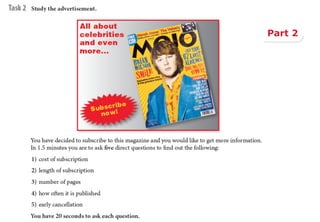
Part 2 - skills
* Understanding the scenario
(advert/photo+text/etc)
* Understanding what you need to ask
for each question
* Forming questions with grammatical
accuracy
* Appropriacy of register
Part 2
Correct each of these questions.
1 How much the bicycle costs?
2 What the best features are?
3 It’s easy to use?
4 When I can collect it?
5 There is a guarantee with it?
Part 2 – Top Tip
It’s important for students to realise that
sometimes there’s more than one way of
asking the question.
E.g.
How much is the bicycle?
How much does the bicycle cost?
Always encourage them to suggest other
possible ways of expressing the same idea.
Part 2
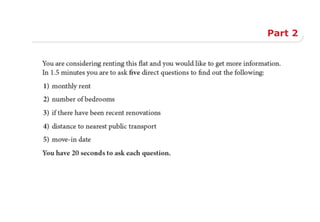
Part 2
monthly rent
Part 2
number of bedrooms
Part 2
If there have been recent renovations
Part 2
distance to nearest public transport
Part 2
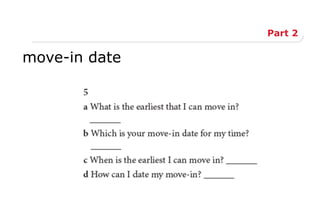
move-in date
Part 2
Alternative task:
they don’t look
at page 144 first
but use these
questions to
predict the task.
Part 2
Part 3
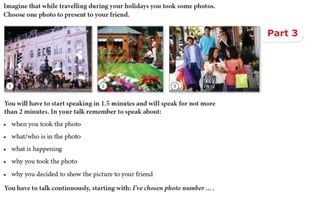
Part 3 - skills
* Key grammar / vocab for describing photos
* Giving reasons (Say why…)
* Ideas generation
* Being able to sustain a long utterance
(fluency more important than grammatical
accuracy)
* Task completion
* Timing
Part 3
Choose the correct word or phrase.
1 I was taking / took this photo at a music
festival.
2 These are my friends at / in the picture.
3 As you can see, we try / are trying to put up
our tent.
4 It took us hours and it was so / such funny
that I had to take a photo.
5 I want / am wanting you to see it so you can
see Igor has a sense of humour.
Part 3 – Top Tip
Choose the correct word or phrase.
1 I was taking / took this photo at a music
festival.
2 These are my friends at / in the picture.
3 As you can see, we try / are trying to put up
our tent.
4 It took us hours and it was so / such funny
that I had to take a photo.
5 I want / am wanting you to see it so you can
see Igor has a sense of humour.
Encourage
students to
give
reasons
why they
chose each
word or
phrase.
Part 3
Part 3 – Top Tip
Don’t interrupt and correct students
when they’re practising doing Parts
3 and 4.
Fluency is as important as, if not
more important than, accuracy.
Make a note of any important
feedback and give it to them
afterwards.
Part 3 – Top Tip
Give students models of successful
and not-so-successful answers.
Encourage them to analyse what
makes them successful or
unsuccessful.
Part 3
Part 4
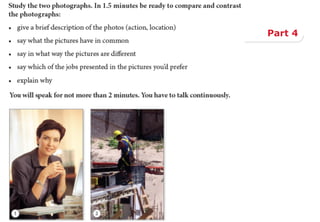
Part 4 - skills
Same as Part 3 plus:
* Comparing / contrasting
* Expressing preference
Parts 3 and 4 – Top Tip
To help develop the skill of giving
reasons, encourage students to come
up with illogical and ridiculous reasons
the first time.
This will be entertaining and motivating.
They can come up with sensible and
logical reasons when they do the task
again.
Part 4
Ideas
generation in
terms of two
situations –
comparing and
contrasting
Part 4
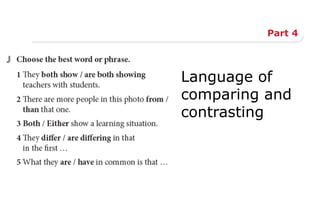
Language of
comparing and
contrasting
All parts
Explicitly
analyse
successful and
unsuccessful
approaches.
All parts – Top Tip
Get students to record themselves
at home with their mobile phones.
If they feel they’ve done ‘badly’,
they delete it and start again.
If they feel they’ve done well, they
keep it and bring it to class.
PDF of all the slides
Macmillan Russia
website

Malcolm Mann: Preparing students effectively for EGE Speaking

  • 1.
  • 2.
    blurb The EGE Speakingpaper is now a reality. In this session, we'll look at the different parts of the paper and examine the skills that are tested in each part. We'll look at key dos and don'ts of preparation and skills development – for the teacher as well as the students – in order to maximise the chances of each student's success.
  • 3.
  • 4.
  • 5.
  • 6.
  • 7.
  • 8.
    Part 1 When readingaloud, native and non-native speakers often have problems with: * Hesitation / saying ‘err’ / saying ‘umm’ / stammering and stuttering * Mispronunciation * Speaking at the wrong speed * Speaking at the wrong volume * Bad intonation * Bad word/phrase/sentence stress * Missing out words * Adding words
  • 9.
    Part 1 We needto give our students a lot of help and guidance in all of these areas, both systematically and through task-based non-systematic language and exam skills development work based on exam practice tasks. Note: This is not an issue of ‘accent’. It is absolutely fine to speak with a Russian accent.
  • 10.
    Top Tip Sometimes it’shelpful to allow – even encourage! – our students to get it wrong before they get it right. This focuses their attention on what to do, and what not to do, in a fun pressure-free way.
  • 11.
    Part 1 –cards for students You speak too fast. You stress the wrong words. You speed up and slow down. You speak too quietly. You speak too loudly. You speak too slowly. You add words that aren’t there. You miss out words. You hesitate too much.
  • 12.
    Part 1 Underline themain stressed syllable in these words. [from the exam practice text] Example: extremely 1 particularly 7 coastal 2 earthquakes 8 predict 3 occur 9 residents 4 affects 10 evacuate 5 tsunamis 11 unfortunately 6 disaster 12 amount
  • 13.
    Part 1 Underline themain stressed syllable in these words. [from the exam practice text] Example: beginning 1 robot 6 precise 2 enter 7 perform 3 limited 8 numerous 4 surgery 9 energy 5 delicate 10 techniques
  • 14.
    Part 1 Read thesewords and decide how the underlined letter ‘c’ is pronounced. 1 circles 2 circles 3 Pacific 4 Pacific 5 ocean 6 occur 7 coastal 8 receive
  • 15.
    Part 1 How manysyllables are there when you say these words? There may be more than one answer for some of the words. Medicine Scale Operation Patient Extremely Fatigue Incision Surgeons Manoeuvre Entirely
  • 16.
    Part 1 How manysyllables are there when you say these words? There may be more than one answer for some of the words. Medicine (2 or 3) Scale (1) Operation (4) Patient (2) Extremely (3) Fatigue (2) Incision (3) Surgeons (2) Manoeuvre (3) Entirely (2 or 3)
  • 17.
    Part 1 Underline themain stress in each word. Photograph Photographer Scientist Scientific Investigate Investigation
  • 18.
    Part 1 –Top Tip Get students to create tongue twisters for each other. Get them to say them as quickly as they can. Example: Freddie the photographer took fancy photographs of scientists and investigators doing scientific investigations.
  • 19.
    Part 1 Write oneletter from each of the following words which is not pronounced. Castle Imagine Scientific Joined Technology Sight
  • 20.
    Part 1 Underline thesyllable which is stressed most in each phrase. Example: It’s the focal point of the room. Let’s have a tennis match tomorrow. Has your dad got a credit card? It’s a huge department store. I’m thinking of getting a new mobile phone.
  • 21.
    Part 1 Underline thesyllable which is stressed most in each phrase. Example: It’s the focal point of the room. Let’s have a tennis match tomorrow. Has your dad got a credit card? It’s a huge department store. I’m thinking of getting a new mobile phone.
  • 22.
    Part 1 Underline themain stressed syllables (not including the numbers) in the sentences below. 1 Dogs are thought to be intelligent creatures. (4 syllables) 2 They can remember approximately 165 words on average. (4 syllables) 3 This includes visual signals and other signs. (4 syllables) 4 A trained dog can learn even more words, up to 250. (4 syllables)
  • 23.
    Part 1 Underline themain stressed syllables (not including the numbers) in the sentences below. 1 Dogs are thought to be intelligent creatures. (4 syllables) 2 They can remember approximately 165 words on average. (4 syllables) 3 This includes visual signals and other signs. (4 syllables) 4 A trained dog can learn even more words, up to 250. (4 syllables)
  • 24.
    Part 1 –Top Tip Once you’ve done listening exercises in coursebooks and exam practice books, give the students the scripts. They listen again, following the script – focusing on pronunciation. They then practise reading the script aloud without the recording (but can refer to the recording where necessary).
  • 25.
  • 26.
    Part 2 -skills * Understanding the scenario (advert/photo+text/etc) * Understanding what you need to ask for each question * Forming questions with grammatical accuracy * Appropriacy of register
  • 27.
    Part 2 Correct eachof these questions. 1 How much the bicycle costs? 2 What the best features are? 3 It’s easy to use? 4 When I can collect it? 5 There is a guarantee with it?
  • 28.
    Part 2 –Top Tip It’s important for students to realise that sometimes there’s more than one way of asking the question. E.g. How much is the bicycle? How much does the bicycle cost? Always encourage them to suggest other possible ways of expressing the same idea.
  • 29.
  • 30.
  • 31.
  • 32.
    Part 2 If therehave been recent renovations
  • 33.
    Part 2 distance tonearest public transport
  • 34.
  • 35.
    Part 2 Alternative task: theydon’t look at page 144 first but use these questions to predict the task.
  • 36.
  • 37.
  • 38.
    Part 3 -skills * Key grammar / vocab for describing photos * Giving reasons (Say why…) * Ideas generation * Being able to sustain a long utterance (fluency more important than grammatical accuracy) * Task completion * Timing
  • 39.
    Part 3 Choose thecorrect word or phrase. 1 I was taking / took this photo at a music festival. 2 These are my friends at / in the picture. 3 As you can see, we try / are trying to put up our tent. 4 It took us hours and it was so / such funny that I had to take a photo. 5 I want / am wanting you to see it so you can see Igor has a sense of humour.
  • 40.
    Part 3 –Top Tip Choose the correct word or phrase. 1 I was taking / took this photo at a music festival. 2 These are my friends at / in the picture. 3 As you can see, we try / are trying to put up our tent. 4 It took us hours and it was so / such funny that I had to take a photo. 5 I want / am wanting you to see it so you can see Igor has a sense of humour. Encourage students to give reasons why they chose each word or phrase.
  • 41.
  • 42.
    Part 3 –Top Tip Don’t interrupt and correct students when they’re practising doing Parts 3 and 4. Fluency is as important as, if not more important than, accuracy. Make a note of any important feedback and give it to them afterwards.
  • 43.
    Part 3 –Top Tip Give students models of successful and not-so-successful answers. Encourage them to analyse what makes them successful or unsuccessful.
  • 44.
  • 45.
  • 46.
    Part 4 -skills Same as Part 3 plus: * Comparing / contrasting * Expressing preference
  • 47.
    Parts 3 and4 – Top Tip To help develop the skill of giving reasons, encourage students to come up with illogical and ridiculous reasons the first time. This will be entertaining and motivating. They can come up with sensible and logical reasons when they do the task again.
  • 48.
    Part 4 Ideas generation in termsof two situations – comparing and contrasting
  • 49.
  • 50.
  • 51.
    All parts –Top Tip Get students to record themselves at home with their mobile phones. If they feel they’ve done ‘badly’, they delete it and start again. If they feel they’ve done well, they keep it and bring it to class.
  • 52.
    PDF of allthe slides Macmillan Russia website