


Study, Work, Life: developing
transferable skills across domains
Steve Taylore-Knowles
today’s young adults ...
aged approx. 18-25: born between 1988 and 1995
‘Generation Y’
‘Echo Boomers’
‘the Millennials’
‘Generation Next’
‘the Net Generation’
‘Generation 9/11’
‘Boomerang Generation’ (parasaito shinguru)
‘Peter Pan Generation’
‘€700 Generation’
‘the Precarious Generation’
‘Generation Flux’
today’s young adults ...
What is the world like for today’s young adults (millenials)?
Telefonica Global Millennial Survey, 2013
‘How employable are today’s graduates?’
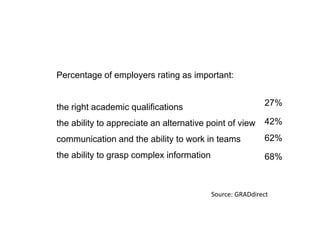
Percentage of employers rating as important:
the right academic qualifications
the ability to appreciate an alternative point of view
communication and the ability to work in teams
the ability to grasp complex information
27%
42%
62%
68%
Source: GRADdirect
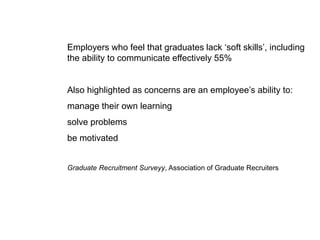
Employers who feel that graduates lack ‘soft skills’, including
the ability to communicate effectively 55%
Also highlighted as concerns are an employee’s ability to:
manage their own learning
solve problems
be motivated
Graduate Recruitment Surveyy, Association of Graduate Recruiters
University of Warwick Podcast (extract)
‘How employable are today’s graduates?’
Professors Kate Purcel and Peter Elias
from the University of Warwick Institute of
Employment Research
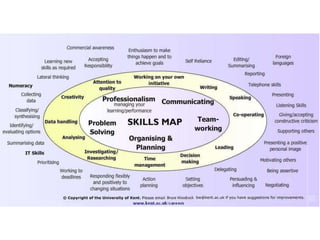
Top ten skills that employers want
University of Kent study of multiple surveys
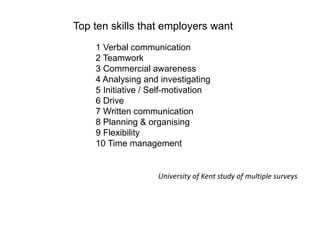
Top ten skills that employers want
1 Verbal communication
2 Teamwork
3 Commercial awareness
4 Analysing and investigating
5 Initiative / Self-motivation
6 Drive
7 Written communication
8 Planning & organising
9 Flexibility
10 Time management
University of Kent study of multiple surveys
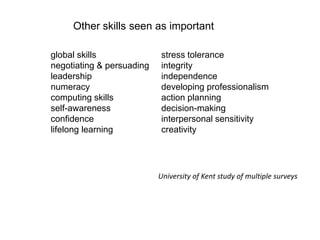
Other skills seen as important
global skills
negotiating & persuading
leadership
numeracy
computing skills
self-awareness
confidence
lifelong learning
stress tolerance
integrity
independence
developing professionalism
action planning
decision-making
interpersonal sensitivity
creativity
University of Kent study of multiple surveys
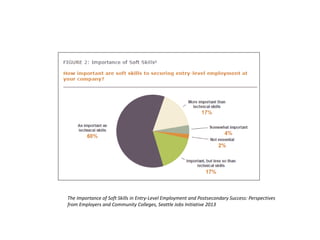
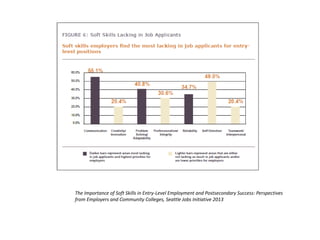
The Importance of Soft Skills in Entry-Level Employment and Postsecondary Success: Perspectives
from Employers and Community Colleges, Seattle Jobs Initiative 2013
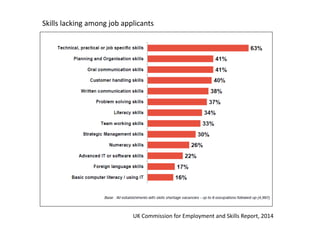
Skills lacking among job applicants
UK Commission for Employment and Skills Report, 2014
The Importance of Soft Skills in Entry-Level Employment and Postsecondary Success: Perspectives
from Employers and Community Colleges, Seattle Jobs Initiative 2013
life skills
psychosocial and interpersonal skills
generally considered important
UNICEF
personal management and social skills which
are necessary for adequate functioning on an
independent basis
International Bureau of Education
Life skills education is designed to facilitate the practice
and reinforcement of psychosocial skills in a culturally
and developmentally appropriate way; it contributes to
the promotion of personal and social development, the
prevention of health and social problems, and the
protection of human rights.
World Health Organisation
It is evident that in addition to practical and vocational
skills, other types of skills such as social, individual and
reflective skills are also needed. Life skills programmes
emphasise abilities that help to facilitate communication,
negotiation, to think critically and solve problems and
make independent decisions.
Madhu Singh, UNESCO Institute for Education
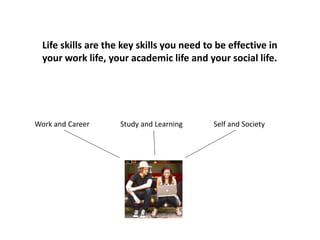
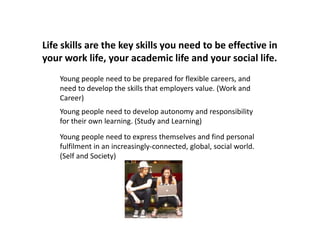
Work and Career Study and Learning Self and Society
Life skills are the key skills you need to be effective in
your work life, your academic life and your social life.
Life skills are the key skills you need to be effective in
your work life, your academic life and your social life.
Young people need to be prepared for flexible careers, and
need to develop the skills that employers value. (Work and
Career)
Young people need to develop autonomy and responsibility
for their own learning. (Study and Learning)
Young people need to express themselves and find personal
fulfilment in an increasingly-connected, global, social world.
(Self and Society)
But I’m an English teacher!
I teach English!
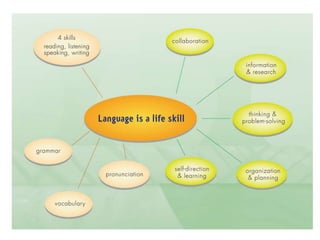
You should be developing life skills in your
English classroom because …
You should be developing life skills in your
English classroom because …
- English alone is no longer enough
… as English becomes more generally
available, little or no competitive
advantage is gained by adopting it.
Rather, it has become a new baseline:
without English you are not even in the
race.
David Graddol
English Next (2006)
British Council
You should be developing life skills in your
English classroom because …
- English alone is no longer enough
- communication skills are key
You should be developing life skills in your English
classroom because …
- English alone is no longer enough
- communication skills are key
- many lifeskills are culturally and linguistically
dependent
You should be developing life skills in your English
classroom because …
- English alone is no longer enough
- communication skills are key
- many lifeskills are culturally and linguistically
dependent
- it’s the expertise teachers already possess
Target skill:
evaluating different plans
Context
Pre-Intermediate / Intermediate
Possible grammar links:
modals of possibility / prediction (may, might, will, could)
will / going to
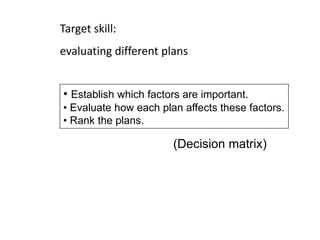
Target skill:
evaluating different plans
• Establish which factors are important.
• Evaluate how each plan affects these factors.
• Rank the plans.
(Decision matrix)
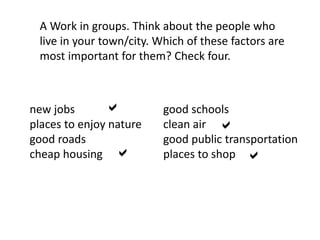
A Work in groups. Think about the people who
live in your town/city. Which of these factors are
most important for them? Check four.
new jobs
places to enjoy nature
good roads
cheap housing
good schools
clean air
good public transportation
places to shop




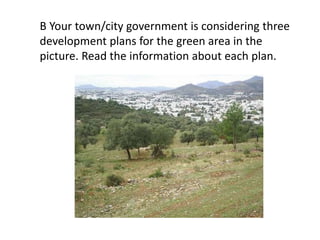
B Your town/city government is considering three
development plans for the green area in the
picture. Read the information about each plan.
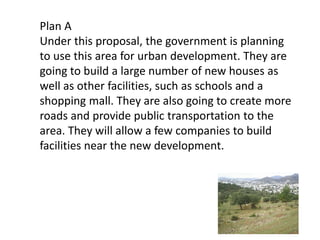
Plan A
Under this proposal, the government is planning
to use this area for urban development. They are
going to build a large number of new houses as
well as other facilities, such as schools and a
shopping mall. They are also going to create more
roads and provide public transportation to the
area. They will allow a few companies to build
facilities near the new development.
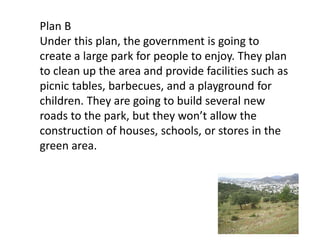
Plan B
Under this plan, the government is going to
create a large park for people to enjoy. They plan
to clean up the area and provide facilities such as
picnic tables, barbecues, and a playground for
children. They are going to build several new
roads to the park, but they won’t allow the
construction of houses, schools, or stores in the
green area.
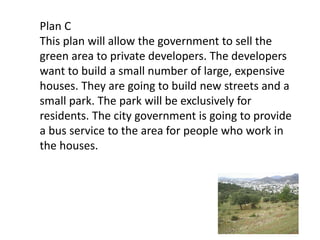
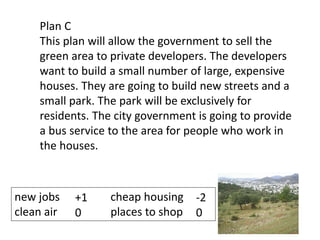
Plan C
This plan will allow the government to sell the
green area to private developers. The developers
want to build a small number of large, expensive
houses. They are going to build new streets and a
small park. The park will be exclusively for
residents. The city government is going to provide
a bus service to the area for people who work in
the houses.
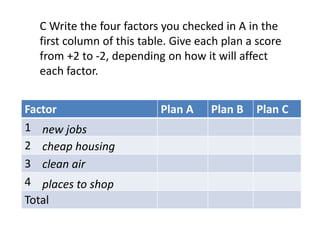
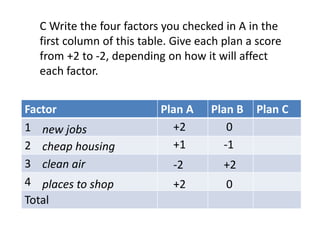
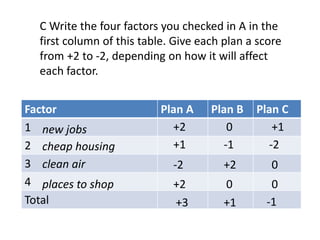
C Write the four factors you checked in A in the
first column of this table. Give each plan a score
from +2 to -2, depending on how it will affect
each factor.
Factor Plan A Plan B Plan C
1
2
3
4
Total
new jobs
cheap housing
clean air
places to shop
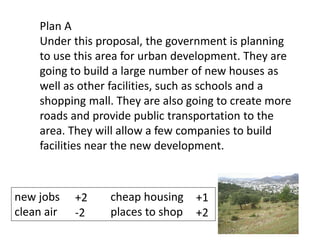
Plan A
Under this proposal, the government is planning
to use this area for urban development. They are
going to build a large number of new houses as
well as other facilities, such as schools and a
shopping mall. They are also going to create more
roads and provide public transportation to the
area. They will allow a few companies to build
facilities near the new development.
new jobs cheap housing
clean air places to shop
+2
-2
+1
+2
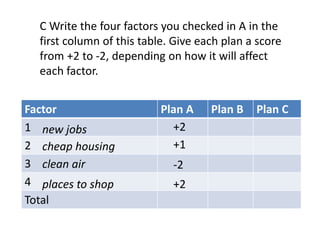
C Write the four factors you checked in A in the
first column of this table. Give each plan a score
from +2 to -2, depending on how it will affect
each factor.
Factor Plan A Plan B Plan C
1
2
3
4
Total
new jobs
cheap housing
clean air
places to shop
+2
+1
-2
+2
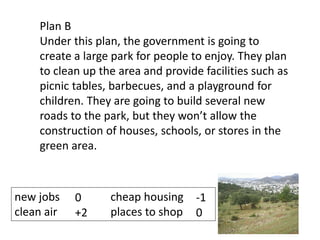
Plan B
Under this plan, the government is going to
create a large park for people to enjoy. They plan
to clean up the area and provide facilities such as
picnic tables, barbecues, and a playground for
children. They are going to build several new
roads to the park, but they won’t allow the
construction of houses, schools, or stores in the
green area.
new jobs cheap housing
clean air places to shop
0
+2
-1
0
C Write the four factors you checked in A in the
first column of this table. Give each plan a score
from +2 to -2, depending on how it will affect
each factor.
Factor Plan A Plan B Plan C
1
2
3
4
Total
new jobs
cheap housing
clean air
places to shop
+2
+1
-2
+2
0
-1
+2
0
Plan C
This plan will allow the government to sell the
green area to private developers. The developers
want to build a small number of large, expensive
houses. They are going to build new streets and a
small park. The park will be exclusively for
residents. The city government is going to provide
a bus service to the area for people who work in
the houses.
new jobs cheap housing
clean air places to shop
+1
0
-2
0
C Write the four factors you checked in A in the
first column of this table. Give each plan a score
from +2 to -2, depending on how it will affect
each factor.
Factor Plan A Plan B Plan C
1
2
3
4
Total
new jobs
cheap housing
clean air
places to shop
+2
+1
-2
+2
0
-1
+2
0
+1
-2
0
0
+3 +1 -1
Target skill:
analyzing assumptions
In critical thinking, ‘assumptions’ refers to anything that is taken
for granted in the presentation of an argument. These may be
facts, ideas or beliefs that are not stated explicitly but which
underlie the argument. Without them, the same conclusion
would not be possible.
Stella Cottrell, Critical Thinking Skills (Palgrave, 2005)
Target skill:
analyzing assumptions
Context
Intermediate / Upper Intermediate
Possible grammar links:
present deductions (must be, might be, could be, can’t be)
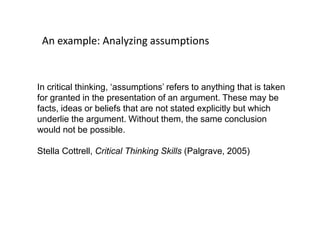
An example: Analyzing assumptions
In critical thinking, ‘assumptions’ refers to anything that is taken
for granted in the presentation of an argument. These may be
facts, ideas or beliefs that are not stated explicitly but which
underlie the argument. Without them, the same conclusion
would not be possible.
Stella Cottrell, Critical Thinking Skills (Palgrave, 2005)
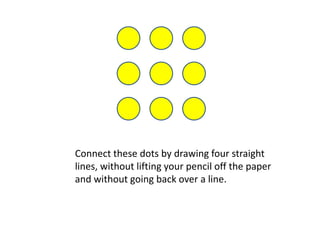
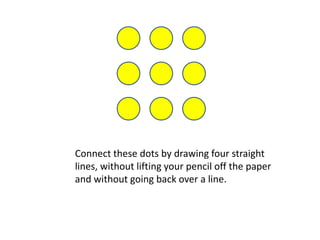
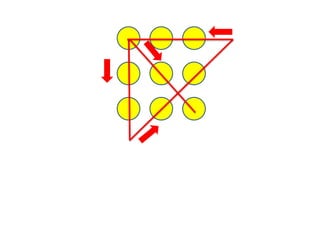
Connect these dots by drawing four straight
lines, without lifting your pencil off the paper
and without going back over a line.
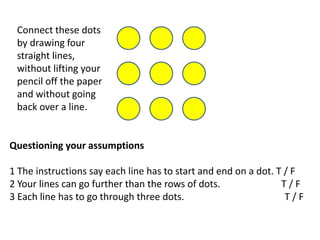
Connect these dots
by drawing four
straight lines,
without lifting your
pencil off the paper
and without going
back over a line.
Questioning your assumptions
1 The instructions say each line has to start and end on a dot. T / F
2 Your lines can go further than the rows of dots. T / F
3 Each line has to go through three dots. T / F
Connect these dots by drawing four straight
lines, without lifting your pencil off the paper
and without going back over a line.
Study, Work, Life: developing
transferable skills across domains
Steve Taylore-Knowles
http://www.facebook.com/STK01

Steve Taylore-Knowles ‘Exploring Life Skills with Open Mind’

  • 1.
    Study, Work, Life:developing transferable skills across domains Steve Taylore-Knowles
  • 2.
    today’s young adults... aged approx. 18-25: born between 1988 and 1995
  • 3.
    aged approx. 18-25:born between 1988 and 1995 ‘Generation Y’ ‘Echo Boomers’ ‘the Millennials’ ‘Generation Next’ ‘the Net Generation’ ‘Generation 9/11’ ‘Boomerang Generation’ (parasaito shinguru) ‘Peter Pan Generation’ ‘€700 Generation’ ‘the Precarious Generation’ ‘Generation Flux’ today’s young adults ...
  • 4.
    What is theworld like for today’s young adults (millenials)? Telefonica Global Millennial Survey, 2013
  • 5.
    ‘How employable aretoday’s graduates?’
  • 6.
    Percentage of employersrating as important: the right academic qualifications the ability to appreciate an alternative point of view communication and the ability to work in teams the ability to grasp complex information 27% 42% 62% 68% Source: GRADdirect
  • 7.
    Employers who feelthat graduates lack ‘soft skills’, including the ability to communicate effectively 55% Also highlighted as concerns are an employee’s ability to: manage their own learning solve problems be motivated Graduate Recruitment Surveyy, Association of Graduate Recruiters
  • 8.
    University of WarwickPodcast (extract) ‘How employable are today’s graduates?’ Professors Kate Purcel and Peter Elias from the University of Warwick Institute of Employment Research
  • 9.
    Top ten skillsthat employers want University of Kent study of multiple surveys
  • 10.
    Top ten skillsthat employers want 1 Verbal communication 2 Teamwork 3 Commercial awareness 4 Analysing and investigating 5 Initiative / Self-motivation 6 Drive 7 Written communication 8 Planning & organising 9 Flexibility 10 Time management University of Kent study of multiple surveys
  • 11.
    Other skills seenas important global skills negotiating & persuading leadership numeracy computing skills self-awareness confidence lifelong learning stress tolerance integrity independence developing professionalism action planning decision-making interpersonal sensitivity creativity University of Kent study of multiple surveys
  • 12.
    The Importance ofSoft Skills in Entry-Level Employment and Postsecondary Success: Perspectives from Employers and Community Colleges, Seattle Jobs Initiative 2013
  • 13.
    Skills lacking amongjob applicants UK Commission for Employment and Skills Report, 2014
  • 14.
    The Importance ofSoft Skills in Entry-Level Employment and Postsecondary Success: Perspectives from Employers and Community Colleges, Seattle Jobs Initiative 2013
  • 15.
  • 16.
    psychosocial and interpersonalskills generally considered important UNICEF
  • 17.
    personal management andsocial skills which are necessary for adequate functioning on an independent basis International Bureau of Education
  • 18.
    Life skills educationis designed to facilitate the practice and reinforcement of psychosocial skills in a culturally and developmentally appropriate way; it contributes to the promotion of personal and social development, the prevention of health and social problems, and the protection of human rights. World Health Organisation
  • 19.
    It is evidentthat in addition to practical and vocational skills, other types of skills such as social, individual and reflective skills are also needed. Life skills programmes emphasise abilities that help to facilitate communication, negotiation, to think critically and solve problems and make independent decisions. Madhu Singh, UNESCO Institute for Education
  • 20.
    Work and CareerStudy and Learning Self and Society Life skills are the key skills you need to be effective in your work life, your academic life and your social life.
  • 21.
    Life skills arethe key skills you need to be effective in your work life, your academic life and your social life. Young people need to be prepared for flexible careers, and need to develop the skills that employers value. (Work and Career) Young people need to develop autonomy and responsibility for their own learning. (Study and Learning) Young people need to express themselves and find personal fulfilment in an increasingly-connected, global, social world. (Self and Society)
  • 24.
    But I’m anEnglish teacher! I teach English!
  • 25.
    You should bedeveloping life skills in your English classroom because …
  • 26.
    You should bedeveloping life skills in your English classroom because … - English alone is no longer enough
  • 27.
    … as Englishbecomes more generally available, little or no competitive advantage is gained by adopting it. Rather, it has become a new baseline: without English you are not even in the race. David Graddol English Next (2006) British Council
  • 28.
    You should bedeveloping life skills in your English classroom because … - English alone is no longer enough - communication skills are key
  • 29.
    You should bedeveloping life skills in your English classroom because … - English alone is no longer enough - communication skills are key - many lifeskills are culturally and linguistically dependent
  • 30.
    You should bedeveloping life skills in your English classroom because … - English alone is no longer enough - communication skills are key - many lifeskills are culturally and linguistically dependent - it’s the expertise teachers already possess
  • 36.
    Target skill: evaluating differentplans Context Pre-Intermediate / Intermediate Possible grammar links: modals of possibility / prediction (may, might, will, could) will / going to
  • 37.
    Target skill: evaluating differentplans • Establish which factors are important. • Evaluate how each plan affects these factors. • Rank the plans. (Decision matrix)
  • 38.
    A Work ingroups. Think about the people who live in your town/city. Which of these factors are most important for them? Check four. new jobs places to enjoy nature good roads cheap housing good schools clean air good public transportation places to shop    
  • 39.
    B Your town/citygovernment is considering three development plans for the green area in the picture. Read the information about each plan.
  • 40.
    Plan A Under thisproposal, the government is planning to use this area for urban development. They are going to build a large number of new houses as well as other facilities, such as schools and a shopping mall. They are also going to create more roads and provide public transportation to the area. They will allow a few companies to build facilities near the new development.
  • 41.
    Plan B Under thisplan, the government is going to create a large park for people to enjoy. They plan to clean up the area and provide facilities such as picnic tables, barbecues, and a playground for children. They are going to build several new roads to the park, but they won’t allow the construction of houses, schools, or stores in the green area.
  • 42.
    Plan C This planwill allow the government to sell the green area to private developers. The developers want to build a small number of large, expensive houses. They are going to build new streets and a small park. The park will be exclusively for residents. The city government is going to provide a bus service to the area for people who work in the houses.
  • 43.
    C Write thefour factors you checked in A in the first column of this table. Give each plan a score from +2 to -2, depending on how it will affect each factor. Factor Plan A Plan B Plan C 1 2 3 4 Total new jobs cheap housing clean air places to shop
  • 44.
    Plan A Under thisproposal, the government is planning to use this area for urban development. They are going to build a large number of new houses as well as other facilities, such as schools and a shopping mall. They are also going to create more roads and provide public transportation to the area. They will allow a few companies to build facilities near the new development. new jobs cheap housing clean air places to shop +2 -2 +1 +2
  • 45.
    C Write thefour factors you checked in A in the first column of this table. Give each plan a score from +2 to -2, depending on how it will affect each factor. Factor Plan A Plan B Plan C 1 2 3 4 Total new jobs cheap housing clean air places to shop +2 +1 -2 +2
  • 46.
    Plan B Under thisplan, the government is going to create a large park for people to enjoy. They plan to clean up the area and provide facilities such as picnic tables, barbecues, and a playground for children. They are going to build several new roads to the park, but they won’t allow the construction of houses, schools, or stores in the green area. new jobs cheap housing clean air places to shop 0 +2 -1 0
  • 47.
    C Write thefour factors you checked in A in the first column of this table. Give each plan a score from +2 to -2, depending on how it will affect each factor. Factor Plan A Plan B Plan C 1 2 3 4 Total new jobs cheap housing clean air places to shop +2 +1 -2 +2 0 -1 +2 0
  • 48.
    Plan C This planwill allow the government to sell the green area to private developers. The developers want to build a small number of large, expensive houses. They are going to build new streets and a small park. The park will be exclusively for residents. The city government is going to provide a bus service to the area for people who work in the houses. new jobs cheap housing clean air places to shop +1 0 -2 0
  • 49.
    C Write thefour factors you checked in A in the first column of this table. Give each plan a score from +2 to -2, depending on how it will affect each factor. Factor Plan A Plan B Plan C 1 2 3 4 Total new jobs cheap housing clean air places to shop +2 +1 -2 +2 0 -1 +2 0 +1 -2 0 0 +3 +1 -1
  • 50.
    Target skill: analyzing assumptions Incritical thinking, ‘assumptions’ refers to anything that is taken for granted in the presentation of an argument. These may be facts, ideas or beliefs that are not stated explicitly but which underlie the argument. Without them, the same conclusion would not be possible. Stella Cottrell, Critical Thinking Skills (Palgrave, 2005)
  • 51.
    Target skill: analyzing assumptions Context Intermediate/ Upper Intermediate Possible grammar links: present deductions (must be, might be, could be, can’t be)
  • 52.
    An example: Analyzingassumptions In critical thinking, ‘assumptions’ refers to anything that is taken for granted in the presentation of an argument. These may be facts, ideas or beliefs that are not stated explicitly but which underlie the argument. Without them, the same conclusion would not be possible. Stella Cottrell, Critical Thinking Skills (Palgrave, 2005)
  • 53.
    Connect these dotsby drawing four straight lines, without lifting your pencil off the paper and without going back over a line.
  • 54.
    Connect these dots bydrawing four straight lines, without lifting your pencil off the paper and without going back over a line. Questioning your assumptions 1 The instructions say each line has to start and end on a dot. T / F 2 Your lines can go further than the rows of dots. T / F 3 Each line has to go through three dots. T / F
  • 55.
    Connect these dotsby drawing four straight lines, without lifting your pencil off the paper and without going back over a line.
  • 57.
    Study, Work, Life:developing transferable skills across domains Steve Taylore-Knowles http://www.facebook.com/STK01