
PET
(Preliminary English Test)
What is it for?
•Do this test if you want to know that you have an
intermediate level of English.
Exam format
Paper Content Marks
(% of total)
Purpose
Reading and Writing
(1 hour 30 minutes)
Reading:
5 parts/
35questions
Writing:
3 parts/
7questions
50% Shows you can read and understand the main points from signs,
newspapers and magazines, and can use vocabulary and structure
correctly.
Listening
(36 minutes, including 6
minutes' transfer time)
4 parts/
25questions
25% You have to be able to follow and understand a range of spoken
materials including announcements and discussions about
everyday life.
Speaking
(10–12 minutes per pair of
candidates)
4 parts 25% Shows how good your spoken English is as you take part in
conversation by asking/answering questions and talking, for
example, about your likes and dislikes. Your Speaking test will be
conducted face to face with one or two other candidates and two
examiners. This makes your test more realistic and more reliable.
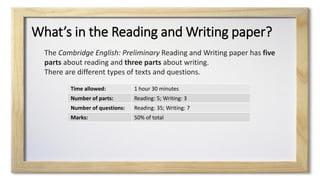
What’s in the Reading and Writing paper?
Time allowed: 1 hour 30 minutes
Number of parts: Reading: 5; Writing: 3
Number of questions: Reading: 35; Writing: 7
Marks: 50% of total
The Cambridge English: Preliminary Reading and Writing paper has five
parts about reading and three parts about writing.
There are different types of texts and questions.
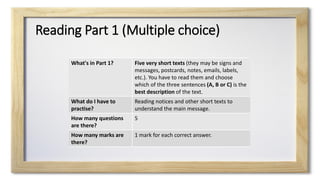
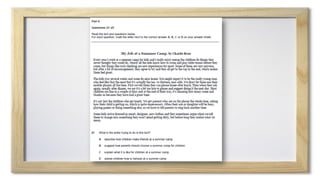
Reading Part 1 (Multiple choice)
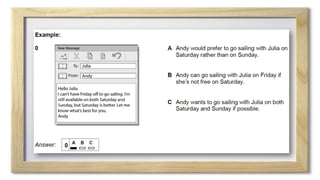
What's in Part 1? Five very short texts (they may be signs and
messages, postcards, notes, emails, labels,
etc.). You have to read them and choose
which of the three sentences (A, B or C) is the
best description of the text.
What do I have to
practise?
Reading notices and other short texts to
understand the main message.
How many questions
are there?
5
How many marks are
there?
1 mark for each correct answer.
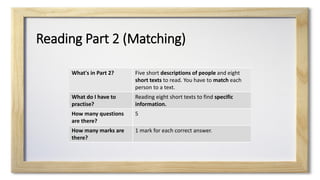
Reading Part 2 (Matching)
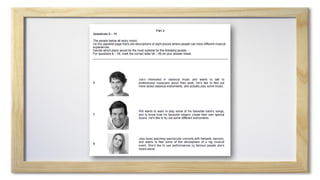
What's in Part 2? Five short descriptions of people and eight
short texts to read. You have to match each
person to a text.
What do I have to
practise?
Reading eight short texts to find specific
information.
How many questions
are there?
5
How many marks are
there?
1 mark for each correct answer.
Reading Part 3 (True/False)
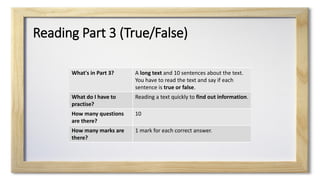
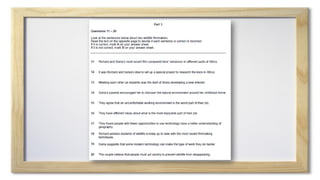
What's in Part 3? A long text and 10 sentences about the text.
You have to read the text and say if each
sentence is true or false.
What do I have to
practise?
Reading a text quickly to find out information.
How many questions
are there?
10
How many marks are
there?
1 mark for each correct answer.
Reading Part 4 (Multiple choice)
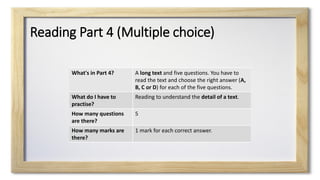
What's in Part 4? A long text and five questions. You have to
read the text and choose the right answer (A,
B, C or D) for each of the five questions.
What do I have to
practise?
Reading to understand the detail of a text.
How many questions
are there?
5
How many marks are
there?
1 mark for each correct answer.
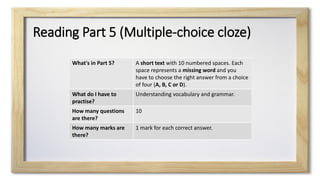
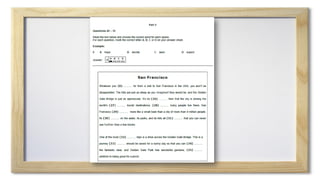
Reading Part 5 (Multiple-choice cloze)
What's in Part 5? A short text with 10 numbered spaces. Each
space represents a missing word and you
have to choose the right answer from a choice
of four (A, B, C or D).
What do I have to
practise?
Understanding vocabulary and grammar.
How many questions
are there?
10
How many marks are
there?
1 mark for each correct answer.
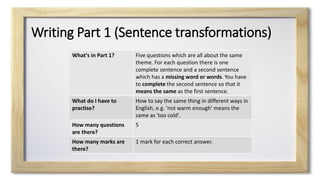
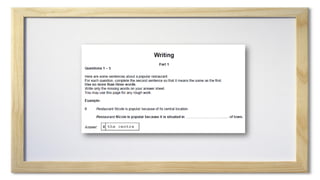
Writing Part 1 (Sentence transformations)
What's in Part 1? Five questions which are all about the same
theme. For each question there is one
complete sentence and a second sentence
which has a missing word or words. You have
to complete the second sentence so that it
means the same as the first sentence.
What do I have to
practise?
How to say the same thing in different ways in
English, e.g. 'not warm enough' means the
same as 'too cold'.
How many questions
are there?
5
How many marks are
there?
1 mark for each correct answer.
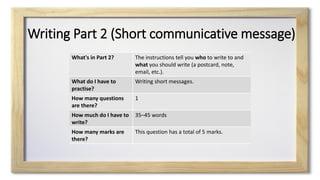
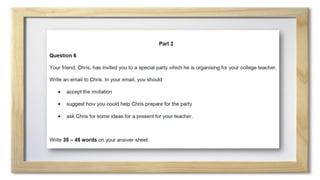
Writing Part 2 (Short communicative message)
What's in Part 2? The instructions tell you who to write to and
what you should write (a postcard, note,
email, etc.).
What do I have to
practise?
Writing short messages.
How many questions
are there?
1
How much do I have to
write?
35–45 words
How many marks are
there?
This question has a total of 5 marks.
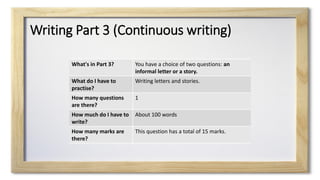
Writing Part 3 (Continuous writing)
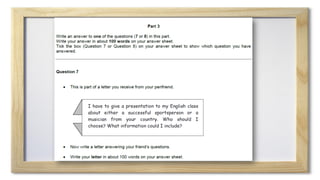
What's in Part 3? You have a choice of two questions: an
informal letter or a story.
What do I have to
practise?
Writing letters and stories.
How many questions
are there?
1
How much do I have to
write?
About 100 words
How many marks are
there?
This question has a total of 15 marks.
What’s in the Listening paper?
Time allowed: 36 minutes, including 6 minutes to copy your
answers onto the answer sheet.
Number of parts: 4
Number of questions: 25
Marks: 25% of total
The Cambridge English: Preliminary Listening paper has four parts. For
each part, you have to listen to a recorded text or texts and answer
some questions. You hear each recording twice.
Part 1 (Multiple choice)
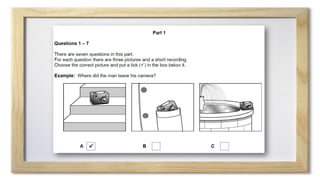
What's in Part 1? Seven short recordings. For each recording
there is a question and three pictures (A, B or
C). You have to listen to the recordings and
choose the right answers.
What do I have to
practise?
Listening to find key information.
How many questions
are there?
7
How many marks are
there?
One mark for each correct answer.
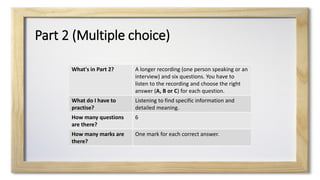
Part 2 (Multiple choice)
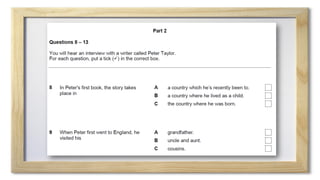
What's in Part 2? A longer recording (one person speaking or an
interview) and six questions. You have to
listen to the recording and choose the right
answer (A, B or C) for each question.
What do I have to
practise?
Listening to find specific information and
detailed meaning.
How many questions
are there?
6
How many marks are
there?
One mark for each correct answer.
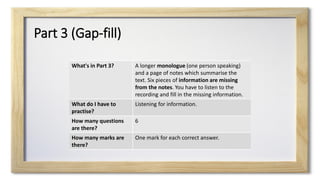
Part 3 (Gap-fill)
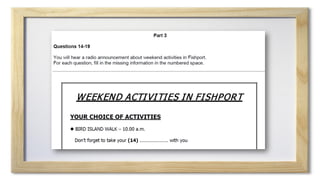
What's in Part 3? A longer monologue (one person speaking)
and a page of notes which summarise the
text. Six pieces of information are missing
from the notes. You have to listen to the
recording and fill in the missing information.
What do I have to
practise?
Listening for information.
How many questions
are there?
6
How many marks are
there?
One mark for each correct answer.
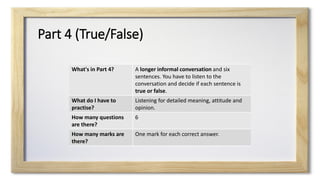
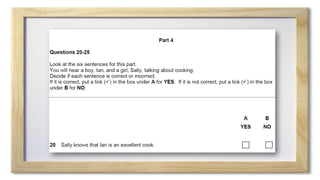
Part 4 (True/False)
What's in Part 4? A longer informal conversation and six
sentences. You have to listen to the
conversation and decide if each sentence is
true or false.
What do I have to
practise?
Listening for detailed meaning, attitude and
opinion.
How many questions
are there?
6
How many marks are
there?
One mark for each correct answer.
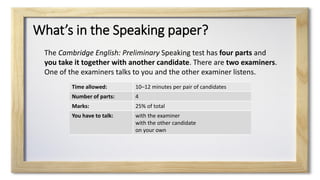
What’s in the Speaking paper?
The Cambridge English: Preliminary Speaking test has four parts and
you take it together with another candidate. There are two examiners.
One of the examiners talks to you and the other examiner listens.
Time allowed: 10–12 minutes per pair of candidates
Number of parts: 4
Marks: 25% of total
You have to talk: with the examiner
with the other candidate
on your own
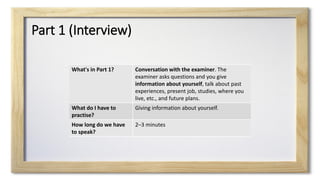
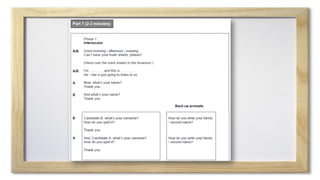
Part 1 (Interview)
What's in Part 1? Conversation with the examiner. The
examiner asks questions and you give
information about yourself, talk about past
experiences, present job, studies, where you
live, etc., and future plans.
What do I have to
practise?
Giving information about yourself.
How long do we have
to speak?
2–3 minutes
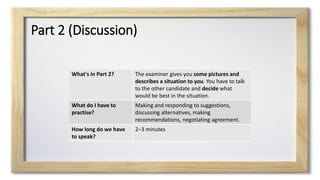
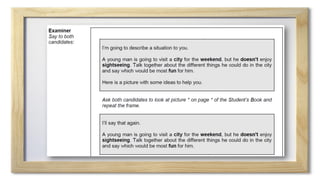
Part 2 (Discussion)
What's in Part 2? The examiner gives you some pictures and
describes a situation to you. You have to talk
to the other candidate and decide what
would be best in the situation.
What do I have to
practise?
Making and responding to suggestions,
discussing alternatives, making
recommendations, negotiating agreement.
How long do we have
to speak?
2–3 minutes
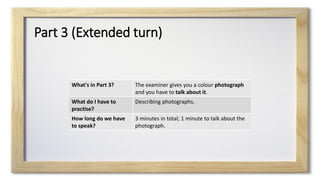
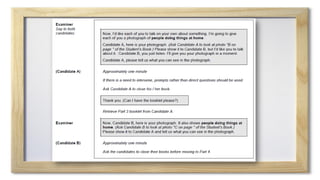
Part 3 (Extended turn)
What's in Part 3? The examiner gives you a colour photograph
and you have to talk about it.
What do I have to
practise?
Describing photographs.
How long do we have
to speak?
3 minutes in total; 1 minute to talk about the
photograph.
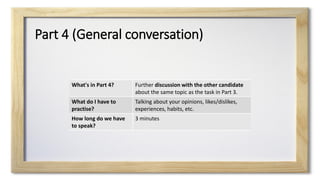
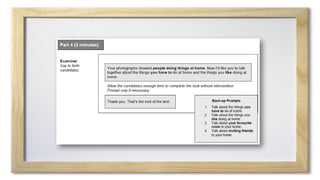
Part 4 (General conversation)
What's in Part 4? Further discussion with the other candidate
about the same topic as the task in Part 3.
What do I have to
practise?
Talking about your opinions, likes/dislikes,
experiences, habits, etc.
How long do we have
to speak?
3 minutes
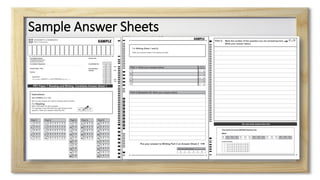
Sample Answer Sheets
This is it!

PET guidelines

  • 1.
  • 2.
    What is itfor? •Do this test if you want to know that you have an intermediate level of English.
  • 3.
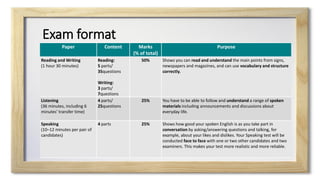
    Exam format Paper ContentMarks (% of total) Purpose Reading and Writing (1 hour 30 minutes) Reading: 5 parts/ 35questions Writing: 3 parts/ 7questions 50% Shows you can read and understand the main points from signs, newspapers and magazines, and can use vocabulary and structure correctly. Listening (36 minutes, including 6 minutes' transfer time) 4 parts/ 25questions 25% You have to be able to follow and understand a range of spoken materials including announcements and discussions about everyday life. Speaking (10–12 minutes per pair of candidates) 4 parts 25% Shows how good your spoken English is as you take part in conversation by asking/answering questions and talking, for example, about your likes and dislikes. Your Speaking test will be conducted face to face with one or two other candidates and two examiners. This makes your test more realistic and more reliable.
  • 4.
    What’s in theReading and Writing paper? Time allowed: 1 hour 30 minutes Number of parts: Reading: 5; Writing: 3 Number of questions: Reading: 35; Writing: 7 Marks: 50% of total The Cambridge English: Preliminary Reading and Writing paper has five parts about reading and three parts about writing. There are different types of texts and questions.
  • 5.
    Reading Part 1(Multiple choice) What's in Part 1? Five very short texts (they may be signs and messages, postcards, notes, emails, labels, etc.). You have to read them and choose which of the three sentences (A, B or C) is the best description of the text. What do I have to practise? Reading notices and other short texts to understand the main message. How many questions are there? 5 How many marks are there? 1 mark for each correct answer.
  • 7.
    Reading Part 2(Matching) What's in Part 2? Five short descriptions of people and eight short texts to read. You have to match each person to a text. What do I have to practise? Reading eight short texts to find specific information. How many questions are there? 5 How many marks are there? 1 mark for each correct answer.
  • 9.
    Reading Part 3(True/False) What's in Part 3? A long text and 10 sentences about the text. You have to read the text and say if each sentence is true or false. What do I have to practise? Reading a text quickly to find out information. How many questions are there? 10 How many marks are there? 1 mark for each correct answer.
  • 11.
    Reading Part 4(Multiple choice) What's in Part 4? A long text and five questions. You have to read the text and choose the right answer (A, B, C or D) for each of the five questions. What do I have to practise? Reading to understand the detail of a text. How many questions are there? 5 How many marks are there? 1 mark for each correct answer.
  • 13.
    Reading Part 5(Multiple-choice cloze) What's in Part 5? A short text with 10 numbered spaces. Each space represents a missing word and you have to choose the right answer from a choice of four (A, B, C or D). What do I have to practise? Understanding vocabulary and grammar. How many questions are there? 10 How many marks are there? 1 mark for each correct answer.
  • 15.
    Writing Part 1(Sentence transformations) What's in Part 1? Five questions which are all about the same theme. For each question there is one complete sentence and a second sentence which has a missing word or words. You have to complete the second sentence so that it means the same as the first sentence. What do I have to practise? How to say the same thing in different ways in English, e.g. 'not warm enough' means the same as 'too cold'. How many questions are there? 5 How many marks are there? 1 mark for each correct answer.
  • 17.
    Writing Part 2(Short communicative message) What's in Part 2? The instructions tell you who to write to and what you should write (a postcard, note, email, etc.). What do I have to practise? Writing short messages. How many questions are there? 1 How much do I have to write? 35–45 words How many marks are there? This question has a total of 5 marks.
  • 19.
    Writing Part 3(Continuous writing) What's in Part 3? You have a choice of two questions: an informal letter or a story. What do I have to practise? Writing letters and stories. How many questions are there? 1 How much do I have to write? About 100 words How many marks are there? This question has a total of 15 marks.
  • 21.
    What’s in theListening paper? Time allowed: 36 minutes, including 6 minutes to copy your answers onto the answer sheet. Number of parts: 4 Number of questions: 25 Marks: 25% of total The Cambridge English: Preliminary Listening paper has four parts. For each part, you have to listen to a recorded text or texts and answer some questions. You hear each recording twice.
  • 22.
    Part 1 (Multiplechoice) What's in Part 1? Seven short recordings. For each recording there is a question and three pictures (A, B or C). You have to listen to the recordings and choose the right answers. What do I have to practise? Listening to find key information. How many questions are there? 7 How many marks are there? One mark for each correct answer.
  • 24.
    Part 2 (Multiplechoice) What's in Part 2? A longer recording (one person speaking or an interview) and six questions. You have to listen to the recording and choose the right answer (A, B or C) for each question. What do I have to practise? Listening to find specific information and detailed meaning. How many questions are there? 6 How many marks are there? One mark for each correct answer.
  • 26.
    Part 3 (Gap-fill) What'sin Part 3? A longer monologue (one person speaking) and a page of notes which summarise the text. Six pieces of information are missing from the notes. You have to listen to the recording and fill in the missing information. What do I have to practise? Listening for information. How many questions are there? 6 How many marks are there? One mark for each correct answer.
  • 28.
    Part 4 (True/False) What'sin Part 4? A longer informal conversation and six sentences. You have to listen to the conversation and decide if each sentence is true or false. What do I have to practise? Listening for detailed meaning, attitude and opinion. How many questions are there? 6 How many marks are there? One mark for each correct answer.
  • 30.
    What’s in theSpeaking paper? The Cambridge English: Preliminary Speaking test has four parts and you take it together with another candidate. There are two examiners. One of the examiners talks to you and the other examiner listens. Time allowed: 10–12 minutes per pair of candidates Number of parts: 4 Marks: 25% of total You have to talk: with the examiner with the other candidate on your own
  • 31.
    Part 1 (Interview) What'sin Part 1? Conversation with the examiner. The examiner asks questions and you give information about yourself, talk about past experiences, present job, studies, where you live, etc., and future plans. What do I have to practise? Giving information about yourself. How long do we have to speak? 2–3 minutes
  • 33.
    Part 2 (Discussion) What'sin Part 2? The examiner gives you some pictures and describes a situation to you. You have to talk to the other candidate and decide what would be best in the situation. What do I have to practise? Making and responding to suggestions, discussing alternatives, making recommendations, negotiating agreement. How long do we have to speak? 2–3 minutes
  • 35.
    Part 3 (Extendedturn) What's in Part 3? The examiner gives you a colour photograph and you have to talk about it. What do I have to practise? Describing photographs. How long do we have to speak? 3 minutes in total; 1 minute to talk about the photograph.
  • 37.
    Part 4 (Generalconversation) What's in Part 4? Further discussion with the other candidate about the same topic as the task in Part 3. What do I have to practise? Talking about your opinions, likes/dislikes, experiences, habits, etc. How long do we have to speak? 3 minutes
  • 39.
  • 40.