Things to take into account
when writing
by Nina Dearle
Answer the question
1. Read the question carefully. It can be
your guide to how to organize your answer.
An essay question should have at least 3
paragraphs and a topic sentence. Form a
thesis sentence before you start and stick
to it. Be sure you stick to the question,
and don’t digress to something that was
not asked. Answer the entire question.
Choose important points. You can’t say it
all.
2. Give yourself a few minutes before
you begin to make a scratchy outline
and to think about what you are going
to say. Write down key words or make
a rough outline to trigger your memory.
Then you can take the pressure off
yourself to remember and write the
same time. As you have little brain
storms and remember things, add them
to your outline. I promise that in the
long run this method saves time and
produces more coherent essays.
Dr. Sara N. James Art History Study Guide
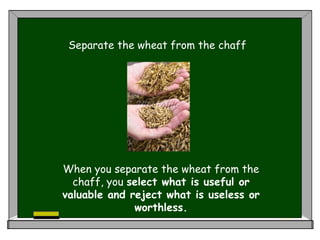
Separate the wheat from the chaff
When you separate the wheat from the
chaff, you select what is useful or
valuable and reject what is useless or
worthless.
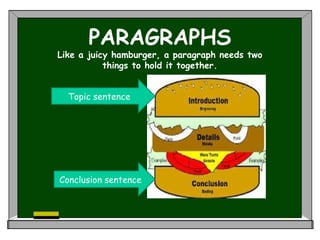
PARAGRAPHS
Like a juicy hamburger, a paragraph needs two
things to hold it together.
Topic sentence
Conclusion sentence
Paragraphs
 A paragraph is a group
of related sentences
that develops one main
idea.  Although there is
no definite length for a
paragraph, it is often
from five to twelve
sentences long.
 Clearly indent the first
word of every paragraph
about 1 inch (5 spaces).
 Most paragraphs
contain one main idea
to which all the
sentences relate.
 The topic sentence
states this main idea.
 The body of the
paragraph develops
and supports this
main idea with
particular facts,
details, and examples.
ELEMENTS OF STYLE
 CHOICE OF WORDS
Good writers are concise
and precise, weeding
out unnecessary words
and choosing the
exact word to convey
meaning.
 CHOICE OF STRUCTURE
A good writer varies
structures to hold the
readers' attention.
Writing the same types of
sentences with the same
structures over and over
and over and over makes
for dull writing
In this context, "domestic issues" and
"foreign policy" are used in a general sense in
the first sentence. The writer then
elaborates by clarifying specific kinds of
issues ("welfare reform" and "peace in the
middle east") referred to by the more
general terms in the earlier sentence.
SPECIFIC AND GENERAL WORDS
The president's knowledge of domestic issues is
superior to his understanding of foreign policy. He has
been more successful with welfare reform, for
example, than with peace in the Middle East.
http://www.wwnorton.com/college/english/write/we/ch5/19b.htm
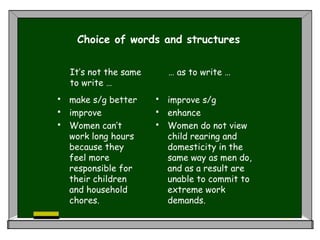
Choice of words and structures
 make s/g better
 improve
 Women can’t
work long hours
because they
feel more
responsible for
their children
and household
chores.
 improve s/g
 enhance
 Women do not view
child rearing and
domesticity in the
same way as men do,
and as a result are
unable to commit to
extreme work
demands.
It’s not the same
to write …
… as to write …
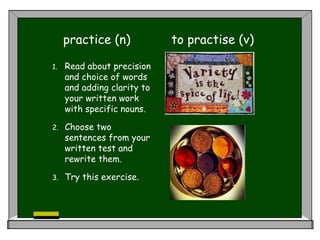
practice (n) to practise (v)
1. Read about
precision and choice of words
and adding clarity to
your written work
with specific nouns.
2. Choose two
sentences from your
written test and
rewrite them.
3. Try this exercise.
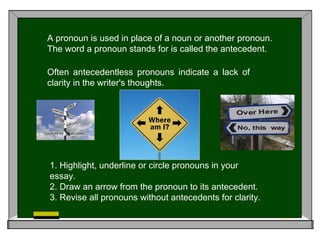
A pronoun is used in place of a noun or another pronoun.
The word a pronoun stands for is called the antecedent.
Often antecedentless pronouns indicate a lack of
clarity in the writer's thoughts.
1. Highlight, underline or circle pronouns in your
essay.
2. Draw an arrow from the pronoun to its antecedent.
3. Revise all pronouns without antecedents for clarity.
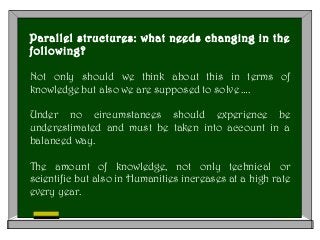
Parallel structures: what needs changing in the
following?
Not only should we think about this in terms of
knowledge but also we are supposed to solve ….
Under no circumstances should experience be
underestimated and must be taken into account in a
balanced way.
The amount of knowledge, not only technical or
scientific but also in Humanities increases at a high rate
every year.

Writing tips revised

  • 1.
    Things to takeinto account when writing by Nina Dearle
  • 2.
    Answer the question 1.Read the question carefully. It can be your guide to how to organize your answer. An essay question should have at least 3 paragraphs and a topic sentence. Form a thesis sentence before you start and stick to it. Be sure you stick to the question, and don’t digress to something that was not asked. Answer the entire question. Choose important points. You can’t say it all.
  • 3.
    2. Give yourselfa few minutes before you begin to make a scratchy outline and to think about what you are going to say. Write down key words or make a rough outline to trigger your memory. Then you can take the pressure off yourself to remember and write the same time. As you have little brain storms and remember things, add them to your outline. I promise that in the long run this method saves time and produces more coherent essays. Dr. Sara N. James Art History Study Guide
  • 4.
    Separate the wheatfrom the chaff When you separate the wheat from the chaff, you select what is useful or valuable and reject what is useless or worthless.
  • 5.
    PARAGRAPHS Like a juicyhamburger, a paragraph needs two things to hold it together. Topic sentence Conclusion sentence
  • 6.
    Paragraphs  A paragraphis a group of related sentences that develops one main idea.  Although there is no definite length for a paragraph, it is often from five to twelve sentences long.  Clearly indent the first word of every paragraph about 1 inch (5 spaces).  Most paragraphs contain one main idea to which all the sentences relate.  The topic sentence states this main idea.  The body of the paragraph develops and supports this main idea with particular facts, details, and examples.
  • 7.
    ELEMENTS OF STYLE CHOICE OF WORDS Good writers are concise and precise, weeding out unnecessary words and choosing the exact word to convey meaning.  CHOICE OF STRUCTURE A good writer varies structures to hold the readers' attention. Writing the same types of sentences with the same structures over and over and over and over makes for dull writing
  • 8.
    In this context,"domestic issues" and "foreign policy" are used in a general sense in the first sentence. The writer then elaborates by clarifying specific kinds of issues ("welfare reform" and "peace in the middle east") referred to by the more general terms in the earlier sentence. SPECIFIC AND GENERAL WORDS The president's knowledge of domestic issues is superior to his understanding of foreign policy. He has been more successful with welfare reform, for example, than with peace in the Middle East. http://www.wwnorton.com/college/english/write/we/ch5/19b.htm
  • 9.
    Choice of wordsand structures  make s/g better  improve  Women can’t work long hours because they feel more responsible for their children and household chores.  improve s/g  enhance  Women do not view child rearing and domesticity in the same way as men do, and as a result are unable to commit to extreme work demands. It’s not the same to write … … as to write …
  • 10.
    practice (n) topractise (v) 1. Read about precision and choice of words and adding clarity to your written work with specific nouns. 2. Choose two sentences from your written test and rewrite them. 3. Try this exercise.
  • 11.
    A pronoun isused in place of a noun or another pronoun. The word a pronoun stands for is called the antecedent. Often antecedentless pronouns indicate a lack of clarity in the writer's thoughts. 1. Highlight, underline or circle pronouns in your essay. 2. Draw an arrow from the pronoun to its antecedent. 3. Revise all pronouns without antecedents for clarity.
  • 12.
    Parallel structures: whatneeds changing in the following? Not only should we think about this in terms of knowledge but also we are supposed to solve …. Under no circumstances should experience be underestimated and must be taken into account in a balanced way. The amount of knowledge, not only technical or scientific but also in Humanities increases at a high rate every year.