Lymphatic leak and
Interventions
Dr. Shobhit Singh
Fellow Radiology
TMC
• Lymphorrhea is a rare but potentially life-
threatening complication that can arise after
surgical procedures.
• Chylothorax caused by damage to the thoracic
duct (TD) or its tributaries can compromise
the immune system and cause nutritional
depletion—with mortality rates of 25%–50%.
• conservative - dietary treatment with total
parenteral nutrition.
• High-output chylothorax (>1000 mL/d) has
usually mandated surgery (surgical TD
ligation).
• But morbidity and mortality rates of 38% and
2.1%.
• Alternative to Sx -- Percutaneous TD
embolization (TDE).
• The standard procedure for TDE 
lymphangiography and transabdominal access
to the TD followed by embolization.
• Recently, magnetic resonance (MR)
lymphangiography and lymphoscintigraphy
have also been used for identification of
anomaly of the TD and the leakage site.
Abdominal lymphorrhea –
1. Lymph without chyle - due to injury of the
aortoiliac and hepatic lymphatic system.
2. With chyle - due to injury of the intestinal
lymphatics,TD, or cisterna chyli.
• In this article –
(a) Anatomic variations in the TD and cisterna
chyli based on clinical importance,
(b) Anatomy of the hepatic lymphatics,
(c) Selection of techniques for
lymphangiography.
(d) Access routes to lymphatics,
(e) Treatment strategies for lymphorrhea.
• The cisterna chyli receives lymph from the
right and left lumbar trunks, hepatic
lymphatics, and intestinal trunk.
• The TD begins at the cisterna chyli and
terminates at the lymphovenous junction
between the TD and systemic vein, adjacent to
the jugulosubclavian angle.
• Both chyle and lymph can leak from any point
along the pathway of the TD, cisterna chyli,
and intestinal lymphatics.
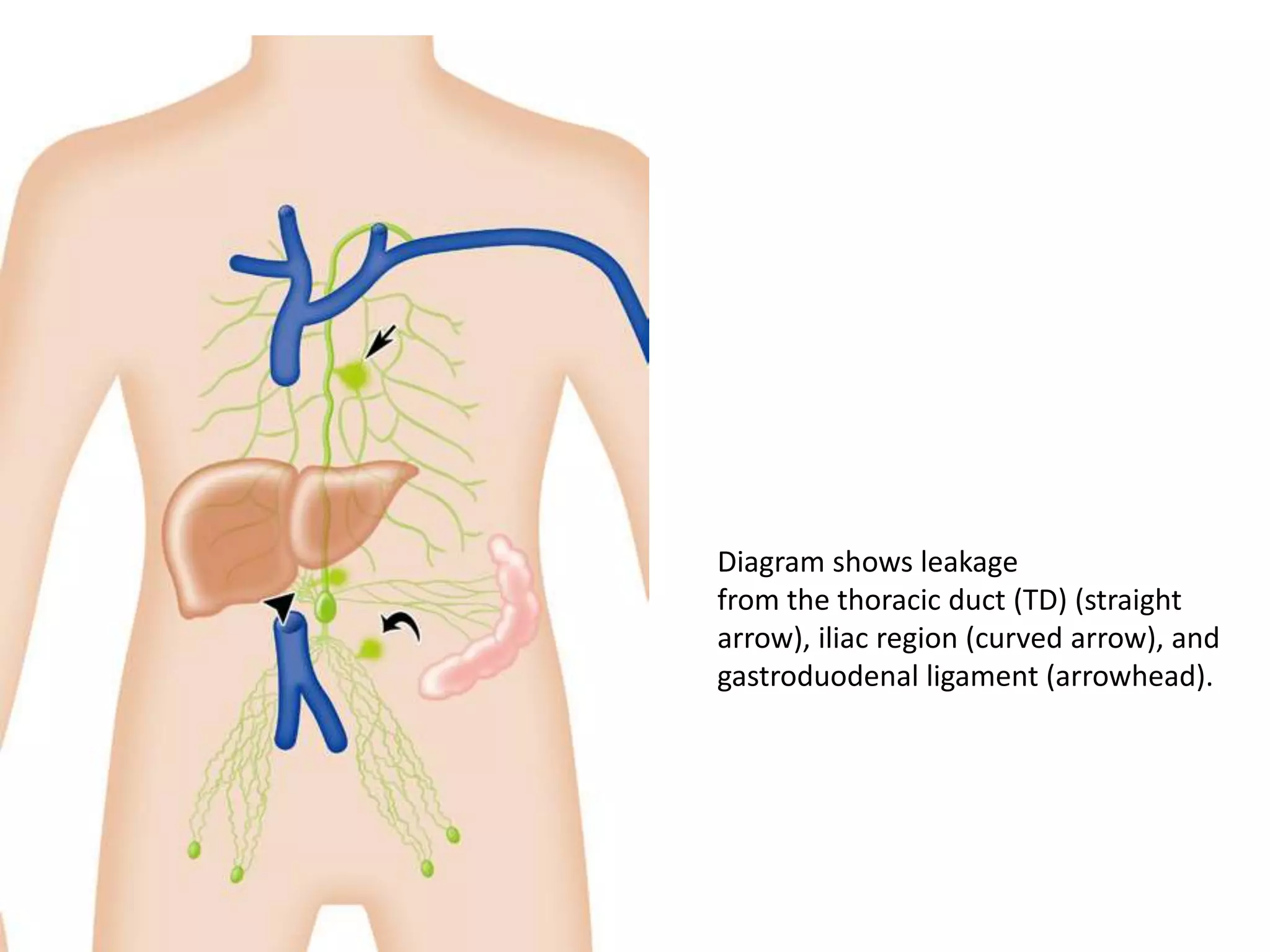
Diagram shows leakage
from the thoracic duct (TD) (straight
arrow), iliac region (curved arrow), and
gastroduodenal ligament (arrowhead).
THORACIC DUCT
• The longest lymphatic duct in the body is the
TD, which can reach up to 45 cm in length.
• Drains lymph and chyle throughout the body
except for the right hemithorax, right head
and neck, and right arm.
• These right lymphatic ducts empty into the
junction of the right subclavian and right
internal jugular veins.
• The TD develops from embryonic right and left
TDs, with multiple communications between
them during early embryogenesis.
• Thereafter, part of the embryonic duct
continues to develop while the other parts
disappear.
• The lower two-thirds and upper one-third of
the adult TD develop from the right and left
embryonic TDs, respectively.
• Johnson et al described the following
anatomic variations of the TD/cisterna chyli.
• The course and location of the TD/cisterna
chyli with respect to the vertebral bodies can
be evaluated using this classification.
Cisterna chyli
TD
T12-L2
T5-T6
NORMAL LEFT SIDED RIGHT SIDED
PROXIMAL DUPLICATION DISTAL DUPLICATION
PLEXIFORM ABSENT CYSTERNA CHYLI
• Left-sided location of the TD/cisterna chyli
requires particular care because it is located
close to or behind the aorta.
• Suspected TD anomalies revealed at
lymphangiography should then be
Comprehensively evaluated with plain CT or
cone-beam CT.
variations in termination of the TD (arrow) in the venous system.
1 = internal jugular vein, 2 = jugulosubclavian angle, 3 = subclavian vein, 4 = other
vein.
• The point of termination in the internal
jugular or subclavian vein is generally within 2
cm of the jugulosubclavian angle.
• An ostial valve at the termination of the TD at
the lymphovenous junction consists of two
long flap-like cusps measuring up to 1 cm in
length and extending obliquely from the wall
of the vein to prevent reflux blood flow.
Anatomy of Hepatic Lymphatics
• The liver normally produces 25%–50% of the
total TD lymphatic fluid.
• The hepatic lymphatic system is divided into
deep and superficial networks.
• The periportal lymphatic tract forms a rich
plexus in the deep system and is responsible
for 80% of hepatic lymph drainage.
• Periportal lymphatics flow toward the hilum
and drain into the hepatic lymph nodes in the
lesser omentum.
• Finally, the efferent lymphatic vessels drain
into the cisterna chyli.
• Therefore, damage to the gastroduodenal
ligament can cause hepatic nonchylous
lymphorrhea.
Lymphangiography Techniques
• Lymphangiography uses iodized oil (Lipiodol).
• Leakage from the iliac, lumbar, or para-aortic
lymphatics or TD/cisterna chyli is suspected, pedal
lymphangiography or intranodal lymphangiography is
useful.
• Leakage from hepatic lymphatics resulting from a
damaged hepatoduodenal ligament can be visualized
only with transhepatic lymphangiography.
Invasive Techniques
Intranodal lymphangiography –
• An inguinal node is directly punctured under US guidance
using a 60-mm, 23-gauge Cathelin needle (terumo) .
• The tip of the needle should be placed at the nodal
hilum.
• Iodized oil is gently injected manually at a rate of about
1–2 mL per 5 minutes under intermittent fluoroscopy.
• TD is visualized approximately 40 minutes after injection
of iodized oil. A total volume of no more than 10 mL of
iodized oil is injected.
Fluoroscopic image obtained
during intranodal
lymphangiography shows a
lymph node as a subtle nodular
stain (arrow), which then follows
lymphatic vessels continuous with
it (arrowheads).
Transhepatic Lymphangiography
• Leakage from hepatic lymphatics is very rare.
• As a consequence of nodal dissection within the
hepatoduodenal ligament.
• Lymphatic vessels form a rich plexus and run parallel
to the portal vein, a 22-gauge Chiba needle should be
advanced parallel to the peripheral portal vein .
• Needle should be placed in the Glisson capsule close
to the branches of the right portal vein.
• A small amount of noniodinated contrast material
should be manually injected while the Chiba needle
is slowly withdrawn under fluoroscopic guidance,
until the hepatic lymphatic channels and leakage are
opacified.
Noninvasive Techniques
Lymphoscintigraphy and SPECT/CT –
• Intradermal or subcutaneous injection of filtered
technetium 99m sulfur colloid, whole-body
lymphoscintigraphy is performed.
• SPECT/CT, which is fusion imaging with both SPECT
and CT, has been used to provide combined
anatomic and functional information more precisely.
MR Lymphangiography –
• T2-weighted MR lymphangiograms.
• T1-weighted dynamic contrast-enhanced MR
lymphangiography (gadopentetate dimeglumine in
an animal study) may become a reliable tool to help
in appropriate treatment planning for chylothorax.
Access Routes to
Lymphatics and Treatment Options
Transabdominal/Translumbar Approach to TD/Cisterna
Chyli –
• First choice when intranodal lymphangiography
confirms normal anatomy.
• Puncture CC/TD with 21-gauge Chiba needle under
fluoroscopic guidance.
• In Right anterior oblique view with caudal angulation,
to avoid penetrating the aorta .
• Advance the wire cranially.
• Chiba needle is then advanced into the TD/cisterna
chyli until penetrating both walls perpendicular to
the flat panel.
• Needle is withdrawn a little, then a guidewire (0.018-
or 0.016-inch) is inserted into the TD and a 2.0-F
microcatheter is advanced over the wire.
• Selective lymphangiography using iodinated contrast
material is performed to detect the site of leakage.
Transabdominal puncture of the TD in chylothorax after esophagectomy. (a) Chiba needle
(arrow) advanced into the cisterna chyli perpendicular to the flat panel.(b) A 2.0-F microcatheter
(arrows) inserted through the cisterna chyli to a level proximal to the leakage point (arrowhead).
In case of anatomic variation –
• plain CT/cone-beam CT to confirm safe and feasible
route.
• A left-sided TD/cisterna chyli or a duplicated TD
located close to or behind the aorta confers the
potential risk of penetrating the aorta during direct
puncture under fluoroscopic guidance.
Thin TD with no cisterna chyli–
• Transabdominal access might be feasible in this
circumstance, but the CT-guided translumbar
approach should be considered.
(a) Diagram shows absence of the cisterna chyli
(arrows) and leakage from the TD
(arrowheads).
Anteroposterior radiograph shows absence of
the cisterna chyli. The TD is thin (arrows) and
runs tortuously (arrowheads).
(c) Image from CT fluoroscopy during puncture
of the TD shows the TD (arrow) and Chiba
needle (arrowhead).
Diagram shows puncture of the tortuous
TD with the Chiba needle (arrow)
Tip of the Chiba needle (black arrow) positioned
in the TD. The course of the TD is tortuous
(white arrows), and leakage from the TD is
visualized (arrowhead).
• When the TD is so thin that it cannot be clearly
visualized with lymphangiography , then can
occasionally be cannulated.
• As the diameter of the TD varies considerably. A
guidewire and microcatheter can be advanced into
the thin TD.
• Selective lymphangiography reveals a dilated TD.
AP lymphangiogram - the cisterna chyli
(arrowhead) and an extremely thin TD (arrows).
Selective thoracic ductography through a
microcatheter (arrowhead) inserted from the
cisterna chyli shows that the TD is dilated
(arrows)
• A microcatheter can be advanced proximal to the
source of a chyle leak after the upper TD is
cannulated.
• The leak can be stopped by embolization from the
source to the cisterna chyli using coils and/or a 2:1
mixture of iodized oil and Nbutyl cyanoacrylate
(NBCA).
• NBCA is mixed with iodized oil to control the polymerization
time and allow visualization with fluoroscopy.
• The speed of NBCA polymerization depends on the rate of
exposure of NBCA to the anions as well as the dilution ratio of
NBCA.
• Owing to relatively stagnant flow in lymphatic vessels, ionic
exposure is significantly less than in blood vessels .
• Therefore, a 2:1 iodized oil/ NBCA dilution provides enough
time for injection.
Embolization of the TD with NBCA (same patient as in Fig
9). Embolization is performed from the leakage point to the
cisterna chyli using a 2:1 mixture of iodized oil and NBCA.
Fluoroscopic image shows a solidified glue tract (*;
between arrows) from the leakage point to the cisterna
chyli.
• When the TD cannot be catheterized due to
tortuosity or other reasons –
• NBCA injection through a Chiba needle .
• Needle disruption might be feasible options.
Diagram shows embolization with NBCA
(blue stain) from the Chiba needle. The NBCA is
solidified in and around the proximal portion of
the TD (*; between arrows)
NBCA stagnated in the TD near the Chiba
needle (*; between arrows). Leakage of NBCA
is seen around the tip of the Chiba needle
(arrowheads).
COMPLICATIONS OF TDE
Early –
• Asymptomatic embolization of the pulmonary artery
with glue.
• Leg edema.
• Pedal suture dehiscence that resulted in wound
infections.
Delayed (mean length of follow-up was 34 Months) –
• Four (8%) had chronic leg swelling that was probably
related to the procedur.
• Three (6%) had abdominal swelling.
• Six (12%) had chronic diarrhea.
Total 49 patients.
• Given the well known significant mortality and
morbidity of untreated chylothorax ...
• TDE can be a feasible treatment option for
chylothorax.
Retrograde Approach from
Lymphovenous Junction to TD
• In anatomic anomalies such as complete left-sided
TD or plexiform variation – transabdominal approach
is difficult.
• Percutaneous transvenous retrograde approach via
the basilic or cephalic vein through the ostial valve of
the TD is an option.
• Intranodal lymphangiography or MR l
lymphangiography is useful to visualize the junction
between the TD and systemic vein.
• With reference to imaging information, 4-F or 5-F
preshaped catheter such as a RIM catheter should be
attached to the ostial valve at the junction.
• Then a microcatheter and 0.016-inch guidewire can
be coaxially introduced and advanced into the lower
TD.
• After visualizing the leakage source with selective
lymphangiography through the microcatheter,
embolized using coils and/or NBCA.
Diagram shows retrograde cannulation . A
microcatheter (arrow) is inserted
into a branch of the TD coaxially through a 4-F
catheter (arrowhead), which is cannulating the
lymphovenous junction.
Digital subtraction lymphangiogram of the TD
shows leakage (arrows) from the branch
(arrowhead).
Digital subtraction image during injection of 33%
NBCA shows sufficient filling of the leakage
(arrow) and the branch (arrowhead)
with NBCA.
Direct Puncture of a Leakage
If no approach to TDE is possible, then –
• lymphatic fluid drainage near the source of the leak .
• Followed by sclerotherapy using OK-432 ( picibanil).
• key to success is to place a drainage tube as close to
the source of the leak as possible.
Diagram shows drainage of lymphatic fluid
(arrowhead) with a pigtail catheter (arrow)
the drainage tube (arrow) inserted into
lymphatic fluid (arrowheads) adjacent to the
leakage point.
• In some cases of abdominal lymphorrhea, a drainage
tube cannot be inserted close to the leakage site
because fluid will spread to the peritoneal cavity.
• CT-guided sclerotherapy through a puncture needle
after intranodal lymphangiography is an option,
which may be therapeutic.
Radiograph after intranodal lymphangiography
shows leakage from the iliac region (arrow).
CT image after intranodal lymphangiography
shows the leakage (arrow); however, there is no
room to insert a drainage tube
adjacent to the leakage site. In this case, the
abdominal lymphorrhea stopped after
lymphangiography
• Lymphangiography alone may be more
effective for low-output abdominal
lymphorrhea (<500 mL/d).
Transhepatic Approach
to Intrahepatic Lymphatics
• Hepatic lymphorrhea ia rare complication.
• T/T - supportive therapy.
• Placement of a peritoneovenous shunt.
• local intraperitoneal sclerotherapy.
• Surgical ligation
Intervention T/T –
• Fine and tortuous intrahepatic lymphatic ducts prevent
selective cannulation with a microcatheter.
1. Therefore after transhepatic lymphangiography,
hepatic lymphatics were embolized using a liquid
embolic system (Onyx) through a chiba needle.
2. CT-guided drainage of lymphatic fluid adjacent to the
source of the leak followed by sclerotherapy
CONCLUSION
• Postoperative lymphorrhea can arise anywhere
within the lymphatic system.
• Lymphorrhea can be safely and effectively treated
with lymphatic intervention, although complications
can occasionally arise.
• Familiarity with the anatomy and variations of the
lymphatic system is essential for selecting
appropriate lymphangiography and treatment
strategies to permit safe intervention.
THANK YOU

lymphatic leak and interventions.ppt

  • 1.
    Lymphatic leak and Interventions Dr.Shobhit Singh Fellow Radiology TMC
  • 2.
    • Lymphorrhea isa rare but potentially life- threatening complication that can arise after surgical procedures. • Chylothorax caused by damage to the thoracic duct (TD) or its tributaries can compromise the immune system and cause nutritional depletion—with mortality rates of 25%–50%.
  • 3.
    • conservative -dietary treatment with total parenteral nutrition. • High-output chylothorax (>1000 mL/d) has usually mandated surgery (surgical TD ligation). • But morbidity and mortality rates of 38% and 2.1%.
  • 4.
    • Alternative toSx -- Percutaneous TD embolization (TDE). • The standard procedure for TDE  lymphangiography and transabdominal access to the TD followed by embolization. • Recently, magnetic resonance (MR) lymphangiography and lymphoscintigraphy have also been used for identification of anomaly of the TD and the leakage site.
  • 5.
    Abdominal lymphorrhea – 1.Lymph without chyle - due to injury of the aortoiliac and hepatic lymphatic system. 2. With chyle - due to injury of the intestinal lymphatics,TD, or cisterna chyli.
  • 6.
    • In thisarticle – (a) Anatomic variations in the TD and cisterna chyli based on clinical importance, (b) Anatomy of the hepatic lymphatics, (c) Selection of techniques for lymphangiography. (d) Access routes to lymphatics, (e) Treatment strategies for lymphorrhea.
  • 7.
    • The cisternachyli receives lymph from the right and left lumbar trunks, hepatic lymphatics, and intestinal trunk. • The TD begins at the cisterna chyli and terminates at the lymphovenous junction between the TD and systemic vein, adjacent to the jugulosubclavian angle. • Both chyle and lymph can leak from any point along the pathway of the TD, cisterna chyli, and intestinal lymphatics.
  • 8.
    Diagram shows leakage fromthe thoracic duct (TD) (straight arrow), iliac region (curved arrow), and gastroduodenal ligament (arrowhead).
  • 9.
    THORACIC DUCT • Thelongest lymphatic duct in the body is the TD, which can reach up to 45 cm in length. • Drains lymph and chyle throughout the body except for the right hemithorax, right head and neck, and right arm. • These right lymphatic ducts empty into the junction of the right subclavian and right internal jugular veins.
  • 10.
    • The TDdevelops from embryonic right and left TDs, with multiple communications between them during early embryogenesis. • Thereafter, part of the embryonic duct continues to develop while the other parts disappear. • The lower two-thirds and upper one-third of the adult TD develop from the right and left embryonic TDs, respectively.
  • 11.
    • Johnson etal described the following anatomic variations of the TD/cisterna chyli. • The course and location of the TD/cisterna chyli with respect to the vertebral bodies can be evaluated using this classification.
  • 12.
  • 13.
  • 14.
  • 15.
    • Left-sided locationof the TD/cisterna chyli requires particular care because it is located close to or behind the aorta. • Suspected TD anomalies revealed at lymphangiography should then be Comprehensively evaluated with plain CT or cone-beam CT.
  • 16.
    variations in terminationof the TD (arrow) in the venous system. 1 = internal jugular vein, 2 = jugulosubclavian angle, 3 = subclavian vein, 4 = other vein.
  • 17.
    • The pointof termination in the internal jugular or subclavian vein is generally within 2 cm of the jugulosubclavian angle. • An ostial valve at the termination of the TD at the lymphovenous junction consists of two long flap-like cusps measuring up to 1 cm in length and extending obliquely from the wall of the vein to prevent reflux blood flow.
  • 18.
    Anatomy of HepaticLymphatics • The liver normally produces 25%–50% of the total TD lymphatic fluid. • The hepatic lymphatic system is divided into deep and superficial networks. • The periportal lymphatic tract forms a rich plexus in the deep system and is responsible for 80% of hepatic lymph drainage.
  • 19.
    • Periportal lymphaticsflow toward the hilum and drain into the hepatic lymph nodes in the lesser omentum. • Finally, the efferent lymphatic vessels drain into the cisterna chyli. • Therefore, damage to the gastroduodenal ligament can cause hepatic nonchylous lymphorrhea.
  • 20.
    Lymphangiography Techniques • Lymphangiographyuses iodized oil (Lipiodol). • Leakage from the iliac, lumbar, or para-aortic lymphatics or TD/cisterna chyli is suspected, pedal lymphangiography or intranodal lymphangiography is useful. • Leakage from hepatic lymphatics resulting from a damaged hepatoduodenal ligament can be visualized only with transhepatic lymphangiography.
  • 21.
    Invasive Techniques Intranodal lymphangiography– • An inguinal node is directly punctured under US guidance using a 60-mm, 23-gauge Cathelin needle (terumo) . • The tip of the needle should be placed at the nodal hilum. • Iodized oil is gently injected manually at a rate of about 1–2 mL per 5 minutes under intermittent fluoroscopy. • TD is visualized approximately 40 minutes after injection of iodized oil. A total volume of no more than 10 mL of iodized oil is injected.
  • 23.
    Fluoroscopic image obtained duringintranodal lymphangiography shows a lymph node as a subtle nodular stain (arrow), which then follows lymphatic vessels continuous with it (arrowheads).
  • 24.
    Transhepatic Lymphangiography • Leakagefrom hepatic lymphatics is very rare. • As a consequence of nodal dissection within the hepatoduodenal ligament. • Lymphatic vessels form a rich plexus and run parallel to the portal vein, a 22-gauge Chiba needle should be advanced parallel to the peripheral portal vein .
  • 25.
    • Needle shouldbe placed in the Glisson capsule close to the branches of the right portal vein. • A small amount of noniodinated contrast material should be manually injected while the Chiba needle is slowly withdrawn under fluoroscopic guidance, until the hepatic lymphatic channels and leakage are opacified.
  • 27.
    Noninvasive Techniques Lymphoscintigraphy andSPECT/CT – • Intradermal or subcutaneous injection of filtered technetium 99m sulfur colloid, whole-body lymphoscintigraphy is performed. • SPECT/CT, which is fusion imaging with both SPECT and CT, has been used to provide combined anatomic and functional information more precisely.
  • 28.
    MR Lymphangiography – •T2-weighted MR lymphangiograms. • T1-weighted dynamic contrast-enhanced MR lymphangiography (gadopentetate dimeglumine in an animal study) may become a reliable tool to help in appropriate treatment planning for chylothorax.
  • 30.
    Access Routes to Lymphaticsand Treatment Options Transabdominal/Translumbar Approach to TD/Cisterna Chyli – • First choice when intranodal lymphangiography confirms normal anatomy. • Puncture CC/TD with 21-gauge Chiba needle under fluoroscopic guidance. • In Right anterior oblique view with caudal angulation, to avoid penetrating the aorta . • Advance the wire cranially.
  • 31.
    • Chiba needleis then advanced into the TD/cisterna chyli until penetrating both walls perpendicular to the flat panel. • Needle is withdrawn a little, then a guidewire (0.018- or 0.016-inch) is inserted into the TD and a 2.0-F microcatheter is advanced over the wire. • Selective lymphangiography using iodinated contrast material is performed to detect the site of leakage.
  • 33.
    Transabdominal puncture ofthe TD in chylothorax after esophagectomy. (a) Chiba needle (arrow) advanced into the cisterna chyli perpendicular to the flat panel.(b) A 2.0-F microcatheter (arrows) inserted through the cisterna chyli to a level proximal to the leakage point (arrowhead).
  • 34.
    In case ofanatomic variation – • plain CT/cone-beam CT to confirm safe and feasible route. • A left-sided TD/cisterna chyli or a duplicated TD located close to or behind the aorta confers the potential risk of penetrating the aorta during direct puncture under fluoroscopic guidance.
  • 36.
    Thin TD withno cisterna chyli– • Transabdominal access might be feasible in this circumstance, but the CT-guided translumbar approach should be considered.
  • 37.
    (a) Diagram showsabsence of the cisterna chyli (arrows) and leakage from the TD (arrowheads). Anteroposterior radiograph shows absence of the cisterna chyli. The TD is thin (arrows) and runs tortuously (arrowheads).
  • 38.
    (c) Image fromCT fluoroscopy during puncture of the TD shows the TD (arrow) and Chiba needle (arrowhead). Diagram shows puncture of the tortuous TD with the Chiba needle (arrow)
  • 39.
    Tip of theChiba needle (black arrow) positioned in the TD. The course of the TD is tortuous (white arrows), and leakage from the TD is visualized (arrowhead).
  • 40.
    • When theTD is so thin that it cannot be clearly visualized with lymphangiography , then can occasionally be cannulated. • As the diameter of the TD varies considerably. A guidewire and microcatheter can be advanced into the thin TD. • Selective lymphangiography reveals a dilated TD.
  • 41.
    AP lymphangiogram -the cisterna chyli (arrowhead) and an extremely thin TD (arrows). Selective thoracic ductography through a microcatheter (arrowhead) inserted from the cisterna chyli shows that the TD is dilated (arrows)
  • 42.
    • A microcathetercan be advanced proximal to the source of a chyle leak after the upper TD is cannulated. • The leak can be stopped by embolization from the source to the cisterna chyli using coils and/or a 2:1 mixture of iodized oil and Nbutyl cyanoacrylate (NBCA).
  • 43.
    • NBCA ismixed with iodized oil to control the polymerization time and allow visualization with fluoroscopy. • The speed of NBCA polymerization depends on the rate of exposure of NBCA to the anions as well as the dilution ratio of NBCA. • Owing to relatively stagnant flow in lymphatic vessels, ionic exposure is significantly less than in blood vessels . • Therefore, a 2:1 iodized oil/ NBCA dilution provides enough time for injection.
  • 44.
    Embolization of theTD with NBCA (same patient as in Fig 9). Embolization is performed from the leakage point to the cisterna chyli using a 2:1 mixture of iodized oil and NBCA. Fluoroscopic image shows a solidified glue tract (*; between arrows) from the leakage point to the cisterna chyli.
  • 45.
    • When theTD cannot be catheterized due to tortuosity or other reasons – • NBCA injection through a Chiba needle . • Needle disruption might be feasible options.
  • 46.
    Diagram shows embolizationwith NBCA (blue stain) from the Chiba needle. The NBCA is solidified in and around the proximal portion of the TD (*; between arrows) NBCA stagnated in the TD near the Chiba needle (*; between arrows). Leakage of NBCA is seen around the tip of the Chiba needle (arrowheads).
  • 47.
    COMPLICATIONS OF TDE Early– • Asymptomatic embolization of the pulmonary artery with glue. • Leg edema. • Pedal suture dehiscence that resulted in wound infections.
  • 48.
    Delayed (mean lengthof follow-up was 34 Months) – • Four (8%) had chronic leg swelling that was probably related to the procedur. • Three (6%) had abdominal swelling. • Six (12%) had chronic diarrhea. Total 49 patients.
  • 49.
    • Given thewell known significant mortality and morbidity of untreated chylothorax ... • TDE can be a feasible treatment option for chylothorax.
  • 50.
    Retrograde Approach from LymphovenousJunction to TD • In anatomic anomalies such as complete left-sided TD or plexiform variation – transabdominal approach is difficult. • Percutaneous transvenous retrograde approach via the basilic or cephalic vein through the ostial valve of the TD is an option. • Intranodal lymphangiography or MR l lymphangiography is useful to visualize the junction between the TD and systemic vein.
  • 51.
    • With referenceto imaging information, 4-F or 5-F preshaped catheter such as a RIM catheter should be attached to the ostial valve at the junction. • Then a microcatheter and 0.016-inch guidewire can be coaxially introduced and advanced into the lower TD. • After visualizing the leakage source with selective lymphangiography through the microcatheter, embolized using coils and/or NBCA.
  • 52.
    Diagram shows retrogradecannulation . A microcatheter (arrow) is inserted into a branch of the TD coaxially through a 4-F catheter (arrowhead), which is cannulating the lymphovenous junction. Digital subtraction lymphangiogram of the TD shows leakage (arrows) from the branch (arrowhead).
  • 53.
    Digital subtraction imageduring injection of 33% NBCA shows sufficient filling of the leakage (arrow) and the branch (arrowhead) with NBCA.
  • 54.
    Direct Puncture ofa Leakage If no approach to TDE is possible, then – • lymphatic fluid drainage near the source of the leak . • Followed by sclerotherapy using OK-432 ( picibanil). • key to success is to place a drainage tube as close to the source of the leak as possible.
  • 55.
    Diagram shows drainageof lymphatic fluid (arrowhead) with a pigtail catheter (arrow) the drainage tube (arrow) inserted into lymphatic fluid (arrowheads) adjacent to the leakage point.
  • 56.
    • In somecases of abdominal lymphorrhea, a drainage tube cannot be inserted close to the leakage site because fluid will spread to the peritoneal cavity. • CT-guided sclerotherapy through a puncture needle after intranodal lymphangiography is an option, which may be therapeutic.
  • 57.
    Radiograph after intranodallymphangiography shows leakage from the iliac region (arrow). CT image after intranodal lymphangiography shows the leakage (arrow); however, there is no room to insert a drainage tube adjacent to the leakage site. In this case, the abdominal lymphorrhea stopped after lymphangiography
  • 58.
    • Lymphangiography alonemay be more effective for low-output abdominal lymphorrhea (<500 mL/d).
  • 60.
    Transhepatic Approach to IntrahepaticLymphatics • Hepatic lymphorrhea ia rare complication. • T/T - supportive therapy. • Placement of a peritoneovenous shunt. • local intraperitoneal sclerotherapy. • Surgical ligation
  • 61.
    Intervention T/T – •Fine and tortuous intrahepatic lymphatic ducts prevent selective cannulation with a microcatheter. 1. Therefore after transhepatic lymphangiography, hepatic lymphatics were embolized using a liquid embolic system (Onyx) through a chiba needle. 2. CT-guided drainage of lymphatic fluid adjacent to the source of the leak followed by sclerotherapy
  • 62.
    CONCLUSION • Postoperative lymphorrheacan arise anywhere within the lymphatic system. • Lymphorrhea can be safely and effectively treated with lymphatic intervention, although complications can occasionally arise. • Familiarity with the anatomy and variations of the lymphatic system is essential for selecting appropriate lymphangiography and treatment strategies to permit safe intervention.
  • 63.

Editor's Notes

  • #13 (a) Normal course: The TD arises from the cisterna chyli at T12–L2 to the right of midline and courses cranially to enter the thorax through the aortic hiatus. The intrathoracic portion of the duct crosses the midline to the left at T5-T6, ascends above the clavicle and behind the jugular vein, then curves inferiorly to drain into the left jugulosubclavian angle. (b) Complete left-sided course: the TD/cisterna chyli courses along the left aspect of the vertebral column throughout its entire length. (c) Complete right-sided course: the TD/cisterna chyli courses along the right aspect of the vertebral column and drains into the right jugulosubclavian angle..
  • #14 (d) Proximal duplication: the TD is partially duplicated proximally near its origin off the cisterna chyli; the two parts then join to form a single vessel that drains into the left jugulosubclavian angle. (e) Distal duplication: the TD is partially duplicated distally; the two parts then join to form a single vessel that drains into the left jugulosubclavian angle.
  • #15 (f) Plexiform variation: a plexiform variant TD, with numerous small web-like channels that eventually join and drain into the left jugulosubclavian angle. (g) Absence of the cisterna chyli: presence of only the TD, with no cisterna chyli.
  • #27 ranshepatic lymphangiography in a 53-year-old man with hepatic lymphorrhea after pancreatoduodenectomy. (a) Diagram of transhepatic lymphangiograhy shows intrahepatic lymphatics (arrows) and leakage from the hepatic hilum (arrowheads). (b) Transhepatic lymphangiogram shows fine and tortuous intrahepatic lymphatics (arrows), which are connected to the hepatic hilum. Leakage from the hepatic lymphatics is clearly visualized at the hilum (arrowheads). (c) Subsequent CT image shows fine and tortuous intrahepatic periportal lymphatics from the peripheral region (arrows) to the hepatic hilum (arrowhead).
  • #33 Typical procedure for transabdominal TDE. (a) A Chiba needle (arrow) is advanced to the cisterna chyli (arrowhead), then a guidewire is inserted into the TD coaxially. (b) A microcatheter alone (arrow) is inserted from the cisterna chyli to the leakage point. (c) Embolization using N-butyl cyanoacrylate (NBCA) is performed from the leakage point to the cisterna chyli (*; between arrows).
  • #34 Transabdominal puncture of the TD in a 66-year-old man with chylothorax after esophagectomy. (a) Fluoroscopic image shows a Chiba needle (arrow) advanced into the cisterna chyli perpendicular to the flat panel. The Chiba needle is grasped by Kelly forceps (arrowheads). (b) Fluoroscopic image shows a 2.0-F microcatheter (arrows) inserted through the cisterna chyli to a level proximal to the leakage point (arrowhead).
  • #36 Proximal duplication of the TD in a 74-year-old man with chylothorax after esophagectomy. (a) Anteroposterior lymphangiogram shows the cisterna chyli (arrow) and proximal duplication of the TD (arrowhead). (b) Axial CT image immediately after lymphangiography shows the cisterna chyli (arrow) and duplicated TD (arrowhead) located behind the aorta.
  • #42 Transabdominal direct puncture of a thin TD in a 64-year-old man with chylothorax after esophagectomy. (a) Anteroposterior lymphangiogram shows the cisterna chyli (arrowhead) and an extremely thin TD (arrows). (b) Selective thoracic ductography through a microcatheter (arrowhead) inserted from the cisterna chyli shows that the TD is dilated (arrows).
  • #45 Embolization of the TD with NBCA in a 66-year-old man with chylothorax after esophagectomy (same patient as in Fig 9). Embolization is performed from the leakage point to the cisterna chyli using a 2:1 mixture of iodized oil and NBCA. Fluoroscopic image shows a solidified glue tract (*; between arrows) from the leakage point to the cisterna chyli. (14) Embolization with NBCA through a Chiba needle in a 54-year-old man with chylothorax after lobectomy (same patient as in Fig 11). (a) Diagram shows embolization with NBCA (blue stain) from the Chiba needle. The NBCA is solidified in and around the proximal portion of the TD (*; between arrows). (b) Radiograph shows the NBCA stagnated in the TD near the Chiba needle (*; between arrows). In addition, leakage of NBCA is seen around the tip of the Chiba needle (arrowheads
  • #53 Retrograde transvenous embolization of the TD in a 73-year-old man with chylothorax after esophagectomy. (a) Diagram shows retrograde cannulation of the TD through the lymphovenous junction. A microcatheter (arrow) is inserted into a branch of the TD coaxially through a 4-F catheter (arrowhead), which is cannulating the lymphovenous junction. (b) Digital subtraction lymphangiogram of the TD shows leakage (arrows) from the branch (arrowhead). (c) Digital subtraction image during injection of 33% NBCA shows sufficient filling of the leakage (arrow) and the branch (arrowhead) with NBCA.
  • #56 Drainage of leakage followed by sclerotherapy in a 73-year-old man with chylothorax after esophagectomy. (a) Diagram shows drainage of lymphatic fluid (arrowhead) with a pigtail catheter (arrow). (b) Anteroposterior radiograph shows the drainage tube (arrow) inserted into lymphatic fluid (arrowheads) adjacent to the leakage point. After serial sclerotherapy using OK-432, the chylothorax improved.
  • #58 Abdominal lymphorrhea due to lymph node dissection in a 73-year-old woman with ascites after rectal resection. (a) Radiograph after intranodal lymphangiography shows leakage from the iliac region (arrow). (b) CT image after intranodal lymphangiography shows the leakage (arrow); however, there is no room to insert a drainage tube adjacent to the leakage site. In this case, the abdominal lymphorrhea stopped after lymphangiography.
  • #60 Flowchart of treatment strategies for highoutput chylothorax. Intervention should be considered before surgery. When intranodal lymphangiography reveals normal TD anatomy, TDE under fluoroscopic guidance is the first choice. For the plexiform variant, intranodal lymphangiography alone might have therapeutic effects or the transvenous retrograde approach should be attempted. For other variants, a safe access route should be determined with CT/cone-beam CT. After identifying a safe route for direct puncture, attempt the transabdominal/translumbar approach. If these strategies fail or a safe route cannot be determined, attempt the transvenous retrograde approach. When no approach is feasible, lymphatic fluid drainage near the source of the leak can be followed by sclerotherapy.