LYMPHATIC AND IMMUNE SYSTEM: AIDS:Terms and ConceptsMEGHAN COCHRAN // BIO120 // MED.TERM.
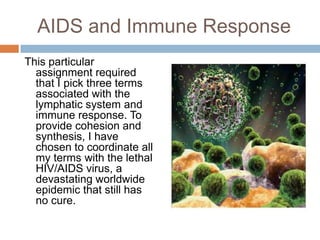
AIDS and Immune ResponseThis particular assignment required that I pick three terms associated with the lymphatic system and immune response. To provide cohesion and synthesis, I have chosen to coordinate all my terms with the lethal HIV/AIDS virus, a devastating worldwide epidemic that still has no cure.
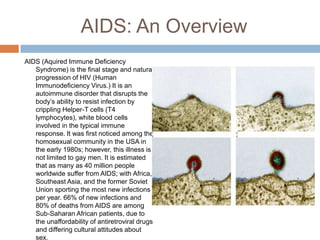
AIDS: An OverviewAIDS (Aquired Immune Deficiency Syndrome) is the final stage and natural progression of HIV (Human Immunodeficiency Virus.) It is an autoimmune disorder that disrupts the body’s ability to resist infection by crippling Helper-T cells (T4 lymphocytes), white blood cells involved in the typical immune response. It was first noticed among the homosexual community in the USA in the early 1980s; however, this illness is not limited to gay men. It is estimated that as many as 40 million people worldwide suffer from AIDS; with Africa, Southeast Asia, and the former Soviet Union sporting the most new infections per year. 66% of new infections and 80% of deaths from AIDS are among Sub-Saharan African patients, due to the unaffordability of antiretroviral drugs and differing cultural attitudes about sex.
Immunological Complications: an OverviewAquired Immunodeficiency Symdrome
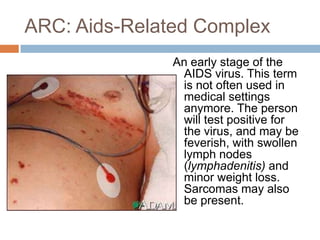
ARC: Aids-Related ComplexAn early stage of the AIDS virus. This term is not often used in medical settings anymore. The person will test positive for the virus, and may be feverish, with swollen lymph nodes (lymphadenitis) and minor weight loss. Sarcomas may also be present.
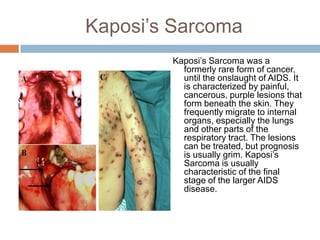
Kaposi’s SarcomaKaposi’s Sarcoma was a formerly rare form of cancer, until the onslaught of AIDS. It is characterized by painful, cancerous, purple lesions that form beneath the skin. They frequently migrate to internal organs, especially the lungs and other parts of the respiratory tract. The lesions can be treated, but prognosis is usually grim. Kaposi’s Sarcoma is usually characteristic of the final stage of the larger AIDS disease.
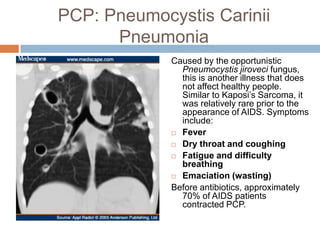
PCP: PneumocystisCarinii PneumoniaCaused by the opportunistic Pneumocystisjiroveci fungus, this is another illness that does not affect healthy people. Similar to Kaposi’s Sarcoma, it was relatively rare prior to the appearance of AIDS. Symptoms include:FeverDry throat and coughingFatigue and difficulty breathingEmaciation (wasting)Before antibiotics, approximately 70% of AIDS patients contracted PCP.
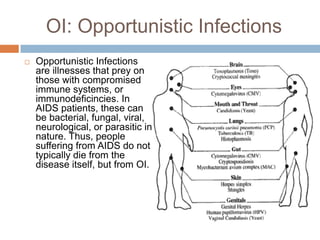
OI: Opportunistic InfectionsOpportunistic Infections are illnesses that prey on those with compromised immune systems, or immunodeficincies. In AIDS patients, these can be bacterial, fungal, viral, neurological, or parasitic in nature. Thus, people suffering from AIDS do not typically die from the disease itself, but from OI.
Terms Discussed: Review: Chapter 6LymphadenitisAcquired Immunodeficiency Syndrome (AIDS)Human Immunodeficiency Virus (HIV)Opportunistic Infections (OI)AIDS-Related Complex (ARC)Kaposi’s SarcomaPneumocystiscariniiPneumonia (PCP)ImmunodeficiencyImmunotherapy
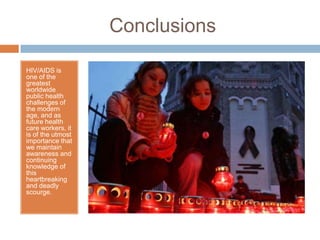
ConclusionsHIV/AIDS is one of the greatest worldwide public health challenges of the modern age, and as future health care workers, it is of the utmost importance that we maintain awareness and continuing knowledge of this heartbreaking and deadly scourge.
BIBLIOGRAPHYAEGIS. (2001). Opportunistic Infections. Retrieved September 30, 2009. Web Site:http://www.aegis.com/topics/oi/Fremgen, Bonnie F., and Suzanne S. Frucht. Medical Terminology: A Living Language. Upper Saddle River, NJ: Pearson Education, 2009.Marieb, Elaine N., R.N., Ph.D. Human Anatomy and Physiology. San Francisco: Pearson Education, 2004.Reuters/Corbis. (2009). National Geographic: Photo Gallery: AIDS. Retrieved September 30, 2009. Web Site:http://science.nationalgeographic.com/science/photos/aids/aids-rally.htmlU.S. National Library of Medicine and National Institute of Health. (2009). Kaposi’s Sarcoma. Retrieved September 30, 2009. Web Site: http://www.nlm.nih.gov/medlineplus/kaposissarcoma.htmlU.S. National Library of Medicine and National Institute of Health. (2009). PneumocystisCariniiPneumonia. Retrieved September 30, 2009. Web Site: http://www.nlm.nih.gov/medlineplus/ency/article/000671.htm

Lymphatic and Immune System

  • 1.
    LYMPHATIC AND IMMUNESYSTEM: AIDS:Terms and ConceptsMEGHAN COCHRAN // BIO120 // MED.TERM.
  • 2.
    AIDS and ImmuneResponseThis particular assignment required that I pick three terms associated with the lymphatic system and immune response. To provide cohesion and synthesis, I have chosen to coordinate all my terms with the lethal HIV/AIDS virus, a devastating worldwide epidemic that still has no cure.
  • 3.
    AIDS: An OverviewAIDS(Aquired Immune Deficiency Syndrome) is the final stage and natural progression of HIV (Human Immunodeficiency Virus.) It is an autoimmune disorder that disrupts the body’s ability to resist infection by crippling Helper-T cells (T4 lymphocytes), white blood cells involved in the typical immune response. It was first noticed among the homosexual community in the USA in the early 1980s; however, this illness is not limited to gay men. It is estimated that as many as 40 million people worldwide suffer from AIDS; with Africa, Southeast Asia, and the former Soviet Union sporting the most new infections per year. 66% of new infections and 80% of deaths from AIDS are among Sub-Saharan African patients, due to the unaffordability of antiretroviral drugs and differing cultural attitudes about sex.
  • 4.
    Immunological Complications: anOverviewAquired Immunodeficiency Symdrome
  • 5.
    ARC: Aids-Related ComplexAnearly stage of the AIDS virus. This term is not often used in medical settings anymore. The person will test positive for the virus, and may be feverish, with swollen lymph nodes (lymphadenitis) and minor weight loss. Sarcomas may also be present.
  • 6.
    Kaposi’s SarcomaKaposi’s Sarcomawas a formerly rare form of cancer, until the onslaught of AIDS. It is characterized by painful, cancerous, purple lesions that form beneath the skin. They frequently migrate to internal organs, especially the lungs and other parts of the respiratory tract. The lesions can be treated, but prognosis is usually grim. Kaposi’s Sarcoma is usually characteristic of the final stage of the larger AIDS disease.
  • 7.
    PCP: PneumocystisCarinii PneumoniaCausedby the opportunistic Pneumocystisjiroveci fungus, this is another illness that does not affect healthy people. Similar to Kaposi’s Sarcoma, it was relatively rare prior to the appearance of AIDS. Symptoms include:FeverDry throat and coughingFatigue and difficulty breathingEmaciation (wasting)Before antibiotics, approximately 70% of AIDS patients contracted PCP.
  • 8.
    OI: Opportunistic InfectionsOpportunisticInfections are illnesses that prey on those with compromised immune systems, or immunodeficincies. In AIDS patients, these can be bacterial, fungal, viral, neurological, or parasitic in nature. Thus, people suffering from AIDS do not typically die from the disease itself, but from OI.
  • 9.
    Terms Discussed: Review:Chapter 6LymphadenitisAcquired Immunodeficiency Syndrome (AIDS)Human Immunodeficiency Virus (HIV)Opportunistic Infections (OI)AIDS-Related Complex (ARC)Kaposi’s SarcomaPneumocystiscariniiPneumonia (PCP)ImmunodeficiencyImmunotherapy
  • 10.
    ConclusionsHIV/AIDS is oneof the greatest worldwide public health challenges of the modern age, and as future health care workers, it is of the utmost importance that we maintain awareness and continuing knowledge of this heartbreaking and deadly scourge.
  • 11.
    BIBLIOGRAPHYAEGIS. (2001). OpportunisticInfections. Retrieved September 30, 2009. Web Site:http://www.aegis.com/topics/oi/Fremgen, Bonnie F., and Suzanne S. Frucht. Medical Terminology: A Living Language. Upper Saddle River, NJ: Pearson Education, 2009.Marieb, Elaine N., R.N., Ph.D. Human Anatomy and Physiology. San Francisco: Pearson Education, 2004.Reuters/Corbis. (2009). National Geographic: Photo Gallery: AIDS. Retrieved September 30, 2009. Web Site:http://science.nationalgeographic.com/science/photos/aids/aids-rally.htmlU.S. National Library of Medicine and National Institute of Health. (2009). Kaposi’s Sarcoma. Retrieved September 30, 2009. Web Site: http://www.nlm.nih.gov/medlineplus/kaposissarcoma.htmlU.S. National Library of Medicine and National Institute of Health. (2009). PneumocystisCariniiPneumonia. Retrieved September 30, 2009. Web Site: http://www.nlm.nih.gov/medlineplus/ency/article/000671.htm