AIDS  (Acquired Immune Deficiency Syndrome)
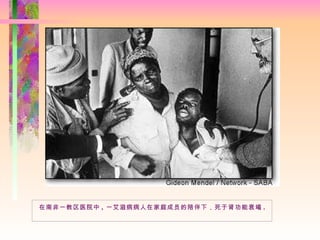
                                                在南非一教区医院中 ,  一艾滋病病人在家庭成员的陪伴下,死于肾功能衰竭 .
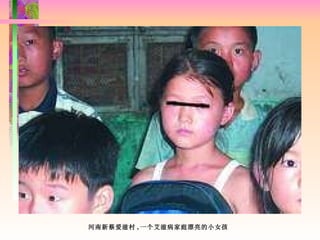
河南新蔡爱滋村 , 一个艾滋病家庭漂亮的小女孩
在第 14 届世界艾滋病大会开幕式期间,关心艾滋病的人士手举蜡烛,在帕劳群岛的圣 · 乔迪举行夜间集会,呼吁研制出便宜的药品援助贫困的发展中国家治疗艾滋病。                                                                           
Definition Sever & often fatal chronic disease HIV (Human immunodeficiency Virus) CD4+T lymphocyte Opportunistic infection & malignant tumor Sexual contact &injection transmission
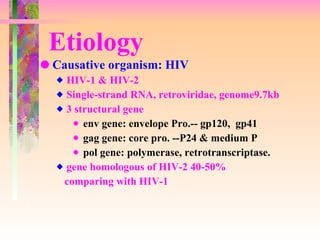
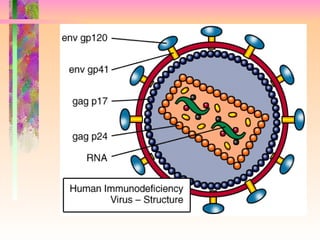
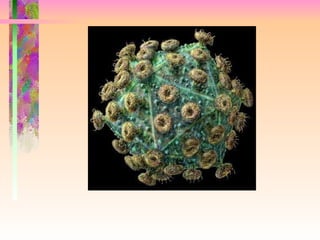
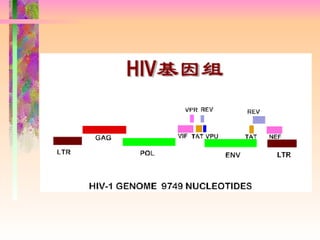
Etiology Causative organism: HIV HIV-1 & HIV-2 Single-strand RNA, retroviridae, genome9.7kb 3 structural gene env gene: envelope Pro.-- gp120,  gp41 gag gene: core pro. --P24 & medium P pol gene: polymerase, retrotranscriptase. gene homologous of HIV-2 40-50% comparing with HIV-1
 
 
Etiology Resistance: sensitive to heat: 56 o C30 min >25% alcohol Isolation: blood cell, plasma, lymph nodes, semen,  saliva, tears, breast milk. Target cell: CD4+T, M, B cell,Nerve cell
 
Epidemiology Source of infection: patients asymptomatic carriers Route of transmission: sexual contact transmission:   homosexual or bisexual: Western world heterosexual: Africa injection transmission: intravenous drug abusers blood or its components transfusion
Epidemiology Route of transmission: vertical spread: placenta: from mother to infant  breast milk other route: organ transplants, artificial insemination needle-stick, hospital staff
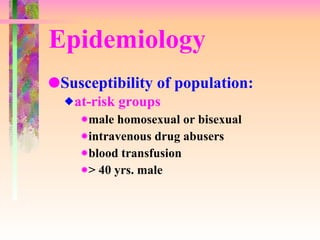
Epidemiology Susceptibility of population: at-risk groups male homosexual or bisexual intravenous drug abusers blood transfusion > 40 yrs. male
 
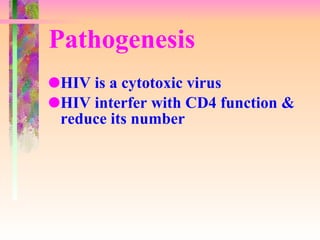
Pathogenesis HIV is a cytotoxic virus HIV interfer with CD4 function & reduce its number
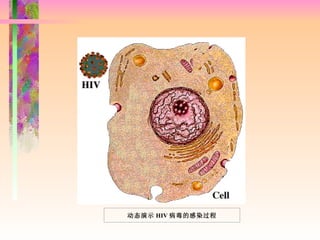
动态演示 HIV 病毒的感染过程
Clinical manifestation Incubation period: 2 to 10 yrs. First period-Illness of infection Symptoms:  fever, headache, anorexia, nausea, enlargement of lymph nodes HIV +, P24 Ag +, CD4/CD8 inverted ratio Last 2 weeks
Clinical manifestation Second period- Asymptomatic contact Initial HIV inf. or after illness of inf. No symptoms HIV +, Anti- core Ag +, anti-envelope Ag + Last 2 to 10 yrs.
Clinical manifestation Third period- PGL (Persistent Generalized Lymphoadenopathy) Enlargement of lymph nodes outside the inguinal area more than 2 areas more that 3 months
Clinical manifestation Fourth period- Manifest AIDS ARC(AIDS-related complex):  fever, loss of weight, anorexia, diarrhea plu PGL nervous system symptoms:  headach, convulsion, paralysis, progress dementia Rare opportunistic infection Unusual malignant tumors Pneumonia
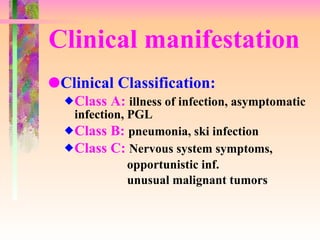
Clinical manifestation Clinical Classification: Class A:  illness of infection, asymptomatic infection, PGL Class B:  pneumonia, ski infection Class C:  Nervous system symptoms,  opportunistic inf.  unusual malignant tumors
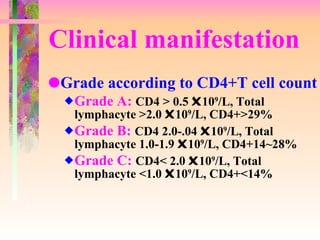
Clinical manifestation Grade according to CD4+T cell count Grade A:  CD4 > 0.5   10 9 /L, Total lymphacyte >2.0   10 9 /L, CD4+>29% Grade B:  CD4 2.0-.04   10 9 /L, Total lymphacyte 1.0-1.9   10 9 /L, CD4+14~28% Grade C:  CD4< 2.0   10 9 /L, Total lymphacyte <1.0   10 9 /L, CD4+<14%
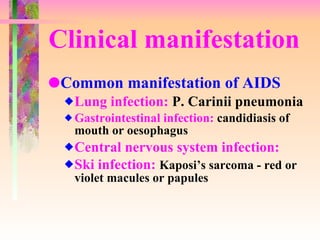
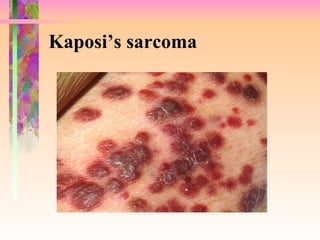
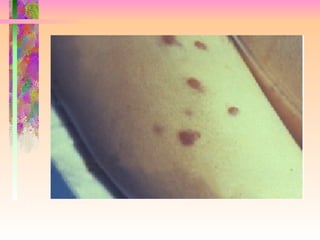
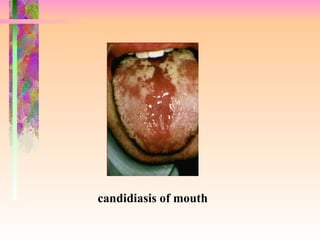
Clinical manifestation Common manifestation of AIDS Lung infection:  P. Carinii pneumonia Gastrointestinal infection:  candidiasis of mouth or oesophagus Central nervous system infection: Ski infection:  Kaposi’s sarcoma - red or violet macules or papules
Kaposi’s sarcoma
 
candidiasis of mouth
Laboratory Findings Blood picture:  WBC and RBC decrease Immunologic test:  CD4+T decrease, CD4/CD8 <1 Serological test:  anti-HIV pos., Ag(gp120, p24), anti-gp120, anti-p24. HIV isolation
Clinical Diagnosis High risk population: >2 pos loss of weight >10% chronic cough or diarrhea > 1 mon intermittent or persistent fever >1 mon PGL herps infection candidias infection in month
Laboratory Diagnosis Anti-p24 or gp120 pos twice, WB or SRIP definite P24 Ag pos HIV isolation from blood, PBMS, cfs, or HIV RNA by Northern blot or HIV pre-DNA by PCR
Treatment There is  no cure  for AIDS at this time.  However, a variety of treatments are available that can help keep symptoms at bay and  improve the quality of life  of those who have already developed symptoms.
Treatment Anti-virus AZT(antiretrovirals ): CD4<0.5 109/L AZT plu IFN(Kaposi’s sarcoma) Pentamidine( pneumocystis carinii pneumnia) Immune therapy complication therapy
complication therapy also called Cocktail therapy Taking two or more antiretroviral drugs at a time is called combination therapy. Taking a combination of three or more anti-HIV drugs is sometimes referred to as Highly Active Antiretroviral Therapy (HAART).  If only one drug was taken, HIV would quickly become resistant to it and the drug would stop working. Taking two or more antiretrovirals at the same time vastly reduces the rate at which resistance would develop, making treatment more effective in the long term.
Prevention Control source of infection isolation sterilization international quarantine Cut the route of transmission Vaccination?(gp120)
HIV infecfion is mainly located in : a.Thailand  b.U.S.A  c.Africa  d.Japan  e.Europe
Which cell is the target cell of HIV? a.CD8+ cells  b.Mononuclear cells c.CTL  e.NK cells  f.CD4+ cells
How many years may the asymptomatic infecfion last  After  the  infection  of  HIV ? a.1year  b.20years  c.2~10years  d.2~10years or more  e.1~20years
The most main route of transmission for AIDS is: Sexual contace Receiving blood and blood products Abuser of intravenous drug  Receiving organs or tissues Eating uncooked food
Which drug is used for the treatment of pneumocystis carinii pneumnia. pentamidine  Bleomycin  spiromycin  clindamycin  Gancyclovir

AIDS

  • 1.
    AIDS (AcquiredImmune Deficiency Syndrome)
  • 2.
  • 3.
  • 4.
    在第 14 届世界艾滋病大会开幕式期间,关心艾滋病的人士手举蜡烛,在帕劳群岛的圣· 乔迪举行夜间集会,呼吁研制出便宜的药品援助贫困的发展中国家治疗艾滋病。                                                                           
  • 5.
    Definition Sever &often fatal chronic disease HIV (Human immunodeficiency Virus) CD4+T lymphocyte Opportunistic infection & malignant tumor Sexual contact &injection transmission
  • 6.
    Etiology Causative organism:HIV HIV-1 & HIV-2 Single-strand RNA, retroviridae, genome9.7kb 3 structural gene env gene: envelope Pro.-- gp120, gp41 gag gene: core pro. --P24 & medium P pol gene: polymerase, retrotranscriptase. gene homologous of HIV-2 40-50% comparing with HIV-1
  • 7.
  • 8.
  • 9.
    Etiology Resistance: sensitiveto heat: 56 o C30 min >25% alcohol Isolation: blood cell, plasma, lymph nodes, semen, saliva, tears, breast milk. Target cell: CD4+T, M, B cell,Nerve cell
  • 10.
  • 11.
    Epidemiology Source ofinfection: patients asymptomatic carriers Route of transmission: sexual contact transmission: homosexual or bisexual: Western world heterosexual: Africa injection transmission: intravenous drug abusers blood or its components transfusion
  • 12.
    Epidemiology Route oftransmission: vertical spread: placenta: from mother to infant breast milk other route: organ transplants, artificial insemination needle-stick, hospital staff
  • 13.
    Epidemiology Susceptibility ofpopulation: at-risk groups male homosexual or bisexual intravenous drug abusers blood transfusion > 40 yrs. male
  • 14.
  • 15.
    Pathogenesis HIV isa cytotoxic virus HIV interfer with CD4 function & reduce its number
  • 16.
  • 17.
    Clinical manifestation Incubationperiod: 2 to 10 yrs. First period-Illness of infection Symptoms: fever, headache, anorexia, nausea, enlargement of lymph nodes HIV +, P24 Ag +, CD4/CD8 inverted ratio Last 2 weeks
  • 18.
    Clinical manifestation Secondperiod- Asymptomatic contact Initial HIV inf. or after illness of inf. No symptoms HIV +, Anti- core Ag +, anti-envelope Ag + Last 2 to 10 yrs.
  • 19.
    Clinical manifestation Thirdperiod- PGL (Persistent Generalized Lymphoadenopathy) Enlargement of lymph nodes outside the inguinal area more than 2 areas more that 3 months
  • 20.
    Clinical manifestation Fourthperiod- Manifest AIDS ARC(AIDS-related complex): fever, loss of weight, anorexia, diarrhea plu PGL nervous system symptoms: headach, convulsion, paralysis, progress dementia Rare opportunistic infection Unusual malignant tumors Pneumonia
  • 21.
    Clinical manifestation ClinicalClassification: Class A: illness of infection, asymptomatic infection, PGL Class B: pneumonia, ski infection Class C: Nervous system symptoms, opportunistic inf. unusual malignant tumors
  • 22.
    Clinical manifestation Gradeaccording to CD4+T cell count Grade A: CD4 > 0.5  10 9 /L, Total lymphacyte >2.0  10 9 /L, CD4+>29% Grade B: CD4 2.0-.04  10 9 /L, Total lymphacyte 1.0-1.9  10 9 /L, CD4+14~28% Grade C: CD4< 2.0  10 9 /L, Total lymphacyte <1.0  10 9 /L, CD4+<14%
  • 23.
    Clinical manifestation Commonmanifestation of AIDS Lung infection: P. Carinii pneumonia Gastrointestinal infection: candidiasis of mouth or oesophagus Central nervous system infection: Ski infection: Kaposi’s sarcoma - red or violet macules or papules
  • 24.
  • 25.
  • 26.
  • 27.
    Laboratory Findings Bloodpicture: WBC and RBC decrease Immunologic test: CD4+T decrease, CD4/CD8 <1 Serological test: anti-HIV pos., Ag(gp120, p24), anti-gp120, anti-p24. HIV isolation
  • 28.
    Clinical Diagnosis Highrisk population: >2 pos loss of weight >10% chronic cough or diarrhea > 1 mon intermittent or persistent fever >1 mon PGL herps infection candidias infection in month
  • 29.
    Laboratory Diagnosis Anti-p24or gp120 pos twice, WB or SRIP definite P24 Ag pos HIV isolation from blood, PBMS, cfs, or HIV RNA by Northern blot or HIV pre-DNA by PCR
  • 30.
    Treatment There is no cure for AIDS at this time. However, a variety of treatments are available that can help keep symptoms at bay and improve the quality of life of those who have already developed symptoms.
  • 31.
    Treatment Anti-virus AZT(antiretrovirals): CD4<0.5 109/L AZT plu IFN(Kaposi’s sarcoma) Pentamidine( pneumocystis carinii pneumnia) Immune therapy complication therapy
  • 32.
    complication therapy alsocalled Cocktail therapy Taking two or more antiretroviral drugs at a time is called combination therapy. Taking a combination of three or more anti-HIV drugs is sometimes referred to as Highly Active Antiretroviral Therapy (HAART). If only one drug was taken, HIV would quickly become resistant to it and the drug would stop working. Taking two or more antiretrovirals at the same time vastly reduces the rate at which resistance would develop, making treatment more effective in the long term.
  • 33.
    Prevention Control sourceof infection isolation sterilization international quarantine Cut the route of transmission Vaccination?(gp120)
  • 34.
    HIV infecfion ismainly located in : a.Thailand b.U.S.A c.Africa d.Japan e.Europe
  • 35.
    Which cell isthe target cell of HIV? a.CD8+ cells b.Mononuclear cells c.CTL e.NK cells f.CD4+ cells
  • 36.
    How many yearsmay the asymptomatic infecfion last After the infection of HIV ? a.1year b.20years c.2~10years d.2~10years or more e.1~20years
  • 37.
    The most mainroute of transmission for AIDS is: Sexual contace Receiving blood and blood products Abuser of intravenous drug Receiving organs or tissues Eating uncooked food
  • 38.
    Which drug isused for the treatment of pneumocystis carinii pneumnia. pentamidine Bleomycin spiromycin clindamycin Gancyclovir

Editor's Notes

  • #5 在第 14 届世界艾滋病大会开幕式期间,关心艾滋病的人士手举蜡烛,在帕劳群岛的圣 · 乔迪举行夜间集会,呼吁研制出便宜的药品援助贫困的发展中国家治疗艾滋病。