Year 9 Physics
Topic: Sound Energy
WALT
• Production of sound
• Transmission of sound
Describing waves
• We can describe waves using three properties that all waves have:
amplitude, wavelength, and frequency.
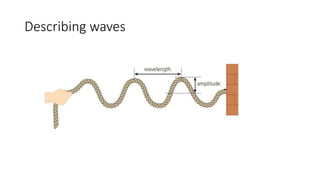
• The distance from one point on a wave to the same point on the next
wave is called the wavelength.
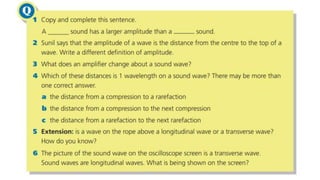
• The distance from the centre of the wave to the highest or lowest
point is called the amplitude.
• The diagram does not show the frequency. If you watched how many
waves go past in 1 second, that would be the frequency.
Using an oscilloscope
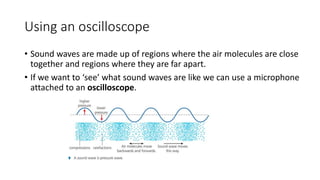
• Sound waves are made up of regions where the air molecules are close
together and regions where they are far apart.
• If we want to ‘see’ what sound waves are like we can use a microphone
attached to an oscilloscope.
Loudness and amplitude
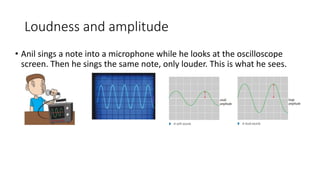
• Anil sings a note into a microphone while he looks at the oscilloscope
screen. Then he sings the same note, only louder. This is what he sees.
Amplification
• You might hear people say that sound ‘dies away’. They think that the sound
wave gets ‘weaker’ as it travels. The sound spreads out as it travels away
from the source. Some energy is transferred to the medium, so the sound
becomes softer.
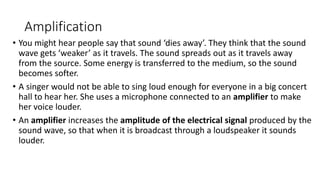
• A singer would not be able to sing loud enough for everyone in a big concert
hall to hear her. She uses a microphone connected to an amplifier to make
her voice louder.
• An amplifier increases the amplitude of the electrical signal produced by the
sound wave, so that when it is broadcast through a loudspeaker it sounds
louder.
Pitch and frequency
• High and low
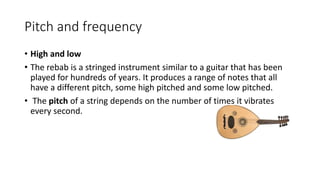
• The rebab is a stringed instrument similar to a guitar that has been
played for hundreds of years. It produces a range of notes that all
have a different pitch, some high pitched and some low pitched.
• The pitch of a string depends on the number of times it vibrates
every second.
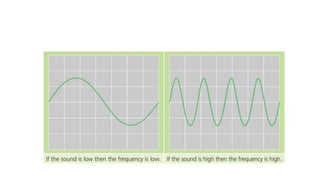
• The number of vibrations or waves per second is called the frequency
and is measured in hertz (Hz).
• High-pitched sounds have a high frequency and
• Low pitched sounds have a low frequency.
• High frequencies are measured in kilohertz (kHz).
Year 9 Physics Term 2 Lesson Presentation Week 1.pptx

Year 9 Physics Term 2 Lesson Presentation Week 1.pptx

  • 1.
  • 2.
    WALT • Production ofsound • Transmission of sound
  • 3.
  • 4.
    • We candescribe waves using three properties that all waves have: amplitude, wavelength, and frequency. • The distance from one point on a wave to the same point on the next wave is called the wavelength. • The distance from the centre of the wave to the highest or lowest point is called the amplitude. • The diagram does not show the frequency. If you watched how many waves go past in 1 second, that would be the frequency.
  • 5.
    Using an oscilloscope •Sound waves are made up of regions where the air molecules are close together and regions where they are far apart. • If we want to ‘see’ what sound waves are like we can use a microphone attached to an oscilloscope.
  • 6.
    Loudness and amplitude •Anil sings a note into a microphone while he looks at the oscilloscope screen. Then he sings the same note, only louder. This is what he sees.
  • 7.
    Amplification • You mighthear people say that sound ‘dies away’. They think that the sound wave gets ‘weaker’ as it travels. The sound spreads out as it travels away from the source. Some energy is transferred to the medium, so the sound becomes softer. • A singer would not be able to sing loud enough for everyone in a big concert hall to hear her. She uses a microphone connected to an amplifier to make her voice louder. • An amplifier increases the amplitude of the electrical signal produced by the sound wave, so that when it is broadcast through a loudspeaker it sounds louder.
  • 9.
    Pitch and frequency •High and low • The rebab is a stringed instrument similar to a guitar that has been played for hundreds of years. It produces a range of notes that all have a different pitch, some high pitched and some low pitched. • The pitch of a string depends on the number of times it vibrates every second.
  • 10.
    • The numberof vibrations or waves per second is called the frequency and is measured in hertz (Hz). • High-pitched sounds have a high frequency and • Low pitched sounds have a low frequency. • High frequencies are measured in kilohertz (kHz).