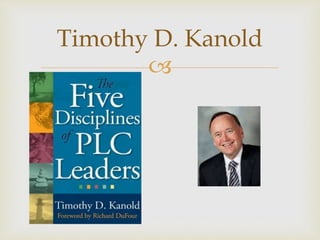
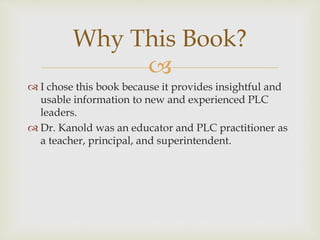
Timothy D. Kanold 

Why This Book? 
 
 I chose this book because it provides insightful and 
usable information to new and experienced PLC 
leaders. 
 Dr. Kanold was an educator and PLC practitioner as 
a teacher, principal, and superintendent.
Major Highlights 
 
The Five Disciplines 
 Vision & Values 
 Accountability & 
Celebration 
 Service & Sharing 
 Reflection & Balance 
 Inspiration & Influence 
PLC Dimensions 
 Supportive & Shared 
Leadership 
 Shared Values & Vision 
 Collective Learning & 
Application 
 Shared Personal Practice 
 Supportive Conditions- 
Relationships/Structures
Vision & Values 
 
 “The leadership work of developing and delivering 
a compelling picture of the school’s future that 
produces energy, passion, and action in yourself 
and others.” 
 Mission is why the school exist---Vision is what we 
should become---Goals are the outputs of our work--- 
Values represent the commitments to action necessary 
to ensure the vision is realized. 
 Most leaders base decisions on their beliefs and not 
on well-researched evidence.
Accountability & Celebration 
 
 “The leadership work of delivering specific 
improvement in student achievement results, and 
monitoring stakeholder actions that lead to those 
results, with consequences.” 
 Have courage to do more than monitor. 
 Using “Loose-Tight” Leadership. 
Tight---guiding what must be done 
Loose---allowing other to decide how it gets 
done under defined quality parameters.
Service & Sharing 
 
 “The leadership work of demonstrating personal 
accountability of the shared vision and to all who 
may be affected by your thought, words, actions, 
and inactions.” 
N-S-E-W Sphere of Influence 
 Becoming a Level 5 leader who is a servant to others, 
shows humility, expands their leadership base, 
exercises good judgment, establishes personal 
intimacy, builds communities of practice, and builds 
the relational capacity of teams.
Reflection & Balance 
 
 “The leadership work of intentionally and 
strategically engaging in and disengaging from 
high-energy activities.” 
 Self-Reflection 
 Team-Reflection 
 Avoid Excuses in your sphere of influence 
 Pendulum of PLC Leadership 
Adults 1st---Adults & Students---Students 1st
Inspiration & Influence 
 
 “The leadership work of consciously creating an 
enduring organizational legacy through the daily 
building of effective PLC practices and behaviors.” 
 Legacy Practice 1: Responding to Failure 
 Legacy Practice 2: Preventing Deep Regret 
 Legacy Practice 3: Choosing the Path of Enduring 
Inspiration 
 PLC leaders are remembered for what they do for 
others
Related PLC Knowledge 
 
 The Five Disciplines of PLC Leaders is intertwined 
with the dimensions of professional learning 
communities. The book is specifically designed to 
provide PLC leaders effective and proven techniques 
in PLC leadership.

Five disciplines

  • 2.
  • 3.
    Why This Book?   I chose this book because it provides insightful and usable information to new and experienced PLC leaders.  Dr. Kanold was an educator and PLC practitioner as a teacher, principal, and superintendent.
  • 4.
    Major Highlights  The Five Disciplines  Vision & Values  Accountability & Celebration  Service & Sharing  Reflection & Balance  Inspiration & Influence PLC Dimensions  Supportive & Shared Leadership  Shared Values & Vision  Collective Learning & Application  Shared Personal Practice  Supportive Conditions- Relationships/Structures
  • 5.
    Vision & Values   “The leadership work of developing and delivering a compelling picture of the school’s future that produces energy, passion, and action in yourself and others.”  Mission is why the school exist---Vision is what we should become---Goals are the outputs of our work--- Values represent the commitments to action necessary to ensure the vision is realized.  Most leaders base decisions on their beliefs and not on well-researched evidence.
  • 6.
    Accountability & Celebration   “The leadership work of delivering specific improvement in student achievement results, and monitoring stakeholder actions that lead to those results, with consequences.”  Have courage to do more than monitor.  Using “Loose-Tight” Leadership. Tight---guiding what must be done Loose---allowing other to decide how it gets done under defined quality parameters.
  • 7.
    Service & Sharing   “The leadership work of demonstrating personal accountability of the shared vision and to all who may be affected by your thought, words, actions, and inactions.” N-S-E-W Sphere of Influence  Becoming a Level 5 leader who is a servant to others, shows humility, expands their leadership base, exercises good judgment, establishes personal intimacy, builds communities of practice, and builds the relational capacity of teams.
  • 8.
    Reflection & Balance   “The leadership work of intentionally and strategically engaging in and disengaging from high-energy activities.”  Self-Reflection  Team-Reflection  Avoid Excuses in your sphere of influence  Pendulum of PLC Leadership Adults 1st---Adults & Students---Students 1st
  • 9.
    Inspiration & Influence   “The leadership work of consciously creating an enduring organizational legacy through the daily building of effective PLC practices and behaviors.”  Legacy Practice 1: Responding to Failure  Legacy Practice 2: Preventing Deep Regret  Legacy Practice 3: Choosing the Path of Enduring Inspiration  PLC leaders are remembered for what they do for others
  • 10.
    Related PLC Knowledge   The Five Disciplines of PLC Leaders is intertwined with the dimensions of professional learning communities. The book is specifically designed to provide PLC leaders effective and proven techniques in PLC leadership.