Luddites

Alexis Burt and Mary Wakeling
Who Were They?
• Textile artisans in the 19th century
• Violently protested against Industrial
  Revolution machinery which made it possible
  to replace them with low-wage workers
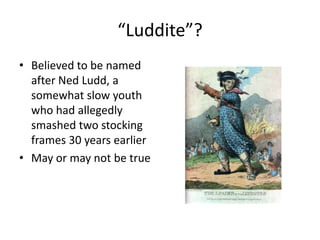
“Luddite”?
• Believed to be named
  after Ned Ludd, a
  somewhat slow youth
  who had allegedly
  smashed two stocking
  frames 30 years earlier
• May or may not be true
The Movement
• Mills and factory machinery were burned by
  handloom weavers
• For a short period, they were strong enough
  to clash with the British Army
• The movement began in Nottingham in 1811
  and spread rapidly through 1816
What Happened?
• In a mass trial in 1813, many were relocated
  or executed
• “Machine breaking” became a capital crime in
  1813 (this legislation was opposed by Lord
  Byron, a Luddite supporter)
Why is this important?
• Legitimate movement that began with
  negotiation and bargaining
• Targets were then carefully selected, not
  random
• Intentions and ideologies didn’t go away when
  the movement did
Incorporating with the Period
• Related anti-revolution sentiments to
  Romanticism

               “So we, boys, we
         Will die fighting, or live free,
    And down with all kings but King Ludd!”
                  -Lord Byron
Sources
• Byron, Lord. "Song for the Luddites." Web. 18
  Sept. 2012.
  <http://orion.it.luc.edu/~sjones1/byr1.htm>.
• Fox, Nicols. "Against the Machine: The Hidden
  Luddite Tradition in Literature, Art, and
  Individual Lives." Google Books. Web. 18
  Sept. 2012.

Luddites

  • 1.
  • 2.
    Who Were They? •Textile artisans in the 19th century • Violently protested against Industrial Revolution machinery which made it possible to replace them with low-wage workers
  • 3.
    “Luddite”? • Believed tobe named after Ned Ludd, a somewhat slow youth who had allegedly smashed two stocking frames 30 years earlier • May or may not be true
  • 4.
    The Movement • Millsand factory machinery were burned by handloom weavers • For a short period, they were strong enough to clash with the British Army • The movement began in Nottingham in 1811 and spread rapidly through 1816
  • 5.
    What Happened? • Ina mass trial in 1813, many were relocated or executed • “Machine breaking” became a capital crime in 1813 (this legislation was opposed by Lord Byron, a Luddite supporter)
  • 6.
    Why is thisimportant? • Legitimate movement that began with negotiation and bargaining • Targets were then carefully selected, not random • Intentions and ideologies didn’t go away when the movement did
  • 7.
    Incorporating with thePeriod • Related anti-revolution sentiments to Romanticism “So we, boys, we Will die fighting, or live free, And down with all kings but King Ludd!” -Lord Byron
  • 8.
    Sources • Byron, Lord."Song for the Luddites." Web. 18 Sept. 2012. <http://orion.it.luc.edu/~sjones1/byr1.htm>. • Fox, Nicols. "Against the Machine: The Hidden Luddite Tradition in Literature, Art, and Individual Lives." Google Books. Web. 18 Sept. 2012.