International Journal of Advance Research in Engineering, Science & Technology(IJAREST),
ISSN(O):2393-9877, ISSN(P): 2394-2444,
Volume 2,Issue 12,December-2015, Impact Factor: 2.125
All Rights Reserved, @IJAREST-2015
35
FPGA Implementation of Data Hiding in Images
Mr.R.V.Rathod1
,Prof.L.K.Chouthmol2
1
Electronics & Telecommunication, Late.G.N.S.College of Engineering, Nashik
2
Electronics & Telecommunication, Late.G.N.S.College of Engineering, Nashik
Abstract
In this paper steganography is used to hide the data inside the images. Steganography is the science that involves
communicating secret data in an appropriate multimedia carrier, e.g., image, audio, and video files. The main goal of
steganography is to ensure that the transmitted message is completely masked, thereby ensuring that the message is accessible
only to the intended receiver and not to any intruders or unauthorized parties. This work focuses on the image steganography with
an image compression using least significant bit with Discrete Wavelet Transform (DWT) on FPGA Spartan III Evaluation
Development Kit (EDK). Current trends support digital image files as the cover file to hide another digital file with secret
message or data. At receiver side, using Inverse Discrete Wavelet transform, both original image as well as hidden data can be
successfully extracted.
Keywords- Steganography, Data hiding, Embedding Data, LSB,, DWT ,MSE, PSNR, Information Security,.
I. INTRODUCTION]
Data hiding is a method of hiding secret messages
into a cover-media such that an unintended observer will not
be aware of the existence of the hidden messages. In this
paper, 8-bit gray scale images are selected as the cove
media. These images are called cover-images. Cover-images
with the secret messages embedded in them are called stego-
images. For data hiding methods, the image quality refers to
the quality of the stego-images. In the digitized world
extensive increase of use of extensive data communication
the problem of security, authentication of the multimedia
data also increases. The solution to this is digital
watermarking. Digital watermarking is the process of the
modification of original multimedia data to embed a data
containing key information such as authentication or
copyright codes. The embedded data must leave original
data unchanged. Steganography is an art of hiding
information in a way that apart from an intended recipient,
suspects the existence of secret message. To hide a secret
message within an object, Do it such a way that the presence
of message is not visible.
II. METHODLOGY
In this paper there are two methodology are used to hide the
data inside the image, using LSB & DWT.As shown in
following fig.a) the general block diagram of
Steganography.
Fig. a) General block Diagram
2.1.Data hiding using LSB.
Data hiding using LSB It is best way to implement
Steganography. It embeds the data into the cover so that it
cannot be detected by a observer. The technique works by
replacing some of the information in a given pixel with
information from the data in the image. While it is possible
to embed data into an image on any bit-plane In a LSB
embedding, we lose some information from the cover
image. [ It is not visible]. Both lossy & lossless image can
be used .
2.2. Data hiding using DWT
Wavelet transform decomposes a signal into a set of basis
functions. These basis functions are called wavelets DWT
transforms a discrete time signal to a discrete wavelet
representation. In this process image pixel values are
divided into even & odd sample, as shown in following
fig.b).
Fig.b] Decomposition of Image using DWT
2.3. Algorithm
The algorithm to hide the data inside the image using DWT
along with LSB technique is given below:
 Select the secrete data [ or Message ]
 Convert the secrete data from decimal to binary.
 Read a cover image
 Resize the cover image by 256 x 256
 Convert the cover image from RBG to gray
 Read the Gray level image [ Cover image]
 Create the header file.
 Break the byte of secrete data to be hidden into
bits.
 Take first 8 bytes of original data from cover
Image.
 Replace the least significant bit by one bit of the
data to be hidden.
 Display new pixel valued image [Stego Image] on
VB [Using LSB]
 Display new pixel valued image [Stego Image] on
VB [Using LSB+DWT]
 Display extracted data using Hyper Terminal
Window.
 Display the value of MSE & PSNR using Hyper
Terminal window.
International Journal of Advance Research in Engineering, Science & Technology(IJAREST),
ISSN(O):2393-9877, ISSN(P): 2394-2444,
Volume 2,Issue 12,December-2015, Impact Factor: 2.125
All Rights Reserved, @IJAREST-2015
36
III. SIMULATION RESULT
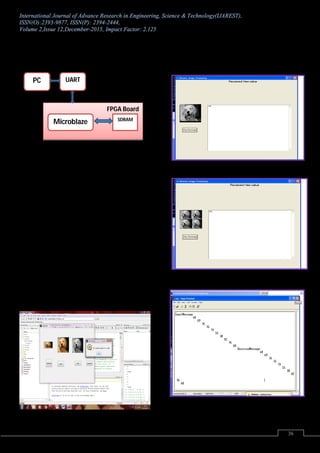
This work is implemented on MatlabR2010a and the
Parallel processor Xilinx FPGA Spartan III. The block
diagram of hardware implementation is shown in following
fig. c).
Fig.c) Hardware Implementation Block diagram
This work optimize the processing time of Least
Significant Bit replacement image steganography in digital
images using Discrete Wavelet Transform. In this research
embedded the secret text data in a given 8‐bit gray scale
image followed by image compression using Discrete
Wavelet Transform on hardware Spartan III. A successful
information hiding will result in the undistinguishable stego
image which can be transmitted via internet. This design
implementation required Xilinx Platform Studio (XPS) EDK
10.1 software platform along with Matlab R2010a & Visual
Basic Studio to display images on computer screen. The
conversion of true color image into gray scale image as well
as resizing of image into (128 * 128) format was carried out
using Matlab R2010a Image Processing Toolbox. While
coding of our design which include LSB encoding, Forward
DWT, LSB decoding & Inverse DWT, was carried out using
Impulse C Language in XPS EDK 10.1. For a comparison
between a parallel processor and serial processor the work is
implemented on MatlabR2010a and the Parallel processor
Xilinx FPGA Spartan III.
3.1. Matlab Simulation Results
By using Matlab first colour image is resized & converted it
into gray level image. And Header file is successfully
created using the MatlabR2010a. The simulation processing
on MatlabR2010a is shown in following fig .d)
Fig. d) Creation of Header File
3.2. FPGA Implementation Results
The design implementation result using Xilinx Platform
Studio (XPS) EDK 10.1 along with Visual Basic Studio and
Hyper terminal window is shown in following Fig.e), Fig f)
& Fig. g),
Fig.e) Output Image using LSB
Fig.f) Output Image using DWT
Fig. g) Input & received message
FPGA Board
Microblaze
Blaze
SDRAM
UARTPC
International Journal of Advance Research in Engineering, Science & Technology(IJAREST),
ISSN(O):2393-9877, ISSN(P): 2394-2444,
Volume 2,Issue 12,December-2015, Impact Factor: 2.125
All Rights Reserved, @IJAREST-2015
37
3.3. Comparative analysis using MSE and PSNR
Lower value of MSE gives good quality of image & higher
value of PSNR gives good quality of images. As shown in
following table & graphs the comparative analysis of MSE
and PSNR values .
Table.a) MSE and PSNR values
Graph.a) MSE [LSB] vs MSE [DWT]
From the above table & graph we can say that the quality of
image by using DWT is good as compare to LSB method.
IV. CONCLUSION
This research provides a hardware solution for
information hiding in 8‐bit gray scale image using Least
Significant Image. steganography technique followed by
Image compression using Discrete Wavelet Transform.
“You never know if a message is hidden”, this is the
dilemma that empowers steganography. As more emphasis
is placed on the areas of copyright protection & privacy
protection. we believe that steganography will continue to
grow in importance as a protection mechanism.
Steganography can be used along with cryptography to
make an highly secure data high way.
IV. ACKNOWLEDGEMENT
My sincere thanks to my paper guide Prof. L.K.
Chouthmol mam ,Dept. Electronics & Telecommunication
of Late.G.N.Sapkal COE Nashik, for her valuable support
and guidance for analyzing and testing the end of the work.
Finally a very Special thanks to my HOD Prof. S.
B. Bagal & ME Co-coordinator, Prof. S. B. Borse who
showed utmost interest in our endeavor and provided their
able guidance and co-operation.
REFERENCES
[1] Ravi Kumar, Kavita Choudhary, Nishant Dubey, “An
Introduction of Image Steganographic Techniques and
Comparison”, International Journal of Electronics and
Computer Science Engineering.
[2] Prashanti .G, Sandhya Rani.K, Deepthi.S “ LSB and
MSB Based Steganography for Embedding Modified
DES Encrypted Text”, International Journal of
Advanced Research in Computer Science and Software
Engineering, Vol. 3, Issue 8, August 2013, pp.788-799.
[3] Namita Tiwari, Dr.Madhu Shandilya,”Evaluation of
Various LSB based Methods of Image Steganography
on GIF File Format”,International Journal of Computer
Applications, Vol. 6– No.2, September 2010 , pp .1-4.
[4] Mr. Rohit Garg, “Comparison Of Lsb & Msb Based
Steganography In Gray-Scale Images Vol.1, Issue 8,Oct
2012”.,International Journal of Engineering Research
and Technology(IJERT).
[5] Mamta Juneja, Parvinder S. Sandhu, and Ekta
Walia,”Application of LSB Based Steganographic
Technique for 8-bit Color Images, World. Academy of
Science, Engineering and Technology, 2009.
[6] Shailender Gupta, Ankur Goyal, Bharat Bhushan,”
Information Hiding Using Least Significant Bit,
Steganography and Cryptography, I.J. Modern
Education and Computer Science 2012, Vol .6 pp. 27-
34
[7] M.Sivaram B.DurgaDevi J.Anne Steffi, “Steganography
of two lsb bits”, International Journal of
Communications and Engineering, Vol.1– No.1, Issue:
01, March 2012.
[8] H. Sencar, M. Ramkumar, and A. Akansu, Data Hiding
Fundamentalsand Applications: Content Security in
Digital Multimedia. Elsevier:Academic, 2004.
Graph.b) PSNR [LSB] vs PSNR [DWT]

Steganography

  • 1.
    International Journal ofAdvance Research in Engineering, Science & Technology(IJAREST), ISSN(O):2393-9877, ISSN(P): 2394-2444, Volume 2,Issue 12,December-2015, Impact Factor: 2.125 All Rights Reserved, @IJAREST-2015 35 FPGA Implementation of Data Hiding in Images Mr.R.V.Rathod1 ,Prof.L.K.Chouthmol2 1 Electronics & Telecommunication, Late.G.N.S.College of Engineering, Nashik 2 Electronics & Telecommunication, Late.G.N.S.College of Engineering, Nashik Abstract In this paper steganography is used to hide the data inside the images. Steganography is the science that involves communicating secret data in an appropriate multimedia carrier, e.g., image, audio, and video files. The main goal of steganography is to ensure that the transmitted message is completely masked, thereby ensuring that the message is accessible only to the intended receiver and not to any intruders or unauthorized parties. This work focuses on the image steganography with an image compression using least significant bit with Discrete Wavelet Transform (DWT) on FPGA Spartan III Evaluation Development Kit (EDK). Current trends support digital image files as the cover file to hide another digital file with secret message or data. At receiver side, using Inverse Discrete Wavelet transform, both original image as well as hidden data can be successfully extracted. Keywords- Steganography, Data hiding, Embedding Data, LSB,, DWT ,MSE, PSNR, Information Security,. I. INTRODUCTION] Data hiding is a method of hiding secret messages into a cover-media such that an unintended observer will not be aware of the existence of the hidden messages. In this paper, 8-bit gray scale images are selected as the cove media. These images are called cover-images. Cover-images with the secret messages embedded in them are called stego- images. For data hiding methods, the image quality refers to the quality of the stego-images. In the digitized world extensive increase of use of extensive data communication the problem of security, authentication of the multimedia data also increases. The solution to this is digital watermarking. Digital watermarking is the process of the modification of original multimedia data to embed a data containing key information such as authentication or copyright codes. The embedded data must leave original data unchanged. Steganography is an art of hiding information in a way that apart from an intended recipient, suspects the existence of secret message. To hide a secret message within an object, Do it such a way that the presence of message is not visible. II. METHODLOGY In this paper there are two methodology are used to hide the data inside the image, using LSB & DWT.As shown in following fig.a) the general block diagram of Steganography. Fig. a) General block Diagram 2.1.Data hiding using LSB. Data hiding using LSB It is best way to implement Steganography. It embeds the data into the cover so that it cannot be detected by a observer. The technique works by replacing some of the information in a given pixel with information from the data in the image. While it is possible to embed data into an image on any bit-plane In a LSB embedding, we lose some information from the cover image. [ It is not visible]. Both lossy & lossless image can be used . 2.2. Data hiding using DWT Wavelet transform decomposes a signal into a set of basis functions. These basis functions are called wavelets DWT transforms a discrete time signal to a discrete wavelet representation. In this process image pixel values are divided into even & odd sample, as shown in following fig.b). Fig.b] Decomposition of Image using DWT 2.3. Algorithm The algorithm to hide the data inside the image using DWT along with LSB technique is given below:  Select the secrete data [ or Message ]  Convert the secrete data from decimal to binary.  Read a cover image  Resize the cover image by 256 x 256  Convert the cover image from RBG to gray  Read the Gray level image [ Cover image]  Create the header file.  Break the byte of secrete data to be hidden into bits.  Take first 8 bytes of original data from cover Image.  Replace the least significant bit by one bit of the data to be hidden.  Display new pixel valued image [Stego Image] on VB [Using LSB]  Display new pixel valued image [Stego Image] on VB [Using LSB+DWT]  Display extracted data using Hyper Terminal Window.  Display the value of MSE & PSNR using Hyper Terminal window.
  • 2.
    International Journal ofAdvance Research in Engineering, Science & Technology(IJAREST), ISSN(O):2393-9877, ISSN(P): 2394-2444, Volume 2,Issue 12,December-2015, Impact Factor: 2.125 All Rights Reserved, @IJAREST-2015 36 III. SIMULATION RESULT This work is implemented on MatlabR2010a and the Parallel processor Xilinx FPGA Spartan III. The block diagram of hardware implementation is shown in following fig. c). Fig.c) Hardware Implementation Block diagram This work optimize the processing time of Least Significant Bit replacement image steganography in digital images using Discrete Wavelet Transform. In this research embedded the secret text data in a given 8‐bit gray scale image followed by image compression using Discrete Wavelet Transform on hardware Spartan III. A successful information hiding will result in the undistinguishable stego image which can be transmitted via internet. This design implementation required Xilinx Platform Studio (XPS) EDK 10.1 software platform along with Matlab R2010a & Visual Basic Studio to display images on computer screen. The conversion of true color image into gray scale image as well as resizing of image into (128 * 128) format was carried out using Matlab R2010a Image Processing Toolbox. While coding of our design which include LSB encoding, Forward DWT, LSB decoding & Inverse DWT, was carried out using Impulse C Language in XPS EDK 10.1. For a comparison between a parallel processor and serial processor the work is implemented on MatlabR2010a and the Parallel processor Xilinx FPGA Spartan III. 3.1. Matlab Simulation Results By using Matlab first colour image is resized & converted it into gray level image. And Header file is successfully created using the MatlabR2010a. The simulation processing on MatlabR2010a is shown in following fig .d) Fig. d) Creation of Header File 3.2. FPGA Implementation Results The design implementation result using Xilinx Platform Studio (XPS) EDK 10.1 along with Visual Basic Studio and Hyper terminal window is shown in following Fig.e), Fig f) & Fig. g), Fig.e) Output Image using LSB Fig.f) Output Image using DWT Fig. g) Input & received message FPGA Board Microblaze Blaze SDRAM UARTPC
  • 3.
    International Journal ofAdvance Research in Engineering, Science & Technology(IJAREST), ISSN(O):2393-9877, ISSN(P): 2394-2444, Volume 2,Issue 12,December-2015, Impact Factor: 2.125 All Rights Reserved, @IJAREST-2015 37 3.3. Comparative analysis using MSE and PSNR Lower value of MSE gives good quality of image & higher value of PSNR gives good quality of images. As shown in following table & graphs the comparative analysis of MSE and PSNR values . Table.a) MSE and PSNR values Graph.a) MSE [LSB] vs MSE [DWT] From the above table & graph we can say that the quality of image by using DWT is good as compare to LSB method. IV. CONCLUSION This research provides a hardware solution for information hiding in 8‐bit gray scale image using Least Significant Image. steganography technique followed by Image compression using Discrete Wavelet Transform. “You never know if a message is hidden”, this is the dilemma that empowers steganography. As more emphasis is placed on the areas of copyright protection & privacy protection. we believe that steganography will continue to grow in importance as a protection mechanism. Steganography can be used along with cryptography to make an highly secure data high way. IV. ACKNOWLEDGEMENT My sincere thanks to my paper guide Prof. L.K. Chouthmol mam ,Dept. Electronics & Telecommunication of Late.G.N.Sapkal COE Nashik, for her valuable support and guidance for analyzing and testing the end of the work. Finally a very Special thanks to my HOD Prof. S. B. Bagal & ME Co-coordinator, Prof. S. B. Borse who showed utmost interest in our endeavor and provided their able guidance and co-operation. REFERENCES [1] Ravi Kumar, Kavita Choudhary, Nishant Dubey, “An Introduction of Image Steganographic Techniques and Comparison”, International Journal of Electronics and Computer Science Engineering. [2] Prashanti .G, Sandhya Rani.K, Deepthi.S “ LSB and MSB Based Steganography for Embedding Modified DES Encrypted Text”, International Journal of Advanced Research in Computer Science and Software Engineering, Vol. 3, Issue 8, August 2013, pp.788-799. [3] Namita Tiwari, Dr.Madhu Shandilya,”Evaluation of Various LSB based Methods of Image Steganography on GIF File Format”,International Journal of Computer Applications, Vol. 6– No.2, September 2010 , pp .1-4. [4] Mr. Rohit Garg, “Comparison Of Lsb & Msb Based Steganography In Gray-Scale Images Vol.1, Issue 8,Oct 2012”.,International Journal of Engineering Research and Technology(IJERT). [5] Mamta Juneja, Parvinder S. Sandhu, and Ekta Walia,”Application of LSB Based Steganographic Technique for 8-bit Color Images, World. Academy of Science, Engineering and Technology, 2009. [6] Shailender Gupta, Ankur Goyal, Bharat Bhushan,” Information Hiding Using Least Significant Bit, Steganography and Cryptography, I.J. Modern Education and Computer Science 2012, Vol .6 pp. 27- 34 [7] M.Sivaram B.DurgaDevi J.Anne Steffi, “Steganography of two lsb bits”, International Journal of Communications and Engineering, Vol.1– No.1, Issue: 01, March 2012. [8] H. Sencar, M. Ramkumar, and A. Akansu, Data Hiding Fundamentalsand Applications: Content Security in Digital Multimedia. Elsevier:Academic, 2004. Graph.b) PSNR [LSB] vs PSNR [DWT]