Nicole WieberneitThomas Wieberneit27.08.2009Loyalty Management
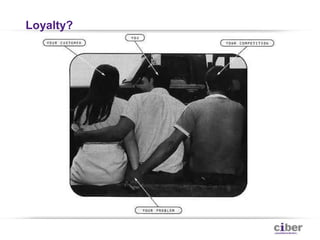
Loyalty?
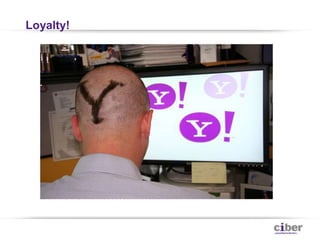
Loyalty!
Thomas Wieberneit2008 – CRM Practice Manager ANZ
CIBER, ANZ
2008 – Executive Consultant & Project Manager
CGI, Canada
2005 – VP CRM Development
SAP, Germany & Canada
2000 – Quality Manager then VP CRM Quality Management
SAP, Germany
1997 – Development Manager CRM Technology & Mobile Solutions
SAP, Germany
1995 – CRM Developer
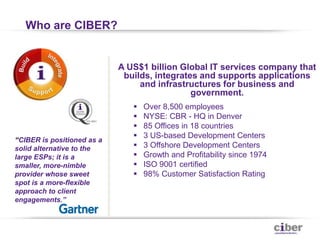
Kiefer & Veittinger, GermanyWho are CIBER?A US$1 billion Global IT services company that builds, integrates and supports applications and infrastructures for business and government.Over 8,500 employees
NYSE: CBR - HQ in Denver
85 Offices in 18 countries
3 US-based Development Centers
3 Offshore Development Centers
Growth and Profitability since 1974
ISO 9001 certified
98% Customer Satisfaction Rating“CIBER is positioned as a solid alternative to the large ESPs; it is a smaller, more-nimble provider whose sweet spot is a more-flexible approach to client engagements.”
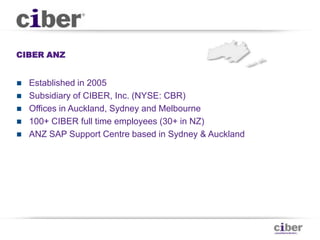
CIBER ANZEstablished in 2005
Subsidiary of CIBER, Inc. (NYSE: CBR)
Offices in Auckland, Sydney and Melbourne
100+ CIBER full time employees (30+ in NZ)
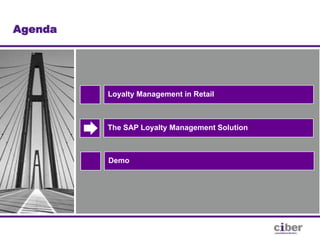
ANZ SAP Support Centre based in Sydney & AucklandHAgendaLoyalty Management in RetailThe SAP Loyalty Management SolutionDemo
Loyalty – What is it? CompaniesConsumersShopping at a single exclusive retailer in a particular category
Frequent shopping at a particular retailer
Loyalty is demonstrated by:Years with retailerStaff favouritesLow price sensitivityWillingness to recommend(COLLOQUY Talk: The Loyalty Marketing Index, June 2008)Loyalty Management is part of enhancing the customer experience. 			 (SAP, 2009)
Loyalty Management is the actions a company undertakes to attract and retain profitable customers. 			    (Memberson, 2009)
Loyalty is a feeling or attitude of devoted attachment and affection. This is mostly measured by  behavioural KPIs like share of value, purchase frequency or retention rate
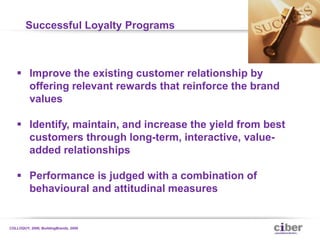
Loyalty Marketing is about creating customers who don’t need ongoing marketing investment and therefore are more profitable (BuildingBrands, 2009)Successful Loyalty ProgramsImprove the existing customer relationship by offering relevant rewards that reinforce the brand values
Identify, maintain, and increase the yield from best customers through long-term, interactive, value-added relationships
Performance is judged with a combination of behavioural and attitudinal measuresCOLLOQUY, 2006, BuildingBrands, 2009
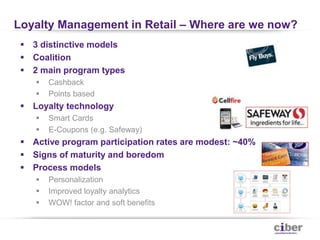
Loyalty Management in Retail – Where are we now? 3 distinctive models
Coalition
2 main program types
Cashback
Points based
Loyalty technology

Loyalty Management For Nzsug

Editor's Notes

  • #3 Loyalty Management is about making sure that you do not find yourself in this situation: It is about knowing your customer and building relationships that are valuable and sustainable for both parties
  • #4 Ultimately you want to be here: Your customers identify themselves with you and your brand – and proudly show this
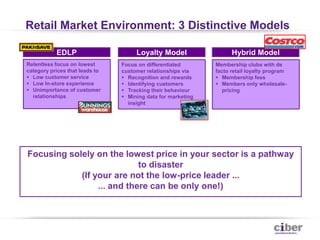
  • #10 Hybrid Model: Costco – just recently opened a store in Melbourne
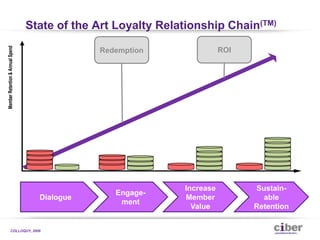
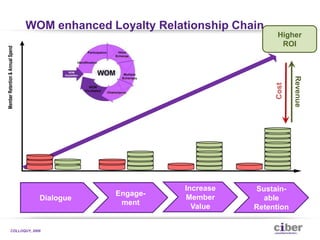
  • #11 Dialogue – Enroll the right customers Determine which customers the company wants to raise their hands to engage in your relationship strategy Highest-value customers to recognize and reward their value high-potential customers who currently split their purchases customers at the highest risk of churning Based on the customer groups a recognition and reward strategy that piques customers’ interestEngagement – Engage customer interest Involve customers via regular communication into a dialogue is critical in moving users through the relationship chain Communication has to answer the question: What’s in it for me? Design Communication with calls to action that will stimulate regular response. Customers who respond are exhibiting increased interest The first redemption is happeningIncrease Member value: Stimulate active participation by encouraging program use and customer engagement Key behaviours include any voluntary customer activity beyond standard transaction Relationship chain analytics are based on such activities as completing surveys, checking points balances online, responding to targeted offers, using kiosks, bidding on auction items, entering sweepstakes, ...Sustainable Retention – Trigger multiple redemptions: Customers who participate in loyalty strategies expect a payoff – the answer to the question “What’s in it for me?” Reward Redemption is both the answer to that question and the ultimate measure of customer value Redemption happens whenever a customer extracts value from a loyalty campaign Multiple redemption is the keySource: Colleen Becker: Forcing the Relationship Chain (http://directmag.com/roi/1119-customer-relationship-chain/ )
  • #12 By comparing the behaviour of loyalty-marketing participators to the behaviour of established control groups, marketers can infer the financial impact of each customer stage by measuring success early in the chain.Proper analysis requires tracking and measurement of loyalty-marketing activity at both the individual customer and segment levels. Key metrics include: Enrollment: Which customers raised their hands to indicate initial interest in the campaign? Are they the right customers? Participation: How many non-participators, one-time participators, and multiple participators are responding to the dialogue efforts? What is the recency of participation by segment? Redemption: How many non-redeemers, onetime redeemers, and multiple redeemers are in the customer file? Is there a steady progression of one-timers to multiples? How recent are the redemptions? Segment mobility: Are you seeing a steady migration of customers from high-potential to high-value segments? How well does program activity correspond to this migration? Churn rates: How many customers are leaving the program? How many are leaving the brand? Is there a reduction in churn? If so, how does that reduction correspond to program activity? Annual average customer value: Is transaction value increasing? Are cross-sell and up-sell penetration rates rising? Customer lifetime value: Is the Net Present Value (NPV) of key segments improving due to increased lift and reduced churn? IncrementalityCustomer equityShare-of-walletIt is important to measure early in the chain to see if they are steering in the right direction. Marketers can examine the reasons behind the results and work to either solve or exploit them – steer right, steer left or hit the gas pedal.
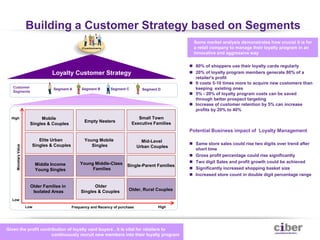
  • #13 Based on the gathered transactional data it is possible to cluster your customers in homogeneous-like segments, which you address with the appropriate marketing strategies and, thus, you make the most out of your marketing expenditures. The clustering could also happen without a point program in place. The sheer amount of transactional data combined with the customer entity should give you enough business insights to promote the right merchandise to the right customer.
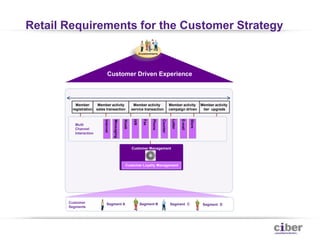
  • #15 Retail RequirementsStrategic integration of channels Member profile / tier / interactions drive customer experience and offersOperational integration of channelsMember registration Profile maintenance Statements / Points Lost / damaged card Nominate new member Change programIntegration of core customer management processesSales operationsSales order processing for point redemptionMarketing OperationsCampaign PlanningCampaign DevelopmentCampaign OptimizationCampaign ExecutionCampaign MeasurementService OperationsService Ticket ProcessingComplaint managementService Interaction
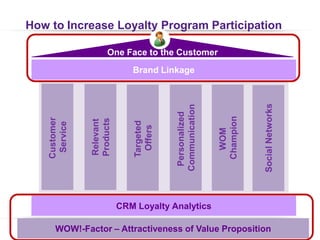
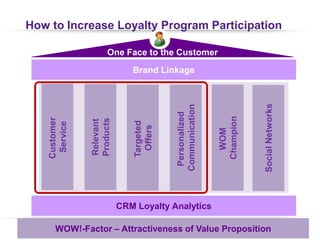
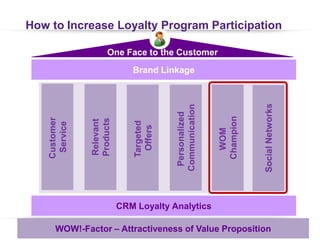
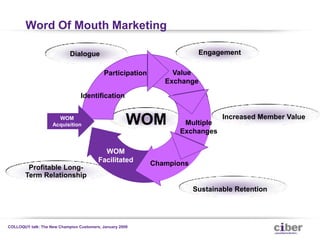
  • #17 Dialogue:Personalised communicationIdentifysigns of interest & engangementOffer recognition and rewardincentivesTrackcustomerbehaviourEngagement:Flawlessredemption-process incl. WOW! – factorLoyaltytacticsthatincent WOM behaviourDevelop and use WOM – metricsIncreased member value:Provide communication platformsOfferincentives to shareproduct informationDevelop social network toolsSustainableRetention:Help to build social capital by creating unique soft benefitsIdentify the champions throughbehavioural & additionalmeasurementsEngage in facilitated WOM activities
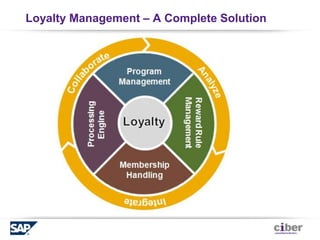
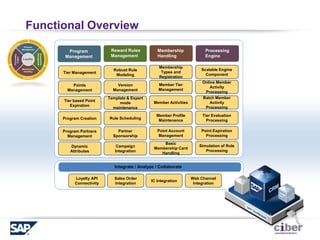
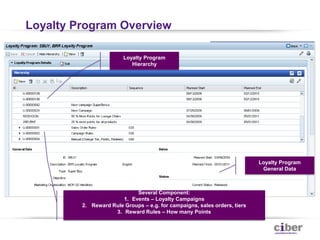
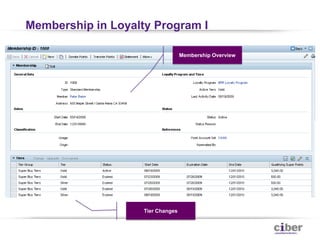
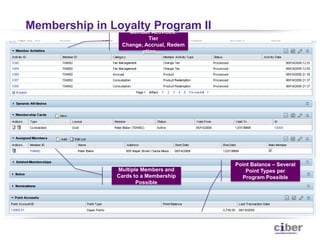
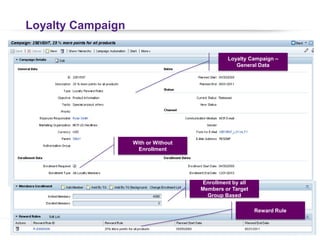
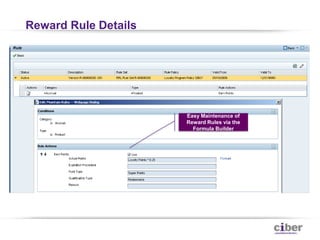
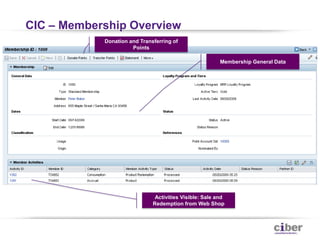
  • #23 Loyalty Program Management enables set-up and maintenance of loyalty programs. Program maintenance includes information about program partners, program-related loyalty status levels, set-up and maintenance of point accounts, as well as program-specific attributes based on flights, nights of stay, dollars spent, frequency of purchases, and so on.Loyalty Reward Rule Management includes the set-up and maintenance of loyalty rules and conditions, campaigns for enrollment and registration, finally being processed by the loyalty engine. All points accrued and redeemed by members are recorded within the member‘s point account. Loyalty Membership represents the participation of an individual person to a specific loyalty program. Membership is opened by registration to the loyalty program, either paper-based, via Web self-service, or Interaction Center. It also includes member activities such as flights, hotel stays, or sales activities, finally being processed by the processing engine against the reward rules. The Loyalty Management Processing Engine is a highly scalable component to process member activities, tier transition evaluation, and point expiration. It is an integrated part of SAP CRM and the “heart” of the SAP CRM based Loyalty Management solution.Additional features in Loyalty Management are:CollaborationIntegrationLoyalty Management is a cross-industry offering and can be configured for different industries.
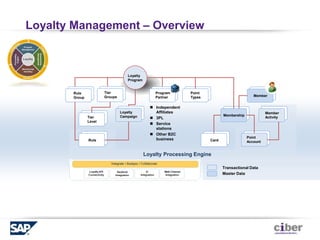
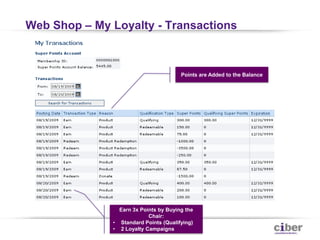
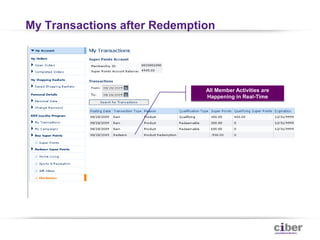
  • #24 This slide gives you an overview of how the individual entities of the loyalty program connect to each other. One could distinguish between the set-up of the program, the corresponding master data, and the transactional data like sales order or POS transactions, which would invoke the infrastructure and the update of the master data objects. At its core the loyalty processing engine would be responsible for complying with all defined rules in order to post the right miles or points to the member accounts. The rule could be a basic rule applying to all standard transactions , but it could also be attached to a campaign, where the rule only applies to a certain target group. The Member is usually identified via card at the POS or via a member number in the Web shop and Interaction Center. Each transaction invokes the rule framework in SAP CRM, creates a member activity, and eventually updates the point account either as a redemption or accrual.And, of course, all interactions are integrated into the SAP CRM regular channels like the Web shop and Interaction Center, or via APIs also to SAP POS.
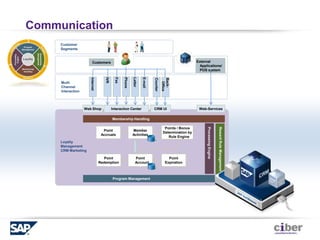
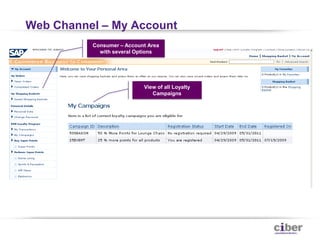
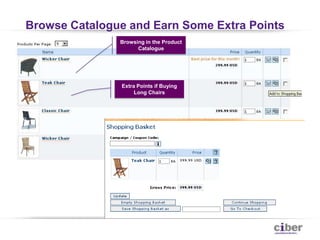
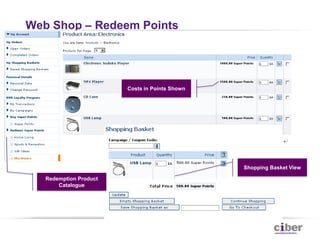
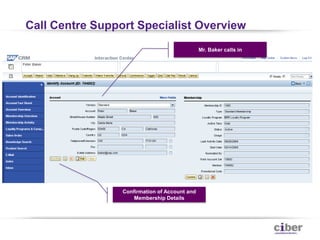
  • #25 Loyalty Management is embedded in SAP CRM. It uses multiple channels to interact with the customer; mainly the SAP CRM Web shop, the Interaction Center, as well as the CRM UI.Its objects are Web service enabled to allow external applications to communicate with SAP CRM loyalty management. It has already been mentioned that loyalty management is a central component in seamlessly integrated into SAP CRM Marketing. Loyalty Management from a communication perspective is mainly about processing activities, member activities like flights, trips, ticket purchases, point redemption, or any other accrual activitiy, either sent by an external system, manually entered, or derived from SAP CRM sales processes. These activities will be processed against system-specific rules and will finally update to passenger tier levels, point accounts, or execute any other customer-specific functionality according to the settings and definitions which have been made for the loyalty program.
  • #26 It has already been mentioned that loyalty management is based on the following four solid pillars:Program ManagementReward Rule ManagementMembership HandlingProcessing EngineEach area is directly addressing individual, loyalty-specific business processes and comes with rich functionality.In this presentation, we will take a look at each block in more detail.