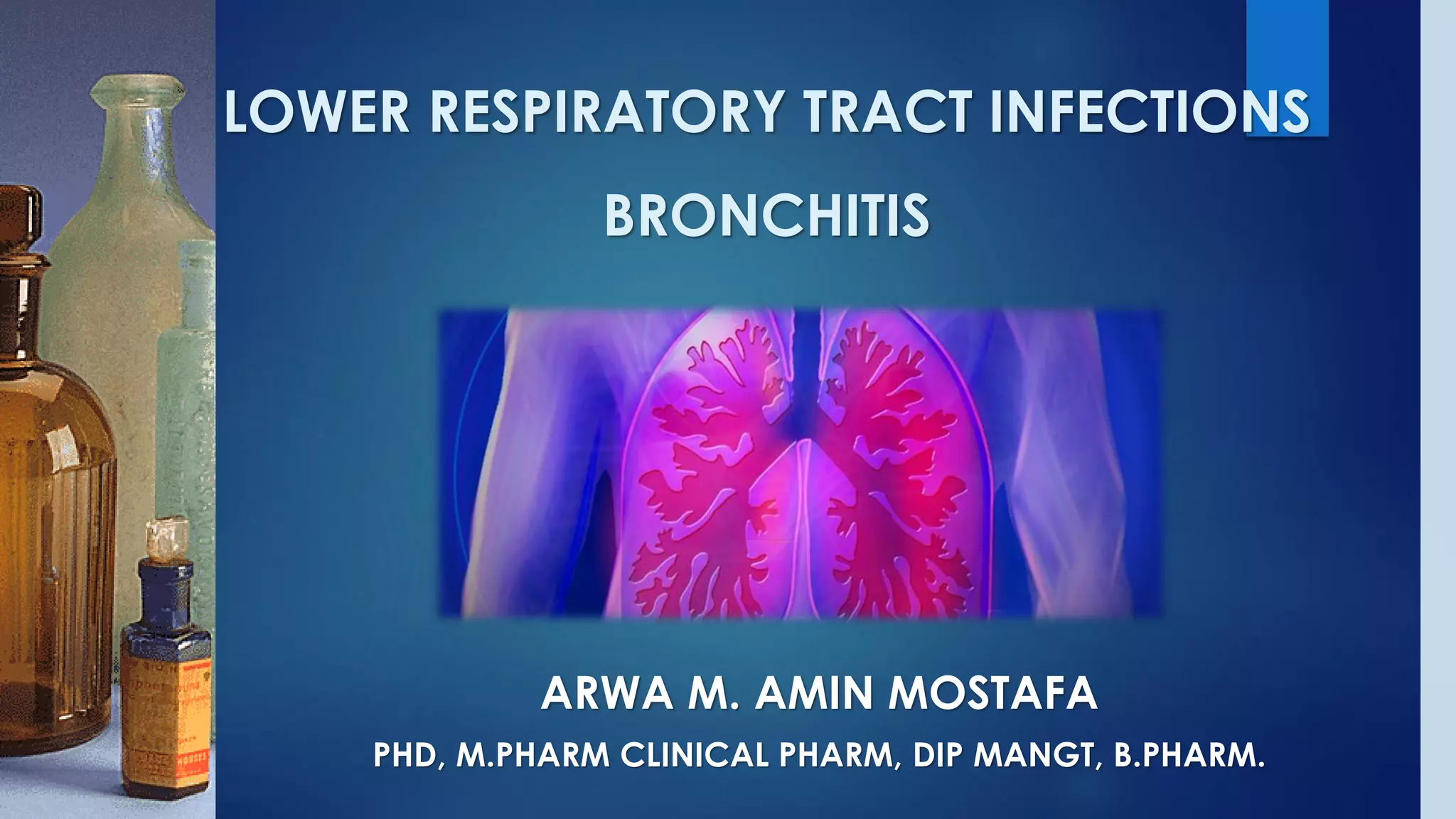

LOWER RESPIRATORY TRACT INFECTIONS
BRONCHITIS
ARWA M. AMIN MOSTAFA
PHD, M.PHARM CLINICAL PHARM, DIP MANGT, B.PHARM.
Arwa M. Amin
What We will Discuss Today?
 What are the Lower Respiratory Tract Infections (LRTIs)?
 What is Bronchitis and what are the different types of
Bronchitis?
 What are the pathogenesis, common pathogens, risk factors
and symptoms of Acute Bronchitis?
 How to manage Acute Bronchitis?
 What are the pathogenesis, risk factors, common bacterial
pathogens, and clinical presentation of Chronic Bronchitis?
 What is Acute Exacerbated Chronic Bronchitis (AECB)?
 How to manage Chronic Bronchitis?
Arwa M. Amin
Lower Respiratory Tract Infections (LRTIs)
 LRTIs are infections which affect the Lower respiratory tract
System, i.e. the Trachea, bronchi (airways) and Lungs.
 LRTIs include:
 Bronchitis
Acute Bronchitis
Chronic Bronchitis
 Bronchiolitis
 Pneumonia
Community Acquired Pneumonia (CAP)
Hospital Acquired Pneumonia (HAP)
Arwa M. Amin
Bronchitis
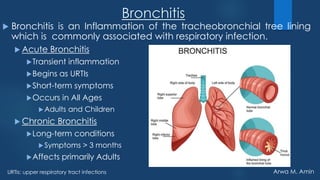
 Bronchitis is an Inflammation of the tracheobronchial tree lining
which is commonly associated with respiratory infection.
 Acute Bronchitis
Transient inflammation
Begins as URTIs
Short-term symptoms
Occurs in All Ages
Adults and Children
 Chronic Bronchitis
Long-term conditions
Symptoms > 3 months
Affects primarily Adults
URTIs: upper respiratory tract infections
Arwa M. Amin
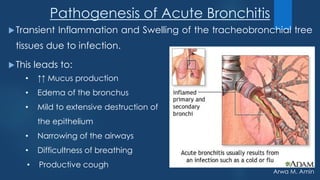
Pathogenesis of Acute Bronchitis
Transient Inflammation and Swelling of the tracheobronchial tree
tissues due to infection.
This leads to:
• ↑↑ Mucus production
• Edema of the bronchus
• Mild to extensive destruction of
the epithelium
• Narrowing of the airways
• Difficultness of breathing
• Productive cough
Arwa M. Amin
Acute Bronchitis: Common Pathogens
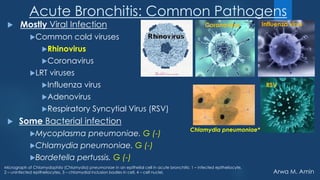
 Mostly Viral Infection
Common cold viruses
Rhinovirus
Coronavirus
LRT viruses
Influenza virus
Adenovirus
Respiratory Syncytial Virus (RSV)
 Some Bacterial infection
Mycoplasma pneumoniae. G (-)
Chlamydia pneumoniae. G (-)
Bordetella pertussis. G (-)
Coronavirus Influenza virus
RSV
Chlamydia pneumoniae*
Micrograph of Chlamydophila (Chlamydia) pneumoniae in an epithelial cell in acute bronchitis: 1 – infected epitheliocyte,
2 – uninfected epitheliocytes, 3 – chlamydial inclusion bodies in cell, 4 – cell nuclei,
Arwa M. Amin
Risk factors of Acute Bronchitis
 Close contact with infected patient
Inhalation of infecting droplets
 Cold climate (Winter months).
 Smoking
 Exposure to tobacco smoke
 Air pollution & dust
Arwa M. Amin
Symptoms of Acute Bronchitis
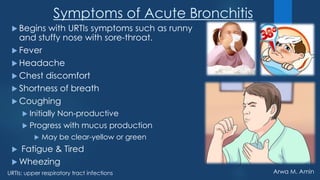
 Begins with URTIs symptoms such as runny
and stuffy nose with sore-throat.
 Fever
 Headache
 Chest discomfort
 Shortness of breath
 Coughing
 Initially Non-productive
 Progress with mucus production
 May be clear-yellow or green
 Fatigue & Tired
 Wheezing
URTIs: upper respiratory tract infections
Arwa M. Amin
Management of Acute Bronchitis
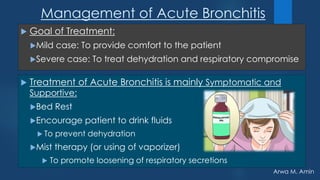
 Treatment of Acute Bronchitis is mainly Symptomatic and
Supportive:
Bed Rest
Encourage patient to drink fluids
 To prevent dehydration
Mist therapy (or using of vaporizer)
 To promote loosening of respiratory secretions
 Goal of Treatment:
Mild case: To provide comfort to the patient
Severe case: To treat dehydration and respiratory compromise
Arwa M. Amin
Management of Acute Bronchitis
 Cough Suppressants:
 Persistent, Mild cough: Dextromethorphan
 Severe Cough: Intermittent codeine
Analgesics-Antipyretic Therapy:
 Aspirin, Acetaminophen and Ibuprofen
 Use Acetaminophen in children
 Avoid using Aspirin in children; why?
 Taking Aspirin in viral infected children may ↑↑ the risk of Reye’s
syndrome development
Arwa M. Amin
Management of Acute Bronchitis
 No Antibiotic (AB) Treatment for Acute Bronchitis unless Bacterial
Infection is suspected or confirmed.
 Acute Bronchitis is Self Limiting. The infection usually goes away
within one week by it self.
 If Bacterial Infection is suspected or confirmed, AB can be used.
 E.g. Mycoplasma pneumonia
Azithromycin
Fluoroquinolone such as Levofloxacin (Adults only)
Arwa M. Amin
Pathogenesis and Risk factors of Chronic Bronchitis
 Chronic Inflammation of the bronchi with hypersecretion of mucus which
causes mucus plugging and smaller airways.
 Chronic smoking and heavy exposure to pollutants compromises
bronchial mucosa.
 Chronic Bronchitis is characterized by cough with excessive mucus
production, most of the days for at least 3 consecutive months for at least
2 consecutive years.
 Often coexist with COPD* & Emphysema**
 Risk Factors:
 Smoking cigarette
 Exposure to Air pollution
 Bacterial and (possibly viral) infection
 Genetic factors
• COPD: chronic obstructive pulmonary disease
** Emphysema: Destruction and enlargement of air-space
Arwa M. Amin
Common Bacterial Pathogens of Chronic Bronchitis
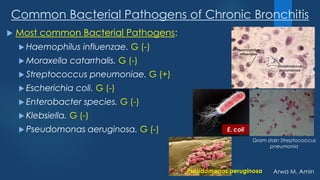
 Most common Bacterial Pathogens:
 Haemophilus influenzae. G (-)
 Moraxella catarrhalis. G (-)
 Streptococcus pneumoniae. G (+)
 Escherichia coli. G (-)
 Enterobacter species. G (-)
 Klebsiella. G (-)
 Pseudomonas aeruginosa. G (-)
Gram stain Streptococcus
pneumonia
E. coli
Pseudomonas aeruginosa
Arwa M. Amin
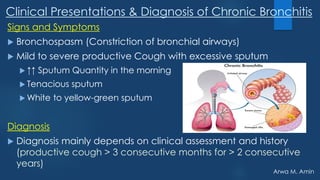
Clinical Presentations & Diagnosis of Chronic Bronchitis
Signs and Symptoms
 Bronchospasm (Constriction of bronchial airways)
 Mild to severe productive Cough with excessive sputum
 ↑↑ Sputum Quantity in the morning
 Tenacious sputum
 White to yellow-green sputum
Diagnosis
 Diagnosis mainly depends on clinical assessment and history
(productive cough > 3 consecutive months for > 2 consecutive
years)
Arwa M. Amin
Chronic Bronchitis with Acute Exacerbation
 Acute Exacerbation of Chronic Bronchitis (AECB) is associated
with increased Purulent Sputum Production.
 Diagnosis of AECB is achieved by Cardinal Symptoms:
 ↑↑ Dyspnea
 ↑↑ Cough
 ↑↑ Sputum production/purulence
 Change in patient “normal” routine
Arwa M. Amin
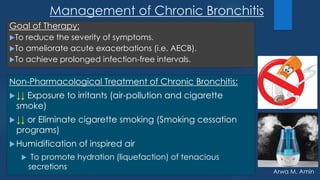
Management of Chronic Bronchitis
Non-Pharmacological Treatment of Chronic Bronchitis:
↓↓ Exposure to irritants (air-pollution and cigarette
smoke)
↓↓ or Eliminate cigarette smoking (Smoking cessation
programs)
Humidification of inspired air
 To promote hydration (liquefaction) of tenacious
secretions
Goal of Therapy:
To reduce the severity of symptoms.
To ameliorate acute exacerbations (i.e. AECB).
To achieve prolonged infection-free intervals.
Arwa M. Amin
Management of Chronic Bronchitis
Pharmacological Therapy
 Symptomatic Treatment:
 Bronchodilators such as short acting β2 agonist (e.g. Albuterol) –
Oral or aerosolized, particularly during AECB.
 Chronic inhalation of long-acting β2 agonist and inhaled
corticosteroid combination (e.g. Salmeterol/Fluticasone) can
improve pulmonary function and quality of life.
 Long term inhalation of Ipratropium:
 ↓↓ Frequency of cough
 ↓↓ Severity of cough
 ↓↓ Volume of expectorated sputum
 Treatment of Chronic Bronchitis co-existing with COPD
 Long acting β2 agonist + Inhaled corticosteroids
Arwa M. Amin
Management of Chronic Bronchitis
Antibiotic (AB) treatment:
AB treatment in Chronic Bronchitis is Effective if 2 or 3 of the following
symptoms are present:
 ↑↑ Dyspnea
 ↑↑ Sputum volume
 ↑↑ Production of Purulent sputum
Commonly used AB for AECB:
Ampicillin & Amoxicillin
Amoxicillin-Clavulanate
Fluoroquinolones: Ciprofloxacin, Levofloxacin, Moxifloxacin
Tetracyclines: Doxycycline, Minocycline, Tetracycline
Trimethoprim-sulfamethoxazole
Arwa M. Amin
Management of Chronic Bronchitis
Vaccination:
Influenza Vaccine (October – December, every year)
Pneumonia vaccine for older adults (> 65 years old) and high risk patients
Arwa M. Amin

Bronchitis: An overview

  • 1.
    LOWER RESPIRATORY TRACTINFECTIONS BRONCHITIS ARWA M. AMIN MOSTAFA PHD, M.PHARM CLINICAL PHARM, DIP MANGT, B.PHARM.
  • 2.
    Arwa M. Amin WhatWe will Discuss Today?  What are the Lower Respiratory Tract Infections (LRTIs)?  What is Bronchitis and what are the different types of Bronchitis?  What are the pathogenesis, common pathogens, risk factors and symptoms of Acute Bronchitis?  How to manage Acute Bronchitis?  What are the pathogenesis, risk factors, common bacterial pathogens, and clinical presentation of Chronic Bronchitis?  What is Acute Exacerbated Chronic Bronchitis (AECB)?  How to manage Chronic Bronchitis?
  • 3.
    Arwa M. Amin LowerRespiratory Tract Infections (LRTIs)  LRTIs are infections which affect the Lower respiratory tract System, i.e. the Trachea, bronchi (airways) and Lungs.  LRTIs include:  Bronchitis Acute Bronchitis Chronic Bronchitis  Bronchiolitis  Pneumonia Community Acquired Pneumonia (CAP) Hospital Acquired Pneumonia (HAP)
  • 4.
    Arwa M. Amin Bronchitis Bronchitis is an Inflammation of the tracheobronchial tree lining which is commonly associated with respiratory infection.  Acute Bronchitis Transient inflammation Begins as URTIs Short-term symptoms Occurs in All Ages Adults and Children  Chronic Bronchitis Long-term conditions Symptoms > 3 months Affects primarily Adults URTIs: upper respiratory tract infections
  • 5.
    Arwa M. Amin Pathogenesisof Acute Bronchitis Transient Inflammation and Swelling of the tracheobronchial tree tissues due to infection. This leads to: • ↑↑ Mucus production • Edema of the bronchus • Mild to extensive destruction of the epithelium • Narrowing of the airways • Difficultness of breathing • Productive cough
  • 6.
    Arwa M. Amin AcuteBronchitis: Common Pathogens  Mostly Viral Infection Common cold viruses Rhinovirus Coronavirus LRT viruses Influenza virus Adenovirus Respiratory Syncytial Virus (RSV)  Some Bacterial infection Mycoplasma pneumoniae. G (-) Chlamydia pneumoniae. G (-) Bordetella pertussis. G (-) Coronavirus Influenza virus RSV Chlamydia pneumoniae* Micrograph of Chlamydophila (Chlamydia) pneumoniae in an epithelial cell in acute bronchitis: 1 – infected epitheliocyte, 2 – uninfected epitheliocytes, 3 – chlamydial inclusion bodies in cell, 4 – cell nuclei,
  • 7.
    Arwa M. Amin Riskfactors of Acute Bronchitis  Close contact with infected patient Inhalation of infecting droplets  Cold climate (Winter months).  Smoking  Exposure to tobacco smoke  Air pollution & dust
  • 8.
    Arwa M. Amin Symptomsof Acute Bronchitis  Begins with URTIs symptoms such as runny and stuffy nose with sore-throat.  Fever  Headache  Chest discomfort  Shortness of breath  Coughing  Initially Non-productive  Progress with mucus production  May be clear-yellow or green  Fatigue & Tired  Wheezing URTIs: upper respiratory tract infections
  • 9.
    Arwa M. Amin Managementof Acute Bronchitis  Treatment of Acute Bronchitis is mainly Symptomatic and Supportive: Bed Rest Encourage patient to drink fluids  To prevent dehydration Mist therapy (or using of vaporizer)  To promote loosening of respiratory secretions  Goal of Treatment: Mild case: To provide comfort to the patient Severe case: To treat dehydration and respiratory compromise
  • 10.
    Arwa M. Amin Managementof Acute Bronchitis  Cough Suppressants:  Persistent, Mild cough: Dextromethorphan  Severe Cough: Intermittent codeine Analgesics-Antipyretic Therapy:  Aspirin, Acetaminophen and Ibuprofen  Use Acetaminophen in children  Avoid using Aspirin in children; why?  Taking Aspirin in viral infected children may ↑↑ the risk of Reye’s syndrome development
  • 11.
    Arwa M. Amin Managementof Acute Bronchitis  No Antibiotic (AB) Treatment for Acute Bronchitis unless Bacterial Infection is suspected or confirmed.  Acute Bronchitis is Self Limiting. The infection usually goes away within one week by it self.  If Bacterial Infection is suspected or confirmed, AB can be used.  E.g. Mycoplasma pneumonia Azithromycin Fluoroquinolone such as Levofloxacin (Adults only)
  • 12.
    Arwa M. Amin Pathogenesisand Risk factors of Chronic Bronchitis  Chronic Inflammation of the bronchi with hypersecretion of mucus which causes mucus plugging and smaller airways.  Chronic smoking and heavy exposure to pollutants compromises bronchial mucosa.  Chronic Bronchitis is characterized by cough with excessive mucus production, most of the days for at least 3 consecutive months for at least 2 consecutive years.  Often coexist with COPD* & Emphysema**  Risk Factors:  Smoking cigarette  Exposure to Air pollution  Bacterial and (possibly viral) infection  Genetic factors • COPD: chronic obstructive pulmonary disease ** Emphysema: Destruction and enlargement of air-space
  • 13.
    Arwa M. Amin CommonBacterial Pathogens of Chronic Bronchitis  Most common Bacterial Pathogens:  Haemophilus influenzae. G (-)  Moraxella catarrhalis. G (-)  Streptococcus pneumoniae. G (+)  Escherichia coli. G (-)  Enterobacter species. G (-)  Klebsiella. G (-)  Pseudomonas aeruginosa. G (-) Gram stain Streptococcus pneumonia E. coli Pseudomonas aeruginosa
  • 14.
    Arwa M. Amin ClinicalPresentations & Diagnosis of Chronic Bronchitis Signs and Symptoms  Bronchospasm (Constriction of bronchial airways)  Mild to severe productive Cough with excessive sputum  ↑↑ Sputum Quantity in the morning  Tenacious sputum  White to yellow-green sputum Diagnosis  Diagnosis mainly depends on clinical assessment and history (productive cough > 3 consecutive months for > 2 consecutive years)
  • 15.
    Arwa M. Amin ChronicBronchitis with Acute Exacerbation  Acute Exacerbation of Chronic Bronchitis (AECB) is associated with increased Purulent Sputum Production.  Diagnosis of AECB is achieved by Cardinal Symptoms:  ↑↑ Dyspnea  ↑↑ Cough  ↑↑ Sputum production/purulence  Change in patient “normal” routine
  • 16.
    Arwa M. Amin Managementof Chronic Bronchitis Non-Pharmacological Treatment of Chronic Bronchitis: ↓↓ Exposure to irritants (air-pollution and cigarette smoke) ↓↓ or Eliminate cigarette smoking (Smoking cessation programs) Humidification of inspired air  To promote hydration (liquefaction) of tenacious secretions Goal of Therapy: To reduce the severity of symptoms. To ameliorate acute exacerbations (i.e. AECB). To achieve prolonged infection-free intervals.
  • 17.
    Arwa M. Amin Managementof Chronic Bronchitis Pharmacological Therapy  Symptomatic Treatment:  Bronchodilators such as short acting β2 agonist (e.g. Albuterol) – Oral or aerosolized, particularly during AECB.  Chronic inhalation of long-acting β2 agonist and inhaled corticosteroid combination (e.g. Salmeterol/Fluticasone) can improve pulmonary function and quality of life.  Long term inhalation of Ipratropium:  ↓↓ Frequency of cough  ↓↓ Severity of cough  ↓↓ Volume of expectorated sputum  Treatment of Chronic Bronchitis co-existing with COPD  Long acting β2 agonist + Inhaled corticosteroids
  • 18.
    Arwa M. Amin Managementof Chronic Bronchitis Antibiotic (AB) treatment: AB treatment in Chronic Bronchitis is Effective if 2 or 3 of the following symptoms are present:  ↑↑ Dyspnea  ↑↑ Sputum volume  ↑↑ Production of Purulent sputum Commonly used AB for AECB: Ampicillin & Amoxicillin Amoxicillin-Clavulanate Fluoroquinolones: Ciprofloxacin, Levofloxacin, Moxifloxacin Tetracyclines: Doxycycline, Minocycline, Tetracycline Trimethoprim-sulfamethoxazole
  • 19.
    Arwa M. Amin Managementof Chronic Bronchitis Vaccination: Influenza Vaccine (October – December, every year) Pneumonia vaccine for older adults (> 65 years old) and high risk patients
  • 20.