ADJECTIVES, CONJUNCTIONS, PREPOSITIONS, AND
INTERJECTIONS
Part of Speech Part II
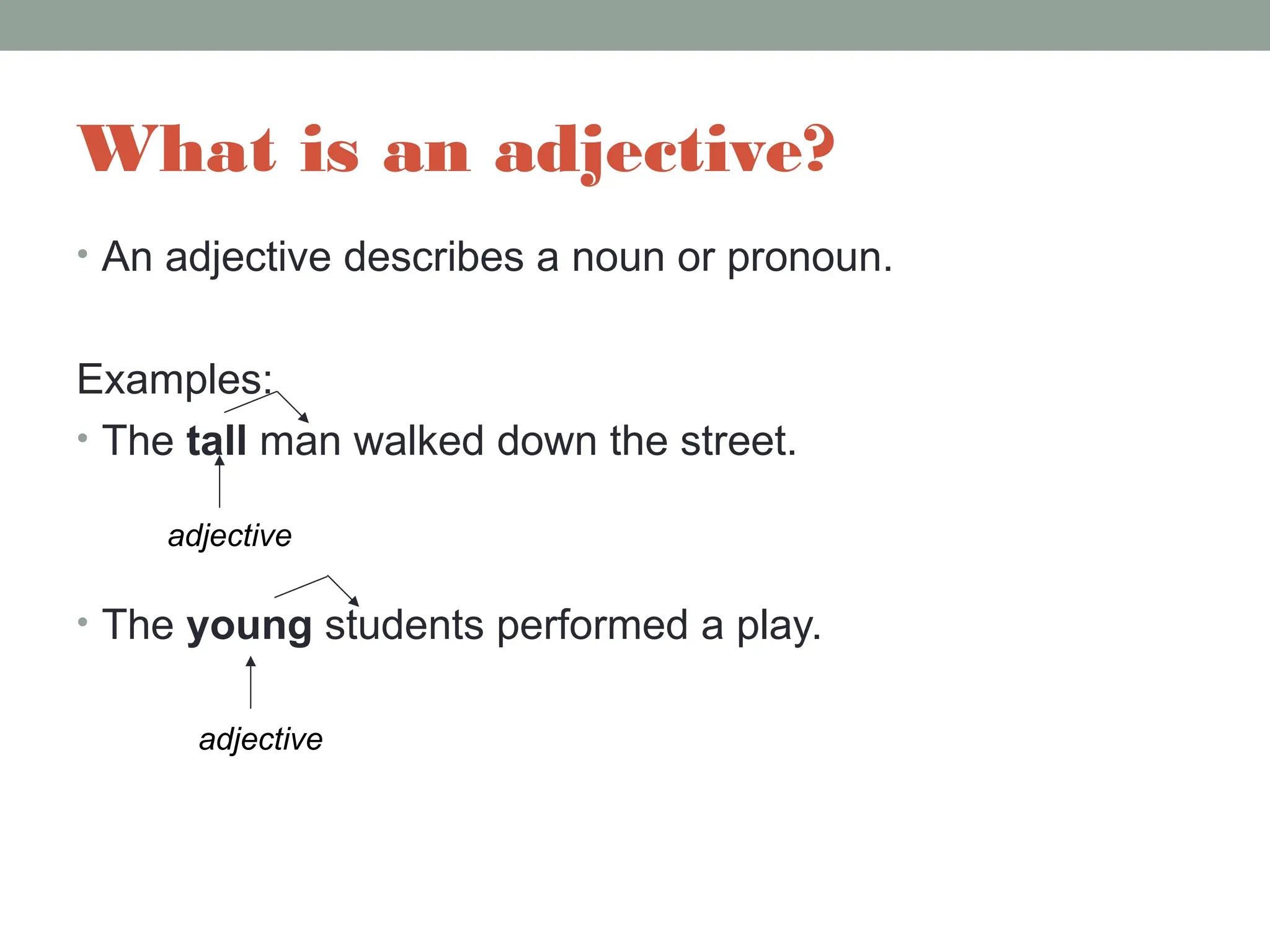
What is an adjective?
• An adjective describes a noun or pronoun.
Examples:
• The tall man walked down the street.
• The young students performed a play.
adjective
adjective
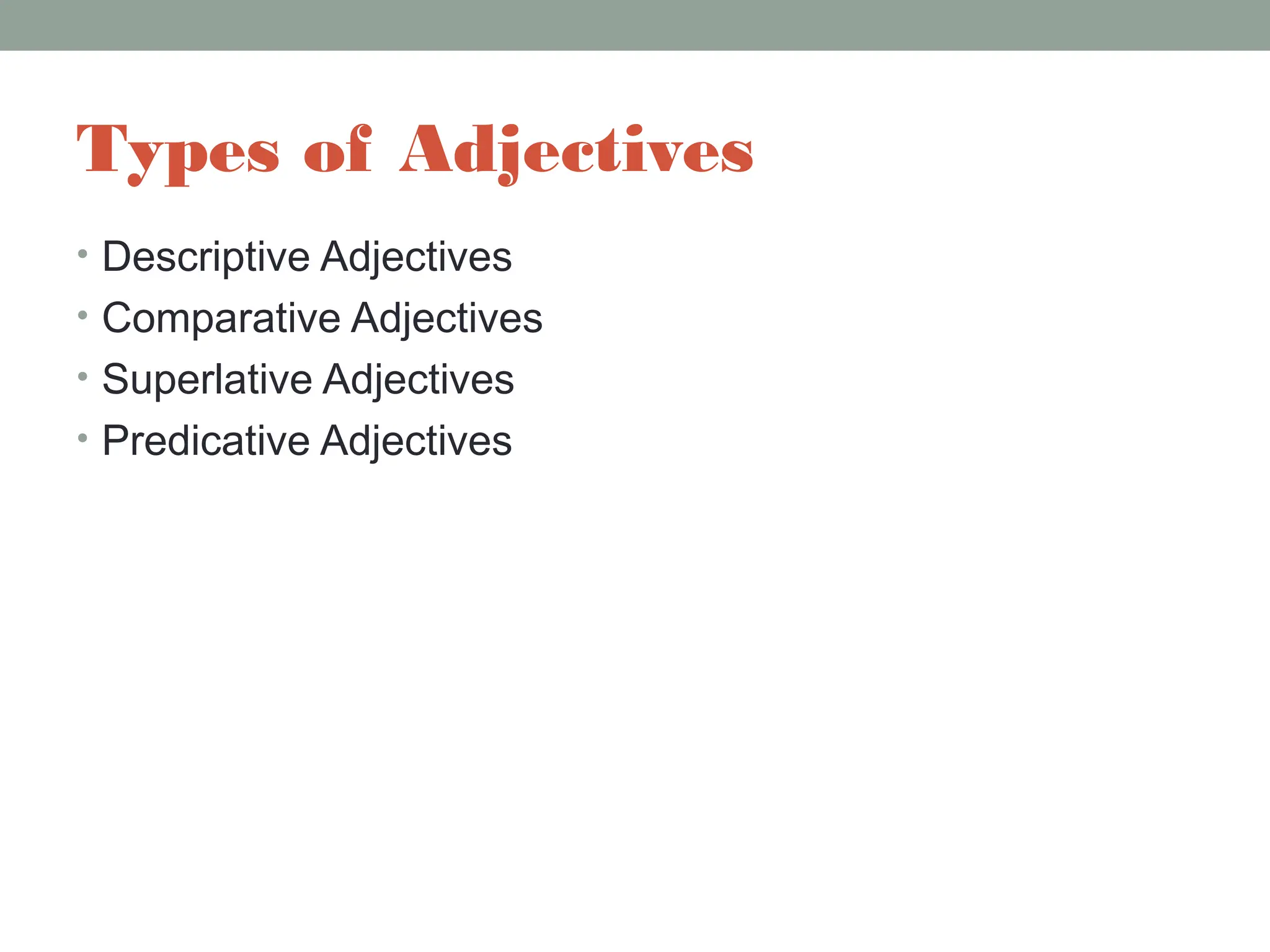
Types of Adjectives
• Descriptive Adjectives
• Comparative Adjectives
• Superlative Adjectives
• Predicative Adjectives
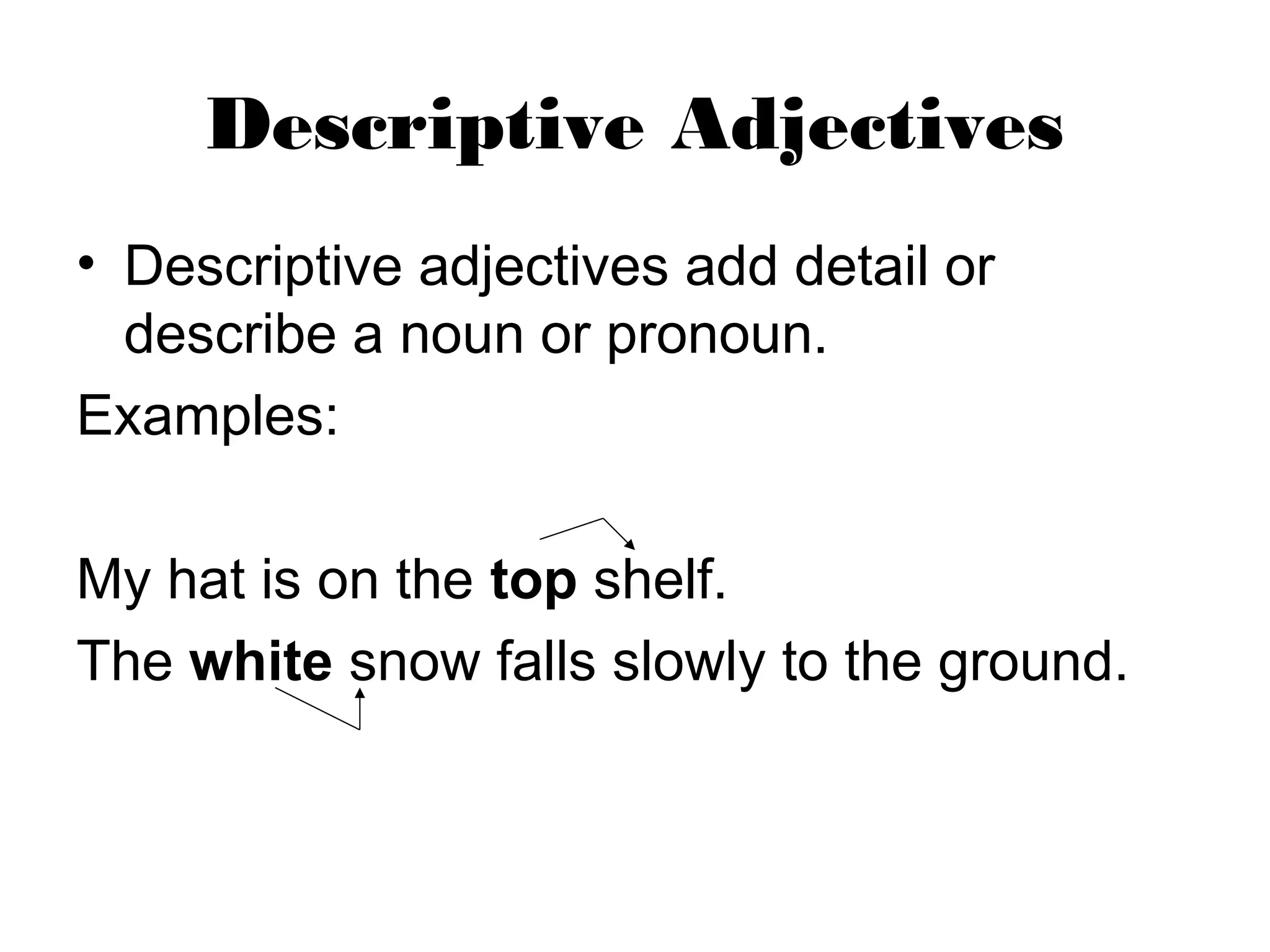
Descriptive Adjectives
• Descriptive adjectives add detail or
describe a noun or pronoun.
Examples:
My hat is on the top shelf.
The white snow falls slowly to the ground.
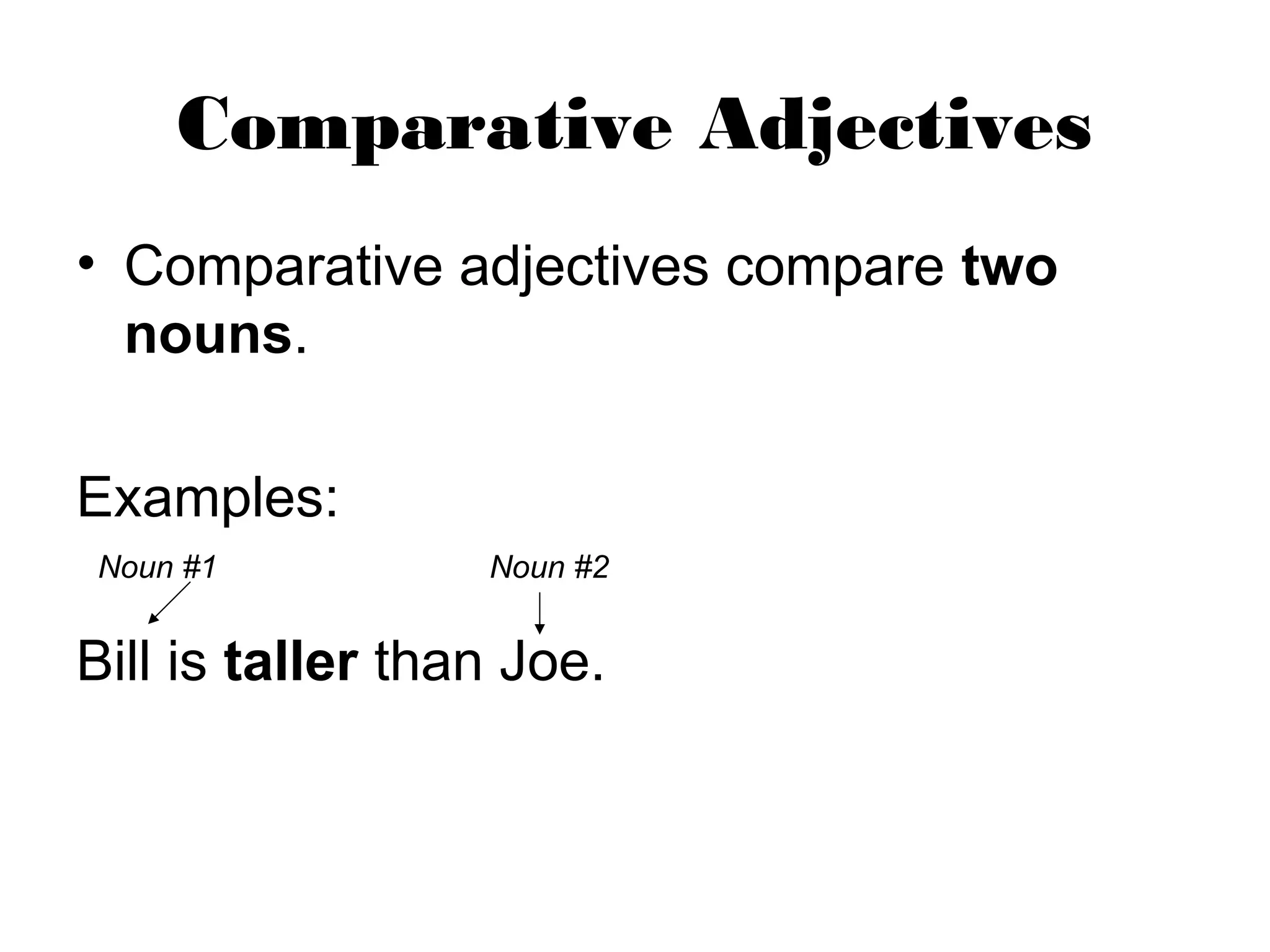
Comparative Adjectives
• Comparative adjectives compare two
nouns.
Examples:
Bill is taller than Joe.
Noun #1 Noun #2
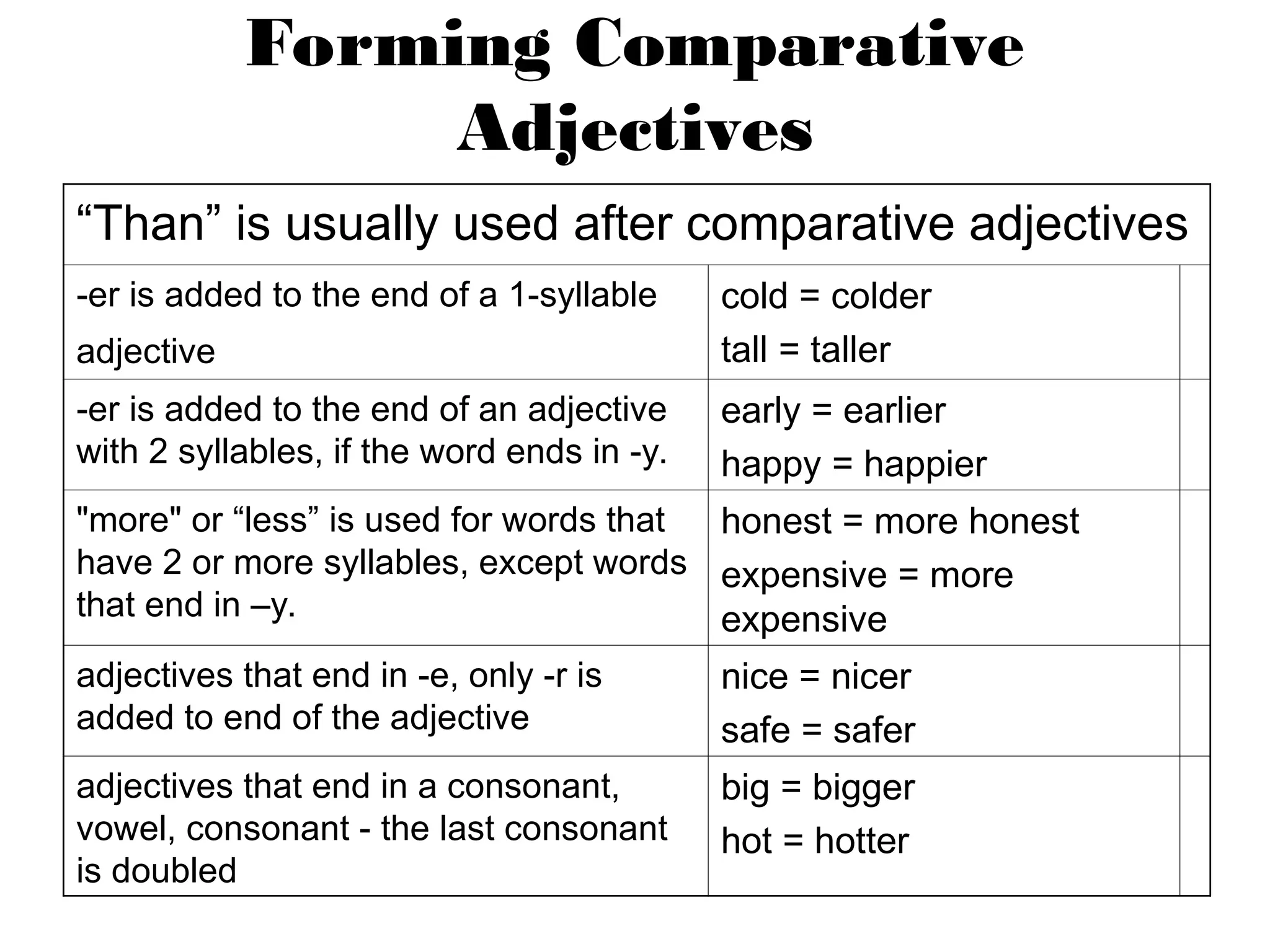
Forming Comparative
Adjectives
“Than” is usually used after comparative adjectives
-er is added to the end of a 1-syllable
adjective
cold = colder
tall = taller
-er is added to the end of an adjective
with 2 syllables, if the word ends in -y.
early = earlier
happy = happier
"more" or “less” is used for words that
have 2 or more syllables, except words
that end in –y.
honest = more honest
expensive = more
expensive
adjectives that end in -e, only -r is
added to end of the adjective
nice = nicer
safe = safer
adjectives that end in a consonant,
vowel, consonant - the last consonant
is doubled
big = bigger
hot = hotter
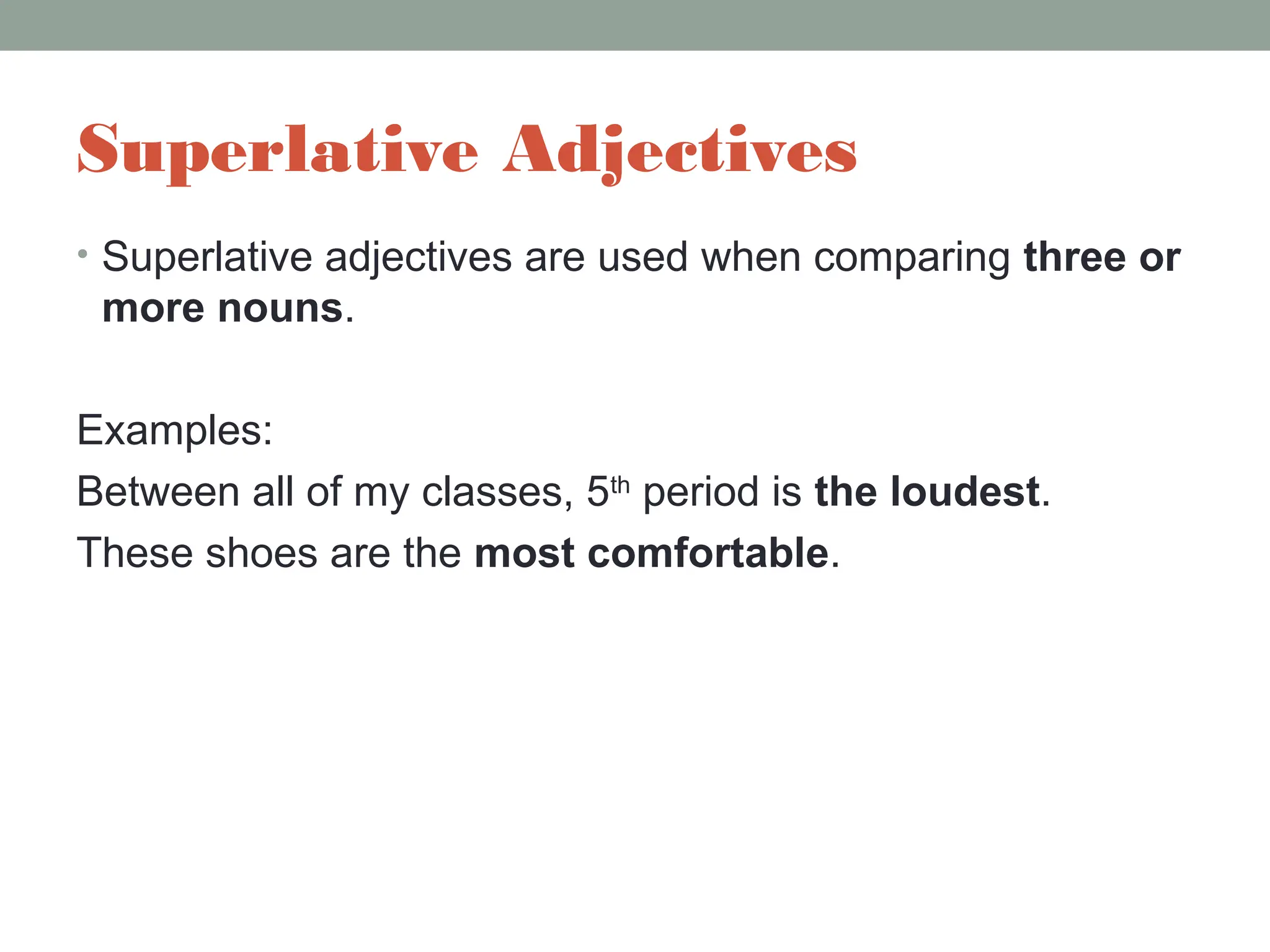
Superlative Adjectives
• Superlative adjectives are used when comparing three or
more nouns.
Examples:
Between all of my classes, 5th
period is the loudest.
These shoes are the most comfortable.
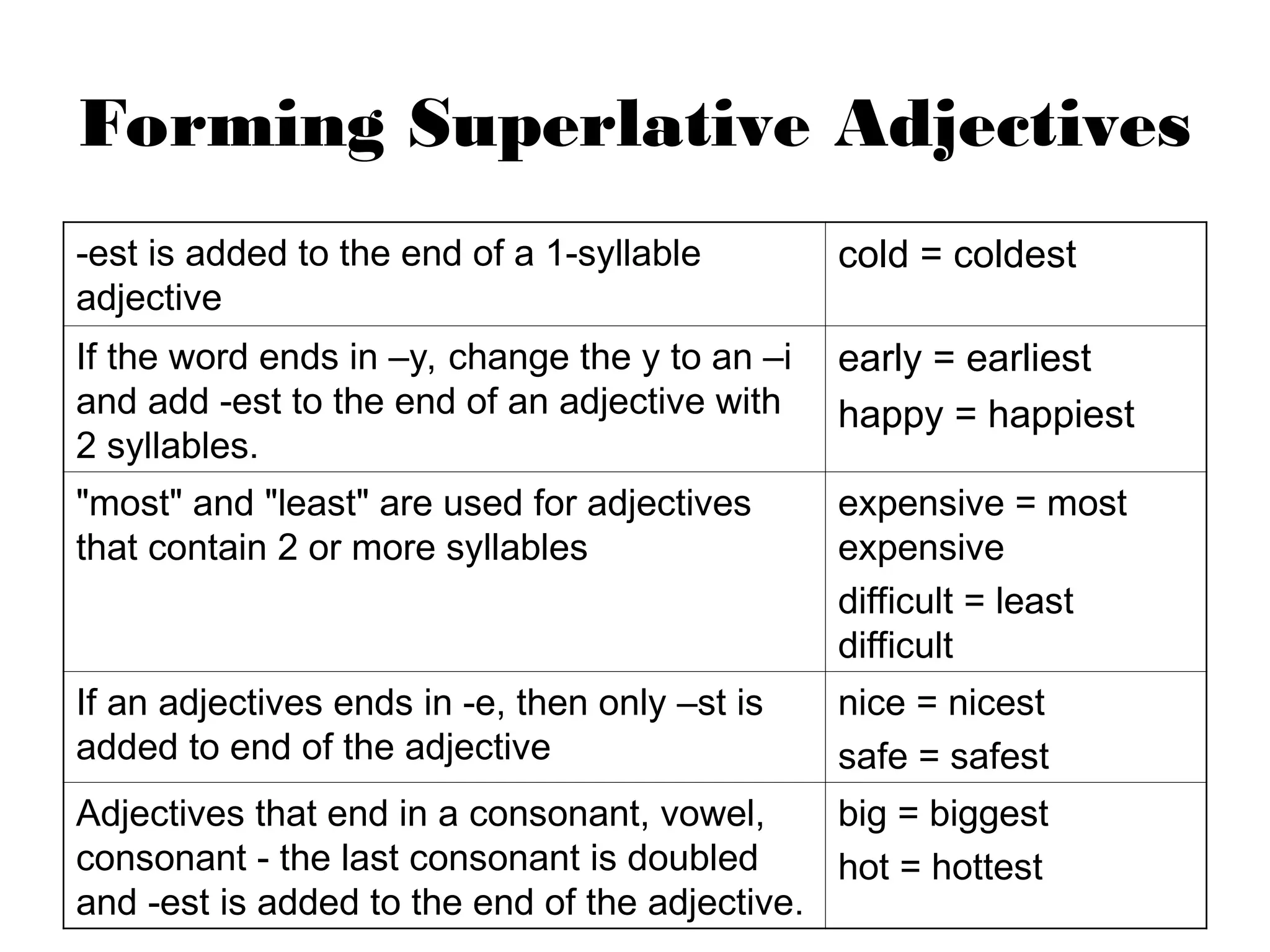
Forming Superlative Adjectives
-est is added to the end of a 1-syllable
adjective
cold = coldest
If the word ends in –y, change the y to an –i
and add -est to the end of an adjective with
2 syllables.
early = earliest
happy = happiest
"most" and "least" are used for adjectives
that contain 2 or more syllables
expensive = most
expensive
difficult = least
difficult
If an adjectives ends in -e, then only –st is
added to end of the adjective
nice = nicest
safe = safest
Adjectives that end in a consonant, vowel,
consonant - the last consonant is doubled
and -est is added to the end of the adjective.
big = biggest
hot = hottest
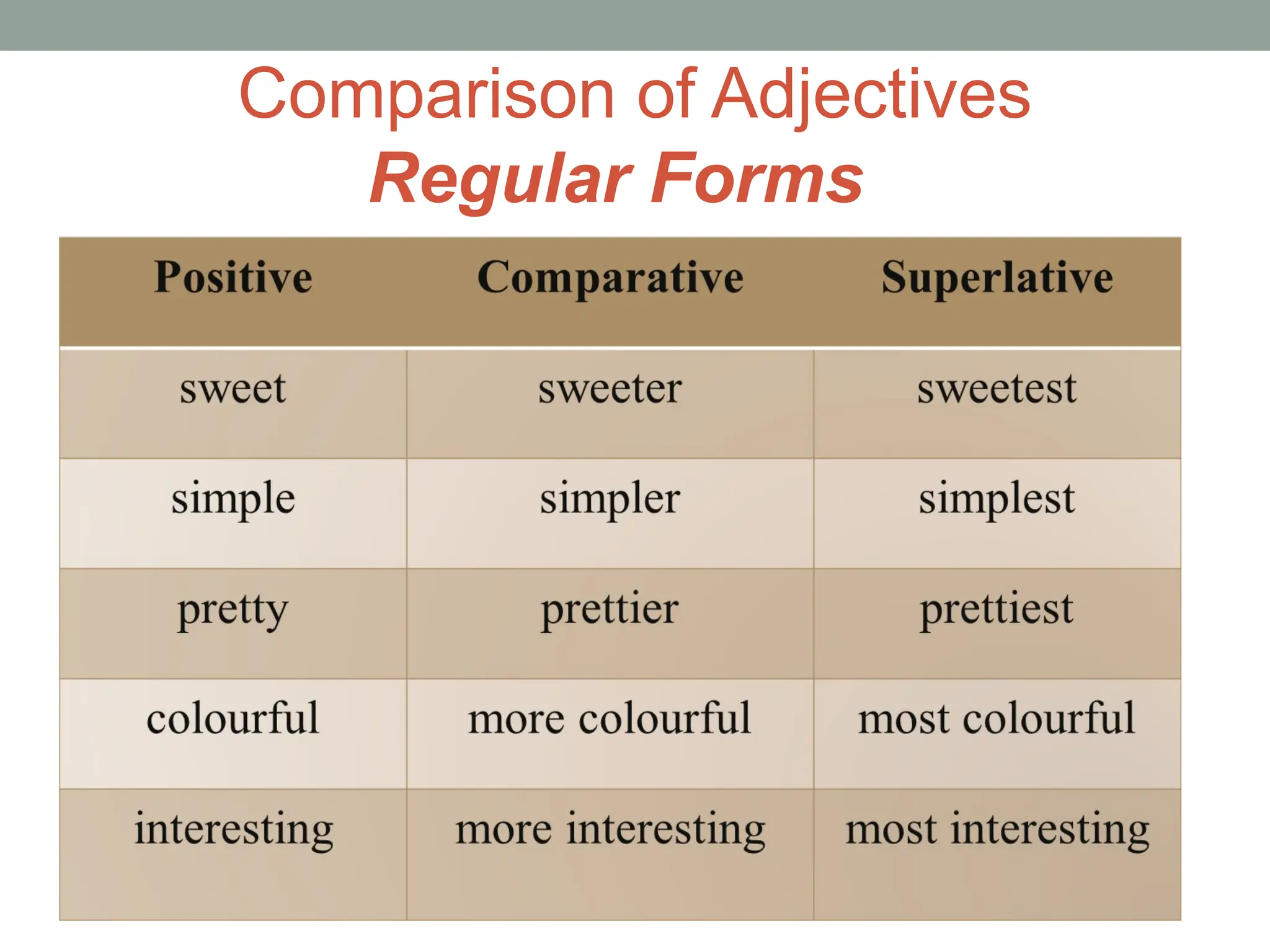
Comparison of Adjectives
Regular Forms
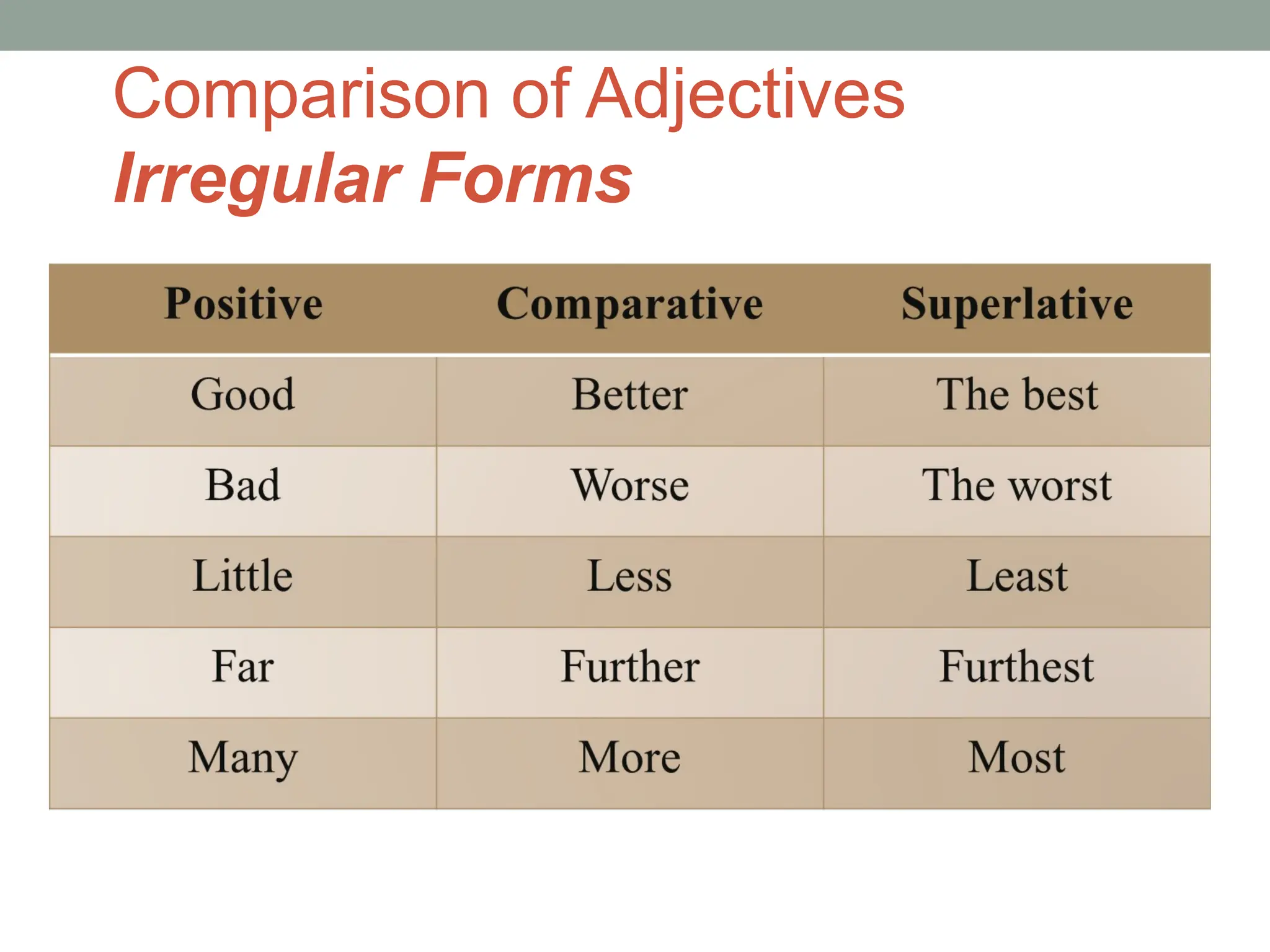
Comparison of Adjectives
Irregular Forms
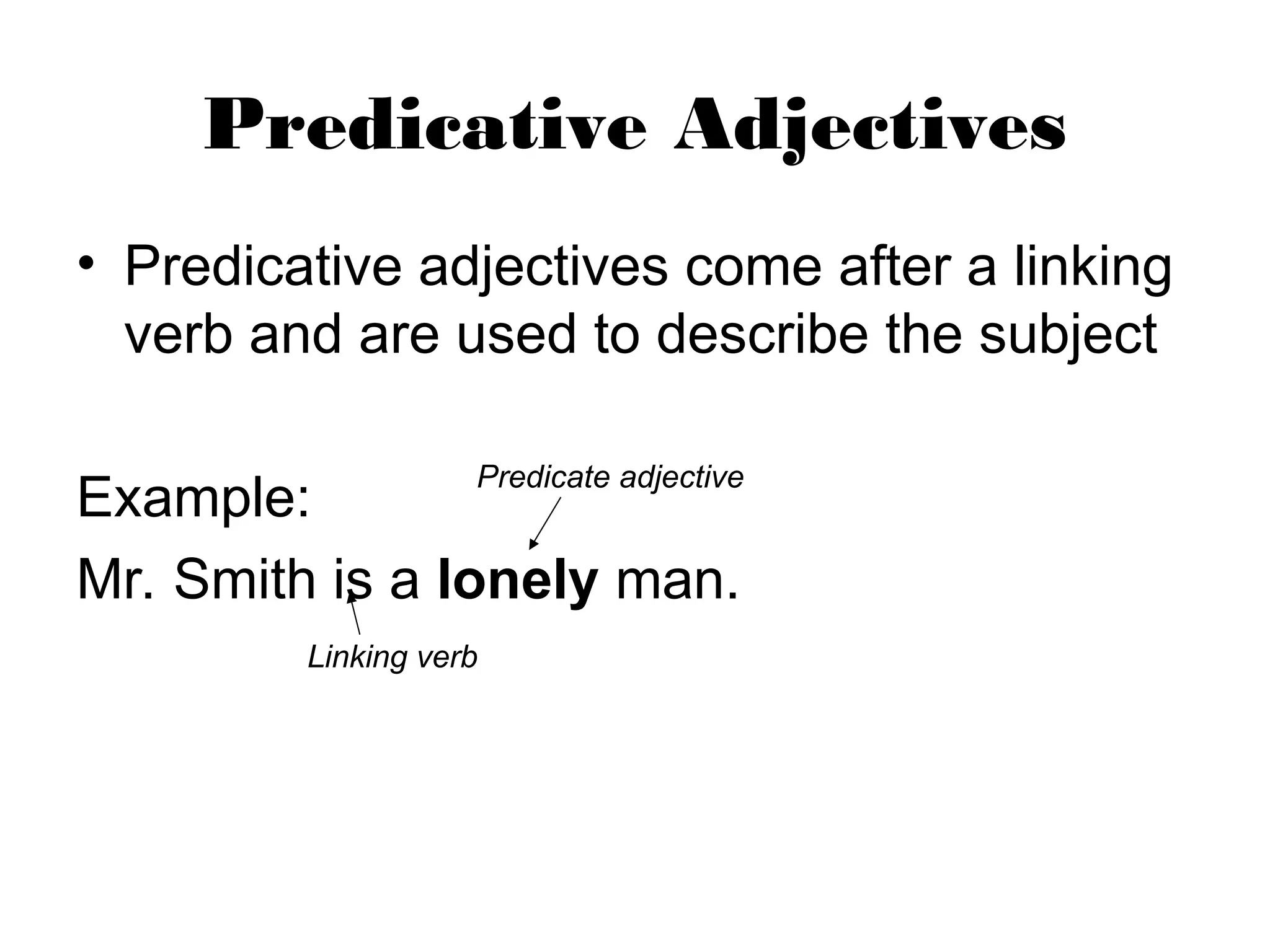
Predicative Adjectives
• Predicative adjectives come after a linking
verb and are used to describe the subject
Example:
Mr. Smith is a lonely man.
Linking verb
Predicate adjective
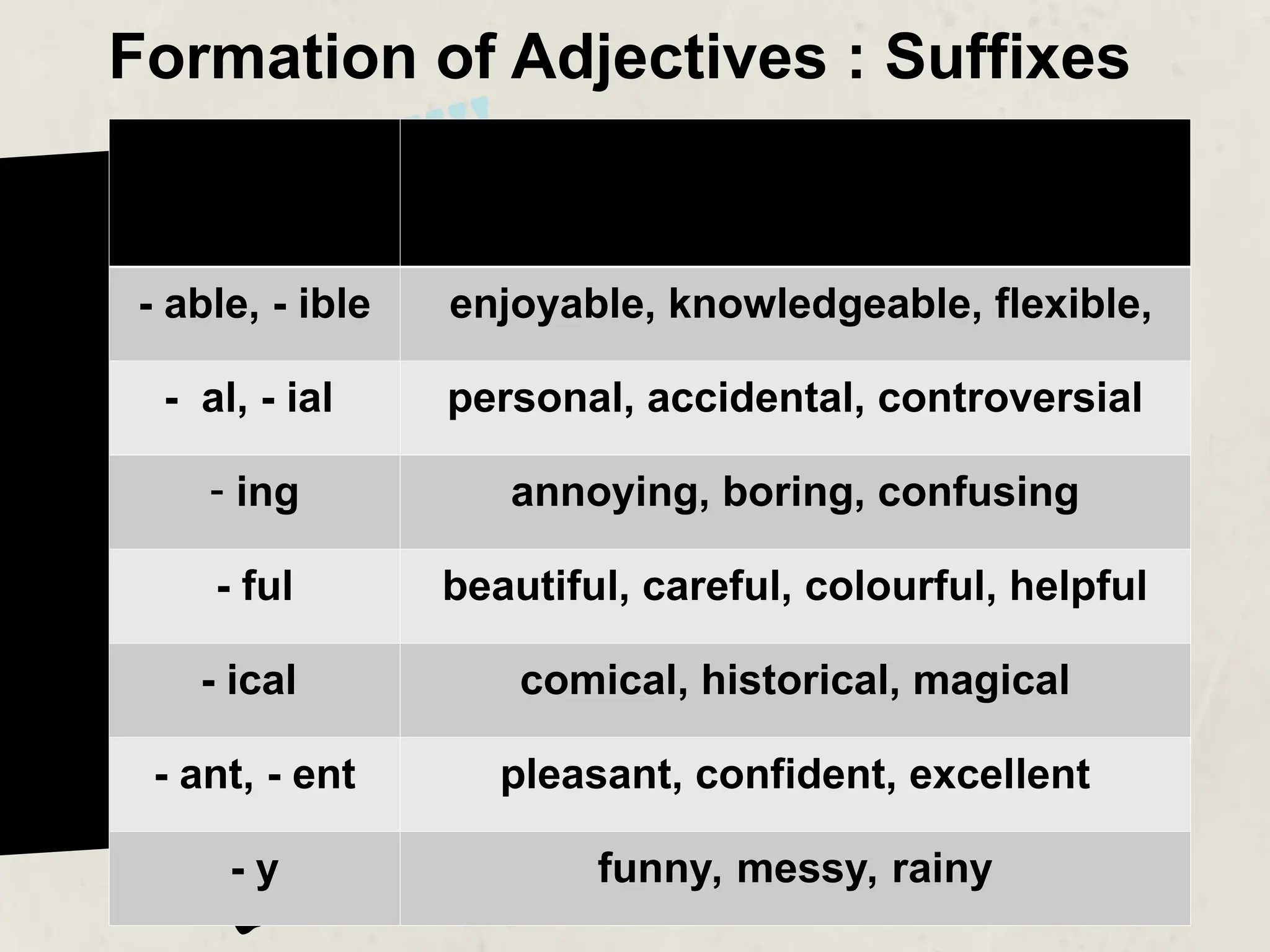
Formation of Adjectives : Suffixes
Common
Suffixes
Examples
- able, - ible enjoyable, knowledgeable, flexible,
- al, - ial personal, accidental, controversial
- ing annoying, boring, confusing
- ful beautiful, careful, colourful, helpful
- ical comical, historical, magical
- ant, - ent pleasant, confident, excellent
- y funny, messy, rainy
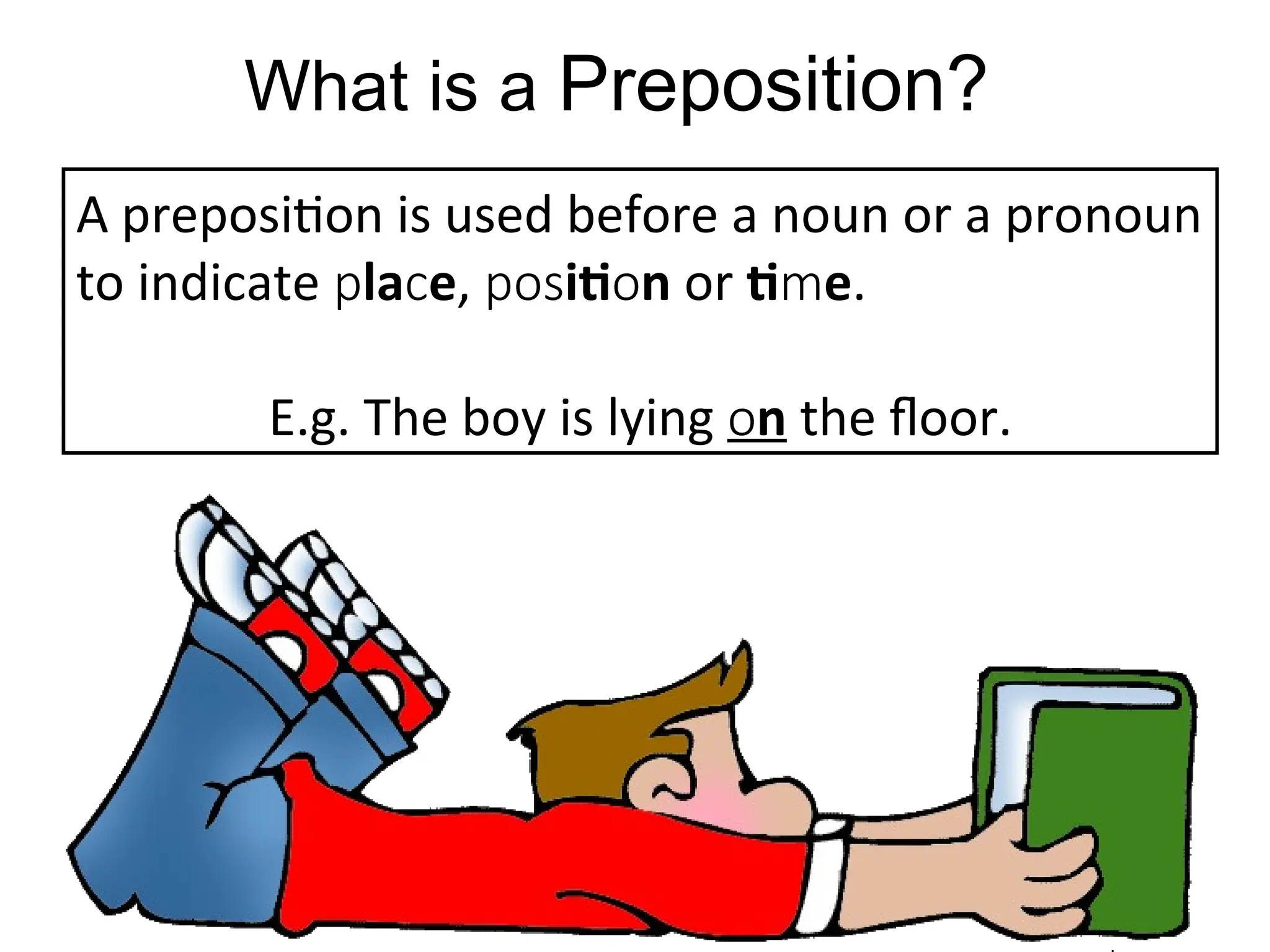
What is a Preposition?
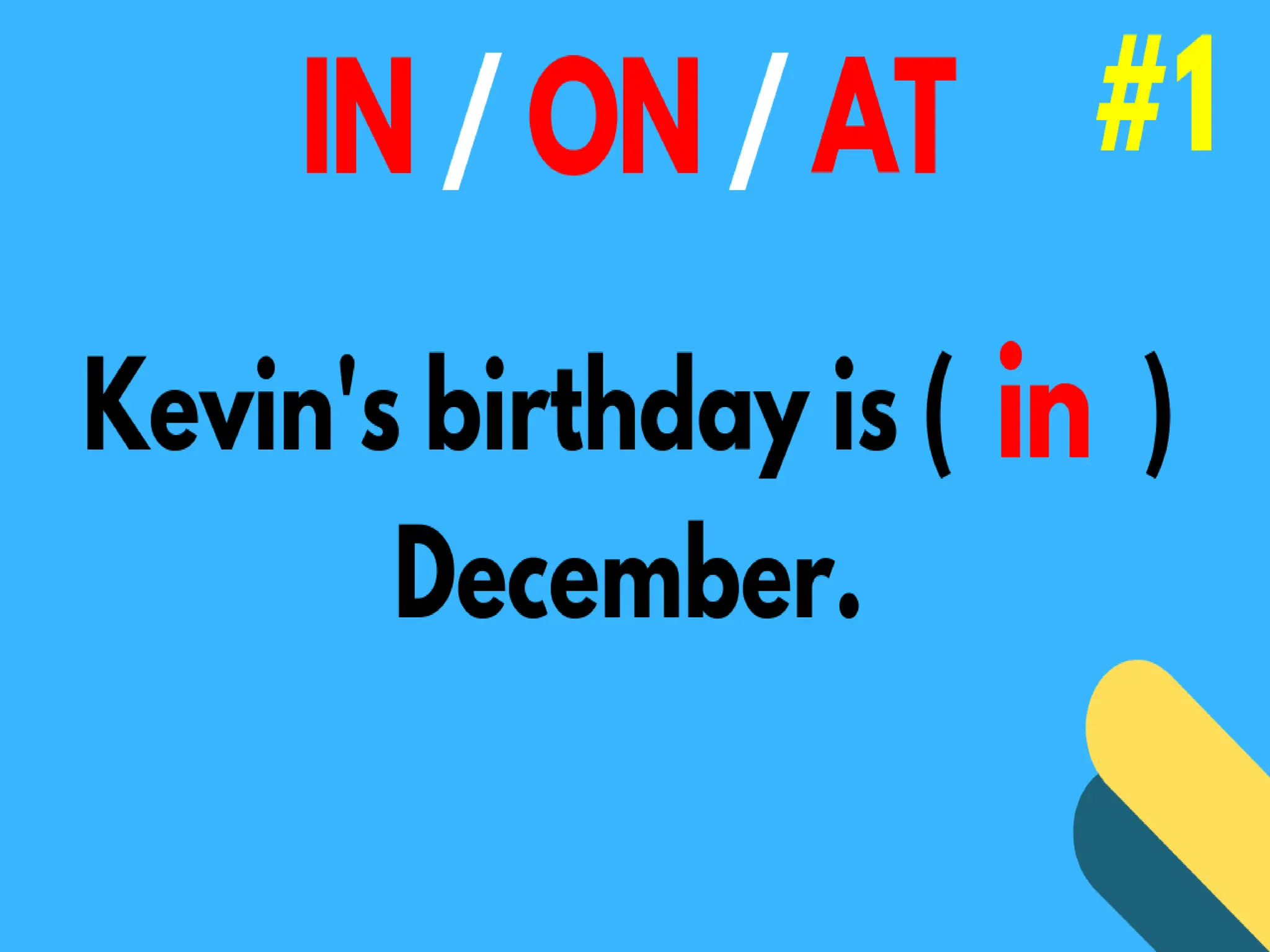
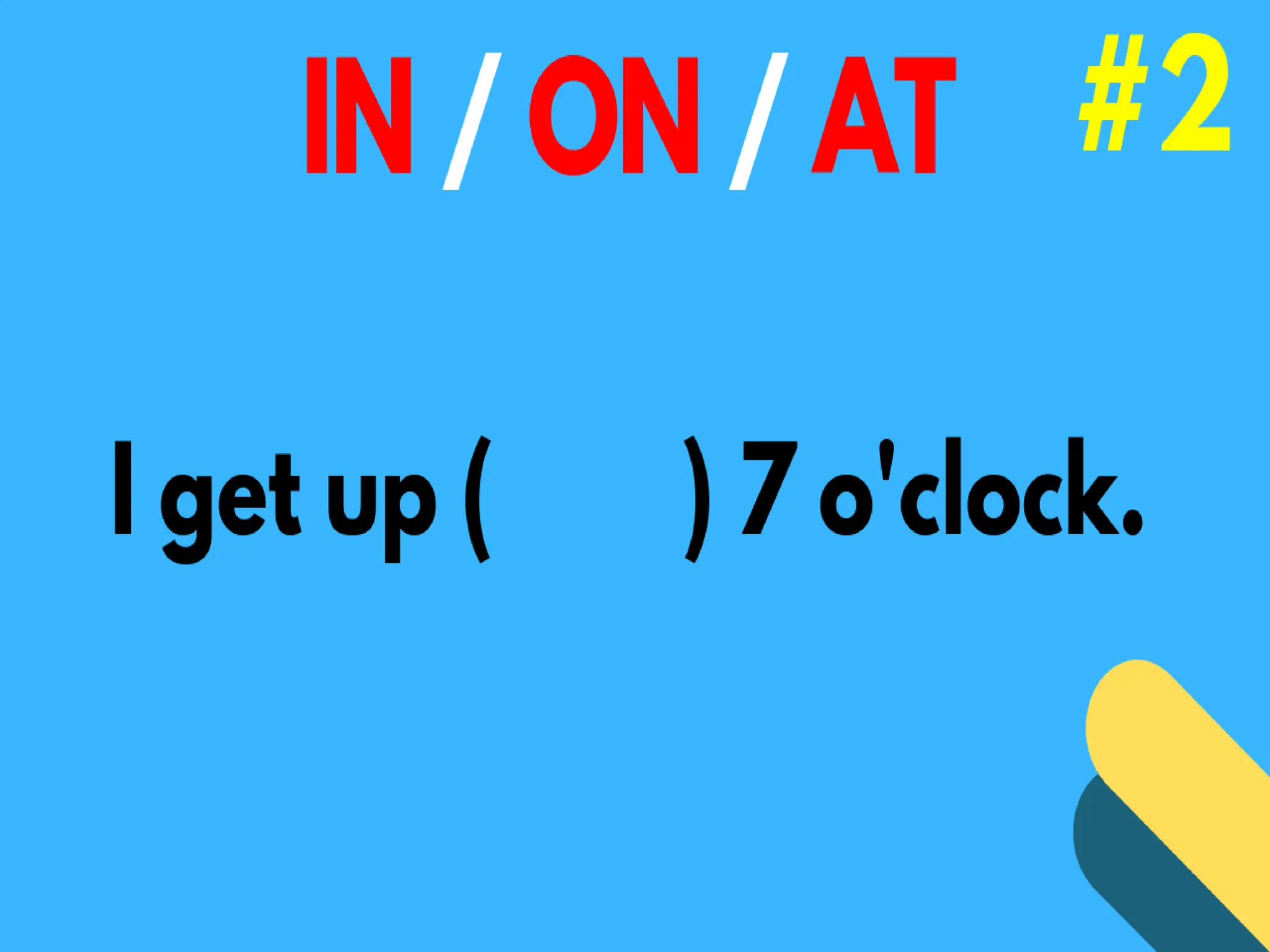
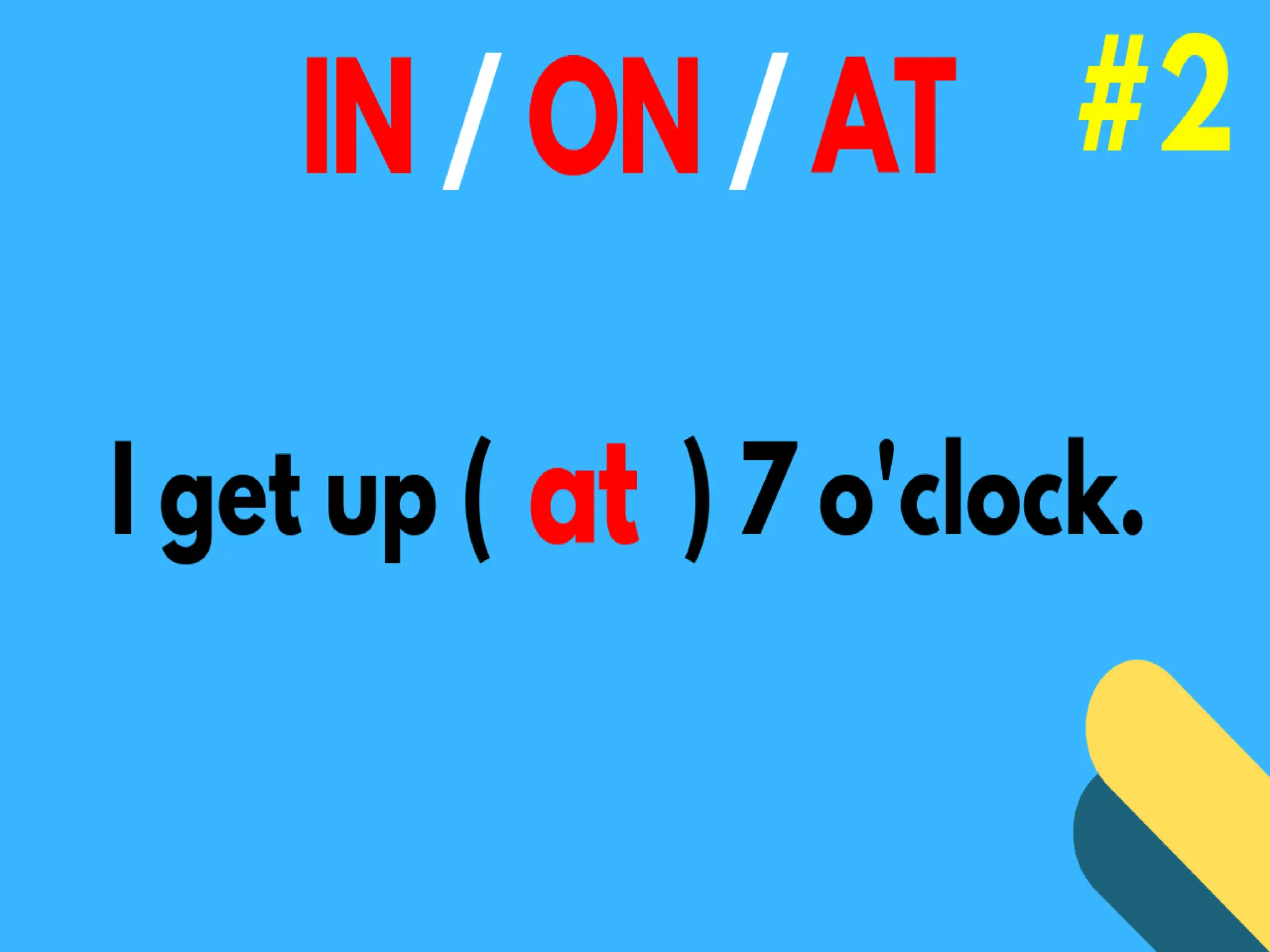
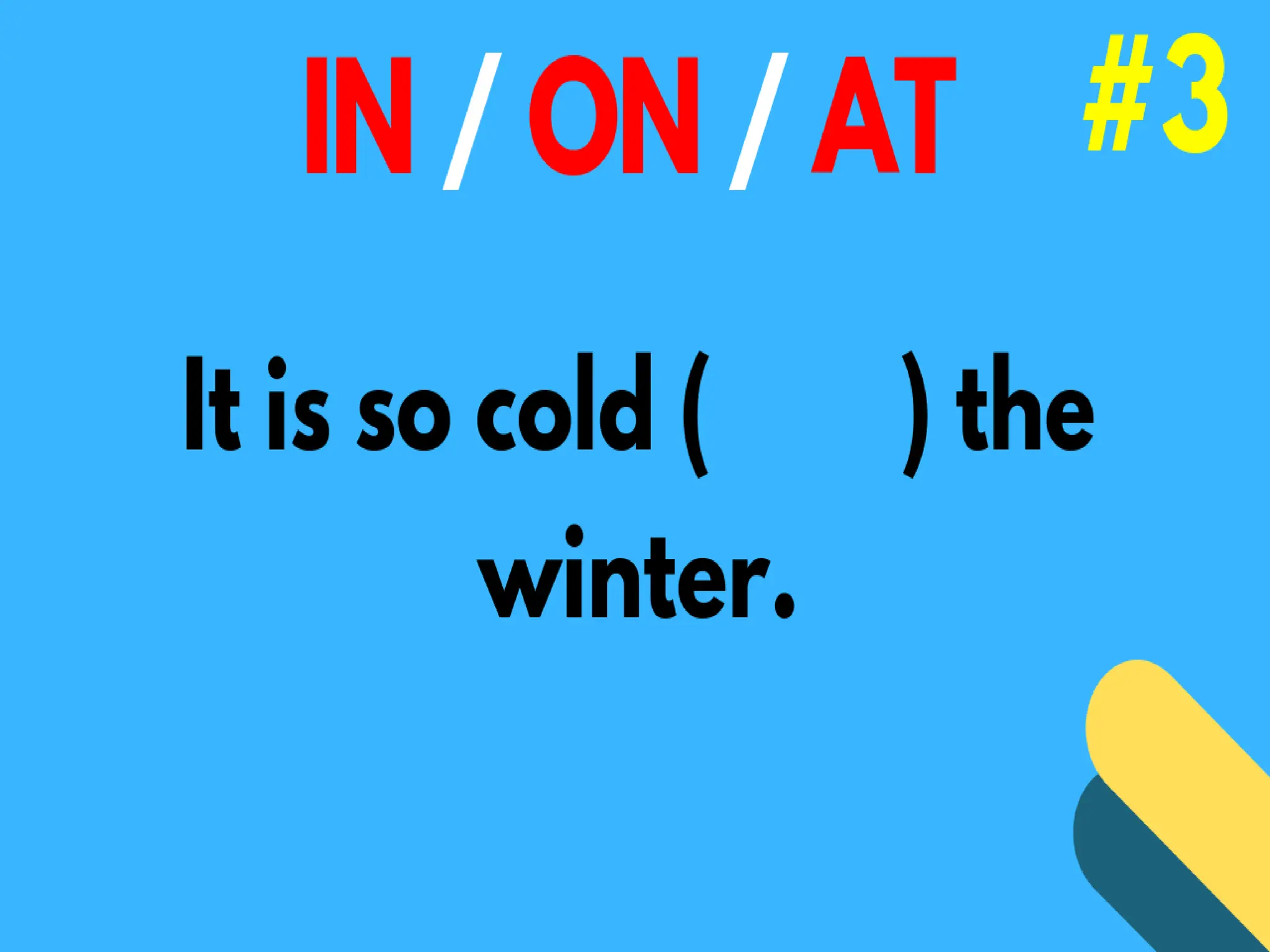
A preposition is used before a noun or a pronoun
to indicate la e
p c , iti n
pos o or ti e
m .
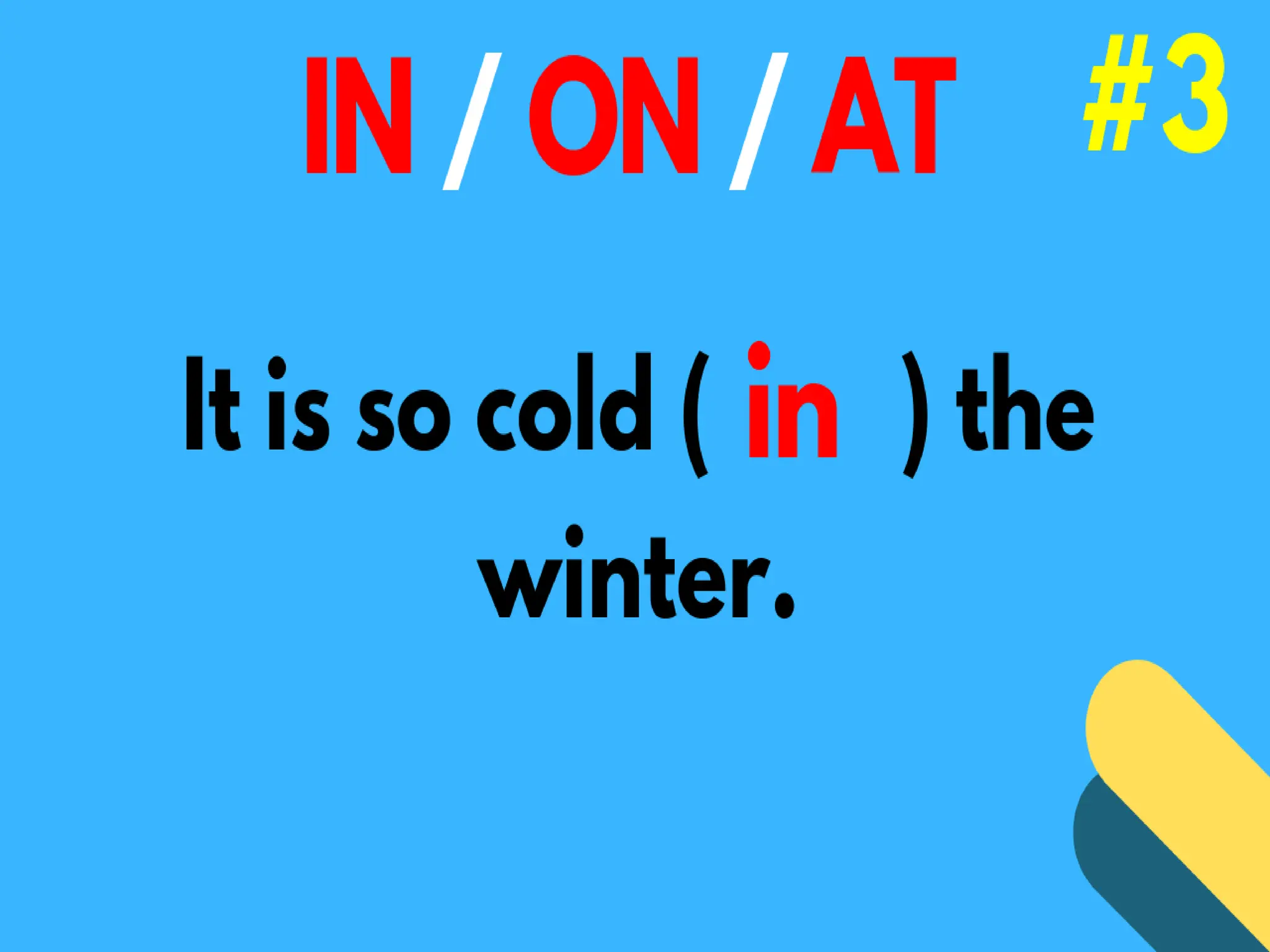
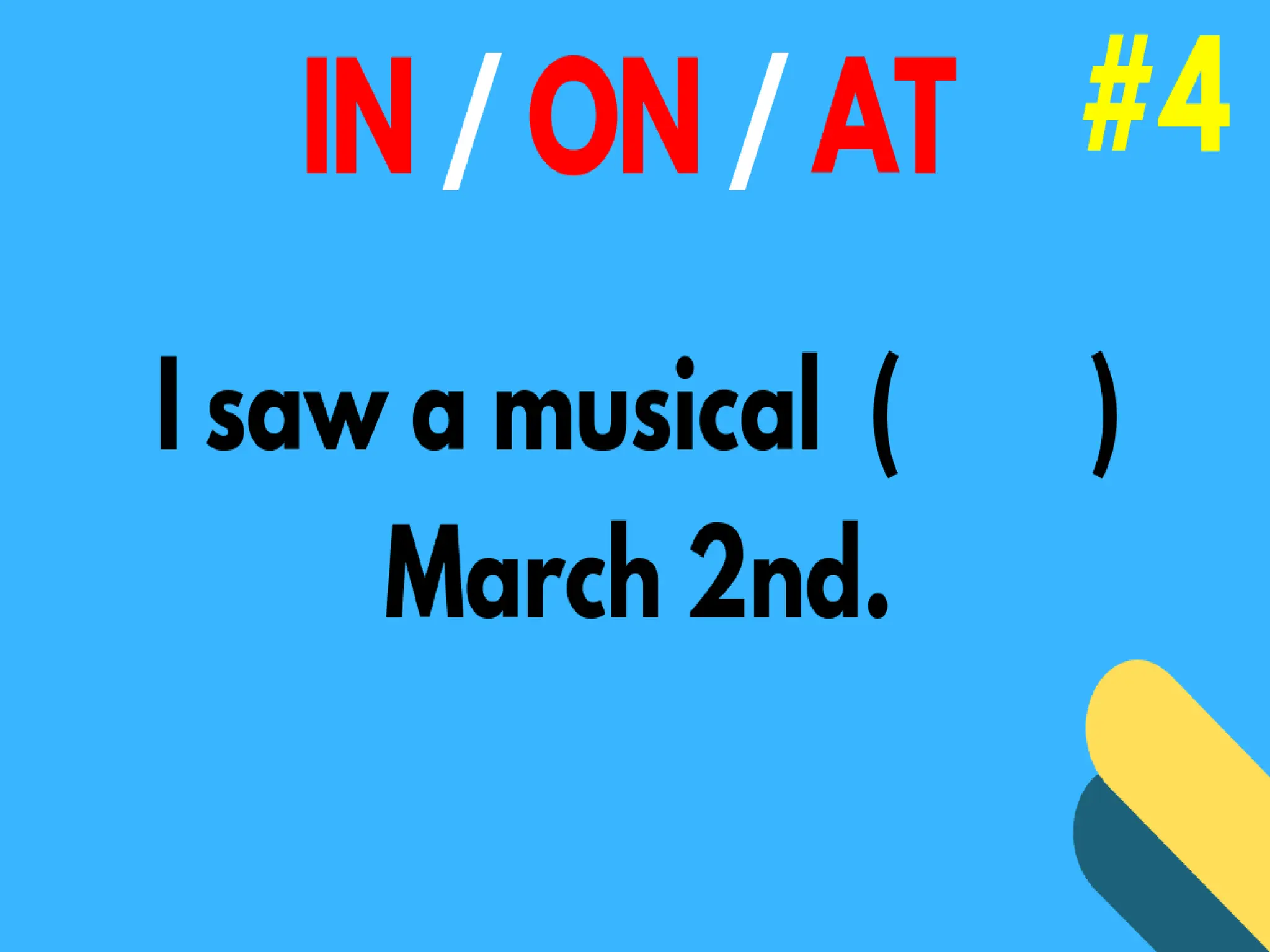
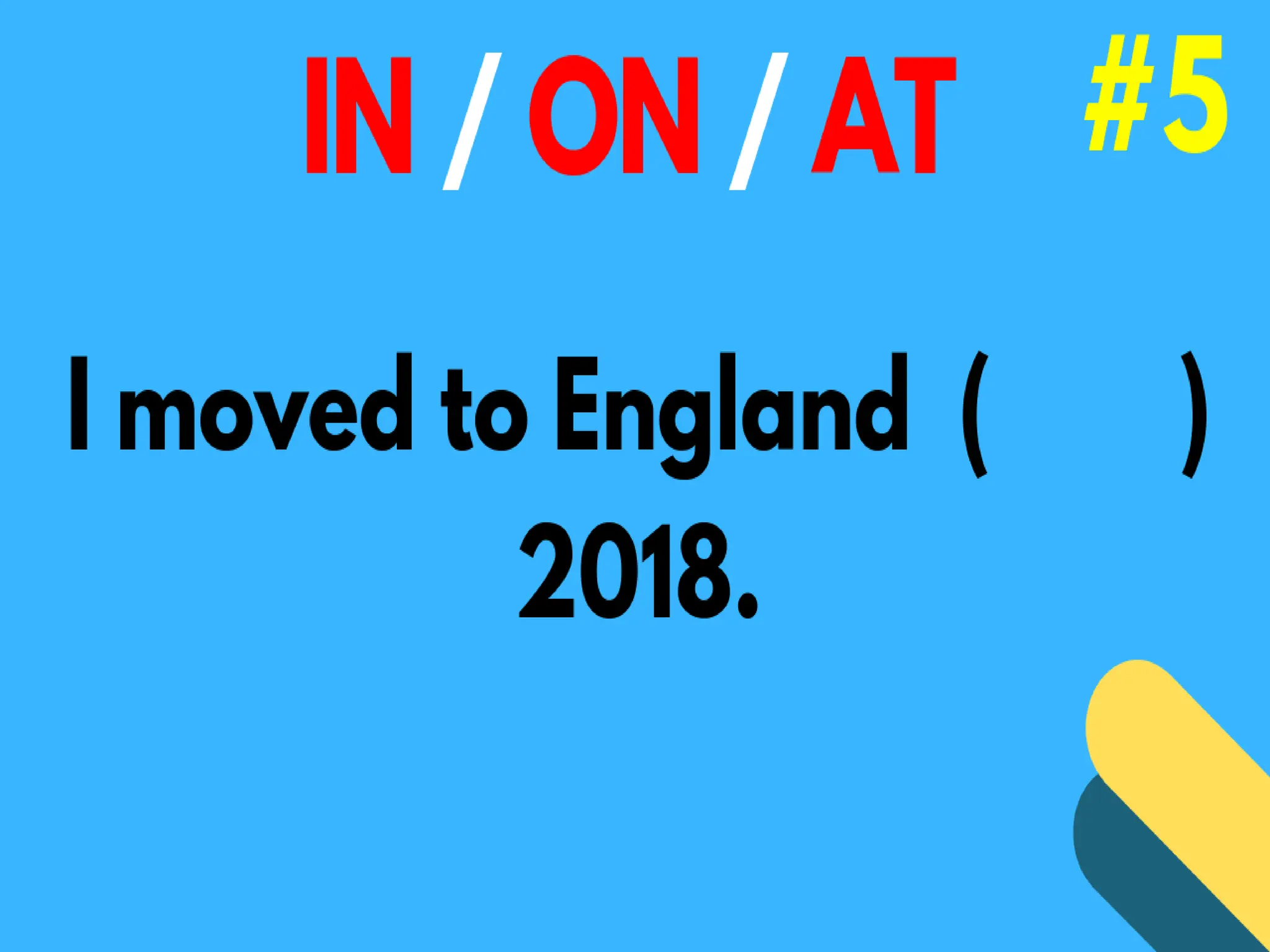
E.g. The boy is lying n
o the floor.
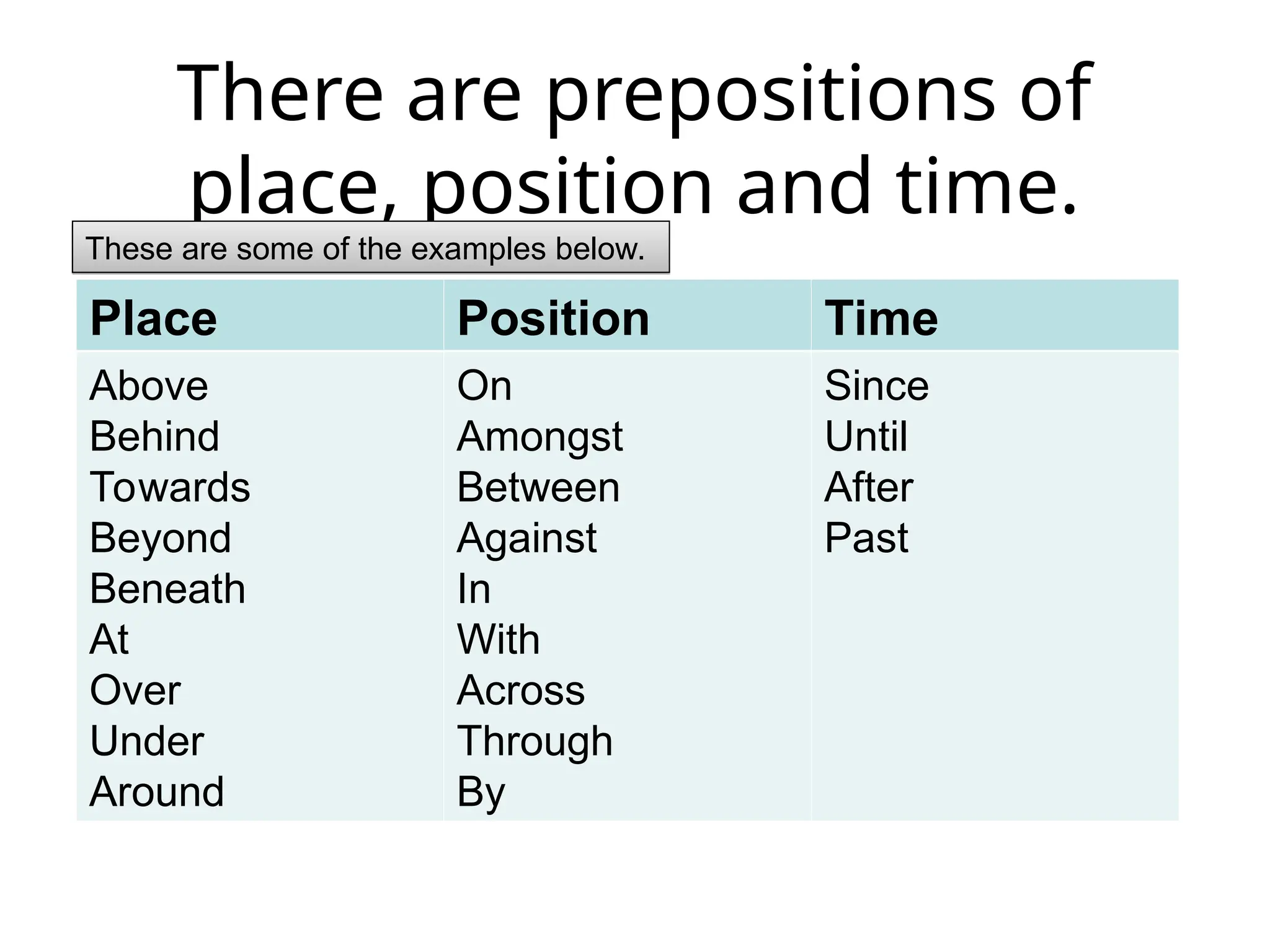
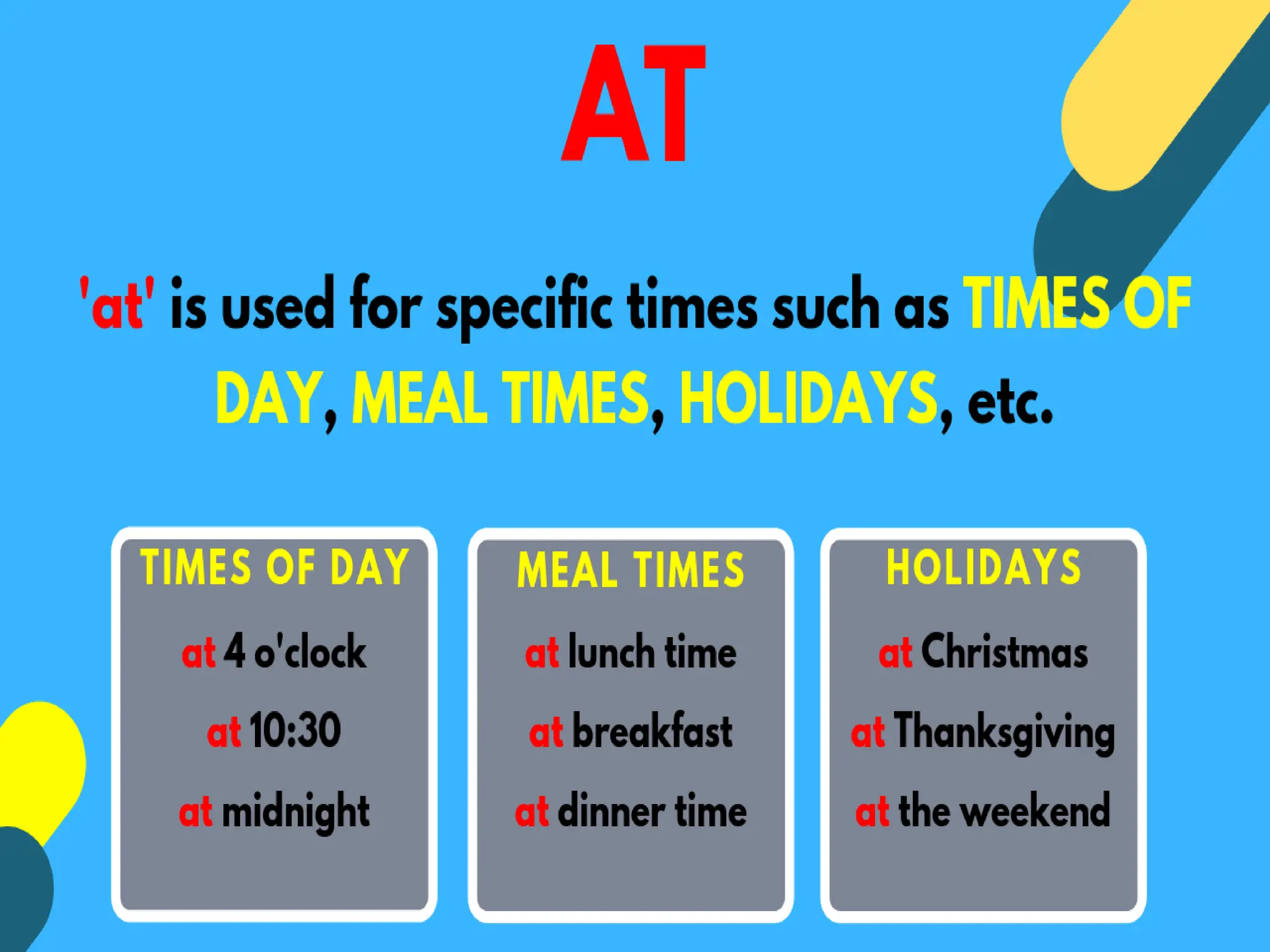
There are prepositions of
place, position and time.
Place Position Time
Above
Behind
Towards
Beyond
Beneath
At
Over
Under
Around
On
Amongst
Between
Against
In
With
Across
Through
By
Since
Until
After
Past
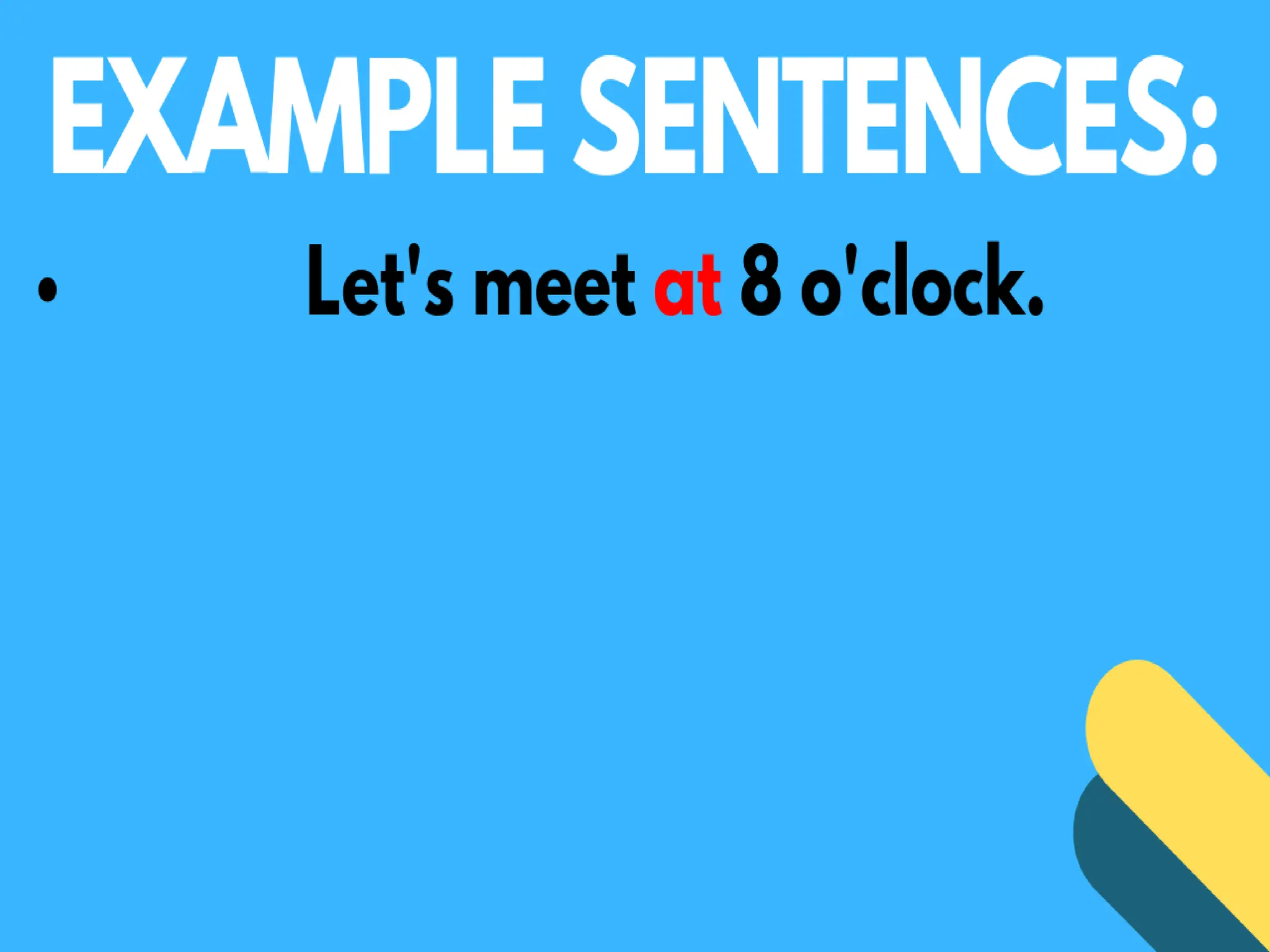
These are some of the examples below.
What is a conjunction?
• Words that is used to connect other words or
groups of words in a sentence.
• Conjunctions can connect two subjects, two
predicates, or two sentences.
• Gulls and puffins are sea birds.
• They swim and dive well.
• Gulls soar, and puffins swim gracefully.
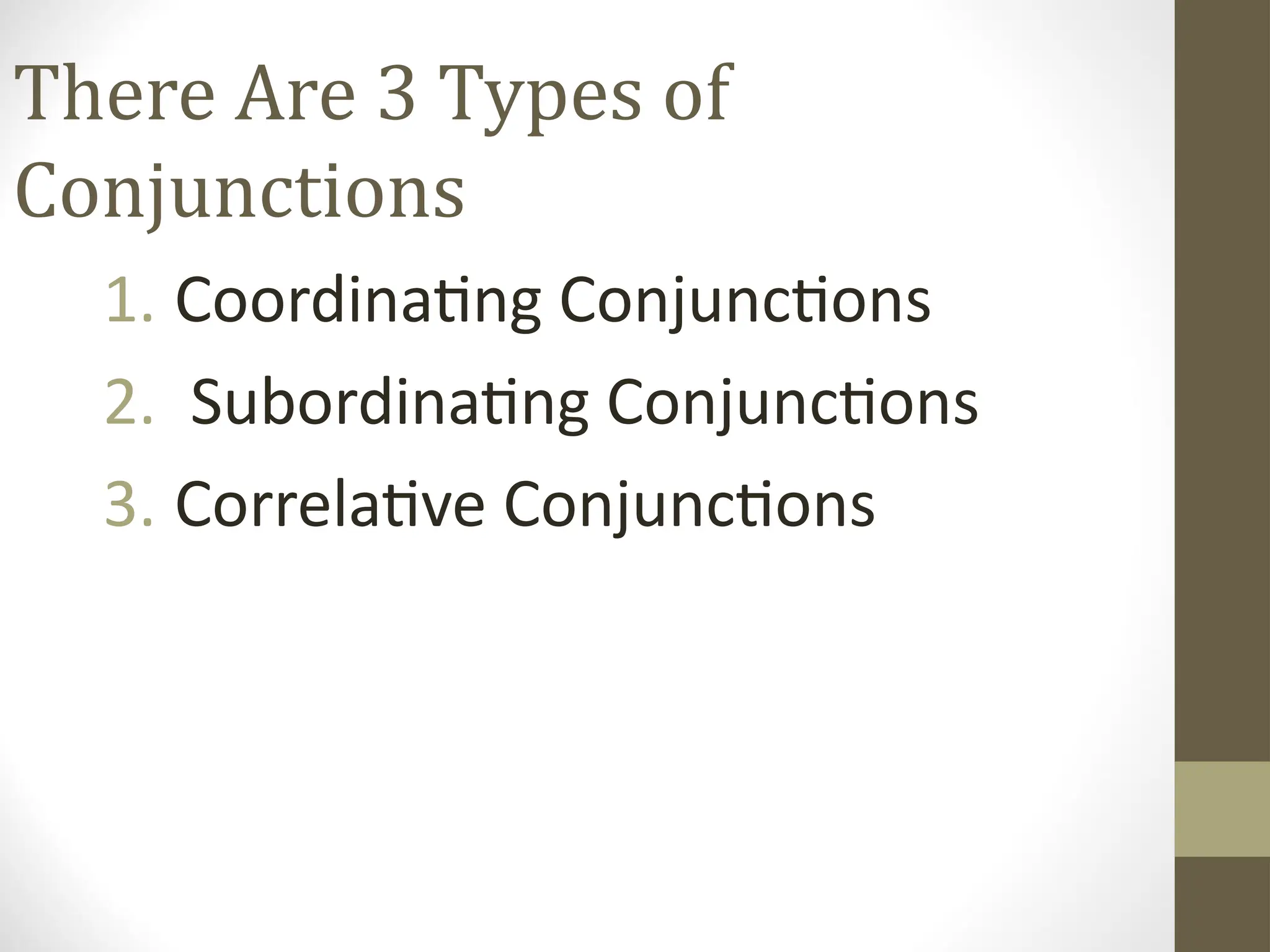
There Are 3 Types of
Conjunctions
1. Coordinating Conjunctions
2. Subordinating Conjunctions
3. Correlative Conjunctions
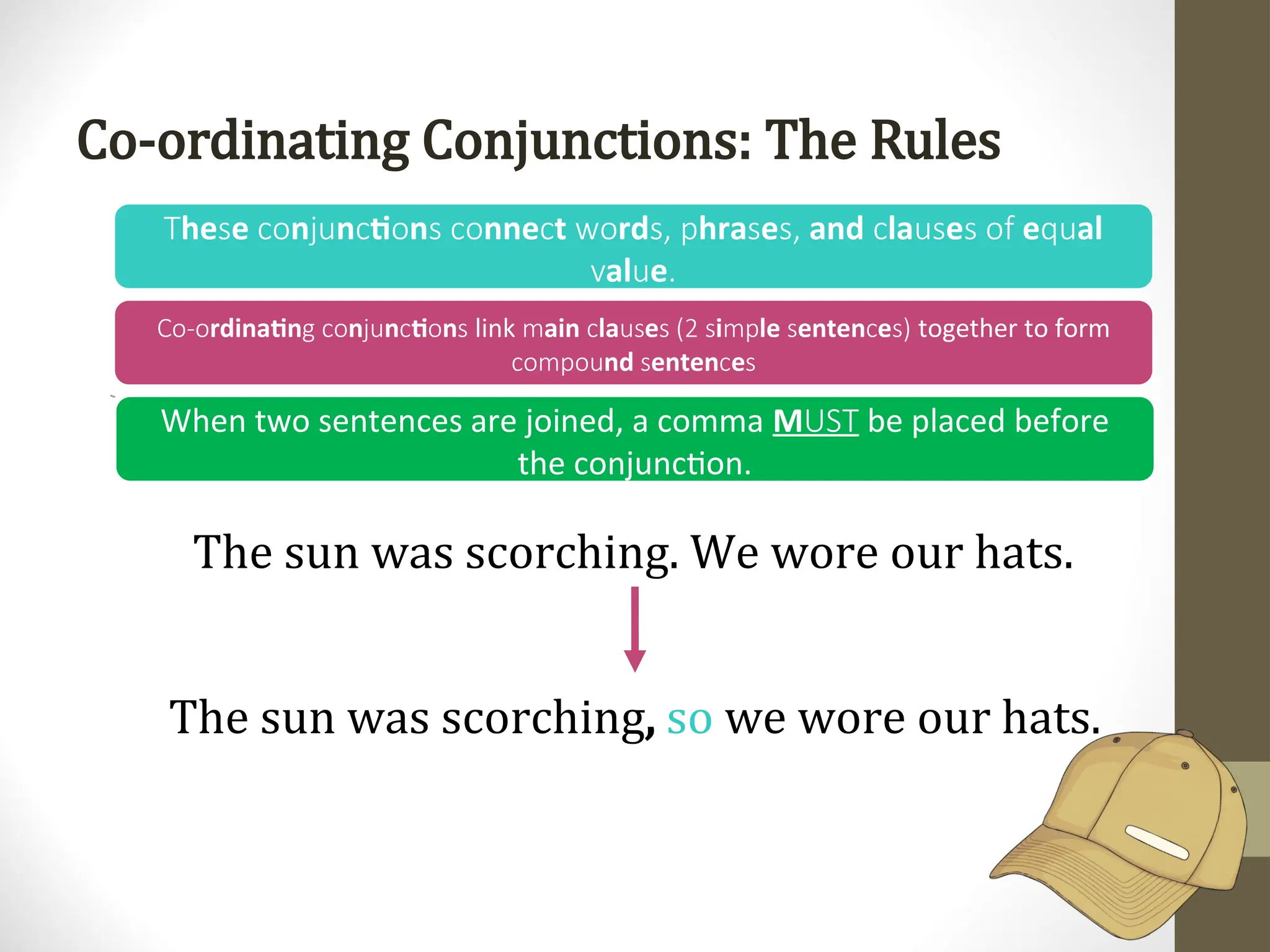
Co-ordinating Conjunctions: The Rules
he e n n ti n nne t rd hra e and la e e al
T s co ju c o s co c wo s, p s s, c us s of qu
al e
v u .
rdinatin n n ti n
Co-o g co ju c o s link ain la e i le enten e
m c us s (2 s mp s c s) together to form
nd enten e
compou s c s
The sun was scorching. We wore our hats.
The sun was scorching, so we wore our hats.
When two sentences are joined, a comma MUST be placed before
the conjunction.
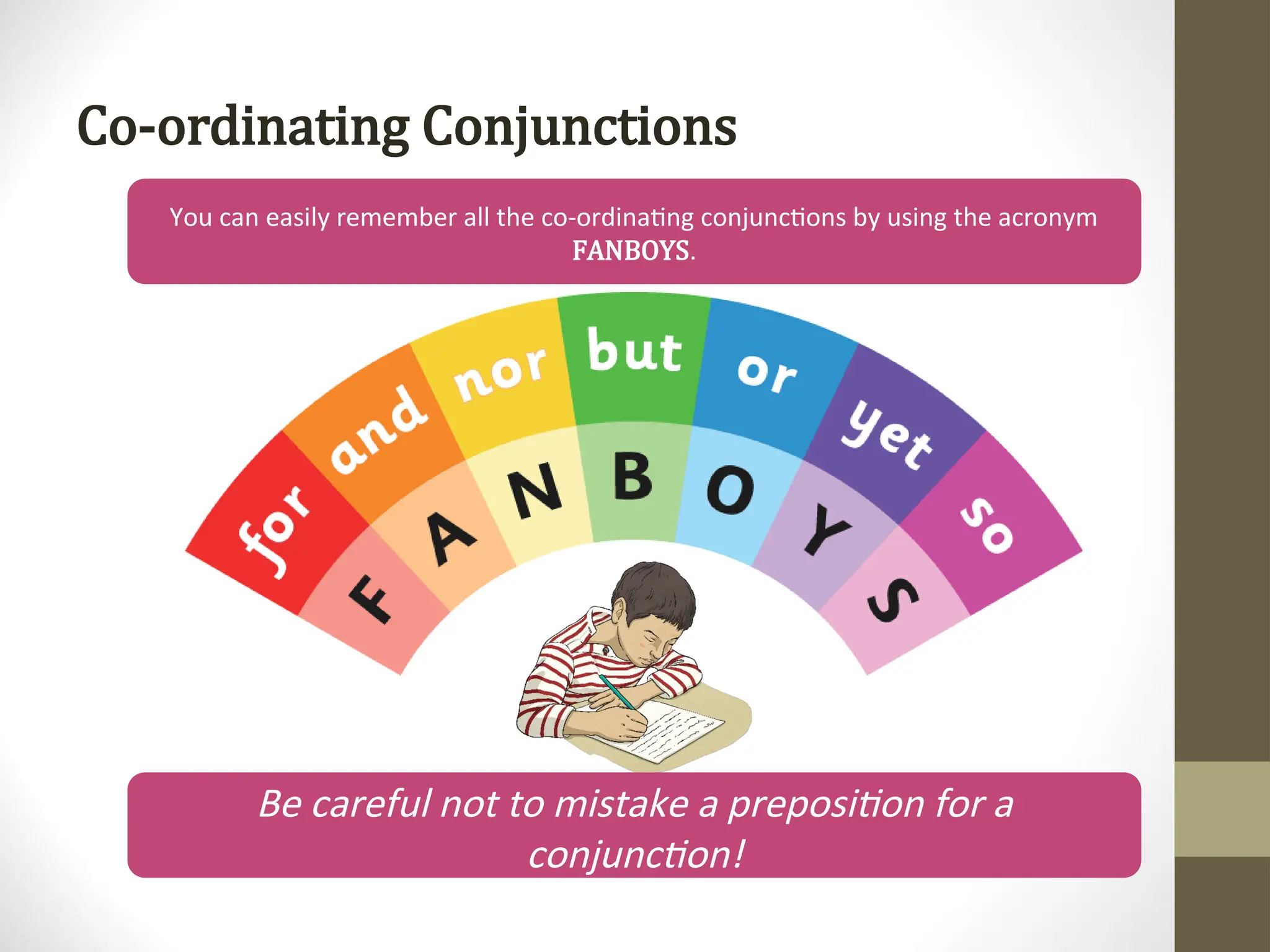
Co-ordinating Conjunctions
You can easily remember all the co-ordinating conjunctions by using the acronym
FANBOYS.
Be careful not to mistake a preposition for a
conjunction!
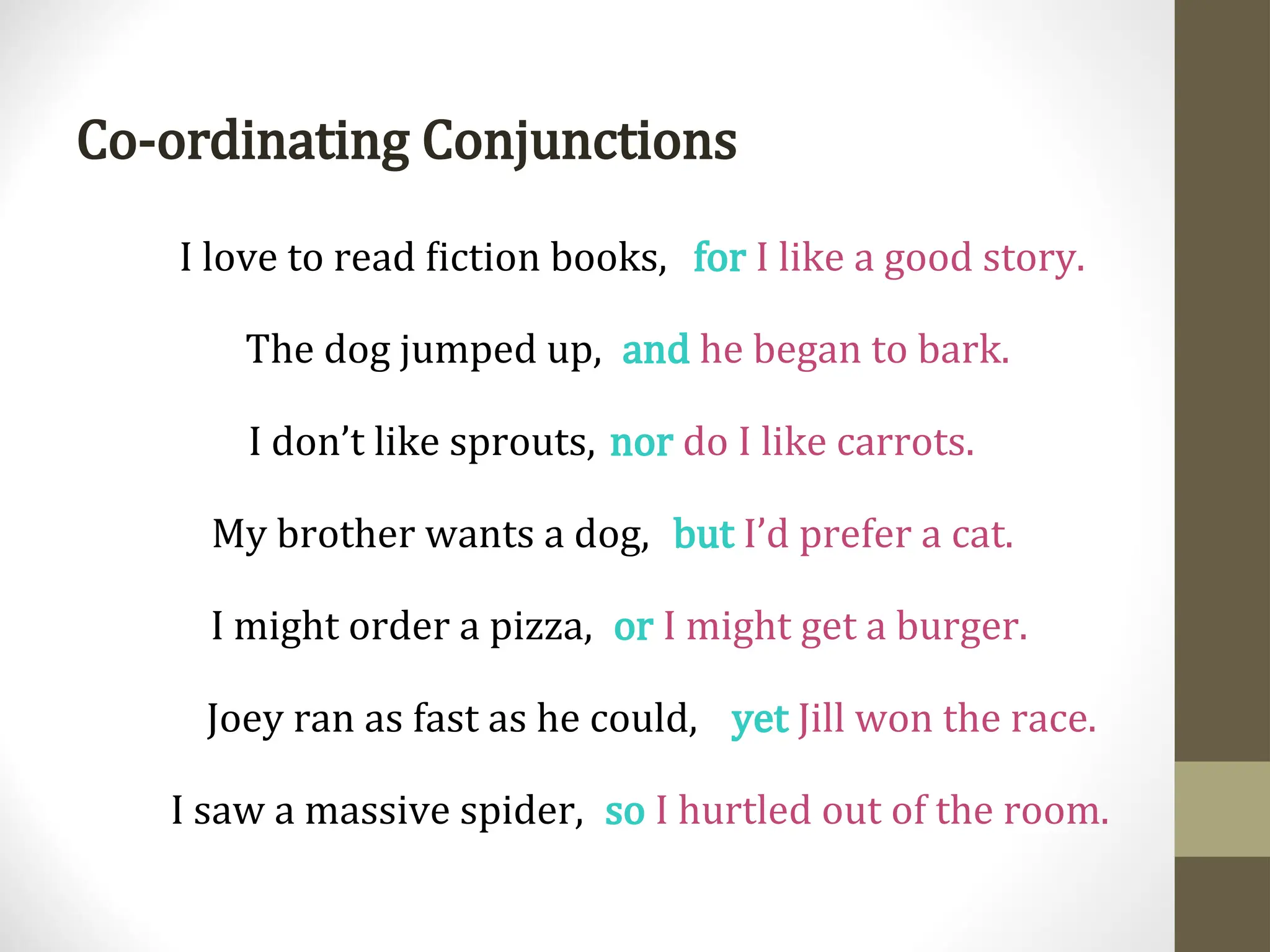
Co-ordinating Conjunctions
I love to read fiction books,
The dog jumped up,
I don’t like sprouts,
My brother wants a dog,
I might order a pizza,
Joey ran as fast as he could,
I saw a massive spider,
for I like a good story.
and he began to bark.
nor do I like carrots.
but I’d prefer a cat.
or I might get a burger.
yet Jill won the race.
so I hurtled out of the room.
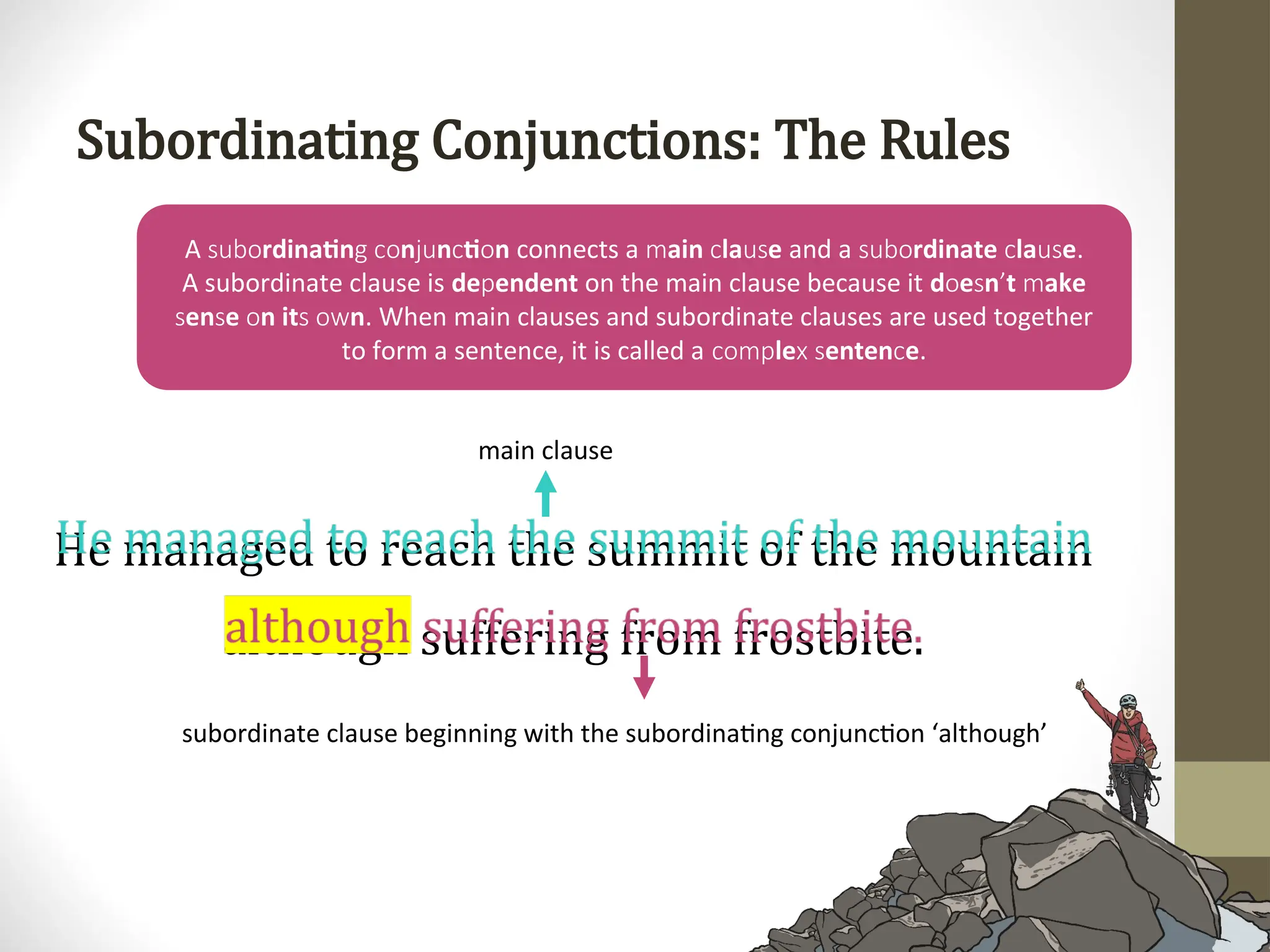
Subordinating Conjunctions: The Rules
He managed to reach the summit of the mountain
although suffering from frostbite.
A rdinatin n n ti n
subo g co ju c o connects a ain la e
m c us and a rdinate la e
subo c us .
A subordinate clause is de endent
p on the main clause because it d e n t ake
o s ’ m
en e n it n
s s o s ow . When main clauses and subordinate clauses are used together
to form a sentence, it is called a le enten e
comp x s c .
main clause
subordinate clause beginning with the subordinating conjunction ‘although’
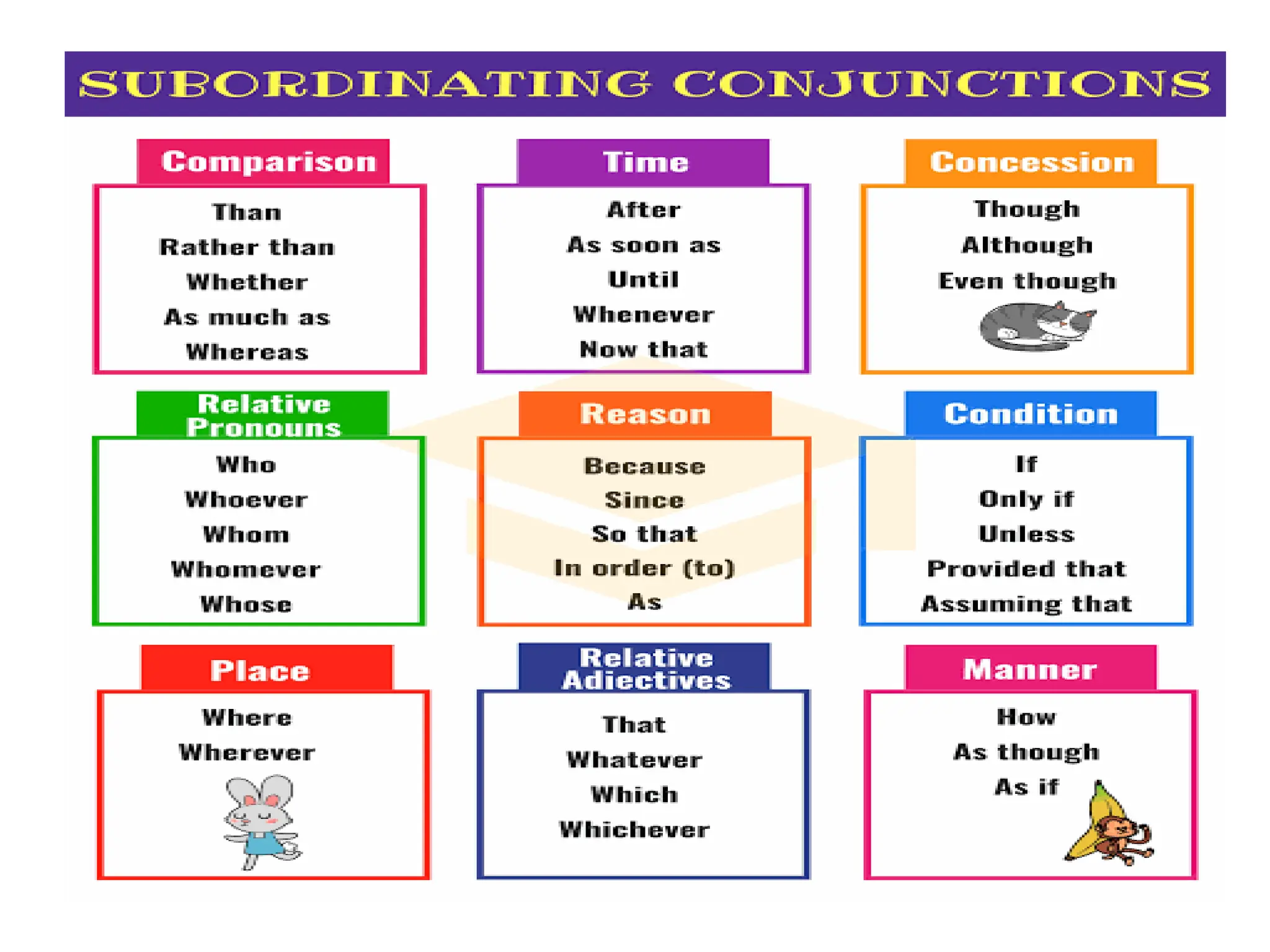
Here is a list of commonly used subordinating
conjunctions...
Subordinating Conjunctions: The Rules
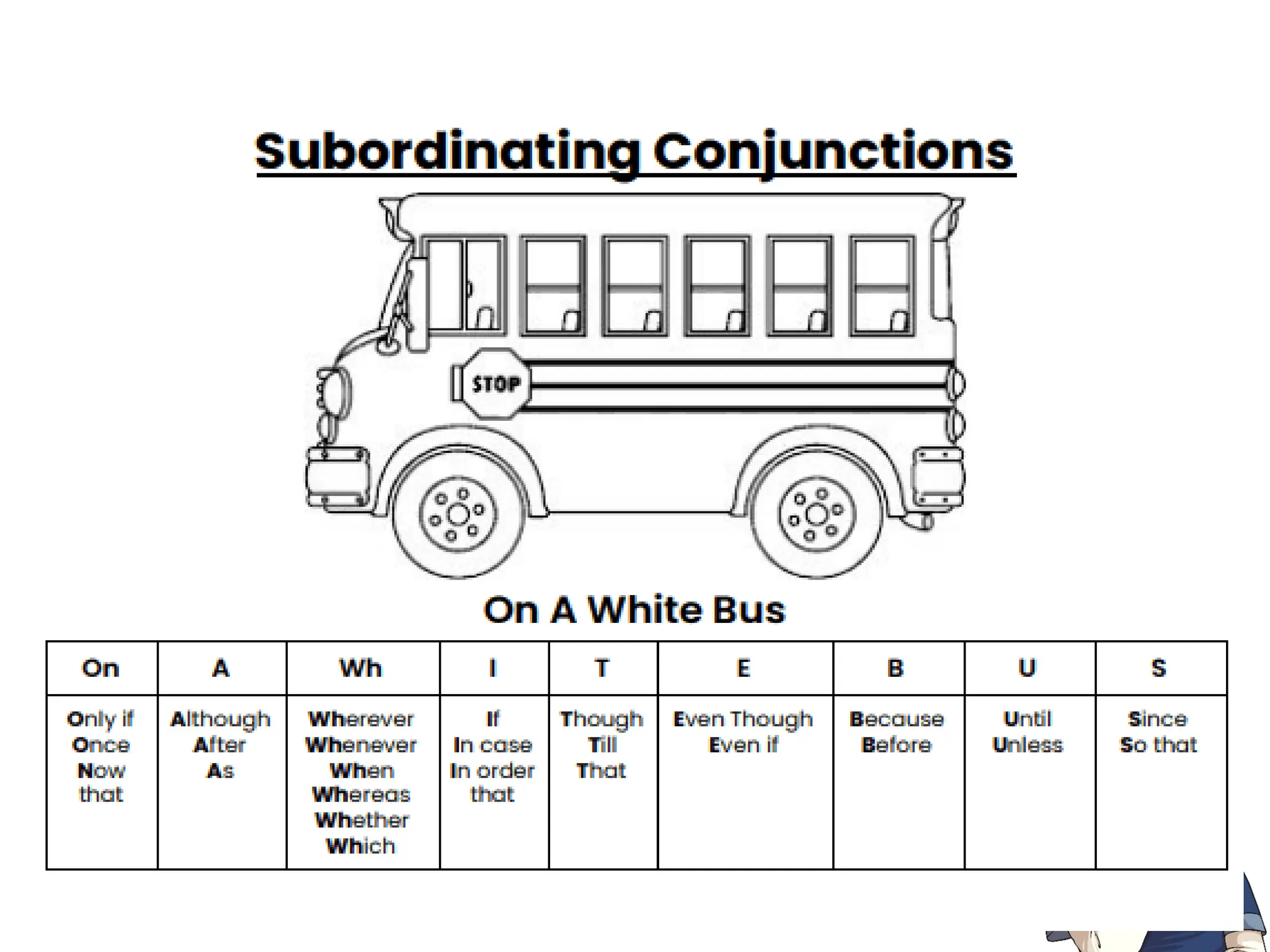
after
while
whether
though
provide
d
unless
becaus
e
if
althoug
h
so that
since
when
before
once
as
until
even
though
Subordinating Conjunctions: The Rules
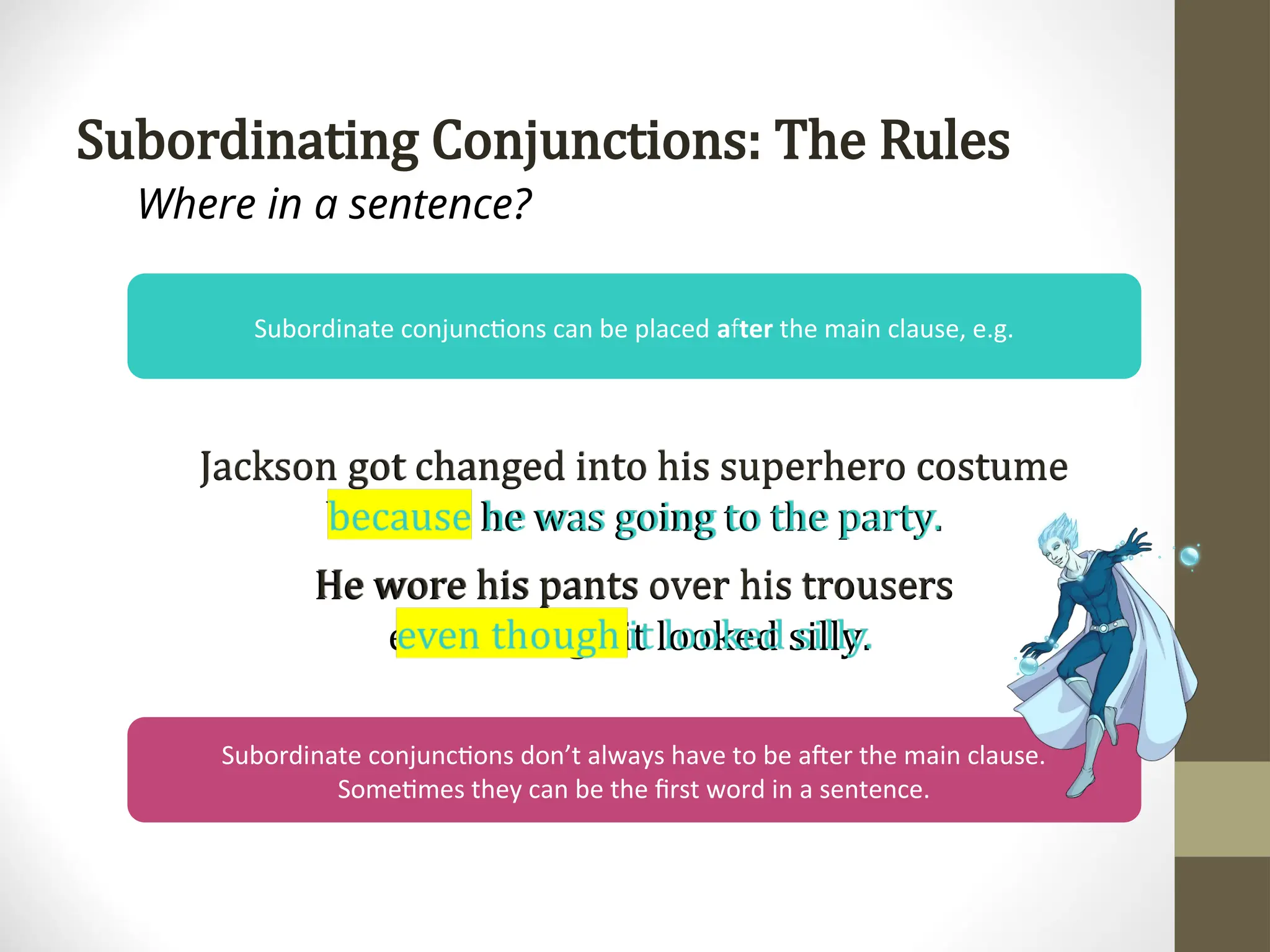
Where in a sentence?
Subordinate conjunctions can be placed a ter
f the main clause, e.g.
Jackson got changed into his superhero costume
because he was going to the party.
He wore his pants over his trousers
even though it looked silly.
Subordinate conjunctions don’t always have to be after the main clause.
Sometimes they can be the first word in a sentence.
Subordinating Conjunctions: The Rules
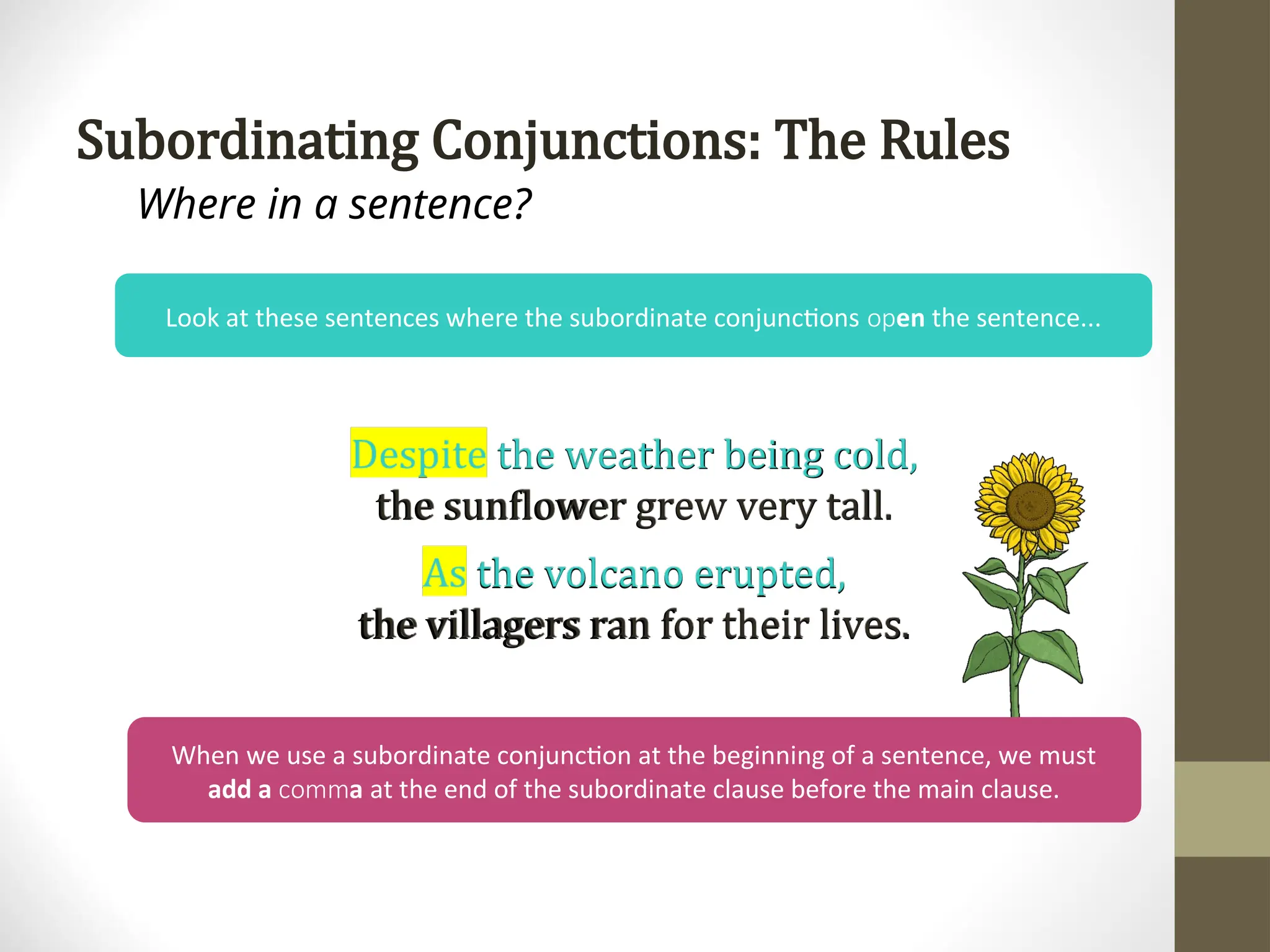
Where in a sentence?
Despite the weather being cold,
the sunflower grew very tall.
As the volcano erupted,
the villagers ran for their lives.
When we use a subordinate conjunction at the beginning of a sentence, we must
add a a
comm at the end of the subordinate clause before the main clause.
Look at these sentences where the subordinate conjunctions en
op the sentence...
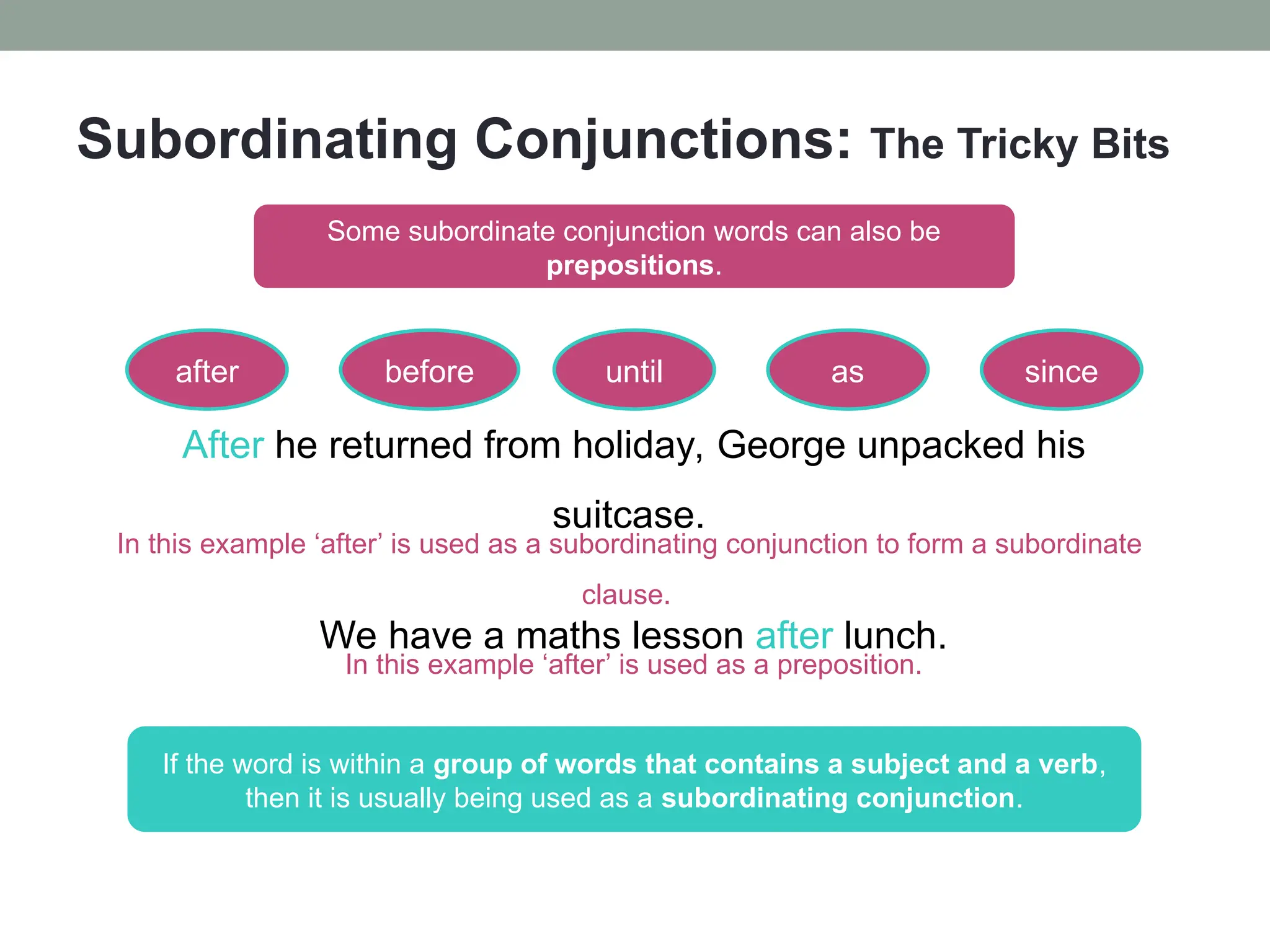
Some subordinate conjunction words can also be
prepositions.
after before until as since
After he returned from holiday, George unpacked his
suitcase.
In this example ‘after’ is used as a subordinating conjunction to form a subordinate
clause.
If the word is within a group of words that contains a subject and a verb,
then it is usually being used as a subordinating conjunction.
We have a maths lesson after lunch.
In this example ‘after’ is used as a preposition.
Subordinating Conjunctions: The Tricky Bits
Preposition
Subordinating
Conjunction
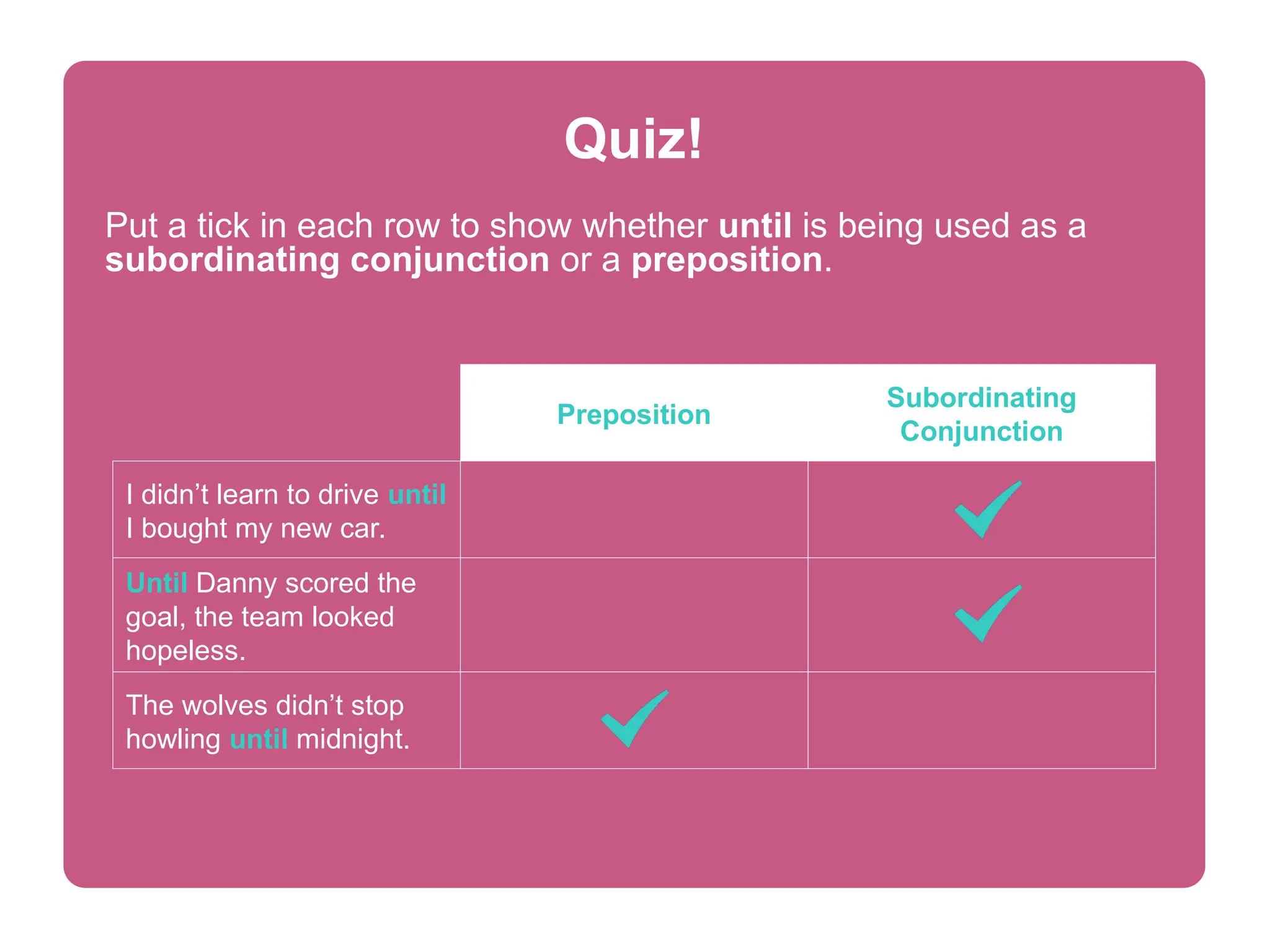
I didn’t learn to drive until
I bought my new car.
Until Danny scored the
goal, the team looked
hopeless.
The wolves didn’t stop
howling until midnight.
Quiz!
Put a tick in each row to show whether until is being used as a
subordinating conjunction or a preposition.
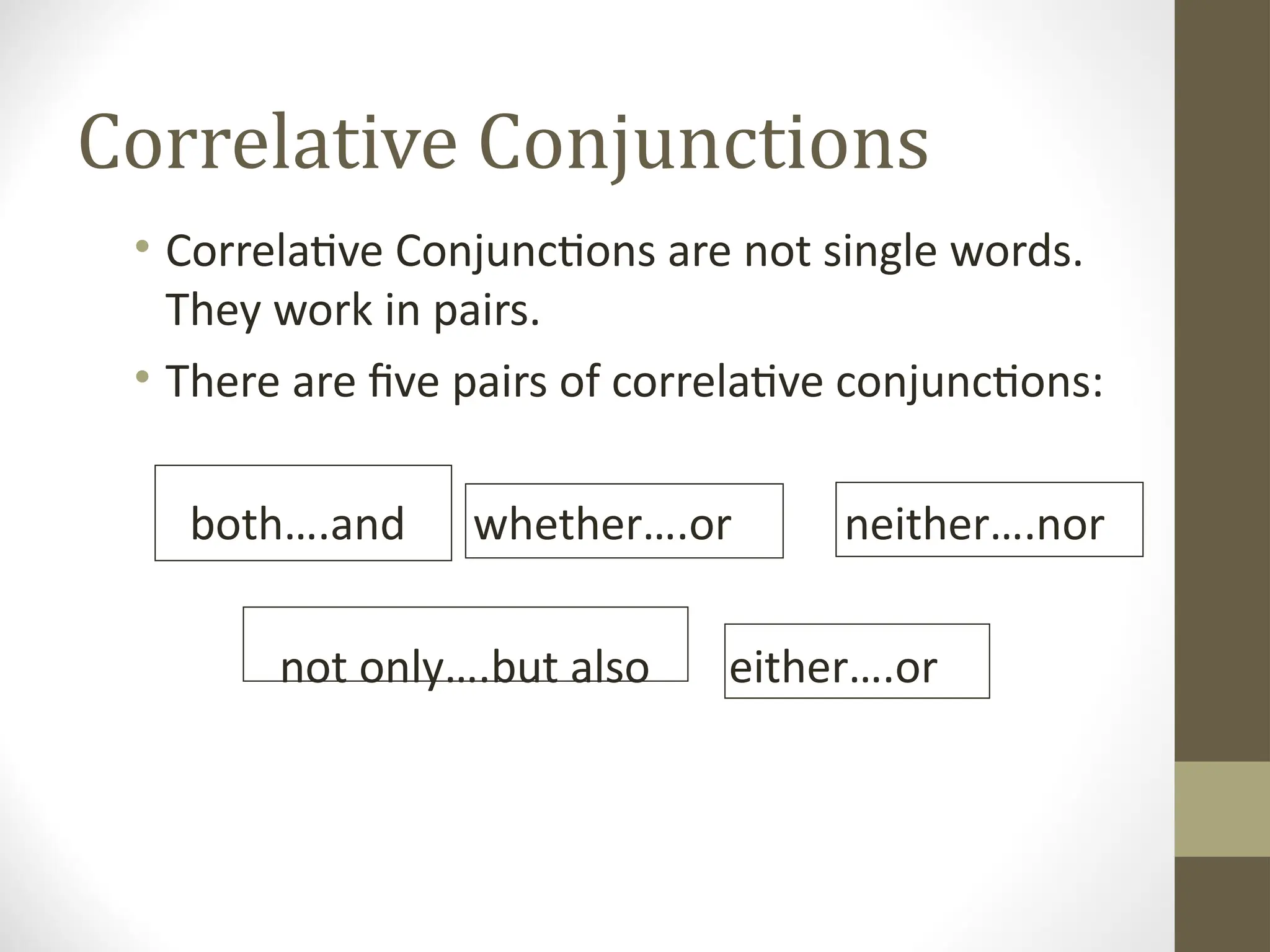
Correlative Conjunctions
• Correlative Conjunctions are not single words.
They work in pairs.
• There are five pairs of correlative conjunctions:
both….and whether….or neither….nor
not only….but also either….or
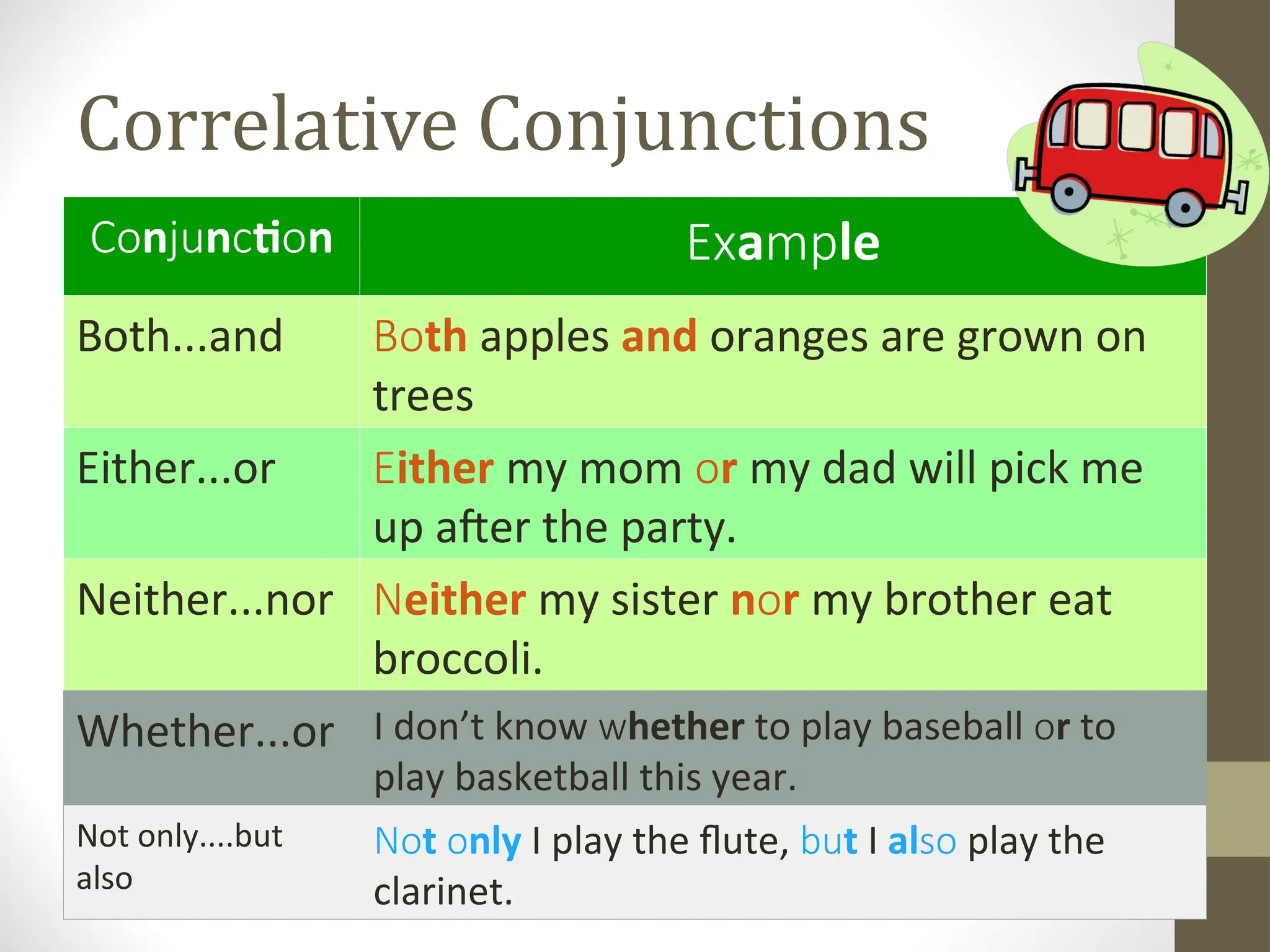
Correlative Conjunctions
n n ti n
Co ju c o a le
Ex mp
Both...and th
Bo apples and oranges are grown on
trees
Either...or ither
E my mom r
o my dad will pick me
up after the party.
Neither...nor either
N my sister n r
o my brother eat
broccoli.
Whether...or I don’t know hether
w to play baseball r
o to
play basketball this year.
Not only....but
also
t nly
No o I play the flute, t
bu I also play the
clarinet.
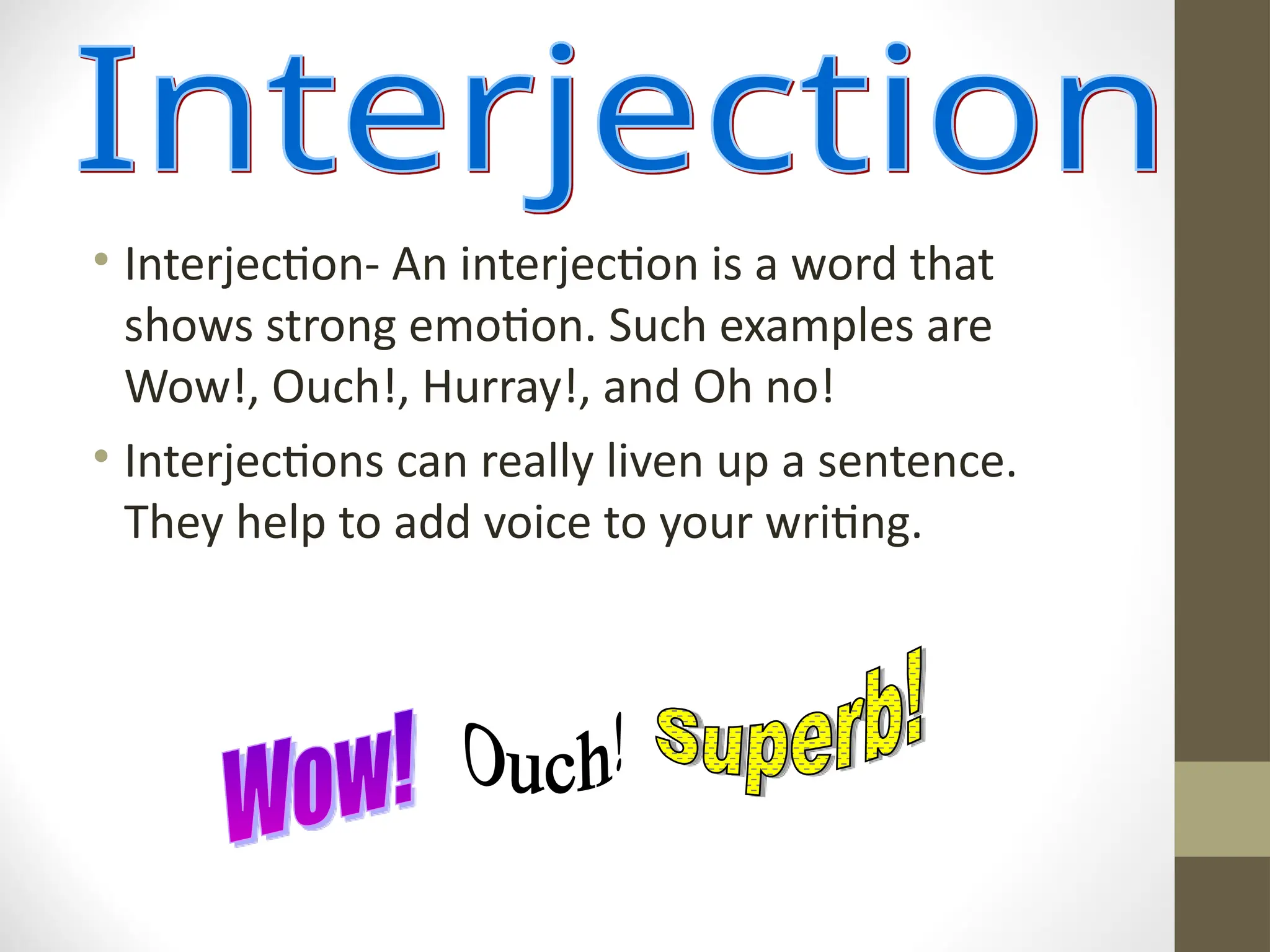
• Interjection- An interjection is a word that
shows strong emotion. Such examples are
Wow!, Ouch!, Hurray!, and Oh no!
• Interjections can really liven up a sentence.
They help to add voice to your writing.
Week 3 - Part of speech part II     .ppt

Week 3 - Part of speech part II .ppt

  • 1.
    ADJECTIVES, CONJUNCTIONS, PREPOSITIONS,AND INTERJECTIONS Part of Speech Part II
  • 2.
    What is anadjective? • An adjective describes a noun or pronoun. Examples: • The tall man walked down the street. • The young students performed a play. adjective adjective
  • 3.
    Types of Adjectives •Descriptive Adjectives • Comparative Adjectives • Superlative Adjectives • Predicative Adjectives
  • 4.
    Descriptive Adjectives • Descriptiveadjectives add detail or describe a noun or pronoun. Examples: My hat is on the top shelf. The white snow falls slowly to the ground.
  • 5.
    Comparative Adjectives • Comparativeadjectives compare two nouns. Examples: Bill is taller than Joe. Noun #1 Noun #2
  • 6.
    Forming Comparative Adjectives “Than” isusually used after comparative adjectives -er is added to the end of a 1-syllable adjective cold = colder tall = taller -er is added to the end of an adjective with 2 syllables, if the word ends in -y. early = earlier happy = happier "more" or “less” is used for words that have 2 or more syllables, except words that end in –y. honest = more honest expensive = more expensive adjectives that end in -e, only -r is added to end of the adjective nice = nicer safe = safer adjectives that end in a consonant, vowel, consonant - the last consonant is doubled big = bigger hot = hotter
  • 7.
    Superlative Adjectives • Superlativeadjectives are used when comparing three or more nouns. Examples: Between all of my classes, 5th period is the loudest. These shoes are the most comfortable.
  • 8.
    Forming Superlative Adjectives -estis added to the end of a 1-syllable adjective cold = coldest If the word ends in –y, change the y to an –i and add -est to the end of an adjective with 2 syllables. early = earliest happy = happiest "most" and "least" are used for adjectives that contain 2 or more syllables expensive = most expensive difficult = least difficult If an adjectives ends in -e, then only –st is added to end of the adjective nice = nicest safe = safest Adjectives that end in a consonant, vowel, consonant - the last consonant is doubled and -est is added to the end of the adjective. big = biggest hot = hottest
  • 9.
  • 10.
  • 11.
    Predicative Adjectives • Predicativeadjectives come after a linking verb and are used to describe the subject Example: Mr. Smith is a lonely man. Linking verb Predicate adjective
  • 12.
    Formation of Adjectives: Suffixes Common Suffixes Examples - able, - ible enjoyable, knowledgeable, flexible, - al, - ial personal, accidental, controversial - ing annoying, boring, confusing - ful beautiful, careful, colourful, helpful - ical comical, historical, magical - ant, - ent pleasant, confident, excellent - y funny, messy, rainy
  • 13.
    What is aPreposition? A preposition is used before a noun or a pronoun to indicate la e p c , iti n pos o or ti e m . E.g. The boy is lying n o the floor.
  • 14.
    There are prepositionsof place, position and time. Place Position Time Above Behind Towards Beyond Beneath At Over Under Around On Amongst Between Against In With Across Through By Since Until After Past These are some of the examples below.
  • 39.
    What is aconjunction? • Words that is used to connect other words or groups of words in a sentence. • Conjunctions can connect two subjects, two predicates, or two sentences. • Gulls and puffins are sea birds. • They swim and dive well. • Gulls soar, and puffins swim gracefully.
  • 40.
    There Are 3Types of Conjunctions 1. Coordinating Conjunctions 2. Subordinating Conjunctions 3. Correlative Conjunctions
  • 41.
    Co-ordinating Conjunctions: TheRules he e n n ti n nne t rd hra e and la e e al T s co ju c o s co c wo s, p s s, c us s of qu al e v u . rdinatin n n ti n Co-o g co ju c o s link ain la e i le enten e m c us s (2 s mp s c s) together to form nd enten e compou s c s The sun was scorching. We wore our hats. The sun was scorching, so we wore our hats. When two sentences are joined, a comma MUST be placed before the conjunction.
  • 42.
    Co-ordinating Conjunctions You caneasily remember all the co-ordinating conjunctions by using the acronym FANBOYS. Be careful not to mistake a preposition for a conjunction!
  • 43.
    Co-ordinating Conjunctions I loveto read fiction books, The dog jumped up, I don’t like sprouts, My brother wants a dog, I might order a pizza, Joey ran as fast as he could, I saw a massive spider, for I like a good story. and he began to bark. nor do I like carrots. but I’d prefer a cat. or I might get a burger. yet Jill won the race. so I hurtled out of the room.
  • 44.
    Subordinating Conjunctions: TheRules He managed to reach the summit of the mountain although suffering from frostbite. A rdinatin n n ti n subo g co ju c o connects a ain la e m c us and a rdinate la e subo c us . A subordinate clause is de endent p on the main clause because it d e n t ake o s ’ m en e n it n s s o s ow . When main clauses and subordinate clauses are used together to form a sentence, it is called a le enten e comp x s c . main clause subordinate clause beginning with the subordinating conjunction ‘although’
  • 45.
    Here is alist of commonly used subordinating conjunctions... Subordinating Conjunctions: The Rules after while whether though provide d unless becaus e if althoug h so that since when before once as until even though
  • 46.
    Subordinating Conjunctions: TheRules Where in a sentence? Subordinate conjunctions can be placed a ter f the main clause, e.g. Jackson got changed into his superhero costume because he was going to the party. He wore his pants over his trousers even though it looked silly. Subordinate conjunctions don’t always have to be after the main clause. Sometimes they can be the first word in a sentence.
  • 47.
    Subordinating Conjunctions: TheRules Where in a sentence? Despite the weather being cold, the sunflower grew very tall. As the volcano erupted, the villagers ran for their lives. When we use a subordinate conjunction at the beginning of a sentence, we must add a a comm at the end of the subordinate clause before the main clause. Look at these sentences where the subordinate conjunctions en op the sentence...
  • 48.
    Some subordinate conjunctionwords can also be prepositions. after before until as since After he returned from holiday, George unpacked his suitcase. In this example ‘after’ is used as a subordinating conjunction to form a subordinate clause. If the word is within a group of words that contains a subject and a verb, then it is usually being used as a subordinating conjunction. We have a maths lesson after lunch. In this example ‘after’ is used as a preposition. Subordinating Conjunctions: The Tricky Bits
  • 49.
    Preposition Subordinating Conjunction I didn’t learnto drive until I bought my new car. Until Danny scored the goal, the team looked hopeless. The wolves didn’t stop howling until midnight. Quiz! Put a tick in each row to show whether until is being used as a subordinating conjunction or a preposition.
  • 51.
    Correlative Conjunctions • CorrelativeConjunctions are not single words. They work in pairs. • There are five pairs of correlative conjunctions: both….and whether….or neither….nor not only….but also either….or
  • 52.
    Correlative Conjunctions n nti n Co ju c o a le Ex mp Both...and th Bo apples and oranges are grown on trees Either...or ither E my mom r o my dad will pick me up after the party. Neither...nor either N my sister n r o my brother eat broccoli. Whether...or I don’t know hether w to play baseball r o to play basketball this year. Not only....but also t nly No o I play the flute, t bu I also play the clarinet.
  • 53.
    • Interjection- Aninterjection is a word that shows strong emotion. Such examples are Wow!, Ouch!, Hurray!, and Oh no! • Interjections can really liven up a sentence. They help to add voice to your writing.