Low Salinity Water Injection: Eni’s Experience
Shrinath Ghadge
Chemical and Petroleum Engineering , University of Pittsburgh,
Pittsburgh, PA 15261
Rotondi, Marco, et al. "Low Salinity Water Injection: eni’s Experience." Abu Dhabi International
Petroleum Exhibition and Conference. Society of Petroleum Engineers, 2014.
PETE 2201
Outline
 Introduction - Low Salinity Water Injection
 Eni low salinity EOR workflow
 Filed case A : Low Salinity water injection
 Filed case B : Low Salinity water + Polymer injection
 Conclusions
2
Why Low Salinity Water Injection?
3
Conventional water flooding
• Lower production rate
• High energy input High operating cost
• Oil molecules are bound to clay particles by
bridges of divalent ions (Ca+2, Mg+2)
• In high sal. Water, bridges are compressed
to clay surface by electrical forces
Basic requirements for a low salinity water flooding
 Injected source water should have a salinity less than 6 g/l and optimal range is
1-2 g/l
 Formation rock should contain water sensitive minerals (clay) and should not be
strongly water-wet
 Formation brine should contain divalent ions
 Reservoir oil should contain polar components
4
Eni Low Salinity EOR Workflow-Year 2006
After the effectiveness of the technique was proved by lab analyses and SWCTTs, an inter-
well pilot was performed.
5
Single-Well Chemical Tracer Test (SWCTT)
Field was Selected in West Africa- Year 2013Eni’s Workflow
6
Field Case (A)-Low Salinity Water Injection
Eni’s Workflow
Lowering the salinity of the injection water to different degrees can
change rock wettability and improve oil recovery.
7
Field Case (B)-Low Salinity +Polymer Injection
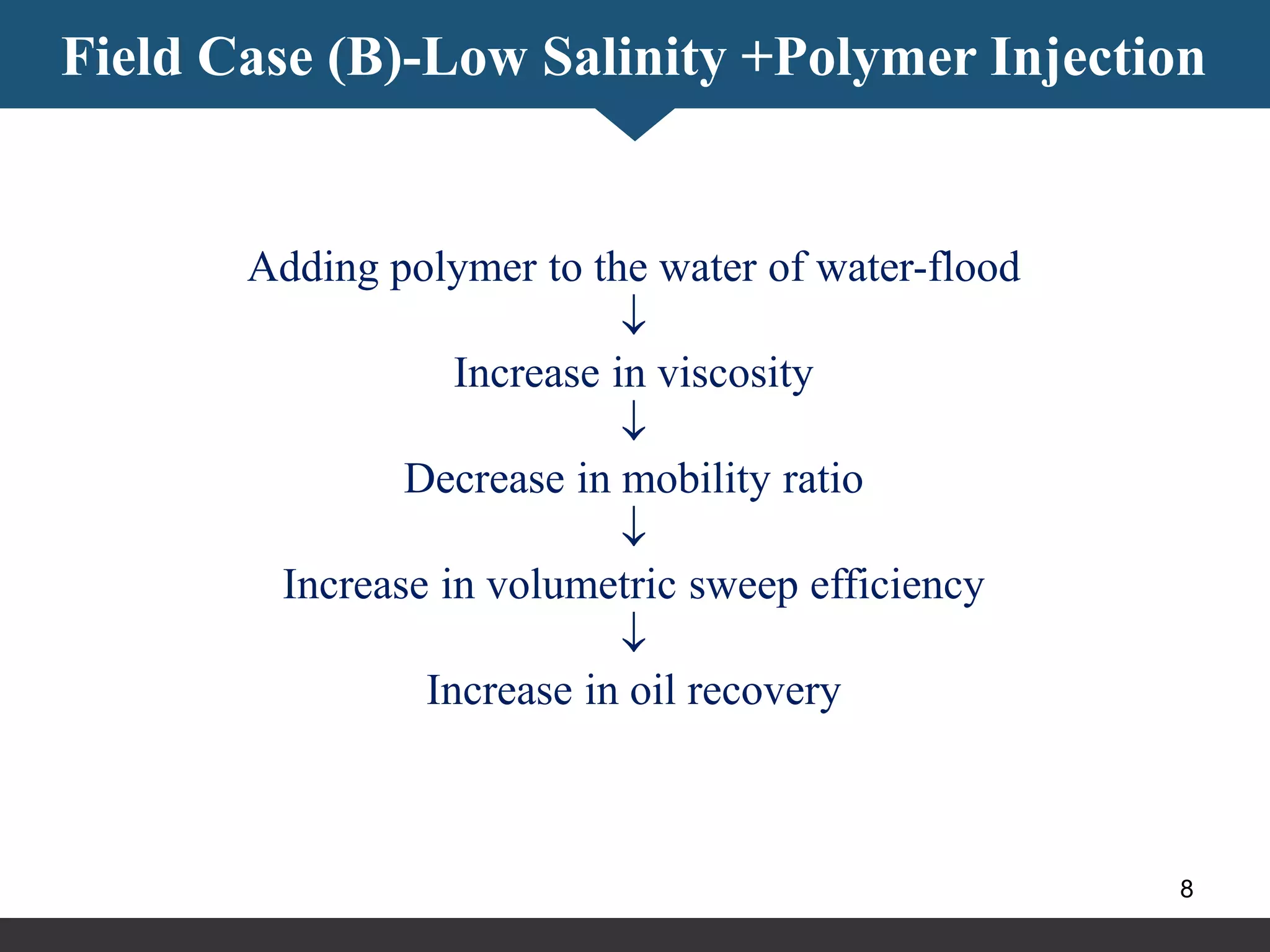
Adding polymer to the water of water-flood

Increase in viscosity

Decrease in mobility ratio

Increase in volumetric sweep efficiency

Increase in oil recovery
8
Single-Well Chemical Tracer Test (SWCTT)
https://www.youtube.com/watch?v=3s0p5C2WSpw
• Additional oil recovery in the range of 3-
4% for polymer injection
• The combination of low salinity and
polymer injection was found be the most
efficient chemical EOR process
Site selected: North Africa
9
Conclusions
 Low salinity water flooding has been recognized as prominent enhanced oil
recovery technique
 Low salinity is considered by Eni a key EOR method due to low capital and
operational costs
 Low Salinity water + Polymer Injection = Highly efficient oil recovery
10
11
Thank you

Low Salinity Water Injection by Shrinath Ghadge

  • 1.
    Low Salinity WaterInjection: Eni’s Experience Shrinath Ghadge Chemical and Petroleum Engineering , University of Pittsburgh, Pittsburgh, PA 15261 Rotondi, Marco, et al. "Low Salinity Water Injection: eni’s Experience." Abu Dhabi International Petroleum Exhibition and Conference. Society of Petroleum Engineers, 2014. PETE 2201
  • 2.
    Outline  Introduction -Low Salinity Water Injection  Eni low salinity EOR workflow  Filed case A : Low Salinity water injection  Filed case B : Low Salinity water + Polymer injection  Conclusions 2
  • 3.
    Why Low SalinityWater Injection? 3 Conventional water flooding • Lower production rate • High energy input High operating cost • Oil molecules are bound to clay particles by bridges of divalent ions (Ca+2, Mg+2) • In high sal. Water, bridges are compressed to clay surface by electrical forces
  • 4.
    Basic requirements fora low salinity water flooding  Injected source water should have a salinity less than 6 g/l and optimal range is 1-2 g/l  Formation rock should contain water sensitive minerals (clay) and should not be strongly water-wet  Formation brine should contain divalent ions  Reservoir oil should contain polar components 4
  • 5.
    Eni Low SalinityEOR Workflow-Year 2006 After the effectiveness of the technique was proved by lab analyses and SWCTTs, an inter- well pilot was performed. 5
  • 6.
    Single-Well Chemical TracerTest (SWCTT) Field was Selected in West Africa- Year 2013Eni’s Workflow 6
  • 7.
    Field Case (A)-LowSalinity Water Injection Eni’s Workflow Lowering the salinity of the injection water to different degrees can change rock wettability and improve oil recovery. 7
  • 8.
    Field Case (B)-LowSalinity +Polymer Injection Adding polymer to the water of water-flood  Increase in viscosity  Decrease in mobility ratio  Increase in volumetric sweep efficiency  Increase in oil recovery 8
  • 9.
    Single-Well Chemical TracerTest (SWCTT) https://www.youtube.com/watch?v=3s0p5C2WSpw • Additional oil recovery in the range of 3- 4% for polymer injection • The combination of low salinity and polymer injection was found be the most efficient chemical EOR process Site selected: North Africa 9
  • 10.
    Conclusions  Low salinitywater flooding has been recognized as prominent enhanced oil recovery technique  Low salinity is considered by Eni a key EOR method due to low capital and operational costs  Low Salinity water + Polymer Injection = Highly efficient oil recovery 10
  • 11.