AVIAT ADVANCED MICROWAVE TECHNOLOGY SEMINAR

IMPROVING MICROWAVE CAPACITY

U N D E R S TA N D I N G T E C H N I Q U E S TO I M P R O V E T H R O U G H P U T


                                                                                    1
microwave
   is just a big pipe


               you get out what you put in
“I canna change the laws o’ physics captain”
How to Understand Vendor Capacity Claims?

    •  It is getting increasingly harder to
     compare capacity claims from
     various vendors
    •  Multiple techniques are being
     employed to boost throughput figures
    •  We will attempt to explain the various
     techniques and how they impact
     capacity


4    AVIAT NETWORKS | APRIL 2012
How can you get more data through the pipe?
how do you get more data
                                     through the pipe?


5   AVIAT NETWORKS | NOVEMBER 2011
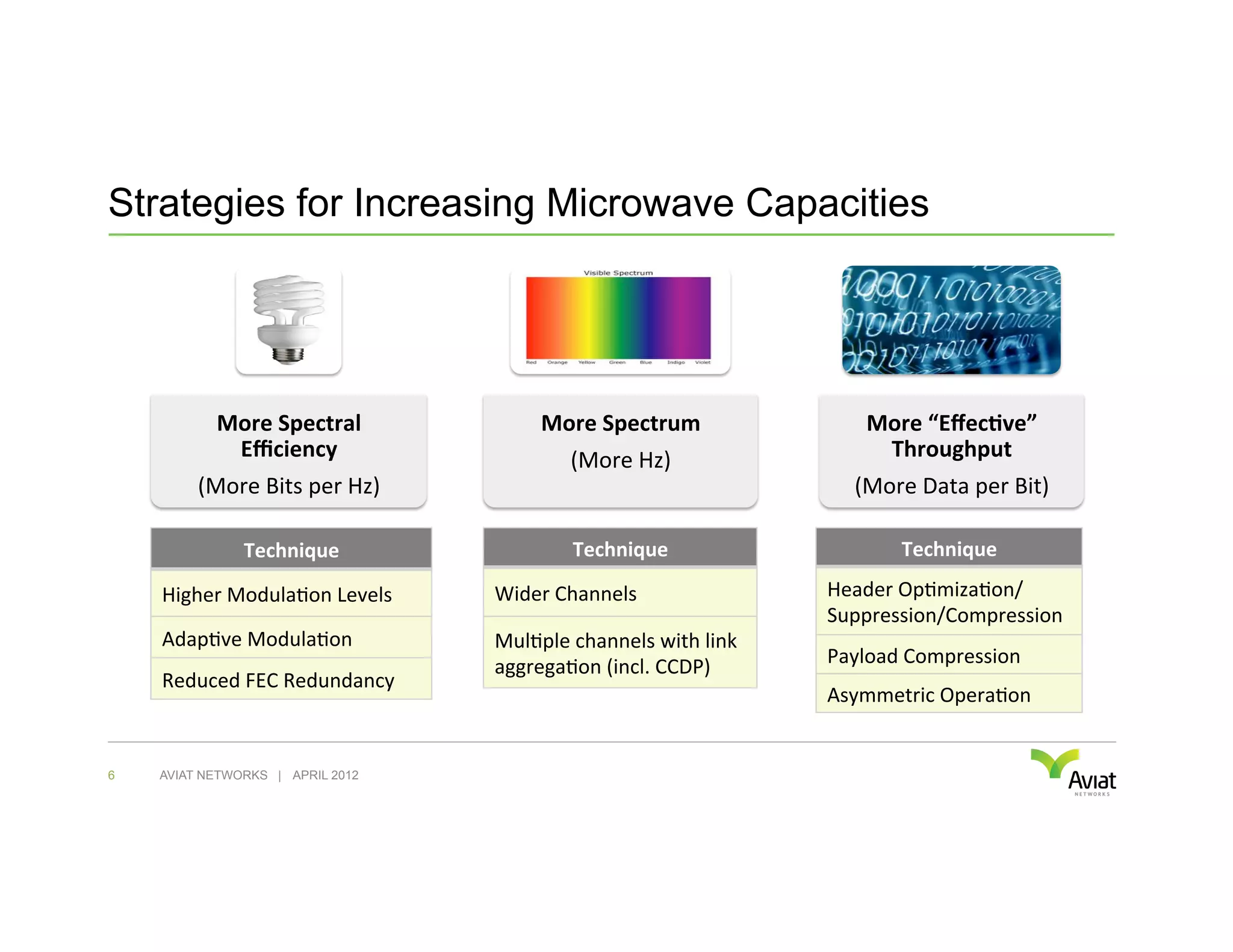
Strategies for Increasing Microwave Capacities


            More	
  Spectral	
                    More	
  Spectrum	
                      More	
  “Effec5ve”	
  
             Efficiency	
                             (More	
  Hz)	
                         Throughput	
  
         (More	
  Bits	
  per	
  Hz)	
                                                  (More	
  Data	
  per	
  Bit)	
  

                Technique	
                            Technique	
                             Technique	
  

    Higher	
  Modula6on	
  Levels	
        Wider	
  Channels	
                       Header	
  Op6miza6on/	
  
                                                                                     Suppression/Compression	
  
    Adap6ve	
  Modula6on	
                 Mul6ple	
  channels	
  with	
  link	
  
                                           aggrega6on	
  (incl.	
  CCDP)	
           Payload	
  Compression	
  
    Reduced	
  FEC	
  Redundancy	
  
                                                                                     Asymmetric	
  Opera6on	


6   AVIAT NETWORKS | APRIL 2012
get a bigger pipe!
How Bigger get more data through the pipe?
Get acan you Pipe!


7   AVIAT NETWORKS | NOVEMBER 2011
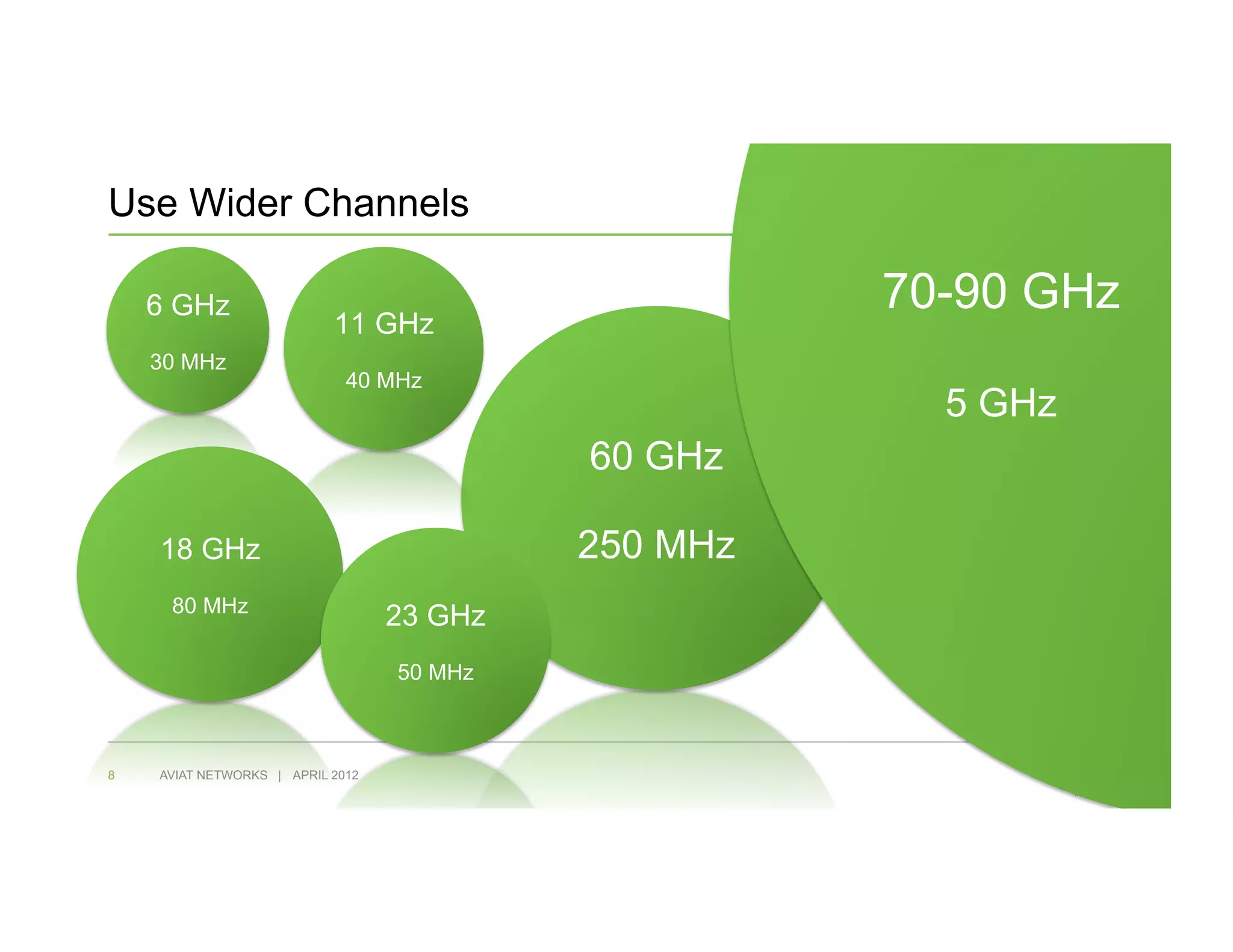
Use Wider Channels

    6 GHz                                            70-90 GHz
                           11 GHz
    30 MHz
                             40 MHz
                                                       5 GHz
                                           60 GHz

    18 GHz                                 250 MHz
     80 MHz
                                  23 GHz
                                  50 MHz


8   AVIAT NETWORKS | APRIL 2012
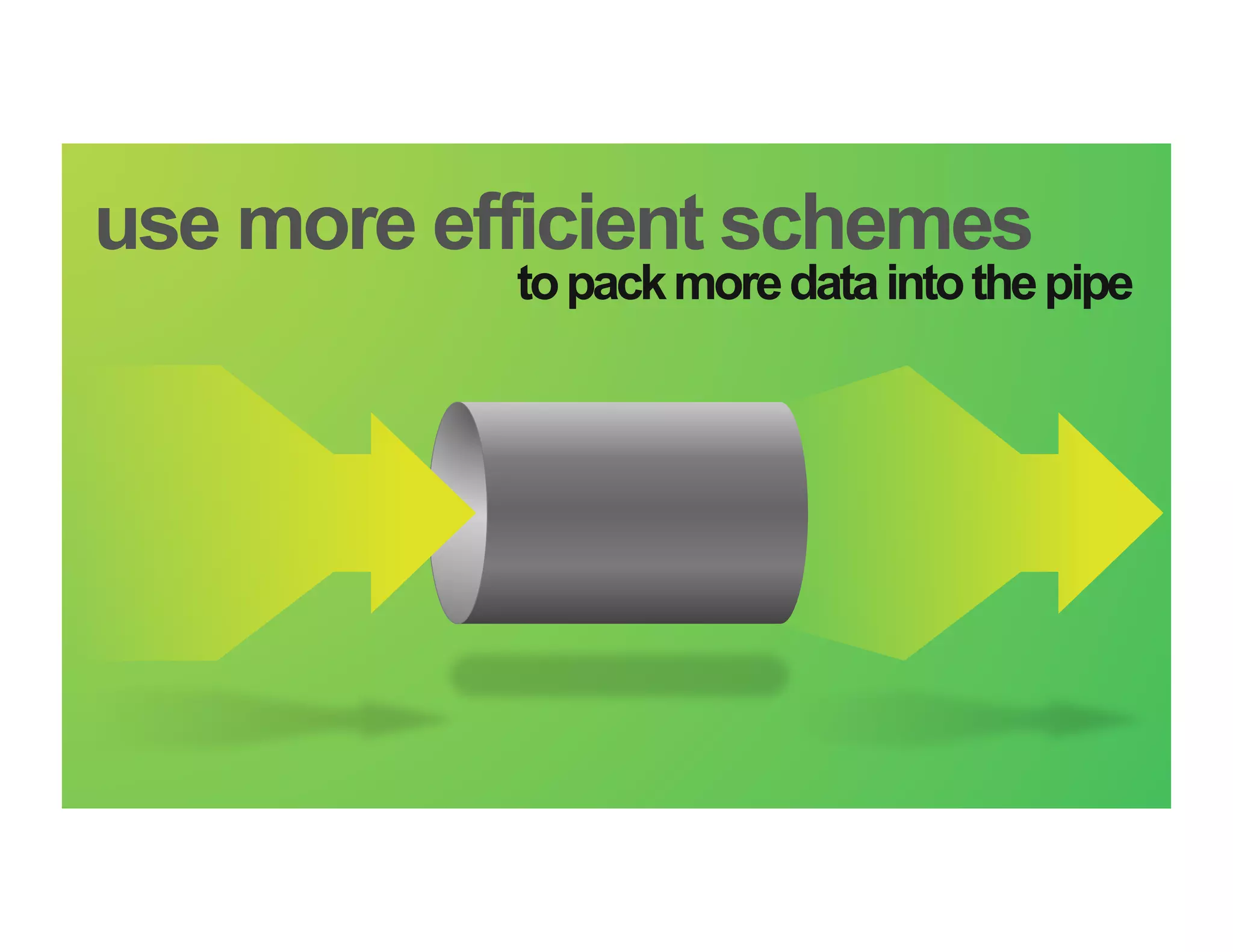
use more efficient schemes
How Bigger get more data through the pipe?
Get acan you Pipe!

                                     to pack more data into the pipe


9   AVIAT NETWORKS | NOVEMBER 2011
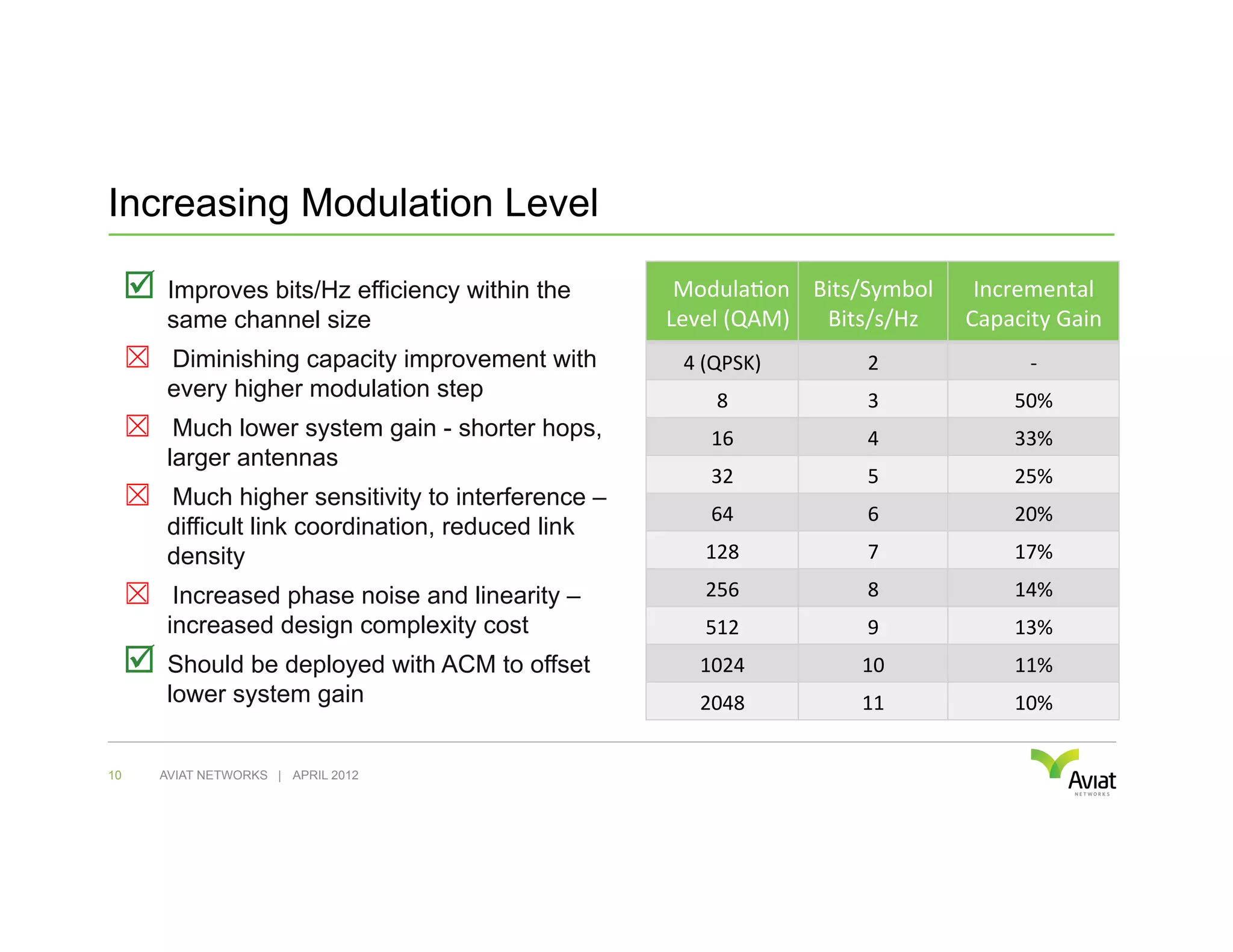
Increasing Modulation Level

     þ  Improves bits/Hz efficiency within the       Modula6on	
   Bits/Symbol	
        Incremental	
  
         same channel size                           Level	
  (QAM)	
   Bits/s/Hz	
     Capacity	
  Gain	
  
     ☒  Diminishing capacity improvement with          4	
  (QPSK)	
        2	
                  -­‐	
  
         every higher modulation step                        8	
            3	
               50%	
  
     ☒  Much lower system gain - shorter hops,              16	
            4	
               33%	
  
         larger antennas
                                                            32	
            5	
               25%	
  
     ☒  Much higher sensitivity to interference –
                                                            64	
            6	
               20%	
  
         difficult link coordination, reduced link
         density                                          128	
             7	
               17%	
  

     ☒  Increased phase noise and linearity –             256	
             8	
               14%	
  
         increased design complexity cost                 512	
             9	
               13%	
  
     þ  Should be deployed with ACM to offset           1024	
            10	
               11%	
  
         lower system gain                               2048	
            11	
               10%	


10      AVIAT NETWORKS | APRIL 2012
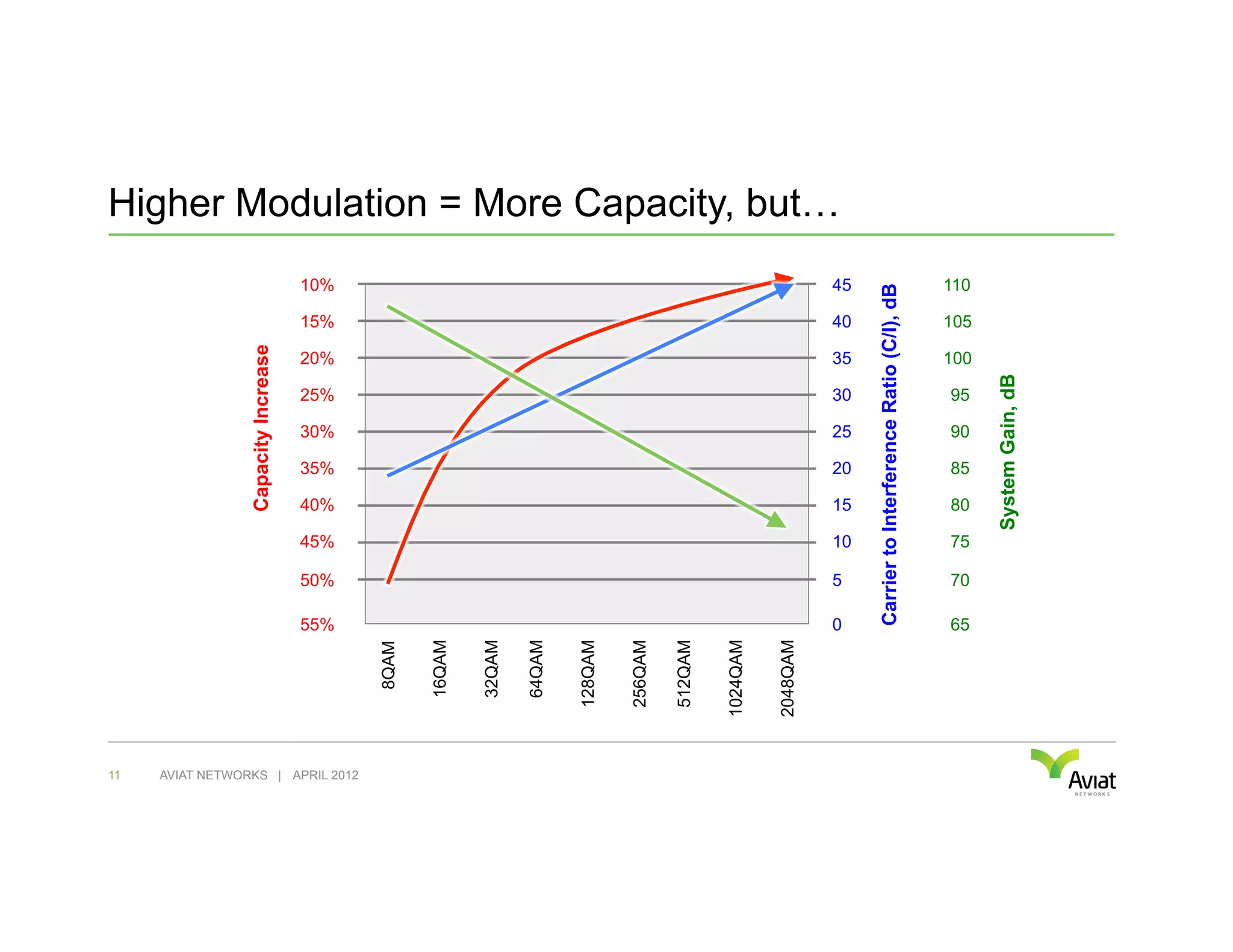
Higher Modulation = More Capacity, but…
                                     10%                                                                                 45                                             110


                                                                                                                              Carrier to Interference Ratio (C/I), dB
                                     15%                                                                                 40                                             105
                 Capacity Increase


                                     20%                                                                                 35                                             100


                                                                                                                                                                              System Gain, dB
                                     25%                                                                                 30                                             95

                                     30%                                                                                 25                                             90

                                     35%                                                                                 20                                             85

                                     40%                                                                                 15                                             80

                                     45%                                                                                 10                                             75

                                     50%                                                                                 5                                              70

                                     55%                                                                                 0                                              65


                                                                                                     1024QAM

                                                                                                               2048QAM
                                                  16QAM

                                                          32QAM

                                                                  64QAM


                                                                          128QAM

                                                                                   256QAM

                                                                                            512QAM
                                           8QAM


11   AVIAT NETWORKS | APRIL 2012
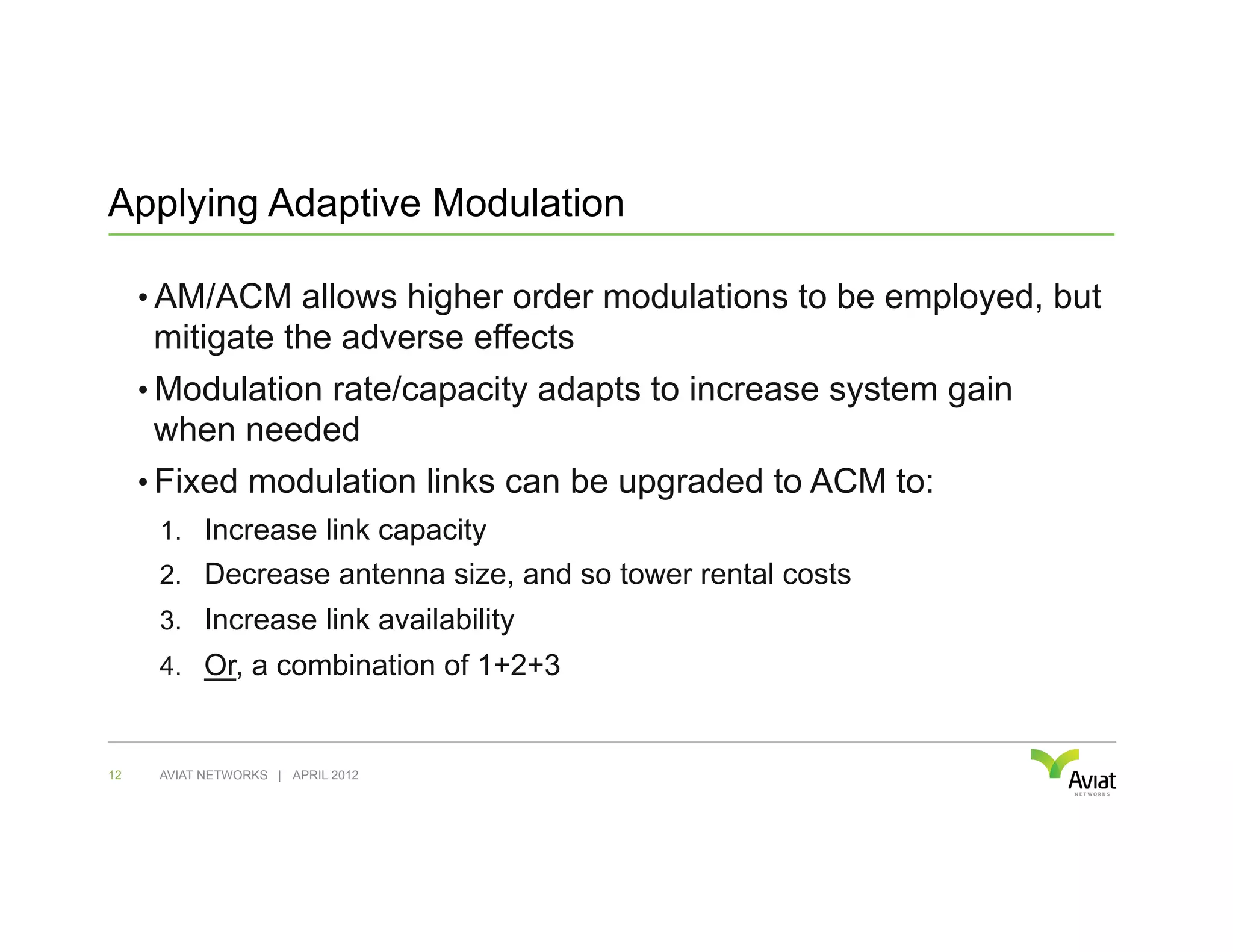
Applying Adaptive Modulation

     •  AM/ACM allows higher order modulations to be employed, but
      mitigate the adverse effects
     •  Modulation rate/capacity adapts to increase system gain
      when needed
     •  Fixed modulation links can be upgraded to ACM to:
      1.  Increase link capacity
      2.  Decrease antenna size, and so tower rental costs
      3.  Increase link availability
      4.  Or, a combination of 1+2+3


12    AVIAT NETWORKS | APRIL 2012
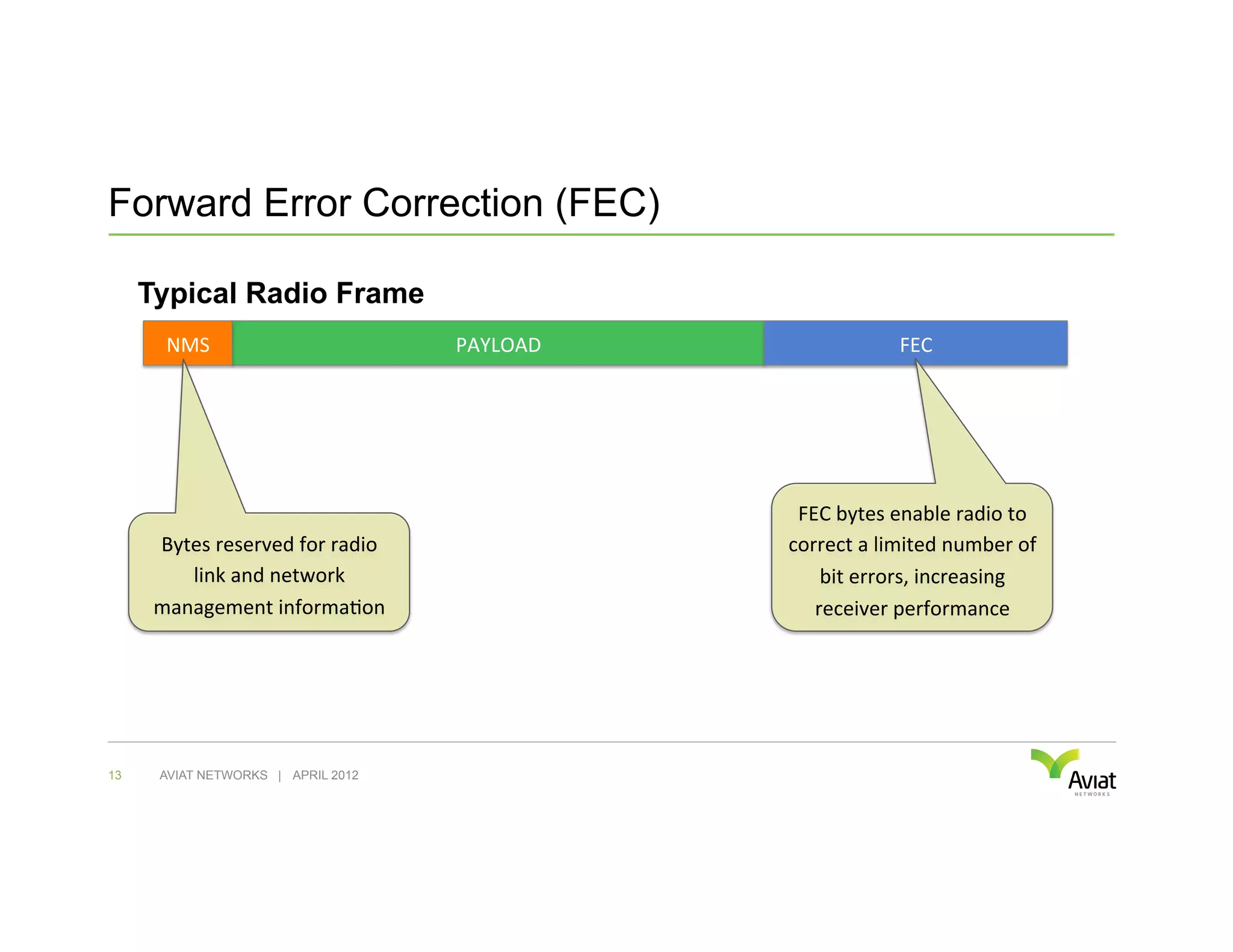
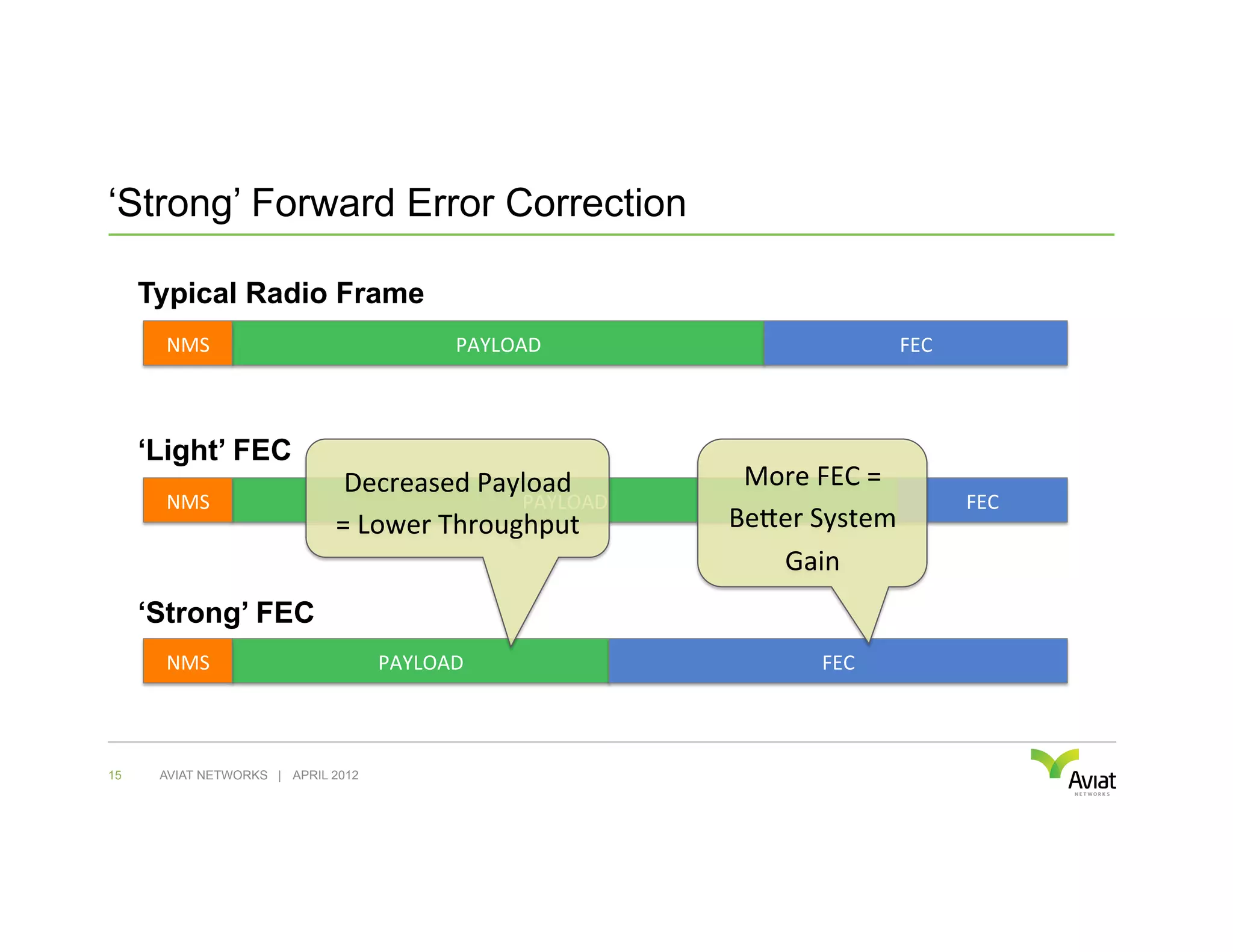
Forward Error Correction (FEC)

     Typical Radio Frame
        NMS	
                                 PAYLOAD	
                       FEC	


                                                             FEC	
  bytes	
  enable	
  radio	
  to	
  
      Bytes	
  reserved	
  for	
  radio	
                   correct	
  a	
  limited	
  number	
  of	
  
         link	
  and	
  network	
                               bit	
  errors,	
  increasing	
  
      management	
  informa6on	
                               receiver	
  performance	


13    AVIAT NETWORKS | APRIL 2012
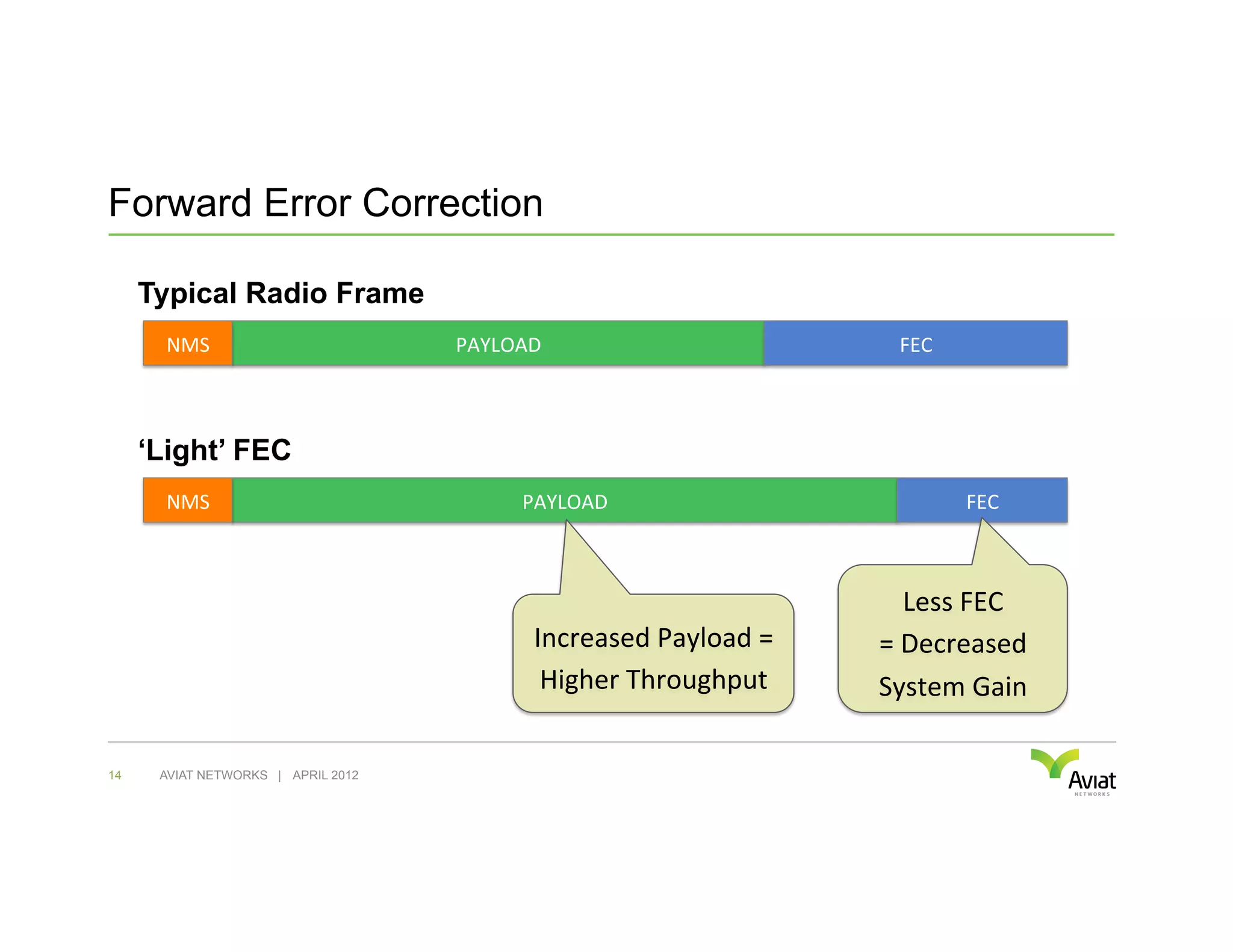
Forward Error Correction

     Typical Radio Frame
       NMS	
                        PAYLOAD	
                                  FEC	


     ‘Light’ FEC
       NMS	
                                PAYLOAD	
                                    FEC	


                                                                                  Less	
  FEC	
  
                                             Increased	
  Payload	
  =	
     =	
  Decreased	
  
                                              Higher	
  Throughput	
         System	
  Gain	
  

14    AVIAT NETWORKS | APRIL 2012
‘Strong’ Forward Error Correction

     Typical Radio Frame
       NMS	
                                 PAYLOAD	
                              FEC	


     ‘Light’ FEC
                              Decreased	
  Payload	
            More	
  FEC	
  =	
  
       NMS	
                                     PAYLOAD	
                                    FEC	
  
                             =	
  Lower	
  Throughput	
        Beaer	
  System	
  
                                                                  Gain	
  
     ‘Strong’ FEC
       NMS	
                        PAYLOAD	
                             FEC	


15    AVIAT NETWORKS | APRIL 2012
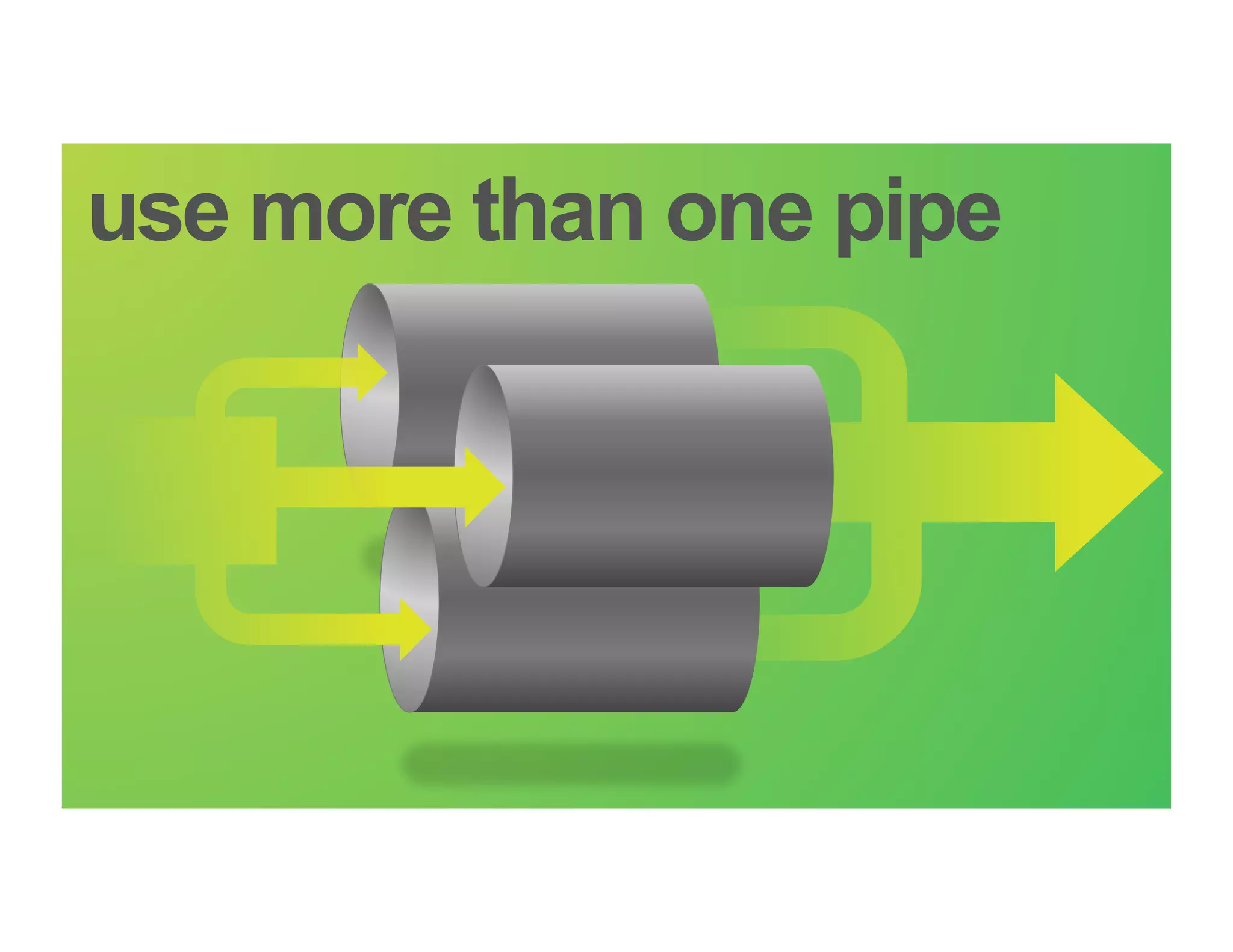
use more than one pipe
Use more than one pipe


16   AVIAT NETWORKS | NOVEMBER 2011
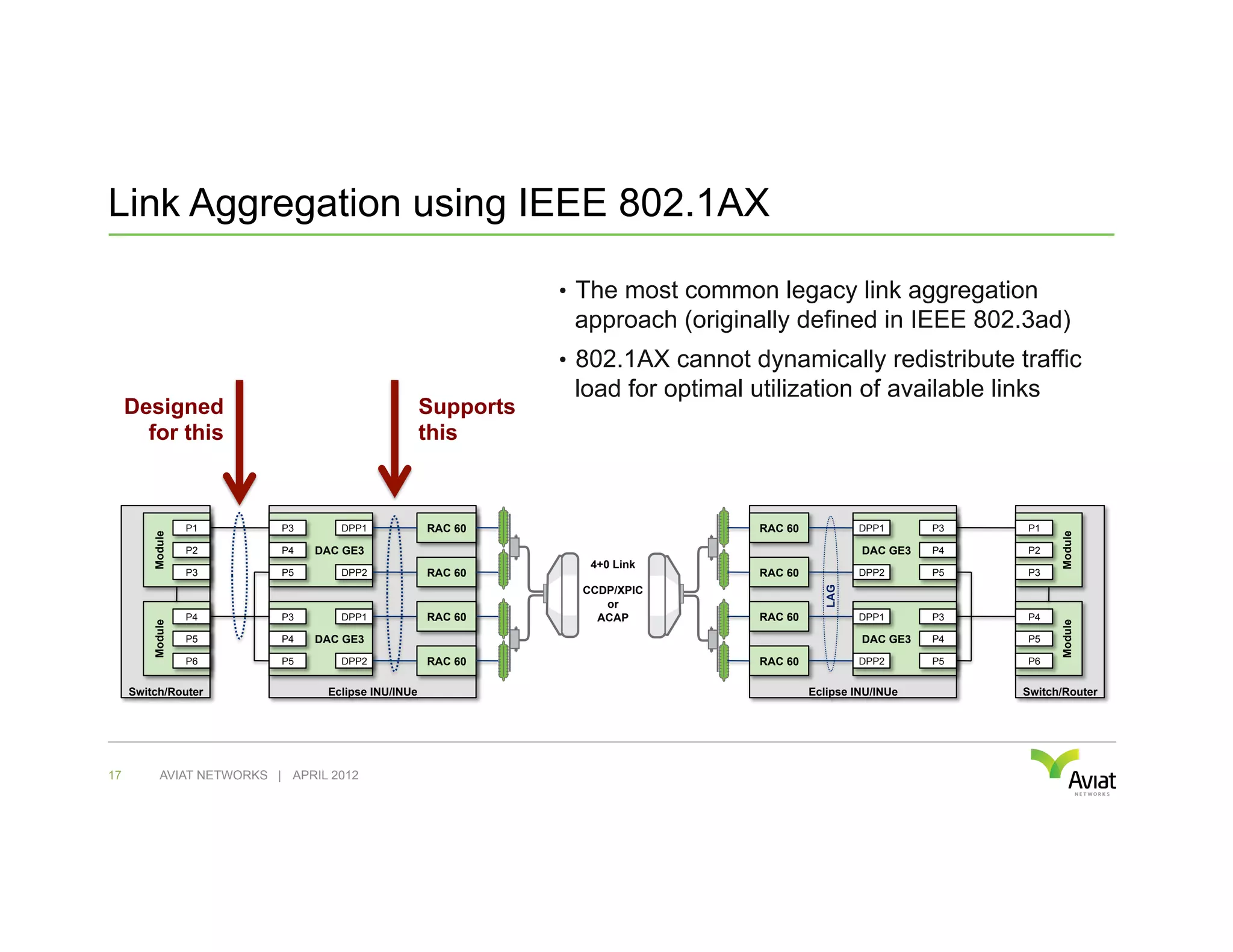
Link Aggregation using IEEE 802.1AX

                                                                •  The most common legacy link aggregation
                                                                 approach (originally defined in IEEE 802.3ad)
                                                                •  802.1AX cannot dynamically redistribute traffic
                                                                 load for optimal utilization of available links
     Designed                                        Supports
       for this                                      this


                  P1        P3      DPP1             RAC 60                        RAC 60            DPP1      P3   P1
         Module


                                                                                                                          Module
                  P2        P4   DAC GE3                                                             DAC GE3   P4   P2
                                                                   4+0 Link
                  P3        P5      DPP2             RAC 60                        RAC 60            DPP2      P5   P3
                                                                  CCDP/XPIC


                                                                                              LAG
                                                                     or
                  P4        P3      DPP1             RAC 60         ACAP           RAC 60            DPP1      P3   P4
         Module


                                                                                                                          Module
                  P5        P4   DAC GE3                                                             DAC GE3   P4   P5

                  P6        P5      DPP2             RAC 60                        RAC 60            DPP2      P5   P6


     Switch/Router                Eclipse INU/INUe                                          Eclipse INU/INUe        Switch/Router


17          AVIAT NETWORKS | APRIL 2012
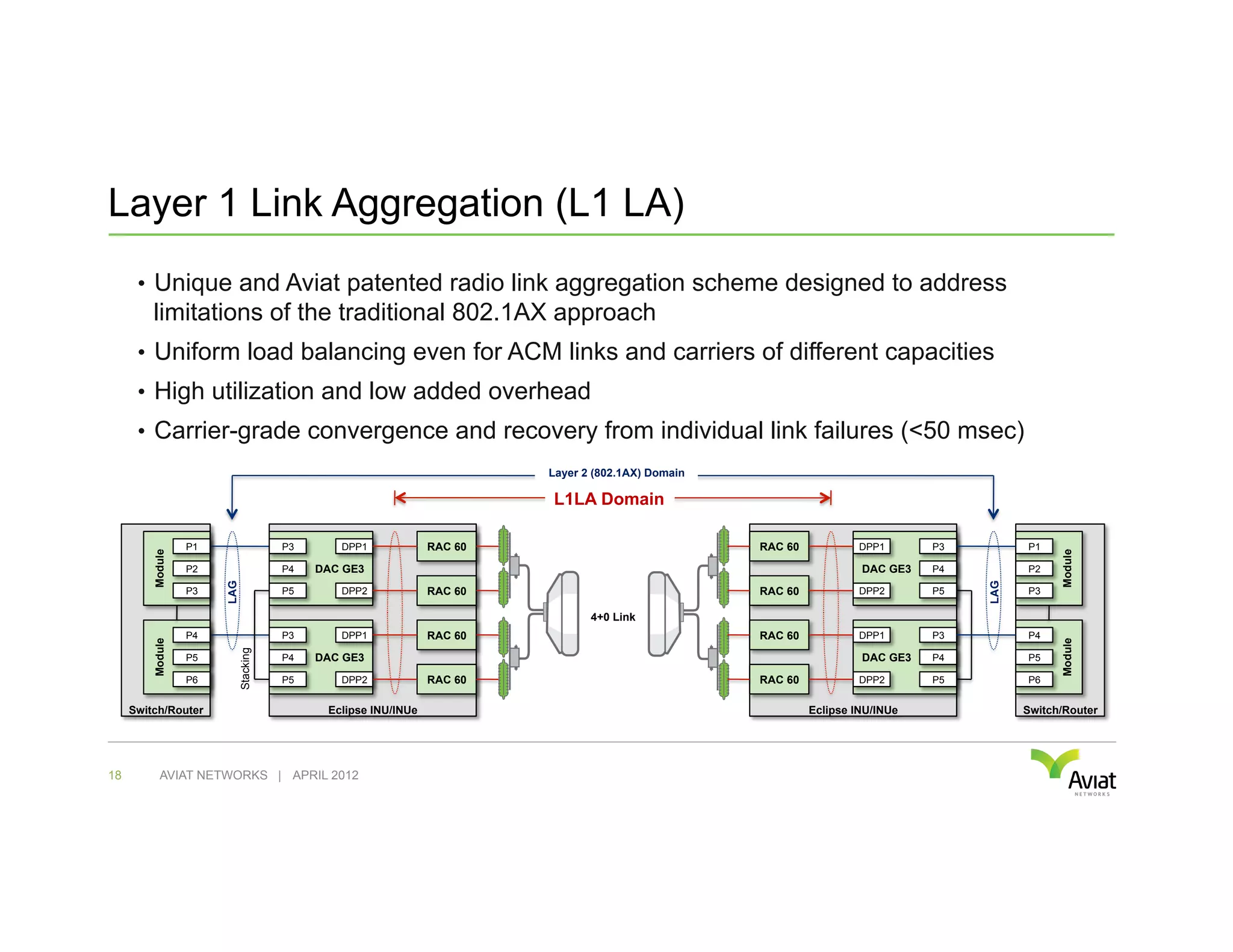
Layer 1 Link Aggregation (L1 LA)
      •  Unique and Aviat patented radio link aggregation scheme designed to address
         limitations of the traditional 802.1AX approach
      •  Uniform load balancing even for ACM links and carriers of different capacities
      •  High utilization and low added overhead
      •  Carrier-grade convergence and recovery from individual link failures (<50 msec)
                                                                          Layer 2 (802.1AX) Domain

                                                                          L1LA Domain

                  P1                    P3      DPP1             RAC 60                              RAC 60            DPP1      P3         P1
         Module


                                                                                                                                                  Module
                  P2                    P4   DAC GE3                                                                   DAC GE3   P4         P2
                       LAG


                                                                                                                                      LAG
                  P3                    P5      DPP2             RAC 60                              RAC 60            DPP2      P5         P3

                                                                                 4+0 Link
                  P4                    P3      DPP1             RAC 60                              RAC 60            DPP1      P3         P4
         Module


                                                                                                                                                  Module
                             Stacking


                  P5                    P4   DAC GE3                                                                   DAC GE3   P4         P5

                  P6                    P5      DPP2             RAC 60                              RAC 60            DPP2      P5         P6


     Switch/Router                            Eclipse INU/INUe                                                Eclipse INU/INUe              Switch/Router


18         AVIAT NETWORKS | APRIL 2012
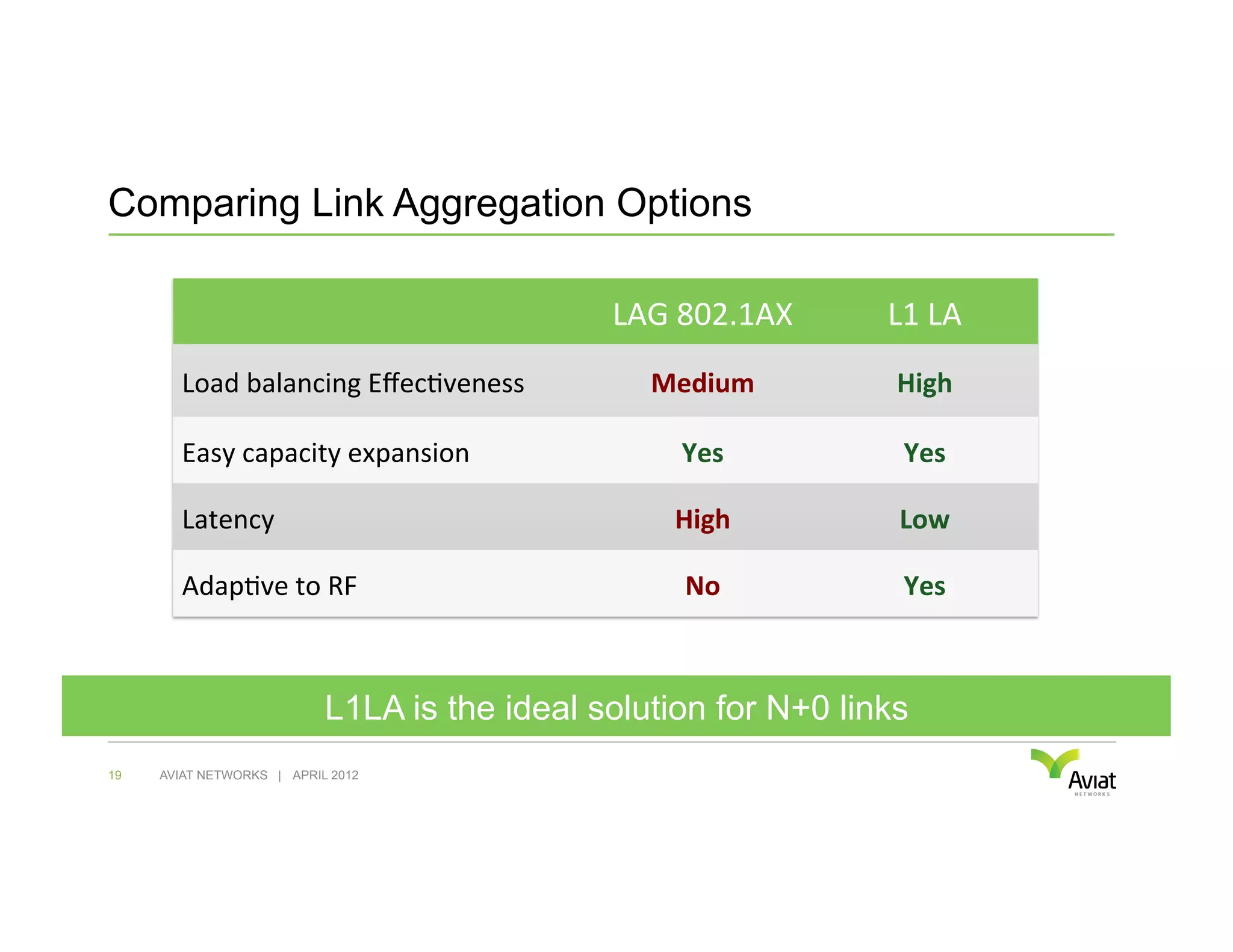
Comparing Link Aggregation Options

                                               LAG	
  802.1AX	
     L1	
  LA	
  
        Load	
  balancing	
  Effec6veness	
        Medium	
           High	
  

        Easy	
  capacity	
  expansion	
              Yes	
            Yes	
  

        Latency	
                                   High	
           Low	
  

        Adap6ve	
  to	
  RF	
                        No	
             Yes	


                           L1LA is the ideal solution for N+0 links
19   AVIAT NETWORKS | APRIL 2012
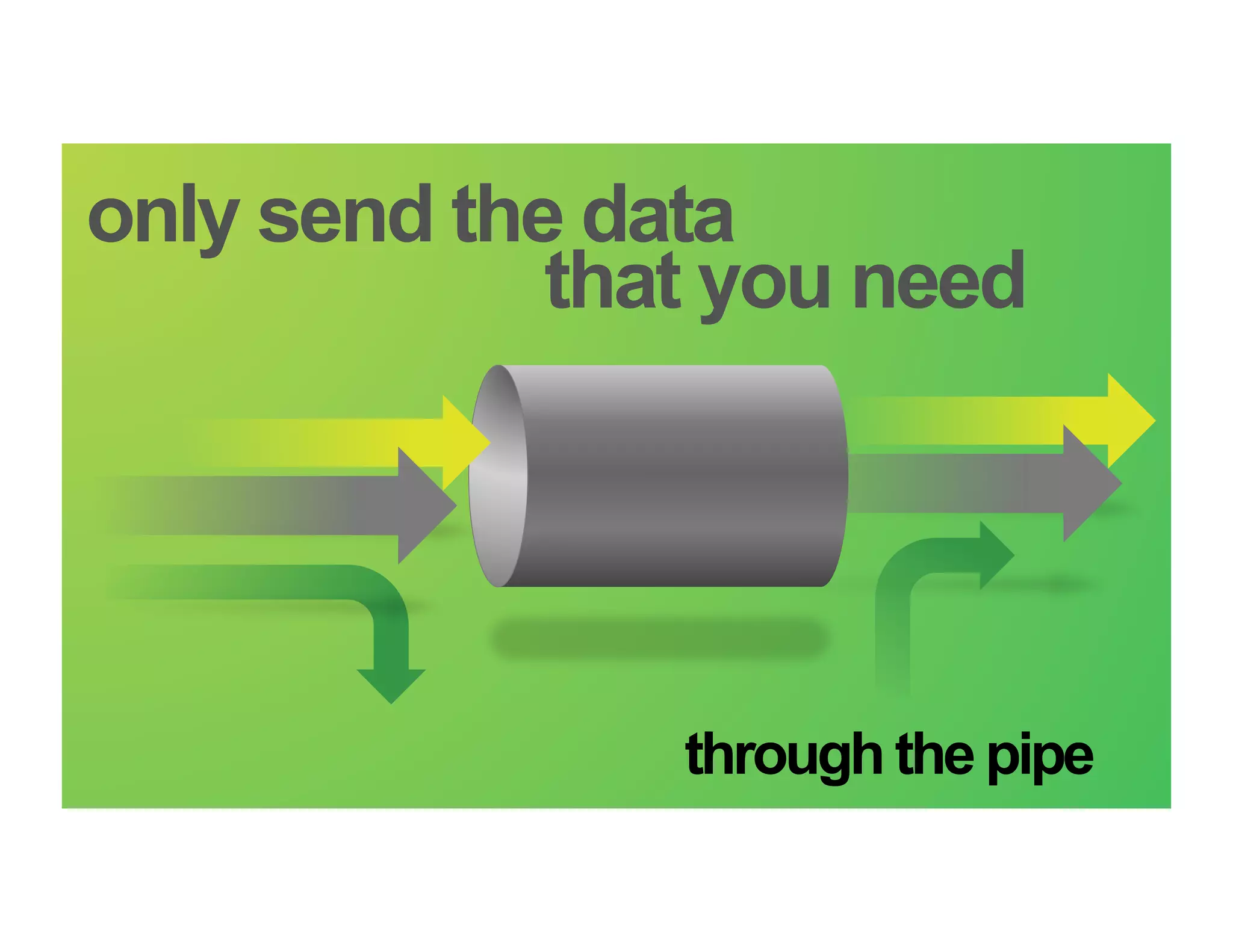
only send the data
Only send the data that you need through the pipe

             that you need


20   AVIAT NETWORKS | NOVEMBER 2011   through the pipe
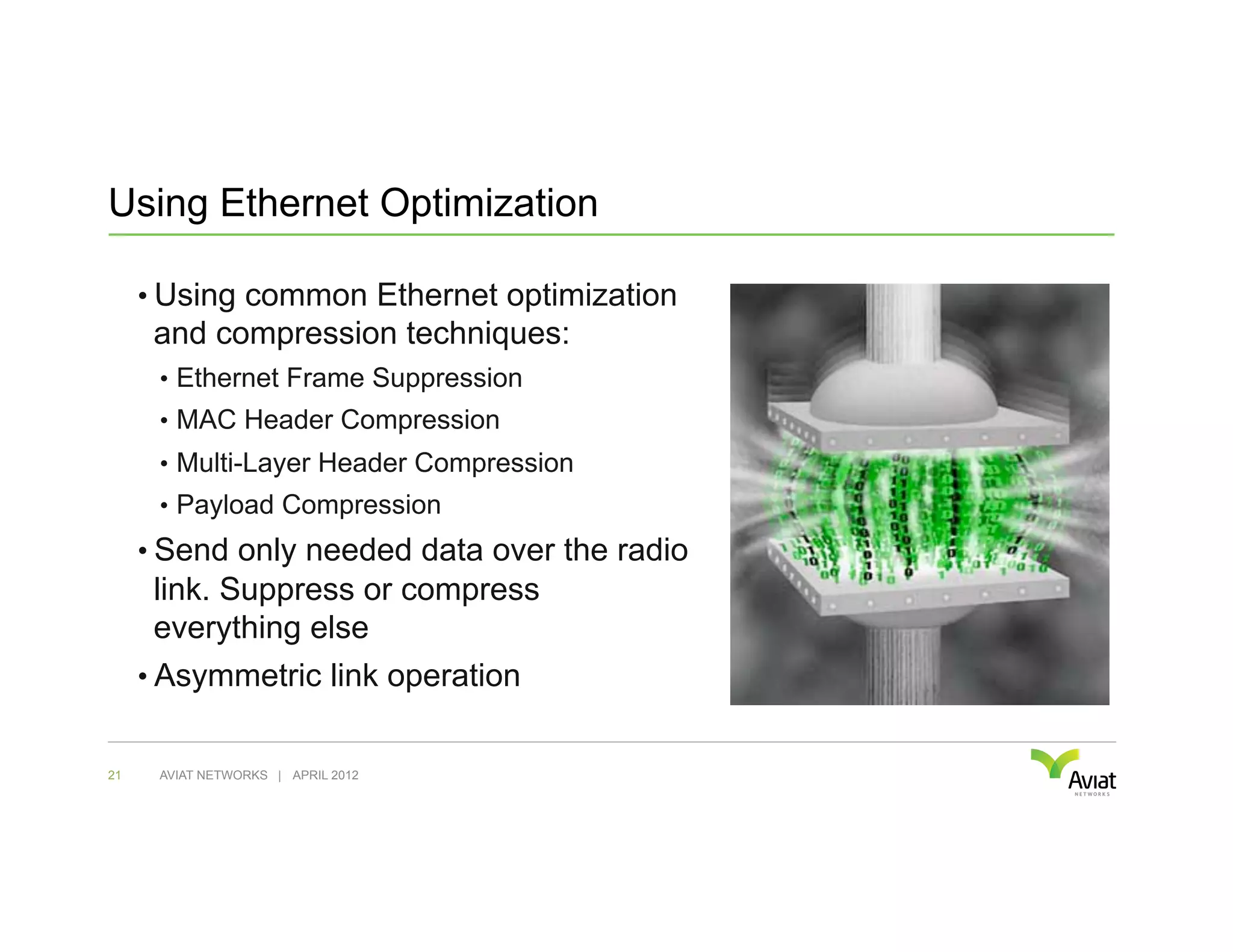
Using Ethernet Optimization

     •  Using common Ethernet optimization
      and compression techniques:
      •  Ethernet Frame Suppression
      •  MAC Header Compression
      •  Multi-Layer Header Compression
      •  Payload Compression
     •  Send only needed data over the radio
      link. Suppress or compress
      everything else
     •  Asymmetric link operation


21    AVIAT NETWORKS | APRIL 2012
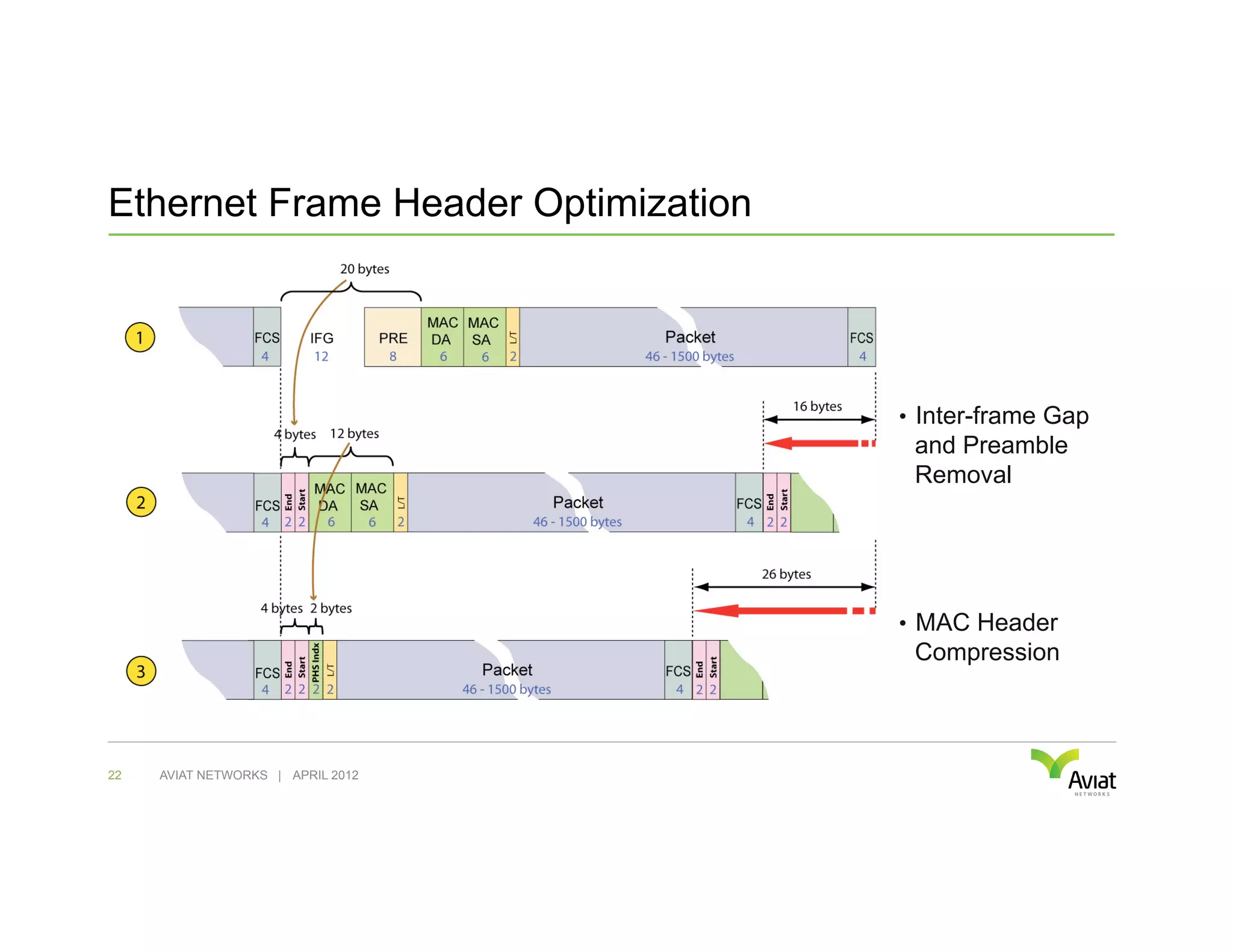
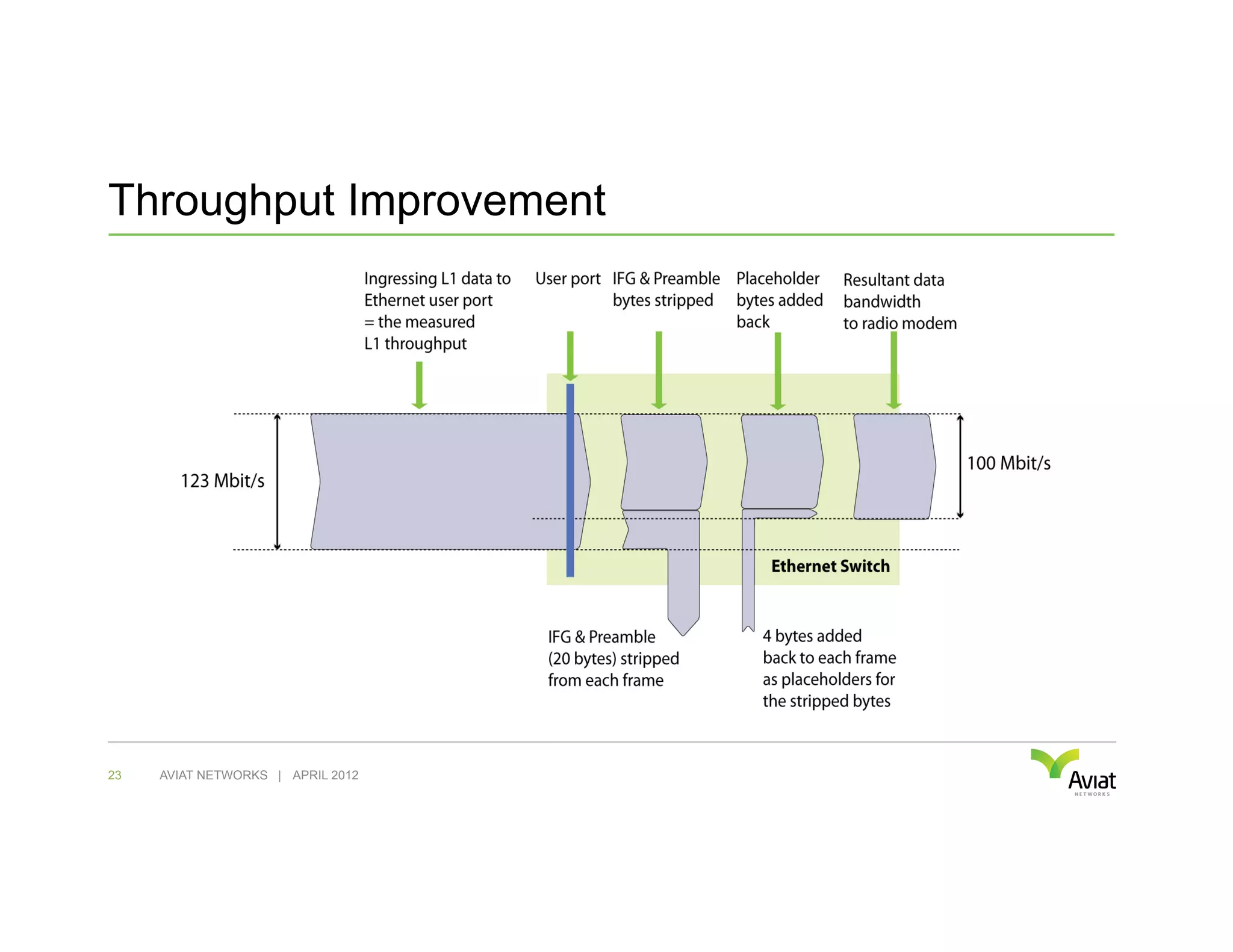
Ethernet Frame Header Optimization


                                     •  Inter-frame Gap
                                      and Preamble
                                      Removal


                                     •  MAC Header
                                      Compression

                                                      !

22   AVIAT NETWORKS | APRIL 2012
Throughput Improvement


23   AVIAT NETWORKS | APRIL 2012
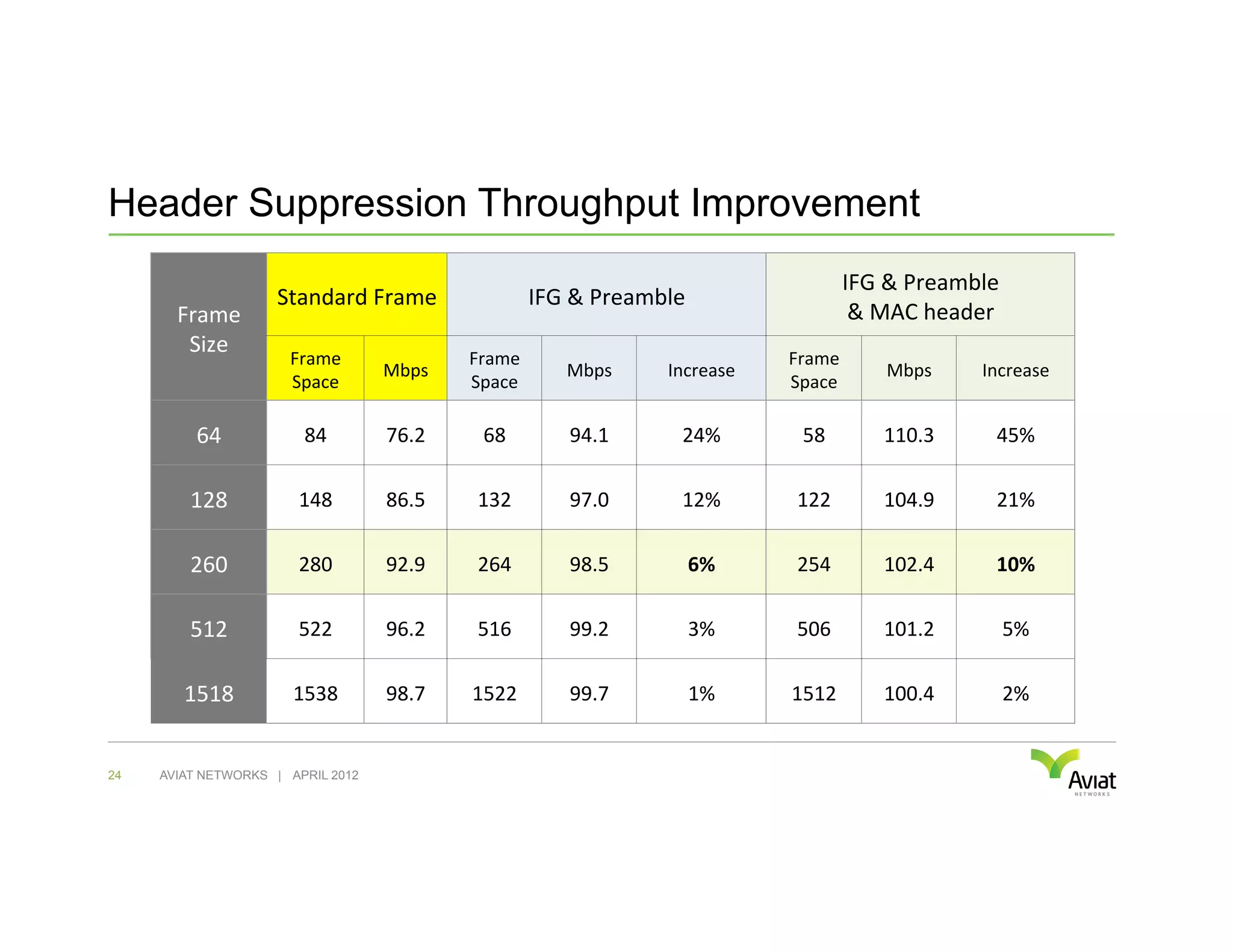
Header Suppression Throughput Improvement
                                                                                                        IFG	
  &	
  Preamble	
  	
  
                    Standard	
  Frame	
                   IFG	
  &	
  Preamble	
  
       Frame	
                                                                                           &	
  MAC	
  header	
  
        Size	
  
                      Frame	
                 Frame	
                                        Frame	
  
                                   Mbps	
                      Mbps	
         Increase	
                       Mbps	
          Increase	
  
                      Space	
                 Space	
                                        Space	
  

          64	
          84	
       76.2	
       68	
            94.1	
          24%	
          58	
           110.3	
            45%	
  

         128	
         148	
       86.5	
      132	
            97.0	
          12%	
         122	
           104.9	
            21%	
  

         260	
         280	
       92.9	
      264	
            98.5	
           6%	
         254	
           102.4	
            10%	
  

         512	
         522	
       96.2	
      516	
            99.2	
           3%	
         506	
           101.2	
             5%	
  

        1518	
         1538	
      98.7	
     1522	
            99.7	
           1%	
        1512	
           100.4	
             2%	


24   AVIAT NETWORKS | APRIL 2012
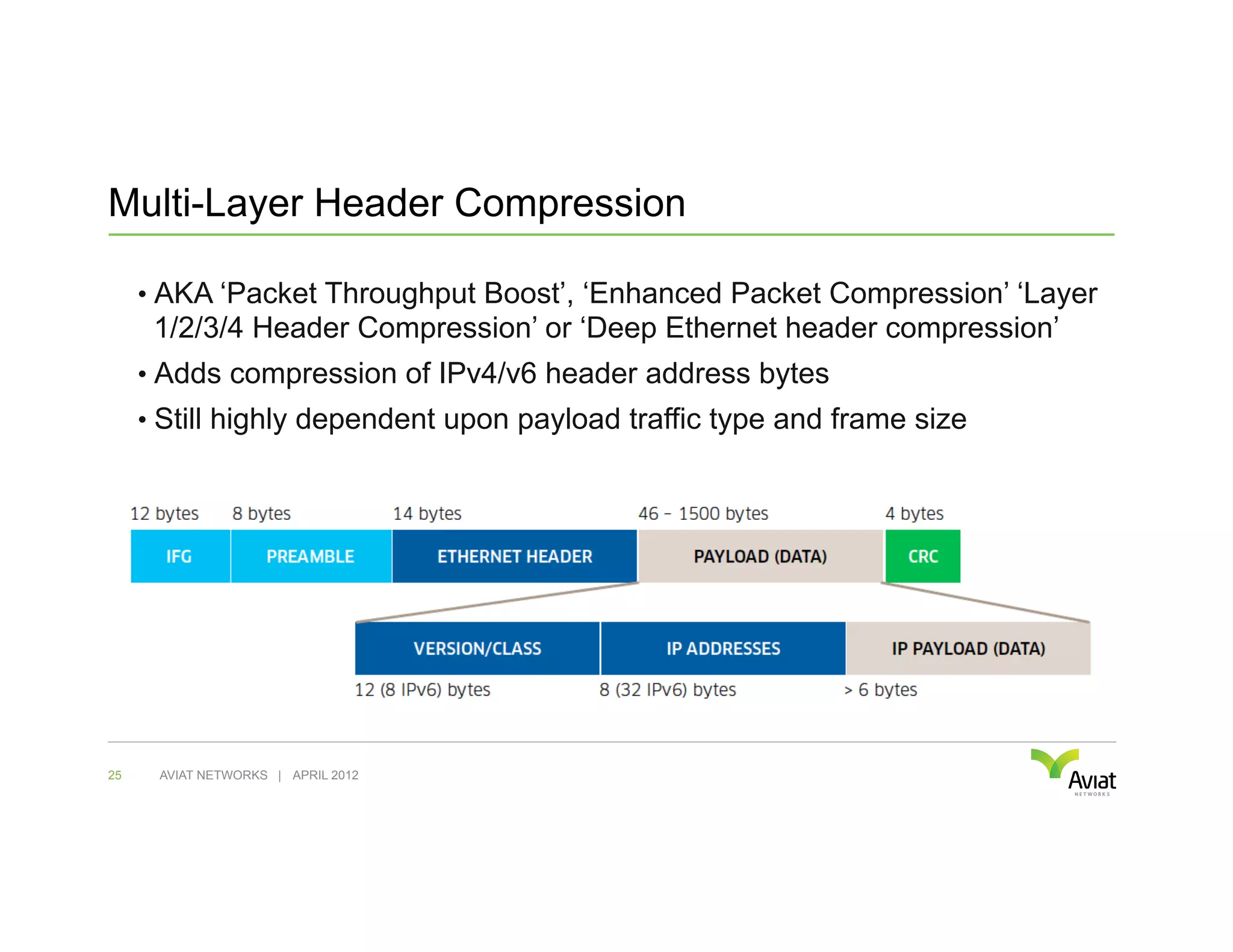
Multi-Layer Header Compression

     •  AKA ‘Packet Throughput Boost’, ‘Enhanced Packet Compression’ ‘Layer
      1/2/3/4 Header Compression’ or ‘Deep Ethernet header compression’
     •  Adds compression of IPv4/v6 header address bytes
     •  Still highly dependent upon payload traffic type and frame size


25    AVIAT NETWORKS | APRIL 2012
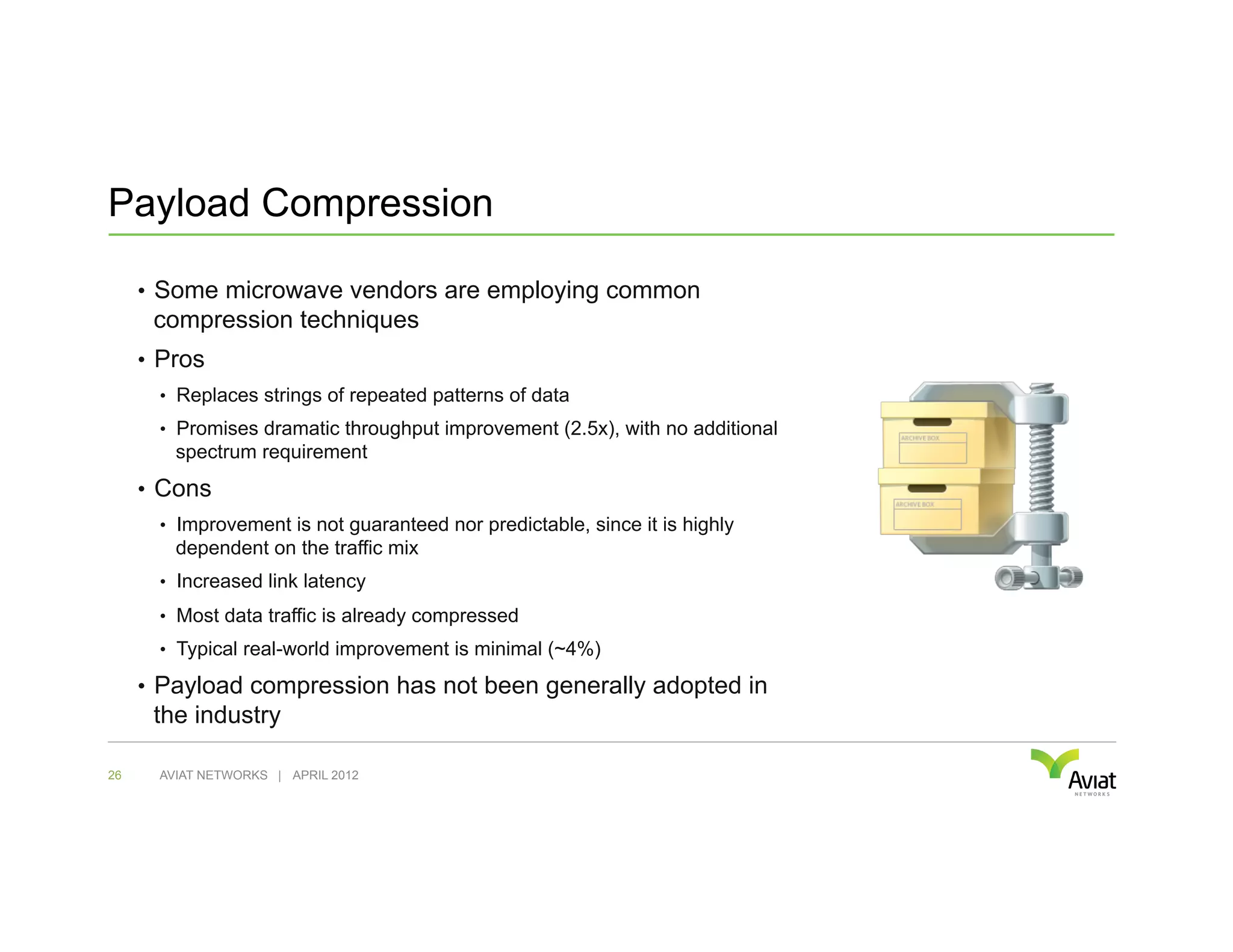
Payload Compression

     •  Some microwave vendors are employing common
      compression techniques
     •  Pros
       •  Replaces strings of repeated patterns of data
       •  Promises dramatic throughput improvement (2.5x), with no additional
         spectrum requirement
     •  Cons
       •  Improvement is not guaranteed nor predictable, since it is highly
         dependent on the traffic mix
       •  Increased link latency
       •  Most data traffic is already compressed
       •  Typical real-world improvement is minimal (~4%)

     •  Payload compression has not been generally adopted in
      the industry

26     AVIAT NETWORKS | APRIL 2012
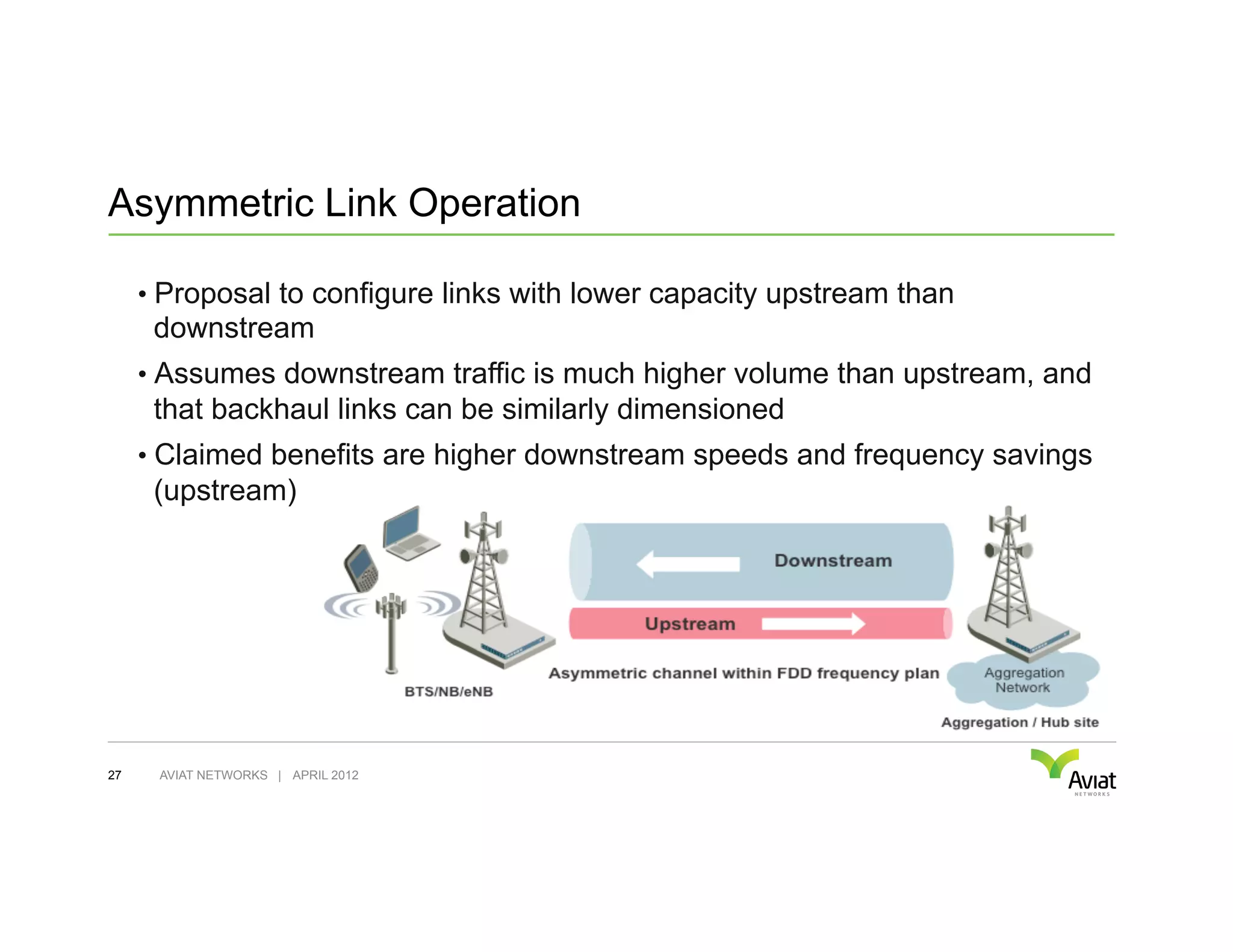
Asymmetric Link Operation

     •  Proposal to configure links with lower capacity upstream than
      downstream
     •  Assumes downstream traffic is much higher volume than upstream, and
      that backhaul links can be similarly dimensioned
     •  Claimed benefits are higher downstream speeds and frequency savings
      (upstream)


27    AVIAT NETWORKS | APRIL 2012
IN CONCLUSION
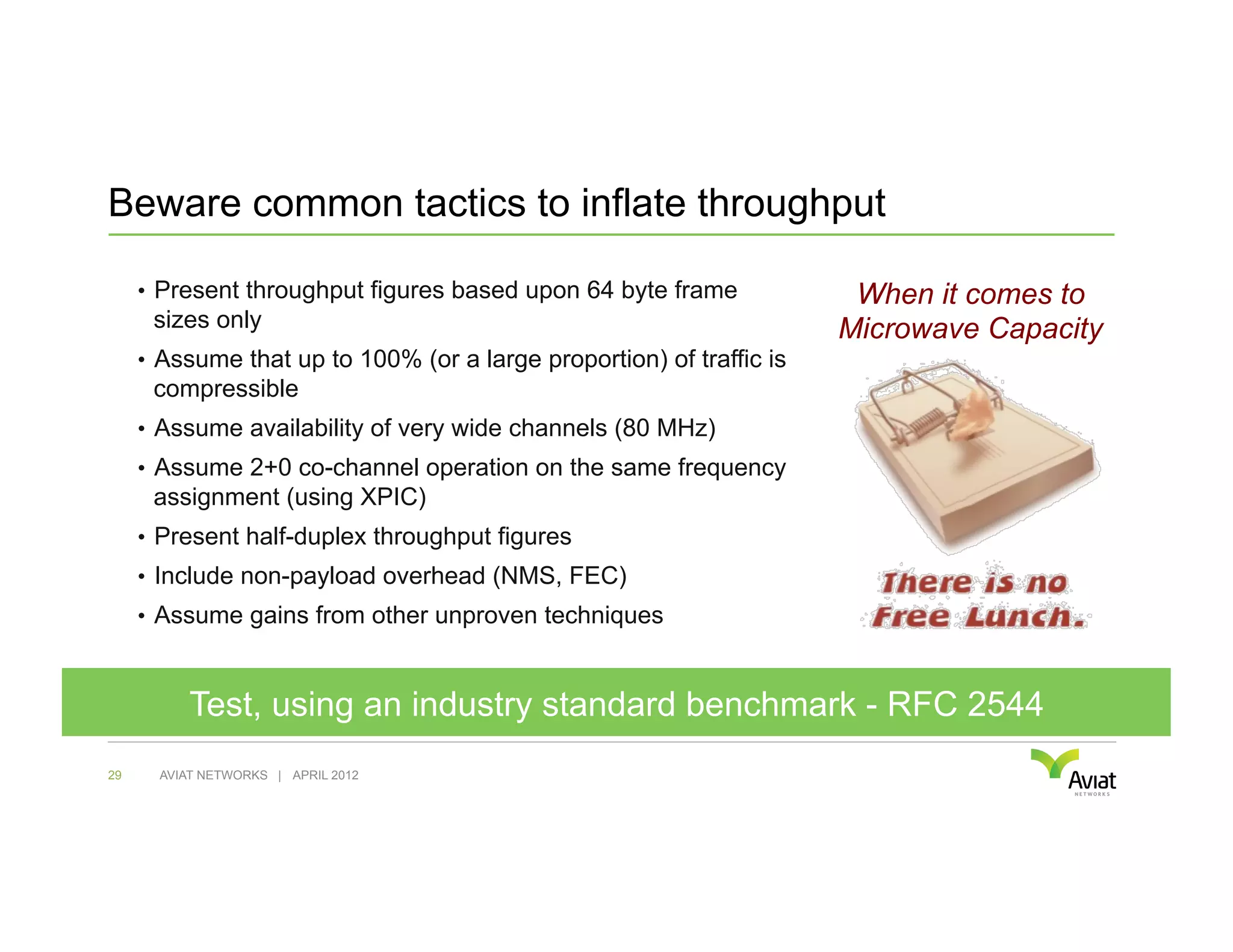
Beware common tactics to inflate throughput

     •  Present throughput figures based upon 64 byte frame             When it comes to
      sizes only                                                       Microwave Capacity
     •  Assume that up to 100% (or a large proportion) of traffic is
      compressible
     •  Assume availability of very wide channels (80 MHz)
     •  Assume 2+0 co-channel operation on the same frequency
      assignment (using XPIC)
     •  Present half-duplex throughput figures
     •  Include non-payload overhead (NMS, FEC)
     •  Assume gains from other unproven techniques


           Test, using an industry standard benchmark - RFC 2544
29     AVIAT NETWORKS | APRIL 2012
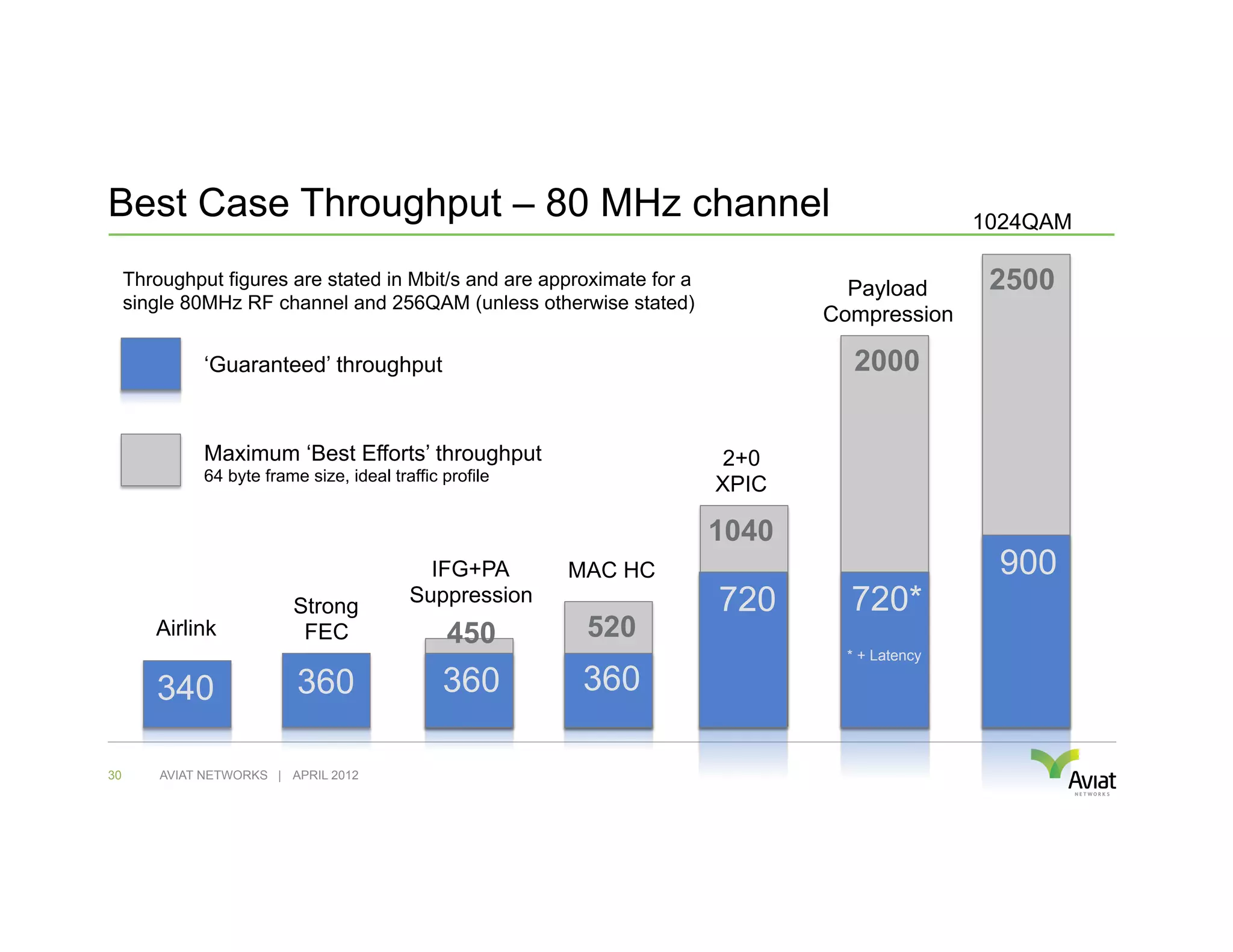
Best Case Throughput – 80 MHz channel                                                           1024QAM

     Throughput figures are stated in Mbit/s and are approximate for a            Payload        2500
     single 80MHz RF channel and 256QAM (unless otherwise stated)
                                                                                Compression

               ‘Guaranteed’ throughput                                             2000


               Maximum ‘Best Efforts’ throughput                         2+0
               64 byte frame size, ideal traffic profile
                                                                         XPIC

                                                                         1040
                                              IFG+PA       MAC HC                                900
                           Strong           Suppression                  720      720*
        Airlink             FEC                  450        520
                                                                                  * + Latency

        340                 360                  360        360

30       AVIAT NETWORKS | APRIL 2012
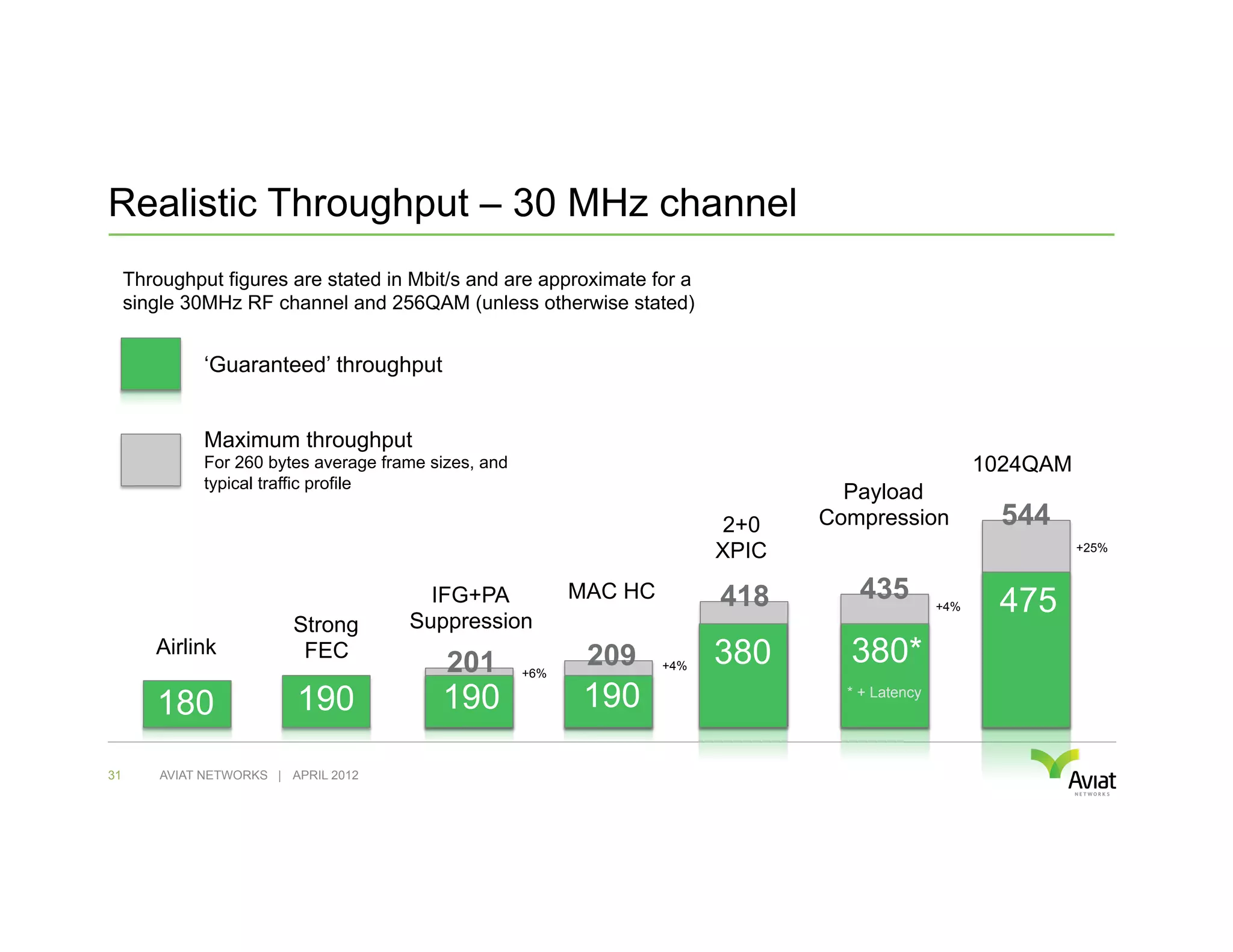
Realistic Throughput – 30 MHz channel
     Throughput figures are stated in Mbit/s and are approximate for a
     single 30MHz RF channel and 256QAM (unless otherwise stated)


               ‘Guaranteed’ throughput


               Maximum throughput
               For 260 bytes average frame sizes, and                                                     1024QAM
               typical traffic profile
                                                                                      Payload
                                                                             2+0    Compression             544
                                                                             XPIC                                   +25%


                                          IFG+PA              MAC HC         418       435          +4%    475
                           Strong       Suppression
        Airlink             FEC
                                             201        +6%
                                                               209     +4%
                                                                             380      380*
        180                190              190                190                    * + Latency


31       AVIAT NETWORKS | APRIL 2012
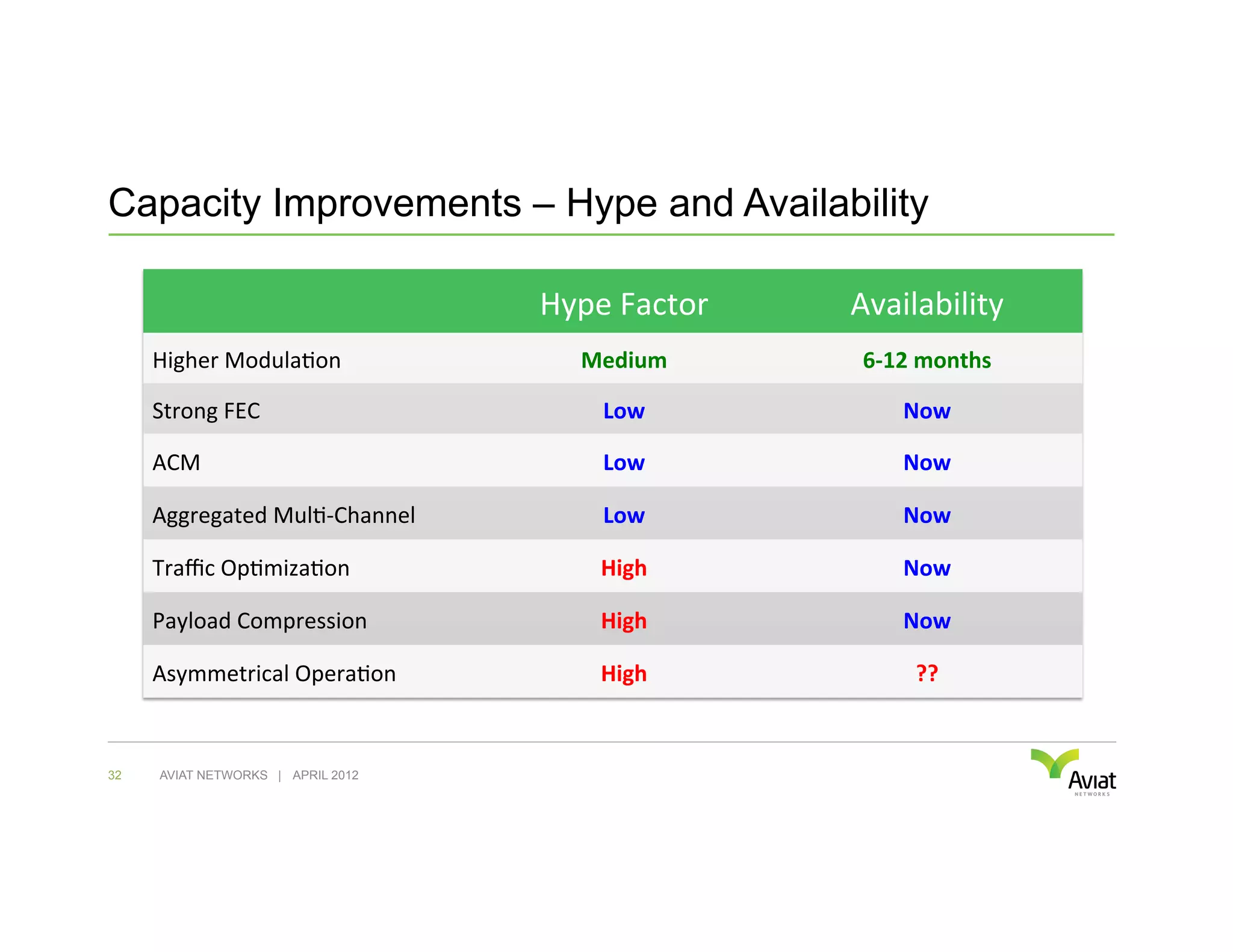
Capacity Improvements – Hype and Availability

                                        Hype	
  Factor	
     Availability	
  
     Higher	
  Modula6on	
                  Medium	
          6-­‐12	
  months	
  

     Strong	
  FEC	
                          Low	
                 Now	
  

     ACM	
                                    Low	
                 Now	
  

     Aggregated	
  Mul6-­‐Channel	
           Low	
                 Now	
  

     Traffic	
  Op6miza6on	
                    High	
                Now	
  

     Payload	
  Compression	
                 High	
                Now	
  

     Asymmetrical	
  Opera6on	
               High	
                 ??	


32    AVIAT NETWORKS | APRIL 2012
AVIATNETWORKS.COM

Improving Microwave Capacity

  • 1.
    AVIAT ADVANCED MICROWAVETECHNOLOGY SEMINAR IMPROVING MICROWAVE CAPACITY U N D E R S TA N D I N G T E C H N I Q U E S TO I M P R O V E T H R O U G H P U T 1
  • 2.
    microwave is just a big pipe you get out what you put in
  • 3.
    “I canna changethe laws o’ physics captain”
  • 4.
    How to UnderstandVendor Capacity Claims? •  It is getting increasingly harder to compare capacity claims from various vendors •  Multiple techniques are being employed to boost throughput figures •  We will attempt to explain the various techniques and how they impact capacity 4 AVIAT NETWORKS | APRIL 2012
  • 5.
    How can youget more data through the pipe? how do you get more data through the pipe? 5 AVIAT NETWORKS | NOVEMBER 2011
  • 6.
    Strategies for IncreasingMicrowave Capacities More  Spectral   More  Spectrum   More  “Effec5ve”   Efficiency   (More  Hz)   Throughput   (More  Bits  per  Hz)   (More  Data  per  Bit)   Technique   Technique   Technique   Higher  Modula6on  Levels   Wider  Channels   Header  Op6miza6on/   Suppression/Compression   Adap6ve  Modula6on   Mul6ple  channels  with  link   aggrega6on  (incl.  CCDP)   Payload  Compression   Reduced  FEC  Redundancy   Asymmetric  Opera6on   6 AVIAT NETWORKS | APRIL 2012
  • 7.
    get a biggerpipe! How Bigger get more data through the pipe? Get acan you Pipe! 7 AVIAT NETWORKS | NOVEMBER 2011
  • 8.
    Use Wider Channels 6 GHz 70-90 GHz 11 GHz 30 MHz 40 MHz 5 GHz 60 GHz 18 GHz 250 MHz 80 MHz 23 GHz 50 MHz 8 AVIAT NETWORKS | APRIL 2012
  • 9.
    use more efficientschemes How Bigger get more data through the pipe? Get acan you Pipe! to pack more data into the pipe 9 AVIAT NETWORKS | NOVEMBER 2011
  • 10.
    Increasing Modulation Level þ  Improves bits/Hz efficiency within the Modula6on   Bits/Symbol   Incremental   same channel size Level  (QAM)   Bits/s/Hz   Capacity  Gain   ☒  Diminishing capacity improvement with 4  (QPSK)   2   -­‐   every higher modulation step 8   3   50%   ☒  Much lower system gain - shorter hops, 16   4   33%   larger antennas 32   5   25%   ☒  Much higher sensitivity to interference – 64   6   20%   difficult link coordination, reduced link density 128   7   17%   ☒  Increased phase noise and linearity – 256   8   14%   increased design complexity cost 512   9   13%   þ  Should be deployed with ACM to offset 1024   10   11%   lower system gain 2048   11   10%   10 AVIAT NETWORKS | APRIL 2012
  • 11.
    Higher Modulation =More Capacity, but… 10% 45 110 Carrier to Interference Ratio (C/I), dB 15% 40 105 Capacity Increase 20% 35 100 System Gain, dB 25% 30 95 30% 25 90 35% 20 85 40% 15 80 45% 10 75 50% 5 70 55% 0 65 1024QAM 2048QAM 16QAM 32QAM 64QAM 128QAM 256QAM 512QAM 8QAM 11 AVIAT NETWORKS | APRIL 2012
  • 12.
    Applying Adaptive Modulation •  AM/ACM allows higher order modulations to be employed, but mitigate the adverse effects •  Modulation rate/capacity adapts to increase system gain when needed •  Fixed modulation links can be upgraded to ACM to: 1.  Increase link capacity 2.  Decrease antenna size, and so tower rental costs 3.  Increase link availability 4.  Or, a combination of 1+2+3 12 AVIAT NETWORKS | APRIL 2012
  • 13.
    Forward Error Correction(FEC) Typical Radio Frame NMS   PAYLOAD   FEC   FEC  bytes  enable  radio  to   Bytes  reserved  for  radio   correct  a  limited  number  of   link  and  network   bit  errors,  increasing   management  informa6on   receiver  performance   13 AVIAT NETWORKS | APRIL 2012
  • 14.
    Forward Error Correction Typical Radio Frame NMS   PAYLOAD   FEC   ‘Light’ FEC NMS   PAYLOAD   FEC   Less  FEC   Increased  Payload  =   =  Decreased   Higher  Throughput   System  Gain   14 AVIAT NETWORKS | APRIL 2012
  • 15.
    ‘Strong’ Forward ErrorCorrection Typical Radio Frame NMS   PAYLOAD   FEC   ‘Light’ FEC Decreased  Payload   More  FEC  =   NMS   PAYLOAD   FEC   =  Lower  Throughput   Beaer  System   Gain   ‘Strong’ FEC NMS   PAYLOAD   FEC   15 AVIAT NETWORKS | APRIL 2012
  • 16.
    use more thanone pipe Use more than one pipe 16 AVIAT NETWORKS | NOVEMBER 2011
  • 17.
    Link Aggregation usingIEEE 802.1AX •  The most common legacy link aggregation approach (originally defined in IEEE 802.3ad) •  802.1AX cannot dynamically redistribute traffic load for optimal utilization of available links Designed Supports for this this P1 P3 DPP1 RAC 60 RAC 60 DPP1 P3 P1 Module Module P2 P4 DAC GE3 DAC GE3 P4 P2 4+0 Link P3 P5 DPP2 RAC 60 RAC 60 DPP2 P5 P3 CCDP/XPIC LAG or P4 P3 DPP1 RAC 60 ACAP RAC 60 DPP1 P3 P4 Module Module P5 P4 DAC GE3 DAC GE3 P4 P5 P6 P5 DPP2 RAC 60 RAC 60 DPP2 P5 P6 Switch/Router Eclipse INU/INUe Eclipse INU/INUe Switch/Router 17 AVIAT NETWORKS | APRIL 2012
  • 18.
    Layer 1 LinkAggregation (L1 LA) •  Unique and Aviat patented radio link aggregation scheme designed to address limitations of the traditional 802.1AX approach •  Uniform load balancing even for ACM links and carriers of different capacities •  High utilization and low added overhead •  Carrier-grade convergence and recovery from individual link failures (<50 msec) Layer 2 (802.1AX) Domain L1LA Domain P1 P3 DPP1 RAC 60 RAC 60 DPP1 P3 P1 Module Module P2 P4 DAC GE3 DAC GE3 P4 P2 LAG LAG P3 P5 DPP2 RAC 60 RAC 60 DPP2 P5 P3 4+0 Link P4 P3 DPP1 RAC 60 RAC 60 DPP1 P3 P4 Module Module Stacking P5 P4 DAC GE3 DAC GE3 P4 P5 P6 P5 DPP2 RAC 60 RAC 60 DPP2 P5 P6 Switch/Router Eclipse INU/INUe Eclipse INU/INUe Switch/Router 18 AVIAT NETWORKS | APRIL 2012
  • 19.
    Comparing Link AggregationOptions LAG  802.1AX   L1  LA   Load  balancing  Effec6veness   Medium   High   Easy  capacity  expansion   Yes   Yes   Latency   High   Low   Adap6ve  to  RF   No   Yes   L1LA is the ideal solution for N+0 links 19 AVIAT NETWORKS | APRIL 2012
  • 20.
    only send thedata Only send the data that you need through the pipe that you need 20 AVIAT NETWORKS | NOVEMBER 2011 through the pipe
  • 21.
    Using Ethernet Optimization •  Using common Ethernet optimization and compression techniques: •  Ethernet Frame Suppression •  MAC Header Compression •  Multi-Layer Header Compression •  Payload Compression •  Send only needed data over the radio link. Suppress or compress everything else •  Asymmetric link operation 21 AVIAT NETWORKS | APRIL 2012
  • 22.
    Ethernet Frame HeaderOptimization •  Inter-frame Gap and Preamble Removal •  MAC Header Compression ! 22 AVIAT NETWORKS | APRIL 2012
  • 23.
    Throughput Improvement 23 AVIAT NETWORKS | APRIL 2012
  • 24.
    Header Suppression ThroughputImprovement IFG  &  Preamble     Standard  Frame   IFG  &  Preamble   Frame   &  MAC  header   Size   Frame   Frame   Frame   Mbps   Mbps   Increase   Mbps   Increase   Space   Space   Space   64   84   76.2   68   94.1   24%   58   110.3   45%   128   148   86.5   132   97.0   12%   122   104.9   21%   260   280   92.9   264   98.5   6%   254   102.4   10%   512   522   96.2   516   99.2   3%   506   101.2   5%   1518   1538   98.7   1522   99.7   1%   1512   100.4   2%   24 AVIAT NETWORKS | APRIL 2012
  • 25.
    Multi-Layer Header Compression •  AKA ‘Packet Throughput Boost’, ‘Enhanced Packet Compression’ ‘Layer 1/2/3/4 Header Compression’ or ‘Deep Ethernet header compression’ •  Adds compression of IPv4/v6 header address bytes •  Still highly dependent upon payload traffic type and frame size 25 AVIAT NETWORKS | APRIL 2012
  • 26.
    Payload Compression •  Some microwave vendors are employing common compression techniques •  Pros •  Replaces strings of repeated patterns of data •  Promises dramatic throughput improvement (2.5x), with no additional spectrum requirement •  Cons •  Improvement is not guaranteed nor predictable, since it is highly dependent on the traffic mix •  Increased link latency •  Most data traffic is already compressed •  Typical real-world improvement is minimal (~4%) •  Payload compression has not been generally adopted in the industry 26 AVIAT NETWORKS | APRIL 2012
  • 27.
    Asymmetric Link Operation •  Proposal to configure links with lower capacity upstream than downstream •  Assumes downstream traffic is much higher volume than upstream, and that backhaul links can be similarly dimensioned •  Claimed benefits are higher downstream speeds and frequency savings (upstream) 27 AVIAT NETWORKS | APRIL 2012
  • 28.
  • 29.
    Beware common tacticsto inflate throughput •  Present throughput figures based upon 64 byte frame When it comes to sizes only Microwave Capacity •  Assume that up to 100% (or a large proportion) of traffic is compressible •  Assume availability of very wide channels (80 MHz) •  Assume 2+0 co-channel operation on the same frequency assignment (using XPIC) •  Present half-duplex throughput figures •  Include non-payload overhead (NMS, FEC) •  Assume gains from other unproven techniques Test, using an industry standard benchmark - RFC 2544 29 AVIAT NETWORKS | APRIL 2012
  • 30.
    Best Case Throughput– 80 MHz channel 1024QAM Throughput figures are stated in Mbit/s and are approximate for a Payload 2500 single 80MHz RF channel and 256QAM (unless otherwise stated) Compression ‘Guaranteed’ throughput 2000 Maximum ‘Best Efforts’ throughput 2+0 64 byte frame size, ideal traffic profile XPIC 1040 IFG+PA MAC HC 900 Strong Suppression 720 720* Airlink FEC 450 520 * + Latency 340 360 360 360 30 AVIAT NETWORKS | APRIL 2012
  • 31.
    Realistic Throughput –30 MHz channel Throughput figures are stated in Mbit/s and are approximate for a single 30MHz RF channel and 256QAM (unless otherwise stated) ‘Guaranteed’ throughput Maximum throughput For 260 bytes average frame sizes, and 1024QAM typical traffic profile Payload 2+0 Compression 544 XPIC +25% IFG+PA MAC HC 418 435 +4% 475 Strong Suppression Airlink FEC 201 +6% 209 +4% 380 380* 180 190 190 190 * + Latency 31 AVIAT NETWORKS | APRIL 2012
  • 32.
    Capacity Improvements –Hype and Availability Hype  Factor   Availability   Higher  Modula6on   Medium   6-­‐12  months   Strong  FEC   Low   Now   ACM   Low   Now   Aggregated  Mul6-­‐Channel   Low   Now   Traffic  Op6miza6on   High   Now   Payload  Compression   High   Now   Asymmetrical  Opera6on   High   ??   32 AVIAT NETWORKS | APRIL 2012
  • 33.