DVB-T and DVB-T2
Comparison and Coverage
July 6, 2011
Copyright © 2015 GatesAir, Inc. All rights reserved.
Featuring
GatesAir’s
Rich Redmond
Chief Product Officer
Steve Rossiter
TV Applications Engineer
6-Jul-11
DVB-T and DVB-T2
Comparison and Coverage
With the growing interest in DVB-T2 as the first planned digital rollout, many customers
would like to understand not only the differences but the real world benefits that DVB-T2
can provide over a DVB-T system.
DVB-T & DVB-T2 standards are similar to each other as both use COFDM (Coded Orthogonal
Frequency Division Multiplex) modulation but DVB-T2 is distinguished by a number of
technical enhancements.
The primary requirements of DVB-T2 were to increase the data carrying capacity by up to
30% over DVB-T and also to improve the flexibility of operation and robustness of reception.
What are the main differences?
Are there real world examples?
1st. Forward Error Correction (FEC)
DVB-T2 uses LDPC (Low density parity-check) codes and BCH (Bose-Chaudhuri-
Hocquengham) to protect against high noise levels and interference.
DVB-T uses Convolutional coding and Reed-Solomon to protect against high noise levels
and interference.
LDPC and BCH does this more efficiently than Convolutional coding and Reed-Solomon.
DVB-T2 includes additional codes rates 3/5 and 4/5, and removed 7/8 code rate.
2nd. Modulation Modes
DVB-T2 has an additional mode: 256QAM.
The addition of 256 QAM allows for an increased number of bits per data cell. This and the
improved FEC (forward error correction) greatly improves the DVB-T2 capacity.
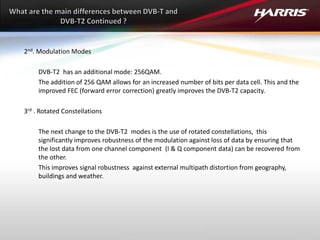
3rd . Rotated Constellations
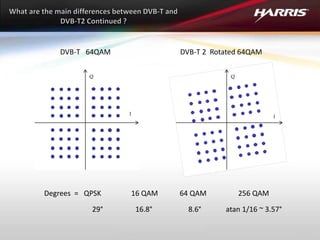
The next change to the DVB-T2 modes is the use of rotated constellations, this
significantly improves robustness of the modulation against loss of data by ensuring that
the lost data from one channel component (I & Q component data) can be recovered from
the other.
This improves signal robustness against external multipath distortion from geography,
buildings and weather.
DVB-T 64QAM DVB-T 2 Rotated 64QAM
Degrees = QPSK 16 QAM 64 QAM 256 QAM
29° 16.8° 8.6° atan 1/16 ~ 3.57°
Q
I
I
Q
4th. Guard Interval
DVB-T2 added three additional guard intervals
19/256 19/128 And 1/128
Additional Guard intervals add to the flexibility and helps maximize the data payload of
DVB-T2. (note a shorter guard interval , such as 1/128, increases payload but decreases
maximum distance in SFN mode)
5th. DFT (Discrete Fourier Transform) Size (also known as FFT , Fast Fourier Transform)
DVB-T used 2k & 8k sizes
DVB-T2 has additional flexibility with 1k, 2k, 4k, 8k, 16k & 32k (additional FFT’s of 16k and
32k significantly increase payloads)
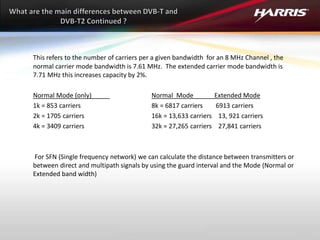
This refers to the number of carriers per a given bandwidth for an 8 MHz Channel , the
normal carrier mode bandwidth is 7.61 MHz. The extended carrier mode bandwidth is
7.71 MHz this increases capacity by 2%.
Normal Mode (only) Normal Mode Extended Mode
1k = 853 carriers 8k = 6817 carriers 6913 carriers
2k = 1705 carriers 16k = 13,633 carriers 13, 921 carriers
4k = 3409 carriers 32k = 27,265 carriers 27,841 carriers
For SFN (Single frequency network) we can calculate the distance between transmitters or
between direct and multipath signals by using the guard interval and the Mode (Normal or
Extended band width)
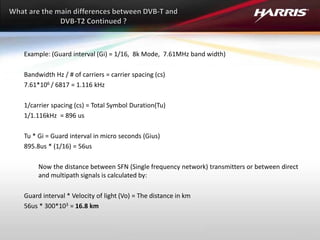
Example: (Guard interval (Gi) = 1/16, 8k Mode, 7.61MHz band width)
Bandwidth Hz / # of carriers = carrier spacing (cs)
7.61*106 / 6817 = 1.116 kHz
1/carrier spacing (cs) = Total Symbol Duration(Tu)
1/1.116kHz = 896 us
Tu * Gi = Guard interval in micro seconds (Gius)
895.8us * (1/16) = 56us
Now the distance between SFN (Single frequency network) transmitters or between direct
and multipath signals is calculated by:
Guard interval * Velocity of light (Vo) = The distance in km
56us * 300*103 = 16.8 km
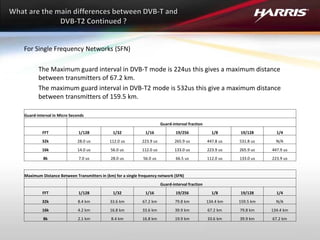
For Single Frequency Networks (SFN)
The Maximum guard interval in DVB-T mode is 224us this gives a maximum distance
between transmitters of 67.2 km.
The maximum guard interval in DVB-T2 mode is 532us this give a maximum distance
between transmitters of 159.5 km.
Guard-interval in Micro Seconds
Guard-interval fraction
FFT 1/128 1/32 1/16 19/256 1/8 19/128 1/4
32k 28.0 us 112.0 us 223.9 us 265.9 us 447.8 us 531.8 us N/A
16k 14.0 us 56.0 us 112.0 us 133.0 us 223.9 us 265.9 us 447.9 us
8k 7.0 us 28.0 us 56.0 us 66.5 us 112.0 us 133.0 us 223.9 us
Maximum Distance Between Transmitters in (km) for a single frequency network (SFN)
Guard-interval fraction
FFT 1/128 1/32 1/16 19/256 1/8 19/128 1/4
32k 8.4 km 33.6 km 67.2 km 79.8 km 134.4 km 159.5 km N/A
16k 4.2 km 16.8 km 33.6 km 39.9 km 67.2 km 79.8 km 134.4 km
8k 2.1 km 8.4 km 16.8 km 19.9 km 33.6 km 39.9 km 67.2 km
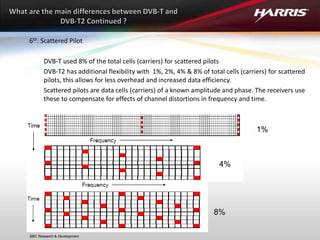
6th. Scattered Pilot
DVB-T used 8% of the total cells (carriers) for scattered pilots
DVB-T2 has additional flexibility with 1%, 2%, 4% & 8% of total cells (carriers) for scattered
pilots, this allows for less overhead and increased data efficiency.
Scattered pilots are data cells (carriers) of a known amplitude and phase. The receivers use
these to compensate for effects of channel distortions in frequency and time.
1%
4%
8%
BBC Research & Development
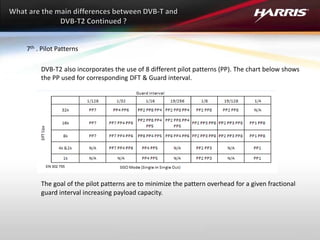
7th . Pilot Patterns
DVB-T2 also incorporates the use of 8 different pilot patterns (PP). The chart below shows
the PP used for corresponding DFT & Guard interval.
The goal of the pilot patterns are to minimize the pattern overhead for a given fractional
guard interval increasing payload capacity.
EN 302 755
8th . Continual Pilots
DVB-T uses 2.6% of the total
DBV-T2 uses 0.35% of the total, increasing payload capacity.
9th Physical Layer Pipes
DVB-T2 uses single and multiple physical layer pipes (PLP). A PLP contains a single
transport stream and all services in a single transport stream are in a single PLP. Multiple
PLPs still have one transport stream per PLP, the advantage is each PLP can have different
modulations and coding modes.
PLP0 PLP1
256 QAM 64 QAM
2/3 code rate 1/2 code rate
The higher the bit rate the higher the carrier to noise ratio the less robust the signal
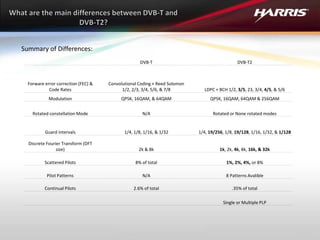
Summary of Differences:
DVB-T DVB-T2
Forware error correction (FEC) &
Code Rates
Convolutional Coding + Reed Solomon
1/2, 2/3, 3/4, 5/6, & 7/8 LDPC + BCH 1/2, 3/5, 23, 3/4, 4/5, & 5/6
Modulation QPSK, 16QAM, & 64QAM QPSK, 16QAM, 64QAM & 256QAM
Rotated constellation Mode N/A Rotated or None rotated modes
Guard intervals 1/4, 1/8, 1/16, & 1/32 1/4, 19/256, 1/8, 19/128, 1/16, 1/32, & 1/128
Discrete Fourier Transform (DFT
size) 2k & 8k 1k, 2k, 4k, 8k, 16k, & 32k
Scattered Pilots 8% of total 1%, 2%, 4%, or 8%
Pilot Patterns N/A 8 Patterns Avalible
Continual Pilots 2.6% of total .35% of total
Single or Multiple PLP
Capacity (Bit Rate Mbps)
The maximum capacity of DVB-T is approximately 31.67 Mbps
The maximum capacity of DVB-T2 is approximately 50.34 Mbps
CNR (Carrier to Noise Ratio)
The carrier to noise ratio is controlled by the modulation mode and the code rate.
With DVB-T2 there has been significant improvements in CNR.
One point to remember with DVB-T and DVB-T2 the lower the transport stream bit rate
the lower the CNR, this equals a more robust signal. As you increase the transport stream
bit rate the CNR increases. This equals a less robust single.
This means a lower quality signal goes father than a higher quality signal.
Compared to DVB-T, DVB-T2 offers a higher transport stream bit rate with a comparable
CNR.
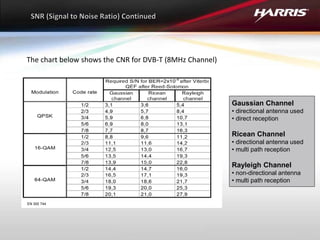
The chart below shows the CNR for DVB-T (8MHz Channel)
Gaussian Channel
• directional antenna used
• direct reception
Ricean Channel
• directional antenna used
• multi path reception
Rayleigh Channel
• non-directional antenna
• multi path reception
EN 300 744
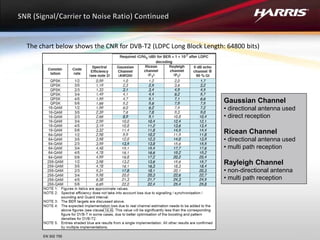
The chart below shows the CNR for DVB-T2 (LDPC Long Block Length: 64800 bits)
Gaussian Channel
• directional antenna used
• direct reception
Ricean Channel
• directional antenna used
• multi path reception
Rayleigh Channel
• non-directional antenna
• multi path reception
EN 302 755
EN 302 755
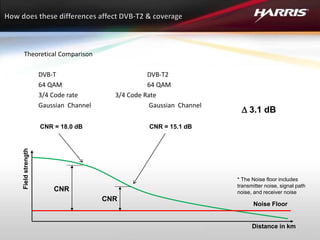
Theoretical Comparison
DVB-T DVB-T2
64 QAM 64 QAM
3/4 Code rate 3/4 Code Rate
Gaussian Channel Gaussian Channel
Distance in km
Field
strength
CNR
CNR
Noise Floor
* The Noise floor includes
transmitter noise, signal path
noise, and receiver noise
∆ 3.1 dB
CNR = 18.0 dB CNR = 15.1 dB
Harris conducted field strength measurements of DVB-T & DVB-T2
This test was conducted in Karaganda, Kazakhstan by Harris Corporation in cooperation
with KATZELRADIO of Kazakhstan.
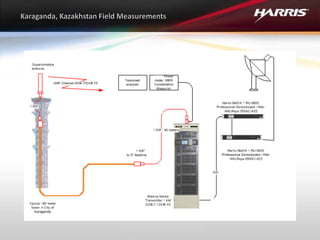
The measurement were taken using a Harris 1kW UAX transmitter with dual exciters one
with DVB-T one with DVB-T2, the transmit antenna was a Omni directional pattern
Superturnstile antenna with a gain of approximately 9.1dBd at 183 meters above ground
level.
The test was conducted at channel 49 (698 MHz), with an ERP of approximately 4.53 kW
average.
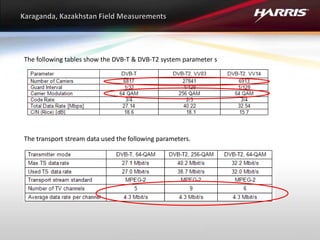
The following tables show the DVB-T & DVB-T2 system parameter s
The transport stream data used the following parameters.
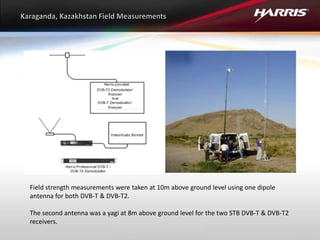
Field strength measurements were taken at 10m above ground level using one dipole
antenna for both DVB-T & DVB-T2.
The second antenna was a yagi at 8m above ground level for the two STB DVB-T & DVB-T2
receivers.
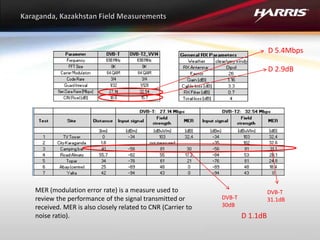
MER (modulation error rate) is a measure used to
review the performance of the signal transmitted or
received. MER is also closely related to CNR (Carrier to
noise ratio).
DVB-T
30dB
DVB-T
31.1dB
D 5.4Mbps
D 2.9dB
D 1.1dB
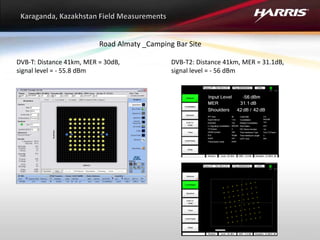
DVB-T: Distance 41km, MER = 30dB,
signal level = - 55.8 dBm
Road Almaty _Camping Bar Site
DVB-T2: Distance 41km, MER = 31.1dB,
signal level = - 56 dBm
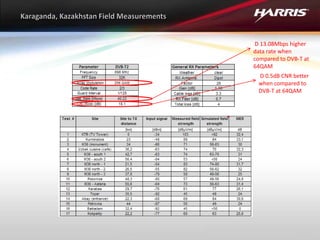
D 0.5dB CNR better
when compared to
DVB-T at 64QAM
D 13.08Mbps higher
data rate when
compared to DVB-T at
64QAM
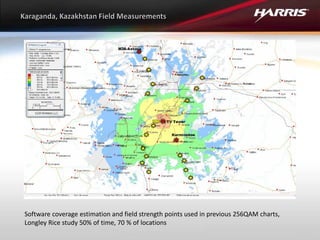
Software coverage estimation and field strength points used in previous 256QAM charts,
Longley Rice study 50% of time, 70 % of locations
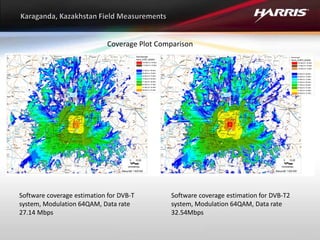
Software coverage estimation for DVB-T
system, Modulation 64QAM, Data rate
27.14 Mbps
Software coverage estimation for DVB-T2
system, Modulation 64QAM, Data rate
32.54Mbps
Coverage Plot Comparison
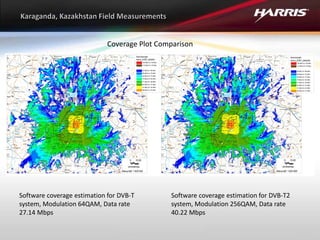
Software coverage estimation for DVB-T
system, Modulation 64QAM, Data rate
27.14 Mbps
Software coverage estimation for DVB-T2
system, Modulation 256QAM, Data rate
40.22 Mbps
Coverage Plot Comparison
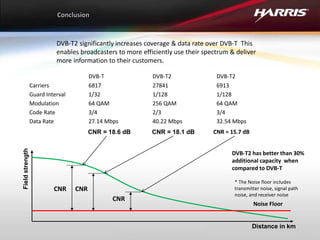
DVB-T DVB-T2 DVB-T2
Carriers 6817 27841 6913
Guard Interval 1/32 1/128 1/128
Modulation 64 QAM 256 QAM 64 QAM
Code Rate 3/4 2/3 3/4
Data Rate 27.14 Mbps 40.22 Mbps 32.54 Mbps
Distance in km
Field
strength
CNR
CNR
Noise Floor
* The Noise floor includes
transmitter noise, signal path
noise, and receiver noise
CNR = 18.6 dB CNR = 18.1 dB CNR = 15.7 dB
CNR
DVB-T2 significantly increases coverage & data rate over DVB-T This
enables broadcasters to more efficiently use their spectrum & deliver
more information to their customers.
DVB-T2 has better than 30%
additional capacity when
compared to DVB-T
DVB-T and DVB-T2 Comparison and Coverage

DVB-T and DVB-T2 Comparison and Coverage

  • 1.
    DVB-T and DVB-T2 Comparisonand Coverage July 6, 2011 Copyright © 2015 GatesAir, Inc. All rights reserved. Featuring GatesAir’s Rich Redmond Chief Product Officer Steve Rossiter TV Applications Engineer
  • 2.
  • 3.
    With the growinginterest in DVB-T2 as the first planned digital rollout, many customers would like to understand not only the differences but the real world benefits that DVB-T2 can provide over a DVB-T system. DVB-T & DVB-T2 standards are similar to each other as both use COFDM (Coded Orthogonal Frequency Division Multiplex) modulation but DVB-T2 is distinguished by a number of technical enhancements. The primary requirements of DVB-T2 were to increase the data carrying capacity by up to 30% over DVB-T and also to improve the flexibility of operation and robustness of reception. What are the main differences? Are there real world examples?
  • 4.
    1st. Forward ErrorCorrection (FEC) DVB-T2 uses LDPC (Low density parity-check) codes and BCH (Bose-Chaudhuri- Hocquengham) to protect against high noise levels and interference. DVB-T uses Convolutional coding and Reed-Solomon to protect against high noise levels and interference. LDPC and BCH does this more efficiently than Convolutional coding and Reed-Solomon. DVB-T2 includes additional codes rates 3/5 and 4/5, and removed 7/8 code rate.
  • 5.
    2nd. Modulation Modes DVB-T2has an additional mode: 256QAM. The addition of 256 QAM allows for an increased number of bits per data cell. This and the improved FEC (forward error correction) greatly improves the DVB-T2 capacity. 3rd . Rotated Constellations The next change to the DVB-T2 modes is the use of rotated constellations, this significantly improves robustness of the modulation against loss of data by ensuring that the lost data from one channel component (I & Q component data) can be recovered from the other. This improves signal robustness against external multipath distortion from geography, buildings and weather.
  • 6.
    DVB-T 64QAM DVB-T2 Rotated 64QAM Degrees = QPSK 16 QAM 64 QAM 256 QAM 29° 16.8° 8.6° atan 1/16 ~ 3.57° Q I I Q
  • 7.
    4th. Guard Interval DVB-T2added three additional guard intervals 19/256 19/128 And 1/128 Additional Guard intervals add to the flexibility and helps maximize the data payload of DVB-T2. (note a shorter guard interval , such as 1/128, increases payload but decreases maximum distance in SFN mode) 5th. DFT (Discrete Fourier Transform) Size (also known as FFT , Fast Fourier Transform) DVB-T used 2k & 8k sizes DVB-T2 has additional flexibility with 1k, 2k, 4k, 8k, 16k & 32k (additional FFT’s of 16k and 32k significantly increase payloads)
  • 8.
    This refers tothe number of carriers per a given bandwidth for an 8 MHz Channel , the normal carrier mode bandwidth is 7.61 MHz. The extended carrier mode bandwidth is 7.71 MHz this increases capacity by 2%. Normal Mode (only) Normal Mode Extended Mode 1k = 853 carriers 8k = 6817 carriers 6913 carriers 2k = 1705 carriers 16k = 13,633 carriers 13, 921 carriers 4k = 3409 carriers 32k = 27,265 carriers 27,841 carriers For SFN (Single frequency network) we can calculate the distance between transmitters or between direct and multipath signals by using the guard interval and the Mode (Normal or Extended band width)
  • 9.
    Example: (Guard interval(Gi) = 1/16, 8k Mode, 7.61MHz band width) Bandwidth Hz / # of carriers = carrier spacing (cs) 7.61*106 / 6817 = 1.116 kHz 1/carrier spacing (cs) = Total Symbol Duration(Tu) 1/1.116kHz = 896 us Tu * Gi = Guard interval in micro seconds (Gius) 895.8us * (1/16) = 56us Now the distance between SFN (Single frequency network) transmitters or between direct and multipath signals is calculated by: Guard interval * Velocity of light (Vo) = The distance in km 56us * 300*103 = 16.8 km
  • 10.
    For Single FrequencyNetworks (SFN) The Maximum guard interval in DVB-T mode is 224us this gives a maximum distance between transmitters of 67.2 km. The maximum guard interval in DVB-T2 mode is 532us this give a maximum distance between transmitters of 159.5 km. Guard-interval in Micro Seconds Guard-interval fraction FFT 1/128 1/32 1/16 19/256 1/8 19/128 1/4 32k 28.0 us 112.0 us 223.9 us 265.9 us 447.8 us 531.8 us N/A 16k 14.0 us 56.0 us 112.0 us 133.0 us 223.9 us 265.9 us 447.9 us 8k 7.0 us 28.0 us 56.0 us 66.5 us 112.0 us 133.0 us 223.9 us Maximum Distance Between Transmitters in (km) for a single frequency network (SFN) Guard-interval fraction FFT 1/128 1/32 1/16 19/256 1/8 19/128 1/4 32k 8.4 km 33.6 km 67.2 km 79.8 km 134.4 km 159.5 km N/A 16k 4.2 km 16.8 km 33.6 km 39.9 km 67.2 km 79.8 km 134.4 km 8k 2.1 km 8.4 km 16.8 km 19.9 km 33.6 km 39.9 km 67.2 km
  • 11.
    6th. Scattered Pilot DVB-Tused 8% of the total cells (carriers) for scattered pilots DVB-T2 has additional flexibility with 1%, 2%, 4% & 8% of total cells (carriers) for scattered pilots, this allows for less overhead and increased data efficiency. Scattered pilots are data cells (carriers) of a known amplitude and phase. The receivers use these to compensate for effects of channel distortions in frequency and time. 1% 4% 8% BBC Research & Development
  • 12.
    7th . PilotPatterns DVB-T2 also incorporates the use of 8 different pilot patterns (PP). The chart below shows the PP used for corresponding DFT & Guard interval. The goal of the pilot patterns are to minimize the pattern overhead for a given fractional guard interval increasing payload capacity. EN 302 755
  • 13.
    8th . ContinualPilots DVB-T uses 2.6% of the total DBV-T2 uses 0.35% of the total, increasing payload capacity. 9th Physical Layer Pipes DVB-T2 uses single and multiple physical layer pipes (PLP). A PLP contains a single transport stream and all services in a single transport stream are in a single PLP. Multiple PLPs still have one transport stream per PLP, the advantage is each PLP can have different modulations and coding modes. PLP0 PLP1 256 QAM 64 QAM 2/3 code rate 1/2 code rate The higher the bit rate the higher the carrier to noise ratio the less robust the signal
  • 14.
    Summary of Differences: DVB-TDVB-T2 Forware error correction (FEC) & Code Rates Convolutional Coding + Reed Solomon 1/2, 2/3, 3/4, 5/6, & 7/8 LDPC + BCH 1/2, 3/5, 23, 3/4, 4/5, & 5/6 Modulation QPSK, 16QAM, & 64QAM QPSK, 16QAM, 64QAM & 256QAM Rotated constellation Mode N/A Rotated or None rotated modes Guard intervals 1/4, 1/8, 1/16, & 1/32 1/4, 19/256, 1/8, 19/128, 1/16, 1/32, & 1/128 Discrete Fourier Transform (DFT size) 2k & 8k 1k, 2k, 4k, 8k, 16k, & 32k Scattered Pilots 8% of total 1%, 2%, 4%, or 8% Pilot Patterns N/A 8 Patterns Avalible Continual Pilots 2.6% of total .35% of total Single or Multiple PLP
  • 15.
    Capacity (Bit RateMbps) The maximum capacity of DVB-T is approximately 31.67 Mbps The maximum capacity of DVB-T2 is approximately 50.34 Mbps CNR (Carrier to Noise Ratio) The carrier to noise ratio is controlled by the modulation mode and the code rate. With DVB-T2 there has been significant improvements in CNR. One point to remember with DVB-T and DVB-T2 the lower the transport stream bit rate the lower the CNR, this equals a more robust signal. As you increase the transport stream bit rate the CNR increases. This equals a less robust single. This means a lower quality signal goes father than a higher quality signal. Compared to DVB-T, DVB-T2 offers a higher transport stream bit rate with a comparable CNR.
  • 16.
    The chart belowshows the CNR for DVB-T (8MHz Channel) Gaussian Channel • directional antenna used • direct reception Ricean Channel • directional antenna used • multi path reception Rayleigh Channel • non-directional antenna • multi path reception EN 300 744
  • 17.
    The chart belowshows the CNR for DVB-T2 (LDPC Long Block Length: 64800 bits) Gaussian Channel • directional antenna used • direct reception Ricean Channel • directional antenna used • multi path reception Rayleigh Channel • non-directional antenna • multi path reception EN 302 755 EN 302 755
  • 18.
    Theoretical Comparison DVB-T DVB-T2 64QAM 64 QAM 3/4 Code rate 3/4 Code Rate Gaussian Channel Gaussian Channel Distance in km Field strength CNR CNR Noise Floor * The Noise floor includes transmitter noise, signal path noise, and receiver noise ∆ 3.1 dB CNR = 18.0 dB CNR = 15.1 dB
  • 19.
    Harris conducted fieldstrength measurements of DVB-T & DVB-T2 This test was conducted in Karaganda, Kazakhstan by Harris Corporation in cooperation with KATZELRADIO of Kazakhstan. The measurement were taken using a Harris 1kW UAX transmitter with dual exciters one with DVB-T one with DVB-T2, the transmit antenna was a Omni directional pattern Superturnstile antenna with a gain of approximately 9.1dBd at 183 meters above ground level. The test was conducted at channel 49 (698 MHz), with an ERP of approximately 4.53 kW average.
  • 20.
    The following tablesshow the DVB-T & DVB-T2 system parameter s The transport stream data used the following parameters.
  • 22.
    Field strength measurementswere taken at 10m above ground level using one dipole antenna for both DVB-T & DVB-T2. The second antenna was a yagi at 8m above ground level for the two STB DVB-T & DVB-T2 receivers.
  • 23.
    MER (modulation errorrate) is a measure used to review the performance of the signal transmitted or received. MER is also closely related to CNR (Carrier to noise ratio). DVB-T 30dB DVB-T 31.1dB D 5.4Mbps D 2.9dB D 1.1dB
  • 24.
    DVB-T: Distance 41km,MER = 30dB, signal level = - 55.8 dBm Road Almaty _Camping Bar Site DVB-T2: Distance 41km, MER = 31.1dB, signal level = - 56 dBm
  • 25.
    D 0.5dB CNRbetter when compared to DVB-T at 64QAM D 13.08Mbps higher data rate when compared to DVB-T at 64QAM
  • 26.
    Software coverage estimationand field strength points used in previous 256QAM charts, Longley Rice study 50% of time, 70 % of locations
  • 27.
    Software coverage estimationfor DVB-T system, Modulation 64QAM, Data rate 27.14 Mbps Software coverage estimation for DVB-T2 system, Modulation 64QAM, Data rate 32.54Mbps Coverage Plot Comparison
  • 28.
    Software coverage estimationfor DVB-T system, Modulation 64QAM, Data rate 27.14 Mbps Software coverage estimation for DVB-T2 system, Modulation 256QAM, Data rate 40.22 Mbps Coverage Plot Comparison
  • 29.
    DVB-T DVB-T2 DVB-T2 Carriers6817 27841 6913 Guard Interval 1/32 1/128 1/128 Modulation 64 QAM 256 QAM 64 QAM Code Rate 3/4 2/3 3/4 Data Rate 27.14 Mbps 40.22 Mbps 32.54 Mbps Distance in km Field strength CNR CNR Noise Floor * The Noise floor includes transmitter noise, signal path noise, and receiver noise CNR = 18.6 dB CNR = 18.1 dB CNR = 15.7 dB CNR DVB-T2 significantly increases coverage & data rate over DVB-T This enables broadcasters to more efficiently use their spectrum & deliver more information to their customers. DVB-T2 has better than 30% additional capacity when compared to DVB-T