WELCOME
SYSTEM ORIENTED
ARCHITECTURE(SOA)
TOPICS
SOA INTRODUCTION
SOA DEFINITION
SOA ARCHITECUTRE
SOA SERVICES
SOA CONNECTIONS
SOA USING JAVA WEB SERVICES
SOA IN COMPUTING
SOA REQUIREMENTS
SOA PRINCIPLES
SOA ARCHITECTURAL PRINCIPLES
SOA IMPLEMENTATION
WHAT IS CLOUD COMPUTING IN SOA
SOA AND TRADITIONAL ARCHITECTURE DIAGRAM
SOA LIFE CYCLE
SOME OF THE RELATED EXAMPLES OF SOA
SOA Introduction

•The combination of Web Services and SOAs resolves
the issues of CORBA and DCOM approaches to SOAs.

• Now Web services have removed another barrier by
allowing applications to interconnect in an object-
model-neutral way.

•For example, using a simple XML-based messaging
scheme, Java applications can invoke Microsoft .NET
applications or CORBA-compliant, or even
COBOL, applications
                                                HOME
A service-oriented architecture is essentially a collection of services.
These services communicate with each other.

The communication can involve either simple data passing or it could
involve two or more services coordinating some activity. Some means
of connecting services to each other is needed.

Service-oriented architectures are not a new thing. The first service-
oriented architecture for many people in the past was with the use
DCOM or Object Request Brokers (ORBs) based on the CORBA
specification


                                                                   HOME
SOA ARCHITECTURE

•Service Oriented Architecture is an umbrella term very similar to
that other umbrella term, “web services”.

• SOA refers more to how these web services interact, however, in
a system.

• Below is a diagram I’ve knocked up which shows in a very crude
fashion the difference between traditional models and SOA.


                                                              NEXT
HOME
SOA SERVICES
 If a service-oriented architecture is to be effective, we need a clear
 understanding of the term service.

  A service is a function that is well-defined, self-contained, and does
 not depend on the context or state of other services


                                                                      HOME
SOA CONNECTIONS

◙The technology of Web services (new window) is the most likely
connection technology of service-oriented architectures.

◙Web services essentially use XML (new window) to create


                                                                  NEXT
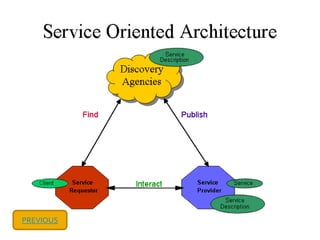
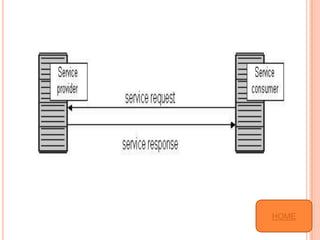
◙The following figure illustrates a basic service-oriented
architecture. It shows a service consumer at the right sending a
service request message to a service provider at the left.

◙ The service provider returns a response message to the
service consumer.

◙ The request and subsequent response connections are
defined in some way that is understandable to both the service
consumer and service provider.

◙A service provider can also be a service consumer.


                                                                   NEXT
HOME
◙   Java became a powerful development platform for Service-Oriented
    Architecture (SOA) in 2006. Java EE 5, released in May
    2006, significantly enhanced the power and usability of the Web
    Services capabilities on the application server.

◙   Then Java SE 6, released in December 2006, incorporated the
    majority of those capabilities into the standard edition of the Java
    programming language.


                                                                NEXT
◙Because robust Web Services technology is the foundation for
implementing SOA, Java now provides the tools modern enterprises
require to integrate their Java applications into SOA infrastructures.

◙Of course, Java has had basic Web Services capabilities for some time.
JAX-RPC 1.0 was released in June 2002. J2EE 1.4, finalized in
November 2003, included JAX-RPC 1.1.


                                                              HOME
SOA IN COMPUTING


In computing, service-oriented architecture (SOA) provides a
set of principles of governing concepts used during phases of
systems development and integration.

Such an architecture will package functionality as interoperable
services: functions provided as a service are available to be used
from systems created by other organizations.

 A system implemented using the theory contained in this
article is called a Service Oriented Architecture implementation


                                                              NEXT
It is an attempt to develop yet another means for applications to
exchange data.

Service-orientation requires loose coupling of services with
operating systems, and other technologies that underlie
applications.

SOA separates functions into distinct units, or services, which
developers make accessible over a network in order that users
can combine and reuse them in the production of applications.

 These services communicate with each other by passing data
from one service to another, or by coordinating an activity
between two or more services.


                                                                HOME
Requirements


In order to efficiently use a SOA, one must[citation needed] meet
the following requirements:

Interoperability between different systems and programming
languages provides the basis for integration between applications on
different platforms through a communication protocol.

One example of such communication is based on the concept of
messages.

 Using messages across defined message channels decreases the
complexity of the end application, thereby allowing the developer of
the application to focus on true application functionality instead of
the intricate needs of a communication protocol.

                                                                     NEXT
Desire to create a federation of resources. Establish and maintain
data flow to a federated data warehouse.

This allows new functionality developed to reference a common
business format for each data element.


                                                                 HOME
Principles


The following guiding principles define the ground rules for
development, maintenance, and usage of the SOA:

Reuse, granularity, modularity, composability,
componentization and interoperability

Standards compliance (both common and industry-specific)

Services identification and categorization, provisioning and
delivery, and monitoring and tracking
                                                      HOME
SOA ARCHITECTURAL PRINCIPALS

oThe following specific architectural principles for design and service
definition focus on specific themes that influence the intrinsic behaviour
of a system and the style of its design:

oService encapsulation – Many web services are consolidated to be used
under the SOA. Often such services were not planned to be under SOA.

oService loose coupling – Services maintain a relationship that
minimizes dependencies and only requires that they maintain an
awareness of each other

oService contract – Services adhere to a communications agreement, as
defined collectively by one or more service description documents


                                                                       NEXT
oService composability – Collections of services can be
coordinated and assembled to form composite services

oService autonomy – Services have control over the logic they
encapsulate

oService optimization – All else equal, high-quality services are
generally considered preferable to low-quality ones

oService discoverability – Services are designed to be outwardly
descriptive so that they can be found and assessed via available
discovery mechanisms


                                                                    HOME
oService reusability – Logic is divided into services with
the intention of promoting reuse

oService Relevance – Functionality is presented at a
granularity recognized by the user as a meaningful service

oService abstraction – Beyond what is described in the
service contract, services hide logic from the outside
world
SOA IMPLEMENTATION

»The following references provide additional considerations for
defining a SOA implementation:

»SOA Reference Architecture provides a working design of an
enterprise-wide SOA implementation with detailed architecture
diagrams, component descriptions, detailed requirements, design
patterns, opinions about standards, patterns on regulation
compliance, standards templates etc.

»Life cycle management SOA Practitioners Guide Part 3:
Introduction to Services Lifecycle introduces the Services Lifecycle
and provides a detailed process for services management though
the service lifecycle, from inception to retirement or repurposing of
the services. It also contains an appendix that includes organization
and governance best practices, templates, comments on key SOA
standards, and recommended links for more information
                                                            HOME
What is cloud computing in SOA?
        This isn’t another quick-start guide to cloud computing and
      Service-Oriented Architecture (though you can follow that link to
      get to one); it’s an investigation into what people are searching for
      on Google.

        So what are the top terms for Cloud computing? It’s no surprise
      that “what is cloud computing?” is near the top of the list. Braving
      Google’s wrath by my apparent keyword spamming, here they are:

       cloud computing
       ibm cloud computing
       what is cloud computing
       microsoft cloud computing


                                                                   HOME
TRADITIONAL ARCHITECTURE DIAGRAM
AND SOA DIAGRAM


                               HOME
SOA LIFE CYCLE

  After establishing an architecture baseline based on the SOA reference
architecture, practitioners should review the services lifecycle.

  This section briefly describes the service lifecycle and identifies the
actors, potential tools, and artifacts associated with each stage of its
stages.

  This document does not cover all the cultural, governance, and
organizations changes required to make SOA a success; instead, it focuses
on defining best practices for the services lifecycle.

  The services lifecycle is part of the execution stage in the SOA lifecycle
diagram below.
                                                                      NEXT
HOME
SOME OF THE REALTED EXAMPLES OF
SOA


 EXAMPLE OF SOA DERIVATIVE PATTERNS PEER TO PEER

 EXAMPLE OF SOA

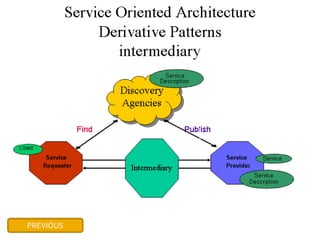
 EXAMPLE OF SOA DERIVATIVE PATTERNS INTERMEDIARY

 EXAMPLE OF SOA DERIVATIVE PATTERNS ONE WAY MESSAGE


                                                      HOME
PREVIOUS
PREVIOUS
PREVIOUS
PREVIOUS   END
ANY QUERIES?
THANK YOU FOR
YOUR PRESENCE
PRESENTATION
DONE BY
ALLU LOUSINA
OF
MCA FINAL YEAR
ROLL NO-13808045

Lousina

  • 1.
  • 2.
  • 3.
    TOPICS SOA INTRODUCTION SOA DEFINITION SOAARCHITECUTRE SOA SERVICES SOA CONNECTIONS SOA USING JAVA WEB SERVICES SOA IN COMPUTING SOA REQUIREMENTS SOA PRINCIPLES SOA ARCHITECTURAL PRINCIPLES SOA IMPLEMENTATION WHAT IS CLOUD COMPUTING IN SOA SOA AND TRADITIONAL ARCHITECTURE DIAGRAM SOA LIFE CYCLE SOME OF THE RELATED EXAMPLES OF SOA
  • 4.
    SOA Introduction •The combinationof Web Services and SOAs resolves the issues of CORBA and DCOM approaches to SOAs. • Now Web services have removed another barrier by allowing applications to interconnect in an object- model-neutral way. •For example, using a simple XML-based messaging scheme, Java applications can invoke Microsoft .NET applications or CORBA-compliant, or even COBOL, applications HOME
  • 5.
    A service-oriented architectureis essentially a collection of services. These services communicate with each other. The communication can involve either simple data passing or it could involve two or more services coordinating some activity. Some means of connecting services to each other is needed. Service-oriented architectures are not a new thing. The first service- oriented architecture for many people in the past was with the use DCOM or Object Request Brokers (ORBs) based on the CORBA specification HOME
  • 6.
    SOA ARCHITECTURE •Service OrientedArchitecture is an umbrella term very similar to that other umbrella term, “web services”. • SOA refers more to how these web services interact, however, in a system. • Below is a diagram I’ve knocked up which shows in a very crude fashion the difference between traditional models and SOA. NEXT
  • 7.
  • 8.
    SOA SERVICES Ifa service-oriented architecture is to be effective, we need a clear understanding of the term service.  A service is a function that is well-defined, self-contained, and does not depend on the context or state of other services HOME
  • 9.
    SOA CONNECTIONS ◙The technologyof Web services (new window) is the most likely connection technology of service-oriented architectures. ◙Web services essentially use XML (new window) to create NEXT
  • 10.
    ◙The following figureillustrates a basic service-oriented architecture. It shows a service consumer at the right sending a service request message to a service provider at the left. ◙ The service provider returns a response message to the service consumer. ◙ The request and subsequent response connections are defined in some way that is understandable to both the service consumer and service provider. ◙A service provider can also be a service consumer. NEXT
  • 11.
  • 12.
    Java became a powerful development platform for Service-Oriented Architecture (SOA) in 2006. Java EE 5, released in May 2006, significantly enhanced the power and usability of the Web Services capabilities on the application server. ◙ Then Java SE 6, released in December 2006, incorporated the majority of those capabilities into the standard edition of the Java programming language. NEXT
  • 13.
    ◙Because robust WebServices technology is the foundation for implementing SOA, Java now provides the tools modern enterprises require to integrate their Java applications into SOA infrastructures. ◙Of course, Java has had basic Web Services capabilities for some time. JAX-RPC 1.0 was released in June 2002. J2EE 1.4, finalized in November 2003, included JAX-RPC 1.1. HOME
  • 14.
    SOA IN COMPUTING Incomputing, service-oriented architecture (SOA) provides a set of principles of governing concepts used during phases of systems development and integration. Such an architecture will package functionality as interoperable services: functions provided as a service are available to be used from systems created by other organizations.  A system implemented using the theory contained in this article is called a Service Oriented Architecture implementation NEXT
  • 15.
    It is anattempt to develop yet another means for applications to exchange data. Service-orientation requires loose coupling of services with operating systems, and other technologies that underlie applications. SOA separates functions into distinct units, or services, which developers make accessible over a network in order that users can combine and reuse them in the production of applications.  These services communicate with each other by passing data from one service to another, or by coordinating an activity between two or more services. HOME
  • 16.
    Requirements In order toefficiently use a SOA, one must[citation needed] meet the following requirements: Interoperability between different systems and programming languages provides the basis for integration between applications on different platforms through a communication protocol. One example of such communication is based on the concept of messages.  Using messages across defined message channels decreases the complexity of the end application, thereby allowing the developer of the application to focus on true application functionality instead of the intricate needs of a communication protocol. NEXT
  • 17.
    Desire to createa federation of resources. Establish and maintain data flow to a federated data warehouse. This allows new functionality developed to reference a common business format for each data element. HOME
  • 18.
    Principles The following guidingprinciples define the ground rules for development, maintenance, and usage of the SOA: Reuse, granularity, modularity, composability, componentization and interoperability Standards compliance (both common and industry-specific) Services identification and categorization, provisioning and delivery, and monitoring and tracking HOME
  • 19.
    SOA ARCHITECTURAL PRINCIPALS oThefollowing specific architectural principles for design and service definition focus on specific themes that influence the intrinsic behaviour of a system and the style of its design: oService encapsulation – Many web services are consolidated to be used under the SOA. Often such services were not planned to be under SOA. oService loose coupling – Services maintain a relationship that minimizes dependencies and only requires that they maintain an awareness of each other oService contract – Services adhere to a communications agreement, as defined collectively by one or more service description documents NEXT
  • 20.
    oService composability –Collections of services can be coordinated and assembled to form composite services oService autonomy – Services have control over the logic they encapsulate oService optimization – All else equal, high-quality services are generally considered preferable to low-quality ones oService discoverability – Services are designed to be outwardly descriptive so that they can be found and assessed via available discovery mechanisms HOME
  • 21.
    oService reusability –Logic is divided into services with the intention of promoting reuse oService Relevance – Functionality is presented at a granularity recognized by the user as a meaningful service oService abstraction – Beyond what is described in the service contract, services hide logic from the outside world
  • 22.
    SOA IMPLEMENTATION »The followingreferences provide additional considerations for defining a SOA implementation: »SOA Reference Architecture provides a working design of an enterprise-wide SOA implementation with detailed architecture diagrams, component descriptions, detailed requirements, design patterns, opinions about standards, patterns on regulation compliance, standards templates etc. »Life cycle management SOA Practitioners Guide Part 3: Introduction to Services Lifecycle introduces the Services Lifecycle and provides a detailed process for services management though the service lifecycle, from inception to retirement or repurposing of the services. It also contains an appendix that includes organization and governance best practices, templates, comments on key SOA standards, and recommended links for more information HOME
  • 23.
    What is cloudcomputing in SOA? This isn’t another quick-start guide to cloud computing and Service-Oriented Architecture (though you can follow that link to get to one); it’s an investigation into what people are searching for on Google. So what are the top terms for Cloud computing? It’s no surprise that “what is cloud computing?” is near the top of the list. Braving Google’s wrath by my apparent keyword spamming, here they are: cloud computing ibm cloud computing what is cloud computing microsoft cloud computing HOME
  • 24.
  • 25.
    SOA LIFE CYCLE After establishing an architecture baseline based on the SOA reference architecture, practitioners should review the services lifecycle. This section briefly describes the service lifecycle and identifies the actors, potential tools, and artifacts associated with each stage of its stages. This document does not cover all the cultural, governance, and organizations changes required to make SOA a success; instead, it focuses on defining best practices for the services lifecycle. The services lifecycle is part of the execution stage in the SOA lifecycle diagram below. NEXT
  • 26.
  • 27.
    SOME OF THEREALTED EXAMPLES OF SOA EXAMPLE OF SOA DERIVATIVE PATTERNS PEER TO PEER EXAMPLE OF SOA EXAMPLE OF SOA DERIVATIVE PATTERNS INTERMEDIARY EXAMPLE OF SOA DERIVATIVE PATTERNS ONE WAY MESSAGE HOME
  • 28.
  • 29.
  • 30.
  • 31.
  • 32.
  • 33.
    THANK YOU FOR YOURPRESENCE PRESENTATION DONE BY ALLU LOUSINA OF MCA FINAL YEAR ROLL NO-13808045