welcome
 
History Originally known as Windows Server Codename  "Longhorn"   Microsoft  chairman  Bill Gates  announced its official title (Windows Server 2008) during his keynote address at WinHEC 16 May 2007 Windows Server 2008 is the most recent release of Microsoft Windows' server line of operating systems Released to manufacturing on February 4, 2008 and officially released on February 27, 2008, it is the successor to Window Server 2003, released nearly five years earlier. Like Windows Vista and Windows 7, Windows Server 2008 is built on Windows NT 6.x .
Windows Server 2008 is built from the same code base as window vista  Improved image-based installation, deployment and recovery, improved diagnostics, monitoring, event logging and reporting tools It provides new security features such as bitlocker & ASLR This allows the system resources to be partitioned dynamically using  Dynamic Hardware Partitioning Features:
ALSR: Address space layout randomization (ASLR) is a  computer security  technique which involves randomly arranging the positions of key data areas, usually including the base  executable  and position of  libraries   heap  and stack in a  process's,  address space Windows Server 2008 includes a variation of installation called  Server Core Server Core Bitlocker: BitLocker Drive Encryption is a  full disk encryption   feature included with the Ultimate and Enterprise editions of microsoft's  windows vista  and  windows 7  desktop operating system
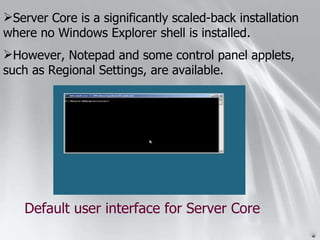
Server Core is a significantly scaled-back installation where no Windows Explorer shell is installed. However, Notepad and some control panel applets, such as Regional Settings, are available. Default user interface for Server Core
Windows Server 2008 offers high-availability to services and applications through Failover   Clustering Most server features and roles can be kept running with little to no downtime. Failover Clustering Self-healing NTFS In previous Windows versions, if the operating system detected corruption in the file system of an NTFS volume, it marked the volume "dirty“ to correct errors on the volume, it had to be taken offline.   The operating system now features S.M.A.R.T. detection techniques to help determine when a hard disk may fail .This feature was first presented within Windows Vista
Hyper-V is a hyperviser-based virtualization system, forming a core part of Microsoft's virtualization strategy Hyper-V: It virtualizes servers on an operating system's kernel layer . It can be thought of as partitioning a single physical server into multiple small computational partitions Hyper-V includes the ability to act as a Xen virtualization hypervisor host allowing Xen-enabled guest operating systems to run virtualized. A beta version of Hyper-V ships with certain x86-64 editions of Windows Server 2008
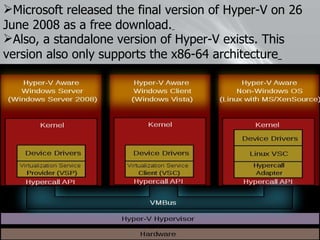
Microsoft released the final version of Hyper-V on 26 June 2008 as a free download.   Also, a standalone version of Hyper-V exists. This version also only supports the x86-64 architecture
Active Directory roles Active Directory roles is expanded with identity, certificate, and rights management services  .  Active Directory, until Windows Server 2003, allowed network administrators to centrally manage connected computers, to set policies for groups of users, and to centrally deploy new applications to multiple computers.   This role of Active Directory is being renamed as Active Directory Domain Services (ADDS).  A number of other additional services are being introduced, including Active Directory Federation Services (ADFS), Active Directory Lightweight Directory Services (AD LDS)
Windows System Resource Manager Windows System Resource Manager (WSRM) is being integrated into Windows Server 2008.  It provides resource management and can be used to control the amount of resources a process or a user can use based on business priorities  CPU time, bandwidth that it can use, number of processors it can be run on, and allocated to a process can be restricted.
Server Manager Server Manager is a new roles-based management tool for Windows Server 2008 .  It is a combination of  Manage Your Server  and  Security Configuration Wizard  from Windows Server 2003 .  Server Manager  gathers together all of the operations users would want to conduct on the server, such as, getting a remote deployment method set up, adding more server roles etc and provides a consolidated, portal-like view about the status of each role.
Windows PowerShell Windows Server 2008 is the first Windows operating system to ship with Windows PowerShell   Microsoft's new extensible command line shell and task-based scripting technology PowerShell is based on object-oriented programming and version 2.0 of the Microsoft   PowerShell's scripting language was specifically designed for IT administration, and can be used in place of cmd.exe and Windows Script Host
Removed features NT backup is replaced by Windows Server Backup, and no longer supports backing up to tape drives  NNTP (Network News Transfer Protocol) is no longer part of Internet Information Services 7.0  Post Office Protocol component has been deprecated and will no longer be supplied as part of Windows OS  Exchange backups. (NT Backup was replaced with VSS-based Windows Server Backup).
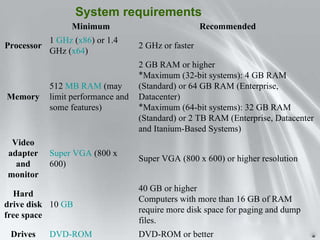
System requirements DVD-ROM or better DVD-ROM Drives 40 GB or higher  Computers with more than 16 GB of RAM require more disk space for paging and dump files. 10  GB Hard drive disk free space Super VGA (800 x 600) or higher resolution Super VGA  (800 x 600) Video adapter and monitor 2 GB RAM or higher  Maximum (32-bit systems): 4 GB RAM (Standard) or 64 GB RAM (Enterprise, Datacenter)  Maximum (64-bit systems): 32 GB RAM (Standard) or 2 TB RAM (Enterprise, Datacenter and Itanium-Based Systems)  512  MB   RAM  (may limit performance and some features) Memory 2 GHz or faster 1  GHz  ( x86 ) or 1.4 GHz ( x64 ) Processor Recommended Minimum
Thank you...


Y Archana

  • 1.
  • 2.
  • 3.
    History Originally knownas Windows Server Codename "Longhorn" Microsoft chairman Bill Gates announced its official title (Windows Server 2008) during his keynote address at WinHEC 16 May 2007 Windows Server 2008 is the most recent release of Microsoft Windows' server line of operating systems Released to manufacturing on February 4, 2008 and officially released on February 27, 2008, it is the successor to Window Server 2003, released nearly five years earlier. Like Windows Vista and Windows 7, Windows Server 2008 is built on Windows NT 6.x .
  • 4.
    Windows Server 2008is built from the same code base as window vista Improved image-based installation, deployment and recovery, improved diagnostics, monitoring, event logging and reporting tools It provides new security features such as bitlocker & ASLR This allows the system resources to be partitioned dynamically using Dynamic Hardware Partitioning Features:
  • 5.
    ALSR: Address spacelayout randomization (ASLR) is a computer security technique which involves randomly arranging the positions of key data areas, usually including the base executable and position of libraries heap and stack in a process's, address space Windows Server 2008 includes a variation of installation called Server Core Server Core Bitlocker: BitLocker Drive Encryption is a full disk encryption feature included with the Ultimate and Enterprise editions of microsoft's windows vista and windows 7 desktop operating system
  • 6.
    Server Core isa significantly scaled-back installation where no Windows Explorer shell is installed. However, Notepad and some control panel applets, such as Regional Settings, are available. Default user interface for Server Core
  • 7.
    Windows Server 2008offers high-availability to services and applications through Failover Clustering Most server features and roles can be kept running with little to no downtime. Failover Clustering Self-healing NTFS In previous Windows versions, if the operating system detected corruption in the file system of an NTFS volume, it marked the volume "dirty“ to correct errors on the volume, it had to be taken offline. The operating system now features S.M.A.R.T. detection techniques to help determine when a hard disk may fail .This feature was first presented within Windows Vista
  • 8.
    Hyper-V is ahyperviser-based virtualization system, forming a core part of Microsoft's virtualization strategy Hyper-V: It virtualizes servers on an operating system's kernel layer . It can be thought of as partitioning a single physical server into multiple small computational partitions Hyper-V includes the ability to act as a Xen virtualization hypervisor host allowing Xen-enabled guest operating systems to run virtualized. A beta version of Hyper-V ships with certain x86-64 editions of Windows Server 2008
  • 9.
    Microsoft released thefinal version of Hyper-V on 26 June 2008 as a free download. Also, a standalone version of Hyper-V exists. This version also only supports the x86-64 architecture
  • 10.
    Active Directory rolesActive Directory roles is expanded with identity, certificate, and rights management services . Active Directory, until Windows Server 2003, allowed network administrators to centrally manage connected computers, to set policies for groups of users, and to centrally deploy new applications to multiple computers. This role of Active Directory is being renamed as Active Directory Domain Services (ADDS). A number of other additional services are being introduced, including Active Directory Federation Services (ADFS), Active Directory Lightweight Directory Services (AD LDS)
  • 11.
    Windows System ResourceManager Windows System Resource Manager (WSRM) is being integrated into Windows Server 2008. It provides resource management and can be used to control the amount of resources a process or a user can use based on business priorities CPU time, bandwidth that it can use, number of processors it can be run on, and allocated to a process can be restricted.
  • 12.
    Server Manager ServerManager is a new roles-based management tool for Windows Server 2008 . It is a combination of Manage Your Server and Security Configuration Wizard from Windows Server 2003 . Server Manager gathers together all of the operations users would want to conduct on the server, such as, getting a remote deployment method set up, adding more server roles etc and provides a consolidated, portal-like view about the status of each role.
  • 13.
    Windows PowerShell WindowsServer 2008 is the first Windows operating system to ship with Windows PowerShell Microsoft's new extensible command line shell and task-based scripting technology PowerShell is based on object-oriented programming and version 2.0 of the Microsoft PowerShell's scripting language was specifically designed for IT administration, and can be used in place of cmd.exe and Windows Script Host
  • 14.
    Removed features NTbackup is replaced by Windows Server Backup, and no longer supports backing up to tape drives NNTP (Network News Transfer Protocol) is no longer part of Internet Information Services 7.0 Post Office Protocol component has been deprecated and will no longer be supplied as part of Windows OS Exchange backups. (NT Backup was replaced with VSS-based Windows Server Backup).
  • 15.
    System requirements DVD-ROMor better DVD-ROM Drives 40 GB or higher Computers with more than 16 GB of RAM require more disk space for paging and dump files. 10 GB Hard drive disk free space Super VGA (800 x 600) or higher resolution Super VGA (800 x 600) Video adapter and monitor 2 GB RAM or higher Maximum (32-bit systems): 4 GB RAM (Standard) or 64 GB RAM (Enterprise, Datacenter) Maximum (64-bit systems): 32 GB RAM (Standard) or 2 TB RAM (Enterprise, Datacenter and Itanium-Based Systems) 512 MB RAM (may limit performance and some features) Memory 2 GHz or faster 1 GHz ( x86 ) or 1.4 GHz ( x64 ) Processor Recommended Minimum
  • 16.
  • 17.
  • 18.
  • 19.
  • 20.