LOUIS KAHN
PRESENTED BY: ANSHIKA GAUTAM
MANU SONI
MAYANK SINGH
MOHD ABDULLAH
AKASH YADAV
‘Every building must have its soul- Louis I. Kahn’
TABLE OF CONTENTS
01
Introduction
02
Characteristics And
Philosophy
03
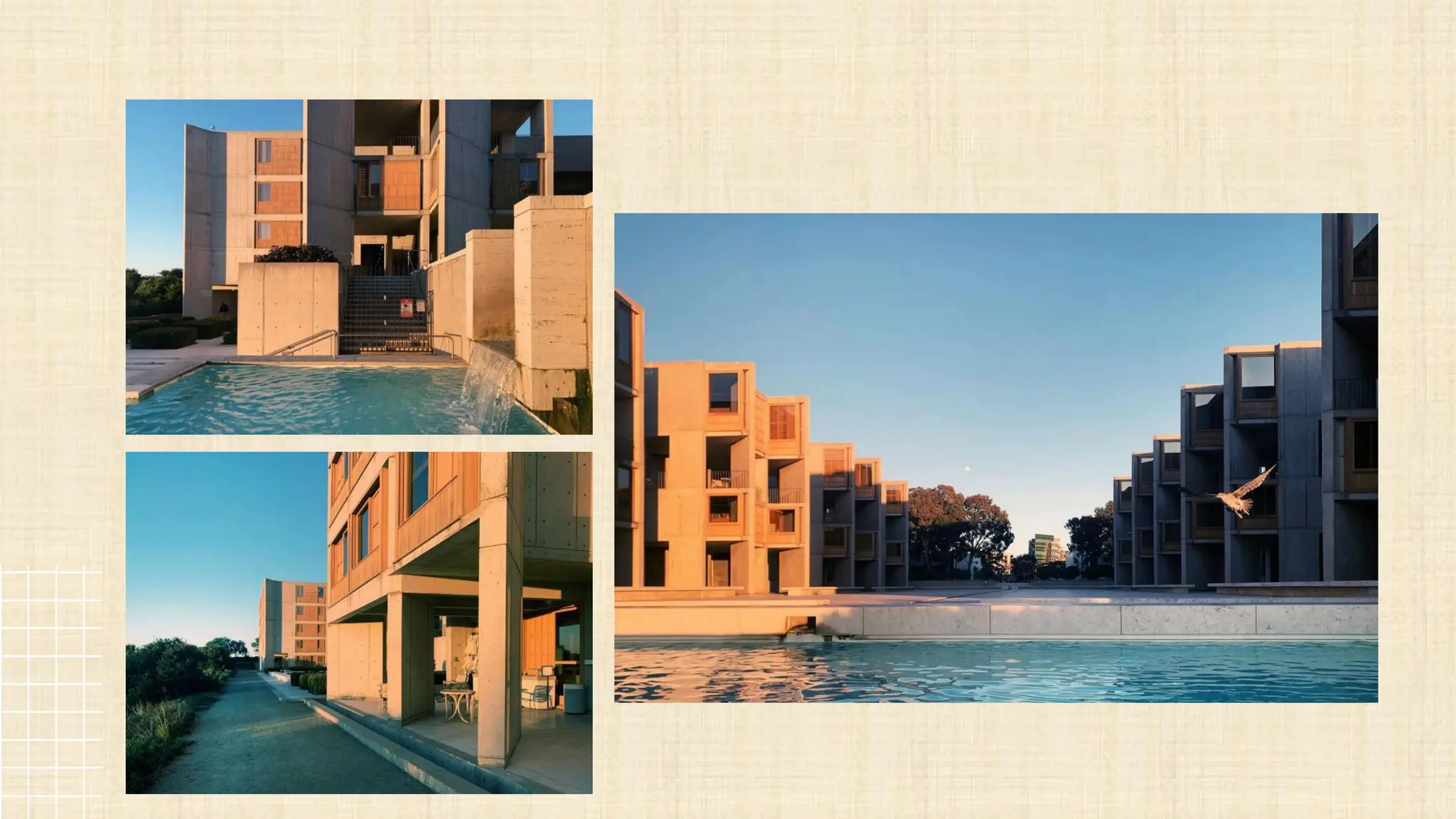
The Salk Institute
04
Kimbell Art Museum
01
INTRODUCTION
INTRODUCTION
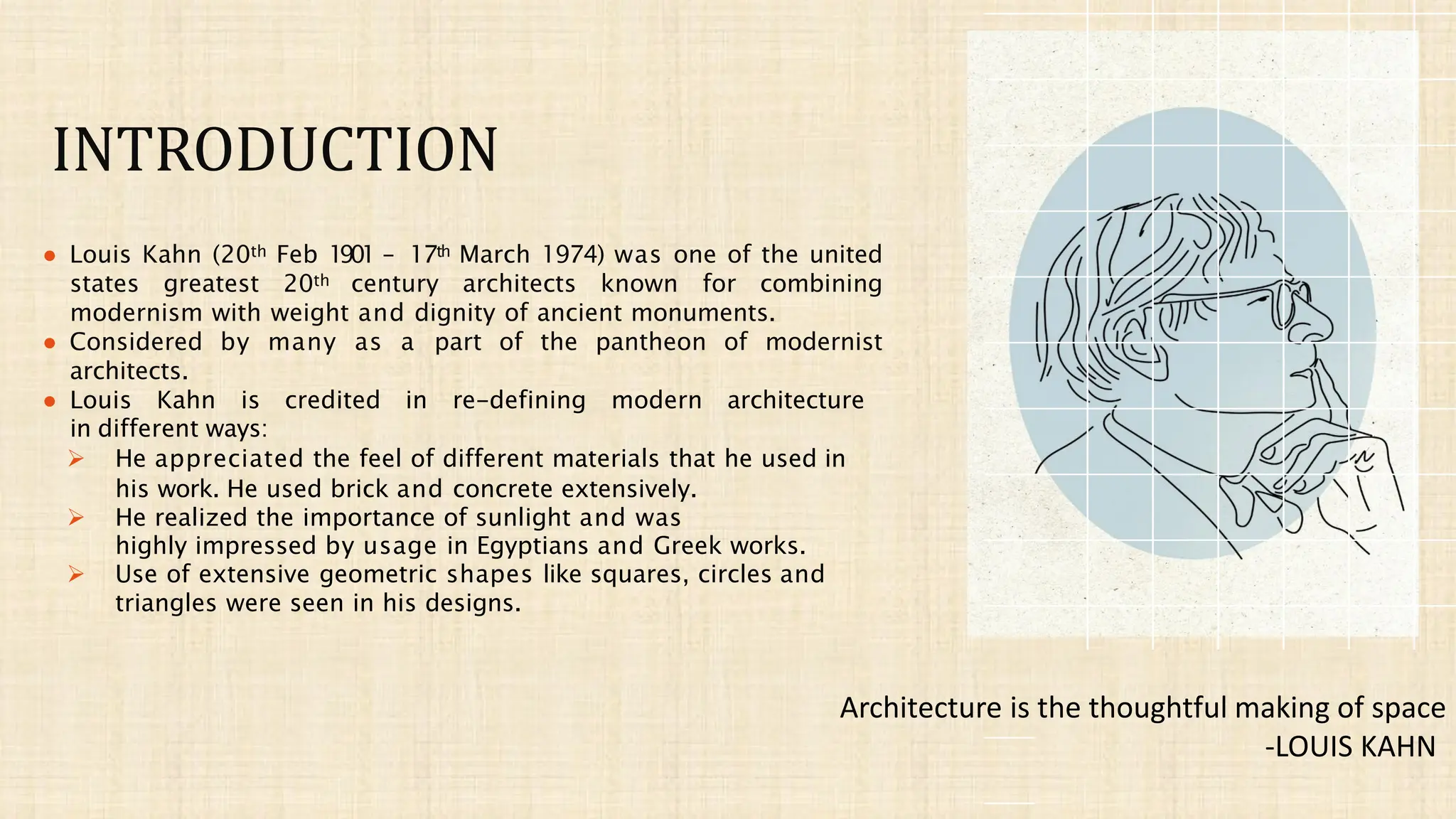
● Louis Kahn (20th Feb 1901 – 17th March 1974) was one of the united
states greatest 20th century architects known for combining
modernism with weight and dignity of ancient monuments.
● Considered by many as a part of the pantheon of modernist
architects.
● Louis Kahn is credited in re-defining modern architecture
in different ways:
➢ He appreciated the feel of different materials that he used in
his work. He used brick and concrete extensively.
➢ He realized the importance of sunlight and was
highly impressed by usage in Egyptians and Greek works.
➢ Use of extensive geometric shapes like squares, circles and
triangles were seen in his designs.
Architecture is the thoughtful making of space
-LOUIS KAHN
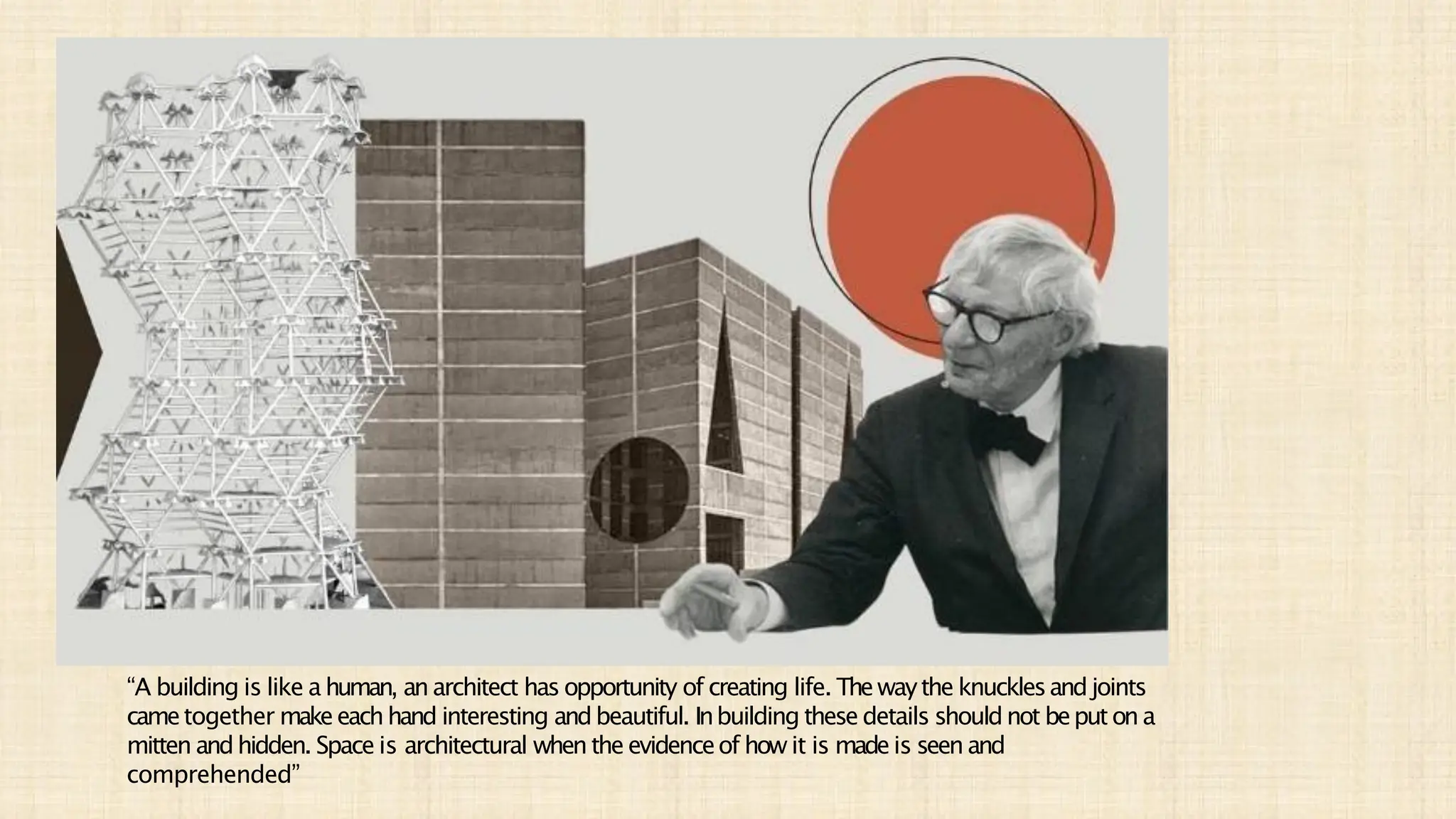
“A building is like a human, anarchitect has opportunity of creating life. Thewaythe knucklesandjoints
cametogether makeeachhand interesting andbeautiful. Inbuilding these details shouldnot beputona
mitten andhidden. Space is architectural whenthe evidenceof how it is madeis seenand
comprehended”
02
CHARACTERISTICS AND
PHILOSOPHY
CHARACTERISTICS
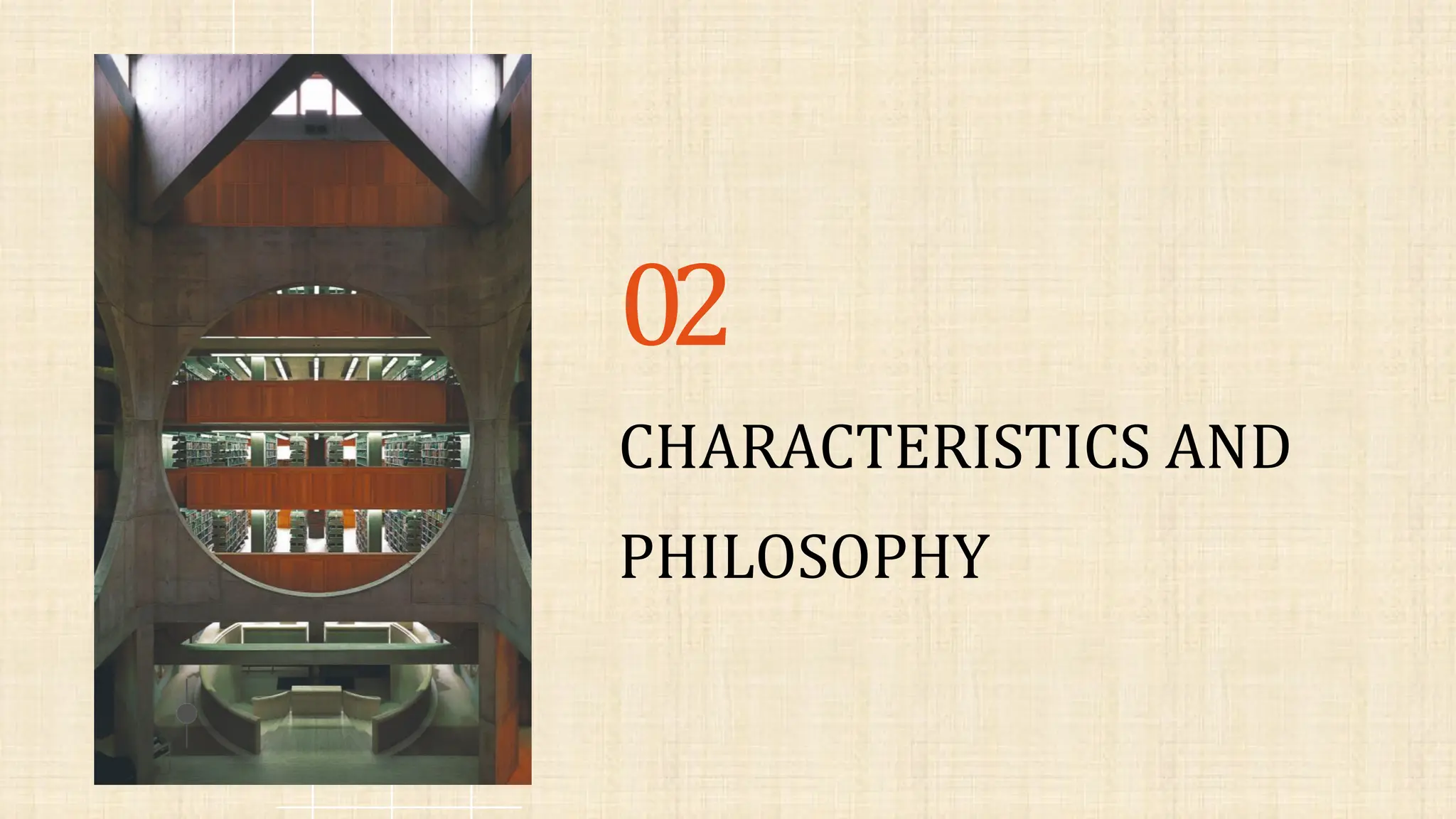
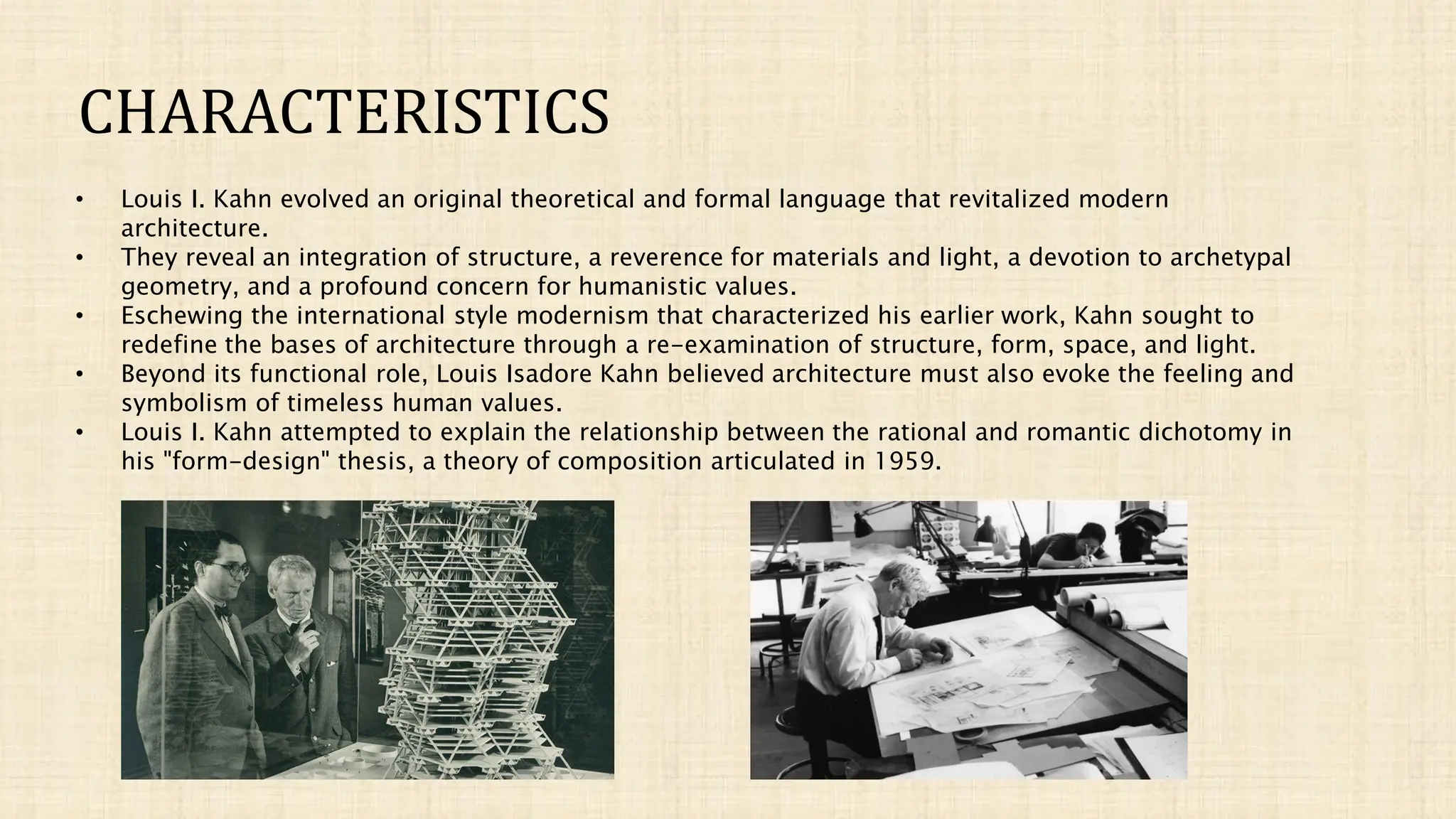
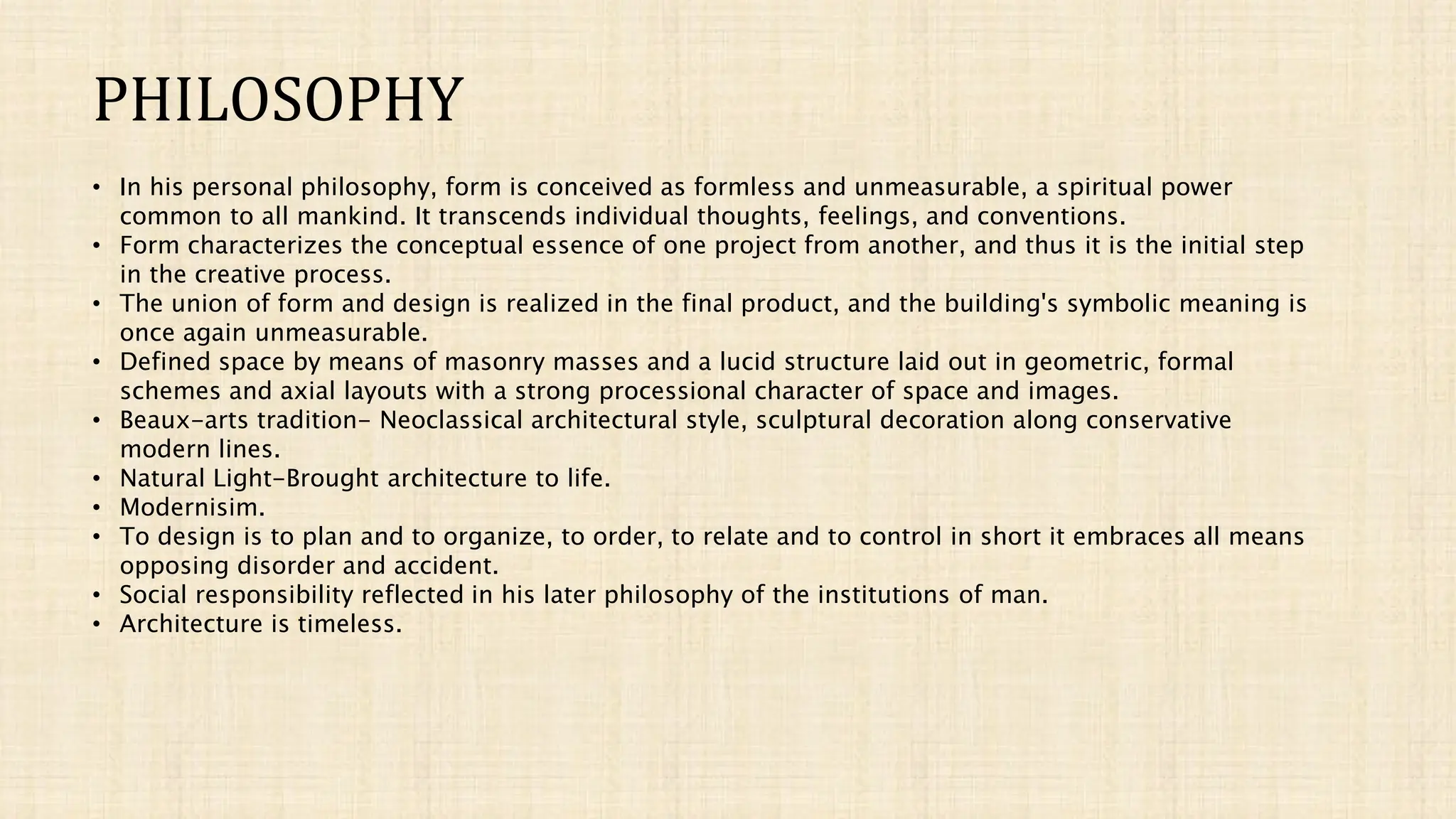
• Louis I. Kahn evolved an original theoretical and formal language that revitalized modern
architecture.
• They reveal an integration of structure, a reverence for materials and light, a devotion to archetypal
geometry, and a profound concern for humanistic values.
• Eschewing the international style modernism that characterized his earlier work, Kahn sought to
redefine the bases of architecture through a re-examination of structure, form, space, and light.
• Beyond its functional role, Louis Isadore Kahn believed architecture must also evoke the feeling and
symbolism of timeless human values.
• Louis I. Kahn attempted to explain the relationship between the rational and romantic dichotomy in
his "form-design" thesis, a theory of composition articulated in 1959.
PHILOSOPHY
• In his personal philosophy, form is conceived as formless and unmeasurable, a spiritual power
common to all mankind. It transcends individual thoughts, feelings, and conventions.
• Form characterizes the conceptual essence of one project from another, and thus it is the initial step
in the creative process.
• The union of form and design is realized in the final product, and the building's symbolic meaning is
once again unmeasurable.
• Defined space by means of masonry masses and a lucid structure laid out in geometric, formal
schemes and axial layouts with a strong processional character of space and images.
• Beaux-arts tradition- Neoclassical architectural style, sculptural decoration along conservative
modern lines.
• Natural Light-Brought architecture to life.
• Modernisim.
• To design is to plan and to organize, to order, to relate and to control in short it embraces all means
opposing disorder and accident.
• Social responsibility reflected in his later philosophy of the institutions of man.
• Architecture is timeless.
THE SALK INSTITUE
03
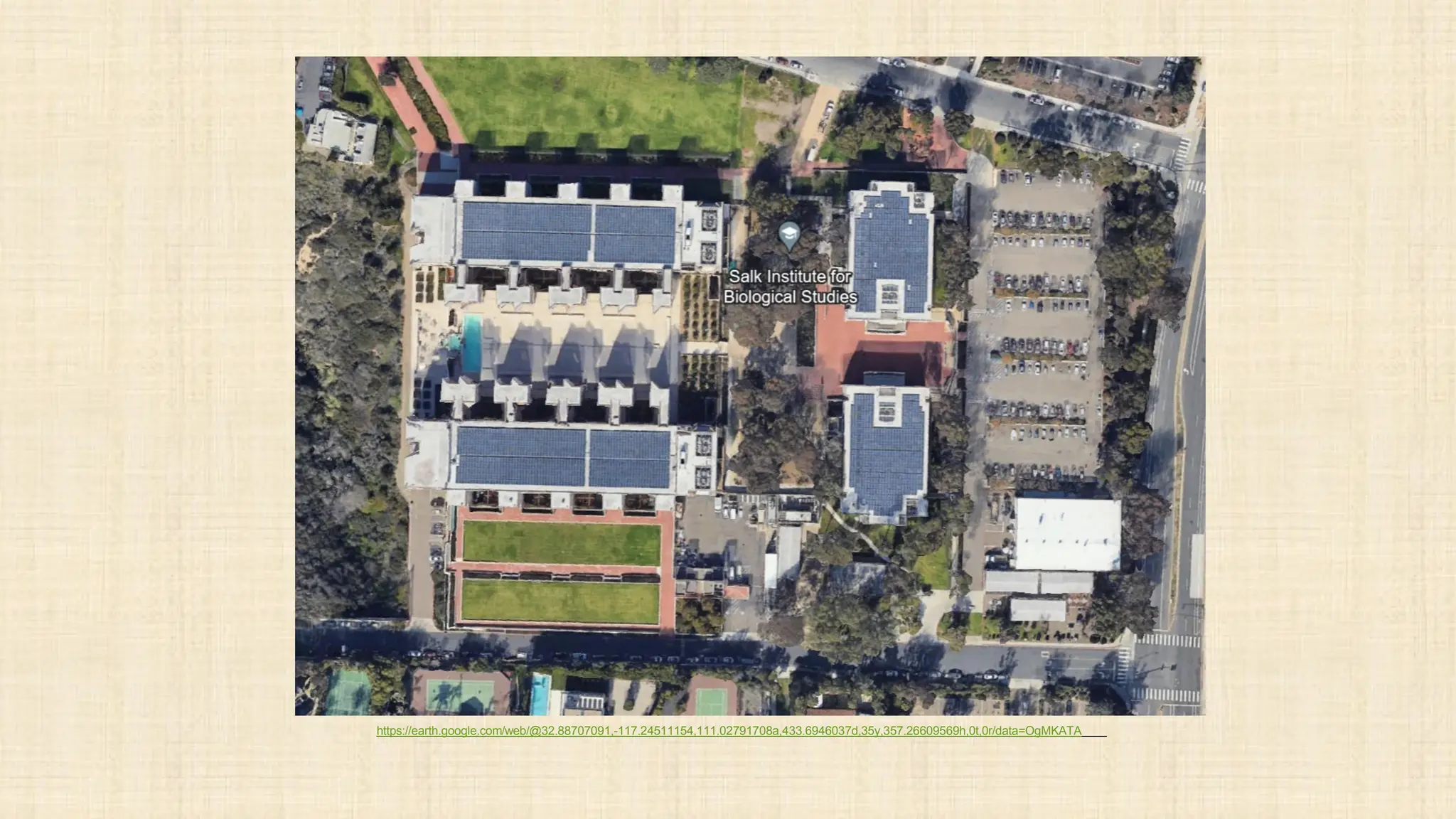
• Architects: Louis Kahn
• Location: 10010 N Torrey Pines Rd, La Jolla, California, United States
• Structural system: Vierendeel trusses
• Concept: Modernism, Primitive Shapes, Voids, Concrete
• Project Year: 1959 – 1965
https://earth.google.com/web/@32.88707091,-117.24511154,111.02791708a,433.6946037d,35y,357.26609569h,0t,0r/data=OgMKATA
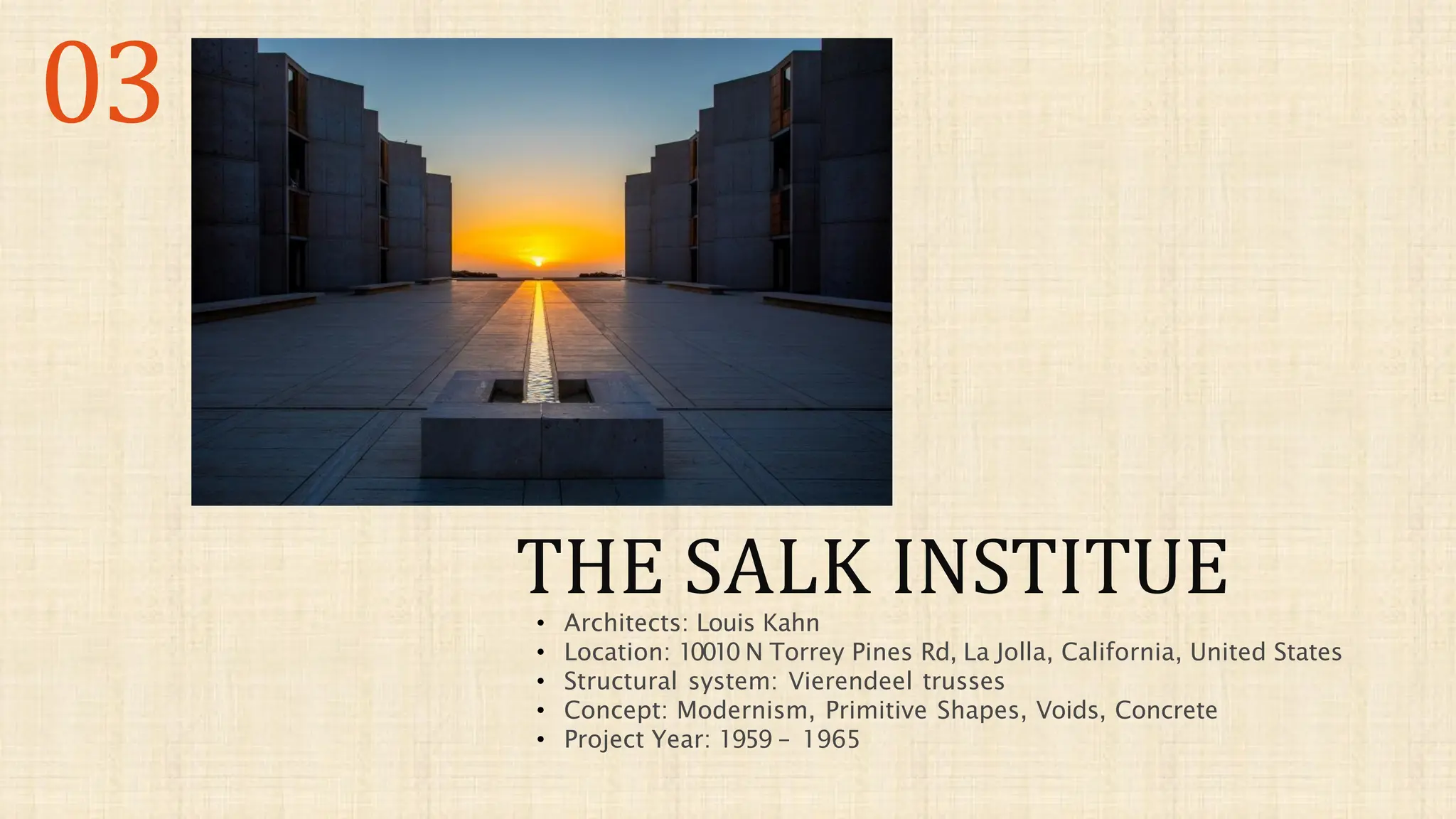
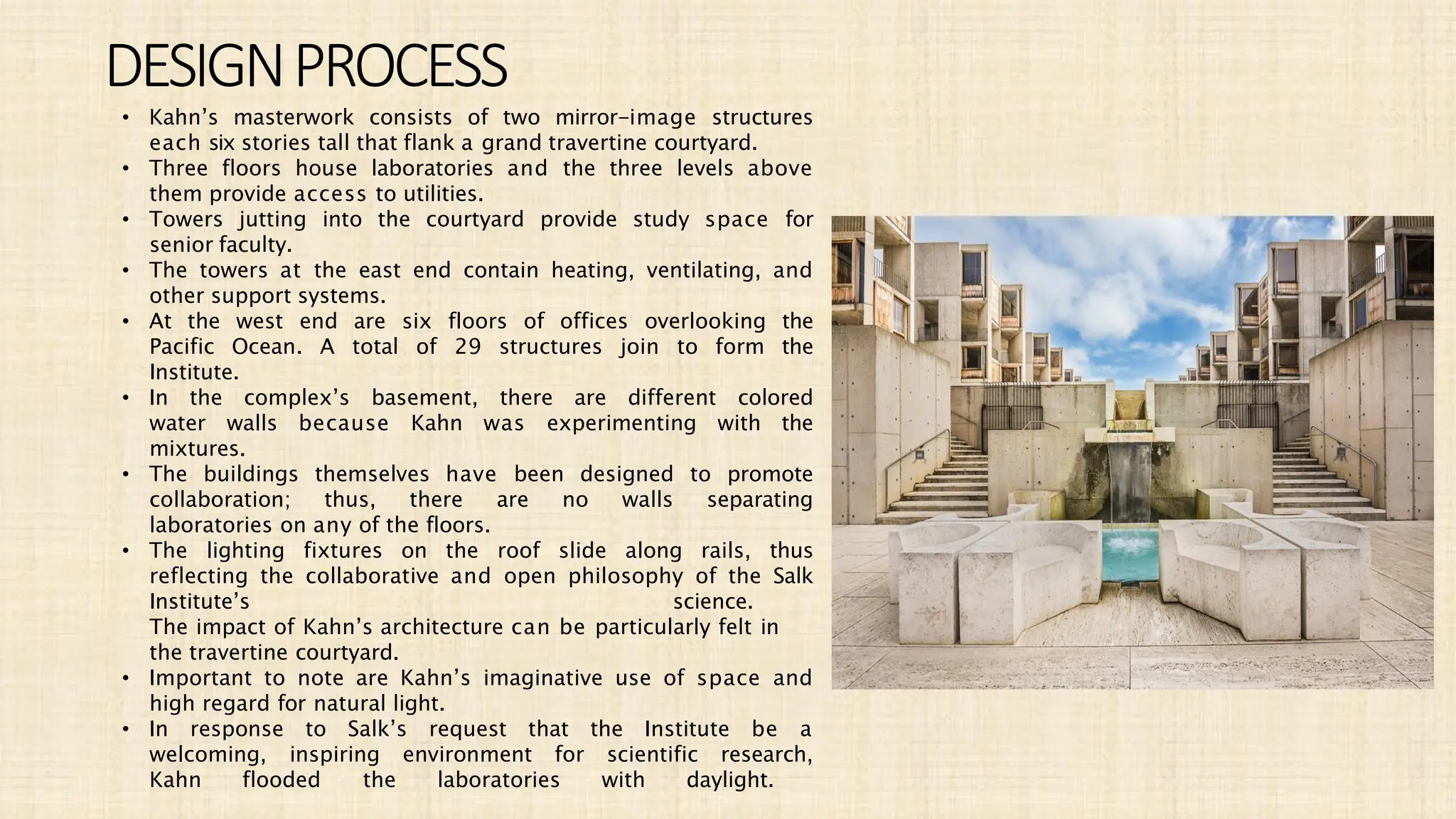
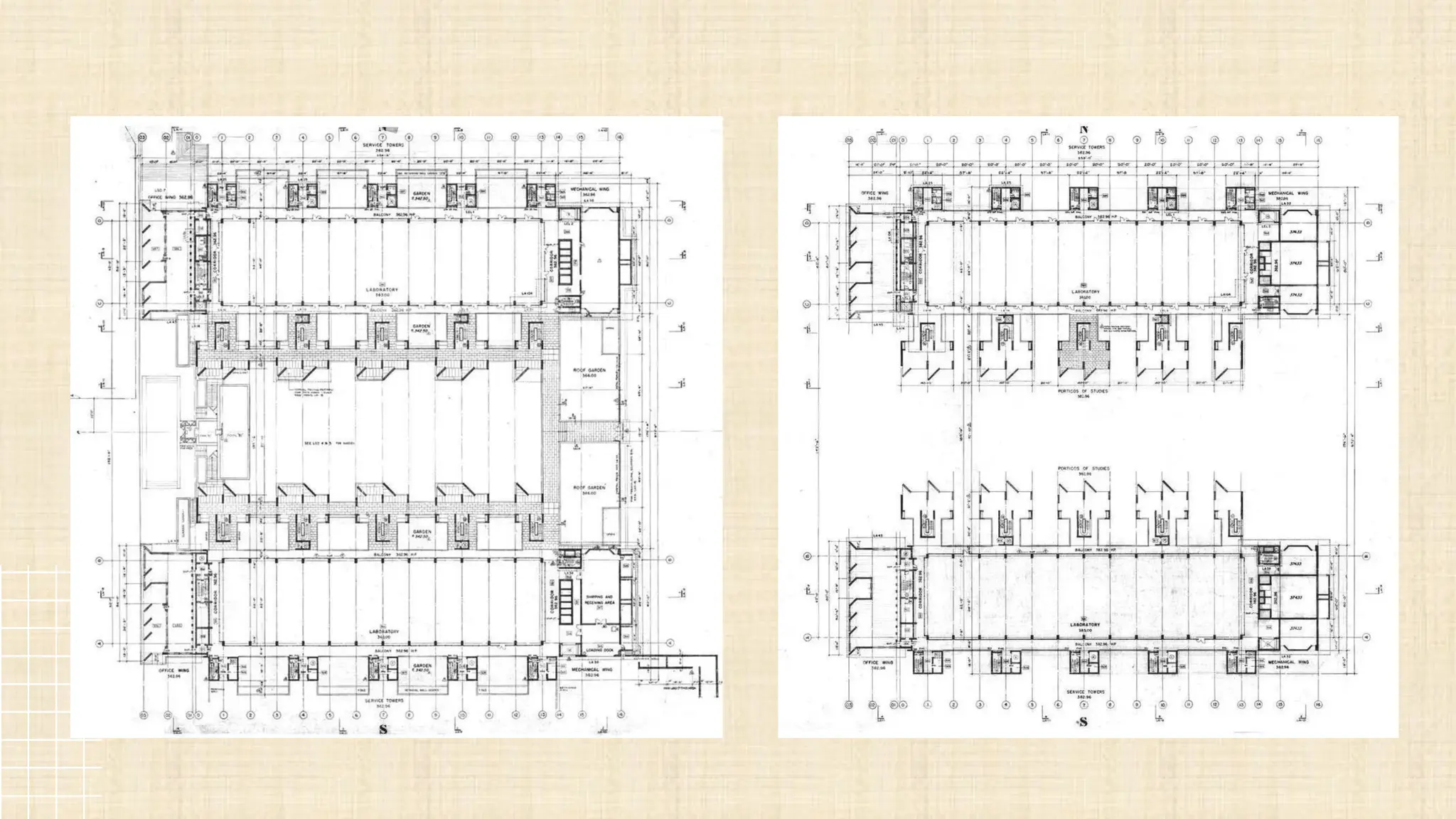
• Kahn’s masterwork consists of two mirror-image structures
each six stories tall that flank a grand travertine courtyard.
• Three floors house laboratories and the three levels above
them provide access to utilities.
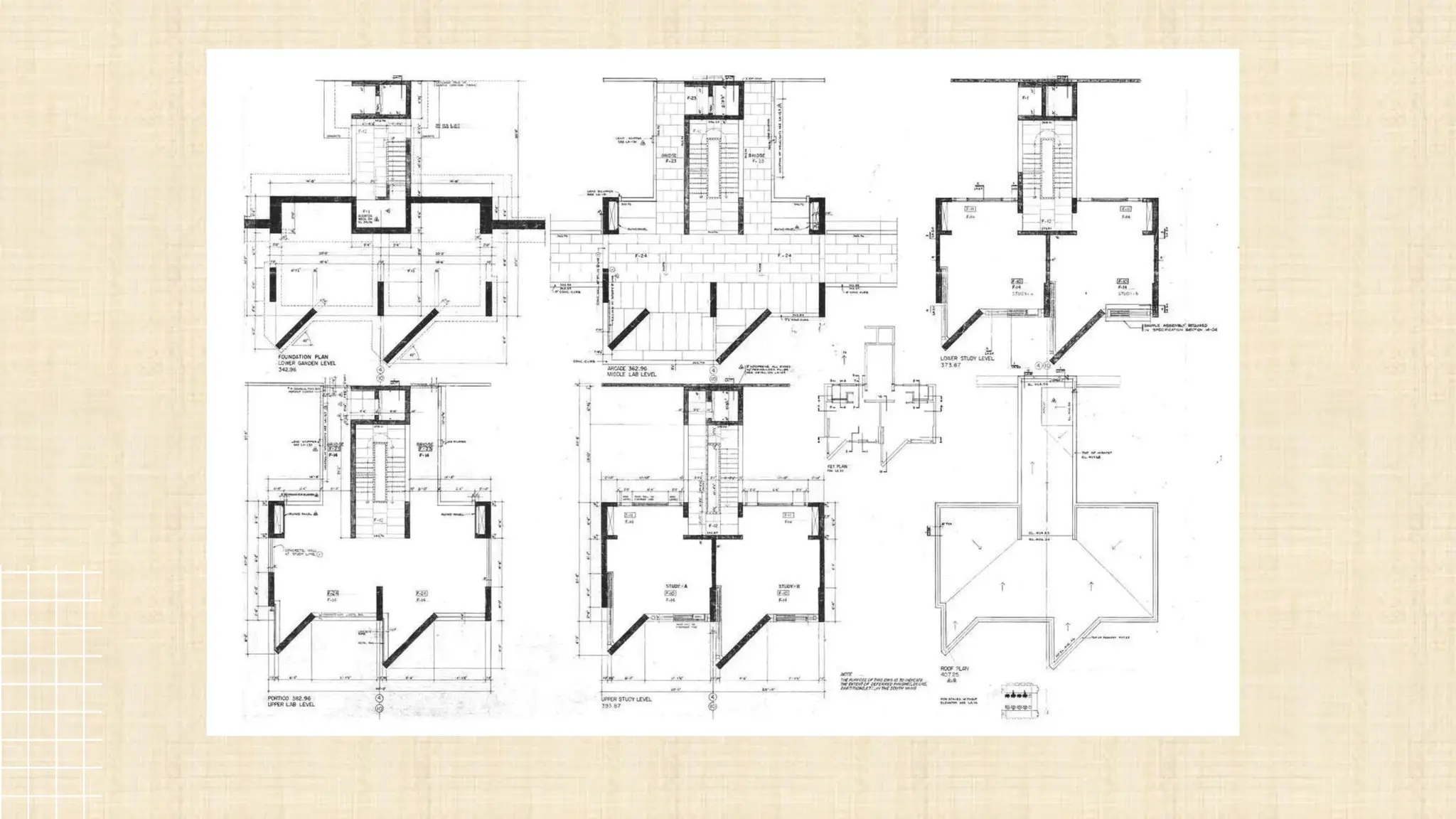
• Towers jutting into the courtyard provide study space for
senior faculty.
• The towers at the east end contain heating, ventilating, and
other support systems.
• At the west end are six floors of offices overlooking the
Pacific Ocean. A total of 29 structures join to form the
Institute.
• In the complex’s basement, there are different colored
water walls because Kahn was experimenting with the
mixtures.
• The buildings themselves have been designed to promote
collaboration; thus, there are no walls separating
laboratories on any of the floors.
• The lighting fixtures on the roof slide along rails, thus
reflecting the collaborative and open philosophy of the Salk
Institute’s science.
The impact of Kahn’s architecture can be particularly felt in
the travertine courtyard.
• Important to note are Kahn’s imaginative use of space and
high regard for natural light.
• In response to Salk’s request that the Institute be a
welcoming, inspiring environment for scientific research,
Kahn flooded the laboratories with daylight.
DESIGNPROCESS
PLANS
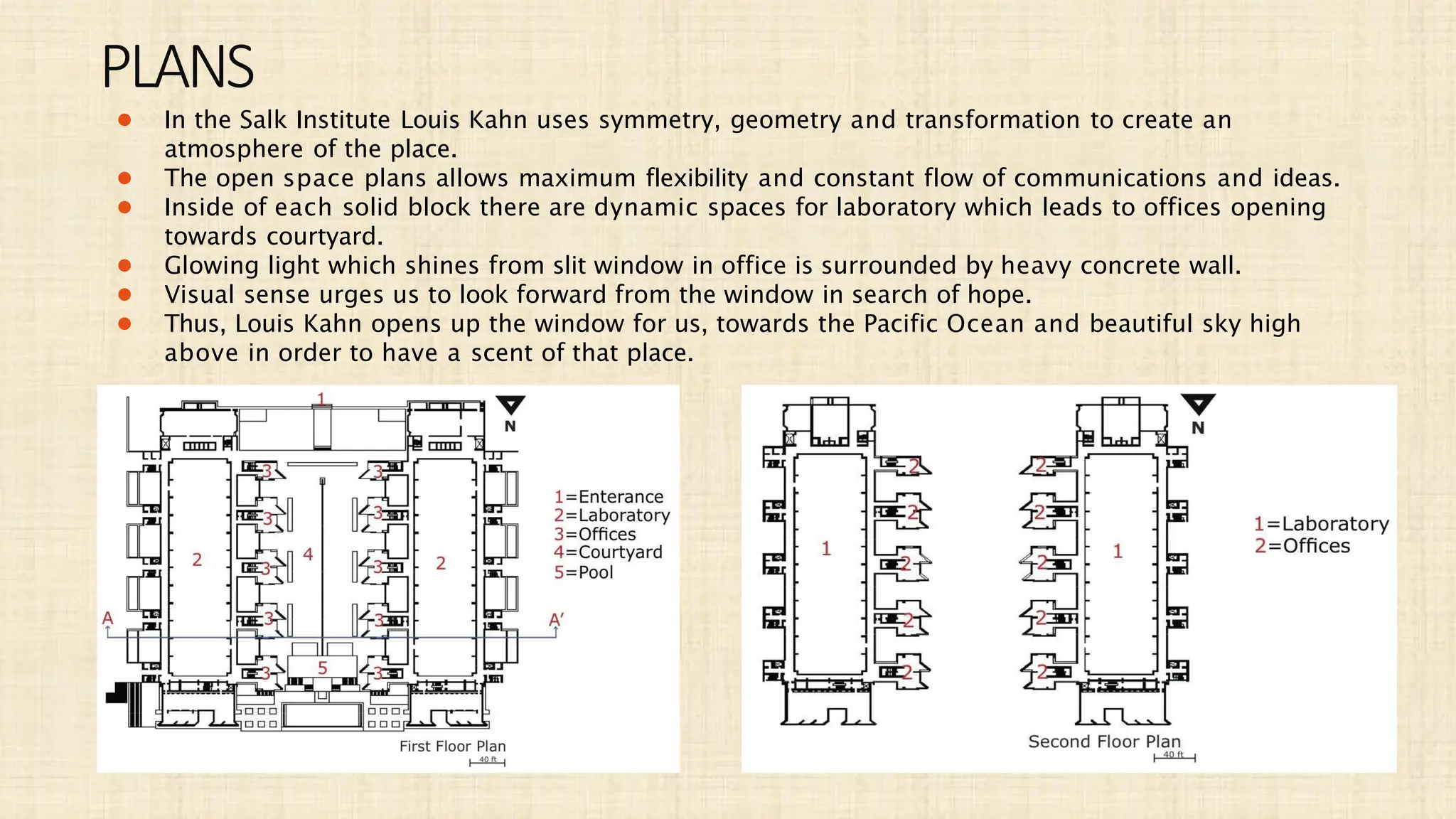
● In the Salk Institute Louis Kahn uses symmetry, geometry and transformation to create an
atmosphere of the place.
● The open space plans allows maximum flexibility and constant flow of communications and ideas.
● Inside of each solid block there are dynamic spaces for laboratory which leads to offices opening
towards courtyard.
● Glowing light which shines from slit window in office is surrounded by heavy concrete wall.
● Visual sense urges us to look forward from the window in search of hope.
● Thus, Louis Kahn opens up the window for us, towards the Pacific Ocean and beautiful sky high
above in order to have a scent of that place.
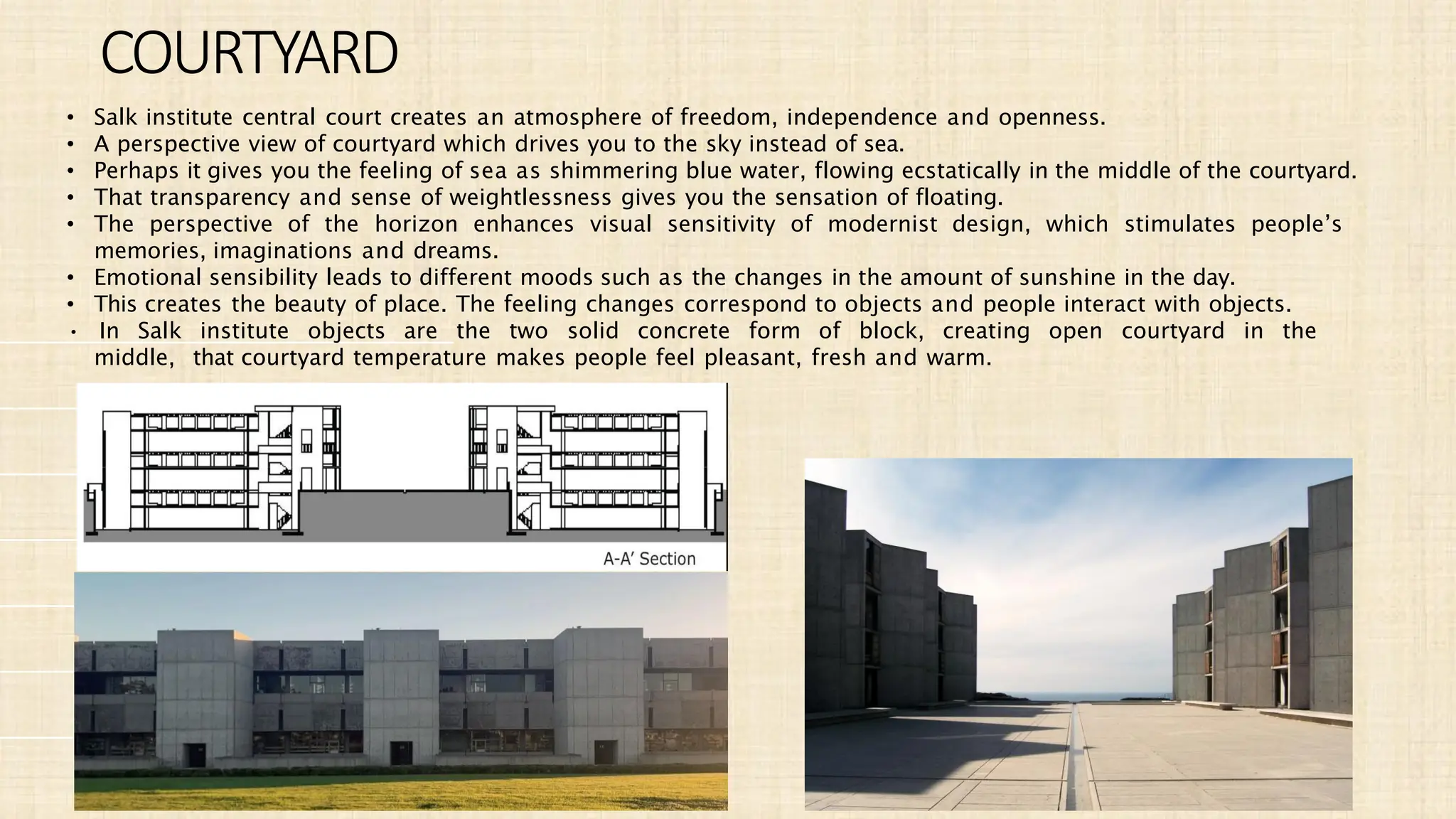
• Salk institute central court creates an atmosphere of freedom, independence and openness.
• A perspective view of courtyard which drives you to the sky instead of sea.
• Perhaps it gives you the feeling of sea as shimmering blue water, flowing ecstatically in the middle of the courtyard.
• That transparency and sense of weightlessness gives you the sensation of floating.
• The perspective of the horizon enhances visual sensitivity of modernist design, which stimulates people’s
memories, imaginations and dreams.
• Emotional sensibility leads to different moods such as the changes in the amount of sunshine in the day.
• This creates the beauty of place. The feeling changes correspond to objects and people interact with objects.
• In Salk institute objects are the two solid concrete form of block, creating open courtyard in the
middle, that courtyard temperature makes people feel pleasant, fresh and warm.
COURTYARD
MATERIALITY
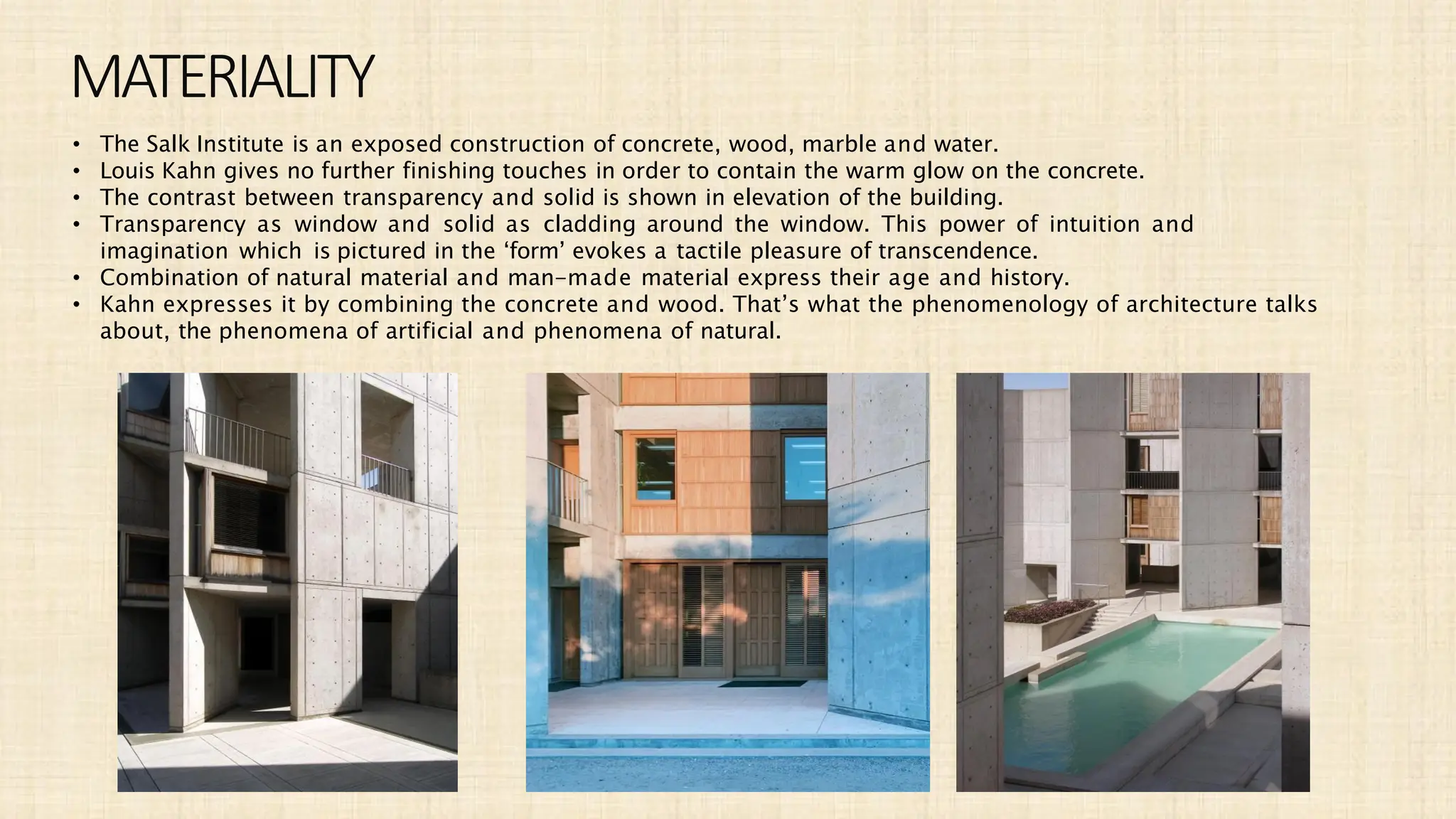
• The Salk Institute is an exposed construction of concrete, wood, marble and water.
• Louis Kahn gives no further finishing touches in order to contain the warm glow on the concrete.
• The contrast between transparency and solid is shown in elevation of the building.
• Transparency as window and solid as cladding around the window. This power of intuition and
imagination which is pictured in the ‘form’ evokes a tactile pleasure of transcendence.
• Combination of natural material and man-made material express their age and history.
• Kahn expresses it by combining the concrete and wood. That’s what the phenomenology of architecture talks
about, the phenomena of artificial and phenomena of natural.
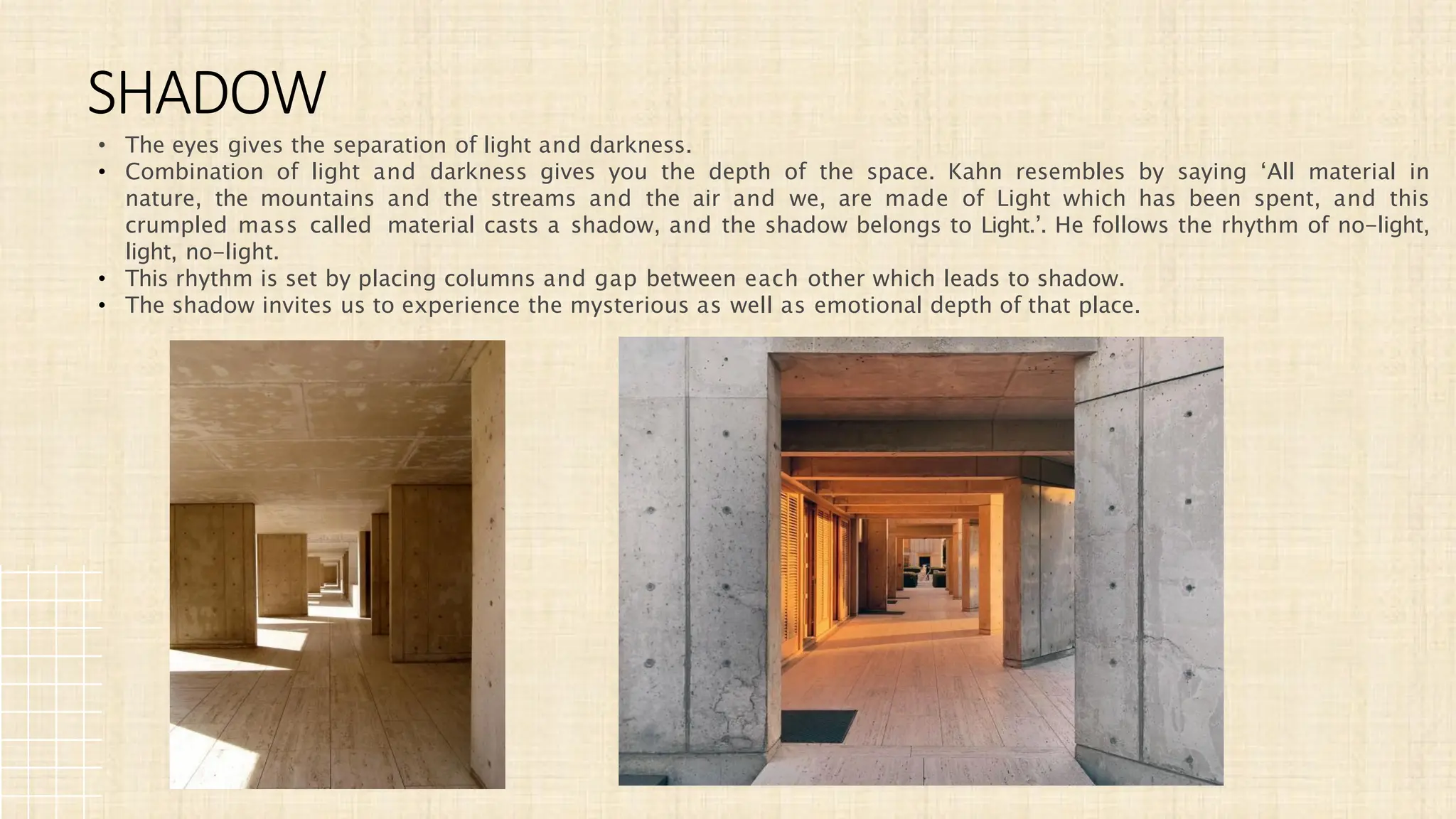
• The eyes gives the separation of light and darkness.
• Combination of light and darkness gives you the depth of the space. Kahn resembles by saying ‘All material in
nature, the mountains and the streams and the air and we, are made of Light which has been spent, and this
crumpled mass called material casts a shadow, and the shadow belongs to Light.’. He follows the rhythm of no-light,
light, no-light.
• This rhythm is set by placing columns and gap between each other which leads to shadow.
• The shadow invites us to experience the mysterious as well as emotional depth of that place.
SHADOW
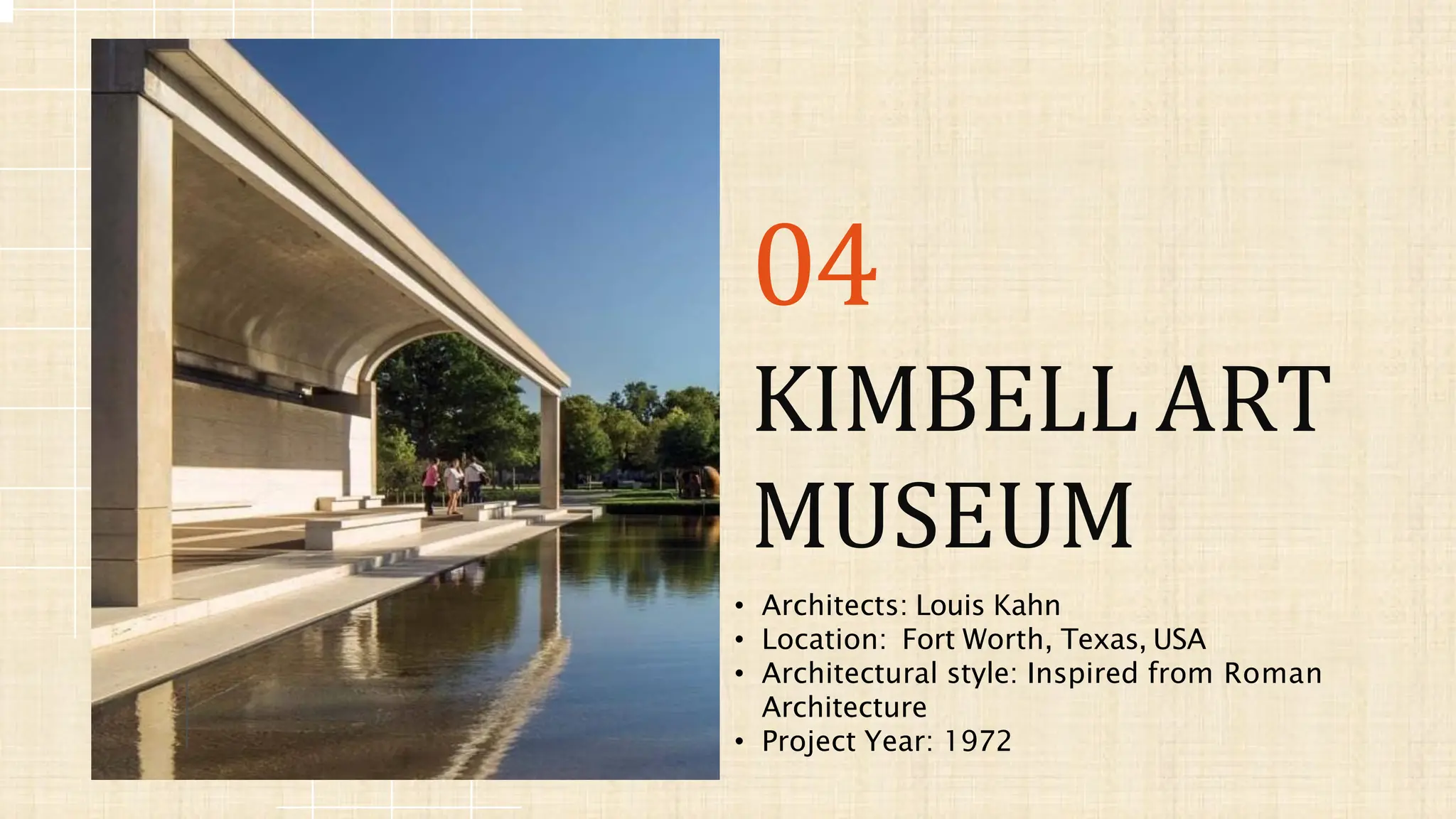
KIMBELL ART
MUSEUM
04
• Architects: Louis Kahn
• Location: Fort Worth, Texas, USA
• Architectural style: Inspired from Roman
Architecture
• Project Year: 1972
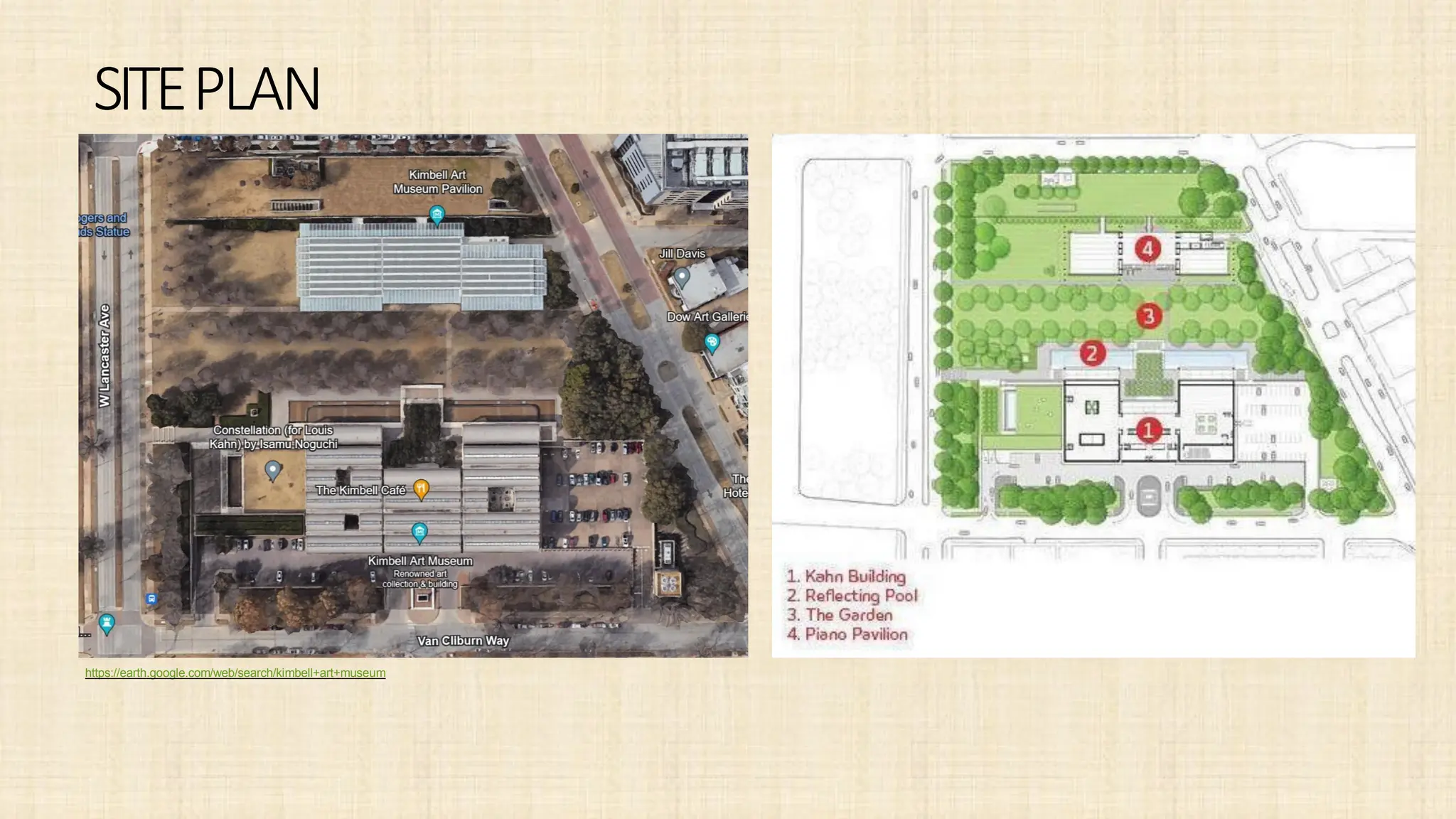
SITEPLAN
https://earth.google.com/web/search/kimbell+art+museum
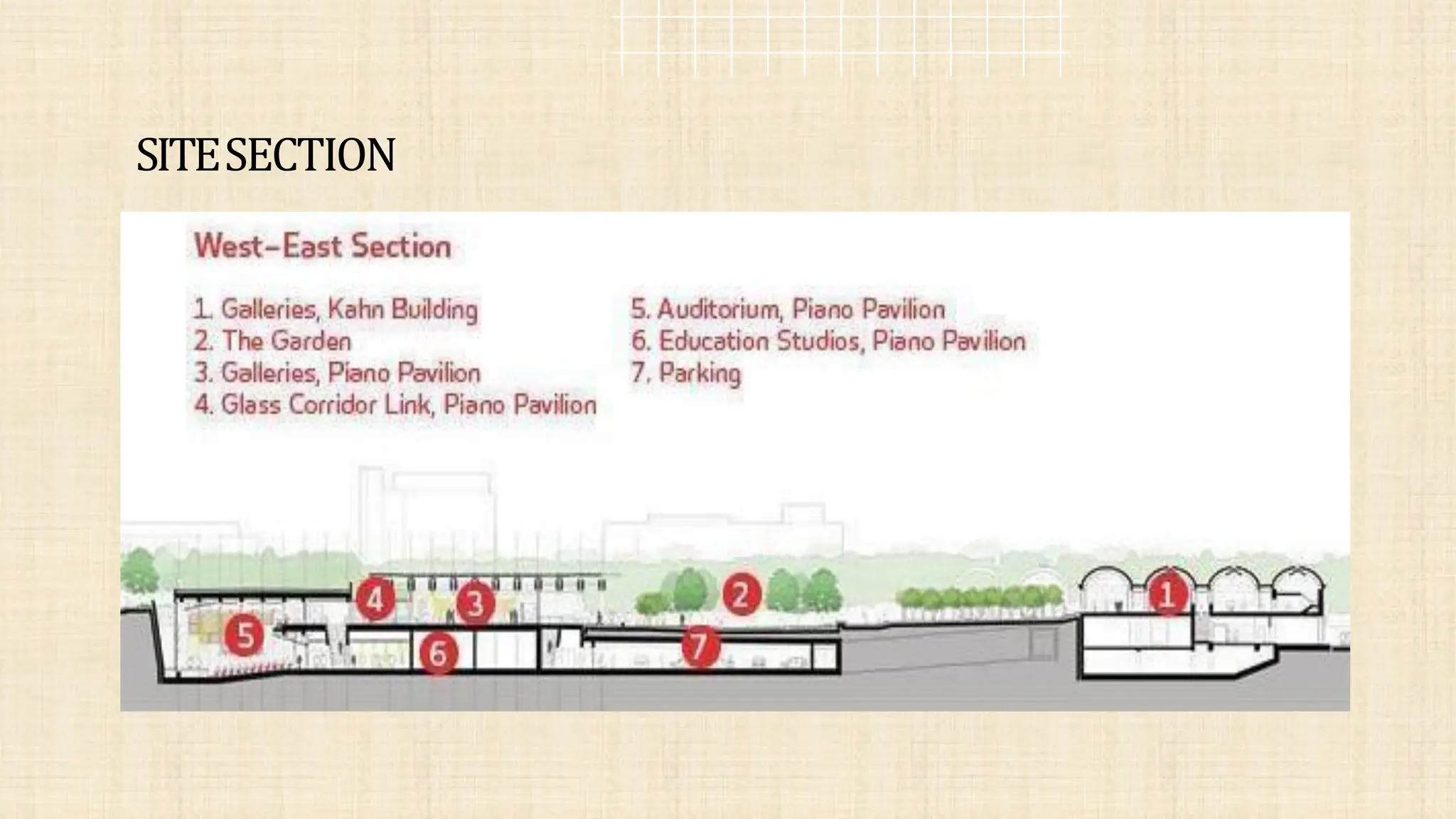
SITESECTION
DESIGN
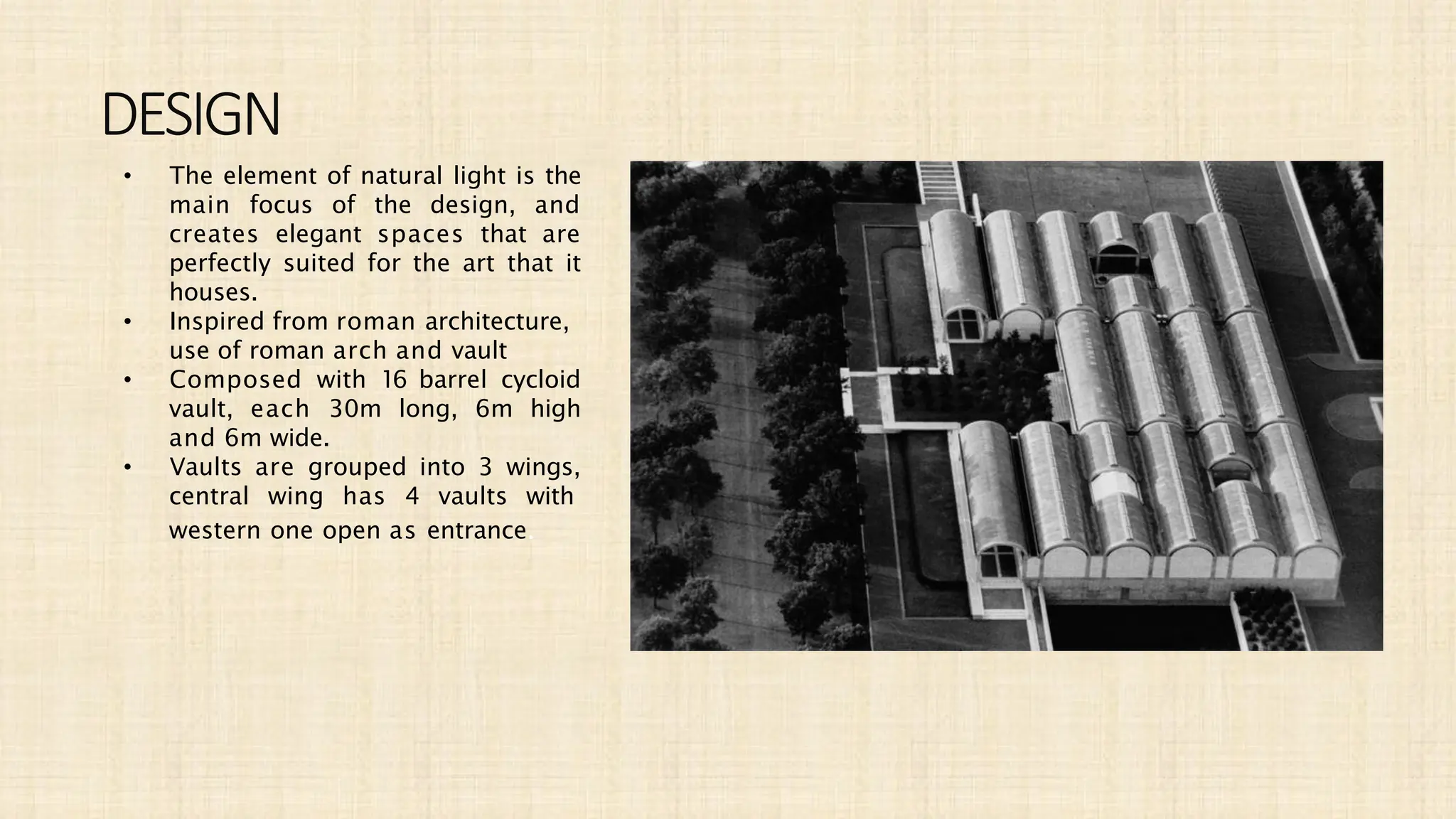
• The element of natural light is the
main focus of the design, and
creates elegant spaces that are
perfectly suited for the art that it
houses.
• Inspired from roman architecture,
use of roman arch and vault
• Composed with 16 barrel cycloid
vault, each 30m long, 6m high
and 6m wide.
• Vaults are grouped into 3 wings,
central wing has 4 vaults with
western one open as entrance.
FLOORPLANS
GROUND
FLOOR
BASEMENT
UPPER FLOOR
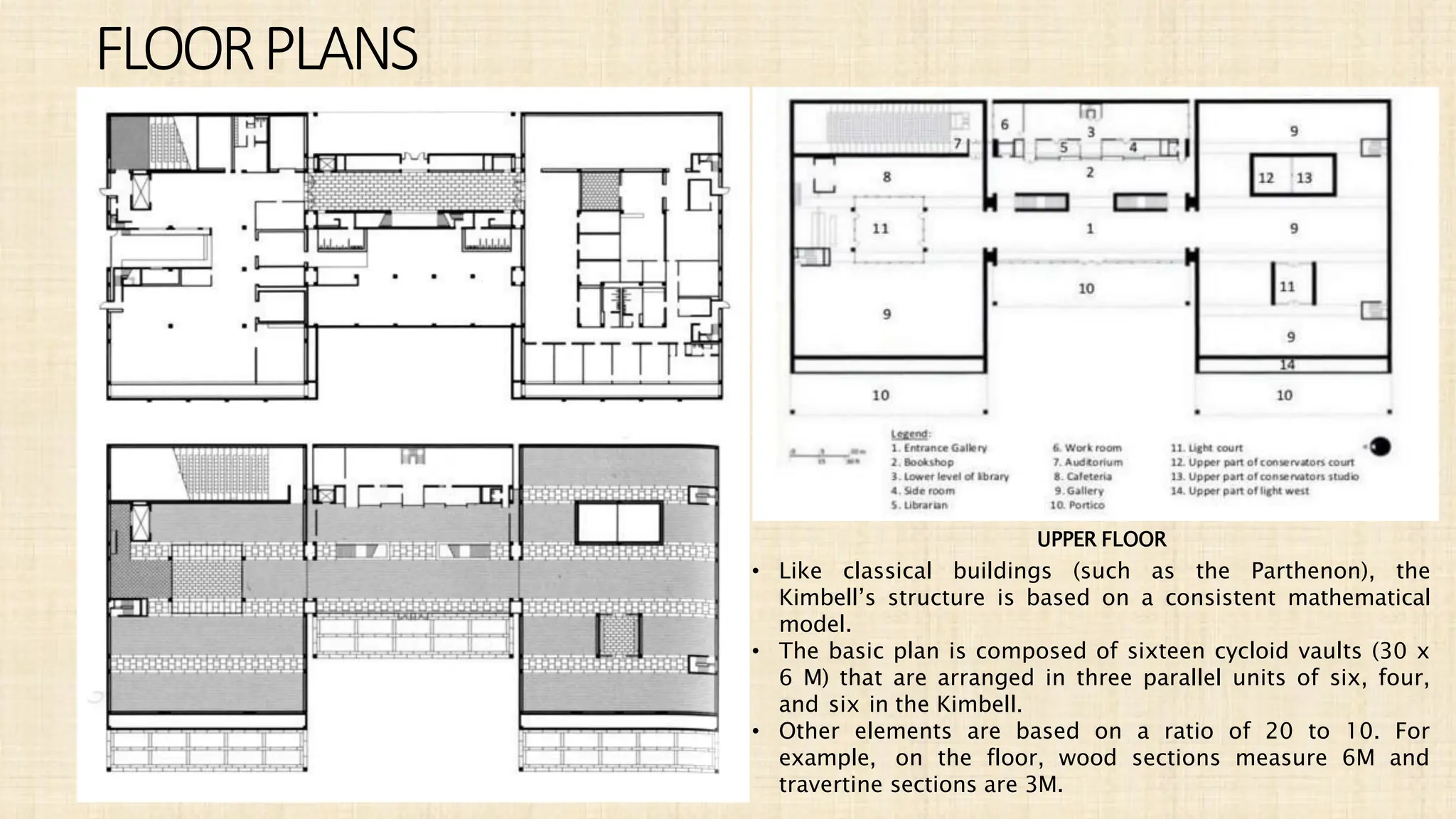
• Like classical buildings (such as the Parthenon), the
Kimbell’s structure is based on a consistent mathematical
model.
• The basic plan is composed of sixteen cycloid vaults (30 x
6 M) that are arranged in three parallel units of six, four,
and six in the Kimbell.
• Other elements are based on a ratio of 20 to 10. For
example, on the floor, wood sections measure 6M and
travertine sections are 3M.
SECTIONS
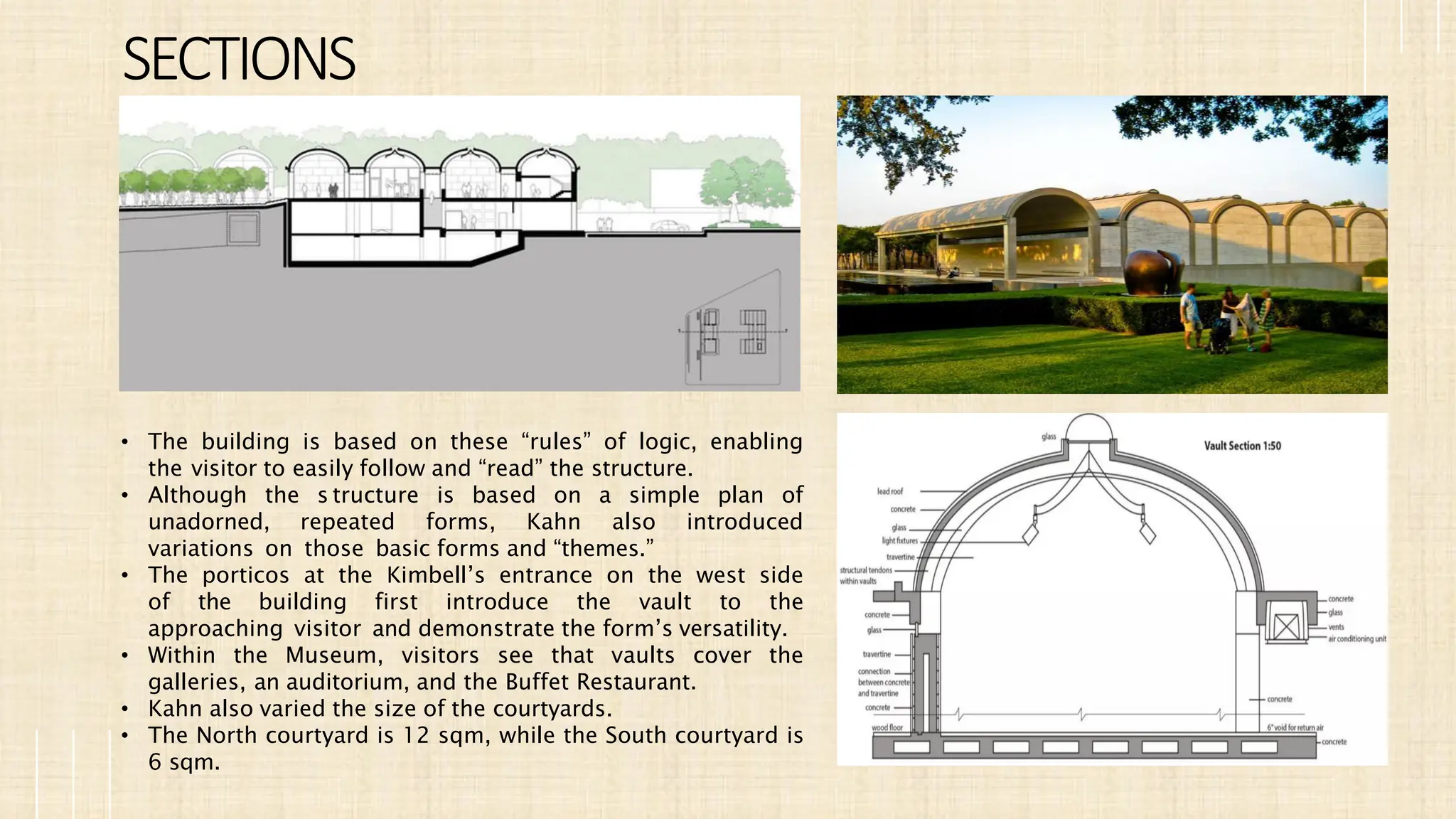
• The building is based on these “rules” of logic, enabling
the visitor to easily follow and “read” the structure.
• Although the s tructure is based on a simple plan of
unadorned, repeated forms, Kahn also introduced
variations on those basic forms and “themes.”
• The porticos at the Kimbell’s entrance on the west side
of the building first introduce the vault to the
approaching visitor and demonstrate the form’s versatility.
• Within the Museum, visitors see that vaults cover the
galleries, an auditorium, and the Buffet Restaurant.
• Kahn also varied the size of the courtyards.
• The North courtyard is 12 sqm, while the South courtyard is
6 sqm.
NATURALLIGHTING
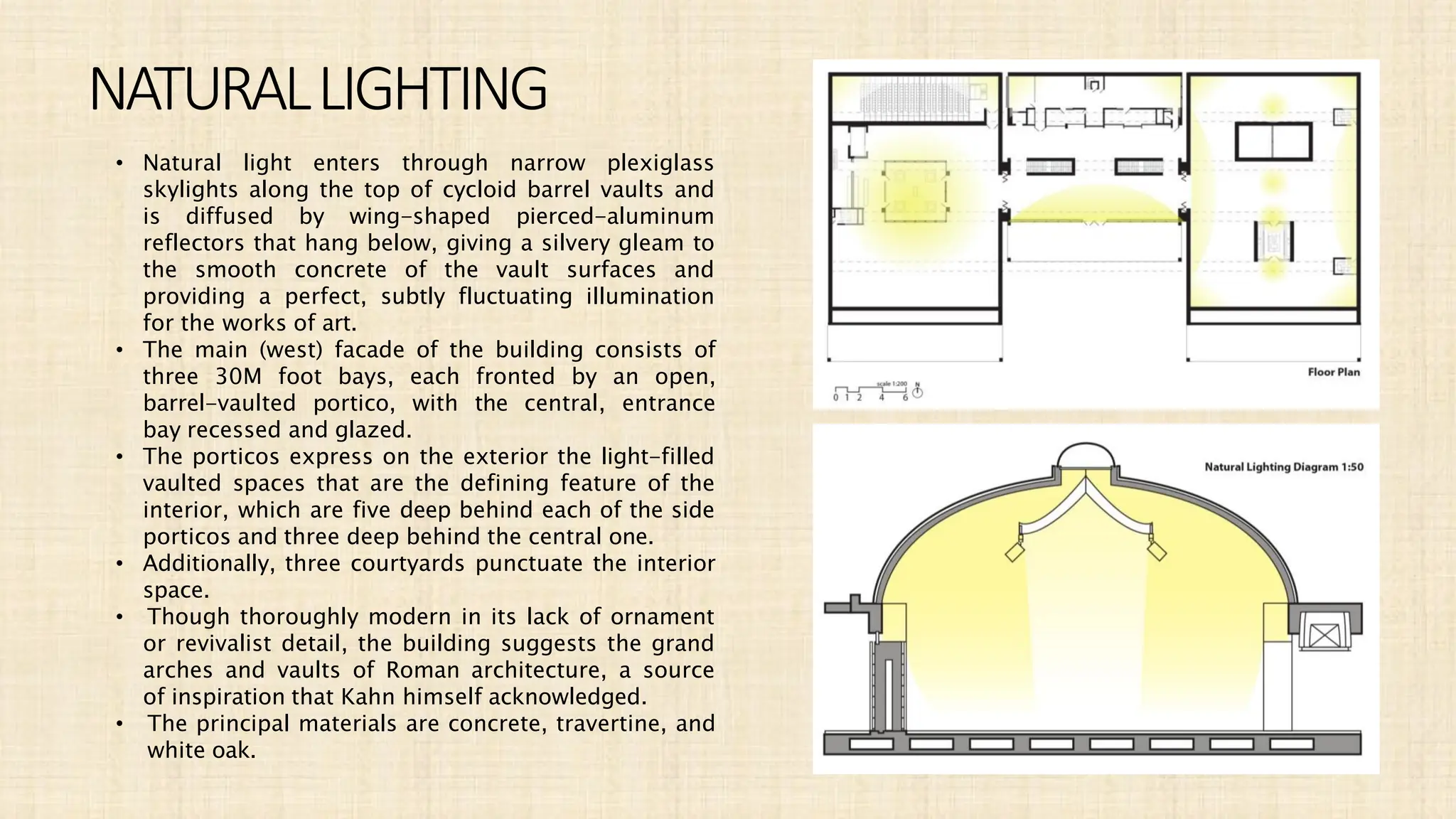
• Natural light enters through narrow plexiglass
skylights along the top of cycloid barrel vaults and
is diffused by wing-shaped pierced-aluminum
reflectors that hang below, giving a silvery gleam to
the smooth concrete of the vault surfaces and
providing a perfect, subtly fluctuating illumination
for the works of art.
• The main (west) facade of the building consists of
three 30M foot bays, each fronted by an open,
barrel-vaulted portico, with the central, entrance
bay recessed and glazed.
• The porticos express on the exterior the light-filled
vaulted spaces that are the defining feature of the
interior, which are five deep behind each of the side
porticos and three deep behind the central one.
• Additionally, three courtyards punctuate the interior
space.
• Though thoroughly modern in its lack of ornament
or revivalist detail, the building suggests the grand
arches and vaults of Roman architecture, a source
of inspiration that Kahn himself acknowledged.
• The principal materials are concrete, travertine, and
white oak.
•
•
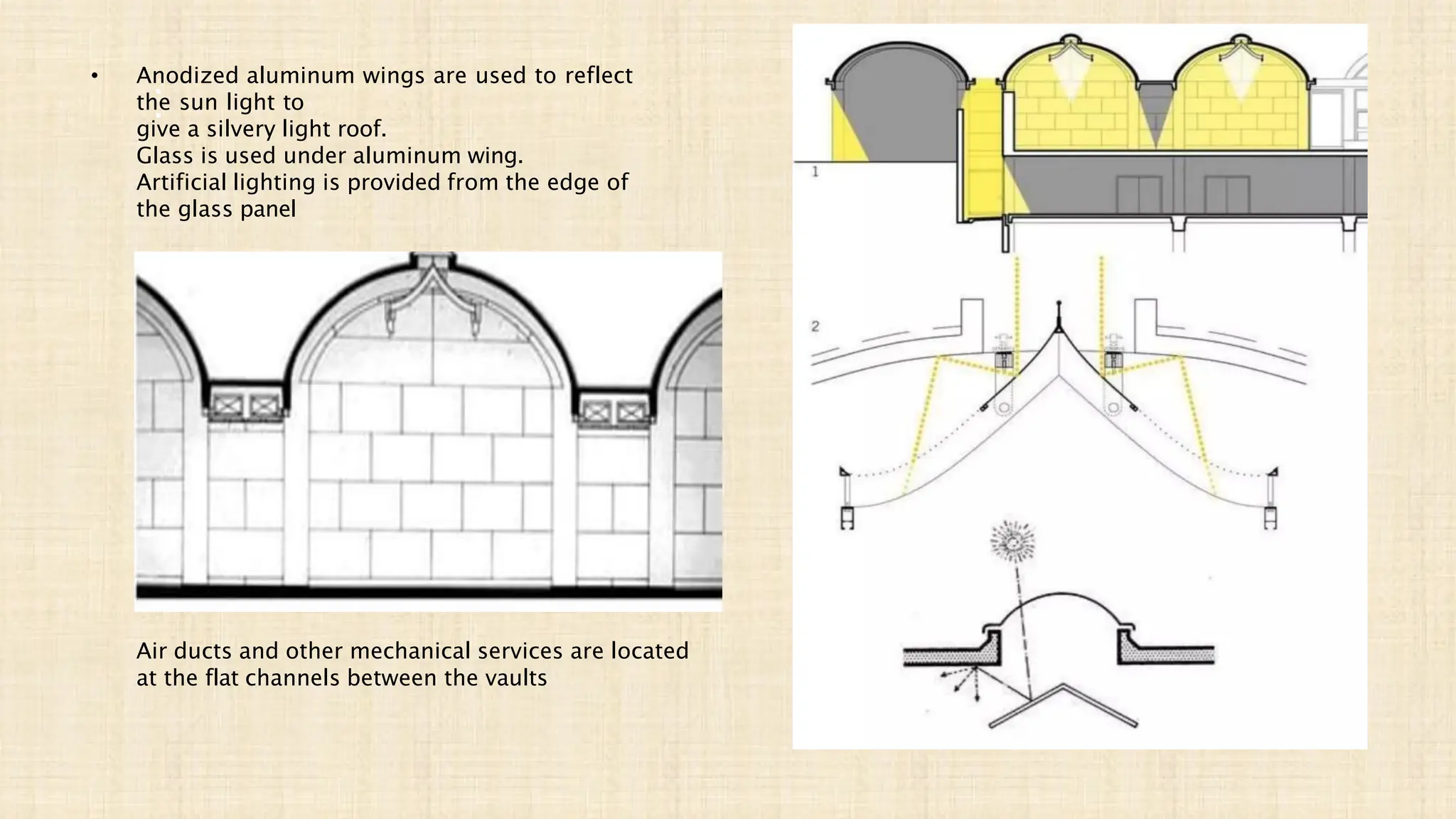
• Anodized aluminum wings are used to reflect
the sun light to
give a silvery light roof.
Glass is used under aluminum wing.
Artificial lighting is provided from the edge of
the glass panel
Air ducts and other mechanical services are located
at the flat channels between the vaults
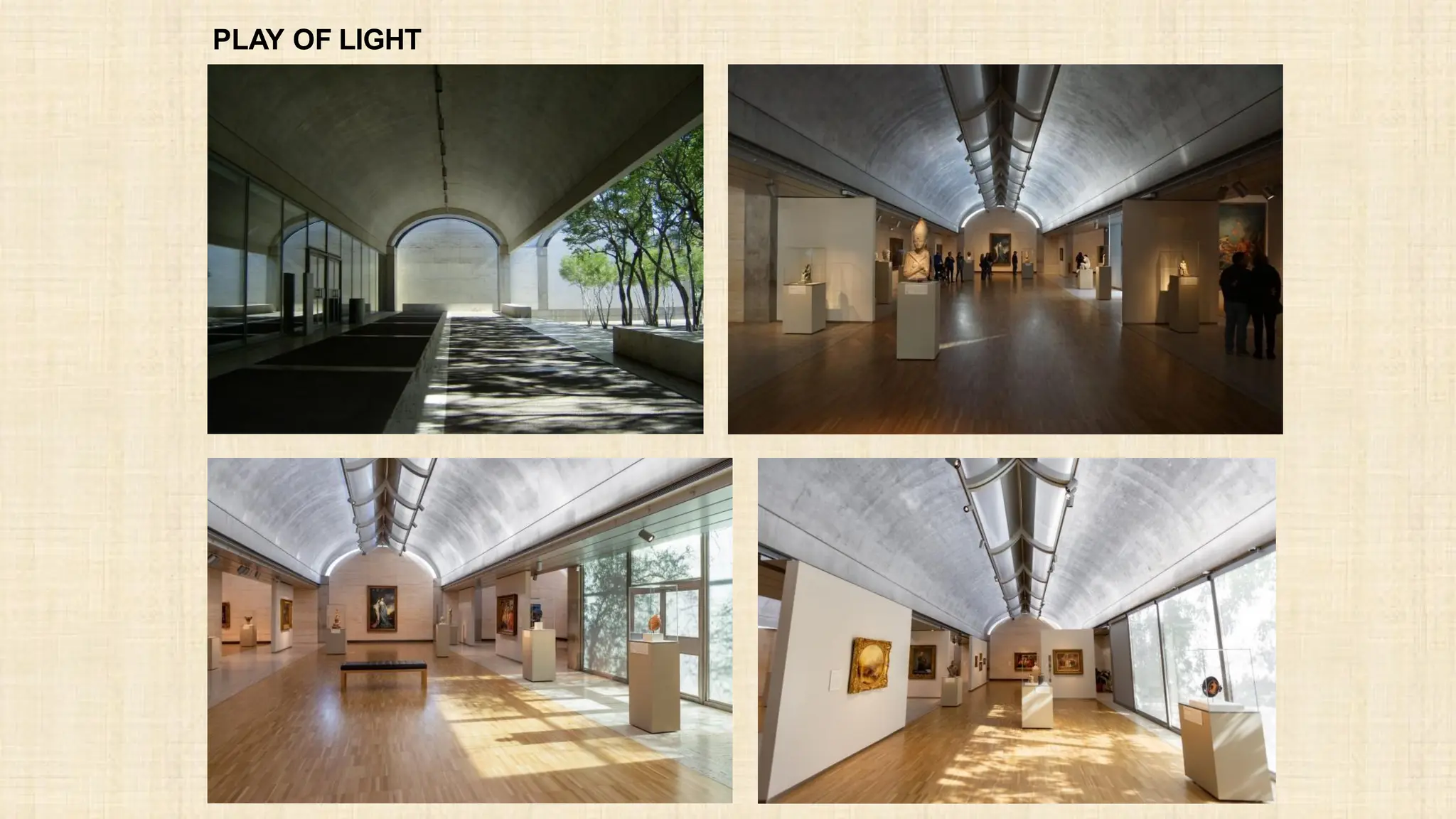
PLAY OF LIGHT
MATERIALITY
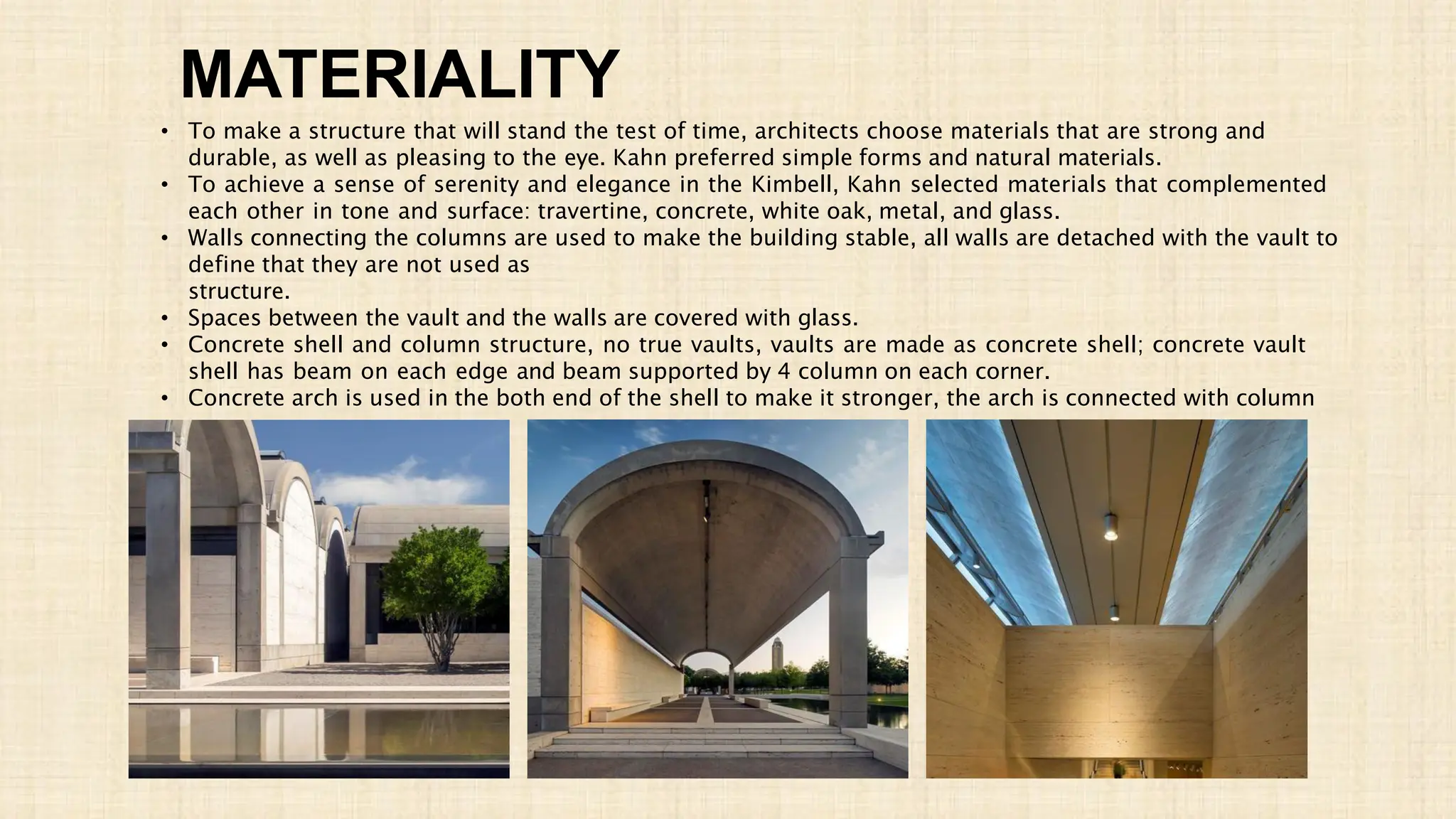
• To make a structure that will stand the test of time, architects choose materials that are strong and
durable, as well as pleasing to the eye. Kahn preferred simple forms and natural materials.
• To achieve a sense of serenity and elegance in the Kimbell, Kahn selected materials that complemented
each other in tone and surface: travertine, concrete, white oak, metal, and glass.
• Walls connecting the columns are used to make the building stable, all walls are detached with the vault to
define that they are not used as
structure.
• Spaces between the vault and the walls are covered with glass.
• Concrete shell and column structure, no true vaults, vaults are made as concrete shell; concrete vault
shell has beam on each edge and beam supported by 4 column on each corner.
• Concrete arch is used in the both end of the shell to make it stronger, the arch is connected with column
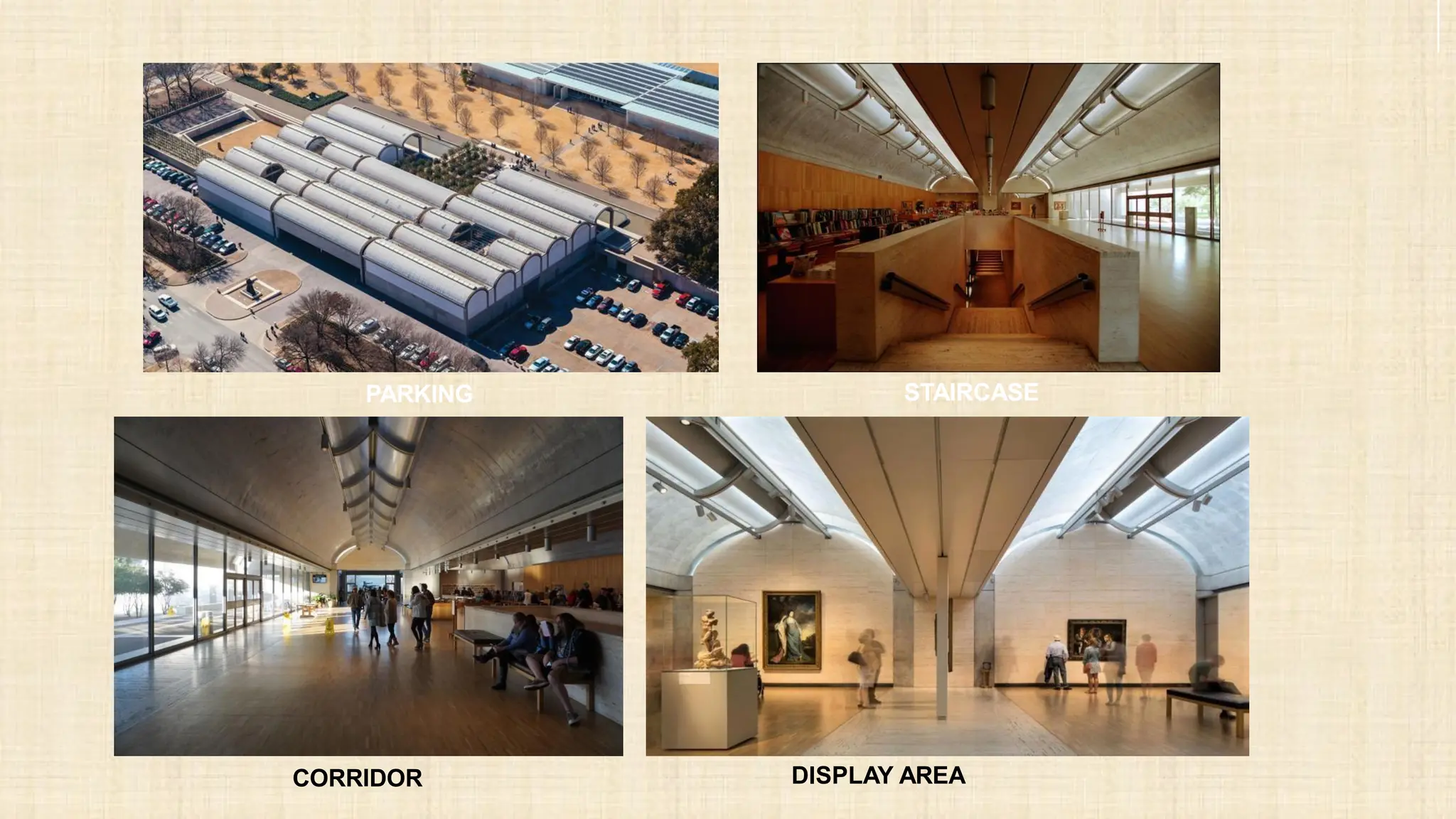
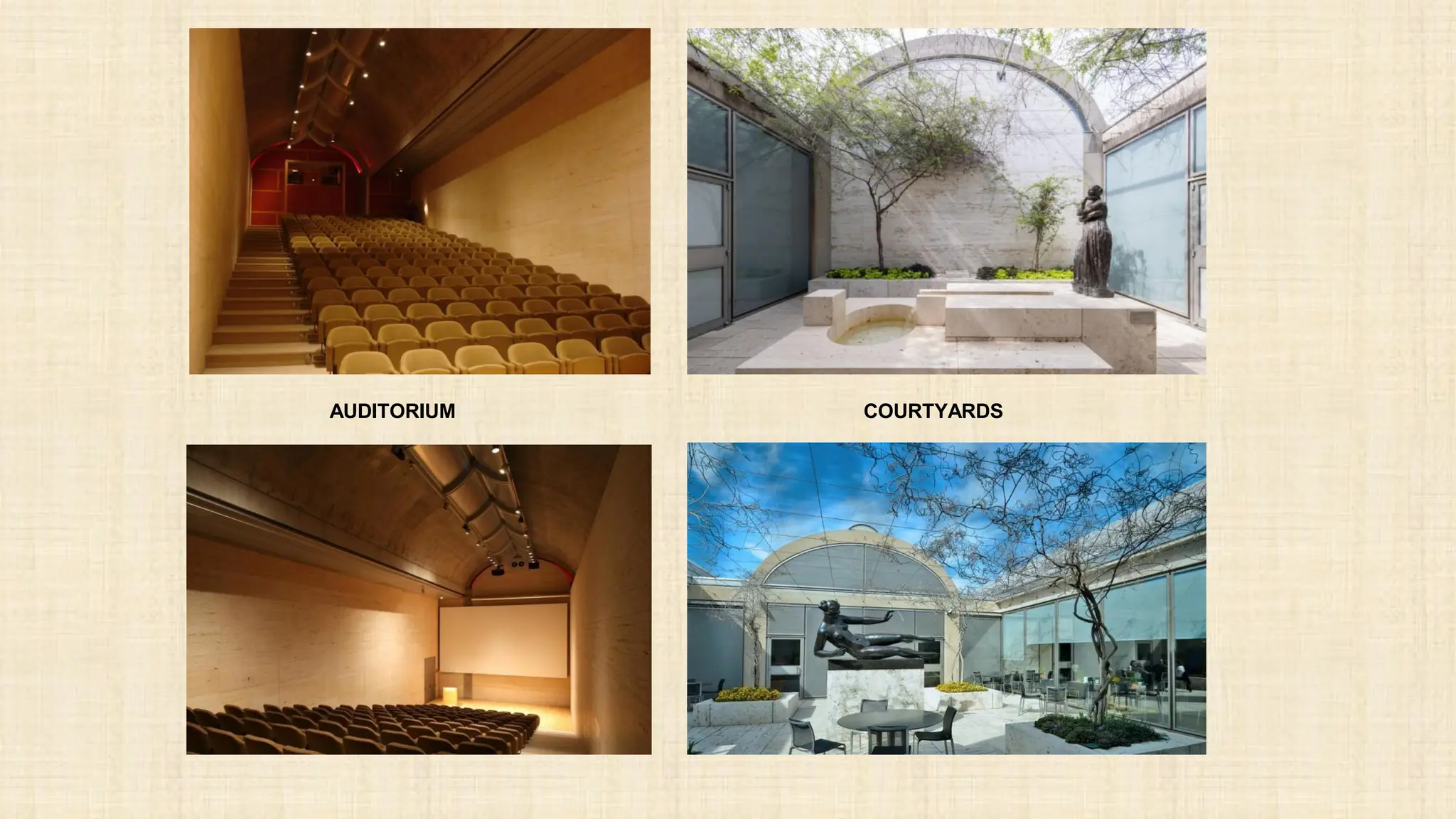
PARKING STAIRCASE
CORRIDOR DISPLAY AREA
AUDITORIUM COURTYARDS
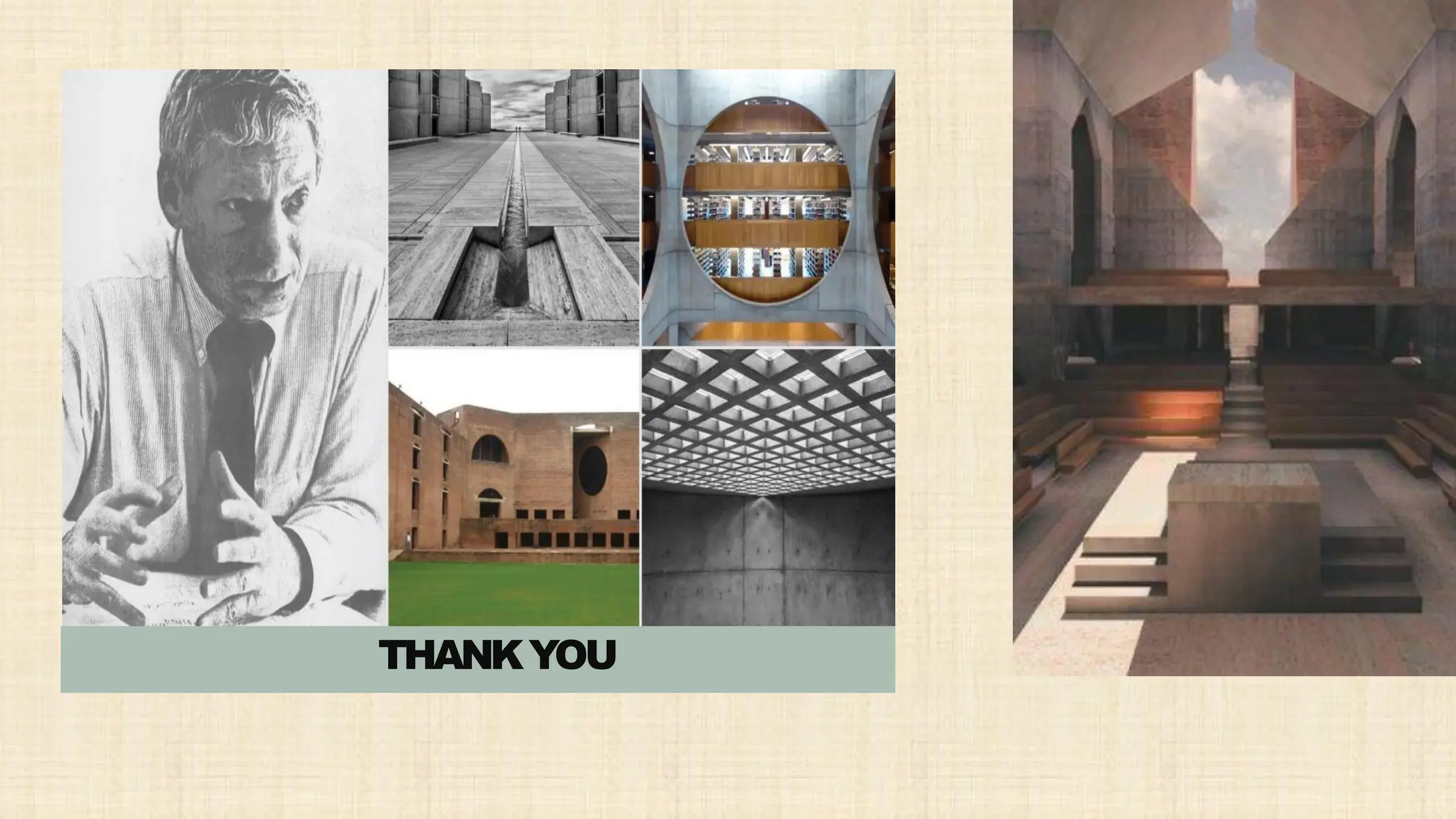
THANKYOU

LOUIS KHAN PDF Introduction The Salk InstituteCharacteristics And Philosophy

  • 1.
    LOUIS KAHN PRESENTED BY:ANSHIKA GAUTAM MANU SONI MAYANK SINGH MOHD ABDULLAH AKASH YADAV ‘Every building must have its soul- Louis I. Kahn’
  • 2.
    TABLE OF CONTENTS 01 Introduction 02 CharacteristicsAnd Philosophy 03 The Salk Institute 04 Kimbell Art Museum
  • 3.
  • 4.
    INTRODUCTION ● Louis Kahn(20th Feb 1901 – 17th March 1974) was one of the united states greatest 20th century architects known for combining modernism with weight and dignity of ancient monuments. ● Considered by many as a part of the pantheon of modernist architects. ● Louis Kahn is credited in re-defining modern architecture in different ways: ➢ He appreciated the feel of different materials that he used in his work. He used brick and concrete extensively. ➢ He realized the importance of sunlight and was highly impressed by usage in Egyptians and Greek works. ➢ Use of extensive geometric shapes like squares, circles and triangles were seen in his designs. Architecture is the thoughtful making of space -LOUIS KAHN
  • 5.
    “A building islike a human, anarchitect has opportunity of creating life. Thewaythe knucklesandjoints cametogether makeeachhand interesting andbeautiful. Inbuilding these details shouldnot beputona mitten andhidden. Space is architectural whenthe evidenceof how it is madeis seenand comprehended”
  • 7.
  • 8.
    CHARACTERISTICS • Louis I.Kahn evolved an original theoretical and formal language that revitalized modern architecture. • They reveal an integration of structure, a reverence for materials and light, a devotion to archetypal geometry, and a profound concern for humanistic values. • Eschewing the international style modernism that characterized his earlier work, Kahn sought to redefine the bases of architecture through a re-examination of structure, form, space, and light. • Beyond its functional role, Louis Isadore Kahn believed architecture must also evoke the feeling and symbolism of timeless human values. • Louis I. Kahn attempted to explain the relationship between the rational and romantic dichotomy in his "form-design" thesis, a theory of composition articulated in 1959.
  • 9.
    PHILOSOPHY • In hispersonal philosophy, form is conceived as formless and unmeasurable, a spiritual power common to all mankind. It transcends individual thoughts, feelings, and conventions. • Form characterizes the conceptual essence of one project from another, and thus it is the initial step in the creative process. • The union of form and design is realized in the final product, and the building's symbolic meaning is once again unmeasurable. • Defined space by means of masonry masses and a lucid structure laid out in geometric, formal schemes and axial layouts with a strong processional character of space and images. • Beaux-arts tradition- Neoclassical architectural style, sculptural decoration along conservative modern lines. • Natural Light-Brought architecture to life. • Modernisim. • To design is to plan and to organize, to order, to relate and to control in short it embraces all means opposing disorder and accident. • Social responsibility reflected in his later philosophy of the institutions of man. • Architecture is timeless.
  • 10.
    THE SALK INSTITUE 03 •Architects: Louis Kahn • Location: 10010 N Torrey Pines Rd, La Jolla, California, United States • Structural system: Vierendeel trusses • Concept: Modernism, Primitive Shapes, Voids, Concrete • Project Year: 1959 – 1965
  • 11.
  • 12.
    • Kahn’s masterworkconsists of two mirror-image structures each six stories tall that flank a grand travertine courtyard. • Three floors house laboratories and the three levels above them provide access to utilities. • Towers jutting into the courtyard provide study space for senior faculty. • The towers at the east end contain heating, ventilating, and other support systems. • At the west end are six floors of offices overlooking the Pacific Ocean. A total of 29 structures join to form the Institute. • In the complex’s basement, there are different colored water walls because Kahn was experimenting with the mixtures. • The buildings themselves have been designed to promote collaboration; thus, there are no walls separating laboratories on any of the floors. • The lighting fixtures on the roof slide along rails, thus reflecting the collaborative and open philosophy of the Salk Institute’s science. The impact of Kahn’s architecture can be particularly felt in the travertine courtyard. • Important to note are Kahn’s imaginative use of space and high regard for natural light. • In response to Salk’s request that the Institute be a welcoming, inspiring environment for scientific research, Kahn flooded the laboratories with daylight. DESIGNPROCESS
  • 13.
    PLANS ● In theSalk Institute Louis Kahn uses symmetry, geometry and transformation to create an atmosphere of the place. ● The open space plans allows maximum flexibility and constant flow of communications and ideas. ● Inside of each solid block there are dynamic spaces for laboratory which leads to offices opening towards courtyard. ● Glowing light which shines from slit window in office is surrounded by heavy concrete wall. ● Visual sense urges us to look forward from the window in search of hope. ● Thus, Louis Kahn opens up the window for us, towards the Pacific Ocean and beautiful sky high above in order to have a scent of that place.
  • 14.
    • Salk institutecentral court creates an atmosphere of freedom, independence and openness. • A perspective view of courtyard which drives you to the sky instead of sea. • Perhaps it gives you the feeling of sea as shimmering blue water, flowing ecstatically in the middle of the courtyard. • That transparency and sense of weightlessness gives you the sensation of floating. • The perspective of the horizon enhances visual sensitivity of modernist design, which stimulates people’s memories, imaginations and dreams. • Emotional sensibility leads to different moods such as the changes in the amount of sunshine in the day. • This creates the beauty of place. The feeling changes correspond to objects and people interact with objects. • In Salk institute objects are the two solid concrete form of block, creating open courtyard in the middle, that courtyard temperature makes people feel pleasant, fresh and warm. COURTYARD
  • 17.
    MATERIALITY • The SalkInstitute is an exposed construction of concrete, wood, marble and water. • Louis Kahn gives no further finishing touches in order to contain the warm glow on the concrete. • The contrast between transparency and solid is shown in elevation of the building. • Transparency as window and solid as cladding around the window. This power of intuition and imagination which is pictured in the ‘form’ evokes a tactile pleasure of transcendence. • Combination of natural material and man-made material express their age and history. • Kahn expresses it by combining the concrete and wood. That’s what the phenomenology of architecture talks about, the phenomena of artificial and phenomena of natural.
  • 18.
    • The eyesgives the separation of light and darkness. • Combination of light and darkness gives you the depth of the space. Kahn resembles by saying ‘All material in nature, the mountains and the streams and the air and we, are made of Light which has been spent, and this crumpled mass called material casts a shadow, and the shadow belongs to Light.’. He follows the rhythm of no-light, light, no-light. • This rhythm is set by placing columns and gap between each other which leads to shadow. • The shadow invites us to experience the mysterious as well as emotional depth of that place. SHADOW
  • 20.
    KIMBELL ART MUSEUM 04 • Architects:Louis Kahn • Location: Fort Worth, Texas, USA • Architectural style: Inspired from Roman Architecture • Project Year: 1972
  • 21.
  • 22.
  • 23.
    DESIGN • The elementof natural light is the main focus of the design, and creates elegant spaces that are perfectly suited for the art that it houses. • Inspired from roman architecture, use of roman arch and vault • Composed with 16 barrel cycloid vault, each 30m long, 6m high and 6m wide. • Vaults are grouped into 3 wings, central wing has 4 vaults with western one open as entrance.
  • 24.
    FLOORPLANS GROUND FLOOR BASEMENT UPPER FLOOR • Likeclassical buildings (such as the Parthenon), the Kimbell’s structure is based on a consistent mathematical model. • The basic plan is composed of sixteen cycloid vaults (30 x 6 M) that are arranged in three parallel units of six, four, and six in the Kimbell. • Other elements are based on a ratio of 20 to 10. For example, on the floor, wood sections measure 6M and travertine sections are 3M.
  • 25.
    SECTIONS • The buildingis based on these “rules” of logic, enabling the visitor to easily follow and “read” the structure. • Although the s tructure is based on a simple plan of unadorned, repeated forms, Kahn also introduced variations on those basic forms and “themes.” • The porticos at the Kimbell’s entrance on the west side of the building first introduce the vault to the approaching visitor and demonstrate the form’s versatility. • Within the Museum, visitors see that vaults cover the galleries, an auditorium, and the Buffet Restaurant. • Kahn also varied the size of the courtyards. • The North courtyard is 12 sqm, while the South courtyard is 6 sqm.
  • 26.
    NATURALLIGHTING • Natural lightenters through narrow plexiglass skylights along the top of cycloid barrel vaults and is diffused by wing-shaped pierced-aluminum reflectors that hang below, giving a silvery gleam to the smooth concrete of the vault surfaces and providing a perfect, subtly fluctuating illumination for the works of art. • The main (west) facade of the building consists of three 30M foot bays, each fronted by an open, barrel-vaulted portico, with the central, entrance bay recessed and glazed. • The porticos express on the exterior the light-filled vaulted spaces that are the defining feature of the interior, which are five deep behind each of the side porticos and three deep behind the central one. • Additionally, three courtyards punctuate the interior space. • Though thoroughly modern in its lack of ornament or revivalist detail, the building suggests the grand arches and vaults of Roman architecture, a source of inspiration that Kahn himself acknowledged. • The principal materials are concrete, travertine, and white oak.
  • 27.
    • • • Anodized aluminumwings are used to reflect the sun light to give a silvery light roof. Glass is used under aluminum wing. Artificial lighting is provided from the edge of the glass panel Air ducts and other mechanical services are located at the flat channels between the vaults
  • 28.
  • 29.
    MATERIALITY • To makea structure that will stand the test of time, architects choose materials that are strong and durable, as well as pleasing to the eye. Kahn preferred simple forms and natural materials. • To achieve a sense of serenity and elegance in the Kimbell, Kahn selected materials that complemented each other in tone and surface: travertine, concrete, white oak, metal, and glass. • Walls connecting the columns are used to make the building stable, all walls are detached with the vault to define that they are not used as structure. • Spaces between the vault and the walls are covered with glass. • Concrete shell and column structure, no true vaults, vaults are made as concrete shell; concrete vault shell has beam on each edge and beam supported by 4 column on each corner. • Concrete arch is used in the both end of the shell to make it stronger, the arch is connected with column
  • 30.
  • 31.
  • 32.